Vacuum fluctuation induced quantum resource harvesting in triple-layer graphene
Pith reviewed 2026-06-27 21:55 UTC · model grok-4.3
The pith
Vacuum fluctuations in a planar microcavity generate controllable coherence and tripartite entanglement in triple-layer graphene.
A machine-rendered reading of the paper's core claim, the machinery that carries it, and where it could break.
Core claim
The confined electromagnetic field inside the microcavity mediates quantum correlations between the three graphene layers, producing analytic expressions for the relative entropy of coherence, the tangle quantifying tripartite entanglement, and a non-Markovianity measure derived from coherence; these quantities are shown to be highly sensitive to the number of cutoff modes, the spatial positioning of the layers, the momentum parameter, and the interlayer rotation angles, with the rotation angle exerting particularly strong control.
What carries the argument
The analytic solution obtained from time-dependent perturbation theory applied to the cavity-confined triple-layer graphene Hamiltonian, which supplies closed-form expressions for the relative entropy of coherence, tangle, and REC-based non-Markovianity.
If this is right
- Changing the rotation angle between layers provides a direct handle on the amount of generated entanglement and coherence.
- Increasing the number of cutoff modes alters the non-Markovian memory effects in a predictable way.
- Shifting the spatial positions of the layers modulates the strength of the vacuum-mediated correlations.
- The same analytic expressions allow the momentum parameter to be used as an additional tuning knob for the quantum resources.
Where Pith is reading between the lines
- If the rotation-angle sensitivity survives in devices, it could be used to read out mechanical twist in graphene-based sensors.
- The same cavity setup might be extended to four or more layers to test whether the vacuum mediation scales to larger multipartite states.
- Because the solution is analytic, it supplies concrete target values that could guide fabrication tolerances for layer alignment.
Load-bearing premise
The planar microcavity model together with time-dependent perturbation theory produces measures that accurately represent the vacuum-induced quantum resources present in a real triple-layer graphene system.
What would settle it
An experiment that fabricates a triple-layer graphene sample inside a planar microcavity, varies the interlayer rotation angle while holding other parameters fixed, and measures whether the observed tripartite entanglement follows the predicted sharp dependence on that angle.
Figures



read the original abstract
We examine the non-Markovian dynamics and the generation of quantum coherence and entanglement within a triple-layer graphene (TLG) system embedded in a planar microcavity. Using time-dependent perturbation theory, we derive an exact analytic solution for the system and demonstrate how the confined electromagnetic field mediates quantum correlations between the graphene layers. We employ three complementary measures; the relative entropy of coherence (REC) to quantify quantum coherence, the tangle to assess tripartite entanglement, and a non-Markovianity measure derived from the REC to characterize quantum memory effects. Our analysis reveals that these quantum resources exhibit remarkable sensitivity to various control parameters. Specifically, we demonstrate that the number of cutoff modes, the spatial positioning of the layers, the momentum parameter, and the interlayer rotation angles provide effective control over coherence, entanglement, and memory effects. We further show that these measures exhibit an exceptional sensitivity to the rotation angle between the layers. Ultimately, our results establish cavity-confined TLG as a highly tunable platform for exploring vacuum-mediated quantum phenomena, providing a framework for the precise manipulation of quantum correlations in graphene-based photonic and optoelectronic devices.
Editorial analysis
A structured set of objections, weighed in public.
Referee Report
Summary. The manuscript examines non-Markovian dynamics and the generation of quantum coherence and entanglement in a triple-layer graphene (TLG) system embedded in a planar microcavity. Using time-dependent perturbation theory, it derives what is described as an exact analytic solution for the system, from which the relative entropy of coherence (REC), the tangle for tripartite entanglement, and a REC-derived non-Markovianity measure are computed. The analysis demonstrates sensitivity of these quantities to control parameters including the number of cutoff modes, spatial positioning of the layers, momentum parameter, and interlayer rotation angles (with particular emphasis on the latter), and concludes that cavity-confined TLG constitutes a highly tunable platform for vacuum-mediated quantum phenomena with applications to graphene-based photonic and optoelectronic devices.
Significance. If the claimed exact analytic solution and the faithful quantification of resources by the chosen measures hold, the work would establish a concrete theoretical framework for parameter-controlled harvesting of vacuum-induced quantum resources in multilayer graphene, offering new handles (especially rotation angles) for coherence and entanglement engineering in cavity QED settings.
major comments (2)
- [Abstract] Abstract: the statement that time-dependent perturbation theory yields an 'exact analytic solution' is internally inconsistent with standard TDPT, which produces a truncated Dyson series valid only in the weak-coupling/short-time regime; no demonstration of resummation, exact diagonalization within the model, or error bounds is indicated, directly undermining the parameter-sensitivity claims for arbitrary control-parameter values.
- [Abstract] Abstract: the assertion that REC, tangle, and REC-based non-Markovianity 'faithfully quantify' the vacuum-induced resources in the physical TLG system rests on the solution being non-perturbative, yet the text provides no verification (e.g., comparison to non-perturbative benchmarks or explicit validity range) that the measures remain accurate outside the perturbative regime.
Simulated Author's Rebuttal
We thank the referee for their careful reading and constructive comments. We address the two major comments on the abstract below.
read point-by-point responses
-
Referee: [Abstract] Abstract: the statement that time-dependent perturbation theory yields an 'exact analytic solution' is internally inconsistent with standard TDPT, which produces a truncated Dyson series valid only in the weak-coupling/short-time regime; no demonstration of resummation, exact diagonalization within the model, or error bounds is indicated, directly undermining the parameter-sensitivity claims for arbitrary control-parameter values.
Authors: We agree that the phrasing 'exact analytic solution' is imprecise and potentially misleading. The expressions we obtained are closed-form analytic results for the first-order perturbative amplitudes within the single-excitation subspace and the chosen cutoff. We will revise the abstract (and relevant sections) to read 'analytic expressions derived from time-dependent perturbation theory' and explicitly note the perturbative regime and its limitations. revision: yes
-
Referee: [Abstract] Abstract: the assertion that REC, tangle, and REC-based non-Markovianity 'faithfully quantify' the vacuum-induced resources in the physical TLG system rests on the solution being non-perturbative, yet the text provides no verification (e.g., comparison to non-perturbative benchmarks or explicit validity range) that the measures remain accurate outside the perturbative regime.
Authors: We accept the point. The measures are evaluated on the perturbative state and are therefore reliable only inside the weak-coupling/short-time regime where the approximation holds. We will revise the abstract to remove the unqualified claim that the measures 'faithfully quantify' the resources and will add a clarifying sentence on the domain of validity. revision: yes
Circularity Check
No circularity in derivation chain
full rationale
The paper states it obtains an analytic solution via time-dependent perturbation theory and then computes REC, tangle, and REC-derived non-Markovianity from that solution. No quoted equations or steps reduce a claimed prediction or derived quantity to a fitted parameter, self-definition, or load-bearing self-citation by construction. The derivation is presented as model-driven computation within the stated Hamiltonian and perturbative framework, with parameter sensitivities reported as outputs rather than inputs. This matches the default case of a self-contained theoretical calculation without the enumerated circular patterns.
Axiom & Free-Parameter Ledger
Reference graph
Works this paper leans on
-
[1]
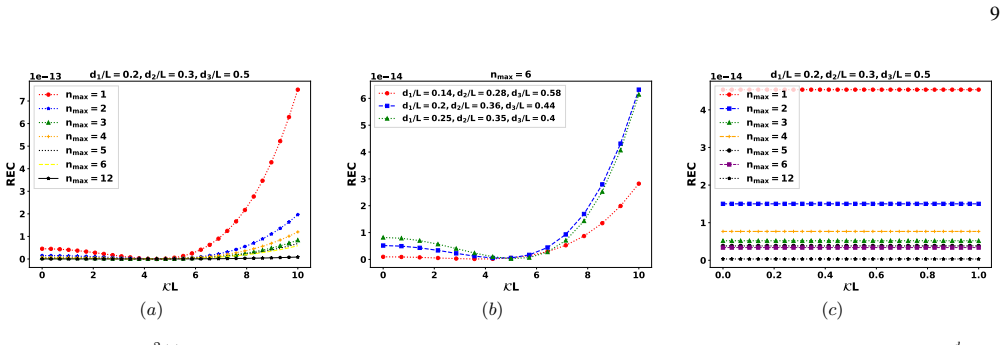
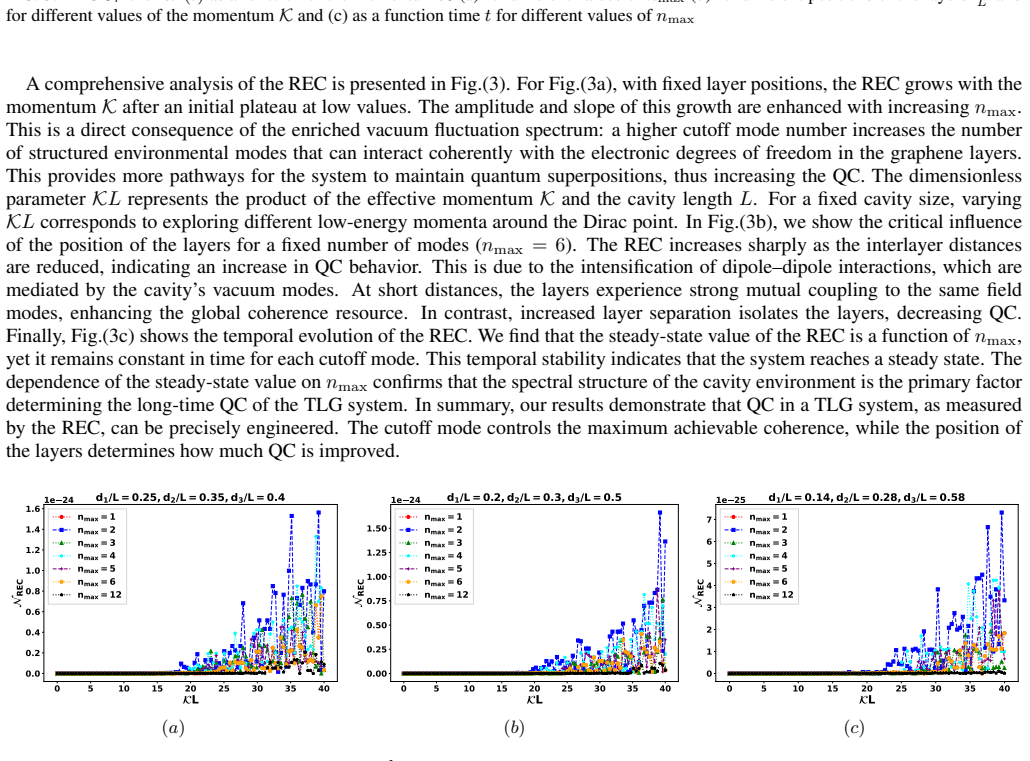
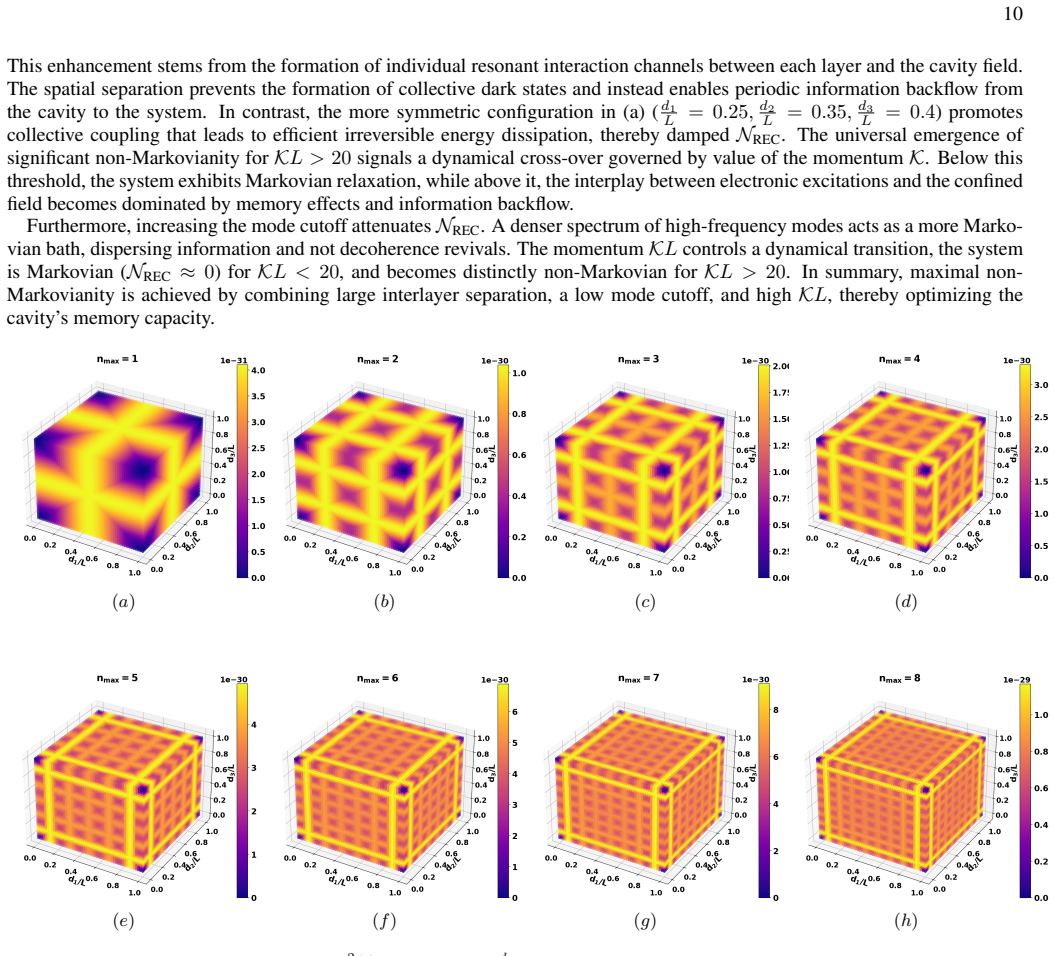
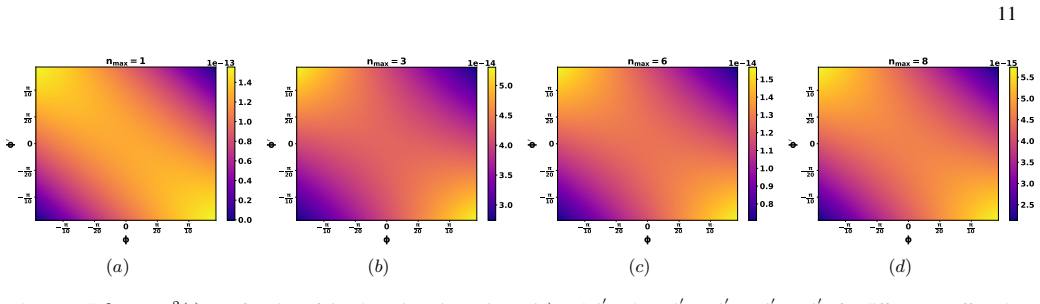
for different cutoff mode nmax, withKL= 0and d1 L = 0.2, d2 L = 0.3, d3 L = 0.5. 1 0 2 0 2 0 1 0 1 0 2 0 2 0 1 0 0 0 ′ 20.25 20.00 19.75 19.50 19.25 19.00 18.75 n m a x = 1 1 e - 5 (a) 1 0 2 0 2 0 1 0 1 0 2 0 2 0 1 0 0 0 ′ 3.5 3.0 2.5 2.0 1.5 1.0 0.5 1 e - 6n m a x = 3 (b) 1 0 2 0 2 0 1 0 1 0 2 0 2 0 1 0 0 0 ′ 8.2 8.0 7.8 7.6 7.4 7.2 n m a x = 6 1 e - 7 (...
-
[2]
modes at fixedKL= 0
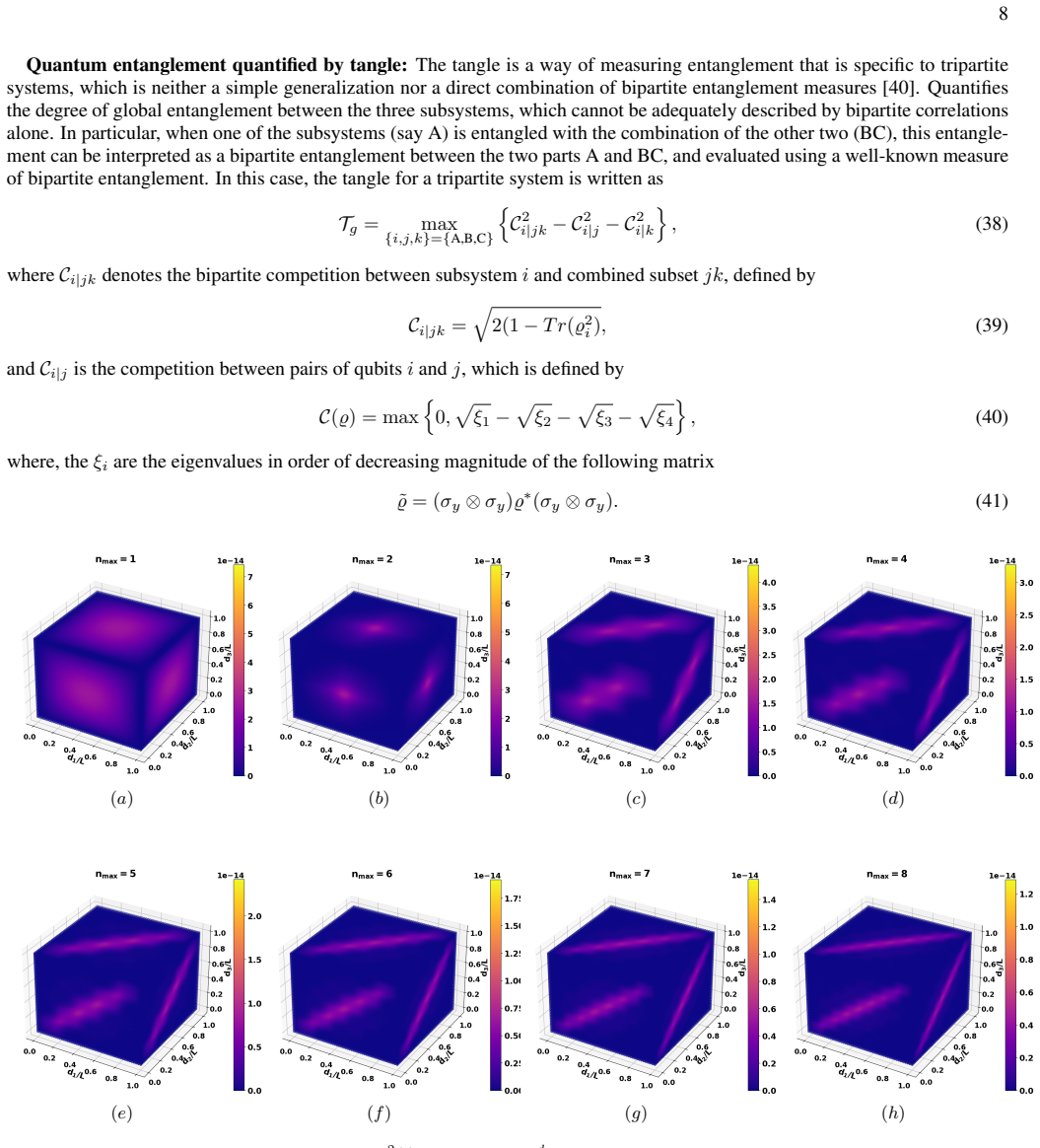
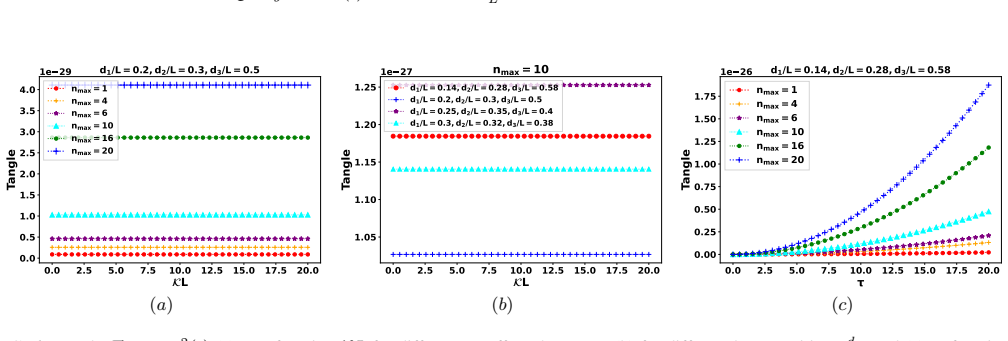
for different cutoff mode nmax, withKL= 0and d1 L = 0.2, d2 L = 0.3, d3 L = 0.5. modes at fixedKL= 0. We observe a fundamental contrast with coherence behavior, the tangle amplitude increases withn max, suggesting distinct physical mechanisms govern entanglement generation versus QC preservation. A comprehensive analysis in Fig. (6) reveals the entangleme...
-
[3]
K. S. Novoselov, A. K. Geim, S. V . Morozov, D. Jiang, Y . Zhang, S. V . Dubonos, I. V . Grigorieva and A. A. Firsov, Electric field effect in atomically thin carbon films, Science306, 666 (2004)
2004
-
[4]
H. Y . Zhuo, X. Zhang, J. X. Liang, Q. Yu, H. Xiao and J. Li, Theoretical understandings of graphene-based metal single-atom catalysts: stability and catalytic performance, Chem. Rev.120, 12315 (2020)
2020
-
[5]
H. Y . Mao, S. Laurent, W. Chen, O. Akhavan, M. Imani, A. A. Ashkarran and M. Mahmoudi, Graphene: promises, facts, opportunities, and challenges in nanomedicine, Chem. Rev.113, 3407 (2013)
2013
-
[6]
L. B. Drissi, E. H. Saidi, Bousmina, Four-dimensional graphene, M. Phys. Rev. D,84, 014504 (2011)
2011
-
[7]
A. A. Balandin, S. Ghosh, W. Bao, I. Calizo, D. Teweldebrhan, F. Miao and C. N. Lau, Superior thermal conductivity of single-layer graphene, Nano lett.8, 902 (2008)
2008
-
[8]
T. Y . Kim, C.-H. Park and N. Marzari, The electronic thermal conductivity of graphene, Nano Lett.16, 2439 (2016)
2016
-
[9]
Huang, C
X. Huang, C. Zhi, Y . Lin, H. Bao, G. Wu, P. Jiang and Y .-W. Mai, Thermal conductivity of graphene-based polymer nanocomposites, Mater. Sci. Eng. R142, 100577 (2020)
2020
-
[10]
Salvo, B
P. Salvo, B. Melai, N. Calisi, C. Paoletti, F. Bellagambi, A. Kirchhain, M. G. Trivella, R. Fuoco and F. Di Francesco, Graphene-based devices for measuring pH, Sens. Actuators B: Chem256, 976 (2018)
2018
-
[11]
Esteghamat and O
A. Esteghamat and O. Akhavan, Graphene as the ultra-transparent conductive layer in developing the nanotechnology-based flexible smart touchscreens, Microelectron. Eng.267, 111899 (2022)
2022
-
[12]
K. P. Loh, Q. Bao, G. Eda and M. Chhowalla, Graphene oxide as a chemically tunable platform for optical applications, Nat. Chem.2, 1015 (2010). 15
2010
-
[13]
Z. H. Khan, A. R. Kermany, A. Ochsner and F. Iacopi, Mechanical and electromechanical properties of graphene and their potential application in MEMS, J. Phys. D: Appl. Phys.50, 053003 (2017)
2017
-
[14]
Rahighi, O
R. Rahighi, O. Akhavan, A.S. Zeraati and S. M. SattariEsfahlan, All-carbon negative differential resistance nanodevice using a single flake of nanoporous graphene, ASC Appl. Electron. Mater.3, 3418 (2021)
2021
-
[15]
M. O. Goerbig, Electronic properties of graphene in a strong magnetic field, Rev. Mod. Phys.83, 1193 (2011)
2011
-
[16]
Koshino, The electronic properties of bilayer graphene, Rep
E.McCann and M. Koshino, The electronic properties of bilayer graphene, Rep. Prog. Phys.76, 056503 (2013)
2013
-
[17]
A. V . Rozhkov, A. O. Sboychakov, A. L. Rakhmanov, and F. Nori, Electronic properties of graphene-based bilayer systems, Phys. Rep. 648, 1 (2016)
2016
-
[18]
D. S. L. Abergel, V . Apalkov, J. Berashevich, K. Ziegler, and T. Chakraborty, Properties of graphene: a theoretical perspective, Adv. Phys.59, 261 (2010)
2010
-
[19]
A. H. C. Neto, F. Guinea, N. M. R. Peres, K. S. Novoselov, and A. K. Geim, The electronic properties of graphene, Rev. Mod. Phys.81, 109 (2009)
2009
-
[20]
K. S. Novoselov, A. K. Geim, S. V . Morozov, D. Jiang, M. I. Katsnelson, I. V . Grigorieva, ... A. A. Firsov, Two-dimensional gas of massless Dirac fermions in graphene, nature,438, 197-200 (2005)
2005
-
[21]
T. C. H. Liew, I.A. Shelykh, and G. Malpuech, Polaritonic devices, Physica (Amsterdam)43E, 1543 (2011)
2011
-
[22]
Riedrich-M ¨oller, L
J. Riedrich-M ¨oller, L. Kipfstuhl, C. Hepp, E. Neu, C. Pauly, F. M ¨ucklich, ... C. Becher, One-and two-dimensional photonic crystal microcavities in single crystal diamond, Nature nanotechnology,7, 69 (2012)
2012
-
[23]
T. Low, A. Chaves, J.D. Caldwell, A. Kumar, N.X. Fang, P. Avouris, T. F. Heinz, F. Guinea, L. Martin-Moreno, and F. Koppensm, Polaritons in layered two-dimensional materials, Nat. Mater.16, 182 (2017)
2017
-
[24]
V . B. Berestetskii, E. M. Lifshitz, and L.P. Pitaevskii, Quantum Electrodynamics: V olume 4 (Pergamon, New York, 1982)
1982
-
[25]
B. S. DeWitt, S.W. Hawking, and W. Israel, General Relativity: An Einstein Centenary Survey (Cambridge University Press, Cambridge, England, 1979)
1979
-
[26]
S. J. Olson and T.C. Ralph, Entanglement between the future and the past in the quantum vacuum, Phys. Rev. Lett.106, 110404 (2011)
2011
-
[27]
S. J. Olson and T.C. Ralph, Extraction of timelike entanglement from the quantum vacuum, Phys. Rev. A,85, 012306 (2012)
2012
-
[28]
Sabin, B
C. Sabin, B. Peropadre, M. del Rey, and E. Martin-Martinez, Extracting past-future vacuum correlations using circuit QED, Phys. Rev. Lett.109, 033602 (2012)
2012
-
[29]
Drosdoff, L
D. Drosdoff, L. M. Woods, Casimir forces and graphene sheets, Phys. Rev. B,82, 155459 (2010)
2010
-
[30]
Zarenia, A
M. Zarenia, A. Perali, D. Neilson, F. M. Peeters, Enhancement of electron-hole superfluidity in double few-layer graphene, Sci Rep,4, 7319 (2014)
2014
-
[31]
R. E. Profumo, M. Polini, R. Asgari, R. Fazio, A. H. MacDonald, Electron-electron interactions in decoupled graphene layers, Phys. Rev. B,82, 085443 (2010)
2010
-
[32]
Bostr ¨om, B
M. Bostr ¨om, B. E. Sernelius, Thermal Effects on the Casimir Force in the0.1−5µmRange, Phys. Rev. Lett,84, 4757 (2000)
2000
-
[33]
Bordag, B
M. Bordag, B. Geyer, G. L. Klimchitskaya, V . M. Mostepanenko, Casimir force at both nonzero temperature and finite conductivity, Phys. Rev. Lett,85, 503 (2000)
2000
-
[34]
C. W. J. Beenakker, Colloquium: Andreev reflection and Klein tunneling in graphene, Rev. Mod. Phys.80, 1337-1354 (2008)
2008
-
[35]
Stauber, G
T. Stauber, G. G ´omez-Santos, Plasmons and near-field amplification in double-layer graphene, Phys. Rev. B,85, 075410 (2012)
2012
-
[36]
I. V . Fialkovsky, V . N. Marachevsky, D. V . Vassilevich, Finite-temperature Casimir effect for graphene, Phys. Rev. B,84, 035446 (2011)
2011
-
[37]
J. S. Ardenghi, Entanglement harvesting in double-layer graphene by vacuum fluctuations in a microcavity, Phys. Rev. D,98, 045006 (2018)
2018
-
[38]
V . A. Bittencourt, A. E. Bernardini, Lattice-layer entanglement in Bernal-stacked bilayer graphene, Phys. Rev. B,95, 195145 (2017)
2017
-
[39]
Arreyes, F
F. Arreyes, F. Escudero, J. S. Ardenghi, A. Juan, Entanglement harvesting in buckled honeycomb lattices by vacuum fluctuations in a microcavity, J. Phys.: Condens. Matter,36, 505701 (2024)
2024
-
[40]
Baumgratz, M
T. Baumgratz, M. Cramer and M. B. Plenio, Quantifying coherence, Phys. Rev. Lett.113, 140401 (2014)
2014
-
[41]
Z. He, H. S. Zeng, Y . Li, Q. Wang, C. Yao, Non-Markovianity measure based on the relative entropy of coherence in an extended space, Phys. Rev. A,96, 022106 (2017)
2017
-
[42]
Coman, J
V . Coman, J. Kundu and W. K. Wootters, Distributed entanglement, Phys. Rev. A,61, 052306 (2000)
2000
-
[43]
O. V . Kibis, O. Kyriienko, I. A. Shelykh, Persistent current induced by vacuum fluctuations in a quantum ring, Phys. Rev. B,87, 245437 (2013)
2013
-
[44]
Arreyes, F
F. Arreyes, F. Escudero, J. S. Ardenghi, Correlations in twisted double-layer graphene with virtual photons in a microcavity, J. Phys.: Condens. Matter,34, 115602 (2022)
2022
-
[45]
O. V . Kibis, Metal-insulator transition in graphene induced by circularly polarized photons, Phys. Rev. B,81, 165433 (2010)
2010
-
[46]
H. P. Breuer, E. M. Laine, J. Piilo, Measure for the degree of non-Markovian behavior of quantum processes in open systems, Phys. Rev. Lett,103210401 (2009)
2009
-
[47]
Dakir, A
Y . Dakir, A. Slaoui, L. B. Drissi, R. A. Laamara, Quantifying non-Markovianity via local quantum Fisher information, Ann. Phys, 170142 (2025)
2025
-
[48]
Dakir, A
Y . Dakir, A. Slaoui, R. A. Laamara, Characterizing non-Markovianity via quantum coherence based on Kirkwood-Dirac quasiprobability. Phys. Lett. A,555, 130775 (2025)
2025
-
[49]
Chanda, S
T. Chanda, S. Bhattacharya, Delineating incoherent non-Markovian dynamics using quantum coherence, Ann. Phys,366, (2016) 1-12
2016
discussion (0)
Sign in with ORCID, Apple, or X to comment. Anyone can read and Pith papers without signing in.