Driving Exchange Interaction in Spin Qubits with Quasi-Zero Pulses
Pith reviewed 2026-06-27 21:30 UTC · model grok-4.3
The pith
Quasi-zero pulses let exchange gates reach similar fidelity with fewer calibration parameters than full distortion compensation.
A machine-rendered reading of the paper's core claim, the machinery that carries it, and where it could break.
Core claim
Quasi-zero pulses generalize net-zero designs by permitting a controlled positive net time integral; when used to drive exchange interactions, they compensate linear-dynamical distortions sufficiently to reach gate fidelities comparable to full convolution-based filtering while using identical pulse durations and fewer adjustable parameters.
What carries the argument
Quasi-zero pulses, which reduce but do not eliminate the net time integral of the drive waveform to suppress linear distortions without full transfer-function knowledge.
If this is right
- Complete gate sets for exchange-only qubits become available with explicit trade-offs among duration, fidelity, and parameter count.
- Calibration effort decreases because only the net integral needs tuning rather than the full distortion transfer function.
- Pulse durations remain unchanged while fidelity stays comparable to the full-filtering baseline.
- Automated calibration routines become feasible for commercial-scale devices because fewer parameters must be optimized.
Where Pith is reading between the lines
- The same pulse-shaping principle could be tested on other qubit platforms where linear distortions limit exchange or coupling control.
- If the linear-distortion assumption holds across larger arrays, the method would directly support scaling without proportional growth in calibration overhead.
- Extending the quasi-zero family to allow small negative integrals might further widen the operating window for gate speed versus error.
Load-bearing premise
Linear-dynamical distortions dominate the observed pulse response and can be canceled adequately by shaping only the net time integral of the waveform.
What would settle it
On the same six-dot device, apply both quasi-zero and full-filtering pulse sets at identical durations and measure whether the average gate fidelity drops by more than a few percent for the quasi-zero set.
Figures

read the original abstract
The implementation of high-fidelity quantum gates for spin qubits requires accurate control of exchange interactions between electrons confined in quantum dots, but pulse distortions can limit this control accuracy. Although linear-dynamical distortions can be compensated for by appropriately convolving the control signal, determining the necessary convolution requires detailed knowledge of the distortion's transfer function, and therefore the calibration of numerous parameters. Alternatively, control pulses can be designed to have a net-zero time integral canceling out linear-dynamical pulse distortions. We generalize net-zero pulse designs to quasi-zero pulses allowing net-positive but reduced time integrals. Using these pulse designs, we systematically develop complete gate sets for exchange-only qubits, and study the resulting tradeoffs between pulse duration, fidelity, and the required number of tunable parameters, both in simulation and experiment. We benchmark the optimized gate pulses on Intel's Tunnel Falls six-dot device and show they achieve fidelities similar to those obtained with a full filtering approach, with identical pulse durations and fewer tuning parameters. This reduction in complexity opens the door to fast and easily automated calibration schemes compatible with large-scale commercial quantum devices.
Editorial analysis
A structured set of objections, weighed in public.
Referee Report
Summary. The paper claims that quasi-zero pulses (generalizing net-zero designs to allow reduced but non-zero net time integrals) compensate linear-dynamical distortions in exchange interactions for spin qubits, enabling complete gate sets for exchange-only qubits with fewer tunable parameters than full filtering while maintaining identical pulse durations and comparable fidelities; this is supported by simulation and benchmarked experimentally on Intel's Tunnel Falls six-dot device.
Significance. If the experimental equivalence holds, the reduction in calibration parameters would meaningfully simplify automated tuning for large-scale spin-qubit processors, lowering the barrier to scalable control of exchange-only qubits without requiring detailed transfer-function measurements.
major comments (2)
- [§4] §4 (Experimental benchmark): the claim of 'similar fidelities' to the full-filtering approach on the Tunnel Falls device is presented without error bars, explicit numerical comparison tables, or raw fidelity values, so the central assertion of parameter reduction at fixed performance cannot be independently verified from the reported data.
- [§3.2] §3.2 (Quasi-zero pulse construction): the derivation that net-integral control alone suffices rests on the linear-response assumption; no quantitative bound or residual-error analysis is given for cases where the device transfer function deviates from the integral-only model (e.g., frequency-dependent or nonlinear terms), leaving the claimed robustness untested at the operating point.
minor comments (3)
- [§2] Notation for the quasi-zero integral reduction factor is introduced without an explicit equation label, making cross-references to the parameter count reduction unclear.
- [Fig. 3] Figure captions for the simulated gate fidelities do not state the number of Monte-Carlo realizations or the precise noise model used, hindering reproducibility.
- [Abstract] The abstract states that 'complete gate sets' are developed, yet the main text does not contain a dedicated subsection enumerating the full set of single- and two-qubit gates with their respective pulse parameters.
Simulated Author's Rebuttal
We are grateful to the referee for their careful reading and valuable feedback on our manuscript. We address each major comment below.
read point-by-point responses
-
Referee: [§4] §4 (Experimental benchmark): the claim of 'similar fidelities' to the full-filtering approach on the Tunnel Falls device is presented without error bars, explicit numerical comparison tables, or raw fidelity values, so the central assertion of parameter reduction at fixed performance cannot be independently verified from the reported data.
Authors: We acknowledge that the experimental comparisons are shown primarily via figures and that explicit tabulated values with uncertainties would improve verifiability. In the revised manuscript we will add a table listing the measured fidelities for both the quasi-zero and full-filtering approaches together with the associated uncertainties obtained from repeated calibrations. revision: yes
-
Referee: [§3.2] §3.2 (Quasi-zero pulse construction): the derivation that net-integral control alone suffices rests on the linear-response assumption; no quantitative bound or residual-error analysis is given for cases where the device transfer function deviates from the integral-only model (e.g., frequency-dependent or nonlinear terms), leaving the claimed robustness untested at the operating point.
Authors: Section 3.2 derives the quasi-zero construction under the linear-response model, which captures the dominant distortion mechanism. The experimental results on the Tunnel Falls device were obtained with the physical transfer function, which necessarily includes any frequency-dependent or residual nonlinear contributions present at the operating point. The observed performance equivalence therefore constitutes a direct empirical test of robustness under realistic conditions. A separate theoretical bound on arbitrary nonlinear deviations is not required to support the claims of the paper. revision: no
Circularity Check
No significant circularity; derivation follows from linear system properties with independent experimental validation
full rationale
The central construction of quasi-zero pulses follows from the standard property of linear dynamical systems that the steady-state response depends on the net time integral of the input waveform. This is not defined in terms of the target result but is a direct consequence of linearity, as stated in the abstract. Gate sets are developed from this principle and then benchmarked on the Tunnel Falls device with measured fidelities, providing an external check rather than a fit to the defining data. No self-citations, fitted inputs renamed as predictions, or uniqueness theorems appear as load-bearing steps in the abstract or described claims. The result remains self-contained against external device measurements.
Axiom & Free-Parameter Ledger
free parameters (1)
- quasi-zero integral reduction factor
axioms (1)
- domain assumption Pulse distortions are dominated by linear dynamical effects that integrate to zero under net-zero drive.
Reference graph
Works this paper leans on
-
[1]
positive segments always precede the negative segments
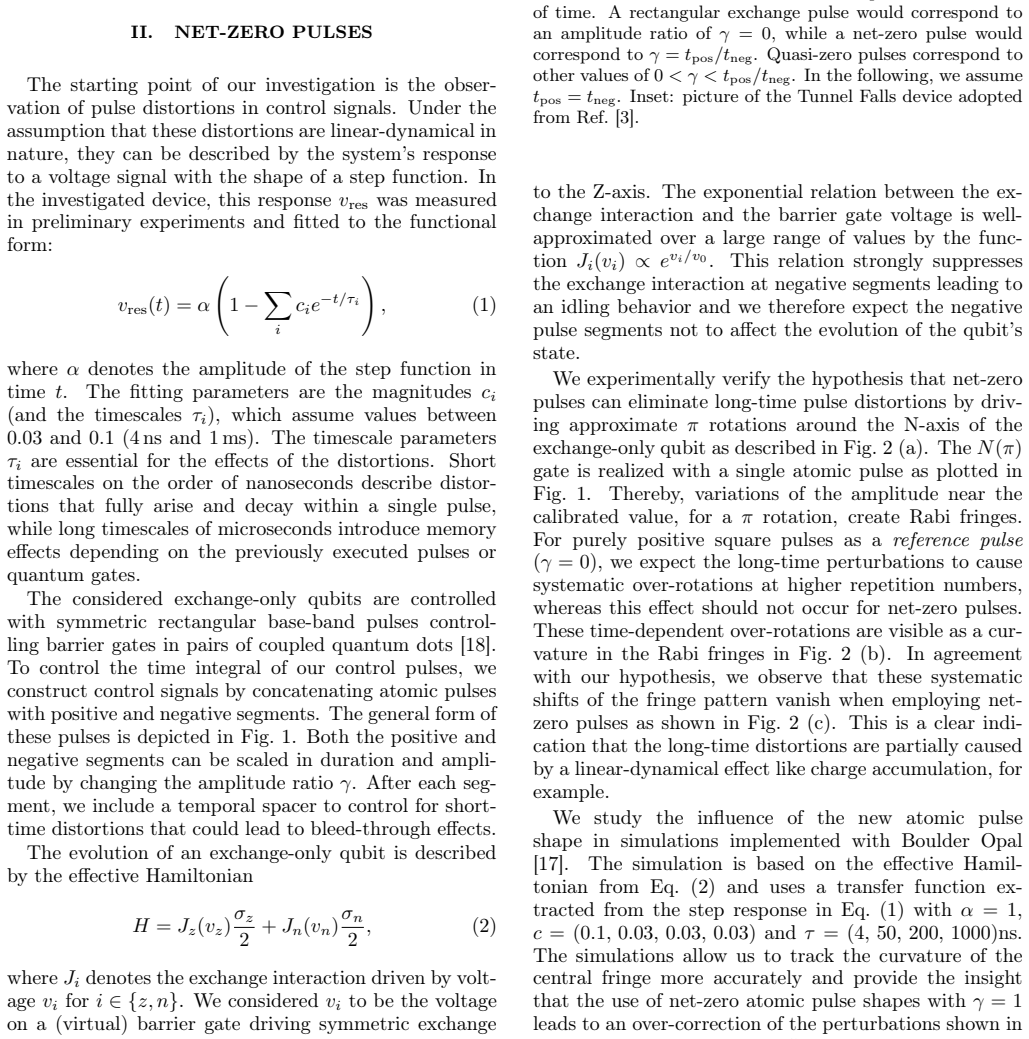
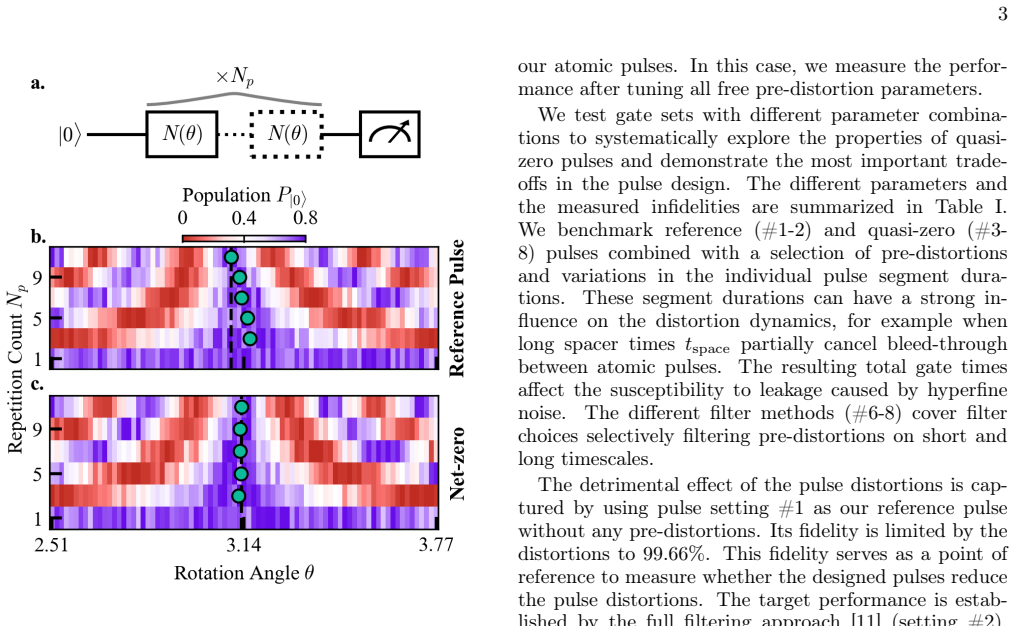
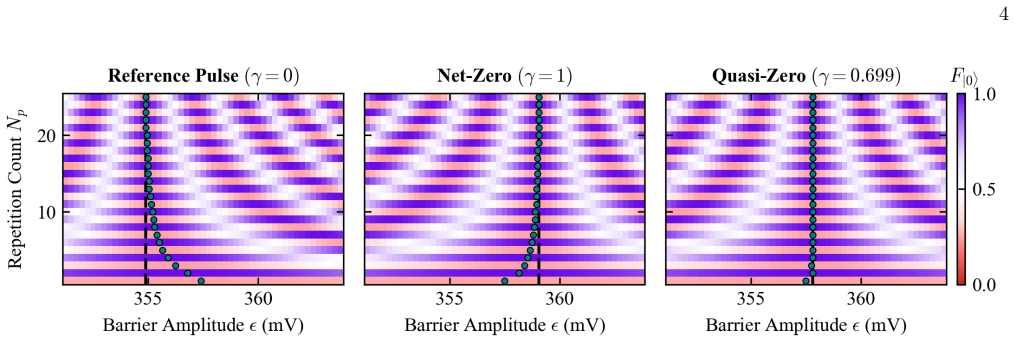
The teal circles mark the center of the fringe pattern for different repetition counts and black dashed lines are included as guide to the eye to spot the curvature of the fringes. positive segments always precede the negative segments. We investigate a reduction of the negative amplitudes to avoid the over-correction by optimizing the alignment of the ce...
-
[2]
These segment durations can have a strong in- fluence on the distortion dynamics, for example when long spacer timest space partially cancel bleed-through between atomic pulses
pulses combined with a selection of pre-distortions and variations in the individual pulse segment dura- tions. These segment durations can have a strong in- fluence on the distortion dynamics, for example when long spacer timest space partially cancel bleed-through between atomic pulses. The resulting total gate times affect the susceptibility to leakage...
-
[3]
Burkard, T
G. Burkard, T. D. Ladd, A. Pan, J. M. Nichol, and J. R. Petta, Semiconductor spin qubits, Rev. Mod. Phys.95, 025003 (2023)
2023
-
[4]
Neyens, O
S. Neyens, O. K. Zietz, T. F. Watson, F. Luthi, A. Neth- wewala, H. C. George, E. Henry, M. Islam, A. J. Wagner, F. Borjans,et al., Probing single electrons across 300-mm spin qubit wafers, Nature629, 80 (2024)
2024
-
[5]
H. C. George, M. T. Mądzik, E. M. Henry, A. J. Wag- ner, M. M. Islam, F. Borjans, E. J. Connors, J. Corrigan, M. Curry, M. K. Harper,et al., 12-spin-qubit arrays fab- ricated on a 300 mm semiconductor manufacturing line, Nano Letters25, 793 (2025)
2025
-
[6]
Huckemann, P
T. Huckemann, P. Muster, W. Langheinrich, V. Brack- mann, M. Friedrich, N. D. Komerički, L. K. Diebel, V. Stieß, D. Bougeard,et al., Industrially fabricated single-electron quantum dots in si/si—ge heterostruc- tures, IEEE Electron Device Letters46, 868 (2025)
2025
-
[7]
N. I. Dumoulin Stuyck, R. Li, C. Godfrin, A. Elsayed, S. Kubicek, J. Jussot, B. T. Chan, F. A. Mohiyaddin, M. Shehata, G. Simion,et al., Uniform spin qubit devices with tunable coupling in an all-silicon 300 mm integrated process, in2021 Symposium on VLSI Technology(2021) pp. 1–2
2021
-
[8]
M. Abraham, E. Acuna, T. S. Adams, M. Akmal, M. R. Alfaro, I. Alvarado, J. Amontree, C. Andrews, R. W. Andrews, M. Antcliffe,et al., A digitally controlled sil- icon quantum processing unit (2026), arXiv:2604.16216 [quant-ph]
Pith/arXiv arXiv 2026
-
[9]
D. P. DiVincenzo, D. Bacon, J. Kempe, G. Burkard, and K. B. Whaley, Universal quantum computation with the exchange interaction, Nature408, 339 (2000)
2000
-
[10]
Russ and G
M. Russ and G. Burkard, Three-electron spin qubits, JournalofPhysics: CondensedMatter29,393001(2017)
2017
-
[11]
R. W. Andrews, C. Jones, M. D. Reed, A. M. Jones, S. D. Ha, M.P.Jura, J.Kerckhoff, M.Levendorf, S.Meenehan, S. T. Merkel,et al., Quantifying error and leakage in an encoded si/sige triple-dot qubit, Nature Nanotechnology 14, 747 (2019)
2019
-
[12]
A. J. Weinstein, M. D. Reed, A. M. Jones, R. W. An- drews, D. Barnes, J. Z. Blumoff, L. E. Euliss, K. Eng, B. H. Fong, S. D. Ha,et al., Universal logic with encoded spin qubits in silicon, Nature615, 817 (2023)
2023
-
[13]
M. T. Mądzik, F. Luthi, G. G. Guerreschi, F. A. Mo- hiyaddin, F. Borjans, J. D. Chadwick, M. J. Curry, J. Ziegler, S. Atanasov, P. L. Bavdaz,et al., Op- erating two exchange-only qubits in parallel (2025), arXiv:2504.01191 [quant-ph]
arXiv 2025
-
[14]
S. D. Ha, E. Acuna, K. Raach, Z. T. Bloom, T. L. Brecht, J. M. Chappell, M. D. Choi, J. E. Christensen, I. T. Counts, D. Daprano,et al., Two-dimensional si spin qubit arrays with multilevel interconnects (2025), arXiv:2502.08861 [quant-ph]
Pith/arXiv arXiv 2025
-
[15]
A. Aggarwal, J. Fernández-Pendás, T. Abad, D. Shiri, H. Jakobsson, M. Rommel, A. Nylander, E. Hogedal, A. Osman, J. Biznárová,et al., Mitigating transients in flux-control signals in a superconducting quantum pro- cessor (2025), arXiv:2503.08645 [quant-ph]
arXiv 2025
-
[16]
Ni, R.-L
M. Ni, R.-L. Ma, Z.-Z. Kong, N. Chu, W.-Z. Liao, S.-K. Zhu, C. Wang, G. Luo, D. Liu, G. Cao,et al., Correct- ing on-chip distortion of control pulses with silicon spin qubits, Chinese Physics B34, 010308 (2025)
2025
-
[17]
M. A. Rol, F. Battistel, F. K. Malinowski, C. C. Bultink, B. M. Tarasinski, R. Vollmer, N. Haider, N. Muthusubra- manian, A. Bruno, B. M. Terhal,et al., Fast, high-fidelity conditional-phase gate exploiting leakage interference in weakly anharmonic superconducting qubits, Phys. Rev. Lett.123, 120502 (2019)
2019
-
[18]
Negîrneac, H
V. Negîrneac, H. Ali, N. Muthusubramanian, F. Battis- tel, R. Sagastizabal, M. S. Moreira, J. F. Marques, W. J. Vlothuizen, M. Beekman, C. Zachariadis, N. Haider, et al., High-fidelity controlled-zgate with maximal in- termediate leakage operating at the speed limit in a su- perconducting quantum processor, Phys. Rev. Lett.126, 220502 (2021)
2021
-
[19]
Q-CTRL,BoulderOpal,https://q-ctrl.com/boulder-opal (2025), [Online]
2025
-
[20]
Martins, F
F. Martins, F. K. Malinowski, P. D. Nissen, S. Barnes, Edwin nd Fallahi, G. C. Gardner, M. J. Manfra, C. M. Marcus, and F. Kuemmeth, Noise suppression using sym- metric exchange gates in spin qubits, Phys. Rev. Lett. 116, 116801 (2016)
2016
-
[21]
Kerckhoff, B
J. Kerckhoff, B. Sun, B. Fong, C. Jones, A. Kiselev, D. Barnes, R. Noah, E. Acuna, M. Akmal, S. Ha,et al., Magnetic gradient fluctuations from quadrupolar73Gein Si/SiGeexchange-only qubits, PRX Quantum2, 010347 (2021)
2021
discussion (0)
Sign in with ORCID, Apple, or X to comment. Anyone can read and Pith papers without signing in.