Defining Unique, Redundant, and Synergistic Quantum Information
Pith reviewed 2026-06-27 21:25 UTC · model grok-4.3
The pith
Unique quantum information must be absent from erasure-correctable qubit subsets
A machine-rendered reading of the paper's core claim, the machinery that carries it, and where it could break.
Core claim
We extend the classical ideas of the Partial Information Decomposition (PID) to the quantum domain and quantify unique, redundant, and synergistic quantum information. We show that unique information plays the central role in quantum error correction codes: any erasure-correctable subset of encoding qubits must contain zero unique information. Synergistic information between two disjoint subsets of encoding qubits appears when a logical operation is supported on the whole set but not on the subsets separately. In a different application of our PID, we show that redundant quantum information is the crucial feature of the decoherence mechanism proposed by Zurek et al. to explain how the classi
What carries the argument
The quantum partial information decomposition that partitions the information between subsystems into unique, redundant, and synergistic parts, with operational meanings in error correction and decoherence.
Load-bearing premise
That the classical PID can be extended to quantum states while retaining the operational interpretations for quantum error correction and decoherence without being disrupted by non-commutativity or measurement effects.
What would settle it
Finding an erasure-correctable set of qubits in a quantum code that nonetheless has positive unique information under the quantum PID definition would disprove the claim that unique information must be zero in such sets.
Figures



read the original abstract
We extend the classical ideas of the Partial Information Decomposition (PID) to the quantum domain and quantify unique, redundant, and synergistic quantum information. We show that unique information plays the central role in quantum error correction codes: any erasure-correctable subset of encoding qubits must contain zero unique information. Synergistic information between two disjoint subsets of encoding qubits appears when a logical operation is supported on the whole set but not on the subsets separately. In a different application of our PID, we show that redundant quantum information is the crucial feature of the decoherence mechanism proposed by Zurek \textit{et al.} to explain how the classical world emerges out of the quantum world.
Editorial analysis
A structured set of objections, weighed in public.
Referee Report
Summary. The manuscript extends the classical partial information decomposition (PID) to quantum states, introducing definitions for unique, redundant, and synergistic quantum information. It claims that unique information is central to quantum error correction, with any erasure-correctable subset of encoding qubits containing zero unique information; synergistic information arises when a logical operation is supported on the full set but not on disjoint subsets; and redundant information is the key feature in Zurek et al.'s decoherence mechanism for the emergence of classicality from quantum systems.
Significance. If the proposed quantum PID definitions preserve the operational interpretations of the classical case, the framework could offer a structured way to analyze information partitioning in quantum error correction and decoherence processes. The explicit links to QEC (erasure correction) and pointer-state decoherence provide concrete test cases. The work supplies formal definitions and applications rather than parameter-free derivations or machine-checked proofs.
major comments (2)
- [Abstract and §4] Abstract and §4 (QEC application): the claim that 'any erasure-correctable subset of encoding qubits must contain zero unique information' is load-bearing for the central QEC result. The manuscript must demonstrate that the quantum definition of unique information inherits the classical operational semantics (information accessible from one source but not the other, without disturbance) under the non-commuting observables and measurement disturbance inherent to quantum erasure channels; otherwise the zero-unique-information statement does not follow from the definitions alone.
- [Abstract and §5] Abstract and §5 (decoherence application): the assertion that 'redundant quantum information is the crucial feature' of Zurek's decoherence mechanism requires an explicit mapping showing that the quantum PID redundant term corresponds to the environment-induced superselection and pointer-basis stability, rather than merely re-labeling classical redundancy. Non-commutativity between system and environment observables risks altering the redundancy interpretation.
minor comments (2)
- [§3] Notation for the quantum PID quantities should be introduced with explicit comparison to the classical PID axioms (e.g., non-negativity, monotonicity) to clarify which properties are retained.
- [Figures] Figure captions for any illustrative circuits or state diagrams should specify the basis in which the unique/redundant quantities are evaluated.
Simulated Author's Rebuttal
We thank the referee for the careful review and constructive feedback. We address each major comment below and will incorporate clarifications in a revised manuscript.
read point-by-point responses
-
Referee: [Abstract and §4] Abstract and §4 (QEC application): the claim that 'any erasure-correctable subset of encoding qubits must contain zero unique information' is load-bearing for the central QEC result. The manuscript must demonstrate that the quantum definition of unique information inherits the classical operational semantics (information accessible from one source but not the other, without disturbance) under the non-commuting observables and measurement disturbance inherent to quantum erasure channels; otherwise the zero-unique-information statement does not follow from the definitions alone.
Authors: We agree that an explicit demonstration is needed to connect the quantum unique-information definition to the classical operational semantics under measurement disturbance. In the revision we will add a dedicated paragraph in §4 deriving that, for any erasure-correctable subset, the unique term vanishes identically because the quantum mutual information between the logical qubit and that subset equals the mutual information with the complementary subset; this equality follows directly from the definition of unique information and the no-disturbance property of the erasure channel on correctable subspaces, without additional assumptions. revision: yes
-
Referee: [Abstract and §5] Abstract and §5 (decoherence application): the assertion that 'redundant quantum information is the crucial feature' of Zurek's decoherence mechanism requires an explicit mapping showing that the quantum PID redundant term corresponds to the environment-induced superselection and pointer-basis stability, rather than merely re-labeling classical redundancy. Non-commutativity between system and environment observables risks altering the redundancy interpretation.
Authors: We accept that a more explicit mapping is required. The revised §5 will contain a step-by-step correspondence: the redundant quantum information is defined via the intersection of quantum mutual informations with distinct environment fragments; this intersection is nonzero precisely when the fragments share the same pointer-basis projectors, thereby enforcing the environment-induced superselection rule. We will also note that the definition is evaluated after decoherence has occurred, so non-commutativity is already accounted for by the pointer-basis restriction. revision: yes
Circularity Check
No significant circularity; definitions and applications are independent of inputs
full rationale
The paper introduces a quantum extension of PID and then applies the resulting quantities to QEC (unique information zero on correctable subsets) and Zurek decoherence (redundant information as key feature). These are presented as consequences of the new definitions rather than tautological reductions; no equations or steps are shown to equate a claimed prediction directly to a fitted parameter or self-referential definition by construction. No load-bearing self-citations or uniqueness theorems imported from the authors' prior work appear in the provided text. The derivation chain remains self-contained against external benchmarks, with the QEC and decoherence statements functioning as interpretive applications rather than forced outputs of the inputs.
Axiom & Free-Parameter Ledger
Reference graph
Works this paper leans on
-
[1]
The four cases of the C-PID
The GHZ and W States Two famously inequivalent [30] tripartite entangled states are the GHZ and W states, given by |GHZ⟩= 1√ 2 (|000⟩+|111⟩),(26) 5 TABLE I. The four cases of the C-PID. Depending on the relative values of the difference between the individual superdense capacities (CA −C B) and the uncorrected one-bit unique capacities (Γ A,Γ B) the PID q...
-
[2]
1 2 3 1 +h( 3+ √ 5 6 )−h( 1
-
[3]
Additionally, as a consequence of the sym- metry, we should expect neither Alice nor Bob to possess unique information
0 1h( 1 3) and |W⟩= 1√ 3 (|001⟩+|010⟩+|100⟩).(27) Both of these states are symmetric between all three com- ponents, so the assignment of components toT,A, andB is arbitrary. Additionally, as a consequence of the sym- metry, we should expect neither Alice nor Bob to possess unique information. Indeed, we find that in both cases the individual parallel and...
-
[4]
spectator
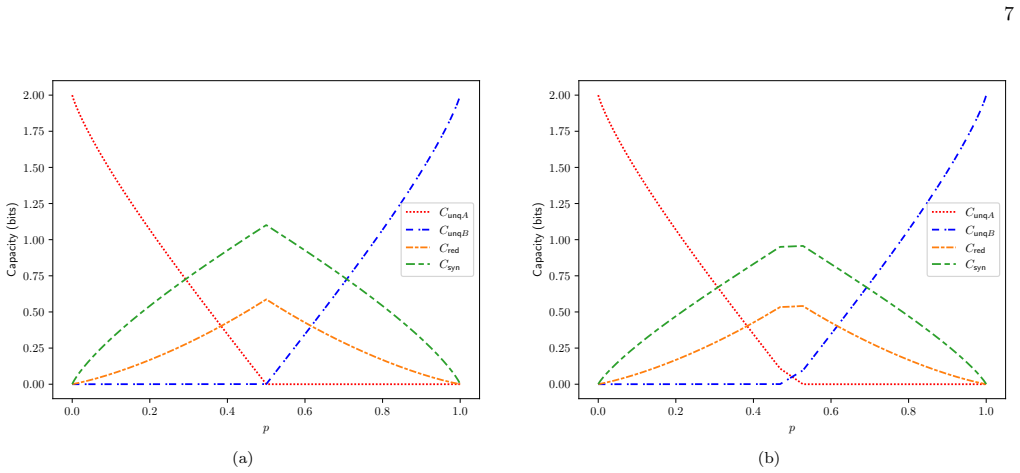
Parameterized Mixed-Bell States Consider the states |ΨA⟩= Φ+ T A ⊗ |ψ⟩B ,(28) |ΨB⟩= Φ+ T B ⊗ |ϕ⟩A ,(29) 0.0 0.2 0.4 0.6 0.8 1.0 p 0.00 0.25 0.50 0.75 1.00 1.25 1.50 1.75 2.00 Capacity (bits) CA CB CAB, ρMB(|0⟩,|0⟩) CAB, ρMB(|+⟩,|0⟩) FIG. 1. Collective and individual two-bit capacities for the statesρ MB(|0⟩,|0⟩;p) andρ MB(|+⟩,|0⟩;p). Forp= 0,1, the target...
-
[5]
Both ¯Zand ¯Xare supported onA
-
[6]
Exactly one of ¯Zand ¯Xis supported onA
-
[7]
quantum-advantage
Neither operator is supported onA. Clearly, in case 1 the receiver can determine exactly which of the four operations was performed on the tar- get and thus gains two bits of information. This case can be thought of as the “quantum-advantage” case: entan- glement permits a super-classical amount of information transmission. In case 2, the receiver can onl...
-
[8]
This implies that a sub- set has no unique information with respect to another if and only if it fails to support more logical operators than the other
Unique Information From the three cases discussed above, it is clear that one subset possessing unique capacity with respect to an- other corresponds to that subset having access to a logical operator that the other does not. This implies that a sub- set has no unique information with respect to another if and only if it fails to support more logical oper...
-
[9]
quantum-disadvantage
Redundant Information For general states (λnot necessarily 1/2), the mini- mum value of the superdense capacity for any subset is 1−H T bits (the “quantum-disadvantage” case). Since any two subsets must have at least this capacity, it is clearly redundant. In fact, by the cleaning lemma (see Appendix D), the redundant capacity for any two sub- sets is eit...
-
[10]
the TABLE IV. Stabilizer generators and logical operators for the three-qubit bit-flip code. g1 Z Z I g2 I Z Z ¯Z Z I I ¯X X X X whole being greater than the sum of its parts
Synergistic Information The presence of synergistic capacity between two sub- sets has an immediate and obvious interpretation in light of the three cases: two subsets possess synergistic capac- ity with respect to one another exactly when their union supports a logical operator that neither does individu- ally. In partitions for which both|A|,|B|≲n/2 but...
-
[11]
For the bit-flip code|ψ i⟩=|i⟩, while for the phase-flip the|ψ i⟩are the |+⟩and|−⟩states
Bit-Flip / Phase-Flip The bit-flip and phase-flip codes are examples ofn- repetition codes, i.e., codes of the form |i⟩ → |ψ i⟩⊗n ,(38) for some orthogonal set of states{|ψ i⟩}. For the bit-flip code|ψ i⟩=|i⟩, while for the phase-flip the|ψ i⟩are the |+⟩and|−⟩states. Clearly, all codes of the form (38) are unitarily equivalent and thus have identical info...
-
[12]
It is an example of a “perfect” code, as it saturates the quantum Hamming 9 TABLE V
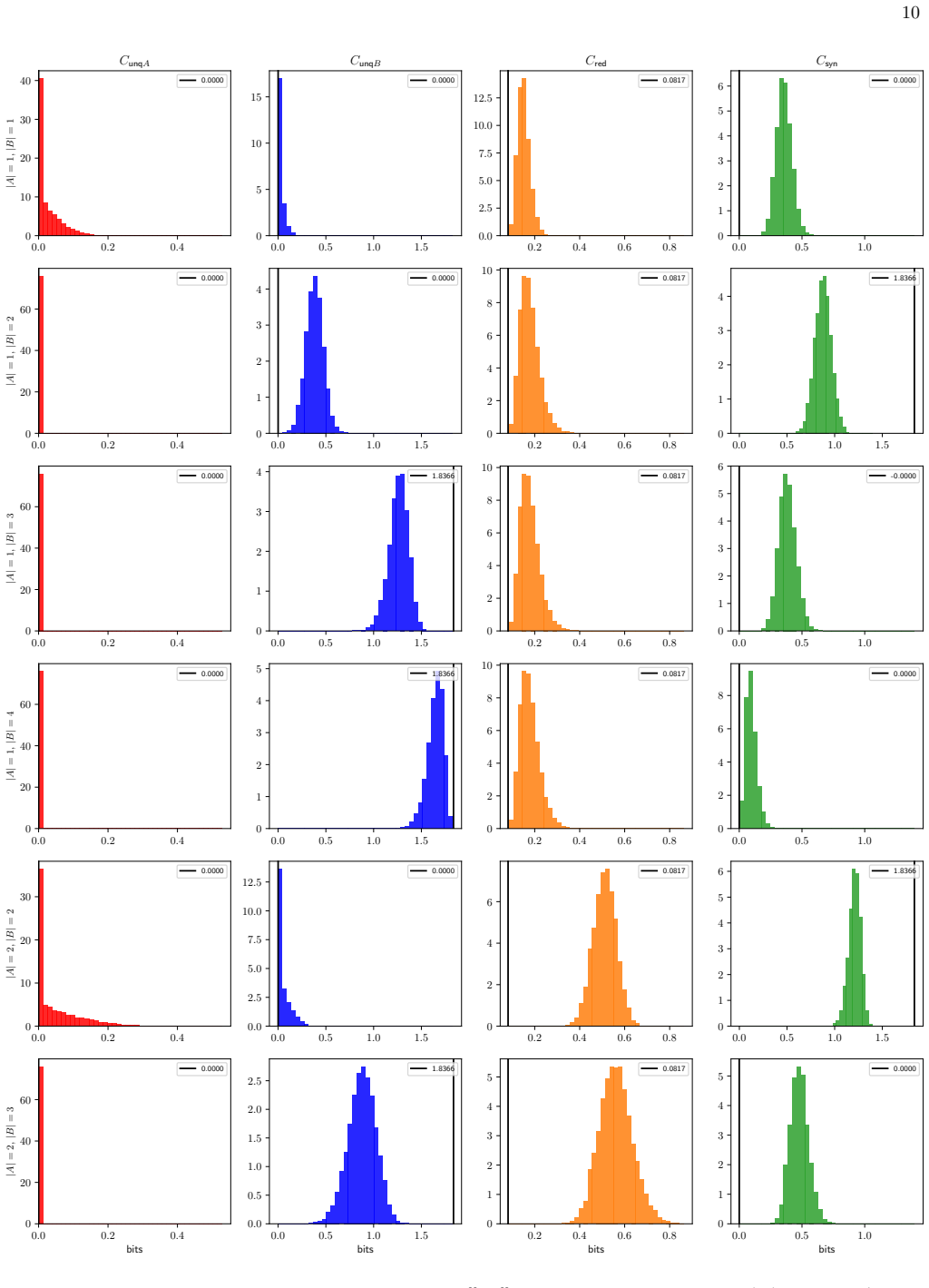
The Five-Qubit Perfect Code The five-qubit code is the smallest code capable of cor- recting arbitrary single-qubit errors. It is an example of a “perfect” code, as it saturates the quantum Hamming 9 TABLE V. Superdense capacities and C-PID for the two pos- sible partitions of the bit-flip and phase-flip codes. Any strict subset of the physical qubits has...
-
[13]
The Steane Code The [[7,1,3]] Steane code is an example of a self-dual CSS code [36, 37] constructed from a classical [7,4,3] Hamming code. Stabilizer generators and logical opera- tors for the Steane code are listed in Table VIII, while superdense capacities and their corresponding C-PIDs for representative partitions are listed in Table IX. Unlike the r...
-
[14]
extremal
The Shor Code The Shor code is a [[9,1,3]] code formed by concate- nating the bit-flip and phase-flip codes. Specifically, the logical qubit is first phase-flip encoded into three qubits, each of which is then bit-flip encoded into a block of three. Stabilizer generators and logical operators for the Shor code are listed in Table X; superdense capacities ...
-
[15]
A. Touil, B. Yan, D. Girolami, S. Deffner, and W. H. Zurek, Eavesdropping on the decohering environment: Quantum darwinism, amplification, and the origin of objective classical reality, Physical Review Letters128, 10.1103/physrevlett.128.010401 (2022)
-
[16]
P. L. Williams and R. D. Beer, Nonnegative decom- position of multivariate information, arXiv preprint arXiv:1004.2515 (2010)
Pith/arXiv arXiv 2010
-
[17]
J. T. Lizier, N. Bertschinger, J. Jost, and M. Wibral, Information decomposition of target effects from multi- source interactions: Perspectives on previous, current and future work, Entropy20, 307 (2018)
2018
-
[18]
E. L. Newman, T. F. Varley, V. K. Parakkattu, S. P. Sherrill, and J. M. Beggs, Revealing the dynamics of neu- ral information processing with multivariate information decomposition, Entropy24, 930 (2022)
2022
-
[19]
Bertschinger, J
N. Bertschinger, J. Rauh, E. Olbrich, J. Jost, and N. Ay, Quantifying unique information, Entropy16, 2161 (2014)
2014
-
[20]
Finn and J
C. Finn and J. T. Lizier, Pointwise partial information decomposition using the specificity and ambiguity lat- tices, Entropy20, 297 (2018)
2018
-
[21]
Griffith and C
V. Griffith and C. Koch, Quantifying synergistic mu- tual information, inGuided self-organization: inception (Springer, 2014) pp. 159–190
2014
-
[22]
A. J. Gutknecht, M. Wibral, and A. Makkeh, Bits and pieces: Understanding information decomposition from part-whole relationships and formal logic, Proceedings of the Royal Society A477, 20210110 (2021)
2021
-
[23]
A. J. Gutknecht, A. Makkeh, and M. Wibral, From babel to boole: The logical organization of information decom- positions, arXiv preprint arXiv:2306.00734 (2023)
arXiv 2023
-
[24]
Harder, C
M. Harder, C. Salge, and D. Polani, Bivariate measure of redundant information, Physical Review E87, 012130 (2013)
2013
-
[25]
R. A. Ince, Measuring multivariate redundant informa- tion with pointwise common change in surprisal, Entropy 19, 318 (2017)
2017
-
[26]
R. G. James, J. Emenheiser, and J. P. Crutchfield, Unique information via dependency constraints, Journal of Physics A: Mathematical and Theoretical52, 014002 (2018)
2018
-
[27]
R. G. James, J. Emenheiser, and J. P. Crutchfield, Unique information and secret key agreement, Entropy 21, 12 (2018)
2018
-
[28]
Kolchinsky, A novel approach to the partial informa- tion decomposition, Entropy24, 403 (2022)
A. Kolchinsky, A novel approach to the partial informa- tion decomposition, Entropy24, 403 (2022)
2022
-
[29]
P. A. Mediano, F. E. Rosas, A. I. Luppi, H. J. Jensen, 22 A. K. Seth, A. B. Barrett, R. L. Carhart-Harris, and D. Bor, Greater than the parts: a review of the in- formation decomposition approach to causal emergence, Philosophical Transactions of the Royal Society A380, 20210246 (2022)
2022
-
[30]
Rauh, Secret sharing and shared information, Entropy 19, 601 (2017)
J. Rauh, Secret sharing and shared information, Entropy 19, 601 (2017)
2017
-
[31]
Wibral, C
M. Wibral, C. Finn, P. Wollstadt, J. T. Lizier, and V. Priesemann, Quantifying information modification in developing neural networks via partial information de- composition, Entropy19, 494 (2017)
2017
-
[32]
Wibral, V
M. Wibral, V. Priesemann, J. W. Kay, J. T. Lizier, and W. A. Phillips, Partial information decomposition as a unified approach to the specification of neural goal func- tions, Brain and cognition112, 25 (2017)
2017
-
[33]
F. E. Rosas, P. A. Mediano, M. Gastpar, and H. J. Jensen, Quantifying high-order interdependencies via multivariate extensions of the mutual information, Phys- ical Review E100, 032305 (2019)
2019
-
[34]
F. E. Rosas, P. A. Mediano, B. Rassouli, and A. B. Bar- rett, An operational information decomposition via syn- ergistic disclosure, Journal of Physics A: Mathematical and Theoretical53, 485001 (2020)
2020
-
[35]
Battiston, E
F. Battiston, E. Amico, A. Barrat, G. Bianconi, G. Fer- raz de Arruda, B. Franceschiello, I. Iacopini, S. K´ efi, V. Latora, Y. Moreno,et al., The physics of higher-order interactions in complex systems, Nature Physics17, 1093 (2021)
2021
-
[36]
N. Ay, D. Polani, and N. Virgo, Information decompo- sition based on cooperative game theory, arXiv preprint arXiv:1910.05979 (2019)
arXiv 1910
-
[37]
R. G. James and J. P. Crutchfield, Multivariate de- pendence beyond shannon information, Entropy19, 531 (2017)
2017
-
[38]
S. J. van Enk, Quantum partial information decomposi- tion, Physical Review A108, 062415 (2023)
2023
-
[39]
S. J. van Enk, Pooling probability distributions and par- tial information decomposition, Physical Review E107, 10.1103/physreve.107.054133 (2023)
-
[40]
Hausladen, R
P. Hausladen, R. Jozsa, B. Schumacher, M. Westmore- land, and W. K. Wootters, Classical information capacity of a quantum channel, Phys. Rev. A54, 1869 (1996)
1996
-
[41]
Schumacher and M
B. Schumacher and M. D. Westmoreland, Sending clas- sical information via noisy quantum channels, Physical Review A56, 131 (1997)
1997
-
[42]
R. Prabhu, A. K. Pati, A. Sen(De), and U. Sen, Exclusion principle for quantum dense coding, Physical Review A 87, 10.1103/physreva.87.052319 (2013)
-
[43]
G. Bowen, Classical information capacity of super- dense coding, Physical Review A63, 10.1103/phys- reva.63.022302 (2001)
-
[44]
Threequbitscanbeentangledintwoinequiv- alent ways,
W. D¨ ur, G. Vidal, and J. I. Cirac, Three qubits can be entangled in two inequivalent ways, Physical Review A 62, 10.1103/physreva.62.062314 (2000)
-
[45]
N. J. Cerf and R. Cleve, Information-theoretic interpreta- tion of quantum error-correcting codes, Physical Review A56, 1721–1732 (1997)
1997
-
[46]
Bravyi and B
S. Bravyi and B. Terhal, A no-go theorem for a two- dimensional self-correcting quantum memory based on stabilizer codes, New Journal of Physics11, 043029 (2009)
2009
-
[47]
J. Haah, Lattice quantum codes and exotic topological phases of matter (2013), arXiv:1305.6973 [quant-ph]
Pith/arXiv arXiv 2013
-
[48]
R. Laflamme, C. Miquel, J. P. Paz, and W. H. Zurek, Per- fect quantum error correction code (1996), arXiv:quant- ph/9602019 [quant-ph]
arXiv 1996
-
[49]
Cleve, D
R. Cleve, D. Gottesman, and H.-K. Lo, How to share a quantum secret, Physical Review Letters83, 648–651 (1999)
1999
-
[50]
A. R. Calderbank and P. W. Shor, Good quantum error-correcting codes exist, Physical Review A54, 1098 (1996)
1996
-
[51]
A. M. Steane, Multiple-particle interference and quan- tum error correction, Proceedings of the Royal Society of London A: Mathematical, Physical and Engineering Sciences452, 2551 (1996)
1996
-
[52]
F. Ma, X. Tan, and J. Wright, Haar random codes attain the quantum hamming bound, approximately (2025), arXiv:2510.07158 [quant-ph]
arXiv 2025
-
[53]
Hayden and J
P. Hayden and J. Preskill, Black holes as mirrors: quan- tum information in random subsystems, Journal of High Energy Physics2007, 120–120 (2007)
2007
-
[54]
C. J. Riedel and W. H. Zurek, Quantum darwinism in an everyday environment: Huge redundancy in scattered photons, Physical review letters105, 020404 (2010)
2010
-
[55]
M. M. Wilde,Quantum information theory(Cambridge university press, 2013)
2013
-
[56]
A. B. Barrett, Exploration of synergistic and redundant information sharing in static and dynamical gaussian sys- tems, Physical Review E91, 10.1103/physreve.91.052802 (2015)
discussion (0)
Sign in with ORCID, Apple, or X to comment. Anyone can read and Pith papers without signing in.