Retarded Correlators of Charge Transport in a Magnetic Field
Pith reviewed 2026-06-27 19:39 UTC · model grok-4.3
The pith
A uniform magnetic field suppresses transverse charge diffusion as 1/B squared in relativistic plasmas while leaving longitudinal diffusion unchanged.
A machine-rendered reading of the paper's core claim, the machinery that carries it, and where it could break.
Core claim
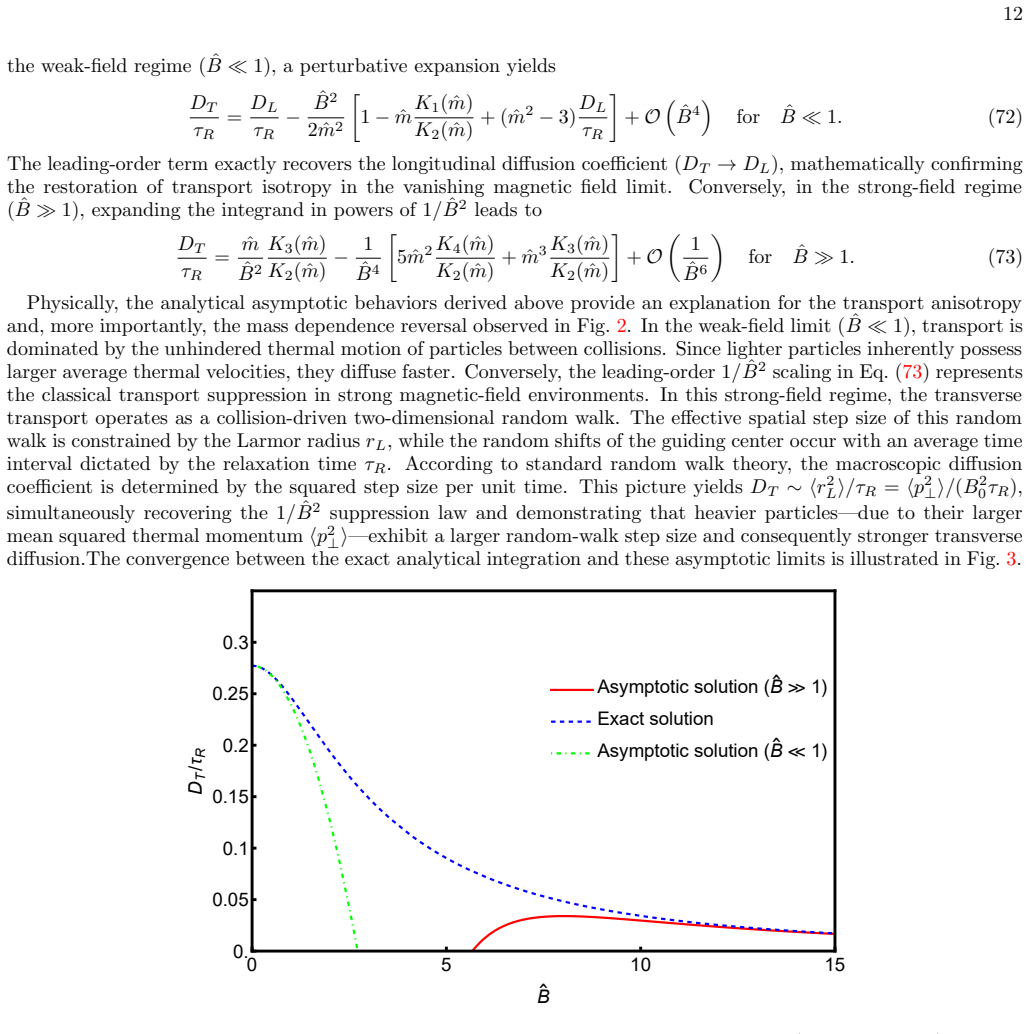
By exactly solving the linearized Boltzmann equation in a uniform magnetic field within the relaxation-time approximation, the authors obtain an analytic solution for the distribution function in terms of Bessel functions. This allows computation of the retarded current-current correlators, verification of Ward identities, and extraction of charge diffusion modes where the transverse diffusion coefficient is suppressed as 1/B_0^2 in the strong-field regime while longitudinal diffusion is unaffected. Non-hydrodynamic branch cuts are analyzed, linked to longitudinal Landau damping and transverse cyclotron damping.
What carries the argument
Exact analytic solution of the linearized Boltzmann equation for the distribution function in a uniform magnetic field, expressed using Bessel functions.
If this is right
- Transverse diffusion coefficient scales as 1/B_0^2 in the strong magnetic field regime.
- Longitudinal diffusion coefficient remains independent of magnetic field strength.
- Retarded current-current correlators satisfy the Ward identities.
- Non-hydrodynamic modes exhibit branch cuts whose thresholds arise from wave-particle interactions.
- Longitudinal modes correspond to Landau damping and transverse modes to cyclotron damping.
Where Pith is reading between the lines
- The suppression result may influence estimates of conductivity in the magnetized quark-gluon plasma formed in heavy-ion collisions.
- The closed-form Bessel solution could be reused to compute other response functions at finite wave vector without further approximation.
- The separation of longitudinal and transverse damping channels suggests similar kinetic treatments could map damping in other magnetized relativistic systems.
- The hydrodynamic extraction procedure supplies a template for isolating diffusion poles from the full correlator at arbitrary field strength.
Load-bearing premise
The collision term can be replaced by a relaxation-time approximation with a single constant relaxation time independent of momentum and magnetic field strength.
What would settle it
A direct measurement or numerical simulation of the transverse diffusion coefficient in a relativistic plasma at increasing magnetic field strengths that checks whether the coefficient falls proportionally to 1 over B squared in the strong-field regime.
Figures


read the original abstract
We study charge transport in a magnetized relativistic plasma using kinetic theory within the relaxation-time approximation. By exactly solving the linearized Boltzmann equation in a uniform magnetic field, we obtain an analytic solution for the distribution function in terms of Bessel functions. Using this solution, we compute the full set of retarded current-current correlators and verify the Ward identities. In the hydrodynamic limit, we extract the charge diffusion modes, demonstrating that the transverse diffusion coefficient is strongly suppressed by the magnetic field, scaling as $1/B_0^2$ in the strong-field regime, while the longitudinal diffusion remains unaffected. Furthermore, we analyze the non-hydrodynamic branch cuts in the complex frequency plane, determining their kinematic thresholds and identifying the underlying wave-particle interactions as longitudinal Landau damping and transverse cyclotron damping.
Editorial analysis
A structured set of objections, weighed in public.
Referee Report
Summary. The manuscript claims an exact analytic solution of the linearized Boltzmann equation in the relaxation-time approximation (constant tau) for a relativistic plasma in uniform B_0, yielding a distribution function in terms of Bessel functions. From this, the full set of retarded current-current correlators is computed, Ward identities are verified, hydrodynamic diffusion poles are isolated (transverse diffusion ~1/B_0^2 in strong fields, longitudinal unaffected), and non-hydrodynamic branch cuts are analyzed with thresholds tied to longitudinal Landau damping and transverse cyclotron damping.
Significance. If the derivation holds, the work supplies an analytic benchmark for magnetized charge transport within a standard kinetic model, with explicit scaling predictions and damping-mode identification that can be compared to numerical simulations or more general collision kernels. The exact solution inside the RTA and explicit Ward-identity verification are concrete strengths.
minor comments (3)
- [Distribution function solution] § on the distribution-function solution: the order and argument of the Bessel functions should be stated explicitly (e.g., J_n( k_perp v_perp / omega_c )) so that the strong-field limit can be reproduced without ambiguity.
- [Hydrodynamic limit] Hydrodynamic-limit extraction: the diffusion coefficients should be written in closed form before the B_0 >> 1/tau limit is taken, so that the 1/B_0^2 scaling can be traced directly to the cyclotron-frequency dependence rather than inferred from numerics.
- [Non-hydrodynamic modes] Branch-cut analysis: the kinematic thresholds for the Landau and cyclotron cuts should be compared quantitatively to the known zero-B and infinite-B limits to confirm continuity of the result.
Simulated Author's Rebuttal
We thank the referee for the positive assessment of our manuscript, the recognition of its strengths in providing an analytic benchmark within the RTA, and the recommendation for minor revision. No specific major comments were listed in the report.
Circularity Check
No significant circularity; derivation self-contained within explicit RTA model
full rationale
The paper begins from the standard relativistic Boltzmann equation with an external uniform magnetic field, adopts the relaxation-time approximation as an explicit modeling choice with constant tau, and solves the linearized equation analytically to obtain an exact distribution function expressed via Bessel functions. From this solution it directly constructs the current-current correlators, verifies Ward identities, and isolates the hydrodynamic poles to extract the diffusion coefficients. The reported transverse suppression scaling as 1/B_0^2 arises mathematically from the cyclotron-frequency term dominating the relaxation rate inside that closed-form solution; no quantity is fitted to data from the same calculation, no result is renamed as a prediction, and no load-bearing premise rests on self-citation. The derivation is therefore independent of its own outputs and self-contained against external benchmarks within the stated framework.
Axiom & Free-Parameter Ledger
free parameters (1)
- relaxation time tau
axioms (2)
- domain assumption Relaxation-time approximation replaces the full collision integral with -delta f / tau
- domain assumption Linear response around equilibrium distribution
Reference graph
Works this paper leans on
-
[1]
Bessel Functions of the First Kind The Bessel function of the first kind of integer ordern, denoted asJ n(z), is the canonical solution to Bessel’s differential equation,z 2y′′ +zy ′ + (z2 −n 2)y= 0. It can be explicitly defined by its Taylor series expansion around z= 0: Jn(z) = ∞X k=0 (−1)k k!Γ(k+n+ 1) z 2 2k+n .(A1) A fundamental identity connecting th...
-
[2]
Modified Bessel Functions of the Second Kind The modified Bessel function of the second kind,K n(x), is a linearly independent solution to the modified equation x2y′′ +xy ′ −(x 2 +n 2)y= 0. For Re(x)>0, it is most conveniently evaluated using its integral representation: Kn(x) = Z ∞ 0 e−xcosht cosh(nt)dt.(A5) An important related integral identity over th...
-
[3]
Global Equilibrium in a General Electromagnetic Field A necessary condition for a system to reach local equilibrium is that the entropy production vanishes, which requires the distribution function to satisfy the detailed balance condition in the collision integral. This restricts the logarithm of the distribution function to be a linear combination of th...
-
[4]
Gauge Independence of the Equilibrium Distribution It is crucial to verify that the global equilibrium distribution function (B13) is independent of the choice of gauge. Consider aU(1) gauge transformation defined by an arbitrary scalar function Λ(x): Aµ(x)→A ′µ(x) =A µ(x) +∂ µΛ(x).(B14) Under this transformation, the electromagnetic field tensorF µν(x) r...
-
[5]
For a stationary fluid, the relevant scalar function Φ(x) is determined byu 0ν∂νAµ =∂ 0Aµ =∂ µΦ
Equilibrium State in a Uniform Magnetic Field We now apply this general result to the specific physical scenario investigated in our study: a plasma immersed in a uniform magnetic fieldB 0 =B 0ˆxwith the fluid being macroscopically at rest, i.e.,u µ =u µ 0 = (1,0,0,0) andT=T 0. For a stationary fluid, the relevant scalar function Φ(x) is determined byu 0ν...
-
[6]
Groot, W
S. Groot, W. Leeuwen, C. van Weert, and C. Weert,Relativistic Kinetic Theory: Principles and Applications(North- Holland Publishing Company, 1980). 22
1980
-
[7]
P. B. Arnold, G. D. Moore, and L. G. Yaffe, JHEP01, 030, arXiv:hep-ph/0209353
-
[8]
P. B. Arnold, G. D. Moore, and L. G. Yaffe, JHEP05, 051, arXiv:hep-ph/0302165
- [9]
-
[10]
Z. Wang, J. Zhao, C. Greiner, Z. Xu, and P. Zhuang, Phys. Rev. C105, L041901 (2022), arXiv:2110.14302 [hep-ph]
arXiv 2022
-
[11]
R. Lenkiewicz, A. Meistrenko, H. van Hees, K. Zhou, Z. Xu, and C. Greiner, Phys. Rev. D100, 091501 (2019), arXiv:1906.12111 [hep-ph]
arXiv 2019
-
[12]
Z. Xu, K. Zhou, P. Zhuang, and C. Greiner, Phys. Rev. Lett.114, 182301 (2015), arXiv:1410.5616 [hep-ph]
Pith/arXiv arXiv 2015
- [13]
-
[14]
A. Schmitt and P. Shternin, Astrophys. Space Sci. Libr.457, 455 (2018), arXiv:1711.06520 [astro-ph.HE]
Pith/arXiv arXiv 2018
-
[15]
P. S. Shternin and D. G. Yakovlev, Phys. Rev. D78, 063006 (2008), arXiv:0808.2018 [astro-ph]
Pith/arXiv arXiv 2008
-
[16]
P. Shternin and D. Ofengeim, Eur. Phys. J. A58, 42 (2022), arXiv:2202.05794 [nucl-th]
arXiv 2022
-
[17]
Bernstein,Kinetic Theory in the Expanding Universe, Cambridge Monographs on Mathematical Physics (Cambridge University Press, 1988)
J. Bernstein,Kinetic Theory in the Expanding Universe, Cambridge Monographs on Mathematical Physics (Cambridge University Press, 1988)
1988
-
[18]
Kolb and M
E. Kolb and M. Turner,The Early Universe(Avalon Publishing, 1994)
1994
- [19]
-
[20]
A. Kurkela, A. Mazeliauskas, J.-F. Paquet, S. Schlichting, and D. Teaney, Phys. Rev. C99, 034910 (2019), arXiv:1805.00961 [hep-ph]
Pith/arXiv arXiv 2019
-
[21]
L. P. Kadanoff and P. C. Martin, Annals Phys.24, 419 (1963)
1963
-
[22]
Kapusta and C
J. Kapusta and C. Gale,Finite-Temperature Field Theory: Principles and Applications, Cambridge Monographs on Math- ematical Physics (Cambridge University Press, 2006)
2006
- [23]
-
[24]
S. A. Hartnoll and S. P. Kumar, JHEP12, 036, arXiv:hep-th/0508092
-
[25]
P. K. Kovtun and A. O. Starinets, Phys. Rev. D72, 086009 (2005), arXiv:hep-th/0506184
Pith/arXiv arXiv 2005
-
[26]
S. Grozdanov, N. Kaplis, and A. O. Starinets, JHEP07, 151, arXiv:1605.02173 [hep-th]
-
[27]
P. Romatschke, Eur. Phys. J. C76, 352 (2016), arXiv:1512.02641 [hep-th]
Pith/arXiv arXiv 2016
- [28]
-
[29]
A. Kurkela and U. A. Wiedemann, Eur. Phys. J. C79, 776 (2019), arXiv:1712.04376 [hep-ph]
Pith/arXiv arXiv 2019
- [30]
-
[31]
L. Gavassino, Phys. Rev. Res.6, L042043 (2024), arXiv:2404.12327 [nucl-th]
arXiv 2024
-
[32]
G. D. Moore, JHEP05, 084, arXiv:1803.00736 [hep-ph]
- [33]
-
[34]
Hu, SciPost Phys.20, 020 (2026), arXiv:2409.05131 [hep-ph]
J. Hu, SciPost Phys.20, 020 (2026), arXiv:2409.05131 [hep-ph]
arXiv 2026
-
[35]
V. Skokov, A. Y. Illarionov, and V. Toneev, Int. J. Mod. Phys. A24, 5925 (2009), arXiv:0907.1396 [nucl-th]
Pith/arXiv arXiv 2009
-
[36]
W.-T. Deng and X.-G. Huang, Phys. Rev. C85, 044907 (2012), arXiv:1201.5108 [nucl-th]
Pith/arXiv arXiv 2012
-
[37]
A. Bzdak and V. Skokov, Phys. Lett. B710, 171 (2012), arXiv:1111.1949 [hep-ph]
Pith/arXiv arXiv 2012
-
[38]
L. McLerran and V. Skokov, Nucl. Phys. A929, 184 (2014), arXiv:1305.0774 [hep-ph]
Pith/arXiv arXiv 2014
-
[39]
N. Abbasi and A. Davody, Phys. Lett. B756, 161 (2016), arXiv:1508.06879 [hep-th]
Pith/arXiv arXiv 2016
-
[40]
K. Hattori, Y. Hirono, H.-U. Yee, and Y. Yin, Phys. Rev. D100, 065023 (2019), arXiv:1711.08450 [hep-th]
arXiv 2019
-
[41]
Z. Fang, K. Hattori, and J. Hu, Phys. Rev. D112, 076016 (2025), arXiv:2409.07096 [hep-ph]
arXiv 2025
-
[42]
Z. Fang, K. Hattori, and J. Hu, Phys. Rev. D110, 056049 (2024), arXiv:2402.18601 [physics.plasm-ph]
arXiv 2024
-
[43]
Z. Fang, K. Hattori, and J. Hu, J. Subatomic Part. Cosmol.1-2, 100003 (2024), arXiv:2410.00721 [hep-ph]
arXiv 2024
-
[44]
X. Guo and P. Zhuang, Phys. Rev. D98, 016007 (2018), arXiv:1711.02924 [hep-th]
Pith/arXiv arXiv 2018
- [45]
-
[46]
J. Hu, S. Shi, Z. Xu, J. Zhao, and P. Zhuang, Phys. Rev. D105, 094013 (2022), arXiv:2202.07938 [nucl-th]
arXiv 2022
-
[47]
K. Fukushima, D. E. Kharzeev, and H. J. Warringa, Phys. Rev. D78, 074033 (2008), arXiv:0808.3382 [hep-ph]
Pith/arXiv arXiv 2008
-
[48]
D. E. Kharzeev, J. Liao, S. A. Voloshin, and G. Wang, Prog. Part. Nucl. Phys.88, 1 (2016), arXiv:1511.04050 [hep-ph]
Pith/arXiv arXiv 2016
-
[49]
K. Hattori and X.-G. Huang, Nucl. Sci. Tech.28, 26 (2017), arXiv:1609.00747 [nucl-th]
Pith/arXiv arXiv 2017
-
[50]
X.-G. Huang, Rept. Prog. Phys.79, 076302 (2016), arXiv:1509.04073 [nucl-th]
Pith/arXiv arXiv 2016
-
[51]
J. Zhao and F. Wang, Prog. Part. Nucl. Phys.107, 200 (2019), arXiv:1906.11413 [nucl-ex]
Pith/arXiv arXiv 2019
-
[52]
J. L. Anderson and H. R. Witting, Physica74, 466 (1974)
1974
-
[53]
Gradshteyn and I
I. Gradshteyn and I. Ryzhik,Table of Integrals, Series, and Products(Academic Press, 2014)
2014
-
[54]
X. Lin, Q.-Z. Sun, X.-H. Wu, and J. Hu, Phys. Rev. D113, 076010 (2026), arXiv:2505.04444 [hep-ph]
Pith/arXiv arXiv 2026
-
[55]
M. Bajec and A. Soloviev, Phys. Rev. D112, 065002 (2025), arXiv:2506.15531 [hep-th]
arXiv 2025
-
[56]
J. Hu, Eur. Phys. J. C85, 281 (2025), arXiv:2310.05606 [hep-ph]
arXiv 2025
- [57]
- [58]
discussion (0)
Sign in with ORCID, Apple, or X to comment. Anyone can read and Pith papers without signing in.