Anisotropic surface tension and stability of quark matter modified by the vector interaction
Pith reviewed 2026-06-27 19:32 UTC · model grok-4.3
The pith
The vector interaction causes transverse surface tension in quark matter to increase with magnetic field strength in strong fields.
A machine-rendered reading of the paper's core claim, the machinery that carries it, and where it could break.
Core claim
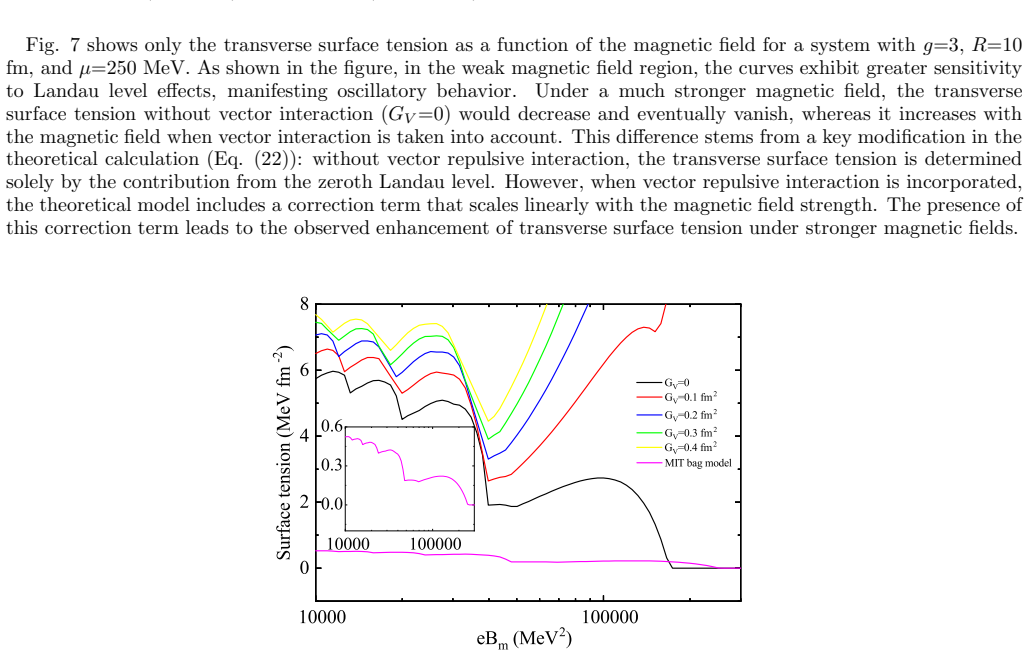
In the quasiparticle model with multiple reflection expansion, the vector interaction enlarges the surface tension of quark matter in both the parallel and transverse directions with respect to the magnetic field. In a stronger magnetic field region, the presence of the vector repulsive interaction leads to an increase in transverse surface tension with the magnetic field strength, which is opposite to the vanishing value without repulsive interaction in the previous work. Consequently, a moderate-intensity magnetic field is required for the formation of a quark matter bubble with the vector interaction. The vector interaction slightly reduces the stability of quark matter. The self-consiste
What carries the argument
The vector repulsive interaction inside the quasiparticle model with multiple reflection expansion, combined with an effective bag function that depends on both chemical potential and magnetic field.
If this is right
- Surface tension is enlarged in both parallel and transverse directions by the vector interaction.
- Transverse surface tension rises with magnetic field strength in the strong-field regime once the vector interaction is present.
- Only moderate magnetic field strengths allow formation of a quark matter bubble when vector repulsion is included.
- The vector interaction produces a slight reduction in the stability of quark matter.
Where Pith is reading between the lines
- The reported anisotropy may favor elongated or oriented shapes for quark-matter droplets inside magnetized neutron-star matter.
- The requirement for moderate rather than arbitrarily strong fields could be tested by embedding the surface-tension result into global models of magnetized compact stars.
- Similar vector-interaction effects might appear in other observables such as the speed of sound or the equation of state under the same magnetic-field conditions.
Load-bearing premise
The effective bag function continues to give a self-consistent thermodynamic treatment of the chemical-potential-dependent quark mass when the bag function itself depends on both chemical potential and magnetic field.
What would settle it
A recalculation of transverse surface tension in the same model that shows the quantity decreasing or reaching zero with rising magnetic field strength even after the vector interaction is added would falsify the main result.
Figures





read the original abstract
In this article, the surface tension and stability of quark matter modified by the vector interaction in a strong magnetic field are investigated in the quasiparticle model with the multiple reflection expansion. The self-consistent thermodynamic treatment of the chemical-potential-dependent quark mass is maintained by the effective bag function, which depends on both the chemical potential and the magnetic field. It is found that the vector interaction could enlarge the surface tension in both the parallel and transverse directions with respect to the magnetic field. In a stronger magnetic field region, the presence of the vector repulsive interaction leads to an increase in transverse surface tension with the magnetic field strength, which is opposite to the vanishing value without repulsive interaction in the previous work. Consequently, it is concluded that a moderate-intensity magnetic field is required for the formation of a quark matter bubble with the vector interaction. Finally, it is demonstrated that the vector interaction slightly reduces the stability of quark matter.
Editorial analysis
A structured set of objections, weighed in public.
Referee Report
Summary. The manuscript studies the anisotropic surface tension and stability of quark matter in a strong magnetic field within the quasiparticle model employing the multiple reflection expansion. An effective bag function B(μ, B) is used to maintain self-consistent thermodynamics for the chemical-potential-dependent quark mass. The vector interaction is found to enlarge surface tension in both parallel and transverse directions. In stronger magnetic field regions, the transverse surface tension increases with field strength (opposite to the vanishing value reported in prior work without the vector term), leading to the conclusion that a moderate-intensity magnetic field is required for quark-matter bubble formation. The vector interaction is also shown to slightly reduce the stability of quark matter.
Significance. If the thermodynamic consistency of the effective bag function is preserved under the addition of the vector interaction, the result supplies a concrete illustration of how repulsive vector forces can reverse the magnetic-field dependence of transverse surface tension. This has potential relevance for the energetics of quark-matter droplets in magnetized environments such as neutron-star interiors. The explicit contrast with the earlier vanishing-tension result is a clear incremental advance, provided the underlying quasiparticle thermodynamics remains intact.
major comments (1)
- [model description and thermodynamic consistency section] The central claim that the vector interaction reverses the B-dependence of transverse surface tension rests on the assertion that the effective bag function B(μ, B) continues to enforce thermodynamic consistency after the vector term is introduced. The abstract states that self-consistency is maintained, yet no explicit check is supplied that the pressure obtained from the grand potential still equals ∫ n dμ or satisfies the Gibbs-Duhem relation once the vector shift in effective chemical potential (or the G_v n² term) is present. If the bag function is not readjusted for the modified density, the reported increase of transverse tension with B could be an artifact of inconsistent thermodynamics rather than a physical effect.
Simulated Author's Rebuttal
We thank the referee for their careful reading and constructive comments. The major concern regarding thermodynamic consistency is addressed below. We will revise the manuscript accordingly.
read point-by-point responses
-
Referee: The central claim that the vector interaction reverses the B-dependence of transverse surface tension rests on the assertion that the effective bag function B(μ, B) continues to enforce thermodynamic consistency after the vector term is introduced. The abstract states that self-consistency is maintained, yet no explicit check is supplied that the pressure obtained from the grand potential still equals ∫ n dμ or satisfies the Gibbs-Duhem relation once the vector shift in effective chemical potential (or the G_v n² term) is present. If the bag function is not readjusted for the modified density, the reported increase of transverse tension with B could be an artifact of inconsistent thermodynamics rather than a physical effect.
Authors: We agree that an explicit verification of thermodynamic consistency after adding the vector interaction would strengthen the manuscript. In our construction the effective bag function B(μ, B) is readjusted to account for the density shift induced by the vector term (via μ* = μ − 2 G_v n), thereby preserving P = ∫ n dμ and the Gibbs-Duhem relation by design. Nevertheless, the referee is correct that this was not demonstrated explicitly. In the revised version we will add a short appendix or subsection that verifies the thermodynamic identities numerically and analytically with the vector interaction included, confirming that the reported rise of transverse surface tension with B is a physical effect. revision: yes
Circularity Check
No significant circularity; model self-contained via effective bag function
full rationale
The derivation relies on the quasiparticle model with multiple reflection expansion, where the effective bag function B(μ,B) is introduced explicitly to enforce thermodynamic consistency for the μ-dependent mass in the presence of both magnetic field and vector interaction. Surface tension results (including the reported reversal of B-dependence under vector repulsion) follow from the model's equations rather than any parameter being fitted to the target surface-tension observables and then relabeled as a prediction. No self-definitional steps, fitted-input predictions, or load-bearing self-citations appear in the abstract or described chain. The approach is standard for this class of models and remains independent of the specific numerical outcomes.
Axiom & Free-Parameter Ledger
free parameters (2)
- vector coupling strength
- effective bag function parameters
axioms (2)
- domain assumption Quasiparticle model with chemical-potential-dependent mass remains thermodynamically consistent when an effective bag function is used.
- domain assumption Multiple reflection expansion accurately captures the anisotropic surface tension of quark matter.
Reference graph
Works this paper leans on
-
[1]
Quark Matter in Strong Magnetic Field
S. Chakrabarty, Phys. Rev. D 54, 1306-1316 (1996) doi:10.1103/PhysRevD.54.1306 [arXiv: hep-ph/9603406 [hep-ph]]
work page internal anchor Pith review Pith/arXiv arXiv doi:10.1103/physrevd.54.1306 1996
-
[2]
The Equation of State of Neutron-Star Matter in Strong Magnetic Fields
A. Broderick, M. Prakash, and J. M. Lattimer, Astrophys. J. 537, 351 (2000) doi:10.1086/309010 [arXiv:astro-ph/0001537 [astro-ph]]
work page internal anchor Pith review Pith/arXiv arXiv doi:10.1086/309010 2000
-
[3]
A. P. Martinez, H. P. Rojas, H. J. M. Cuesta, M. Boligan, an d M. G. Orsaria, Int. J. Mod. Phys. D 14, 1959 (2005) doi:10.1142/S0218271805007401 [arXiv:astro-ph/050625 6 [astro-ph]]
-
[4]
D. Deb, B. Mukhopadhyay, and F. Weber, Astrophys. J. 922, 149 (2021) doi:10.3847/1538-4357/ac222a [arXiv:2108.1 2436 [astro-ph.HE]]
-
[5]
E. J. Ferrer, V. de la Incera, J. P. Keith, I. Portillo and P . L. Springsteen, Phys. Rev. C 82, 065802 (2010) doi:10.1103/PhysRevC.82.065802 [arXiv:1009.3521 [hep- ph]]
work page internal anchor Pith review Pith/arXiv arXiv doi:10.1103/physrevc.82.065802 2010
-
[6]
V. R. Khalilov, Phys. Rev. D 65, 056001 (2002) doi:10.1103/PhysRevD.65.056001
-
[7]
Surface tension of highly magnetized degenerate quark matter
G. Lugones and A. G. Grunfeld, Phys. Rev. C 95, no.1, 015804 (2017) doi:10.1103/PhysRevC.95.015804 [ar Xiv:1610.05875 [nucl-th]]
work page internal anchor Pith review Pith/arXiv arXiv doi:10.1103/physrevc.95.015804 2017
-
[8]
Surface tension of hot and dense quark matter under strong magnetic fields
G. Lugones and A. G. Grunfeld, Phys. Rev. C 99, no.3, 035804 (2019) doi:10.1103/PhysRevC.99.035804 [ar Xiv:1811.09954 [astro-ph.HE]]
work page internal anchor Pith review Pith/arXiv arXiv doi:10.1103/physrevc.99.035804 2019
-
[9]
A. G. Grunfeld and G. Lugones, Astron. Nachr. 342, no.1-2, 205-210 (2021) doi:10.1002/asna.202113905 [arX iv:2011.06131 [nucl-th]]
-
[10]
C. J. Xia, G. X. Peng, E. G. Zhao, and S. G. Zhou, Phys. Rev. D 93, 085025 (2016) doi:10.1103/PhysRevD.93.085025
-
[11]
T. A. S. Do Carmo, G. Lugones, and A. G. Grunfeld, J. Phys. G 40, 035201 (2013) doi:10.1088/0954-3899/40/3/035201 [arXiv:1301.3483 [hep-ph]]
work page internal anchor Pith review Pith/arXiv arXiv doi:10.1088/0954-3899/40/3/035201 2013
-
[12]
G. Lugones and A. G. Grunfeld, Phys. Rev. D 84, 085003 (2011) doi:10.1103/PhysRevD.84.085003 [arXiv:1 105.3992 [astro- ph.SR]]
-
[13]
B. W. Mintz, R. Stiele, R. O. Ramos, and J. Schaffner-Biel ich, Phys. Rev. D 87, 036004 (2013) doi:10.1103/PhysRevD.87.054004 [arXiv:1210.7155 [hep- ph]]
work page internal anchor Pith review Pith/arXiv arXiv doi:10.1103/physrevd.87.054004 2013
-
[14]
D. Sen, N. Alam, and G. Chaudhuri, Phys. Rev. D 106, 083008 (2022) doi:10.1103/PhysRevD.106.083008 [arXiv: 2209.13890 [nucl-th]]
-
[15]
S. Pal, S. Podder, D. Sen, and G. Chaudhuri, Phys. Rev. D 107, 063019 (2023) doi:10.1103/PhysRevD.107.063019 [arXiv:2303.04653 [nucl-th]]
-
[16]
A. Chodos, R. L. Jaffe, K. Johnson, C. B. Thorn, and V. F. We isskopf, Phys. Rev. D 9, 3471 (1974) doi:10.1103/PhysRevD.9.3471
-
[17]
D. Sen, N. Alam, and G. Chaudhuri, J. Phys. G 48, 105201 (2021) doi:10.1088/1361-6471/ac1713 [arXiv:210 7.08971 [nucl-th]]
-
[18]
S. Podder, S. Pal, D. Sen, and G. Chaudhuri, Nucl. Phys. A 1042, 122796 (2024) doi:10.1016/j.nuclphysa.2023.122796 [arXiv:2311.08962 [nucl-th]]
-
[19]
Z. Zhang, P. C. Chu, X. H. Li, H. Liu, and X. M. Zhang, Phys. Rev. D 103, 103021 (2021) doi:10.1103/PhysRevD.103.103021
-
[20]
P. C. Chu, X. H. Li, H. Liu, M. Ju, and Y. Zhou, Phys. Rev. C 108, 025808 (2023) doi:10.1103/PhysRevC.108.025808
-
[21]
Z. J. Ma, Z. Y. Lu, J. F. Xu, G. X. Peng, X. Fu, and J. Wang, Ph ys. Rev. D 108, 054017 (2023) doi:10.1103/PhysRevD.108.054017 [arXiv:308.05308 [hep -ph]]
-
[22]
G. X. Peng, H. C. Chiang, J. J. Yang, L. Li, and B. Liu, Phys . Rev. C 61, 015201 (2000) doi:10.1103/PhysRevC.61.015201 [arXiv:hep-ph/9911222 [hep-ph]]
work page internal anchor Pith review Pith/arXiv arXiv doi:10.1103/physrevc.61.015201 2000
-
[23]
X. J. Wen, X. H. Zhong, G. X. Peng, P. N. Shen, and P. Z. Ning , Phys. Rev. C 72, 015204 (2005) doi:10.1103/PhysRevC.72.015204 [arXiv:hep-ph/0506050 [hep-ph]]
work page internal anchor Pith review Pith/arXiv arXiv doi:10.1103/physrevc.72.015204 2005
-
[24]
P. C. Chu and L. W. Chen, Astrophys. J. 780, 135 (2013) doi:10.1088/0004-637X/780/2/135 [arXiv:121 2.1388 [astro- ph.SR]]
-
[25]
O. G. Benvenuto and G. Lugones, Phys. Rev. D 51, 1989 (1995) doi:10.1103/PhysRevD.51.1989
-
[26]
A. Chodos, R. L. Jaffe, K. Johnson, and C. B. Thorn, Phys. R ev. D 10, 2599 (1974) doi:10.1103/PhysRevD.10.2599
-
[27]
E. Farhi and R. L. Jaffe, Phys. Rev. D 30, 2379 (1984) doi:10.1103/PhysRevD.30.2379
-
[28]
A. Peshier, B. K¨ ampfer, O. P. Pavlenko, and G. Soff, Phys . Lett. B 337, 235–239 (1994) doi:10.1016/0370-2693(94)90969-5
-
[29]
P. K. Srivastava, S. K. Tiwari and C. P. Singh, Phys. Rev. D 82, 014023 (2010) doi:10.1103/PhysRevD.82.014023 [arXiv:1002.4780 [hep-ph]]
work page internal anchor Pith review Pith/arXiv arXiv doi:10.1103/physrevd.82.014023 2010
-
[30]
N. Itoh, Prog. Theor. Phys. 44, 291 (1970) doi:10.1143/PTP.44.291
-
[31]
A. R. Bodmer, Phys. Rev. D 4, 1601 (1971) doi:10.1103/PhysRevD.4.1601
-
[32]
Witten, Cosmic Separation of Phases, Phys
E. Witten, Phys. Rev. D 30, 272 (1984) doi:10.1103/PhysRevD.30.272
-
[33]
S. Pal and G. Chaudhuri, Phys. Rev. D 110, 123021 (2024) doi:10.1103/PhysRevD.110.123021 [arXiv: 2411.10735 [hep-ph]]
-
[34]
Medium effects in strange quark matter and strange stars
K. Schertler, C. Greiner and M. H. Thoma, Nucl. Phys. A 616, 659-679 (1997) doi:10.1016/S0375-9474(97)00014-6 [arXiv:hep-ph/9611305 [hep-ph]]
work page internal anchor Pith review Pith/arXiv arXiv doi:10.1016/s0375-9474(97)00014-6 1997
-
[35]
K. Schertler, C. Greiner, and M. H. Thoma, J. Phys. G 23, 2051 (1997) doi:10.1088/0954-3899/23/12/030
-
[36]
A. Peshier, B. Kampfer and G. Soff, Phys. Rev. C 61, 045203 (2000) doi:10.1103/PhysRevC.61.045203 [arXiv:h ep- 14 ph/9911474 [hep-ph]]
-
[37]
V. M. Bannur, Phys. Rev. C 78, 045206 (2008) doi:10.1103/PhysRevC.78.045206 [arXiv:0 712.2886 [hep-ph]]
-
[38]
X. J. Wen, Z. Q. Feng, N. Li and G. X. Peng, J. Phys. G 36, 025011 (2009) doi:10.1088/0954-3899/36/2/025011
-
[39]
M. Ju, J. Hu, and H. Shen, Astrophys. J. 923, 250 (2021) doi:10.3847/1538-4357/ac30dd [arXiv:2111.0 8909 [nucl-th]]
-
[40]
R. Balian and C. Bloch, Annals Phys. 60, 401-447 (1970) doi:10.1016/0003-4916(70)90497-5
-
[41]
J. Madsen, Phys. Rev. Lett. 70, 391-393 (1993) doi:10.1103/PhysRevLett.70.391
-
[42]
M. S. Berger and R. L. Jaffe, Phys. Rev. C 35, 213-225 (1987) doi:10.1103/PhysRevC.35.213
-
[43]
G. Lugones and A. G. Grunfeld, Phys. Rev. D 104, L101301 (2021) doi:10.1103/PhysRevD.104.L101301
-
[44]
Y. Y. He and X. J. Wen, Phys. Rev. D 107, 074030 (2023) doi:10.1103/PhysRevD.107.074030 [arXiv: 2304.03491 [hep-ph]]
-
[45]
I. Mardor and B. Svetitsky, Phys. Rev. D 44, 878 (1991) doi:10.1103/PhysRevD.44.878
-
[46]
J. Madsen, Phys. Rev. D 50, 3328 (1994) doi:10.1103/PhysRevD.50.3328 [arXiv:hep-p h/9407314 [hep-ph]]
-
[47]
O. Kiriyama, Phys. Rev. D 72, 054009 (2005) doi:10.1103/PhysRevD.72.054009 [arXiv:h ep-ph/0507188 [hep-ph]]
-
[48]
D. A. Terrero, D. M. Paret, and A. P. Martinez Int. J. Mod. Phys. D 27, 1850016 (2018) doi:10.1142/S0218271818500165
-
[49]
B. Jia, E. Sharpe, and R. Wu, J. High Energ. Phys. 2014, 17 (2014). doi:10.1007/JHEP08(2014)017
-
[50]
E. S. Fraga, M. Hippert, and A. Schmitt, Phys. Rev. D 99, 014046 (2019) doi:10.1103/PhysRevD.99.014046 [arXiv:1810.13226 [hep-ph]]
work page internal anchor Pith review Pith/arXiv arXiv doi:10.1103/physrevd.99.014046 2019
-
[51]
M. Ju, P. Chu, X. Wu, and H. Liu, Eur. Phys. J. C 85, 1, 40(2025) doi:10.1140/epjc/s10052-025-13788-9. 15 Appendix A: Thermodynamic consistency with effective mass In the appendix sections, for the sake of convenience, we have dis regarded the quark flavor indices in the variables. In the grand canonical ensemble, the thermodynamic pressure of quarks with a...
discussion (0)
Sign in with ORCID, Apple, or X to comment. Anyone can read and Pith papers without signing in.