Cascaded Rydberg antiblockade: Multi-atom excitation dynamics and entanglement
Pith reviewed 2026-06-27 18:28 UTC · model grok-4.3
The pith
Global periodic driving synthesizes an effective Hamiltonian enabling perfect state transfer across a five-site Dicke-state lattice in four Rydberg atoms.
A machine-rendered reading of the paper's core claim, the machinery that carries it, and where it could break.
Core claim
By applying a global periodic driving to four fully connected Rydberg atoms we synthesize an effective Hamiltonian in the Dicke-state lattice that enables perfect state transfer across the five-site lattice with multiple programmable pathways from stepwise nearest-neighbor jumps to a single-step transition. This DSL platform further allows simulation of a dynamic Su-Schrieffer-Heeger model where soft quantum control achieves topologically inspired full Rydberg antiblockade from the all-ground to the fully excited state with enhanced robustness against disorder. Incorporating the shortcut to adiabaticity technique generates high-fidelity entangled twin-Fock and Greenberger-Horne-Zeilinger sta
What carries the argument
The Floquet-modulated cascaded Rydberg antiblockade regime that creates the five-site Dicke-state lattice and its effective Hamiltonian for programmable state transfer.
If this is right
- Perfect state transfer becomes achievable across the five-site DSL via multiple programmable pathways including stepwise and single-step routes.
- The dynamic Su-Schrieffer-Heeger model enables topologically inspired full Rydberg antiblockade with enhanced robustness against disorder.
- Shortcut-to-adiabaticity protocols generate high-fidelity twin-Fock and GHZ states on sub-microsecond timescales.
- The synthetic Dicke-state lattice supplies a flexible programmable platform for quantum simulation and multipartite entanglement engineering in Rydberg arrays.
Where Pith is reading between the lines
- The programmable pathways could be used to design specific multi-qubit operations or error-protected transfer protocols.
- Robustness to disorder may translate into practical advantages when the scheme is implemented in arrays with realistic imperfections.
- The Floquet construction might be adapted to other platforms with collective interactions to create analogous synthetic dimensions.
Load-bearing premise
The rotating-wave approximation holds and the Floquet modulation frequency is much larger than the interaction strengths without significant higher-order corrections or decoherence during the protocol.
What would settle it
An experiment that applies the proposed global periodic driving to four Rydberg atoms and measures whether the population transfer from the all-ground state to the fully excited state reaches near-unit fidelity as predicted by the effective Hamiltonian or shows clear deviations when the modulation frequency is lowered.
Figures

read the original abstract
We propose a cascaded Rydberg antiblockade (RAB) regime via a Floquet modulation in four fully connected interacting atoms, which establishes a new synthetic dimension, Dicke-state lattice (DSL), in the space of collective spin excitations. By applying a global periodic driving, we synthesize an effective Hamiltonian that enables perfect state transfer across the five-site DSL with multiple programmable pathways from stepwise nearest-neighbor jumps to a single-step transition. This DSL platform further allows us to simulate a dynamic Su-Schrieffer-Heeger model, where soft quantum control is employed to achieve topologically inspired full RAB $|0000\rangle \to |1111\rangle$ with enhanced robustness against disorder. Moreover, by incorporating the shortcut to adiabaticity technique, we generate high-fidelity entangled twin-Fock and Greenberger-Horne-Zeilinger states on the four atoms within sub-microsecond timescales, outperforming the speed limits of conventional adiabatic protocols. Our work demonstrates a flexible and programmable synthetic dimension for quantum simulation and multipartite entanglement engineering in Rydberg atom arrays, paving the way for the future development of quantum information processing.
Editorial analysis
A structured set of objections, weighed in public.
Referee Report
Summary. The paper proposes a cascaded Rydberg antiblockade regime realized via global Floquet modulation on four fully connected atoms. This creates a synthetic five-site Dicke-state lattice (DSL) in the space of collective excitations, enabling an effective Hamiltonian that supports perfect state transfer along multiple programmable pathways (stepwise nearest-neighbor or single-step). The DSL is further used to simulate a dynamic Su-Schrieffer-Heeger model with soft quantum control for robust full antiblockade, and shortcut-to-adiabaticity protocols are applied to generate high-fidelity twin-Fock and GHZ states on sub-microsecond timescales.
Significance. If the effective-Hamiltonian derivations hold under realistic conditions, the work introduces a programmable synthetic dimension for Rydberg arrays that combines topological robustness with fast entanglement engineering, offering a concrete route to multipartite entangled states and quantum simulation beyond conventional adiabatic limits.
major comments (3)
- [effective Hamiltonian derivation (Floquet section)] The central claim of perfect state transfer on the five-site DSL (abstract and the effective-Hamiltonian section) rests on the high-frequency rotating-wave approximation for the Floquet drive. No explicit bounds on the modulation frequency ω relative to the Rydberg interaction V or driving amplitude are supplied, nor is an analytic error estimate or Magnus-expansion remainder provided; this scale separation is load-bearing for the asserted exact pathways and must be verified.
- [results on state transfer and entanglement generation] No numerical integration of the time-dependent Schrödinger equation or fidelity calculations under finite modulation strength and decoherence are presented to benchmark the effective model against the full driven Hamiltonian. This absence directly affects the reliability of the programmable-pathway and SSH-simulation claims.
- [shortcut-to-adiabaticity subsection] The shortcut-to-adiabaticity protocol for twin-Fock and GHZ generation (final section) is stated to outperform conventional adiabatic limits, yet no comparison of the required driving parameters or resulting fidelity under the same noise model is given, leaving the speed-up claim unquantified.
minor comments (2)
- [model section] Notation for the collective spin operators and the DSL site indexing should be introduced with an explicit table or diagram early in the manuscript for clarity.
- [abstract] The abstract states 'four fully connected interacting atoms' while the DSL is five-site; a brief sentence reconciling the mapping would help readers.
Simulated Author's Rebuttal
We thank the referee for their careful reading and constructive comments on our manuscript. We address each major comment below and have revised the manuscript to incorporate additional analysis and numerical benchmarks as requested.
read point-by-point responses
-
Referee: [effective Hamiltonian derivation (Floquet section)] The central claim of perfect state transfer on the five-site DSL (abstract and the effective-Hamiltonian section) rests on the high-frequency rotating-wave approximation for the Floquet drive. No explicit bounds on the modulation frequency ω relative to the Rydberg interaction V or driving amplitude are supplied, nor is an analytic error estimate or Magnus-expansion remainder provided; this scale separation is load-bearing for the asserted exact pathways and must be verified.
Authors: We agree that explicit bounds on the modulation frequency and an error estimate are necessary to rigorously support the high-frequency approximation. In the revised manuscript we add a dedicated paragraph deriving the validity condition via a second-order Magnus expansion, yielding an error bound O((V/ω)^2 + (Ω/ω)^2) where Ω is the drive amplitude, together with the requirement ω ≫ max(V, Ω). We also include a brief numerical check confirming convergence of the effective model for the parameters used in the main text. revision: yes
-
Referee: [results on state transfer and entanglement generation] No numerical integration of the time-dependent Schrödinger equation or fidelity calculations under finite modulation strength and decoherence are presented to benchmark the effective model against the full driven Hamiltonian. This absence directly affects the reliability of the programmable-pathway and SSH-simulation claims.
Authors: We acknowledge that direct benchmarking against the full time-dependent Hamiltonian is required to substantiate the effective-model predictions. The revised manuscript now contains new numerical results obtained by integrating the time-dependent Schrödinger equation for the driven four-atom system, both with and without phenomenological decoherence. Additional figures report state-transfer fidelities (>0.98) and SSH-model dynamics under finite ω, confirming that the programmable pathways and topological features remain accurate within the stated parameter regime. revision: yes
-
Referee: [shortcut-to-adiabaticity subsection] The shortcut-to-adiabaticity protocol for twin-Fock and GHZ generation (final section) is stated to outperform conventional adiabatic limits, yet no comparison of the required driving parameters or resulting fidelity under the same noise model is given, leaving the speed-up claim unquantified.
Authors: We agree that a side-by-side comparison under identical noise conditions is needed to quantify the speed-up. The revised version includes a new table and accompanying plots that compare evolution time, peak Rabi frequency, and final fidelity for the shortcut-to-adiabaticity protocol versus conventional adiabatic ramps, all evaluated under the same Rydberg-decay and dephasing model. The results show a factor-of-three reduction in gate time while maintaining fidelities above 0.97, thereby substantiating the claimed advantage. revision: yes
Circularity Check
No circularity: effective Hamiltonian derived via standard Floquet/RWA methods independent of target PST or entanglement outcomes
full rationale
The paper's central derivation synthesizes an effective Hamiltonian from global periodic driving under the rotating-wave approximation and high-frequency limit (ω ≫ interaction strengths). This is a conventional Floquet-engineering step whose validity rests on stated scale-separation assumptions rather than on the target perfect state transfer, SSH simulation, or entanglement fidelities. No equations reduce the claimed PST pathways or entangled-state generation to a fit, self-definition, or self-citation chain; the outcomes follow from the constructed effective model once the RWA is accepted. The manuscript contains no load-bearing self-citations that would render the uniqueness or form of the DSL or cascaded RAB circular. The derivation chain is therefore self-contained.
Axiom & Free-Parameter Ledger
free parameters (1)
- Floquet modulation amplitude and frequency
axioms (2)
- domain assumption Rotating-wave approximation holds for the periodic driving
- domain assumption Four atoms are fully connected with uniform Rydberg interactions
invented entities (1)
-
Dicke-state lattice (DSL)
no independent evidence
Reference graph
Works this paper leans on
-
[1]
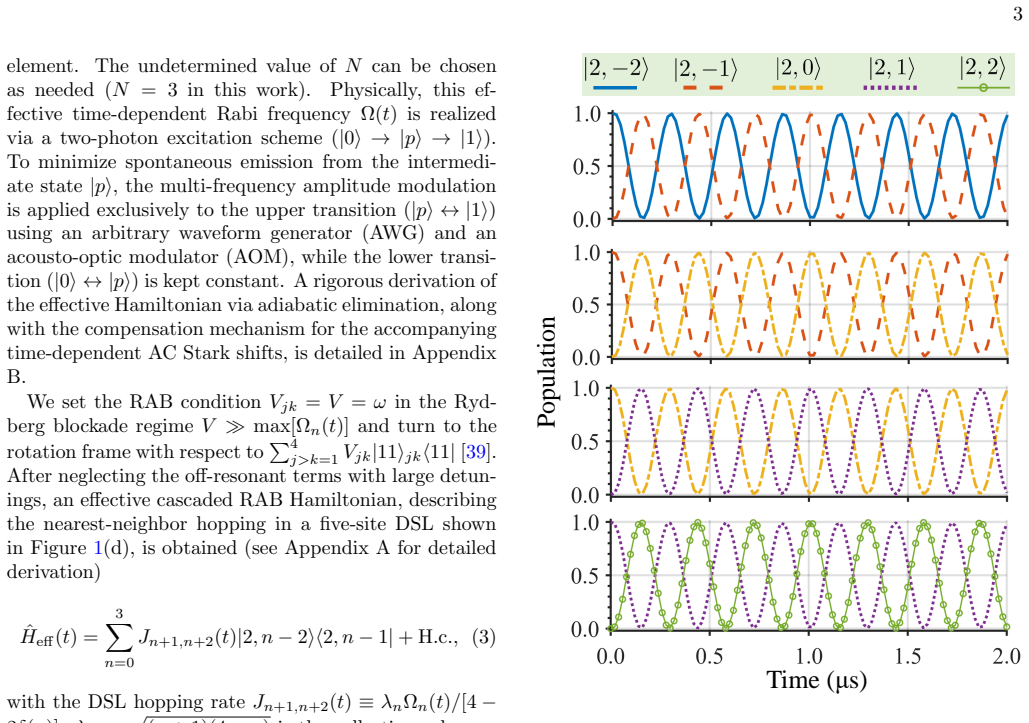
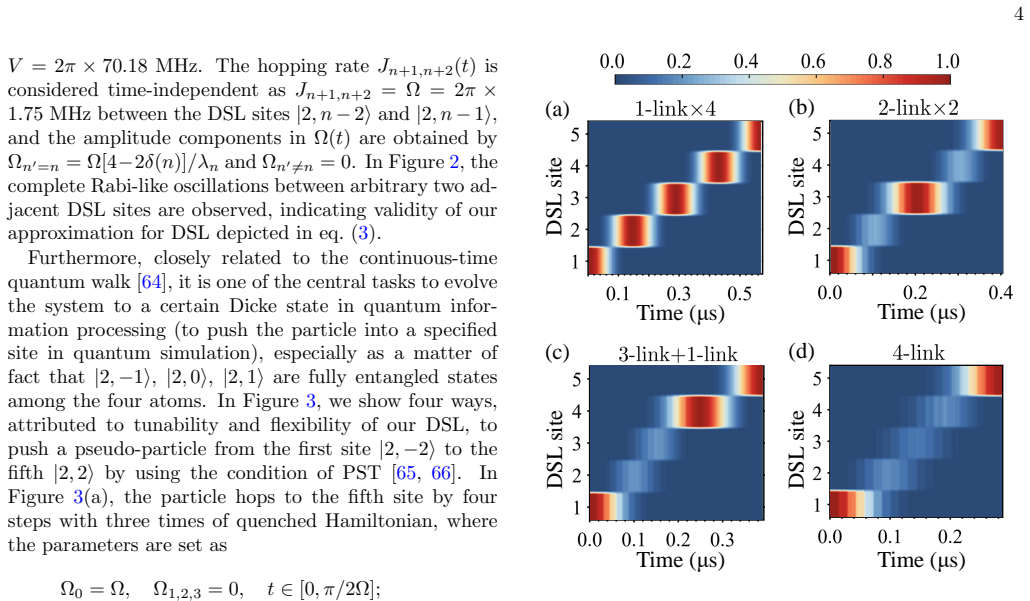
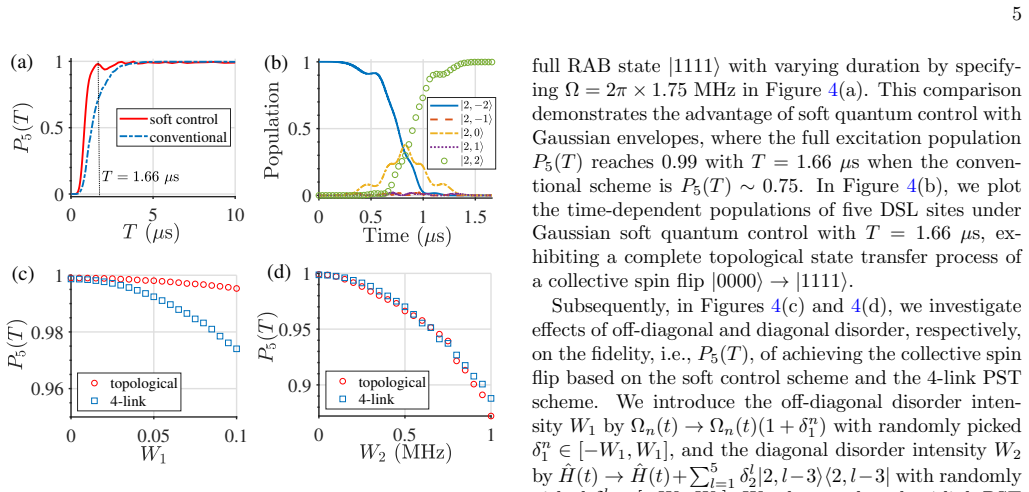
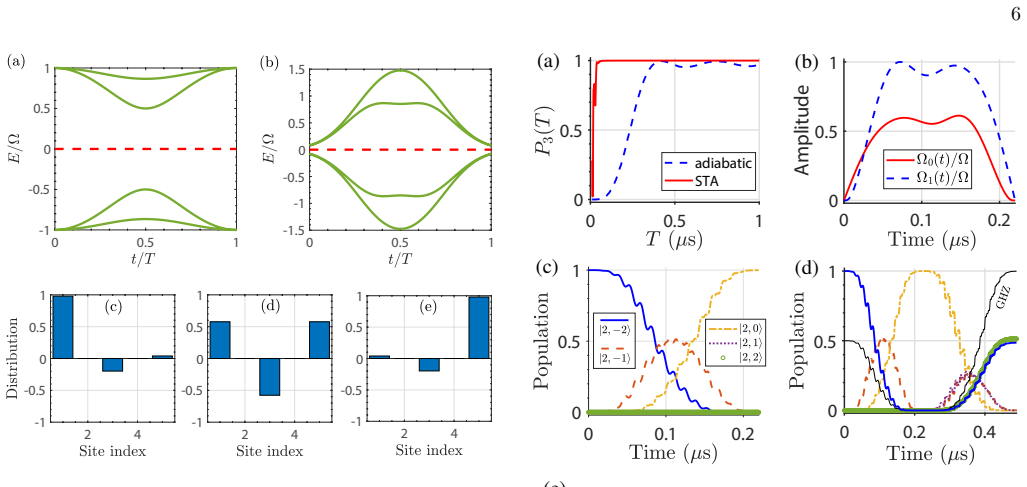
We then can use the STA scheme, similar to the process of generating the twin-Fock state|2,0⟩, to transfer|2,0⟩to the GHZ state of four atoms. To com- plete the generation of GHZ state, we connect the process of generating the twin-Fock state from the fully ground state|2,−2⟩(setting the durationT 1 = 0.22µs) to the process of transferring|2,0⟩to the GHZ ...
-
[2]
Zhang, G
J. Zhang, G. Pagano, P. W. Hess, A. Kyprianidis, P. Becker, H. Kaplan, A. V. Gorshkov, Z.-X. Gong, and C. Monroe, Nature551, 601 (2017)
2017
-
[3]
J. Yao, L. Lin, and M. Bukov, Phys. Rev. X11, 031070 (2021)
2021
-
[4]
Y. Yao, L. Xiang, Z. Guo, Z. Bao, Y.-F. Yang, Z. Song, H. Shi, X. Zhu, F. Jin, J. Chen, S. Xu, Z. Zhu, F. Shen, N. Wang, C. Zhang, Y. Wu, Y. Zou, P. Zhang, H. Li, Z. Wang, C. Song, C. Cheng, R. Mondaini, H. Wang, J. Q. You, S.-Y. Zhu, L. Ying, and Q. Guo, Nat. Phys. 19, 1459 (2023)
2023
-
[5]
Q. Wang, Y. Liang, Z. Wang, S. Guan, P. Yang, P. Zhang, G. Li, and T. Zhang, Sci. China Phys. Mech. Astron.68, 264211 (2025)
2025
-
[6]
Y.-T. Lee, B. Pokharel, J. Cohn, A. Schleife, and A. Banerjee, Phys. Rev. Lett.136, 050603 (2026)
2026
-
[7]
Saffman, T
M. Saffman, T. G. Walker, and K. Mølmer, Rev. Mod. Phys.82, 2313 (2010)
2010
-
[8]
Browaeys and T
A. Browaeys and T. Lahaye, Nat. Phys.16, 132 (2020)
2020
-
[9]
Zhang, T.-Y
Z.-Y. Zhang, T.-Y. Zhang, Z.-K. Liu, D.-S. Ding, and B.-S. Shi, Acta Phys. Sin.69, 180301 (2020)
2020
-
[10]
Morgado and S
M. Morgado and S. Whitlock, AVS Quantum Sci.3, 023501 (2021)
2021
-
[11]
X. Wu, X. Liang, Y. Tian, F. Yang, C. Chen, Y.-C. Liu, M. K. Tey, and L. You, Chin. Phys. B30, 020305 (2021)
2021
-
[12]
Shi, Quantum Sci
X.-F. Shi, Quantum Sci. Technol.7, 023002 (2022). 9
2022
-
[13]
Shao, S.-L
X.-Q. Shao, S.-L. Su, L. Li, R. Nath, J.-H. Wu, and W. Li, Appl. Phys. Rev.11, 031320 (2024)
2024
-
[14]
S. X. Li, W. L. Mu, J. B. You, and X. Q. Shao, Phys. Rev. A109, 062603 (2024)
2024
-
[15]
Tang, X.-X
H.-Y. Tang, X.-X. Li, J.-B. You, and X.-Q. Shao, APL Quantum1, 036109 (2024)
2024
-
[16]
Y. Zeng, P. Xu, X. He, Y. Liu, M. Liu, J. Wang, D. J. Papoular, G. V. Shlyapnikov, and M. Zhan, Phys. Rev. Lett.119, 160502 (2017)
2017
-
[17]
An, B.-W
Z.-Y. An, B.-W. Lu, J. Li, C.-W. Yang, L. Li, X.-H. Bao, and J.-W. Pan, Phys. Rev. Lett.134, 230803 (2025)
2025
-
[18]
Fromonteil, D
C. Fromonteil, D. Bluvstein, and H. Pichler, PRX Quan- tum4, 020335 (2023)
2023
-
[19]
S. J. Evered, D. Bluvstein, M. Kalinowski, S. Ebadi, T. Manovitz, H. Zhou, S. H. Li, A. A. Geim, T. T. Wang, N. Maskara, H. Levine, G. Semeghini, M. Greiner, V. Vuleti´ c, and M. D. Lukin, Nature622, 268 (2023)
2023
-
[20]
S.-L. Su, C. Wang, P.-Y. Song, and G. Chen, Chin. Phys. Lett.41, 040302 (2024)
2024
-
[21]
Sun, Sci
Y. Sun, Sci. China Phys. Mech. Astron.67, 120311 (2024)
2024
-
[22]
C. F. Sun, X. Y. Chen, W. L. Mu, G. C. Wang, J. B. You, and X. Q. Shao, EPJ Quantum Technol.11, 34 (2024)
2024
-
[23]
C. Ates, T. Pohl, T. Pattard, and J. M. Rost, Phys. Rev. Lett.98, 023002 (2007)
2007
-
[24]
T. E. Lee, H. H¨ affner, and M. C. Cross, Phys. Rev. Lett. 108, 023602 (2012)
2012
-
[25]
F. M. Gambetta, C. Zhang, M. Hennrich, I. Lesanovsky, and W. Li, Phys. Rev. Lett.125, 133602 (2020)
2020
-
[26]
Su, F.-Q
S.-L. Su, F.-Q. Guo, J.-L. Wu, Z. Jin, X. Q. Shao, and S. Zhang, Europhys. Lett.131, 53001 (2020)
2020
-
[27]
Liu, Z.-C
F. Liu, Z.-C. Yang, P. Bienias, T. Iadecola, and A. V. Gorshkov, Phys. Rev. Lett.128, 013603 (2022)
2022
-
[28]
X. X. Li, D. X. Li, and X. Q. Shao, Phys. Rev. A109, 042604 (2024)
2024
-
[29]
F. Q. Guo, S.-L. Su, W. Li, and X. Q. Shao, Phys. Rev. A111, 022420 (2025)
2025
-
[30]
Eckardt, Rev
A. Eckardt, Rev. Mod. Phys.89, 011004 (2017)
2017
-
[31]
L. B. Nguyen, Y. Kim, A. Hashim, N. Goss, B. Marinelli, B. Bhandari, D. Das, R. K. Naik, J. M. Kreikebaum, A. N. Jordan, D. I. Santiago, and I. Siddiqi, Nat. Phys. 20, 240 (2024)
2024
-
[32]
L. Zhou, B. Liu, Y. Liu, Y. Lu, Q. Li, X. Xie, N. Lydick, R. Hao, C. Liu, K. Watanabe, T. Taniguchi, Y.-H. Chou, S. R. Forrest, and H. Deng, Nat. Commun.15, 7782 (2024)
2024
-
[33]
Basak, Y
S. Basak, Y. Chougale, and R. Nath, Phys. Rev. Lett. 120, 123204 (2018)
2018
-
[34]
L. Zhao, M. D. K. Lee, M. M. Aliyu, and H. Loh, Nat. Commun.14, 7128 (2023)
2023
-
[35]
S. K. Mallavarapu, A. Niranjan, W. Li, S. W¨ uster, and R. Nath, Phys. Rev. A103, 023335 (2021)
2021
-
[36]
Y. Wei, M. Artoni, G. C. La Rocca, J. H. Wu, and X. Q. Shao, Phys. Rev. A113, 032812 (2026)
2026
-
[37]
Wu, S.-L
J.-L. Wu, S.-L. Su, Y. Wang, J. Song, Y. Xia, and Y.-Y. Jiang, Opt. Lett.45, 1200 (2020)
2020
-
[38]
J.-L. Wu, Y. Wang, J.-X. Han, Y.-K. Feng, S.-L. Su, Y. Xia, Y. Jiang, and J. Song, Photon. Res.9, 814 (2021)
2021
-
[39]
J.-L. Wu, Y. Wang, J.-X. Han, S.-L. Su, Y. Xia, Y. Jiang, and J. Song, Phys. Rev. A103, 012601 (2021)
2021
-
[40]
J.-L. Wu, Y. Wang, J.-X. Han, S.-L. Su, Y. Xia, J. Song, and Y. Jiang, Adv. Quantum Technol.5, 2200042 (2022)
2022
-
[41]
Wu, J.-L
J. Wu, J.-L. Wu, F.-Q. Guo, B.-B. Liu, S.-L. Su, X.-K. Song, L. Ye, and D. Wang, npj Quantum Inf.11, 118 (2025)
2025
-
[42]
R. Li, D. Yu, S.-L. Su, and J. Qian, Phys. Rev. A101, 042328 (2020)
2020
-
[43]
J.-L. Wu, Y. Wang, J.-X. Han, Y. Jiang, J. Song, Y. Xia, S.-L. Su, and W. Li, Phys. Rev. Appl.16, 064031 (2021)
2021
-
[44]
S. L. Su, H. Z. Shen, E. Liang, and S. Zhang, Phys. Rev. A98, 032306 (2018)
2018
-
[45]
T. H. Xing, X. Wu, and G. F. Xu, Phys. Rev. A101, 012306 (2020)
2020
-
[46]
S.-L. Su, Y. Gao, E. Liang, and S. Zhang, Phys. Rev. A 95, 022319 (2017)
2017
-
[47]
S. Bai, X. Tian, X. Han, Y. Jiao, J. Wu, J. Zhao, and S. Jia, New J. Phys.22, 013004 (2020)
2020
-
[48]
Boada, A
O. Boada, A. Celi, J. I. Latorre, and M. Lewenstein, Phys. Rev. Lett.108, 133001 (2012)
2012
-
[49]
Ozawa and H
T. Ozawa and H. M. Price, Nat. Rev. Phys.1, 349 (2019)
2019
-
[50]
Ehrhardt, S
M. Ehrhardt, S. Weidemann, L. J. Maczewsky, M. Hein- rich, and A. Szameit, Laser Photon. Rev.17, 2200518 (2023)
2023
-
[51]
Arg¨ uello-Luengo, U
J. Arg¨ uello-Luengo, U. Bhattacharya, A. Celi, R. W. Chhajlany, T. Grass, M. P lodzie´ n, D. Rakshit, T. Sala- mon, P. Stornati, L. Tarruell, and M. Lewenstein, Com- mun. Phys.7, 143 (2024)
2024
-
[52]
D. Yu, W. Song, L. Wang, R. Srikanth, S. K. Sridhar, T. Chen, C. Huang, G. Li, X. Qiao, X. Wu, Z. Dong, Y. He, M. Xiao, X. Chen, A. Dutt, B. Gadway, and L. Yuan, Photon. Insights4, R06 (2025)
2025
-
[53]
W. P. Su, J. R. Schrieffer, and A. J. Heeger, Phys. Rev. Lett.42, 1698 (1979)
1979
-
[54]
J. F. Haase, Z.-Y. Wang, J. Casanova, and M. B. Plenio, Phys. Rev. Lett.121, 050402 (2018)
2018
-
[55]
Gu´ ery-Odelin, A
D. Gu´ ery-Odelin, A. Ruschhaupt, A. Kiely, E. Tor- rontegui, S. Mart´ ınez-Garaot, and J. G. Muga, Rev. Mod. Phys.91, 045001 (2019)
2019
-
[56]
Y. Wang, X. Zhang, T. A. Corcovilos, A. Kumar, and D. S. Weiss, Phys. Rev. Lett.115, 043003 (2015)
2015
-
[57]
Y. Wang, A. Kumar, T.-Y. Wu, and D. S. Weiss, Science 352, 1562 (2016)
2016
-
[58]
Barredo, V
D. Barredo, V. Lienhard, S. de L´ es´ eleuc, T. Lahaye, and A. Browaeys, Nature561, 79 (2018)
2018
-
[59]
Kumar, T.-Y
A. Kumar, T.-Y. Wu, F. Giraldo, and D. S. Weiss, Na- ture561, 83 (2018)
2018
-
[60]
Z. Meng, L. Wang, W. Han, F. Liu, K. Wen, C. Gao, P. Wang, C. Chin, and J. Zhang, Nature615, 231 (2023)
2023
-
[61]
Levine, A
H. Levine, A. Keesling, A. Omran, H. Bernien, S. Schwartz, A. S. Zibrov, M. Endres, M. Greiner, V. Vuleti´ c, and M. D. Lukin, Phys. Rev. Lett.121, 123603 (2018)
2018
-
[62]
P. W. Claeys, M. Pandey, D. Sels, and A. Polkovnikov, Phys. Rev. Lett.123, 090602 (2019)
2019
-
[63]
H. Zhou, X. Chen, X. Nie, J. Bian, Y. Ji, Z. Li, and X. Peng, Sci. Bull.64, 888 (2019)
2019
-
[64]
Levine, A
H. Levine, A. Keesling, G. Semeghini, A. Omran, T. T. Wang, S. Ebadi, H. Bernien, M. Greiner, V. Vuleti´ c, H. Pichler, and M. D. Lukin, Phys. Rev. Lett.123, 170503 (2019)
2019
-
[65]
Farhi and S
E. Farhi and S. Gutmann, Phys. Rev. A58, 915 (1998)
1998
-
[66]
Christandl, N
M. Christandl, N. Datta, A. Ekert, and A. J. Landahl, Phys. Rev. Lett.92, 187902 (2004)
2004
-
[67]
X. Li, Y. Ma, J. Han, T. Chen, Y. Xu, W. Cai, H. Wang, Y. Song, Z.-Y. Xue, Z.-q. Yin, and L. Sun, Phys. Rev. Appl.10, 054009 (2018). 10
2018
-
[68]
Qi, G.-L
L. Qi, G.-L. Wang, S. Liu, S. Zhang, and H.-F. Wang, Opt. Lett.45, 2018 (2020)
2018
-
[69]
F. Mei, G. Chen, L. Tian, S.-L. Zhu, and S. Jia, Phys. Rev. A98, 012331 (2018)
2018
-
[70]
Guo, J.-L
J.-K. Guo, J.-L. Wu, J. Cao, S. Zhang, and S.-L. Su, Phys. Rev. A110, 043510 (2024)
2024
-
[71]
Yin and X.-Q
H.-D. Yin and X.-Q. Shao, Opt. Lett.46, 2541 (2021)
2021
-
[72]
X. Li, X. Shao, and W. Li, Phys. Rev. Appl.18, 044042 (2022)
2022
-
[73]
Q. Wu, J. Xing, and H. Yin, EPJ Quantum Technol.11, 1 (2024)
2024
-
[74]
J.-L. Wu, S. Tang, Y. Wang, X. Wang, J.-X. Han, C. L¨ u, J. Song, S.-L. Su, Y. Xia, and Y. Jiang, Sci. China Phys. Mech. Astron.65, 220311 (2022)
2022
-
[75]
Wu, K.-H
J.-L. Wu, K.-H. Xiao, X. Ni, J.-K. Guo, X.-L. Zhang, Q.- D. Chen, Y. Wang, Z.-Z. Li, S.-L. Su, Z.-N. Tian, and H.-B. Sun, Nat. Commun.17, 966 (2025)
2025
-
[76]
Zheng, Y.-H
R.-H. Zheng, Y.-H. Kang, D. Ran, Z.-C. Shi, and Y. Xia, Phys. Rev. A101, 012345 (2020)
2020
-
[77]
Haase, G
T. Haase, G. Alber, and V. M. Stojanovi´ c, Phys. Rev. A103, 032427 (2021)
2021
-
[78]
Haase, G
T. Haase, G. Alber, and V. M. Stojanovi´ c, Phys. Rev. Res.4, 033087 (2022)
2022
-
[79]
V. M. Stojanovi´ c and J. K. Nauth, Phys. Rev. A106, 052613 (2022)
2022
-
[80]
J. K. Nauth and V. M. Stojanovi´ c, Phys. Rev. A106, 032605 (2022)
2022
discussion (0)
Sign in with ORCID, Apple, or X to comment. Anyone can read and Pith papers without signing in.