Hydride formation and phase separation in palladium nanoparticles from a transferable atomic cluster expansion potential
Pith reviewed 2026-06-27 15:42 UTC · model grok-4.3
The pith
An atomic cluster expansion potential for Pd-H matches near-DFT accuracy on key properties and enables molecular dynamics of nanoparticles up to 12 nm.
A machine-rendered reading of the paper's core claim, the machinery that carries it, and where it could break.
Core claim
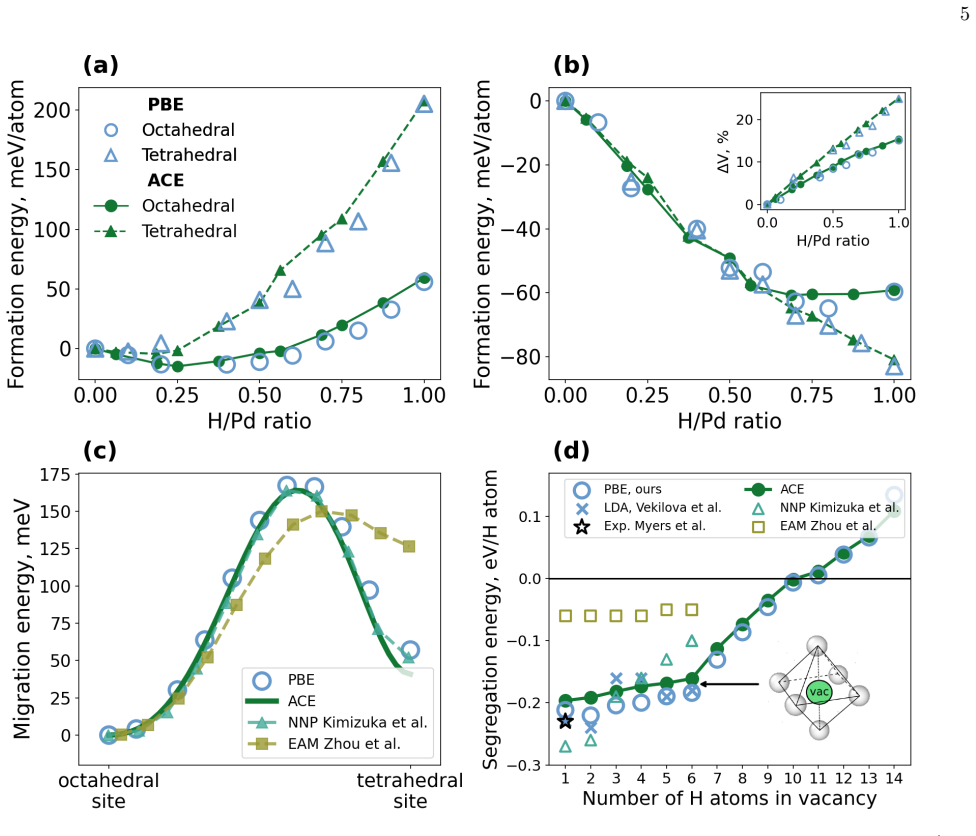
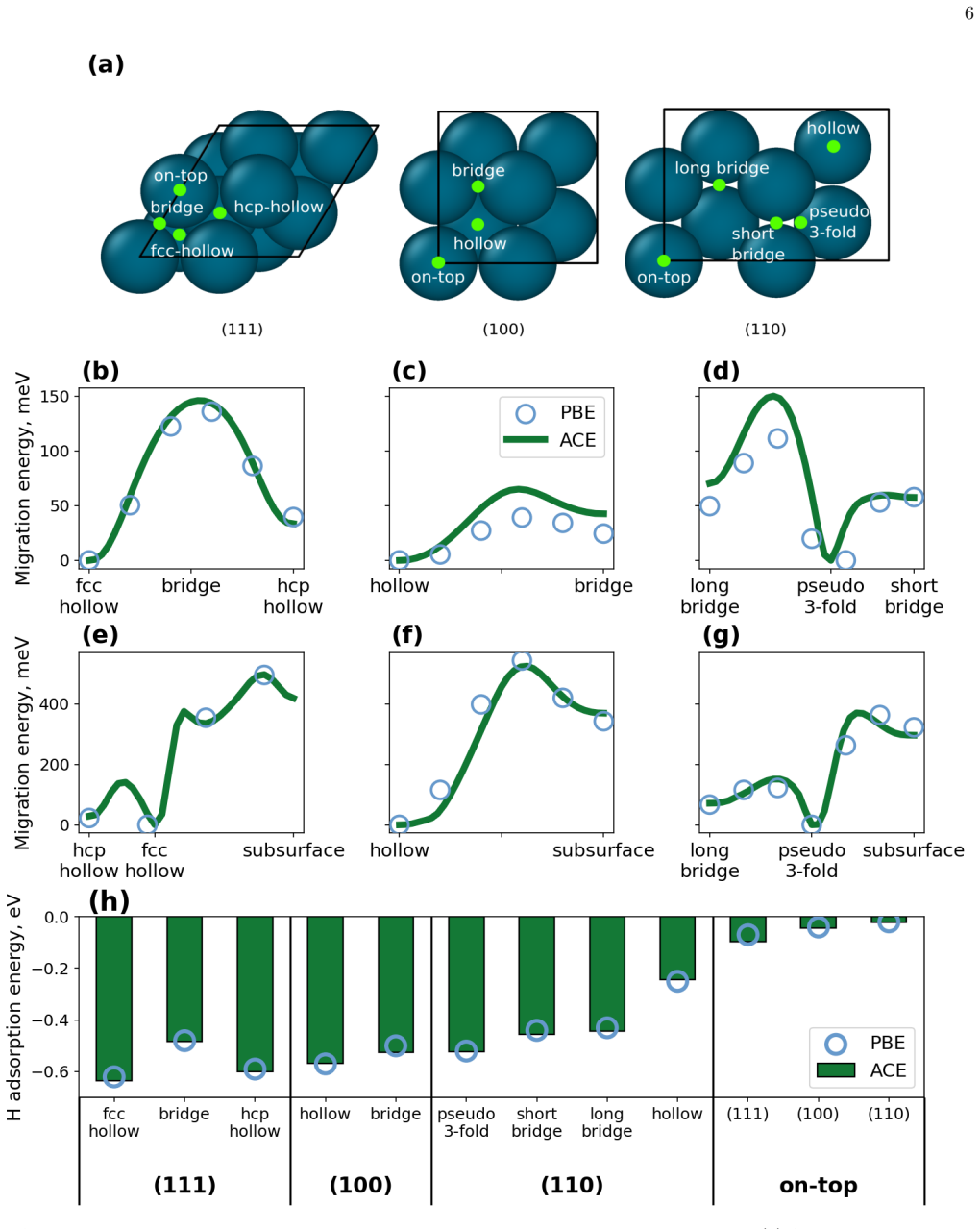
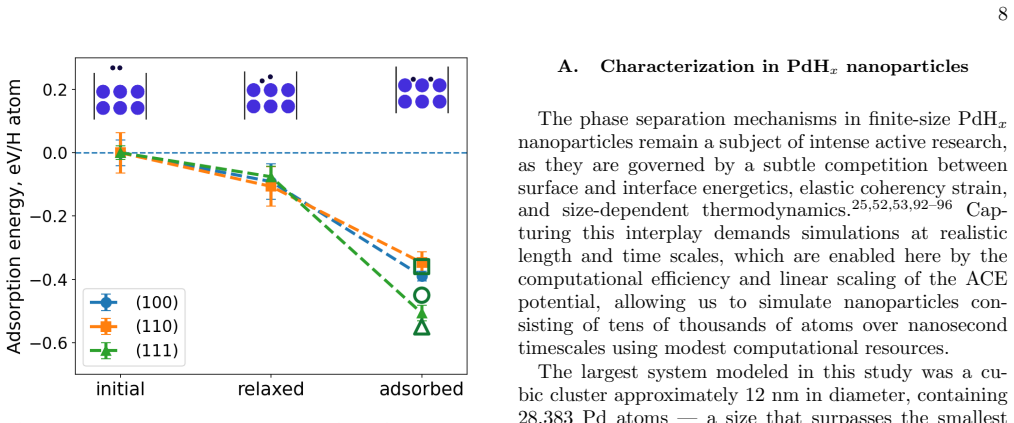
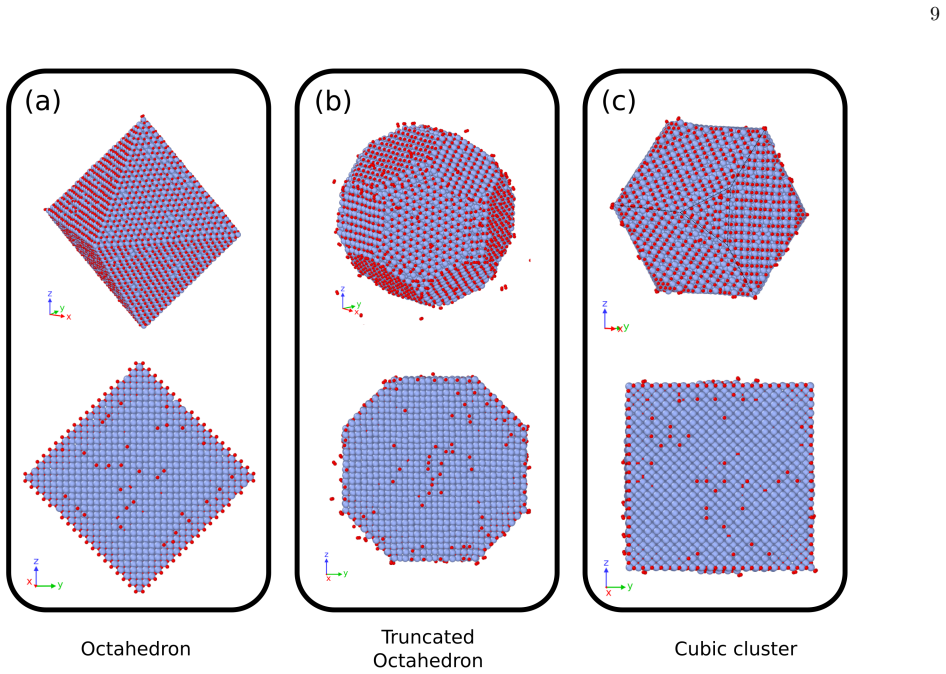
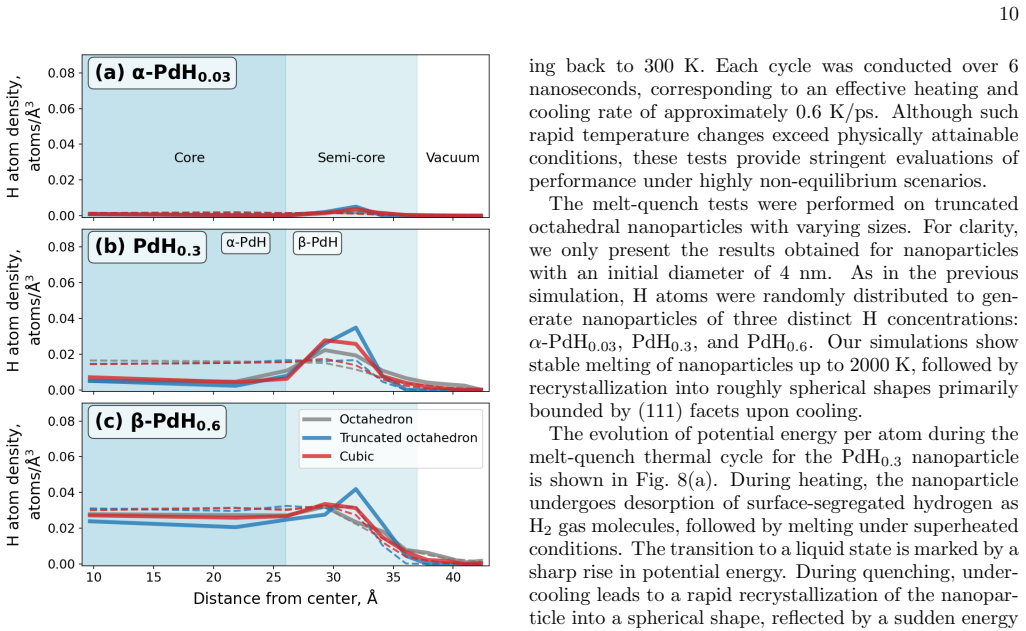
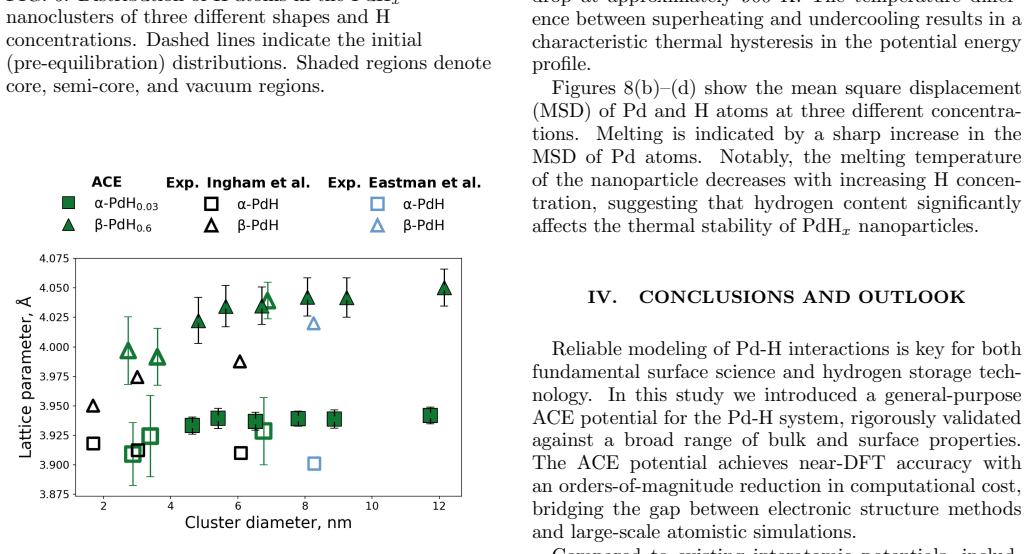
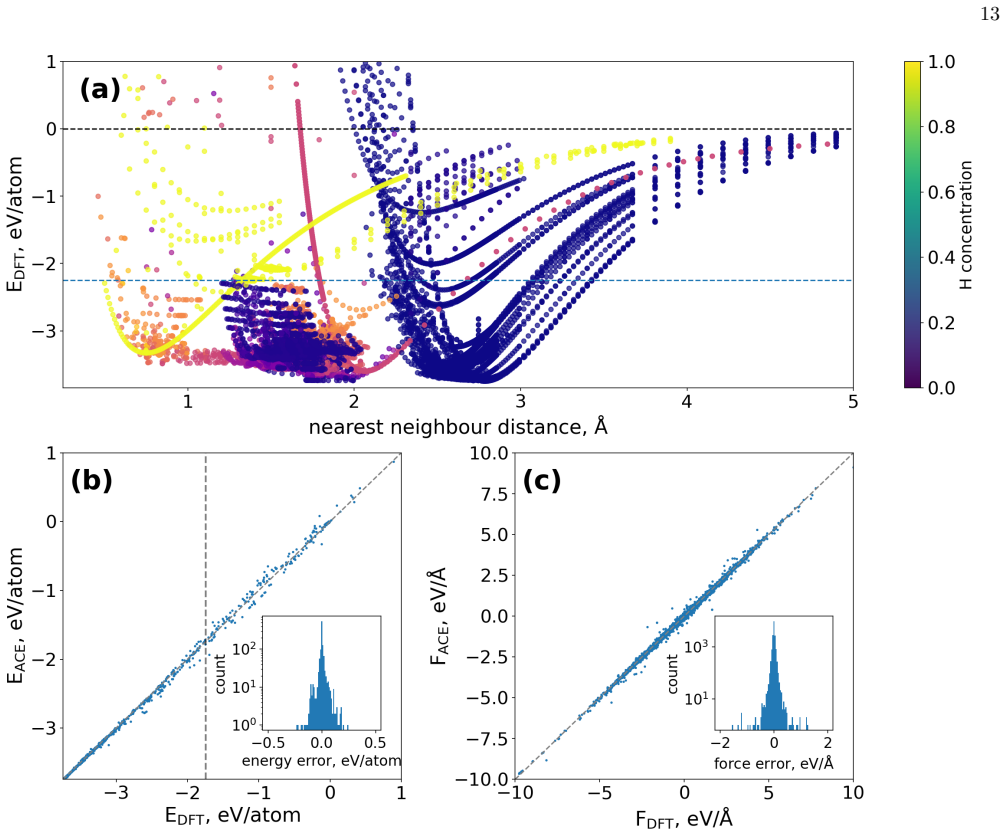
We introduce an atomic cluster expansion (ACE) for Pd-H that reproduces formation energies, phonon spectra, elastic constants, hydrogen migration barriers and surface adsorption with near-DFT accuracy. Its near-linear scaling and CPU efficiency make molecular dynamics of PdH_x nanoparticles exceeding 28,000 atoms tractable over nanosecond timescales. These simulations resolve, at the atomic scale, the kinetic separation of alpha- and beta-PdH_x into a core-shell architecture, reproduce the experimentally observed size dependence of the lattice parameter, and uncover a pronounced hydrogen-induced lowering of the nanoparticle melting temperature.
What carries the argument
The atomic cluster expansion (ACE) potential for the Pd-H system, which encodes many-body interactions to deliver transferable energies and forces across bulk, surface and high-hydrogen regimes.
If this is right
- Molecular dynamics of PdH_x nanoparticles larger than 12 nm becomes routine on nanosecond timescales.
- Alpha-beta phase separation proceeds through a kinetically resolved core-shell architecture.
- Lattice parameters of the nanoparticles follow the experimentally reported size dependence.
- Hydrogen incorporation measurably lowers the melting temperature of the particles.
Where Pith is reading between the lines
- The same construction route could be applied to other metal-hydride systems to test whether core-shell separation is generic at the nanoscale.
- The observed melting-point depression may limit the thermal stability window for nanoparticle-based hydrogen-storage devices.
- Surface and interface energetics captured by the potential open the door to simulating hydrogen permeation through polycrystalline or supported Pd films.
Load-bearing premise
The potential remains accurate on nanoparticle surfaces, interfaces and high-hydrogen concentrations without further fitting beyond its bulk low-hydrogen training data.
What would settle it
Direct imaging or scattering measurements that either confirm or contradict the simulated core-shell morphology, the exact size scaling of the lattice parameter, or the predicted melting-temperature depression in 5-12 nm PdH_x particles would settle the claim.
Figures



read the original abstract
The palladium-hydrogen system is a prototype for hydrogen-metal interactions and underpins technologies such as hydrogen storage, catalysis and purification. Yet its nanoscale behaviour -- where surface and interface energetics, elastic coherency strain and size-dependent thermodynamics govern phase separation -- has eluded accurate atomistic simulation. Empirical potentials misrepresent the energetics of interstitial hydrogen, while existing machine-learning models are restricted to bulk phases at low-hydrogen environments. Here we introduce an atomic cluster expansion (ACE) for Pd-H that reproduces formation energies, phonon spectra, elastic constants, hydrogen migration barriers and surface adsorption with near-DFT accuracy, benchmarked directly against neutron-scattering, high-pressure and lattice-expansion experiments. Its near-linear scaling and CPU efficiency make molecular dynamics of PdH$_x$ nanoparticles exceeding 28,000 atoms ($\sim$12 nm in diameter) tractable over nanosecond timescales. These simulations resolve, at the atomic scale, the kinetic separation of $\alpha$- and $\beta$-PdH$_x$ into a core-shell architecture, reproduce the experimentally observed size dependence of the lattice parameter, and uncover a pronounced hydrogen-induced lowering of the nanoparticle melting temperature. The potential brings experimentally relevant scales of metal-hydride dynamics within quantitative reach.
Editorial analysis
A structured set of objections, weighed in public.
Referee Report
Summary. The manuscript introduces an atomic cluster expansion (ACE) potential for the Pd-H system, trained on DFT data for bulk low-hydrogen configurations. It claims near-DFT accuracy for formation energies, phonon spectra, elastic constants, hydrogen migration barriers and surface adsorption, with direct experimental benchmarks. The potential's efficiency enables MD simulations of PdH_x nanoparticles (~12 nm, >28,000 atoms) that resolve kinetic α-β phase separation into a core-shell architecture, reproduce size-dependent lattice parameters, and show hydrogen-induced lowering of the melting temperature.
Significance. If the transferability claims hold, the work is significant for enabling quantitative atomistic simulations of metal-hydride nanoparticles at experimentally relevant scales and timescales. The combination of near-DFT fidelity, experimental validation, and computational efficiency addresses a clear gap in modeling surface/interface effects and phase kinetics in Pd-H systems relevant to hydrogen storage and catalysis.
major comments (1)
- [Abstract] The central claim that the bulk-trained ACE potential retains near-DFT accuracy for the nanoparticle MD observables (core-shell phase separation, coherency strains, high-x regimes, and melting-point depression) rests on unverified transferability. The abstract asserts reproduction of surface adsorption and experimental benchmarks, but provides no direct evidence that accuracy is preserved under the distinct coordination numbers, interface strains, and high-hydrogen concentrations encountered in the ~12 nm particles; this is load-bearing for trusting the reported MD results as quantitative predictions.
Simulated Author's Rebuttal
We thank the referee for their careful reading and for highlighting the transferability question, which is central to the work. We respond to the single major comment below.
read point-by-point responses
-
Referee: [Abstract] The central claim that the bulk-trained ACE potential retains near-DFT accuracy for the nanoparticle MD observables (core-shell phase separation, coherency strains, high-x regimes, and melting-point depression) rests on unverified transferability. The abstract asserts reproduction of surface adsorption and experimental benchmarks, but provides no direct evidence that accuracy is preserved under the distinct coordination numbers, interface strains, and high-hydrogen concentrations encountered in the ~12 nm particles; this is load-bearing for trusting the reported MD results as quantitative predictions.
Authors: We agree that direct DFT validation on 28 000-atom nanoparticles is impossible and that transferability must be demonstrated carefully. The training set is indeed bulk-dominated at low H, yet the potential was explicitly validated on surface adsorption energies (under-coordinated Pd atoms) and on formation energies spanning a wide H concentration range. Elastic constants and phonon spectra further probe strain response. Most importantly, the nanoparticle MD results reproduce the experimentally measured size dependence of the lattice parameter (which encodes coherency strain, core-shell phase separation and local high-x environments) as well as the hydrogen-induced melting-point depression reported in the literature. These experimental benchmarks therefore provide indirect but quantitative support for the reported observables. We will revise the manuscript by (i) expanding the abstract to state the range of H concentrations and surface tests explicitly and (ii) adding a dedicated transferability subsection that summarises all validation data relevant to nanoparticle conditions and notes the remaining limitations. This constitutes a partial revision. revision: partial
Circularity Check
No significant circularity; derivation is self-contained
full rationale
The paper constructs an ACE potential by fitting to DFT-computed formation energies, phonons, elastic constants, barriers and surface adsorption for Pd-H. It then applies this potential in MD to generate new observables (core-shell phase separation kinetics, size-dependent lattice parameters, hydrogen-induced melting point depression) on nanoparticle scales. These MD outputs are not redefinitions or statistical fits to the training data but dynamical consequences under the fitted model. No load-bearing self-citations, ansatz smuggling, or uniqueness theorems from the same authors are invoked to force the results; external experimental benchmarks (neutron scattering, high-pressure data) provide independent falsifiability. The central claims therefore remain non-circular.
Axiom & Free-Parameter Ledger
Reference graph
Works this paper leans on
-
[1]
G. W. Crabtree, M. S. Dresselhaus, and M. V. Buchanan, The hydrogen economy, Physics today57, 39 (2004)
2004
-
[2]
J. O. Abe, A. Popoola, E. Ajenifuja, and O. M. Popoola, Hydrogen energy, economy and storage: Review and recommendation, International journal of hydrogen en- ergy44, 15072 (2019)
2019
-
[3]
Manchester, A
F. Manchester, A. San-Martin, and J. Pitre, The h-pd (hydrogen-palladium) system, Journal of phase equilib- ria15, 62 (1994)
1994
-
[4]
B. D. Adams and A. Chen, The role of palladium in a hydrogen economy, Materials today14, 282 (2011)
2011
-
[5]
Dekura, H
S. Dekura, H. Kobayashi, K. Kusada, and H. Kitagawa, Hydrogen in palladium and storage properties of re- lated nanomaterials: Size, shape, alloying, and metal- organic framework coating effects, ChemPhysChem20, 1158 (2019)
2019
-
[6]
Yamauchi, R
M. Yamauchi, R. Ikeda, H. Kitagawa, and M. Takata, Nanosize effects on hydrogen storage in palladium, The Journal of Physical Chemistry C112, 3294 (2008)
2008
-
[7]
G. Li, H. Kobayashi, S. Dekura, R. Ikeda, Y. Kubota, K. Kato, M. Takata, T. Yamamoto, S. Matsumura, and H. Kitagawa, Shape-dependent hydrogen-storage prop- erties in pd nanocrystals: which does hydrogen prefer, octahedron (111) or cube (100)?, Journal of the Amer- ican Chemical Society136, 10222 (2014)
2014
-
[8]
L´ opez-Serrano, S
J. L´ opez-Serrano, S. B. Duckett, and A. Lled´ os, Palladium-catalyzed hydrogenation: Detection of pal- ladium hydrides. a joint study using para-hydrogen- enhanced nmr spectroscopy and density functional the- ory, Journal of the American Chemical Society128, 9596 (2006)
2006
-
[9]
A. J. McCue and J. A. Anderson, Recent advances in selective acetylene hydrogenation using palladium con- taining catalysts, Frontiers of Chemical Science and En- gineering9, 142 (2015)
2015
-
[10]
G. M. Lari, B. Pu´ ertolas, M. Shahrokhi, N. L´ opez, and J. P´ erez-Ram´ ırez, Hybrid palladium nanoparticles for direct hydrogen peroxide synthesis: The key role of the ligand, Angewandte Chemie International Edition56, 1775 (2017)
2017
-
[11]
J. D. Benck, A. Jackson, D. Young, D. Rettenwander, and Y.-M. Chiang, Producing high concentrations of hy- drogen in palladium via electrochemical insertion from aqueous and solid electrolytes, Chemistry of Materials 31, 4234 (2019)
2019
-
[12]
H.-Y. Sun, Y. Ding, Y.-Q. Yue, Q. Xue, F.-M. Li, J.- X. Jiang, P. Chen, and Y. Chen, Bifunctional palladium hydride nanodendrite electrocatalysts for hydrogen evo- lution integrated with formate oxidation, ACS Applied Materials & Interfaces13, 13149 (2021)
2021
-
[13]
W. Xu, G. Fan, J. Chen, J. Li, L. Zhang, S. Zhu, X. Su, F. Cheng, and J. Chen, Nanoporous palladium hydride for electrocatalytic n2 reduction under ambient con- ditions, Angewandte Chemie International Edition59, 3511 (2020)
2020
-
[14]
Checchetto, N
R. Checchetto, N. Bazzanella, B. Patton, and A. Miotello, Palladium membranes prepared by rf mag- netron sputtering for hydrogen purification, Surface and Coatings Technology177, 73 (2004)
2004
-
[15]
Rahimpour, F
M. Rahimpour, F. Samimi, A. Babapoor, T. Tohidian, and S. Mohebi, Palladium membranes applications in reaction systems for hydrogen separation and purifica- tion: A review, Chemical Engineering and Processing: Process Intensification121, 24 (2017)
2017
-
[16]
L. L. Jewell and B. H. Davis, Review of absorption and adsorption in the hydrogen–palladium system, Applied Catalysis A: General310, 1 (2006). 15
2006
-
[17]
Kaur and K
M. Kaur and K. Pal, Review on hydrogen storage ma- terials and methods from an electrochemical viewpoint, Journal of Energy Storage23, 234 (2019)
2019
-
[18]
T. R. Somo, T. C. Maponya, M. W. Davids, M. J. Hato, M. V. Lototskyy, and K. D. Modibane, A comprehensive review on hydrogen absorption behaviour of metal alloys prepared through mechanical alloying, Metals10, 562 (2020)
2020
-
[19]
T. B. Flanagan and W. Oates, The palladium-hydrogen system, Annual Review of Materials Science21, 269 (1991)
1991
-
[20]
Worsham Jr, M
J. Worsham Jr, M. Wilkinson, and C. Shull, Neutron- diffraction observations on the palladium-hydrogen and palladium-deuterium systems, Journal of Physics and Chemistry of Solids3, 303 (1957)
1957
-
[21]
L. Cser, G. T¨ or¨ ok, G. Krexner, M. Prem, and I. Sharkov, Neutron holographic study of palladium hy- dride, Applied physics letters85, 1149 (2004)
2004
-
[22]
M. W. Tew, J. T. Miller, and J. A. van Bokhoven, Parti- cle size effect of hydride formation and surface hydrogen adsorption of nanosized palladium catalysts: L3 edge vs k edge x-ray absorption spectroscopy, The Journal of Physical Chemistry C113, 15140 (2009)
2009
-
[23]
Jamieson, G
H. Jamieson, G. Weatherly, and F. Manchester, Theβ→ αphase transformation in palladium-hydrogen alloys, Journal of the Less Common Metals50, 85 (1976)
1976
-
[24]
Goods and S
S. Goods and S. Guthrie, Mechanical properties of pal- ladium and palladium hydride, Scripta Metallurgica26 (1992)
1992
-
[25]
Griessen, N
R. Griessen, N. Strohfeldt, and H. Giessen, Thermody- namics of the hybrid interaction of hydrogen with pal- ladium nanoparticles, Nature materials15, 311 (2016)
2016
-
[26]
H. A. Aleksandrov, S. M. Kozlov, S. Schauermann, G. N. Vayssilov, and K. M. Neyman, How absorbed hy- drogen affects the catalytic activity of transition metals, Angewandte Chemie126, 13589 (2014)
2014
-
[27]
Johansson, E
M. Johansson, E. Skulason, G. Nielsen, S. Murphy, R. M. Nielsen, and I. Chorkendorff, Hydrogen adsorp- tion on palladium and palladium hydride at 1 bar, Sur- face science604, 718 (2010)
2010
-
[28]
N. J. Johnson, B. Lam, B. P. MacLeod, R. S. Sherbo, M. Moreno-Gonzalez, D. K. Fork, and C. P. Berlinguette, Facets and vertices regulate hydrogen up- take and release in palladium nanocrystals, Nature ma- terials18, 454 (2019)
2019
-
[29]
Suleiman, J
M. Suleiman, J. Faupel, C. Borchers, H.-U. Krebs, R. Kirchheim, and A. Pundt, Hydrogen absorption be- haviour in nanometer sized palladium samples stabilised in soft and hard matrix, Journal of alloys and com- pounds404, 523 (2005)
2005
-
[30]
A. T. Landers, H. Peng, D. M. Koshy, S. H. Lee, J. T. Feaster, J. C. Lin, J. W. Beeman, D. Higgins, J. Yano, W. S. Drisdell,et al., Dynamics and hysteresis of hydro- gen intercalation and deintercalation in palladium elec- trodes: A multimodal in situ x-ray diffraction, coulom- etry, and computational study, Chemistry of Materials 33, 5872 (2021)
2021
-
[31]
B. Lin, X. Wu, L. Xie, Y. Kang, H. Du, F. Kang, J. Li, and L. Gan, Atomic imaging of subsurface interstitial hydrogen and insights into surface reactivity of palla- dium hydrides, Angewandte Chemie International Edi- tion59, 20348 (2020)
2020
-
[32]
Lischka and A
M. Lischka and A. Groß, Hydrogen on palladium: A model system for the interaction of atoms and molecules with metal surfaces, Recent Developments in Vacuum Science and Technology37, 2 (2003)
2003
-
[33]
T. E. Felter, E. C. Sowa, and M. A. Van Hove, Location of hydrogen adsorbed on palladium (111) studied by low-energy electron diffraction, Phys. Rev. B40, 891 (1989)
1989
-
[34]
R. Behm, K. Christmann, and G. Ertl, Adsorption of hydrogen on pd(100), Surface Science99, 320 (1980)
1980
-
[35]
Skottke, R
M. Skottke, R. J. Behm, G. Ertl, V. Penka, and W. Moritz, LEED structure analysis of the clean and (2×1)H covered Pd(110) surface, The Journal of Chem- ical Physics87, 6191 (1987)
1987
-
[36]
Netzer and M
F. Netzer and M. El Gomati, Electronic excitations on clean and adsorbate covered pd(111) by angle resolved electron energy loss spectroscopy, Surface Science124, 26 (1983)
1983
-
[37]
Conrad, G
H. Conrad, G. Ertl, and E. Latta, Adsorption of hydro- gen on palladium single crystal surfaces, Surface Science 41, 435 (1974)
1974
-
[38]
T. O. Schmidt, A. Ngoipala, R. L. Arevalo, S. A. Watzele, R. Lipin, R. M. Kluge, S. Hou, R. W. Haid, A. Senyshyn, E. L. Gubanova, A. S. Bandarenka, and M. Vandichel, Elucidation of structure–activity rela- tions in proton electroreduction at pd surfaces: Theoret- ical and experimental study, Small18, 2202410 (2022)
2022
-
[39]
Hong and T
S. Hong and T. S. Rahman, Adsorption and diffusion of hydrogen on pd (211) and pd (111): Results from first-principles electronic structure calculations, Physi- cal Review B75, 155405 (2007)
2007
-
[40]
Abraham B
A. Abraham B. Padama, H. Kasai, Y. Wibisono Budhi, and N. B. Arboleda Jr, Ab initio investigation of hy- drogen atom adsorption and absorption on pd (110) surface, Journal of the Physical Society of Japan81, 114705 (2012)
2012
-
[41]
Groß, Coverage effects in the adsorption of H2 on Pd (100) studied by ab initio molecular dynamics simula- tions, The Journal of chemical physics135(2011)
A. Groß, Coverage effects in the adsorption of H2 on Pd (100) studied by ab initio molecular dynamics simula- tions, The Journal of chemical physics135(2011)
2011
-
[42]
Gr¨ onbeck and V
H. Gr¨ onbeck and V. P. Zhdanov, Effect of lattice strain on hydrogen diffusion in pd: A density functional theory study, Physical Review B84, 052301 (2011)
2011
-
[43]
W. Dong, V. Ledentu, P. Sautet, A. Eichler, and J. Hafner, Hydrogen adsorption on palladium: a com- parative theoretical study of different surfaces, Surface science411, 123 (1998)
1998
-
[44]
Ngoipala, R
A. Ngoipala, R. Lipin, R. L. Arevalo, and M. Vandichel, Computational unravelling of cathodic hydride forma- tion on palladium surfaces, International Journal of Hy- drogen Energy53, 829 (2024)
2024
-
[45]
Lipin, A
R. Lipin, A. Ngoipala, R. L. Arevalo, and M. Vandichel, Computational surface pourbaix diagrams to unravel cathodic hydride formation on defective palladium sur- faces, International Journal of Hydrogen Energy61, 460 (2024)
2024
-
[46]
X. Zhou, J. Zimmerman, B. Wong, and J. Hoyt, An embedded-atom method interatomic potential for pd–h alloys, Journal of Materials Research23, 704–718 (2008)
2008
-
[47]
T. P. Senftle, M. J. Janik, and A. C. Van Duin, A reaxff investigation of hydride formation in palladium nanoclusters via monte carlo and molecular dynamics simulations, The Journal of Physical Chemistry C118, 4967 (2014)
2014
-
[48]
X. Zhou, T. Heo, B. Wood, V. Stavila, S. Kang, and M. Allendorf, Molecular dynamics studies of fundamen- 16 tal bulk properties of palladium hydrides for hydrogen storage, Journal of Applied Physics123(2018)
2018
-
[49]
X. Zhou, T. W. Heo, B. C. Wood, V. Stavila, S. Kang, and M. D. Allendorf, Temperature-and concentration- dependent hydrogen diffusivity in palladium from statistically-averaged molecular dynamics simulations, Scripta Materialia149, 103 (2018)
2018
-
[50]
F. J. Valencia, R. I. Gonz´ alez, D. Tramontina, J. Rogan, J. A. Valdivia, M. Kiwi, and E. M. Bringa, Hydrogen storage in palladium hollow nanoparticles, The Journal of Physical Chemistry C120, 23836 (2016)
2016
-
[51]
E. A. Crespo, M. Ruda, S. R. de Debiaggi, E. M. Bringa, F. U. Braschi, and G. Bertolino, Hydrogen absorption in pd nanoparticles of different shapes, international jour- nal of hydrogen energy37, 14831 (2012)
2012
-
[52]
X. Sun, M. Ariza, M. Ortiz, and K. Wang, Atomistic modeling and analysis of hydride phase transformation in palladium nanoparticles, Journal of the Mechanics and Physics of Solids125, 360 (2019)
2019
-
[53]
Schwarz, A
R. Schwarz, A. Khachaturyan, A. Caro, M. Baskes, and E. Martinez, Coherent phase decomposition in the pd–h system, Journal of Materials Science55, 4864 (2020)
2020
-
[54]
Kimizuka, B
H. Kimizuka, B. Thomsen, and M. Shiga, Artificial neu- ral network-based path integral simulations of hydrogen isotope diffusion in palladium, Journal of Physics: En- ergy4, 034004 (2022)
2022
-
[55]
V. L. Deringer, M. A. Caro, and G. Cs´ anyi, Ma- chine learning interatomic potentials as emerging tools for materials science, Advanced Materials31, 1902765 (2019)
2019
-
[56]
Behler, Perspective: Machine learning potentials for atomistic simulations, The Journal of chemical physics 145(2016)
J. Behler, Perspective: Machine learning potentials for atomistic simulations, The Journal of chemical physics 145(2016)
2016
-
[57]
Drautz, Atomic cluster expansion for accurate and transferable interatomic potentials, Phys
R. Drautz, Atomic cluster expansion for accurate and transferable interatomic potentials, Phys. Rev. B99, 014104 (2019)
2019
-
[58]
Lysogorskiy, C
Y. Lysogorskiy, C. v. d. Oord, A. Bochkarev, S. Menon, M. Rinaldi, T. Hammerschmidt, M. Mrovec, A. Thomp- son, G. Cs´ anyi, C. Ortner, and R. Drautz, Performant implementation of the atomic cluster expansion (pace) and application to copper and silicon, npj Computa- tional Materials7, 97 (2021)
2021
-
[61]
Janssen, S
J. Janssen, S. Surendralal, Y. Lysogorskiy, M. Todor- ova, T. Hickel, R. Drautz, and J. Neugebauer, pyiron: An integrated development environment for computa- tional materials science, Computational Materials Sci- ence163, 24 (2019)
2019
-
[62]
Ibrahim, Y
E. Ibrahim, Y. Lysogorskiy, M. Mrovec, and R. Drautz, Atomic cluster expansion for a general-purpose inter- atomic potential of magnesium, Phys. Rev. Mater.7, 113801 (2023)
2023
-
[63]
Namakian, D
R. Namakian, D. Moldovan, and T. D. Swinburne, Tem- perature dependent stacking fault free energy profiles and partial dislocation separation in fcc cu, Computa- tional Materials Science218, 111971 (2023)
2023
-
[64]
Liang, M
Y. Liang, M. Mrovec, Y. Lysogorskiy, M. Vega-Paredes, C. Scheu, and R. Drautz, Atomic cluster expansion for pt–rh catalysts: From ab initio to the simulation of nan- oclusters in few steps, Journal of Materials Research38, 5125 (2023)
2023
-
[65]
J. Pan, H. Cheng, G. Yan, L. Zhang, W. Yu, and S. Shen, Atomic cluster expansion interatomic poten- tial for defects and thermodynamics of cu–w system, Journal of Applied Physics136, 155108 (2024)
2024
-
[66]
Qamar, M
M. Qamar, M. Mrovec, Y. Lysogorskiy, A. Bochkarev, and R. Drautz, Atomic cluster expansion for quantum- accurate large-scale simulations of carbon, Journal of Chemical Theory and Computation19, 5151 (2023)
2023
-
[67]
L. C. Erhard, J. Rohrer, K. Albe, and V. L. Deringer, Modelling atomic and nanoscale structure in the silicon- oxygen system through active machine learning, Nature Communications15, 1927 (2024)
1927
-
[68]
Leimeroth, J
N. Leimeroth, J. Rohrer, and K. Albe, General purpose potential for glassy and crystalline phases of cu-zr alloys based on the ace formalism, Phys. Rev. Mater.8, 043602 (2024)
2024
-
[69]
D. F. Thomas du Toit, Y. Zhou, and V. L. Deringer, Hy- perparameter optimization for atomic cluster expansion potentials, Journal of Chemical Theory and Computa- tion20, 10103 (2024)
2024
-
[70]
Attarian, C
S. Attarian, C. Shen, D. Morgan, and I. Szlufarska, Best practices for fitting machine learning interatomic poten- tials for molten salts: A case study using nacl-mgcl2, Computational Materials Science246, 113409 (2025)
2025
-
[71]
Attarian, D
S. Attarian, D. Morgan, and I. Szlufarska, Studies of ni- cr complexation in flibe molten salt using machine learn- ing interatomic potentials, Journal of Molecular Liquids 400, 124521 (2024)
2024
-
[72]
Kahle, B
L. Kahle, B. Minisini, T. Bui, J. T. First, C. Buda, T. Goldman, and E. Wimmer, A dual-cutoff machine- learned potential for condensed organic systems ob- tained via uncertainty-guided active learning, Phys. Chem. Chem. Phys.26, 22665 (2024)
2024
-
[73]
J. P. Perdew, K. Burke, and M. Ernzerhof, Generalized gradient approximation made simple, Phys. Rev. Lett. 77, 3865 (1996)
1996
-
[74]
N. V. Ilawe, J. A. Zimmerman, and B. M. Wong, Breaking badly: Dft-d2 gives sizeable errors for tensile strengths in palladium-hydride solids, Journal of Chem- ical Theory and Computation11, 5426 (2015)
2015
-
[75]
Grimme, A
S. Grimme, A. Hansen, J. G. Brandenburg, and C. Bannwarth, Dispersion-corrected mean-field elec- tronic structure methods, Chemical Reviews116, 5105 (2016)
2016
-
[76]
Ngoipala, C
A. Ngoipala, C. Schott, V. Briega-Martos, M. Qamar, M. Mrovec, S. Javan Nikkhah, T. O. Schmidt, L. Dev- ille, A. Capogrosso, L. Moumaneix, T. Kallio, A. Viola, F. Maillard, R. Drautz, A. S. Bandarenka, S. Cherevko, M. Vandichel, and E. L. Gubanova, Hydride-induced re- construction of pd electrode surfaces: A combined com- putational and experimental study...
2025
-
[77]
Atlan, C
C. Atlan, C. Chatelier, A. Ngoipala, K. Olson, A. Viola, E. Bellec, M. Grimes, B. Gilles, M. Qamar, M. Mrovec, et al., Probing strain in individual palladium nanocrys- tals during electrochemically induced phase transitions, Journal of the American Chemical Society147, 25417 (2025)
2025
-
[78]
Viola, I
A. Viola, I. Saldan, S. Javan Nikkhah, M. Umer, A. Ngoipala, M. Vandichel, J. M. Macak, and F. Mail- lard, Influence of the size and shape of palladium 17 nanoparticles on their electrochemical hydrogen sorp- tion capacity, Journal of the American Chemical Society 148, 9548 (2026)
2026
-
[79]
Bochkarev, Y
A. Bochkarev, Y. Lysogorskiy, and R. Drautz, Graph atomic cluster expansion for semilocal interactions be- yond equivariant message passing, Phys. Rev. X14, 021036 (2024)
2024
-
[80]
Lysogorskiy, A
Y. Lysogorskiy, A. Bochkarev, and R. Drautz, Graph atomic cluster expansion for foundational machine learning interatomic potentials, npj Computational Ma- terials12, 114 (2026)
2026
-
[81]
Drautz, Atomic cluster expansion for accurate and transferable interatomic potentials, Physical Review B 99, 014104 (2019)
R. Drautz, Atomic cluster expansion for accurate and transferable interatomic potentials, Physical Review B 99, 014104 (2019)
2019
-
[82]
Dusson, M
G. Dusson, M. Bachmayr, G. Csanyi, R. Drautz, S. Et- ter, C. van der Oord, and C. Ortner, Atomic cluster ex- pansion: Completeness, efficiency and stability, J. Com- put. Phys.454, 110946 (2022)
2022
discussion (0)
Sign in with ORCID, Apple, or X to comment. Anyone can read and Pith papers without signing in.