Analog quantum simulation of chiral magnetic dynamics using optical superlattices
Pith reviewed 2026-06-27 14:15 UTC · model grok-4.3
The pith
Ultracold atoms in optical superlattices simulate chiral magnetic dynamics from the massive Schwinger model.
A machine-rendered reading of the paper's core claim, the machinery that carries it, and where it could break.
Core claim
The massive Schwinger model in the zero gauge coupling limit maps onto the Rice-Mele model, with the fermion mass and topological angle encoded in the superlattice parameters. This enables analog simulation of chiral magnetic dynamics through two quench protocols, where the vector current exhibits mass dependence robust to experimental noise.
What carries the argument
The mapping from the massive Schwinger model to the Rice-Mele model realized by optical superlattices, where superlattice parameters encode the fermion mass and topological angle.
If this is right
- The vector current dynamics show clear dependence on the fermion mass in both chirality injection and relaxation protocols.
- These dynamics remain observable even with realistic experimental noise and imperfections.
- The vector current can be directly measured using single-bond-resolved detection.
Where Pith is reading between the lines
- Similar lattice mappings could enable cold-atom simulations of other non-equilibrium chiral effects if the zero-coupling approximation is relaxed.
- Bond-resolved current measurements might connect this setup to related phenomena in condensed-matter systems.
- The approach suggests a path for testing gauge-theory predictions in controllable atomic environments beyond the cases simulated here.
Load-bearing premise
The massive Schwinger model in the zero gauge coupling limit maps onto the Rice-Mele model with the fermion mass and topological angle encoded in the superlattice parameters.
What would settle it
An experiment implementing the proposed superlattice parameters and quench protocols that fails to show the predicted mass-dependent vector current dynamics would falsify the simulation proposal.
Figures
read the original abstract
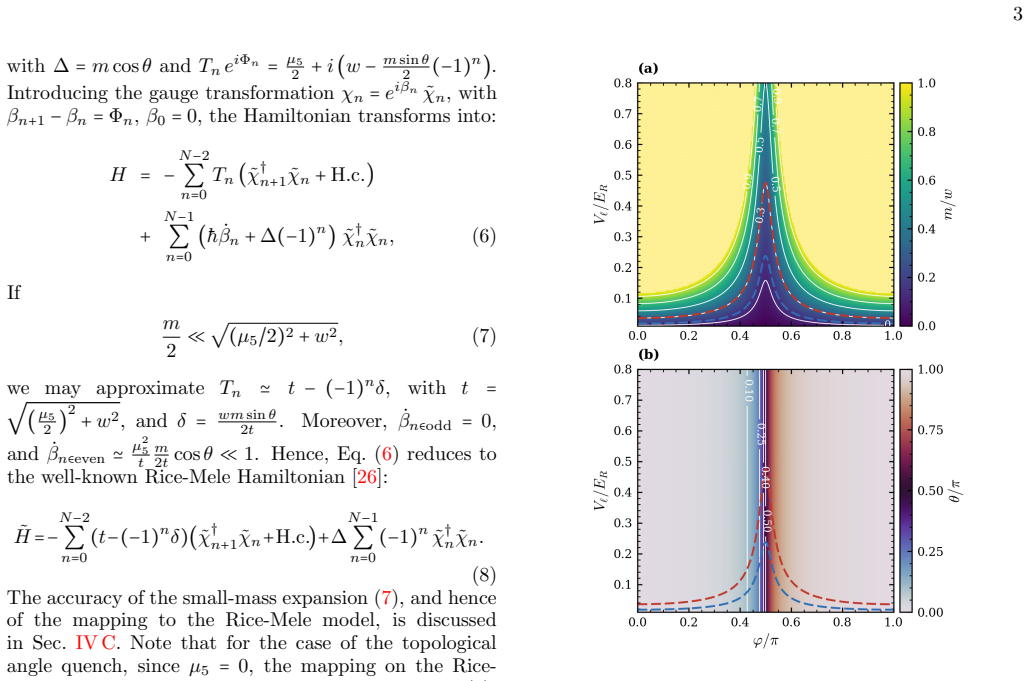
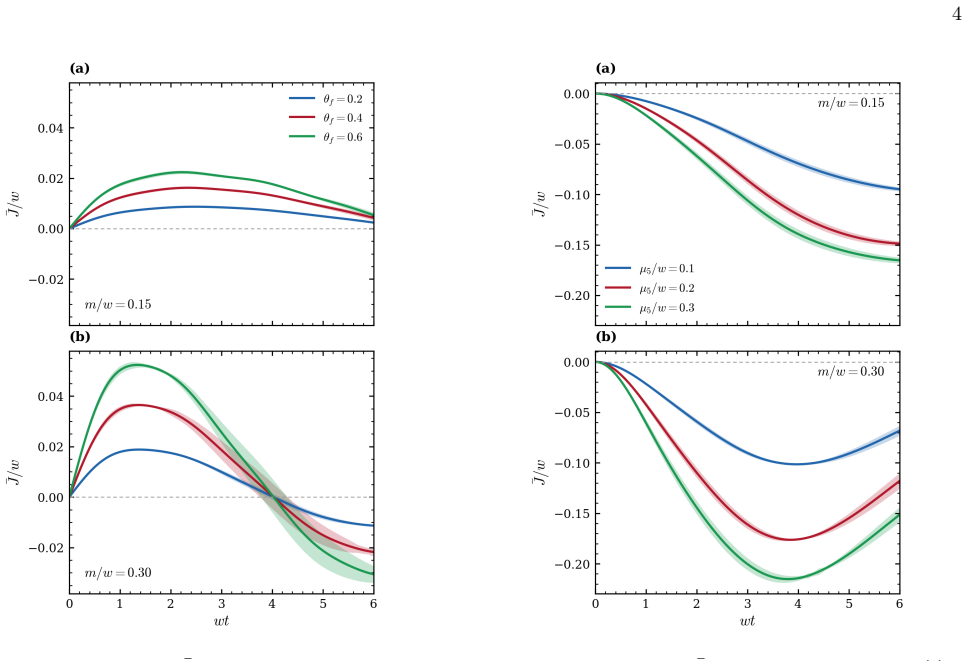
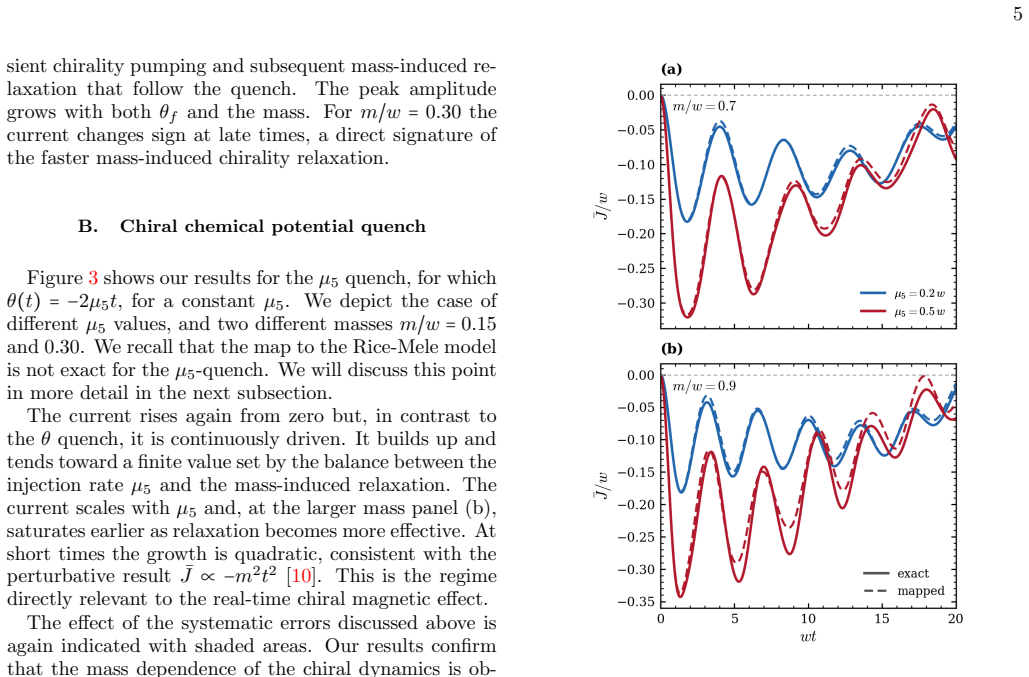
We propose an analog quantum simulation of chiral magnetic dynamics using ultracold atoms in an optical superlattice. The massive Schwinger model in the zero gauge coupling limit maps onto the Rice-Mele model, with the fermion mass and topological angle encoded in the superlattice parameters. We study the real-time dynamics of the vector current following two quench protocols that drive continuous chirality injection and chirality relaxation. Simulations with realistic superlattice parameters and experimental noise demonstrates clear mass dependence of the current dynamics in both protocols, robust against experimental imperfections. The vector current may be directly measurable via single-bond-resolved detection, establishing cold atom superlattices as a viable platform for probing non-equilibrium chiral phenomena.
Editorial analysis
A structured set of objections, weighed in public.
Referee Report
Summary. The manuscript proposes an analog quantum simulation of chiral magnetic dynamics using ultracold atoms in optical superlattices. It states that the massive Schwinger model at zero gauge coupling maps onto the Rice-Mele model, with fermion mass m and topological angle θ encoded in the superlattice parameters. Two quench protocols are introduced to study real-time vector current dynamics (continuous chirality injection and relaxation), and numerical simulations with realistic parameters and experimental noise are reported to show clear mass dependence that remains robust to imperfections. Direct measurement of the vector current via single-bond-resolved detection is suggested as feasible.
Significance. If the mapping holds with controlled fidelity, the work would establish optical superlattices as a viable platform for probing non-equilibrium chiral magnetic phenomena in a highly controllable setting, with the reported robustness to noise strengthening experimental relevance. The explicit suggestion of single-bond-resolved detection provides a concrete experimental pathway.
major comments (2)
- [Abstract and mapping section] Abstract and the mapping section (likely §2): the central claim that the zero-gauge-coupling massive Schwinger model maps faithfully onto the Rice-Mele Hamiltonian with m and θ directly encoded in staggered potential and dimerization is load-bearing, yet the explicit operator mapping, any higher-order tunneling corrections, and the precise form of the vector-current operator under this encoding are not shown; without this, the simulated mass dependence cannot be guaranteed to reproduce the continuum chiral-magnetic phenomenology.
- [Simulations and results section] Simulations and results section (likely §4): the statement that simulations with realistic superlattice parameters and experimental noise demonstrate clear mass dependence robust against imperfections lacks reported details on the numerical method, error analysis, convergence checks, or independent verification that the lattice vector current matches the Schwinger-model operator; this undermines the robustness claim.
minor comments (2)
- Notation for the Rice-Mele parameters (dimerization and staggered potential) should be defined explicitly with reference to the Schwinger-model quantities they encode.
- Figure captions for the current-dynamics plots should include the specific noise model parameters and the number of disorder realizations used.
Simulated Author's Rebuttal
We thank the referee for their careful reading and constructive feedback, which highlights important points for strengthening the manuscript. We address each major comment below and will revise the paper accordingly to provide the requested details.
read point-by-point responses
-
Referee: [Abstract and mapping section] Abstract and the mapping section (likely §2): the central claim that the zero-gauge-coupling massive Schwinger model maps faithfully onto the Rice-Mele Hamiltonian with m and θ directly encoded in staggered potential and dimerization is load-bearing, yet the explicit operator mapping, any higher-order tunneling corrections, and the precise form of the vector-current operator under this encoding are not shown; without this, the simulated mass dependence cannot be guaranteed to reproduce the continuum chiral-magnetic phenomenology.
Authors: We agree that the explicit operator mapping is essential to substantiate the central claim. In the revised manuscript we will add a dedicated subsection deriving the precise correspondence between the Schwinger-model operators (including the vector current) and the Rice-Mele Hamiltonian, explicitly showing how m and θ are encoded in the staggered potential and dimerization. We will also quantify higher-order tunneling corrections for the experimental parameter regime and demonstrate that they remain negligible, thereby confirming that the observed mass dependence reproduces the expected continuum chiral-magnetic phenomenology. revision: yes
-
Referee: [Simulations and results section] Simulations and results section (likely §4): the statement that simulations with realistic superlattice parameters and experimental noise demonstrate clear mass dependence robust against imperfections lacks reported details on the numerical method, error analysis, convergence checks, or independent verification that the lattice vector current matches the Schwinger-model operator; this undermines the robustness claim.
Authors: We acknowledge that additional methodological transparency is required. In the revised version we will specify the numerical technique employed, report error estimates and convergence tests with respect to system size, time discretization, and bond dimension (where applicable), and include an explicit check that the lattice vector-current operator reproduces the Schwinger-model operator under the established mapping. These additions will provide quantitative support for the robustness of the mass-dependent dynamics against experimental imperfections. revision: yes
Circularity Check
No circularity; mapping is input proposal, simulations are forward from it
full rationale
The paper states the mapping of the zero-gauge-coupling massive Schwinger model onto the Rice-Mele model (with m and θ encoded in superlattice parameters) as the foundational premise in the abstract. Simulations then proceed from that premise using realistic parameters and noise to extract current dynamics. No derivation within the paper reduces any prediction back to fitted quantities or self-citations by construction; the mapping is not shown as internally derived from the reported results. This is a standard proposal structure with independent simulation content.
Axiom & Free-Parameter Ledger
axioms (1)
- domain assumption The massive Schwinger model in the zero gauge coupling limit maps onto the Rice-Mele model, with fermion mass and topological angle encoded in superlattice parameters.
Reference graph
Works this paper leans on
-
[1]
D. E. Kharzeev, Progress in Particle and Nuclear Physics 75, 133 (2014)
2014
-
[2]
Kharzeev, J
D. Kharzeev, J. Liao, S. Voloshin, and G. Wang, Progress in Particle and Nuclear Physics88, 1 (2016)
2016
-
[3]
D. T. Son and B. Z. Spivak, Physical Review B88, 104412 (2013)
2013
-
[4]
B. Z. Spivak and A. V. Andreev, Phys. Rev. B93, 085107 (2016)
2016
-
[5]
Q. Li, D. E. Kharzeev, C. Zhang, Y. Huang, I. Pletikosi´ c, A. V. Fedorov, R. D. Zhong, J. A. Schneeloch, G. D. Gu, and T. Valla, Nature Physics12, 550 (2016)
2016
-
[6]
A. L. Levy, A. B. Sushkov, F. Liu, B. Shen, N. Ni, H. D. Drew, and G. S. Jenkins, Phys. Rev. B101, 125102 (2020)
2020
-
[7]
Behnami, D
M. Behnami, D. V. Efremov, S. Aswartham, G. Shipunov, B. R. Piening, C. G. F. Blum, V. Kocsis, J. Dufouleur, I. Pallecchi, M. Putti, B. B¨ uchner, H. Re- ichlova, and F. Caglieris, Phys. Rev. B112, 045101 (2025)
2025
-
[8]
I. M. Georgescu, S. Ashhab, and F. Nori, Reviews of Modern Physics86, 153 (2014)
2014
-
[9]
Coleman, Annals of Physics101, 239 (1976)
S. Coleman, Annals of Physics101, 239 (1976)
1976
-
[10]
D. E. Kharzeev and Y. Kikuchi, Phys. Rev. Res.2, 023342 (2020)
2020
-
[11]
Ikeda, Z.-B
K. Ikeda, Z.-B. Kang, D. E. Kharzeev, W. Qian, and F. Zhao, Journal of High Energy Physics2024, 31 (2024)
2024
-
[12]
Bloch, J
I. Bloch, J. Dalibard, and S. Nascimbene, Nature Physics 8, 267 (2012)
2012
-
[13]
A. J. Daley, I. Bloch, C. Kokail, S. Flannigan, N. Pearson, M. Troyer, and P. Zoller, Nature607, 667 (2022)
2022
-
[14]
Gross and I
C. Gross and I. Bloch, Science357, 995 (2017)
2017
-
[15]
Altman, K
E. Altman, K. R. Brown, G. Carleo, L. D. Carr, E. Dem- ler, C. Chin, B. DeMarco, S. E. Economou, M. A. Eriks- son, K.-M. C. Fu, M. Greiner, K. R. A. Hazzard, R. G. Hulet, A. J. Kollar, B. L. Lev, M. D. Lukin, R. Ma, X. Mi, S. Misra, C. Monroe, K. Murch, Z. Nazario, K.-K. Ni, A. C. Potter, P. Roushan, M. Saffman, M. Schleier- Smith, I. Siddiqi, R. Simmonds...
2021
-
[16]
Huang, Scientific Reports6, 20601 (2016)
X.-G. Huang, Scientific Reports6, 20601 (2016)
2016
-
[17]
Zheng, Z
Z. Zheng, Z. Lin, D.-W. Zhang, S.-L. Zhu, and Z. D. Wang, Phys. Rev. Res.1, 033102 (2019)
2019
-
[18]
Schweizer, F
C. Schweizer, F. Grusdt, M. Berngruber, L. Barbiero, E. Demler, M. Aidelsburger, and I. Bloch, Nature Physics 15, 1168 (2019)
2019
-
[19]
Aidelsburger, L
M. Aidelsburger, L. Barbiero, A. Bermudez, T. Chanda, A. Dauphin, D. Gonzalez-Cuadra, P. R. Grzybowski, S. Hands, F. Jendrzejewski, J. Junemann, G. Juzeliu- nas, V. Kasper, A. Piga, S.-J. Ran, M. Rizzi, G. Sierra, L. Tagliacozzo, E. Tirrito, T. V. Zache, J. Zakrzewski, E. Zohar, and M. Lewenstein, Philosophical Transactions of the Royal Society A380, 2021...
2022
-
[20]
Dalmonte and S
M. Dalmonte and S. Montangero, Contemporary Physics 57, 388 (2016)
2016
-
[21]
Zohar, J
E. Zohar, J. I. Cirac, and B. Reznik, Reports on Progress in Physics79, 014401 (2016)
2016
-
[22]
T. V. Zache, N. Mueller, J. T. Schneider, F. Jendrze- jewski, J. Berges, and P. Hauke, Phys. Rev. Lett.122, 050403 (2019)
2019
-
[23]
D. E. Kharzeev, Annals of Physics325, 205 (2010), jan- uary 2010 Special Issue
2010
-
[24]
Kogut and L
J. Kogut and L. Susskind, Physical Review D11, 395 (1975)
1975
-
[25]
Dempsey, I
R. Dempsey, I. R. Klebanov, S. S. Pufu, and B. Zan, Phys. Rev. Res.4, 043133 (2022)
2022
-
[26]
M. J. Rice and E. J. Mele, Physical Review Letters49, 1455 (1982)
1982
-
[27]
Impertro, S
A. Impertro, S. Karch, J. F. Wienand, S. Huh, C. Schweizer, I. Bloch, and M. Aidelsburger, Phys. Rev. Lett.133, 063401 (2024)
2024
-
[28]
Lohse, C
M. Lohse, C. Schweizer, O. Zilberberg, M. Aidelsburger, and I. Bloch, Nature Physics12, 350 (2016)
2016
-
[29]
Walter, Z
A.-S. Walter, Z. Zhu, M. Gachter, J. Minguzzi, S. Roschinski, K. Sandholzer, K. Viebahn, and T. Esslinger, Nature Physics19, 1471 (2023)
2023
-
[30]
Viebahn, A.-S
K. Viebahn, A.-S. Walter, E. Bertok, Z. Zhu, M. Gachter, A. A. Aligia, F. Heidrich-Meisner, and T. Esslinger, Physical Review X14, 021049 (2024)
2024
-
[31]
J. S. Schwinger, Physical Review128, 2425 (1962)
1962
-
[32]
E. A. Martinez, C. A. Muschik, P. Schindler, D. Nigg, A. Erhard, M. Heyl, P. Hauke, M. Dalmonte, T. Monz, P. Zoller, and R. Blatt, Nature534, 516 (2016). A. Lattice formulation of the Schwinger model We recall in this appendix, the derivation of the lattice model (3). For more details we refer e.g. to Ref. [10]. The Lagrangian density of the massive Schwi...
2016
discussion (0)
Sign in with ORCID, Apple, or X to comment. Anyone can read and Pith papers without signing in.