Experimental evaluation of optimal abstract operators for sharing and linearity analysis
Pith reviewed 2026-06-27 14:29 UTC · model grok-4.3
The pith
Optimal abstract operators for sharing and linearity analysis were implemented in the PLAI analyzer to measure their effect on precision and performance.
A machine-rendered reading of the paper's core claim, the machinery that carries it, and where it could break.
Core claim
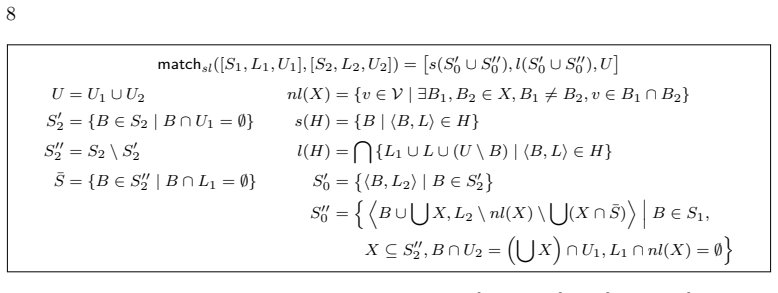
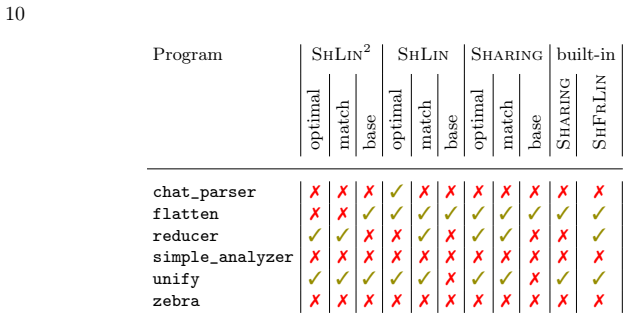
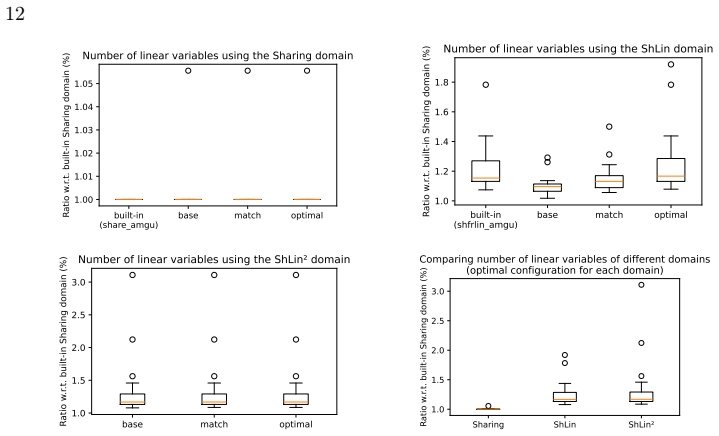
We have implemented these abstract operators and the corresponding abstract domains within the PLAI analyzer, part of the CiaoPP preprocessor, and we report the impact of increasing operator precision on the accuracy and performance of the overall analysis.
What carries the argument
Optimal abstract operators for unification and matching that achieve the maximum precision possible inside sharing and linearity abstract domains.
If this is right
- Higher-precision operators produce more accurate sharing and linearity information for the analyzed programs.
- The performance cost of the optimal operators can be directly compared against simpler operators inside the same analyzer.
- The experimental data clarify how close practical analyses come to the theoretical maximum precision of the abstract domain.
- Designers of static analyzers gain quantitative guidance on whether the added complexity of optimal operators is justified for their workloads.
Where Pith is reading between the lines
- Similar experimental comparisons could be performed for other abstract domains used in logic-program analysis to identify where precision gains are cheapest.
- If the measured overhead remains modest across more programs, optimal operators could become the default choice rather than an optional refinement.
- The same implementation approach might be adapted to measure precision-efficiency trade-offs in related analyses such as groundness or aliasing.
Load-bearing premise
The chosen test programs and performance metrics in the PLAI implementation are representative of the precision and efficiency effects that would appear in typical real-world logic-program analyses.
What would settle it
Re-running the same analyses on a different or larger collection of programs and obtaining no measurable change in accuracy or runtime when switching to the optimal operators would show that the reported impact does not hold.
Figures



read the original abstract
In the field of static analysis of logic programs, the optimality of abstract operators is a valuable theoretical property, as it provides insight into the structure of abstract domains and the maximum precision that can be achieved. However, implementing optimal operators is often complex and may significantly impact performance, giving rise to a trade-off between precision and efficiency. We experimentally investigate this trade-off in the context of sharing and linearity analysis of logic programs. Our experiments build on previous work that proposed several optimal operators for unification and matching. We have implemented these abstract operators and the corresponding abstract domains within the PLAI analyzer, part of the CiaoPP preprocessor, and we report the impact of increasing operator precision on the accuracy and performance of the overall analysis.
Editorial analysis
A structured set of objections, weighed in public.
Referee Report
Summary. The paper experimentally evaluates optimal abstract operators for sharing and linearity analysis of logic programs. It implements these operators (previously proposed for unification and matching) and the corresponding abstract domains inside the PLAI analyzer of the CiaoPP preprocessor, then reports the resulting effects on analysis accuracy and performance.
Significance. If the results are reproducible and the test suite is representative, the work supplies concrete data on the precision-efficiency trade-off that arises when replacing standard operators with optimal ones in a realistic abstract-interpretation setting for logic programs.
major comments (1)
- [experimental evaluation section (and abstract)] The manuscript asserts that experiments were performed inside PLAI and that the impact on accuracy and performance is reported, yet the text supplies no information on benchmark selection, statistical methods, or controls. This omission is load-bearing for the central claim, because the reported gains cannot be evaluated for representativeness without knowing the programs, metrics, and experimental design.
Simulated Author's Rebuttal
We thank the referee for the detailed review and the positive assessment of the work's significance. We agree that the experimental section requires additional information to support the central claims and will revise accordingly.
read point-by-point responses
-
Referee: [experimental evaluation section (and abstract)] The manuscript asserts that experiments were performed inside PLAI and that the impact on accuracy and performance is reported, yet the text supplies no information on benchmark selection, statistical methods, or controls. This omission is load-bearing for the central claim, because the reported gains cannot be evaluated for representativeness without knowing the programs, metrics, and experimental design.
Authors: We agree with this observation. The current manuscript text does not provide the requested details on benchmark selection, metrics, statistical methods, or experimental controls. In the revised version we will expand the experimental evaluation section (and update the abstract if needed) with a clear description of the benchmark suite, the programs selected, the accuracy and performance metrics used, and any controls or statistical procedures applied. This will make the evaluation reproducible and allow assessment of representativeness. revision: yes
Circularity Check
No circularity: purely experimental reporting on prior operators
full rationale
The paper performs an experimental evaluation of abstract operators previously proposed for sharing and linearity analysis. It implements them in the PLAI analyzer and measures precision/performance trade-offs on test programs. No derivation chain, fitted predictions, self-definitional equations, or load-bearing self-citations exist; the central claims are empirical observations from the implementation, not reductions to inputs by construction. Benchmark representativeness is a separate correctness concern, not circularity.
Axiom & Free-Parameter Ledger
Reference graph
Works this paper leans on
-
[1]
Aliasing and Groundness Analysis of Logic Programs through Abstract Interpretation and its Safety , year =
Werner Hans and Stephan Winkler , institution =. Aliasing and Groundness Analysis of Logic Programs through Abstract Interpretation and its Safety , year =
-
[2]
Static Analysis of Logic Programs for Independent
Dean Jacobs and Anno Langen , journal =. Static Analysis of Logic Programs for Independent. 1992 , doi =
1992
-
[3]
Hermenegildo , journal =
Kalyan Muthukumar and Manuel V. Hermenegildo , journal =. Compile-Time Derivation of Variable Dependency Using Abstract Interpretation , volume =. 1992 , doi =
1992
-
[4]
Sharing and Groundness Dependencies in Logic Programs , volume =
Michael Codish and Harald S. Sharing and Groundness Dependencies in Logic Programs , volume =. ACM Transactions on Programming Languages and Systems , month = sep, number =. 1999 , doi =
1999
-
[5]
Hill and Enea Zaffanella , journal =
Roberto Bagnara and Patricia M. Hill and Enea Zaffanella , journal =. Set-Sharing is Redundant for Pair-Sharing , volume =. 2002 , doi =
2002
-
[6]
Morales and Pedro López-Gárcia and Manuel V
Daniel Jurjio-Rivas and Jose F. Morales and Pedro López-Gárcia and Manuel V. Hermenegildo , journal =. Abstract Environment Trimming , volume =. 2024 , doi =
2024
-
[7]
Derivation and Safety of an Abstract Unification Algorithm for Groundness and Aliasing Analysis , year =
Michael Codish and Dennis Dams and Eyal Yardeni , booktitle =. Derivation and Safety of an Abstract Unification Algorithm for Groundness and Aliasing Analysis , year =
-
[8]
A Synergistic Analysis for Sharing and Groundness which traces Linearity , volume =
Andy King , booktitle =. A Synergistic Analysis for Sharing and Groundness which traces Linearity , volume =. 1994 , doi =
1994
-
[9]
The Role of Linearity in Sharing Analysis , volume =
Gianluca Amato and Maria Chiara Meo and Francesca Scozzari , journal =. The Role of Linearity in Sharing Analysis , volume =. 2022 , doi =
2022
-
[10]
Hill , journal =
Roberto Bagnara and Enea Zaffanella and Patricia M. Hill , journal =. Enhanced Sharing Analysis Techniques: A Comprehensive Evaluation , volume =. 2005 , doi =
2005
-
[11]
Improving Abstract Interpretations by Combining Domains , volume =
Michael Codish and Anne Mulkers and Maurice Bruynooghe and Maria Garc. Improving Abstract Interpretations by Combining Domains , volume =. ACM Transactions on Programming Languages and Systems , number =. 1995 , doi =
1995
-
[12]
Optimality in Goal-Dependent Analysis of Sharing , volume =
Gianluca Amato and Francesca Scozzari , journal =. Optimality in Goal-Dependent Analysis of Sharing , volume =. 2009 , doi =
2009
-
[13]
On the Interaction Between Sharing and Linearity , volume =
Gianluca Amato and Francesca Scozzari , journal =. On the Interaction Between Sharing and Linearity , volume =. 2010 , doi =
2010
-
[14]
Optimal Multibinding Unification for Sharing and Linearity Analysis , volume =
Gianluca Amato and Francesca Scozzari , journal =. Optimal Multibinding Unification for Sharing and Linearity Analysis , volume =. 2014 , doi =
2014
-
[15]
Optimal Matching for Sharing and Linearity Analysis , volume =
Gianluca Amato and Francesca Scozzari , journal =. Optimal Matching for Sharing and Linearity Analysis , volume =. 2024 , doi =
2024
-
[16]
Morales and German Puebla and Manuel V
Francisco Bueno and Pedro López-García and José F. Morales and German Puebla and Manuel V. Hermenegildo , institution =. 2025 , url =
2025
-
[17]
Hermenegildo and Pedro López-García and and José F
Francisco Bueno and Manuel Carro and Manuel V. Hermenegildo and Pedro López-García and and José F. Morales , institution =. 1997 , url =
1997
-
[18]
A Practical Framework for the Abstract Interpretation of Logic Programs , volume =
Maurice Bruynooghe , journal =. A Practical Framework for the Abstract Interpretation of Logic Programs , volume =
-
[19]
Hermenegildo , booktitle =
Kalyan Muthukumar and Manuel V. Hermenegildo , booktitle =. Combined Determination of Sharing and Freeness of Program Variables Through Abstract Interpretation , year =
-
[20]
Optimal Groundness Analysis Using Propositional Logic , volume =
Agostino Cortesi and Gilberto Fil. Optimal Groundness Analysis Using Propositional Logic , volume =. The Journal of Logic Programming , number =
-
[21]
Abstract Interpretation Frameworks , volume =
Patrick Cousot and Radhia Cousot , journal =. Abstract Interpretation Frameworks , volume =. 1992 , doi =
1992
-
[22]
On Collecting Semantics for Program Analysis , volume =
Gianluca Amato and Maria Chiara Meo and Francesca Scozzari , journal =. On Collecting Semantics for Program Analysis , volume =. 2020 , doi =
2020
-
[23]
Howe and Andy King , journal =
Jacob M. Howe and Andy King , journal =. Three Optimisations for Sharing , volume =. 2003 , doi =
2003
-
[24]
Hill and Enea Zaffanella and Roberto Bagnara , journal =
Patricia M. Hill and Enea Zaffanella and Roberto Bagnara , journal =. A Correct, Precise and Efficient Integration of Set-Sharing, Freeness and Linearity for the Analysis of Finite and Rational Tree Languages , volume =. 2004 , doi =
2004
-
[25]
Inferring Linear Invariants with Parallelotopes , volume =
Gianluca Amato and Marco Rubino and Francesca Scozzari , journal =. Inferring Linear Invariants with Parallelotopes , volume =. 2017 , doi =
2017
-
[26]
Gianluca Amato and Francesca Scozzari , booktitle =. The. 2023 , doi =
2023
-
[27]
Logic Programming, Proceedings of the Eighth International Conference , editor =
Logic Programming, Proceedings of the Eighth International Conference , year =. Logic Programming, Proceedings of the Eighth International Conference , editor =
-
[28]
Formal Methods, 25th International Symposium,
Formal Methods, 25th International Symposium,. Formal Methods, 25th International Symposium,. 2023 , doi =
2023
discussion (0)
Sign in with ORCID, Apple, or X to comment. Anyone can read and Pith papers without signing in.