Doubly-strange hidden-charm pentaquarks from the Fermi statistics of the light-quark cloud
Pith reviewed 2026-06-27 15:30 UTC · model grok-4.3
The pith
Doubly-strange hidden-charm pentaquarks form two negative-parity triplets whose upper kaon-associated states are nearly degenerate.
A machine-rendered reading of the paper's core claim, the machinery that carries it, and where it could break.
Core claim
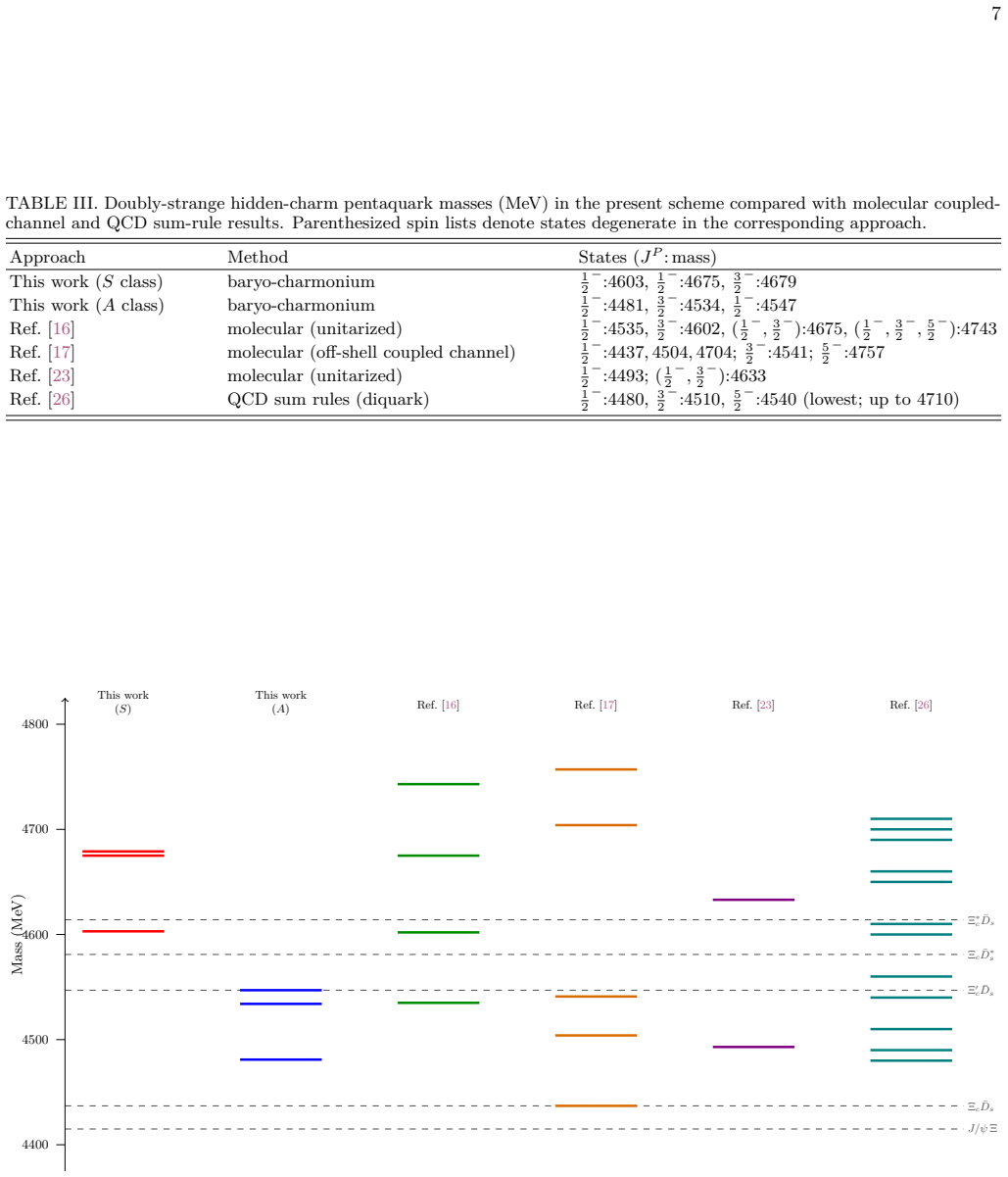
We obtain two negative-parity triplets, one produced with a kaon and one with an antiproton, the lowest kaon-associated 1/2- state near 4.60 GeV and the antiproton-associated triplet some 120 MeV below. The robust, distinctive prediction is that the upper two kaon-associated states form a near-degenerate doublet, in sharp contrast to the well-separated triplets of the lighter sectors -- a sparse, fixed-spacing pattern that sets the scheme apart from the molecular and diquark alternatives. The internal splittings follow without adjustment from the measured Pc and Pcs spectra; the absolute scale relies on the additive strange-mass ansatz.
What carries the argument
the Fermi statistics of the light-quark cloud, which sets all mass splittings through color-octet chromomagnetic couplings J^ss scaled from lighter sectors
If this is right
- Internal splittings of the new states are fixed by the measured Pc and Pcs spectra with no additional parameters.
- The absolute mass scale is set by the single additive strange-mass ansatz.
- The predicted masses lie close to existing molecular coupled-channel and QCD sum-rule estimates.
- The near-degenerate upper doublet plus fixed lower spacing distinguishes the model from both molecular and diquark pictures.
Where Pith is reading between the lines
- Confirmation of the doublet would tighten constraints on any model that treats the light degrees of freedom as a single effective cloud rather than explicit molecular channels.
- The same cloud statistics could be applied to triply strange or bottom analogs to generate further testable mass patterns.
- Production rates or decay branching ratios into kaon versus antiproton final states might reflect the different cloud wave functions of the two triplets.
Load-bearing premise
An additive strange-mass increment taken from the Pc to Pcs shift continues to hold when two strange quarks are present.
What would settle it
A search for states near 4.60 GeV in the kaon channel that either shows or fails to show a near-degenerate pair separated by only a few MeV while the third member lies lower by roughly the same amount as in the lighter Pc and Pcs triplets.
Figures

read the original abstract
We extend the baryo-charmonium picture of pentaquarks -- a color-octet $c\bar c$ core bonded to a color-octet light-quark cloud -- to the doubly-strange sector $c\bar c ssq$. The mass splittings are set entirely by the light cloud, so the only new inputs are the strange-strange couplings $J^{ss}$, fixed by a second application of the chromomagnetic scaling, and an additive strange-mass increment taken from the observed $P_c\!\to\!P_{cs}$ shift. We obtain two negative-parity triplets, one produced with a kaon and one with an antiproton, the lowest kaon-associated $\tfrac12^-$ state near $4.60$~GeV and the antiproton-associated triplet some $120$~MeV below. The robust, distinctive prediction is that the upper two kaon-associated states form a near-degenerate doublet, in sharp contrast to the well-separated triplets of the lighter sectors -- a sparse, fixed-spacing pattern that sets the scheme apart from the molecular and diquark alternatives. The internal splittings follow without adjustment from the measured $P_c$ and $P_{cs}$ spectra; the absolute scale relies on the additive strange-mass ansatz, the main assumption of the extrapolation. The predicted masses agree with recent molecular coupled-channel and QCD sum-rule results.
Editorial analysis
A structured set of objections, weighed in public.
Referee Report
Summary. The manuscript extends the baryo-charmonium picture to doubly-strange hidden-charm pentaquarks ( c̄c ssq ). Mass splittings within each sector are fixed entirely by the Fermi statistics and chromomagnetic interactions of the light-quark cloud, with internal splittings taken directly from the measured Pc and Pcs spectra. The only new inputs are the strange-strange couplings J^ss (fixed by a second application of chromomagnetic scaling) and an additive strange-mass increment fitted to the observed Pc-to-Pcs shift. The resulting spectrum consists of two negative-parity triplets (one kaon-associated, one antiproton-associated), with the lowest kaon-associated 1/2⁻ state near 4.60 GeV and the antiproton-associated triplet ~120 MeV lower. The central, robust prediction is that the upper two kaon-associated states form a near-degenerate doublet, in contrast to the well-separated triplets of the lighter sectors. The predicted masses are stated to agree with recent molecular coupled-channel and QCD sum-rule calculations.
Significance. If the results hold, the work supplies a largely data-driven, falsifiable prediction for the doubly-strange sector whose key structural feature (the near-degenerate doublet) arises solely from the light-cloud splittings already fixed by experiment and is insensitive to the absolute-scale ansatz. This pattern provides a clear, testable distinction from molecular and diquark alternatives. The direct importation of measured internal splittings without adjustment and the explicit demonstration that the reported degeneracy does not depend on the value of the strange-mass increment are genuine strengths of the approach.
minor comments (3)
- The assertion that the predicted masses 'agree with recent molecular coupled-channel and QCD sum-rule results' is stated in the abstract but is not supported by any explicit numerical comparison, table, or figure in the manuscript. Adding such a comparison would allow readers to assess the level of agreement directly.
- The notation used to label the individual states within each triplet (e.g., how the 1/2⁻, 3/2⁻, 5/2⁻ members are distinguished and associated with kaon or antiproton channels) is not fully defined in the abstract or the opening paragraphs; a short table or explicit listing would improve clarity.
- The manuscript refers to the original Pc and Pcs experimental measurements only in passing; adding the specific references (e.g., to the LHCb papers) in the introduction would help readers trace the input data.
Simulated Author's Rebuttal
We thank the referee for the supportive summary, recognition of the strengths of the approach, and recommendation for minor revision. No specific major comments appear in the report.
Circularity Check
No significant circularity identified
full rationale
The derivation takes internal mass splittings directly from measured Pc and Pcs spectra (external data) and applies a uniform additive strange-mass shift fitted only to the prior Pc-to-Pcs transition. The reported near-degenerate doublet is the direct inheritance of the observed splitting pattern under the light-cloud Fermi-statistics assumption; the absolute scale shift does not alter relative positions or induce state-dependent effects. No self-citation, self-definition, or fitted-parameter-renamed-as-prediction is present in the load-bearing steps. The central claim remains an extrapolation from independent observations rather than a reduction to the paper's own inputs.
Axiom & Free-Parameter Ledger
free parameters (2)
- J^{ss}
- strange-mass increment
axioms (3)
- domain assumption chromomagnetic scaling applies unchanged to strange-strange sector
- ad hoc to paper additive strange-mass ansatz for absolute scale
- domain assumption Fermi statistics of light-quark cloud determines allowed states
Reference graph
Works this paper leans on
-
[1]
no fitted parameters
From Eqs. (2)–(3) the crossover is governed by a compact condition, ∆E 3/2 >∆E 1/2 ⇐⇒ ⏐⏐⏐⏐ Jqq A Jqq S ⏐⏐⏐⏐>2 κqs κqq,(11) i.e.|Jqq A /Jqq S|>1.2for the adopted scaling. The fitted ra- tio is1.43+0.10 −0.10, so the inversion is realized; sampling the fitted couplingsJ qq S,A from (asymmetric) Gaussians with the errors of Table I and the ratioκqs/κqq unifo...
2025
-
[2]
R. Aaij et al. (LHCb), Phys. Rev. Lett.115, 072001 (2015), arXiv:1507.03414 [hep-ex]
Pith/arXiv arXiv 2015
-
[3]
R. Aaij et al. (LHCb), Phys. Rev. Lett.122, 222001 (2019), arXiv:1904.03947 [hep-ex]
Pith/arXiv arXiv 2019
- [4]
-
[5]
R. Aaij et al. (LHCb), Phys. Rev. Lett.131, 031901 (2023), arXiv:2210.10346 [hep-ex]
arXiv 2023
-
[6]
I. Adachiet al. (Belle, Belle-II), Phys. Rev. Lett.135, 041901 (2025), arXiv:2502.09951 [hep-ex]
arXiv 2025
- [7]
-
[8]
A. Esposito, A. Pilloni, and A. D. Polosa, Phys. Rept. 668, 1 (2017), arXiv:1611.07920 [hep-ph]
Pith/arXiv arXiv 2017
-
[9]
L. Meng, B. Wang, G.-J. Wang, and S.-L. Zhu, Phys. Rept.1019, 1 (2023), arXiv:2204.08716 [hep-ph]
arXiv 2023
-
[10]
D. Germani, F. Niliani, and A. D. Polosa, Eur. Phys. J. C84, 755 (2024), arXiv:2403.04068 [hep-ph]
arXiv 2024
-
[11]
V. V. Anisovich, M. A. Matveev, J. Nyiri, A. V. Sarant- sev, and A. N. Semenova, Int. J. Mod. Phys. A30, 1550190 (2015), arXiv:1509.04898 [hep-ph]
Pith/arXiv arXiv 2015
-
[12]
Q. Meng, E. Hiyama, K. U. Can, P. Gubler, M. Oka, A. Hosaka, and H. Zong, Phys. Lett. B798, 135028 (2019), arXiv:1907.00144 [nucl-th]
arXiv 2019
-
[13]
F.-L. Wang, R. Chen, and X. Liu, Phys. Rev. D103, 034014 (2021), arXiv:2011.14296 [hep-ph]
arXiv 2021
- [14]
-
[15]
J. Ferretti and E. Santopinto, Sci. Bull.67, 1209 (2022), arXiv:2111.08650 [hep-ph]
arXiv 2022
-
[16]
F.-L. Wang, X.-D. Yang, R. Chen,and X. Liu, Phys. Rev. D103, 054025 (2021), arXiv:2101.11200 [hep-ph]
arXiv 2021
-
[17]
L. Roca, J. Song, and E. Oset, Phys. Rev. D109, 094005 (2024), arXiv:2403.08732 [hep-ph]
arXiv 2024
-
[18]
S. Clymton, H.-C. Kim, and T. Mart, Phys. Rev. D112, 034015 (2025), arXiv:2506.23587 [hep-ph]
arXiv 2025
-
[19]
L. Roca, J. Song, and E. Oset, Eur. Phys. J. C86, 100 (2026), arXiv:2509.19840 [hep-ph]
arXiv 2026
-
[20]
Özdem, Eur
U. Özdem, Eur. Phys. J. A58, 46 (2022)
2022
- [21]
- [22]
- [23]
-
[24]
J. A. Marsé-Valera, V. K. Magas, and A. Ramos, Phys. Rev. Lett.130, 091903 (2023), arXiv:2210.02792 [hep- ph]
arXiv 2023
-
[25]
J. A. Marsé-Valera, V. K. Magas, and A. Ramos, Phys. Rev. D111, 054020 (2025), arXiv:2410.10682 [hep-ph]
arXiv 2025
-
[26]
B838, 137747 (2023), arXiv:2210.04465 [hep-ph]
P.G.Ortega, D.R.Entem,andF.Fernandez,Phys.Lett. B838, 137747 (2023), arXiv:2210.04465 [hep-ph]
arXiv 2023
-
[27]
Z.-G. Wang and Y. Liu, Nucl. Phys. B1027, 117456 (2026), arXiv:2511.13067 [hep-ph]
Pith/arXiv arXiv 2026
-
[28]
A. Hayrapetyanet al. (CMS), Eur. Phys. J. C84, 1062 (2024), arXiv:2401.16303 [hep-ex]
arXiv 2024
- [29]
-
[30]
A. Ali, L. Maiani, and A. D. Polosa,Multiquark Hadrons (Cambridge University Press, 2019)
2019
discussion (0)
Sign in with ORCID, Apple, or X to comment. Anyone can read and Pith papers without signing in.