Determining universal spectra from probability distributions
Pith reviewed 2026-06-27 14:29 UTC · model grok-4.3
The pith
The probability distribution of two-particle correlation functions informs the spectra of universal n-body clusters.
A machine-rendered reading of the paper's core claim, the machinery that carries it, and where it could break.
Core claim
The probability distribution of a two-particle correlation function computed over background auxiliary field configurations used to generate the interactions informs about the spectra of universal n-body clusters. The present work applies numerical lattice computations and an analytic expansion in the limit of large numbers of identical species in an attempt to refine the initial predictions, with exploratory calculations shown and directions for future work outlined.
What carries the argument
The probability distribution of the two-particle correlation function evaluated over auxiliary field configurations that generate the interactions.
If this is right
- Refined numerical and analytic predictions improve the accuracy with which distribution features predict n-body spectra.
- Lattice computations provide concrete checks on the distribution-to-spectrum mapping for small n.
- The large-species analytic limit supplies an independent test that can constrain the form of the mapping.
- Exploratory calculations identify which features of the distribution are most informative for future work.
Where Pith is reading between the lines
- If the mapping holds across different regularizations, the same distribution approach could be applied to other lattice formulations of short-range interactions.
- The method may connect to existing few-body techniques that also use correlation functions to extract binding information without full diagonalization.
- Testable extensions include checking whether the distribution features remain predictive when the number of particles is increased beyond the explored range.
Load-bearing premise
The auxiliary field configurations produce a correlation function distribution whose features map directly and without bias to the universal n-body spectra, independent of the specific regularization or lattice artifacts.
What would settle it
A direct comparison in which n-body energies extracted from the correlation-function distribution disagree with energies obtained by solving the n-body problem on the same lattice for a chosen set of interaction parameters.
Figures

read the original abstract
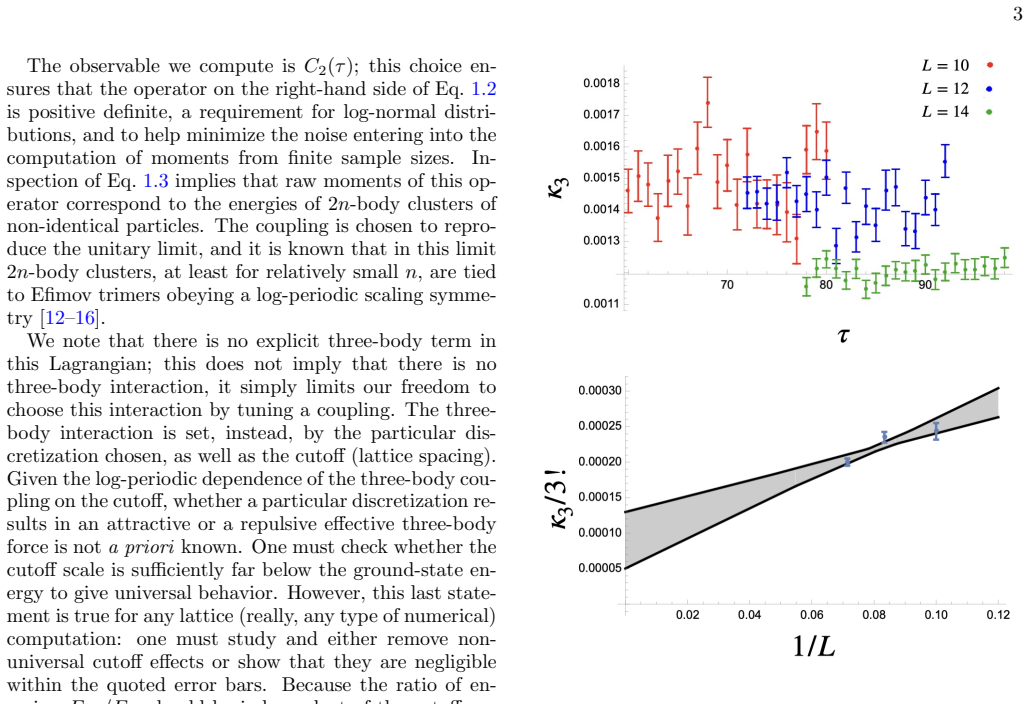
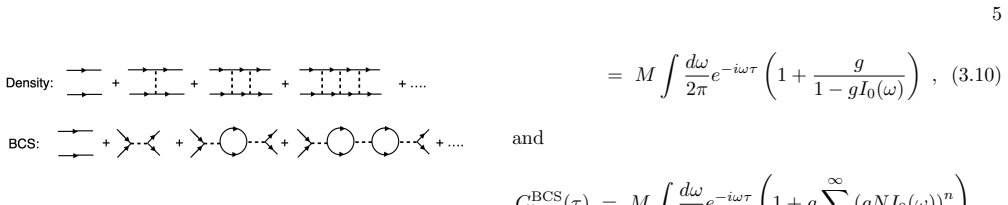
The probability distribution of a two-particle correlation function computed over background auxiliary field configurations, used to generate the interactions, has been shown to inform about the spectra of universal $n$-body clusters [1]. Here, we utilize two approaches, a numerical lattice computation and an analytic expansion in the limit of large numbers of identical species, in an attempt to refine the initial predictions. Exploratory calculations in these directions are presented, and future investigations laid out.
Editorial analysis
A structured set of objections, weighed in public.
Referee Report
Summary. The manuscript claims that features of the probability distribution of a two-particle correlation function, computed over background auxiliary-field configurations, can be used to determine spectra of universal n-body clusters, building on Ref. [1]. It describes two refinement approaches—a numerical lattice computation and an analytic expansion in the large-species limit—presents exploratory calculations in these directions, and outlines future investigations.
Significance. If validated with concrete, regularization-independent results, the method could provide a novel route to universal spectra from correlation distributions, with the lattice and large-N analytic approaches offering potential cross-checks. The exploratory character and absence of specific outcomes or validation currently limit the significance.
major comments (3)
- [Abstract] Abstract and overall manuscript: the text describes exploratory calculations and future plans but supplies no specific numerical results, error estimates, or direct comparisons to known spectra, so the refinements to the predictions of Ref. [1] cannot be assessed.
- [Numerical lattice computation] Numerical lattice approach (throughout): no explicit invariance tests are shown under variation of auxiliary-field regularization, lattice spacing, or UV cutoff; without such tests the claimed direct, unbiased mapping from distribution features to universal spectra remains unsupported.
- [Analytic expansion] Analytic large-species expansion: the expansion is presented as a refinement, yet no concrete derivations or comparisons demonstrate that the extracted spectral information is independent of the auxiliary-field construction already used in Ref. [1], leaving the circularity issue unaddressed.
minor comments (1)
- [General] Notation distinguishing new quantities from those defined in Ref. [1] should be introduced explicitly to improve readability.
Simulated Author's Rebuttal
We thank the referee for their careful reading and constructive comments on our manuscript. We respond to each major comment below.
read point-by-point responses
-
Referee: [Abstract] Abstract and overall manuscript: the text describes exploratory calculations and future plans but supplies no specific numerical results, error estimates, or direct comparisons to known spectra, so the refinements to the predictions of Ref. [1] cannot be assessed.
Authors: We agree with the observation that the manuscript is exploratory and does not include specific numerical results or comparisons. This is consistent with the stated purpose of describing approaches and outlining future work. We will revise the abstract to more clearly indicate the preliminary nature of the calculations presented. revision: yes
-
Referee: [Numerical lattice computation] Numerical lattice approach (throughout): no explicit invariance tests are shown under variation of auxiliary-field regularization, lattice spacing, or UV cutoff; without such tests the claimed direct, unbiased mapping from distribution features to universal spectra remains unsupported.
Authors: The lattice computations are exploratory, and we acknowledge that invariance tests under changes in regularization parameters have not been performed or shown. Such tests are essential for establishing the robustness of the method and will be addressed in future investigations. We will add text to the manuscript to clarify this limitation. revision: partial
-
Referee: [Analytic expansion] Analytic large-species expansion: the expansion is presented as a refinement, yet no concrete derivations or comparisons demonstrate that the extracted spectral information is independent of the auxiliary-field construction already used in Ref. [1], leaving the circularity issue unaddressed.
Authors: We recognize that the manuscript does not provide concrete derivations or comparisons to demonstrate independence from the auxiliary-field construction in Ref. [1]. The large-species expansion is intended as a distinct analytic approach, but further work is needed to address potential circularity. We will revise the text to better articulate this and the steps toward independence. revision: yes
Circularity Check
No circularity: refinements presented as independent exploratory calculations
full rationale
The manuscript references prior work [1] only for the base observation that correlation-function distributions inform n-body spectra, then introduces two distinct new methods (numerical lattice computation and large-species analytic expansion) as refinements. No equations or steps are shown that reduce the new predictions to quantities already defined in [1] by construction, nor is any load-bearing uniqueness theorem or ansatz imported solely via self-citation. The derivation chain therefore remains self-contained against external benchmarks.
Axiom & Free-Parameter Ledger
Reference graph
Works this paper leans on
-
[1]
N-body Efimov states from two- particle noise,
A. N. Nicholson, “N-body Efimov states from two- particle noise,” Phys. Rev. Lett.109, 073003 (2012), arXiv:1202.4402 [cond-mat.quant-gas]
Pith/arXiv arXiv 2012
-
[2]
The Analysis of Algorithms for Lat- tice Field Theory,
G. P. Lepage, “The Analysis of Algorithms for Lat- tice Field Theory,” inTASI, Boulder(1989) pp. 97–120, https://inspirehep.net/literature/287173
1989
-
[3]
The Strategy for Computing the Hadronic Mass Spectrum,
G. Parisi, “The Strategy for Computing the Hadronic Mass Spectrum,” Phys. Rept.103, 203–211 (1984)
1984
-
[4]
M. G. Endres, D. B. Kaplan, J.-W. Lee, and A. N. Nicholson, “Listening to Noise,” PoSLATTICE2011, 017 (2011), arXiv:1112.4023 [hep-lat]
Pith/arXiv arXiv 2011
-
[5]
Noise, sign problems, and statistics,
M. G. Endres, D. B. Kaplan, J.-W. Lee, and A. N. Nicholson, “Noise, sign problems, and statistics,” Phys. Rev. Lett.107, 201601 (2011), arXiv:1106.0073 [hep-lat]
Pith/arXiv arXiv 2011
-
[6]
Sign problems, noise, and chiral symmetry breaking in a QCD-like theory,
D. Grabowska, D. B. Kaplan, and A. N. Nicholson, “Sign problems, noise, and chiral symmetry breaking in a QCD-like theory,” Phys. Rev. D87, 014504 (2013), arXiv:1208.5760 [hep-lat]
Pith/arXiv arXiv 2013
-
[7]
Log-normal distribution for correlators in lattice QCD?
T. DeGrand, “Log-normal distribution for correlators in lattice QCD?” Phys. Rev. D86, 014512 (2012), arXiv:1204.4664 [hep-lat]
Pith/arXiv arXiv 2012
-
[8]
Lattice quantum chromo- dynamics at large isospin density,
R. Abbott, W. Detmold, F. Romero-L´ opez, Z. Davoudi, M. Illa, A. Parre˜ no, R. J. Perry, P. E. Shanahan, and M. L. Wagman (NPLQCD), “Lattice quantum chromo- dynamics at large isospin density,” Phys. Rev. D108, 114506 (2023), arXiv:2307.15014 [hep-lat]
arXiv 2023
-
[9]
Nu- clear physics from lattice qcd,
S. Beane, W. Detmold, K. Orginos, and M. Savage, “Nu- clear physics from lattice qcd,” Progress in Particle and Nuclear Physics66, 1–40 (2011)
2011
-
[10]
Uncertainty quantification in lattice qcd calculations for nuclear physics,
S. R. Beane, W. Detmold, K. Orginos, and M. J. Savage, “Uncertainty quantification in lattice qcd calculations for nuclear physics,” Journal of Physics G: Nuclear and Par- ticle Physics42, 034022 (2015)
2015
-
[11]
Statistics of baryon correlation functions in lattice QCD,
M. L. Wagman and M. J. Savage, “Statistics of baryon correlation functions in lattice QCD,” Phys. Rev. D96, 114508 (2017), arXiv:1611.07643 [hep-lat]
Pith/arXiv arXiv 2017
-
[12]
Weakly Bound Cluster States of Efimov Character,
J. von Stecher, “Weakly Bound Cluster States of Efimov Character,” J. Phys. B43, 101002 (2010), arXiv:0909.4056 [cond-mat.quant-gas]
Pith/arXiv arXiv 2010
-
[13]
Universality and scal- ing in theN-body sector of Efimov physics,
M. Gattobigio and A. Kievsky, “Universality and scal- ing in theN-body sector of Efimov physics,” Phys. Rev. A90, 012502 (2014), arXiv:1309.1927 [cond-mat.quant- gas]
Pith/arXiv arXiv 2014
-
[14]
Y. Yan and D. Blume, “Incorporating exact two-body propagators for zero-range interactions into N -body Monte Carlo simulations,” Phys. Rev. A91, 043607 (2015), arXiv:1508.00075 [cond-mat.quant-gas]
Pith/arXiv arXiv 2015
-
[15]
Saturation properties of helium drops from a Leading Order description,
A. Kievsky, A. Polls, B. Juli´ a-D´ ıaz, and N. K. Tim- ofeyuk, “Saturation properties of helium drops from a Leading Order description,” Phys. Rev. A96, 040501 (2017), arXiv:1707.05628 [cond-mat.quant-gas]
Pith/arXiv arXiv 2017
-
[16]
Ground-state properties of unitary bosons: from clusters to matter,
J. Carlson, S. Gandolfi, U. van Kolck, and S. A. Vi- tiello, “Ground-state properties of unitary bosons: from clusters to matter,” Phys. Rev. Lett.119, 223002 (2017), arXiv:1707.08546 [cond-mat.quant-gas]
Pith/arXiv arXiv 2017
-
[17]
Lattice Monte Carlo calculations for unitary fermions in a finite box,
M. G. Endres, D. B. Kaplan, J.-W. Lee, and A. N. Nicholson, “Lattice Monte Carlo calculations for unitary fermions in a finite box,” Phys. Rev. A87, 023615 (2013), arXiv:1203.3169 [hep-lat]
Pith/arXiv arXiv 2013
-
[18]
Quantum Field Theory in Large-N Wonderland: Three Lectures,
P. Romatschke, “Quantum Field Theory in Large-N Wonderland: Three Lectures,” Acta Phys. Polon. B55, 4–A2 (2024), arXiv:2310.00048 [hep-th]
arXiv 2024
-
[19]
A New expansion for nucleon-nucleon interactions,
D. B. Kaplan, M. J. Savage, and M. B. Wise, “A New expansion for nucleon-nucleon interactions,” Phys. Lett. B424, 390–396 (1998), arXiv:nucl-th/9801034
Pith/arXiv arXiv 1998
-
[20]
Amaro-Seoane, Physical Review D99, 10.1103/phys- revd.99.123025 (2019)
S. Lawrence and P. Romatschke, “Gravitational-wave- to-matter coupling of superfluid fermi gases near uni- tarity,” Physical Review A107(2023), 10.1103/phys- reva.107.033327
-
[21]
Fermi gas near unitarity around four and two spatial dimensions,
Y. Nishida and D. T. Son, “Fermi gas near unitarity around four and two spatial dimensions,” Physical Re- view A75(2007), 10.1103/physreva.75.063617
discussion (0)
Sign in with ORCID, Apple, or X to comment. Anyone can read and Pith papers without signing in.