Nonreciprocal photon bundle emission
Pith reviewed 2026-06-27 13:00 UTC · model grok-4.3
The pith
Directional quantum squeezing produces nonreciprocal two-photon bundle emission in a resonator-atom system.
A machine-rendered reading of the paper's core claim, the machinery that carries it, and where it could break.
Core claim
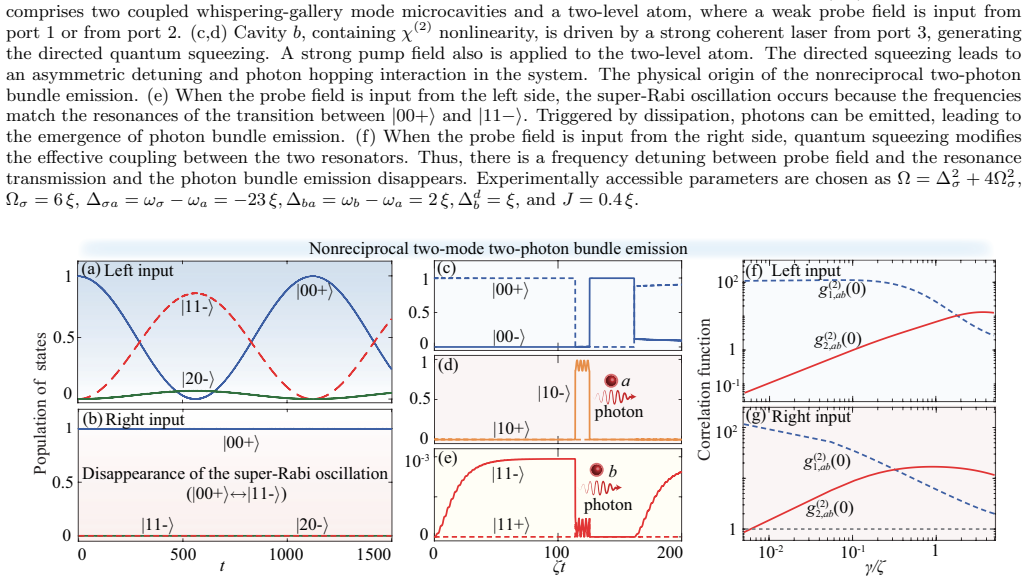
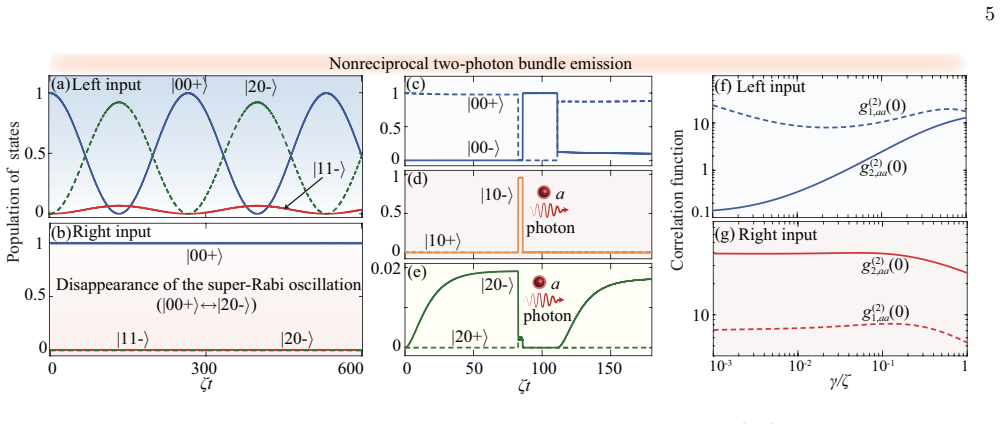
Directional quantum squeezing induces asymmetric frequency detuning and photon hopping interaction between the two resonators, leading to the directional excitation of the two-photon super-Rabi oscillation. By harnessing intrinsic dissipation of the system, two types of two-photon bundle emission can be selectively induced for the probe field input from one direction while it is prohibited with the probe from the other direction.
What carries the argument
Directional quantum squeezing, which produces the asymmetric detuning and hopping that enables one-way two-photon super-Rabi oscillation.
If this is right
- Nonreciprocal multiquanta emission becomes achievable through an all-optical mechanism without external fields.
- The same directional control can be applied to chiral quantum emitters.
- Backscattering-immune photonic communications become feasible using the induced asymmetry.
- Two distinct types of two-photon bundles can be toggled by input direction alone.
Where Pith is reading between the lines
- The mechanism may extend to higher-order photon bundles by adjusting the squeezing strength.
- Circuit-QED realizations could test the effect at microwave frequencies with existing hardware.
- The approach connects nonreciprocal optics to squeezing-based sources without requiring topological structures.
Load-bearing premise
Directional quantum squeezing can be realized in the compound resonator-atom system without unmodeled losses or noise that would erase the required asymmetry.
What would settle it
An experiment that measures equal two-photon bundle emission rates for probe light entering from both directions, despite the presence of directional squeezing, would falsify the claimed nonreciprocity.
Figures

read the original abstract
Quantum squeezing, a cornerstone of quantum optics and photonics, has played a key role in achieving ultra-precision sensing and realizing nonreciprocal engineering. However, the nonreciprocal multiquanta emission has remained largely unexplored by using directional quantum squeezing. Here, the one-way photon-photon bundle emission in a compound system consisted of two coupled optical resonators and a two-level atom is investigated. It is found that the directional quantum squeezing induces the asymmetric frequency detuning and photon hopping interaction between the two resonators, leading to the directional excitation of the two-photon super-Rabi oscillation. In particular, by harnessing intrinsic dissipation of the system, two types of two-photon bundle emission can be selectively induced for the probe field input from one direction while it is prohibited with the probe from the other direction. This finding bridges the broad fields ranging from nonreciprocal physics to quantum squeezing optics and multiquanta emission control through an all-optical approach, which can enable potential applications in chiral quantum emitters and backscattering-immune photonic communications.
Editorial analysis
A structured set of objections, weighed in public.
Referee Report
Summary. The manuscript proposes a scheme for nonreciprocal two-photon bundle emission in a compound system of two coupled optical resonators and a two-level atom. Directional quantum squeezing is shown to induce asymmetric frequency detuning and photon hopping, enabling directional two-photon super-Rabi oscillations. Harnessing the system's intrinsic dissipation then allows selective induction of two types of two-photon bundle emission for a probe field incident from one direction while prohibiting it from the opposite direction.
Significance. If the central derivations hold, the result would link directional squeezing to controlled multiquanta emission and nonreciprocity via an all-optical mechanism, potentially enabling applications in chiral quantum emitters and backscattering-immune photonic systems. The explicit use of intrinsic dissipation for directionality is a constructive feature.
major comments (1)
- [model and Hamiltonian section] The central claim rests on directional quantum squeezing producing asymmetric detuning and hopping without reciprocal loss channels. The model description does not specify the microscopic implementation (auxiliary drives or engineered baths) or demonstrate that these elements preserve one-way super-Rabi oscillations under realistic parameters; this is load-bearing for the nonreciprocity result.
minor comments (1)
- [results section] Notation for the two types of bundle emission and the super-Rabi frequency should be defined explicitly with equations rather than descriptive text.
Simulated Author's Rebuttal
We thank the referee for their careful reading of the manuscript and for identifying this important point regarding the model section. We address the comment below and have prepared revisions to strengthen the presentation of the directional squeezing implementation.
read point-by-point responses
-
Referee: [model and Hamiltonian section] The central claim rests on directional quantum squeezing producing asymmetric detuning and hopping without reciprocal loss channels. The model description does not specify the microscopic implementation (auxiliary drives or engineered baths) or demonstrate that these elements preserve one-way super-Rabi oscillations under realistic parameters; this is load-bearing for the nonreciprocity result.
Authors: We agree that a more explicit discussion of the microscopic origin is warranted. In the revised manuscript we add a dedicated paragraph in the model section outlining an all-optical implementation via auxiliary coherent drives applied to the two resonators, which generate the directional squeezing terms in the effective Hamiltonian without introducing additional reciprocal loss channels. We also include numerical simulations using experimentally accessible parameters (squeezing amplitudes up to 0.3, resonator decay rates of order 0.01–0.05 in normalized units, and atom-resonator coupling strengths consistent with circuit-QED platforms) that confirm the directional super-Rabi oscillations remain intact and the nonreciprocity is preserved. These additions directly address the load-bearing aspect of the claim. revision: yes
Circularity Check
No significant circularity; derivation is self-contained from model assumptions
full rationale
The paper posits directional quantum squeezing as an input mechanism that induces asymmetric detuning and hopping between resonators, then derives directional two-photon super-Rabi oscillations and selective bundle emission via intrinsic dissipation. No load-bearing step reduces a prediction to a fitted parameter, self-citation, or redefinition by construction; the central nonreciprocity follows from the stated asymmetry without tautological closure. The analysis remains independent of external benchmarks as a proposed physical effect.
Axiom & Free-Parameter Ledger
axioms (1)
- domain assumption Standard quantum optical models (master equation, squeezing operators) apply to the resonator-atom system
Reference graph
Works this paper leans on
-
[1]
Dell’Anno, S
F. Dell’Anno, S. D. Siena, F. Illuminati,Phys. Rep. 2006,428, 53–168
2006
-
[2]
Pan, Z.-B
J.-W. Pan, Z.-B. Chen, C.-Y. Lu, H. Weinfurter, A. Zeilinger, M. ˙Zukowski,Rev. Mod. Phys.2012,84, 777
2012
-
[3]
D’Angelo, M
M. D’Angelo, M. V. Chekhova, Y. Shih,Phys. Rev. Lett. 2001,87, 013602
2001
-
[4]
A. N. Boto, P. Kok, D. S. Abrams,Phys. Rev. Lett.2000, 85, 2733
2000
-
[5]
H. J. Kimble,Nature2008,453, 1023–1030
-
[6]
Thew,Nat
N, Gisin, R. Thew,Nat. Photonics2007,1, 165–171
-
[7]
Giovannetti, S
V. Giovannetti, S. Lloyd, L. Maccone,Science2004,306, 1330–1336
-
[8]
Giovannetti, S
V. Giovannetti, S. Lloyd, L. Maccone,Nat. Photonics 2011,5, 222–229
2011
-
[9]
C. S. Mu˜ noz, E. del Valle, A. G. Tudela, K. M¨ uller, S. Lichtmannecker, M. Kaniber, C. Tejedor, J. J. Fin- ley, F. P. Laussy,Nat. Photonics2014,8, 550–555. 7
-
[10]
C. S. Mu˜ noz, F. P. Laussy, C. Tejedor, E. del Valle,New J. Phys.2015,17, 123021
2015
-
[11]
Chang, A
Y. Chang, A. Gonz´ alez-Tudela, C. S. Mu˜ noz, C. Navarrete-Benlloch, T. Shi,Phys. Rev. Lett.2016, 117, 203602
2016
-
[12]
C. S. Mu˜ noz, F. P. Laussy, E. del Valle, C. Tejedor, A. Gonz´ alez-Tudela,Optica2018,5, 14–26
-
[13]
Q. Bin, Y. Wu, X.-Y. L¨ u,Phys. Rev. Lett.2021,127, 073602
2021
-
[14]
Jiang, F
S.-Y. Jiang, F. Zou, Y. Wang, J.-F. Huang, X.-W. Xu, J.-Q. Liao,Opt. Express2023,31, 15697
-
[15]
J. Tang, Y. G. Deng,APL Photonics2023,8, 076103
-
[16]
C. D. Gou, J. Xu, F. Wang, X. M. Hu,New J. Phys. 2024,26, 073046
2024
-
[17]
Gonz´ aez-Tudela, V
A. Gonz´ aez-Tudela, V. Paulisch, D. E. Chang, H. J. Kim- ble, J. I. Cirac,Phys. Rev. Lett.2015,115, 163603
2015
-
[18]
Gonz´ aez-Tudela, V
A. Gonz´ aez-Tudela, V. Paulisch, H. J. Kimble, J. I. Cirac, Phys. Rev. Lett.2017,118, 213601
2017
-
[19]
F. Xing, Z. Y. Liao, X.-H. Wang,Phys. Rev. A2024, 109, 013718
-
[20]
Zou, J.-Q
F. Zou, J.-Q. Liao, Y. Li,Phys. Rev. A2022,105, 053507
-
[21]
G. C. M´ enard, A. Peugeot, C. Padurariu, C. Rolland, B. Kubala, Y. Mukharsky, Z. Iftikhar, C. Altimiras, P. Roche,et al.,Phys. Rev. X2022,12, 021006
-
[22]
Chiarella, T
G. Chiarella, T. Frank, P. Farrera, G. Rempe,Optica Quantum2024,2, 346–350
-
[23]
Y. G. Deng, T. Shi, S. Yi,Photonics Res.2021,9, 1289
2021
-
[24]
Bin, X.-Y
Q. Bin, X.-Y. L¨ u, F. P. Laussy, F. Nori, Y. Wu,Phys. Rev. Lett.2020,124, 053601
2020
-
[25]
H. Y. Yuan, J. K. Xie, R. A. Duine,Phys. Rev. Applied 2023,19, 064070
2023
-
[26]
Bin, Q.-Y
Q. Bin, Q.-Y. Qiu, Y. Wu, X.-Y. L¨ u,Laser Photonics Rev.2024,18, 2300977
2024
-
[27]
C. D. Gou, X. M. Hu, J. Xu, F. Wang,Phys. Rev. Re- search2024,6, 023052
-
[28]
D. L. Sounas, A. Al` u,Nat. Photonics2017,11, 774–783
-
[29]
Peng, S ¸
B. Peng, S ¸. K. ¨Ozdemir, F. C. Lei, F. Monifi, M. Gi- anfreda, G. L. Long, S. H. Fan, F. Nori, C. M. Bender, L. Yang,Nat. Phys.2014,10, 394–398
2014
-
[30]
Y. Shi, Z. Yu, S. Fan,Nat. Photonics2015,9, 388–392
-
[31]
Shen, Y.-L
Z. Shen, Y.-L. Zhang, Y. Chen, C.-L. Zou, Y.-F. Xiao, X.-B. Zou, F.-W. Sun, G.-C. Guo, C.-H. Dong,Nat. Pho- tonics2016,10, 657–661
-
[32]
Maayani, R
S. Maayani, R. Dahan, Y. Kligerman, E. Moses, A. U. Hassan, H. Jing, F. Nori, D. N. Christodoulides, T. Carmon,Nature2018,558, 569–572
-
[33]
Zhang, Y
S. Zhang, Y. Hu, G. Lin, Y. P. Niu, K. Y. Xia, J. B. Gong, S. Q. Gong,Nat. Photonics2018,12, 744–748
-
[34]
K. Y. Xia, F. Nori, M. Xiao,Phys. Rev. Lett.2018,121, 203602
2018
-
[35]
Cotrufo, A
M. Cotrufo, A. Cordaro, D. L. Sounas, A. Polman, A. Al` u,Nat. Photonics,2024,18, 81–90
2024
-
[36]
Z. N. Zhang, A. K. Dehaghi, P. Ghosh, L. X. Zhu,Phys. Rev. Lett.2025,135, 016901
2025
-
[37]
X. M. Li, H. C. Yang, E. Z. Wu, X. C. Yao, Y. Li, F. Gao, H. S. Chen, Z. J. Wang,Nat. Commun.2025,16, 7703
2025
-
[38]
Q. Bin, H. Jing, Y. Wu, F. Nori, X.-Y. L¨ u,Phys. Rev. Lett.2024,133, 043601
2024
-
[39]
D. F. Walls,Nature1983,306, 141–146
-
[40]
R. E. Slusher, L. W. Hollberg, B. Yurke, J. C. Mertz, J. F. Valley,Phys. Rev. Lett.1985,55, 2409–2412
1985
-
[41]
L. A. Wu, H. J. Kimble, J. L. Hall, H. F. Wu,Phys. Rev. Lett.1986,57, 2520–2523
1986
-
[42]
A. E. Ulanov, B. Ruhnke, T. Wildi, T. Herr,Nat. Com- mun.2025,16, 10791
2025
-
[43]
Schnabel,Physics Reports2017,684, 1–51
R. Schnabel,Physics Reports2017,684, 1–51
-
[44]
C. M. Caves, K. S. Thorne, R. W. P. Drever,Rev. Mod. Phys.1980,52, 341
1980
-
[45]
C. M. Caves,Phys. Rev. D1981,23, 1693
-
[46]
Grote, K
H. Grote, K. Danzmann, K. L. Dooley, J. Slutsky, H. Vahlbruch,Phys. Rev. Lett.2013,110, 181101
2013
-
[47]
J. Aasi, J. Abadie, B. P. Abbott, R. Abbott, T. D. Ab- bott, M. R. Abernathy, C. Adams, T. Adams, P. Ad- desso,et al.,Nat. Photonics2013,7, 613–619
-
[48]
M. Tse, H. C. Yu, N. Kijbunchoo, A. Fernandez-Galiana, P. Dupej, L. Barsotti, C. D. Blair, D. D. Brown, S. E. Dwyer,et al.,Phys. Rev. Lett.2019,123, 231107
2019
-
[49]
S. L. Braunstein, P. van Loock,Rev. Mod. Phys.2005, 77, 513
2005
-
[50]
X.-Y. L¨ u, Y. Wu, J. R. Johansson, H. Jing, J. Zhang, F. Nori,Phys. Rev. Lett.2015,114, 093602
2015
-
[51]
Leroux, L
C. Leroux, L. C. G. Govia, A. A. Clerk,Phys. Rev. Lett. 2018,120, 093602
2018
-
[52]
W. Qin, A. Miranowicz, P. B. Li, X.-Y. L¨ u, J. Q. You, F. Nori,Phys. Rev. Lett.2018,120, 093601
2018
-
[53]
W. Qin, A. Miranowicz, F. Nori,Phys. Rev. Lett.2024, 133, 233605
2024
-
[54]
Fruchart, R
M. Fruchart, R. Hanai, P. B. Littlewood, V. Vitelli,Na- ture2021,592, 363–369
-
[55]
Huang, A
R. Huang, A. Miranowicz, J.-Q. Liao, F. Nori, H. Jing, Phys. Rev. Lett.2018,121, 153601
2018
-
[56]
B. J. Li, R. Huang, X. W. Xu, A. Miranowicz, H. Jing, Photonics Res.2019,7, 630–641
2019
-
[57]
B. J. Li, S ¸. K. ¨Ozdemir, X.-W. Xu, L. Zhang, L.- M. Kuang, H. Jing,Phys. Rev. A2021,103, 053522
-
[58]
B. J. Li, Y. L. Zuo, L.-M. Kuang, H. Jing, C. H. Lee,npj Quantum Inf.2024,10, 75
2024
-
[59]
Ahmadi, P
B. Ahmadi, P. Mazurek, P. Horodecki, S. Barzanjeh, Phys. Rev. Lett.2024,132, 210402
2024
-
[60]
Veenstra, O
J. Veenstra, O. Gamayun, X. F. Guo, A. Sarvi, C. V. Meinersen, C. Coulais,Nature2024,627, 528–533
-
[61]
Zhu, C.-S
G.-L. Zhu, C.-S. Hu, H. Wang, W. Qin, X.-Y. L¨ u, F. Nori, Phys. Rev. Lett.2024,132, 193602
2024
-
[62]
Nadolny, C
T. Nadolny, C. Bruder, M. Brunelli,Phys. Rev. X2025, 15, 011010
-
[63]
Z. M. Zhang, Z. X. Xu, R. Huang, X. D. Lu, F. B. Zhang, D. H. Li, S ¸. K. ¨Ozdemir, F. Nori, H. Bao,et al.,Nat. Photonics2025,19, 840–846
-
[64]
L. Tang, J. S. Tang, M. Y. Chen, F. Nori, M. Xiao, K. Y. Xia,Phys. Rev. Lett.2022,128, 083604
2022
-
[65]
Huang, Y.-B
S.-T. Huang, Y.-B. Qian, Z.-Y. Zhang, L. Sun, B. P. Hou, L. Tang,Adv. Quantum Technol.2024,7, 2400217
2024
-
[66]
Shen, J.-Q
C.-P. Shen, J.-Q. Chen, X.-F. Pan, Y.-M. Ren, X.- L. Dong, X.-L.Hei, Y.-F. Qiao, P.-B. Li,Phys. Rev. A 2023,108, 023716
2023
-
[67]
Wang, L.-L
D.-Y. Wang, L.-L. Yan, S.-L. Su, C.-H. Bai, H.-F. Wang, E. Liang,Opt. Express2023,31, 22343–22357
-
[68]
Liu, K.-W
D.-W. Liu, K.-W. Huang, Y. Wu, L.-G. Si,Appl. Phys. Lett.2023,123, 061103
2023
-
[69]
Huang, Y
K.-W. Huang, Y. Wu, L.-G. Si,Opt. Lett.2022,47, 3311–3314
2022
-
[70]
T.-X. Lu, Y. Wang, K. Y. Xia, X. Xiao, L.-M. Kuang, H. Jing,Sci. China Phys. Mech. Astron.2024,67, 260312
2024
-
[71]
Jiao, S.-D
Y.-F. Jiao, S.-D. Zhang, Y.-L. Zhang, A. Miranowicz, L.- 8 M. Kuang, H. Jing,Phys. Rev. Lett.2020,125, 143605
2020
-
[72]
T.-X. Lu, B. J. Li, Y. Wang, D.-Y. Wang, X. Xiao, H. Jing,Phys. Rev. Applied2024,22, 064001
-
[73]
Zhang, B
J. Zhang, B. Peng, S ¸. K. ¨Ozdemir, K. Pichler, D. O. Krimer, G. M. Zhao, F. Nori, Y.-x. Liu, S. Rotter, L. Yang,Nat. Photon.2018,12, 479–484
2018
-
[74]
Z. W. Pan, Y. Yang, W. Y. Liu, E. B. Xing, Y. R. Zhou, J. Tang, J. Liu,Laser Photonics Rev.2024,18, 2400593
2024
-
[75]
Y. Tao, W. Y. Liu, S. X. Wang, C.M. Nan, L. Liu, Y. Bai, Y. R. Zhou, E. B. Xing, J. Tang, J. Liu,Opt. Express 2024,32, 79–91
2024
-
[76]
S. X. Wang, W. Y. Liu, Y. Tao, X. S. Ding, C. M. Nan, Y. R. Zhou, L. Liu, Y. Bai, E. B. Xing, J. Tang, J. Liu, J. Lightwave Technol.2024,42, 3884-3890
2024
-
[77]
Wang, Y.-H
J.-Q. Wang, Y.-H. Yang, M. Li, X.-X. Hu, J. B. Surya, X.-B. Xu, C.-H. Dong, G.-C. Guo, H. X. Tang,et al., Phys. Rev. Lett.2021,126, 133601
2021
-
[78]
Zhang, B
M. Zhang, B. Buscaino, C. Wang, A. Shams-Ansari, C. Reimer, R. R. Zhu, J. M. Kahn, M. Lonˇ car,Nature 2019,568, 373–377
2019
-
[79]
X. Y. Lu, G. Moille, A. Rao, D. A. Westly, K. Srinivasan, Nat. Photonics2021,15, 131–136
-
[80]
C. W. Gardiner, P. Zoller,Quantum Noise(Springer, Berlin, 2000)
2000
discussion (0)
Sign in with ORCID, Apple, or X to comment. Anyone can read and Pith papers without signing in.