Analytical performance evaluation of quantum radar architectures: From single-photon to entangled-noise radars
Pith reviewed 2026-06-27 13:22 UTC · model grok-4.3
The pith
Analytical expressions using the Lambert W function give the maximum detection range for single-photon and entangled-noise quantum radars.
A machine-rendered reading of the paper's core claim, the machinery that carries it, and where it could break.
Core claim
The central claim is that the maximum detection range for both single-photon direct-detection quantum radars and quantum-entangled noise radars can be expressed analytically using the Lambert W function once all relevant system, target, and environmental parameters are included, and that the entangled noise radar can therefore be regarded as an enhanced direct-detection radar possessing an effective threshold signal-to-noise ratio.
What carries the argument
The Lambert W function expressions for maximum detection range that fold in every listed system, target, and environmental parameter, together with the range enhancement factor (REF) that quantifies the advantage of quantum entanglement over classical noise correlation.
If this is right
- Direct comparison between noise radars and direct-detection radars becomes possible through the shared analytical form.
- A quantum-entangled noise radar behaves as a direct-detection radar whose effective threshold signal-to-noise ratio is lowered by entanglement.
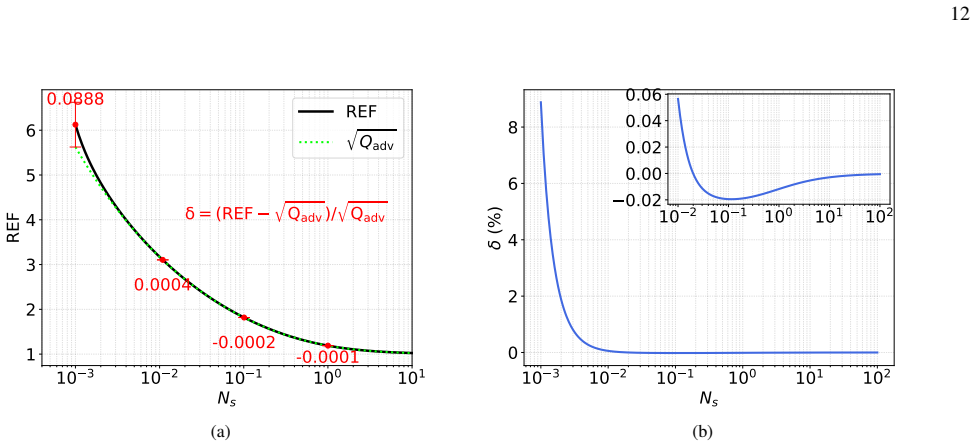
- The range enhancement factor quantifies how much farther the entangled version reaches than its classical-correlated counterpart.
- A simple rule-of-thumb approximation exists for the range enhancement factor.
- Current microwave detection technology already permits entangled-noise radars with maximum ranges on the order of a few kilometers, with the best results obtained by combining a quantum transducer and an optical-photon detector.
Where Pith is reading between the lines
- - The antenna limitation identified in the analysis implies that further range gains would require targeted improvements in microwave antenna design rather than detector upgrades alone.
- - The closed-form range expressions could be used to optimize operating frequencies or bandwidths for specific atmospheric conditions not explicitly varied in the paper.
- - Side-by-side experimental comparison of entangled and classical noise radars under identical parameters would directly test the predicted range enhancement factor.
- - The few-kilometer feasibility window opens the possibility of testing these radars in short-range remote-sensing or perimeter-monitoring scenarios.
Load-bearing premise
The models for signal propagation, target reflectivity, and noise statistics are assumed to permit a closed-form solution via the Lambert W function without additional approximations that would invalidate the range expressions.
What would settle it
A laboratory or field measurement of actual maximum detection range for a given set of system, target, and environmental parameters that deviates systematically from the numerical value returned by the Lambert W expression.
Figures





read the original abstract
This article presents a comprehensive analysis of two classes of quantum radars, including quantum direct-detection and quantum-entangled noise radars. In the first case, inspired by the well-established concept of single-photon LiDARs, we investigated the performance of single-photon radars, in which state-of-the-art single microwave-photon detectors are employed to enhance the detection sensitivity and enable the detection of weaker signals. We derived analytical expressions for the maximum detection range of both classes of quantum radars in terms of the Lambert W function, by considering all relevant system, target, and environmental parameters. Our formulation facilitates direct comparison of noise radars with direct-detection radars and suggests that a quantum-entangled noise radar can be regarded as an enhanced direct-detection radar with an effective threshold signal-to-noise ratio. Furthermore, we applied this framework to classical-correlated noise radars and defined the parameter range enhancement factor (REF) to quantify the superiority of quantum-entangled noise radars over their classical counterparts. Moreover, we introduced a rule-of-thumb for approximating the REF. We also examined the influence of limitations imposed by various microwave detection technologies. Our analysis shows that the conventional antennas limit the potential benefits of quantum-entangled noise radar systems. We also demonstrated that the optimal detection method for these radars is a microwave detector based on a quantum transducer combined with a single optical-photon detector. We showed that, with the current technology, implementing a quantum-entangled noise radar with the maximum detection range on the order of few kilometers is possible. Finally, we explored the potential applications of quantum-entangled noise radars.
Editorial analysis
A structured set of objections, weighed in public.
Referee Report
Summary. The manuscript analyzes two classes of quantum radars: single-photon direct-detection radars and quantum-entangled noise radars. It derives closed-form analytical expressions for maximum detection range in both cases using the Lambert W function after incorporating system, target, and environmental parameters. The work frames quantum-entangled noise radars as enhanced direct-detection systems with an effective SNR threshold, introduces a range enhancement factor (REF) to quantify gains over classical-correlated noise radars, supplies a rule-of-thumb approximation for the REF, evaluates limitations from current microwave detection technologies, identifies quantum-transducer-plus-optical-photon-detector as optimal, and concludes that few-kilometer ranges are feasible with present technology.
Significance. If the derivations hold exactly, the paper supplies a useful closed-form framework that enables direct, parameter-inclusive comparison of quantum radar architectures without requiring numerical simulation for each scenario. The explicit Lambert W expressions and the REF metric constitute concrete, falsifiable tools for performance evaluation; the identification of technologically feasible detection chains and the practical range estimate are additional strengths that could inform experimental road-mapping in quantum radar research.
major comments (1)
- [Derivation of maximum detection range] Derivation of maximum detection range (section presenting the Lambert W expressions): the central claim that the SNR or photon-count threshold equation rearranges exactly into canonical Lambert-W form x exp(x) = g(parameters) must be verified by displaying the intermediate detection-threshold equation and the algebraic rearrangement steps. Any non-exponential factors arising from entangled-noise statistics, transduction efficiency, or atmospheric propagation would invalidate the closed-form claim unless shown to cancel or be negligible.
minor comments (2)
- [Abstract] Abstract: the phrase 'all relevant system, target, and environmental parameters' would be clearer if accompanied by an explicit enumeration or reference to the parameter list used in the range formulas.
- [REF approximation] REF rule-of-thumb: a short derivation or error-bound analysis for the approximation would strengthen the practical utility claim.
Simulated Author's Rebuttal
We thank the referee for the positive assessment and constructive comment. We address the single major comment below.
read point-by-point responses
-
Referee: [Derivation of maximum detection range] Derivation of maximum detection range (section presenting the Lambert W expressions): the central claim that the SNR or photon-count threshold equation rearranges exactly into canonical Lambert-W form x exp(x) = g(parameters) must be verified by displaying the intermediate detection-threshold equation and the algebraic rearrangement steps. Any non-exponential factors arising from entangled-noise statistics, transduction efficiency, or atmospheric propagation would invalidate the closed-form claim unless shown to cancel or be negligible.
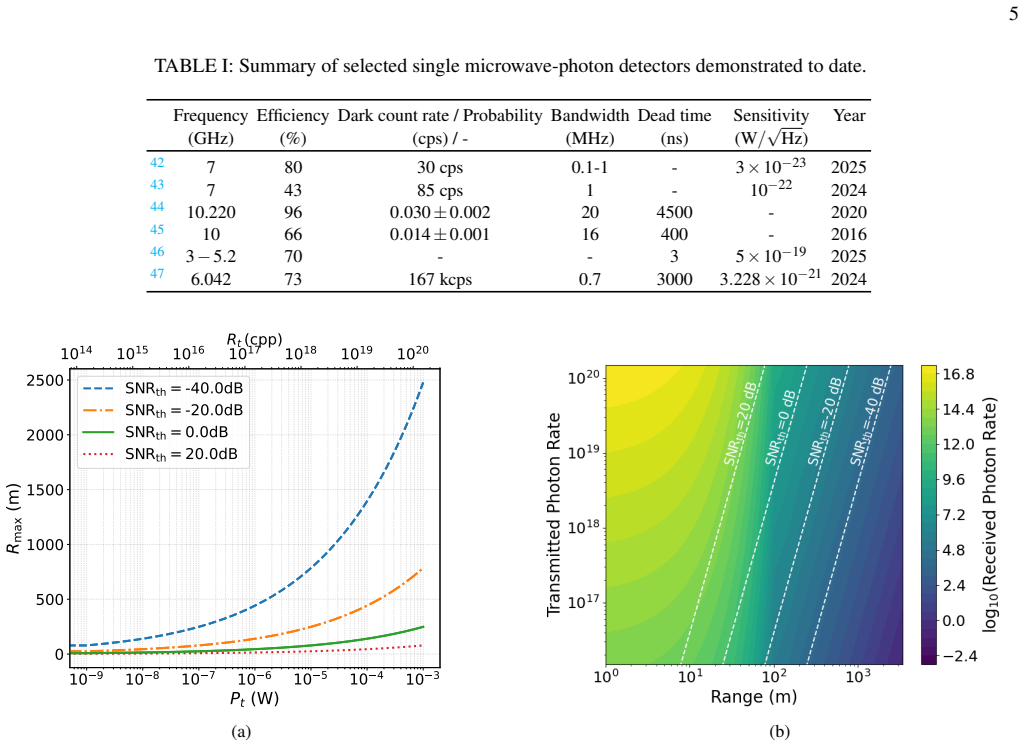
Authors: We agree that the intermediate steps must be shown explicitly. In the revised manuscript we will insert the detection-threshold equation (SNR or photon-count form) together with the algebraic manipulations that reduce it to canonical Lambert-W form x exp(x) = g(parameters). Entangled-noise statistics enter solely through an effective SNR threshold; transduction efficiency appears as a constant multiplicative prefactor that is absorbed into g; atmospheric propagation contributes an exponential attenuation that combines with the range-dependent term to preserve the exact x exp(x) structure. The added derivation will display these cancellations step by step. revision: yes
Circularity Check
No circularity: Lambert W range expressions are algebraic rearrangements of detection equations
full rationale
The paper sets up detection threshold equations incorporating system, target, and environmental parameters, then solves for maximum range R via the Lambert W function when the functional form permits exact rearrangement to x exp(x) = g(parameters). This is a direct mathematical inversion of the model equations rather than a self-definitional loop, fitted input renamed as prediction, or load-bearing self-citation. No uniqueness theorems, ansatzes, or prior author results are invoked to force the form; the REF is explicitly defined as a comparative metric. The derivation chain is therefore self-contained and externally verifiable against the stated propagation and noise models.
Axiom & Free-Parameter Ledger
Reference graph
Works this paper leans on
-
[1]
Guarnieri, ``The Early History of Radar [Historical]," IEEE Ind
M. Guarnieri, ``The Early History of Radar [Historical]," IEEE Ind. Electron. Mag., vol. 4, no. 3, pp. 36-42, Sept. 2010, DOI 10.1109/MIE.2010.937936
-
[2]
Alistair, and Donald Russell Reynolds, ``Radar entomology: observing insect flight and migration,'' Cabi, 2012
Drake, V. Alistair, and Donald Russell Reynolds, ``Radar entomology: observing insect flight and migration,'' Cabi, 2012
2012
-
[3]
B. J. Jang, S. H. Wi, J. G. Yook, M. Q. Lee, and K. J. Lee, ``Wireless bio-radar sensor for heartbeat and respiration detection," Prog. Electromagn. Res. C, vol. 5, pp. 149-168, Dec. 2008, DOI 10.2528/PIERC08110603
-
[4]
Creed, J
L. Creed, J. Graham, C. Jenkins, S. Diaz-Riofrio, A. Wilson, and M. Vasile. (2021, October) STRATHcube: the design of a CubeSat for space debris detection using in-orbit passive bistatic radar. presented at 72nd International Astronautical Congress
2021
-
[5]
Kauffman, ``Radar based navigation in unknown terrain,'' Air Force Institute of Technology, 2012
Kyle J. Kauffman, ``Radar based navigation in unknown terrain,'' Air Force Institute of Technology, 2012
2012
-
[6]
S. Bauer, J. W. Chapman, D. R. Reynolds, J. A. Alves, A. M. Dokter, M. M. H. Menz, N. Sapir, M. Ciach, L. B. Pettersson, J. F. Kelly, H. Leijnse, J. Shamoun-Baranes, ``From agricultural benefits to aviation safety: realizing the potential of continent-wide radar networks," BioScience, vpl. 67, no. 10, pp. 912-918, Jun. 2017, DOI 10.1093/biosci/bix074
-
[7]
E. Morganti, L. Angelini, A. Adami, D. Lalanne, L. Lorenzelli, E. Mugellini, ``A smart watch with embedded sensors to recognize objects, grasps and forearm gestures," Proc. Eng., vol. 41, pp. 1169-1175, 2012, DOI 10.1016/j.proeng.2012.07.297
-
[8]
Skolnik, ``Radar handbook,'' McGraw-Hill Education, 2008
Merrill I. Skolnik, ``Radar handbook,'' McGraw-Hill Education, 2008
2008
-
[9]
R. M. Narayanan, Y. Xu, P. D. Hoffmeyer, and J. O. Curtis, ``Design, performance, and applications of a coherent ultra-wideband random noise radar,"Opt. Eng., vol. 37, no. 6. pp. 1855-1869, Jun. 1998, DOI 10.1117/1.601699
-
[10]
Lukin, ``Noise radar technology," Telecom
Konstantin A. Lukin, ``Noise radar technology," Telecom. Rad. Eng., vol. 55, no. 12, 2001, DOI 10.1615/TelecomRadEng.v55.i12.20
-
[11]
K. Savci, A. G. Stove, F. De Palo, A. Y. Erdogan, G. Galati, K. A. Lukin, S. Lukin, P. Marques, G. Pavan, C. Wasserzier, ``Noise Radar?Overview and Recent Developments," IEEE Aerosp. Electron. Syst. Mag., vol. 35, no. 9, pp. 8-20, Sept. 2020, DOI 10.1109/MAES.2020.2990591
-
[12]
D. Massaro, R. Ardoino, and M. Grazzini, ``An Efficient Processing Architecture for Range Profiling Using Noise Radar Technology," Aerospace, vol. 5, no. 1, Jan. 2018, DOI 10.3390/aerospace5010004
-
[13]
Torrom \'e , Ricardo Gallego and Barzanjeh, Shabir, ``Advances in quantum radar and quantum LiDAR," Prog. Quant. Electron., pp. 100497, 2023, DOI 10.1016/j.pquantelec.2023.100497
-
[14]
Shapiro, Jeffrey H., ``The quantum illumination story," IEEE Aerosp. Electron. Syst. Mag., vol. 35, no. 4, pp. 8-20, 2020, DOI 10.1109/MAES.2019.2957870
-
[15]
Pirandola, Stefano, B. Roy Bardhan, Tobias Gehring, Christian Weedbrook, and Seth Lloyd, ``Advances in photonic quantum sensing," Nat. Photonics, vol. 12, no. 12, pp. 724-733, 2018, DOI 10.1038/s41566-018-0301-6
-
[16]
Lloyd, ``Enhanced sensitivity of photodetection via quantum illumination," Science, vol
S. Lloyd, ``Enhanced sensitivity of photodetection via quantum illumination," Science, vol. 321, no. 5895, pp. 1463-1465, 2008, DOI 10.1126/science.1160627
-
[17]
E. D. Lopaeva, I. R. Berchera, I. P. Degiovanni, S. Olivares, G. Brida, and M. Genovese, ``Experimental realization of quantum illumination," Phys. Rev. Lett., vol. 110, no. 15, pp. 153603, 2013, DOI https://doi.org/10.1103/PhysRevLett.110.153603
-
[18]
Sh. Barzanjeh, S. Guha, Ch. Weedbrook, D. Vitali, J. H. Shapiro, and S. Pirandola, ``Microwave quantum illumination," Phys. Rev. Lett., vol. 114, no. 8, pp. 080503, 2015, DOI https://doi.org/10.1103/PhysRevLett.114.080503
-
[19]
Luong, B
D. Luong, B. Balaji, C. W. Sandbo Chang, V. M. Ananthapadmanabha Rao and C. Wilson, ''Microwave Quantum Radar: An Experimental Validation," In 2018 International Carnahan Conference on Security Technology (ICCST), Montreal, QC, Canada, 2018 , pp. 1-5
2018
-
[20]
Balaji, ``Quantum radar: Snake oil or good idea?," In 2018 International Carnahan Conference on Security Technology (ICCST), Montreal, QC, Canada, 2018, pp
B. Balaji, ``Quantum radar: Snake oil or good idea?," In 2018 International Carnahan Conference on Security Technology (ICCST), Montreal, QC, Canada, 2018, pp. 1-7
2018
-
[21]
Ph. S. Blakey, H. Liu, G. Papangelakis, Y. Zhang, Z. M. Leger, M. L. Iu, and A. S. Helmy, ``Quantum and non-local effects offer over 40dB noise resilience advantage towards quantum lidar," Nat. Commun., vol. 13, no. 1, pp. 5633, 2022, DOI https://doi.org/10.1038/s41467-022-33376-9
-
[22]
H. Liu, Ch. Qin, G. Papangelakis, M. L. Iu, and A. S. Helmy, ``Compact all-fiber quantum-inspired LiDAR with over 100dB noise rejection and single photon sensitivity," Nat Commun., vol. 14, no. 1, pp. 5344, 2023, DOI https://doi.org/10.1038/s41467-023-40914-6
-
[23]
Reichert, R
M. Reichert, R. Di Candia, M. Z. Win, M. Sanz, ``Quantum-enhanced Doppler lidar," npj Quantum Inf., vol. 8, no. 1, pp. 147, 2022
2022
-
[24]
R. J. Murchie, J. D. Pritchard and J. Jeffers, ``Object detection and rangefinding with quantum states using simple detection," arXiv:2307.10785v3 [quant-ph], 2023
arXiv 2023
-
[25]
M. P. Mrozowski, R. J. Murchie, J. Jeffers, and J. D. Pritchard, ``Demonstration of quantum-enhanced rangefinding robust against classical jamming," Opt. Exp., vol. 32, no. 3, pp. 1916-2928, 2024, DOI https://doi.org/10.1364/OE.503619
- [26]
-
[27]
D. Wang, J. Zhao, Y. Wang, L. Zhou, and Y. Zhao, ``Quantum secured LiDAR with Gaussian modulated coherent states," arXiv:2308.12171v1 [quant-ph], 2023
arXiv 2023
-
[28]
R. Murray, and A. Lyons, ``Two-photon interference LiDAR imaging," Opt. Exp., vol. 30, no. 15, pp. 27164-27170, 2022, DOI https://doi.org/10.1364/OE.461248
-
[29]
Thomas Brougham, Nigam Samantaray, and John Jeffers, ``Using random coherent states to mimic quantum illumination," Phys. Rev. A, vol. 108, no. 5, pp. 052404, Nov. 2023, DOI https://doi.org/10.1103/PhysRevA.108.052404
-
[30]
A. Karsa, G. Spedalieri, Q. Zhuang, and S. Pirandola, ``Quantum illumination with a generic Gaussian source," Phys. Rev. Res., vol. 2, no. 2, pp. 023414, June. 2020, DOI 10.1103/PhysRevResearch.2.023414
-
[31]
S. Barzanjeh, S. Pirandola, D. Vitali, and J. M. Fink ``Microwave quantum illumination using a digital receiver," Sci. Adv., vol. 6, no. 19, pp. eabb0451, May. 2020, DOI 10.1126/sciadv.abb0451
-
[32]
Luong, I
D. Luong, I. W. K. Lam, B. Balaji, and S. Rajan, ``Correlation Coefficient vs. Transmit Power for an Experimental Noise Radar," In 2023 IEEE Radar Conference (RadarConf23), San Antonio, TX, USA, 2023, pp. 1-5
2023
-
[33]
Livreri, E
P. Livreri, E. Enrico, D. Vitali, and A. Farina, ``Microwave Quantum Radar using a Josephson Traveling Wave Parametric Amplifier and a Phase-Conjugate Receiver for a long-distance detection," 2023 IEEE Radar Conference (RadarConf23), San Antonio, TX, USA, 2023, pp. 1-5
2023
-
[34]
Livreri, E
P. Livreri, E. Enrico, L. Fasolo, G. Di Giuseppe, N. Malossi, P. Piergentili, and D. Vitali, ``Microwave Quantum Radar based on a Josephson Traveling wave Parametric Amplifier and a Phase-Conjugate Receiver," TechRxiv.21778007.v1, 2022
2022
-
[35]
D. Luong, B. Balaji and S. Rajan, ``Performance Prediction for Coherent Noise Radars Using the Correlation Coefficient," IEEE Access, vol. 10, pp. 8627-8633, 2022, DOI 10.1109/ACCESS.2021.3135292
-
[36]
R. Wei, J. Li, W. Wang, Zh. Ye, Ch. Zhao, and Q. Guo, ``Evaluating the detection range of microwave quantum illumination radar," IET Radar. Sonar. Nav., vol. 17, no. 11, pp. 1664-1673, Aug. 2023, DOI https://doi.org/10.1049/rsn2.12456
-
[37]
F. Bischeltsrieder, M. W \"u rth, J Russer, M. Peichl, and W. Utschick, ``Engineering Constraints and Application Regimes of Quantum Radar," IEEE Trans. Radar Syst., vol. 2, pp. 197--214, Feb. 2024, DOI 10.1109/TRS.2024.3361048
-
[38]
P. Livreri, B. Galvano, L. Fasolo, L. Oberto, E. Enrico, ``Josephson Traveling Wave Parametric Amplifier as Quantum Source of Entangled Photons for Microwave Quantum Radar Applications," ELECTROMAGNETIC WAVES, vol. 179, pp. 113--124, 2024, DOI https://dx.doi.org/10.2528/pier24041705
-
[39]
M. Ankel, R. Jonsson, T. Bryllert, L. M. H. Ulander, and P. Delsing, ``Bistatic noise radar: Demonstration of correlation noise suppression," IET Radar, Sonar. Navigation, vol. 17, no. 3, pp. 351, Nov. 2023, DOI https://doi.org/10.1049/rsn2.12345
-
[40]
R. M. Corless, G. H. Gonnet, D. EG. Hare, D. J. Jeffrey, and D.E. Knuth,``On the Lambert W function," Advances in Computational mathematics, vol. 5, pp. 329--359, 1996, DOI https://doi.org/10.1007/BF02124750
-
[41]
Steinvall, ``Laser system range calculations and the Lambert W function," Applied Optics, vol
O. Steinvall, ``Laser system range calculations and the Lambert W function," Applied Optics, vol. 48, pp. B1--B7, 2008, DOI https://doi.org/10.1364/AO.48.0000B1
-
[42]
Enhancing the sensitivity of single microwave photon detection with bandwidth tunability
L. Pallegoix, J. Travesedo, A. S. May, L. Balembois, D. Vion, P. Bertet, E. Flurin, ``Enhancing the sensitivity of single microwave photon detection with bandwidth tunability," arXiv preprint arXiv:2501.07354 2025, DOI https://doi.org/10.48550/arXiv.2501.07354
work page internal anchor Pith review Pith/arXiv arXiv doi:10.48550/arxiv.2501.07354 2025
-
[43]
L. Balembois, J. Travesedo, L. Pallegoix, A. May, E. Billaud, M. Villiers, D. Estève, D. Vion, P. Bertet, E. Flurin, ``Cyclically operated microwave single-photon counter with sensitivity of 10^ -22 W/ Hz " Physical Review Applied, vol. 21, pp. 014043, 2024, DOI https://doi.org/10.1103/PhysRevApplied.21.014043
-
[44]
R. Dassonneville, R. Assouly, T. Peronnin, P. Rouchon, B. Huard, ``Number-resolved photocounter for propagating microwave mode" Physical Review Applied, vol. 14, pp. 044022, 2020, DOI https://doi.org/10.1103/PhysRevApplied.14.044022
-
[45]
K. Inomata, Z. Lin, K Koshino, W. D. Oliver, J. S. Tsai, T. Yamamoto, Y. Nakamura, ``Single microwave-photon detector using an artificial -type three-level system" Nature communications, vol. 7, pp.12303, 2016, DOI 10.1038/ncomms12303
-
[46]
F. Oppliger, W. Jang, A. Tarascio, F. De Palma, C. Reichl, W. Wegscheider, V. F. Maisi, D. Zumb \"u hl, and P. Scarlino, ``High-Efficiency Tunable Microwave Photon Detector Based on a Semiconductor Double Quantum Dot Coupled to a Superconducting High-Impedance Cavity" arXiv preprint arXiv:2506.19828, 2025, DOI arXiv preprint arXiv:2506.19828
Pith/arXiv arXiv 2025
-
[47]
K. Petrovnin, J. Wang, M. Perelshtein, P. Hakonen, and G. S. Paraoanu, ``Microwave photon detection at parametric criticality" PRX Quantum, vol. 5, pp.020342, 2024, DOI https://doi.org/10.1103/PRXQuantum.5.020342
-
[48]
K. Liu, C. Luo, J. Yi, and H. Wang, ``Target detection method using heterodyne single-photon radar at terahertz frequencies" IEEE Geoscience and Remote Sensing Letters, vol. 19, pp.1--5, 2021, DOI 10.1109/LGRS.2021.3070546
-
[49]
Zh.-P. Li, J.-T. Ye, X. Huang, P. Jiang, Y. Cao, Y. Hong, Ch. Yu, J. Zhang, Q. Zhang, Ch.-Zh. Peng, F. Xu, and J.-W. Pan, ``Single-photon imaging over 200 km," Optica. vol. 8, no.3, pp. 344-349, 2021, DOI https://doi.org/10.1364/OPTICA.408657
-
[50]
L. M. Hirvonen and K. Suhling, ``Wide-field TCSPC: methods and applications" Measurement Science and Technology, vol. 28, no. 1, pp.012003, 2016, DOI 10.1088/1361-6501/28/1/012003
-
[51]
Attenuation by atmospheric gases and related effects,
P. Series "Attenuation by atmospheric gases and related effects," Rec, ITU-R, vol. 25, pp. 676-12, 2019
2019
-
[52]
D. Luong, S. Rajan and B. Balaji, ``Entanglement-Based Quantum Radar: From Myth to Reality," IEEE Aerospace and Electronic Systems Magazine, vol. 35, no. 4, pp. 22-35, 2020, DOI 10.1109/MAES.2020.2970261
-
[53]
C. W. Sandbo Chang, A. M. Vadiraj, J. Bourassa, B. Balaji and C. M. Wilson, ``Quantum-enhanced noise radar," Appl. Phys. Lett. vol. 114, no. 11, 2019, DOI https://doi.org/10.1063/1.5085002
-
[54]
G. Sorelli, N. Treps, F. Grosshans and F. Boust, ``Detecting a Target With Quantum Entanglement," IEEE Aerospace and Electronic Systems Magazine.vol. 37, no. 5, pp. 68-90, 2022, DOI 10.1109/MAES.2021.3116323
-
[55]
M. Dawood and R. M. Narayanan, ``Receiver operating characteristics for the coherent UWB random noise radar," IEEE Transactions on Aerospace and Electronic Systems, vol. 37, no. 2, pp. 586-594, 2021, DOI 10.1109/7.937470
-
[56]
R. W. Boyd, G. S. Agarwal, W. V. Davis, A. L. Gaeta, E. M. Nagasako, andM. Kauranen, ``Quantum noise characteristics of nonlinear optical amplifiers," Acta Physica Polonica A, vol. 86, no. 1, pp. 117--126, 1994
1994
-
[57]
S. Guha, B. I. Erkmen, ``Gaussian-state quantum-illumination receivers for target detection," Physical Review A—Atomic, Molecular, and Optical Physics, vol. 80, pp. 052310, 2009, DOI https://doi.org/10.1103/PhysRevA.80.052310
-
[58]
Frasca and A
M. Frasca and A. Farina, ``Entangled coherent states for quantum radar applications," 2020 IEEE International Radar Conference (RADAR), Washington, DC, USA, 2020, pp. 969-972
2020
-
[59]
D. Luong, C. W. Sandbo Chang, A. M. Vadiraj, A. Damini, C. M. Wilson, and B. Balaji ``Receiver operating characteristics for a prototype quantum two-mode squeezing radar," IEEE Transactions on Aerospace and Electronic Systems, vol. 56, no. 3, pp. 2041-2060, 2019, DOI 10.1109/TAES.2019.2951213
-
[60]
Luong, S
D. Luong, S. Rajan and B. Balaji, ``Estimating Correlation Coefficients for Quantum Radar and Noise Radar: A Simulation Study," 2019 IEEE Global Conference on Signal and Information Processing (GlobalSIP), Ottawa, ON, Canada, 2019, pp. 1-5
2019
-
[61]
D. Makarov, ``Theory for the beam splitter in quantum optics: Quantum entanglement of photons and their statistics, HOM effect," Mathematics, vol. 10, no. 24, pp. 4794, 2022, DOI https://doi.org/10.3390/math10244794
-
[62]
Microwave Quantum Radar using a Josephson Traveling Wave Parametric Amplifier,
P. Livreri, E. Enrico, L. Fasolo, A. Greco, A. Rettaroli, D. Vitali, A. Farina, Com. F. Marchetti, and A. Sq. D. Giacomin, "Microwave Quantum Radar using a Josephson Traveling Wave Parametric Amplifier," 2022 IEEE Radar Conference (RadarConf22), 2022, pp. 1-5
2022
-
[63]
Flux-driven Josephson traveling-wave parametric amplifier,
AB. Zorin, "Flux-driven Josephson traveling-wave parametric amplifier," Phys. Rev. Appl., vol. 12, no. 4, pp. 044051, Oct. 2019, DOI 10.1103/PhysRevApplied.12.044051
-
[64]
u hne, L. Pascarella, and M. Magno,
J. Mandula, J. K \"u hne, L. Pascarella, and M. Magno, "Towards real-time fast unmanned aerial vehicle detection using dynamic vision sensors," arXiv preprint arXiv:2403.11875, 2024, DOI https://doi.org/10.48550/arXiv.2403.11875
-
[65]
Microwave Quantum Radar using a Josephson Traveling Wave Parametric Amplifier and a Phase-Conjugate Receiver for a long-distance detection,
P. Livreri, E. Enrico, D. Vitali, and A. Farina, "Microwave Quantum Radar using a Josephson Traveling Wave Parametric Amplifier and a Phase-Conjugate Receiver for a long-distance detection," 2023 IEEE Radar Conference (RadarConf23), San Antonio, TX, USA, 2023, pp. 1-5
2023
-
[66]
Photonic radar for contactless vital sign detection,
Z. Zhang, Y. Liu, T. Stephens, B. J. Eggleton, "Photonic radar for contactless vital sign detection," Nature Photonics, vol. 17, no. 9, pp. 791--797, 2023, DOI https://doi.org/10.1038/s41566-023-01245-6
-
[67]
Radar ornithology and biological conservation,
J. Gauthreaux, A. Sidney, and C. G. Belser, "Radar ornithology and biological conservation," The Auk, vol. 120, no. 2, pp. 266--277, 2003, DOI https://doi.org/10.1093/auk/120.2.266
-
[68]
Lieutenant-Commander Graham Hill, ``Quantum Radar Is Stealth Radar: Examining the Potential Impact on the Defence Team," Available: https://www.cfc.forces.gc.ca/259/290/24/192/Hill
-
[69]
B. Balaji, M. Frasca and A. Farina, ``Quantum Radar Research: A Snapshot in Time," IEEE Aerospace and Electronic Systems Magazine, vol. 35, no. 4, pp. 74-76, 2020, DOI 10.1109/MAES.2020.2977800
-
[70]
Thermal agitation of electricity in conductors,
J. B. Johnson, "Thermal agitation of electricity in conductors," Physical review, vol. 32, no. 1, pp. 97, 1928, DOI https://doi.org/10.1103/PhysRev.32.97
-
[71]
Perspectives on quantum transduction
N. Lauk, N. Sinclair, S. Barzanjeh, J. P. Covey, M. Saffman, M. Spiropulu, and C. Simon, "Perspectives on quantum transduction" Quantum Science and Technology, vol. 5, no. 2, pp. 020501, 2020, DOI 10.1088/2058-9565/ab788a
-
[72]
Quantum-enabled microwave-to-optical transduction via silicon nanomechanics,
H. Zhao, W. D. Chen, A. Kejriwal, and M. Mirhosseini, "Quantum-enabled microwave-to-optical transduction via silicon nanomechanics," Nature Nanotechnology, pp. 1--7, 2025, DOI https://doi.org/10.1038/s41565-025-01874-8
-
[73]
and Gu, M., ``How discord underlies the noise resilience of quantum illumination," New J
Weedbrook, C., Pirandola, S., Thompson, J., Vedral, V. and Gu, M., ``How discord underlies the noise resilience of quantum illumination," New J. Phys., vol. 18, no. 4, pp. 043027, 2016, DOI 10.1088/1367-2630/18/4/043027
-
[74]
and Lloyd, S., ``Optimality of Gaussian discord," Phys
Pirandola, S., Spedalieri, G., Braunstein, S.L., Cerf, N.J. and Lloyd, S., ``Optimality of Gaussian discord," Phys. Rev. Lett., vol. 113, no. 14, pp. 140405, 2014, DOI 10.1103/PhysRevLett.113.140405
-
[75]
Devetak, Igor, and Andreas Winter, ``Distilling common randomness from bipartite quantum states," IEEE Trans. Inf. Theory, vol. 50, no. 12, pp. 3183-3196, 2004, DOI 10.1109/TIT.2004.838115
-
[76]
M. Aspelmeyer, T. J. Kippenberg, and F. Marquardt, ``Cavity optomechanics," Rev. Mod. Phys., vol. 86, no. 4, pp. 1391, 2014, DOI https://doi.org/10.1103/RevModPhys.86.1391
-
[77]
P. Ghelfi, F. Laghezza, F. Scotti, G. Serafino, A. Capria, S. Pinna, D. Onori, C. Porzi, M. Scaffardi, A. Malacarne, V. Vercesi, E. Lazzeri, F. Berizzi, and A. Bogoni, ``A fully photonics-based coherent radar system," Nat., vol. 507, no. 7492, pp. 341-345, 2014, DOI https://doi.org/10.1038/nature13078
-
[78]
M. Bonaldi, A. Borrielli, G. Di Giuseppe, N. Malossi, B. Morana, R. Natali, P. Piergentili, P. M. Sarro, E. Serra, and D. Vitali ``Low Noise Opto-Electro-Mechanical Modulator for RF-to-Optical Transduction in Quantum Communications," Entropy, vol. 25, no. 7, pp. 1087, 2023, DOI https://doi.org/10.3390/e25071087
-
[79]
T. Gonzalez-Raya, and M. Sanz, ``Coplanar antenna design for microwave entangled signals propagating in open air," Quantum, vol. 6, pp. 783, 2022, DOI 10.22331/q-2022-08-23-783
-
[80]
P. Vezio, M. Bonaldi, A. Borrielli, F. Marino, B. Morana, P. M. Sarro, E. Serra, and F. Marin, ``Optical self-cooling of a membrane oscillator in a cavity optomechanical experiment at room temperature," Phys. Rev. A, vol. 108, no. 10, pp. 063508, Dec 2023, DOI 10.1103/PhysRevA.108.063508
discussion (0)
Sign in with ORCID, Apple, or X to comment. Anyone can read and Pith papers without signing in.