The dynamics of the Anglerfish cluster
Pith reviewed 2026-06-27 12:32 UTC · model grok-4.3
The pith
The Anglerfish cluster MACS0600 is undergoing a merger in which a compact cool core has crossed the main cluster without complete disruption.
A machine-rendered reading of the paper's core claim, the machinery that carries it, and where it could break.
Core claim
MACS0600 is undergoing a merger in which a compact cool core has crossed the main, more massive cluster without being completely disrupted, while significantly perturbing the surrounding ICM.
What carries the argument
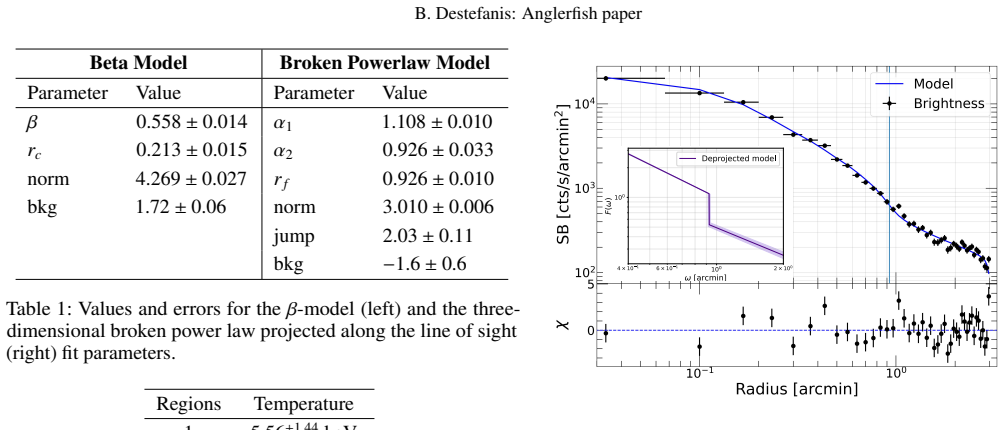
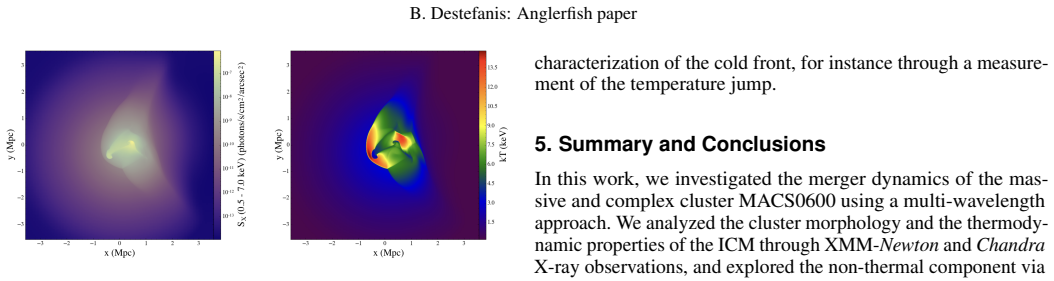
Multi-wavelength dynamical reconstruction that combines X-ray surface-brightness discontinuities, temperature maps, radio-X-ray spatial offsets, and optical velocity indicators to distinguish a line-of-sight merger geometry from other projections.
If this is right
- Cool cores can survive passage through a more massive cluster when the merger axis is close to the line of sight.
- Merger-driven turbulence elevates central temperatures and powers the observed diffuse radio emission.
- Cold-front edges mark the boundary where the infalling core has displaced the ambient ICM.
- Accounting for projection effects is required to avoid misinterpreting substructure in complex clusters.
Where Pith is reading between the lines
- The survival of the cool core implies that the duration and impact parameter of the encounter are short enough to limit stripping.
- Similar radio-X-ray mismatches may serve as quick indicators for recent core-crossing events in other clusters.
- Numerical simulations of line-of-sight mergers could be compared directly to the observed temperature and radio maps to test the reconstruction.
- The perturbed ICM around the cool core may seed future sloshing or additional radio emission on longer timescales.
Load-bearing premise
The observed X-ray peak offset, cold front, and radio mismatch arise from a line-of-sight merger rather than a different viewing angle or unrelated substructures.
What would settle it
Absence of a measurable line-of-sight velocity difference between galaxies associated with the cool core and those of the main cluster in deeper spectroscopic data.
Figures



read the original abstract
Merging galaxy clusters represent the ideal laboratory to test our understanding of the large scale structure formation history and the processes involved. While many merging clusters have been identified, only a limited number have been studied in detail through multi-wavelength analysis and dynamical reconstruction, this type of analysis being crucial to account for projection degeneracies. This work investigates the merger dynamics of the massive and complex cluster MACS0600 using high spatial, $\sim 15$ arcsec, radio and X-ray datasets in combination with ancillary optical data. We analyze the cluster morphology and the thermodynamic properties of the intracluster medium (ICM) through XMM-Newton and Chandra X-ray observations, and explore the non-thermal component via diffuse radio emission observed with Meerkat. We find a disturbed X-ray morphology with multiple substructures and a clear offset between the bulk of the radio emission and the X-ray peak. At the location of the X-ray peak, we detect a compact cool core surrounded by hotter gas and associated with a surface brightness discontinuity consistent with a cold front. The central region exhibits elevated temperatures and hosts most of the diffuse radio emission, suggesting merger-driven turbulence. Optical data further support a relative motion between the cool core and the main cluster along the line of sight. We conclude that MACS0600 is undergoing a merger in which a compact cool core has crossed the main, more massive cluster without being completely disrupted, while significantly perturbing the surrounding ICM.
Editorial analysis
A structured set of objections, weighed in public.
Referee Report
Summary. The manuscript presents a multi-wavelength study of the galaxy cluster MACS0600 (the Anglerfish cluster) combining XMM-Newton and Chandra X-ray data, MeerKAT radio observations, and ancillary optical data. It reports a disturbed X-ray morphology with multiple substructures, an offset between the bulk of the diffuse radio emission and the X-ray peak, a compact cool core at the X-ray peak surrounded by hotter gas and bounded by a surface-brightness discontinuity interpreted as a cold front, elevated central temperatures, and optical indications of relative motion along the line of sight. The central claim is that MACS0600 is undergoing a merger in which a compact cool core has already crossed the main, more massive cluster along the line of sight without complete disruption while perturbing the ICM.
Significance. If the line-of-sight merger geometry is robustly established, the work supplies a well-observed example of cool-core survival through a cluster crossing and the resulting ICM turbulence, adding to the small sample of clusters with detailed dynamical reconstructions. The direct use of public high-resolution X-ray and radio datasets to identify morphological and thermodynamic features is a clear strength.
major comments (1)
- [Conclusion / dynamical reconstruction] Conclusion and dynamical-reconstruction discussion: the claim that the observed X-ray peak offset, cold-front discontinuity, radio-X-ray spatial mismatch, and optical data indicate a specific line-of-sight merger in which the cool core has already crossed the main cluster rests on qualitative morphological arguments. No quantitative test (forward modeling of surface-brightness and temperature maps, velocity-dispersion constraints, or comparison to hydrodynamical simulations viewed at multiple angles) is supplied to discriminate this geometry from a transverse merger or unrelated substructure alignments, despite the abstract explicitly noting that accounting for projection degeneracies is crucial. This leaves the central dynamical interpretation underconstrained.
minor comments (2)
- [X-ray thermodynamic properties section] The thermodynamic analysis would benefit from explicit comparison of the reported central temperature elevation to expectations from merger-driven turbulence models or to control samples of relaxed clusters.
- [Radio analysis] Figure captions and text should clarify the precise spatial resolution and smoothing scales applied to the MeerKAT radio image when discussing the radio-X-ray offset.
Simulated Author's Rebuttal
We thank the referee for the constructive feedback on our multi-wavelength analysis of MACS0600. We address the major comment below and will revise the manuscript accordingly to strengthen the discussion of the dynamical interpretation.
read point-by-point responses
-
Referee: [Conclusion / dynamical reconstruction] Conclusion and dynamical-reconstruction discussion: the claim that the observed X-ray peak offset, cold-front discontinuity, radio-X-ray spatial mismatch, and optical data indicate a specific line-of-sight merger in which the cool core has already crossed the main cluster rests on qualitative morphological arguments. No quantitative test (forward modeling of surface-brightness and temperature maps, velocity-dispersion constraints, or comparison to hydrodynamical simulations viewed at multiple angles) is supplied to discriminate this geometry from a transverse merger or unrelated substructure alignments, despite the abstract explicitly noting that accounting for projection degeneracies is crucial. This leaves the central dynamical interpretation underconstrained.
Authors: We agree that the dynamical reconstruction relies on a qualitative synthesis of multiple independent observables rather than quantitative forward modeling or hydrodynamical simulations. The interpretation is motivated by the specific combination of a compact cool core with a bounding cold front at the X-ray peak, the spatial offset of the bulk radio emission, elevated central temperatures, and optical indications of line-of-sight relative motion. These features are difficult to reconcile with a purely transverse merger or chance alignments, but we acknowledge the projection degeneracy. In revision we will expand the discussion section to explicitly enumerate alternative geometries (including transverse merger) and explain why the observed cold-front orientation and kinematic data favor the proposed line-of-sight crossing. A full suite of tailored simulations lies beyond the scope of this observational study. revision: partial
- Performing forward modeling of surface-brightness and temperature maps or comparison to hydrodynamical simulations at multiple viewing angles
Circularity Check
No circularity: conclusions drawn from direct multi-wavelength spatial data
full rationale
The paper presents an observational analysis of X-ray morphology, temperature structure, cold-front discontinuity, radio-X-ray offset, and optical velocity indicators to support a line-of-sight merger scenario. No equations, parameter fits, or derivations appear in the provided text; the central claim is an interpretive synthesis of observed features rather than a reduction of any quantity to itself by construction. Self-citation load-bearing, ansatz smuggling, or fitted-input-called-prediction patterns are absent. The noted projection degeneracy is a question of evidence completeness, not circularity in the derivation chain.
Axiom & Free-Parameter Ledger
Reference graph
Works this paper leans on
-
[1]
& Grevesse, N
Anders, E. & Grevesse, N. 1989, Geochim. Cosmochim. Acta, 53, 197
1989
-
[2]
W., Piffaretti, R., et al
Arnaud, M., Pratt, G. W., Piffaretti, R., et al. 2010, A&A, 517, A92
2010
-
[3]
2026, A&A, 707, A143
Balboni, M., Gastaldello, F., Bonafede, A., et al. 2026, A&A, 707, A143
2026
-
[4]
W., et al
Bartalucci, I., Arnaud, M., Pratt, G. W., et al. 2017, A&A, 608, A88
2017
-
[5]
2024, A&A, 689, A324
Bartalucci, I., Rossetti, M., Boschin, W., et al. 2024, A&A, 689, A324
2024
-
[6]
A., Biviano, A., & Abadi, M
Benavides, J. A., Biviano, A., & Abadi, M. G. 2023, A&A, 669, A147
2023
-
[7]
2019, A&A, 630, A77
Botteon, A., Cassano, R., Eckert, D., et al. 2019, A&A, 630, A77
2019
-
[8]
J., Brunetti, G., & Shimwell, T
Botteon, A., Markevitch, M., van Weeren, R. J., Brunetti, G., & Shimwell, T. W. 2023, A&A, 674, A53
2023
-
[9]
J., Eckert, D., et al
Botteon, A., van Weeren, R. J., Eckert, D., et al. 2024, A&A, 690, A222
2024
-
[10]
& Mazzotta, P
Bourdin, H. & Mazzotta, P. 2008, A&A, 479, 307
2008
-
[11]
2013, ApJ, 764, 82
Bourdin, H., Mazzotta, P., Markevitch, M., Giacintucci, S., & Brunetti, G. 2013, ApJ, 764, 82
2013
-
[12]
L., Slezak, E., Bijaoui, A., & Teyssier, R
Bourdin, H., Sauvageot, J. L., Slezak, E., Bijaoui, A., & Teyssier, R. 2004, A&A, 414, 429
2004
-
[13]
Briggs, D. S. 1995, in American Astronomical Society Meeting Abstracts, V ol. 187, American Astronomical Society Meeting Abstracts, 112.02
1995
-
[14]
& Jones, T
Brunetti, G. & Jones, T. W. 2014, International Journal of Modern Physics D, 23, 1430007
2014
-
[15]
G., Ettori, S., Lovisari, L., et al
Campitiello, M. G., Ettori, S., Lovisari, L., et al. 2022, A&A, 665, A117 CASA Team, Bean, B., Bhatnagar, S., et al. 2022, PASP, 134, 114501
2022
-
[16]
2006, MNRAS, 369, 1577
Cassano, R., Brunetti, G., & Setti, G. 2006, MNRAS, 369, 1577
2006
-
[17]
& Fusco-Femiano, R
Cavaliere, A. & Fusco-Femiano, R. 1976, A&A, 49, 137
1976
-
[18]
& Fusco-Femiano, R
Cavaliere, A. & Fusco-Femiano, R. 1978, A&A, 70, 677 CHEX-MATE Collaboration, Arnaud, M., Ettori, S., et al. 2021, A&A, 650, A104
1978
-
[19]
2019, A&A, 632, A27
Clavico, S., De Grandi, S., Ghizzardi, S., et al. 2019, A&A, 632, A27
2019
-
[20]
H., Arnaud, M., Pointecouteau, E., & Pratt, G
Croston, J. H., Arnaud, M., Pointecouteau, E., & Pratt, G. W. 2006, A&A, 459, 1007
2006
-
[21]
2006, Proceedings of SPIE - The International Society for Optical Engineering, 6269
Dalton, G., Caldwell, M., Ward, A., et al. 2006, Proceedings of SPIE - The International Society for Optical Engineering, 6269
2006
-
[22]
2013, MNRAS, 429, 3564
Donnert, J., Dolag, K., Brunetti, G., & Cassano, R. 2013, MNRAS, 429, 3564
2013
-
[23]
& Shectman, S
Dressler, A. & Shectman, S. A. 1988, AJ, 95, 985
1988
-
[24]
C., & Henry, J
Ebeling, H., Edge, A. C., & Henry, J. P. 2001, The Astrophysical Journal, 553, 668
2001
-
[25]
2020, The Open Journal of Astrophysics, 3, 12
Eckert, D., Finoguenov, A., Ghirardini, V ., et al. 2020, The Open Journal of Astrophysics, 3, 12
2020
-
[26]
2012, A&A, 540, A123
Einasto, M., Vennik, J., Nurmi, P., et al. 2012, A&A, 540, A123
2012
-
[27]
2010, A&A, 524, A68
Ettori, S., Gastaldello, F., Leccardi, A., et al. 2010, A&A, 524, A68
2010
-
[28]
2012, A&A Rev., 20, 54
Feretti, L., Giovannini, G., Govoni, F., & Murgia, M. 2012, A&A Rev., 20, 54
2012
-
[29]
C., Allen, G
Fruscione, A., McDowell, J. C., Allen, G. E., et al. 2006, in Society of Photo- Optical Instrumentation Engineers (SPIE) Conference Series, V ol. 6270, Ob- servatory Operations: Strategies, Processes, and Systems, ed. D. R. Silva & R. E. Doxsey, 62701V
2006
-
[30]
J., Zitrin, A., Richard, J., et al
Furtak, L. J., Zitrin, A., Richard, J., et al. 2024, Monthly Notices of the Royal Astronomical Society, 533, 2242
2024
-
[31]
2013, ApJ, 770, 56
Gastaldello, F., Di Gesu, L., Ghizzardi, S., et al. 2013, ApJ, 770, 56
2013
-
[32]
2005, A&A, 442, 29
Girardi, M., Demarco, R., Rosati, P., & Borgani, S. 2005, A&A, 442, 29
2005
-
[33]
A., Wittman, D., et al
Golovich, N., Dawson, W. A., Wittman, D., et al. 2016, ApJ, 831, 110
2016
-
[34]
A., Wittman, D
Golovich, N., Dawson, W. A., Wittman, D. M., et al. 2019, ApJS, 240, 39
2019
-
[35]
C., Harris, W
Hou, A., Parker, L. C., Harris, W. E., & Wilman, D. J. 2009, ApJ, 702, 1199
2009
-
[36]
2025, A&A, 694, A320
Hu, D., Werner, N., Xu, H., et al. 2025, A&A, 694, A320
2025
-
[37]
Hugo, B. V . 2021, Reference Flux Scale for MeerKAT: Long Term Observation and Field Modelling of PKS B0407-65
2021
-
[38]
2001, A&A, 365, L1
Jansen, F., Lumb, D., Altieri, B., et al. 2001, A&A, 365, L1
2001
-
[39]
& MeerKAT Team
Jonas, J. & MeerKAT Team. 2016, in MeerKAT Science: On the Pathway to the SKA, 1
2016
-
[40]
& Raftery, A
Kass, R. & Raftery, A. 1995, Journal of the american statistical association, 90, 773
1995
-
[41]
Kravtsov, A. V . & Borgani, S. 2012, ARA&A, 50, 353
2012
-
[42]
V ., Vikhlinin, A., & Nagai, D
Kravtsov, A. V ., Vikhlinin, A., & Nagai, D. 2006, ApJ, 650, 128
2006
-
[43]
R., Fekete, G., et al
Lupton, R., Blanton, M. R., Fekete, G., et al. 2004, PASP, 116, 133
2004
-
[44]
2019, Monthly Notices of the Royal Astronomical Society, 485, 2922
Lyskova, N., Churazov, E., Zhang, C., et al. 2019, Monthly Notices of the Royal Astronomical Society, 485, 2922
2019
-
[45]
& Vikhlinin, A
Markevitch, M. & Vikhlinin, A. 2007, Phys. Rep., 443, 1
2007
-
[46]
P., Waters, B., Schiebel, D., Young, W., & Golap, K
McMullin, J. P., Waters, B., Schiebel, D., Young, W., & Golap, K. 2007, in Astronomical Society of the Pacific Conference Series, V ol. 376, Astronomical Data Analysis Software and Systems XVI, ed. R. A. Shaw, F. Hill, & D. J. Bell, 127
2007
-
[47]
2026, arXiv e-prints, arXiv:2603.10187
Nishiwaki, K., Brunetti, G., Vazza, F., & Gheller, C. 2026, arXiv e-prints, arXiv:2603.10187
Pith/arXiv arXiv 2026
-
[48]
Offringa, A. R. 2010, AOFlagger: RFI Software, Astrophysics Source Code Library, record ascl:1010.017
2010
-
[49]
R., McKinley, B., Hurley-Walker, N., et al
Offringa, A. R., McKinley, B., Hurley-Walker, N., et al. 2014, MNRAS, 444, 606
2014
-
[50]
R., van de Gronde, J
Offringa, A. R., van de Gronde, J. J., & Roerdink, J. B. T. M. 2012, A&A, 539, A95
2012
-
[51]
B., Monteiro-Oliveira, R., Bagchi, J., et al
Pandge, M. B., Monteiro-Oliveira, R., Bagchi, J., et al. 2019, MNRAS, 482, 5093
2019
-
[52]
V ., Bonafede, A., Bernardi, G., et al
Pignataro, G. V ., Bonafede, A., Bernardi, G., et al. 2024, A&A, 691, A99
2024
-
[53]
O., & Bird, C
Pinkney, J., Roettiger, K., Burns, J. O., & Bird, C. M. 1996, ApJS, 104, 1 Planck Collaboration, Ade, P. A. R., Aghanim, N., et al. 2016, A&A, 594, A27
1996
-
[54]
W., Böhringer, H., Croston, J
Pratt, G. W., Böhringer, H., Croston, J. H., et al. 2007, A&A, 461, 71
2007
-
[55]
2020, in American Astronomical Society Meeting Abstracts, V ol
Rahaman, M., Datta, A., & Raja, R. 2020, in American Astronomical Society Meeting Abstracts, V ol. 236, American Astronomical Society Meeting Ab- stracts #236, 127.02
2020
-
[56]
& Ebeling, H
Repp, A. & Ebeling, H. 2018, MNRAS, 479, 844
2018
-
[57]
2020, ApJ, 893, 74
Ruppin, F., McDonald, M., Brodwin, M., et al. 2020, ApJ, 893, 74
2020
-
[58]
Sarazin, C. L. 1988, X-ray emission from clusters of galaxies (American Physical Society)
1988
-
[59]
2016, The R Journal, 8, 205
Scrucca, L., Fop, M., Murphy, T., & Raftery, A. 2016, The R Journal, 8, 205
2016
-
[60]
Sunyaev, R. A. & Zeldovich, Y . B. 1972, Comments on Astrophysics and Space Physics, 4, 173 van Weeren, R., de Gasperin, F., Akamatsu, H., et al. 2019, Space Sci. Rev., 215, 16 V oit, G. M. 2005, Reviews of Modern Physics, 77, 207
1972
-
[61]
C., Brinkman, B., Canizares, C., et al
Weisskopf, M. C., Brinkman, B., Canizares, C., et al. 2002, PASP, 114, 1
2002
-
[62]
ZuHone, J. A. 2011, ApJ, 728, 54
2011
-
[63]
A., Kowalik, K., Öhman, E., Lau, E., & Nagai, D
ZuHone, J. A., Kowalik, K., Öhman, E., Lau, E., & Nagai, D. 2018, ApJS, 234, 4 Article number, page 10 of 10
2018
discussion (0)
Sign in with ORCID, Apple, or X to comment. Anyone can read and Pith papers without signing in.