Feasibility demonstration of continuous signal-based neutron noise measurements by experiments and simulations
Pith reviewed 2026-06-27 10:55 UTC · model grok-4.3
The pith
Analyzing continuous detector current provides unbiased neutron noise parameters at high count rates.
A machine-rendered reading of the paper's core claim, the machinery that carries it, and where it could break.
Core claim
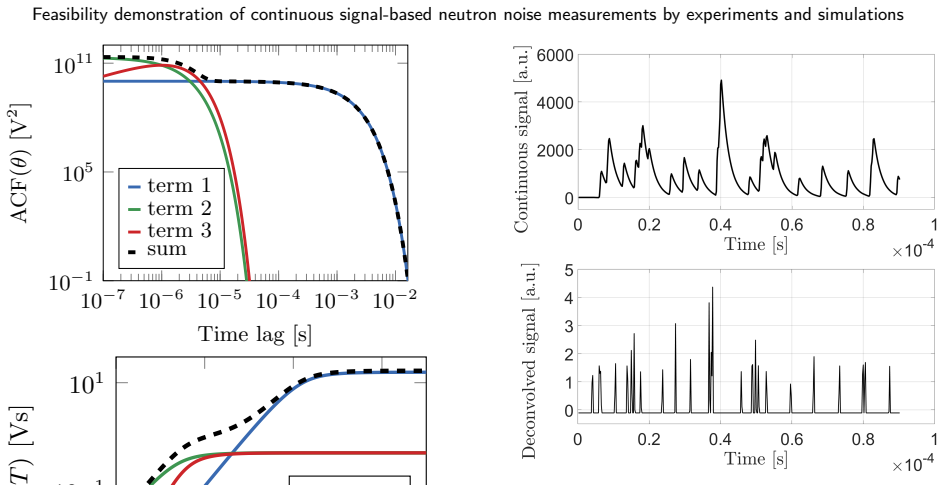
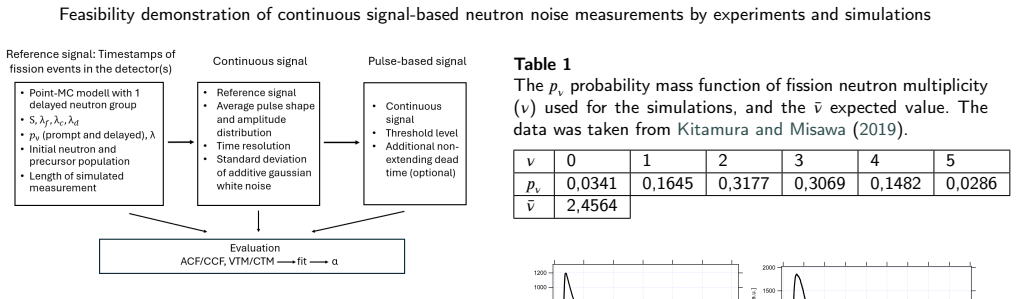
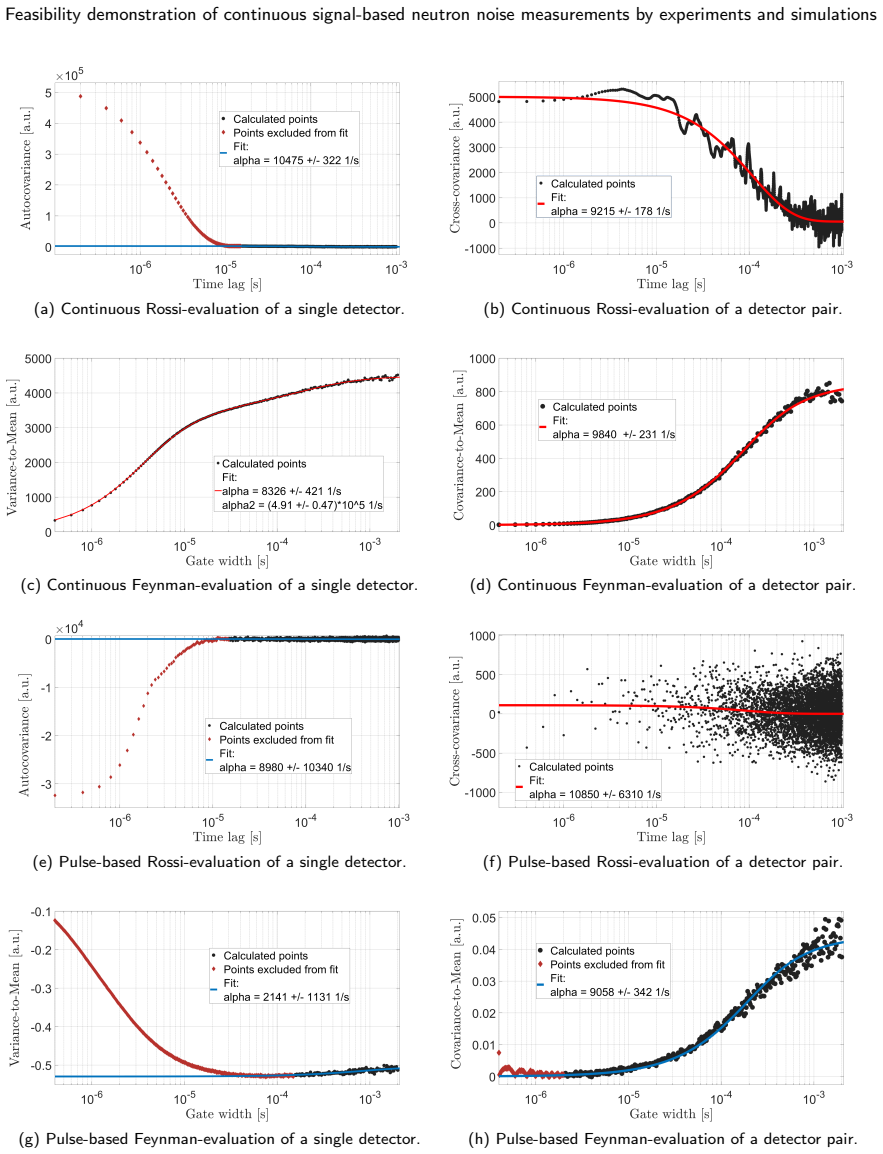
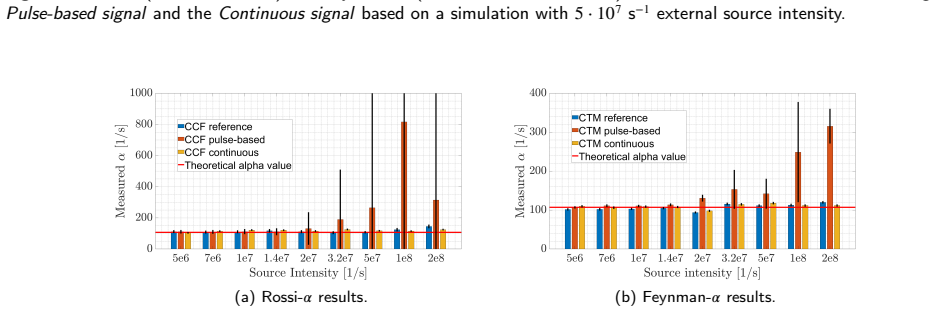
The stochastic model of the detector current is applied to derive Rossi- and Feynman-type formulations for the prompt neutron decay constant. Pulse-shape distortions are mitigated using detector pairs or by deconvolving the average pulse-shape through inverse Fourier and Wiener filtering. Simulations demonstrate accurate alpha-parameter estimation at count rates where pulse-counting becomes unusable and enable evaluation of significantly higher alpha values. Measurements confirm that continuous and deconvolved signals provide unbiased results despite dead-time and electronic artifacts.
What carries the argument
Stochastic model of the detector current, from which Rossi- and Feynman-type alpha formulations are derived after pulse-shape mitigation.
If this is right
- Accurate estimation of the alpha parameter at count rates where pulse counting fails.
- Ability to evaluate higher values of the prompt neutron decay constant.
- Establishment of continuous signal analysis as a practical alternative for high-rate reactor noise diagnostics.
- Unbiased results from deconvolved signals in presence of dead-time artifacts.
Where Pith is reading between the lines
- This approach may allow noise diagnostics in reactor regimes previously inaccessible due to high count rates.
- If scalable, it could simplify instrumentation by tolerating standard electronics with post-processing corrections.
- Similar continuous-signal techniques might apply to other stochastic processes in radiation detection.
Load-bearing premise
The stochastic model of the detector current accurately represents the physics and that pulse-shape distortions can be fully removed by detector pairs or deconvolution without introducing new bias.
What would settle it
Observation of systematic bias in the estimated prompt neutron decay constant from continuous signals after deconvolution at high rates would falsify the feasibility claim.
Figures




read the original abstract
Neutron noise methods are used to determine kinetic parameters such as the prompt neutron decay constant, but traditional pulse-counting suffers from dead-time and pile-up at high detection rates. Recent theory shows that analysing the continuous detector current can avoid these limitations if pulse-shape effects are properly treated. This work presents a feasibility study of continuous-signal neutron noise analysis based on simulations and experiments performed at two research reactors. The stochastic model of the detector current is applied to derive Rossi- and Feynman-type formulations, and pulse-shape distortions are mitigated using detector pairs or by deconvolving the average pulse-shape through inverse Fourier and Wiener filtering. Simulations demonstrate accurate $\alpha$-parameter estimation at count rates where pulse-counting becomes unusable, and enable evaluation of significantly higher $\alpha$ values. Measurements at KUCA and BME TR confirm that continuous and deconvolved signals provide unbiased results despite dead-time and electronic artifacts, establishing the method as a practical alternative for high-rate reactor noise diagnostics.
Editorial analysis
A structured set of objections, weighed in public.
Referee Report
Summary. The paper claims that continuous detector current signals, analyzed via stochastic-model-derived Rossi- and Feynman-type formulations with pulse-shape mitigation by detector-pair subtraction or inverse-Fourier/Wiener deconvolution of the average pulse shape, yield accurate and unbiased estimates of the prompt neutron decay constant alpha at high count rates where traditional pulse counting fails due to dead time and pile-up. This is supported by simulations showing accurate alpha recovery and by reactor measurements at KUCA and BME TR that confirm unbiased results despite artifacts.
Significance. If the unbiasedness claim holds after proper validation of the deconvolution step, the method would provide a practical alternative for high-rate neutron noise diagnostics, enabling measurements at higher alpha values and count rates than pulse-based techniques allow, which is relevant for reactor kinetics and safety analysis.
major comments (2)
- [Abstract / mitigation steps] Abstract and methods section on mitigation: the claim that continuous and deconvolved signals provide unbiased alpha estimates requires explicit demonstration that the average pulse shape used in the Wiener filter was not extracted from the identical high-rate traces (which contain dead-time and pile-up). If the shape is data-derived rather than from separate low-rate calibration, residual correlated artifacts can propagate into the autocorrelation or variance, violating the unbiasedness asserted in the derivation of the Rossi/Feynman expressions from the stochastic current model.
- [Results] Results section (simulations and reactor measurements): the abstract states 'accurate alpha-parameter estimation' and 'unbiased results' but the provided text contains no quantitative values, error bars, comparison metrics, or exclusion criteria for the reported alpha; without these, the central claim that the method works 'at count rates where pulse-counting becomes unusable' cannot be verified.
minor comments (2)
- [Theory/derivation] Clarify notation for the stochastic current model and the exact form of the derived Rossi- and Feynman-type expressions; ensure they are written out with all assumptions stated.
- [Results] Add quantitative tables or plots comparing alpha from continuous vs. pulse methods, including uncertainties, for both simulations and the two reactor experiments.
Simulated Author's Rebuttal
We thank the referee for the constructive comments on our manuscript. We address each major point below and will revise the paper to improve clarity and verifiability.
read point-by-point responses
-
Referee: [Abstract / mitigation steps] Abstract and methods section on mitigation: the claim that continuous and deconvolved signals provide unbiased alpha estimates requires explicit demonstration that the average pulse shape used in the Wiener filter was not extracted from the identical high-rate traces (which contain dead-time and pile-up). If the shape is data-derived rather than from separate low-rate calibration, residual correlated artifacts can propagate into the autocorrelation or variance, violating the unbiasedness asserted in the derivation of the Rossi/Feynman expressions from the stochastic current model.
Authors: We agree this requires explicit clarification. The average pulse shape for the Wiener filter was derived from separate low-rate calibration measurements acquired under conditions without pile-up or dead-time, not from the high-rate analysis traces. We will revise the methods section to state this explicitly and confirm the separation of calibration and analysis datasets, thereby preserving the unbiasedness of the derived Rossi/Feynman expressions. revision: yes
-
Referee: [Results] Results section (simulations and reactor measurements): the abstract states 'accurate alpha-parameter estimation' and 'unbiased results' but the provided text contains no quantitative values, error bars, comparison metrics, or exclusion criteria for the reported alpha; without these, the central claim that the method works 'at count rates where pulse-counting becomes unusable' cannot be verified.
Authors: The full results section reports quantitative alpha values with uncertainties from simulations and KUCA/BME TR experiments, including direct comparisons to pulse-counting limits. To enhance verifiability as requested, we will add an explicit summary table listing alpha estimates, error bars, count rates, and comparison metrics in the revised manuscript. revision: yes
Circularity Check
No significant circularity; derivations are self-contained from stochastic model
full rationale
The paper derives Rossi- and Feynman-type formulations directly from the stochastic model of the detector current, then applies standard mitigation techniques (detector-pair subtraction or Wiener deconvolution) to handle pulse-shape effects. No quoted equations or steps reduce the target quantities (such as alpha) to fitted parameters by construction, nor do any load-bearing premises collapse to self-citations whose content is unverified. The central claim that continuous signals yield unbiased results after mitigation rests on the external validity of the stochastic model and the deconvolution method, not on internal redefinition. This is the normal case of a derivation that remains independent of its fitted outputs.
Axiom & Free-Parameter Ledger
axioms (2)
- domain assumption The stochastic model of the detector current accurately represents neutron detection events and their timing statistics
- domain assumption Pulse-shape distortions can be removed without residual bias by either detector pairing or Fourier/Wiener deconvolution
Reference graph
Works this paper leans on
-
[1]
doi:http://dx.doi.org/10.1016/j.anucene.2010.11.009. BME, NTI, . Training reactor description. URL:http://www.reak.bme.hu/ en/training-reactor.html. Endo, T., Yamamoto, A.,
-
[2]
Annals of Nuclear Energy 124, 606–615
Comparison of theoretical formulae and bootstrap method for statistical error estimation of feynman-𝛼 method. Annals of Nuclear Energy 124, 606–615. URL:https: //www.sciencedirect.com/science/article/pii/S0306454918305589, doi:https://doi.org/10.1016/j.anucene.2018.10.032. Feynman, R.P., De Hoffmann, F., Serber, R.,
-
[3]
Journal of Nuclear Energy (1954) 3, 64–IN10
Dispersion of the neutron emission in u-235 fission. Journal of Nuclear Energy (1954) 3, 64–IN10. Gunawan, F.E.,
1954
-
[4]
Inverse Problems in Science and Engineering 24, 1107–1132
Impact force reconstruction using the regularized wiener filter method. Inverse Problems in Science and Engineering 24, 1107–1132. doi:10.1080/17415977.2015.1101760. Hazama, T.,
-
[5]
de Izarra, G., Jammes, C., Geslot, B., Di Salvo, J., Destouches, C.,
doi:http://dx.doi.org/10.1016/S0306-4549(02)00091-9. de Izarra, G., Jammes, C., Geslot, B., Di Salvo, J., Destouches, C.,
-
[6]
Review of Scientific Instruments 86, 115111
Spectron, a neutron noise measurement system in frequency domain. Review of Scientific Instruments 86, 115111. URL:https://doi.org/ 10.1063/1.4935250, doi:10.1063/1.4935250. Kitamura, Y., Misawa, T.,
-
[7]
Annals of Nuclear Energy 123, 119–134
Delayed neutron effect in time-domain fluctuation analyses of neutron detector current signals. Annals of Nuclear Energy 123, 119–134. URL:https: //www.sciencedirect.com/science/article/pii/S0306454918304778, doi:https://doi.org/10.1016/j.anucene.2018.09.004. Kitamura, Y., Pázsit, I., Misawa, T.,
-
[8]
Annals of Nuclear Energy 120, 691–706
Determination of prompt neutron decay constant by time-domain fluctuation analyses of detector current signals. Annals of Nuclear Energy 120, 691–706. URL:https: //www.sciencedirect.com/science/article/pii/S0306454918303232, doi:https://doi.org/10.1016/j.anucene.2018.06.021. Lux, I., Baranyai, A.,
-
[9]
Chapter 10 - power spectral density, in: Probability and Random Processes. second edition ed.. Academic Press, Boston, pp. 429–471. URL:https: //www.sciencedirect.com/science/article/pii/B9780123869814500138, doi:https://doi.org/10.1016/B978-0-12-386981-4.50013-8. Nagy,L.,Pázsit,I.,Pál,L.,Klujber,G.,Szieberth,M.,2020. Measurements and simulations to inves...
-
[10]
doi:10.1109/TNS.2018.2831180. Pál, L., Pázsit, I.,
-
[11]
Campbelling-type theory of fission chamber signals generated by neutron chains in a multiplying medium. Nuclear InstrumentsandMethodsinPhysicsResearch794,90–101.URL:https: //www.sciencedirect.com/science/article/pii/S0168900215006166, doi:https://doi.org/10.1016/j.nima.2015.05.006. Pál, L., Pázsit, I., Elter, Zs.,
-
[12]
Nuclear Instruments and Methods in Physics Research 763, 44–52
Comments on the stochastic characteristics of fission chamber signals. Nuclear Instruments and Methods in Physics Research 763, 44–52. URL:https: //www.sciencedirect.com/science/article/pii/S0168900214007220, doi:https://doi.org/10.1016/j.nima.2014.06.018. Pázsit, I., Pál, L., 2008.Neutron Fluctuations: a Treatise on the Physics of Branching Processes. El...
-
[13]
Annals of Nuclear Energy 82, 90–97
Openmc: A state-of-the-art monte carlo code for research and development. Annals of Nuclear Energy 82, 90–97. URL:https://www.sciencedirect.com/science/article/pii/ S030645491400379X, doi:https://doi.org/10.1016/j.anucene.2014.07
-
[14]
Measure- mentofmultiple𝛼-modesattheDelphisubcriticalassemblybyneutron noise techniques
Szieberth,M.,Klujber,G.,Kloosterman,J.L.,deHaas,D.,2014. Measure- mentofmultiple𝛼-modesattheDelphisubcriticalassemblybyneutron noise techniques. Annals of Nuclear Energy (accepted). Szieberth, M., Nagy, L., Klujber, G., Misawa, T., Barth, I., Pázsit, I.,
2014
-
[15]
ANS - American Nuclear Society doi:10.13182/M& C21-33878
Experimentaldemonstrationofneutronfluctuationanalysisbasedonthe continuous signal of fission chambers: neutron multiplicity and reactor noise measurements. ANS - American Nuclear Society doi:10.13182/M& C21-33878. Werner, C.J., et al.,
-
[16]
Extrapolation, Interpolation, and Smoothing of Sta- tionary Time Series: With Engineering Applications. The MIT Press. URL:https://doi.org/10.7551/mitpress/2946.001.0001, doi:10. 7551/mitpress/2946.001.0001. Williams, M.M.R.,
discussion (0)
Sign in with ORCID, Apple, or X to comment. Anyone can read and Pith papers without signing in.