The Gravitational Form Factor of the Pion in Perturbative QCD with a Dilaton Interaction
Pith reviewed 2026-06-27 12:12 UTC · model grok-4.3
The pith
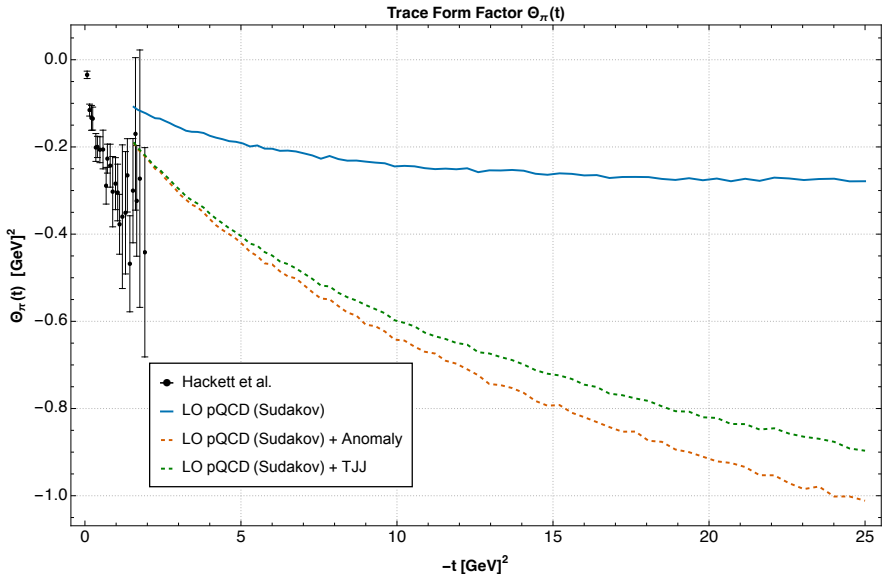
The QCD trace anomaly induces a dilaton-like scalar contribution that significantly modifies the pion gravitational form factors at large momentum transfer.
A machine-rendered reading of the paper's core claim, the machinery that carries it, and where it could break.
Core claim
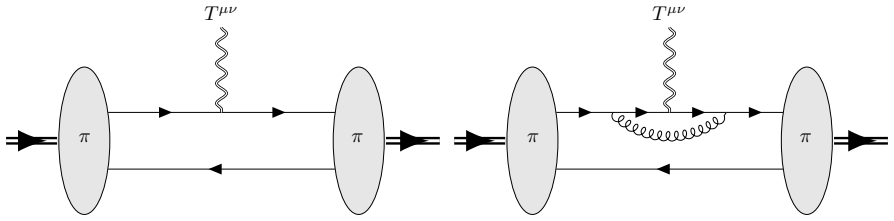
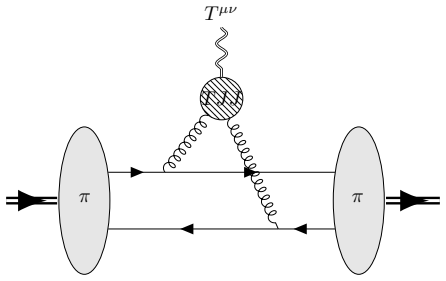
We demonstrate that the non-Abelian TJJ correlator, which couples the local QCD energy-momentum tensor to two external gluon fields, explicitly encodes the perturbative effects of the trace anomaly and induces a scalar, dilaton-like contribution to the hard-scattering kernel. After performing a careful separation of the quark and gluon sectors that accounts for modifications from gauge-fixing terms and Slavnov-Taylor identities, the anomaly-induced corrections are shown to significantly modify the behavior of the pion GFFs at large momentum transfer, leaving a unique imprint on the trace sector and the D-term.
What carries the argument
The non-Abelian TJJ correlator encoding the trace anomaly effects as a scalar dilaton-like contribution to the hard kernel in the QCD factorization of pion GFFs.
If this is right
- The D-term receives significant anomaly-induced modifications at large momentum transfer.
- The trace sector of the GFFs exhibits a distinctive imprint from the dilaton-like interaction.
- Phenomenological predictions for pion GFFs at intermediate and large momentum transfers are altered by these corrections.
- Consistency with Slavnov-Taylor identities is maintained through the separation of quark and gluon sectors.
Where Pith is reading between the lines
- If the modifications hold, lattice calculations of pion GFFs at high momentum may need to account for these anomaly effects to match perturbative predictions.
- This approach could be extended to other mesons or baryons to study anomaly impacts on their gravitational properties.
- Future high-energy experiments probing pion structure might detect the unique trace sector signature.
Load-bearing premise
The Sudakov resummation framework combined with a Gaussian model for the pion's transverse-momentum-dependent wave function regulates soft-gluon endpoint divergences and yields realistic predictions at intermediate and large momentum transfer.
What would settle it
A high-momentum-transfer measurement or lattice QCD result for the pion D-term or trace sector that shows no deviation from standard perturbative QCD calculations without the dilaton-like anomaly term would falsify the central claim.
Figures


read the original abstract
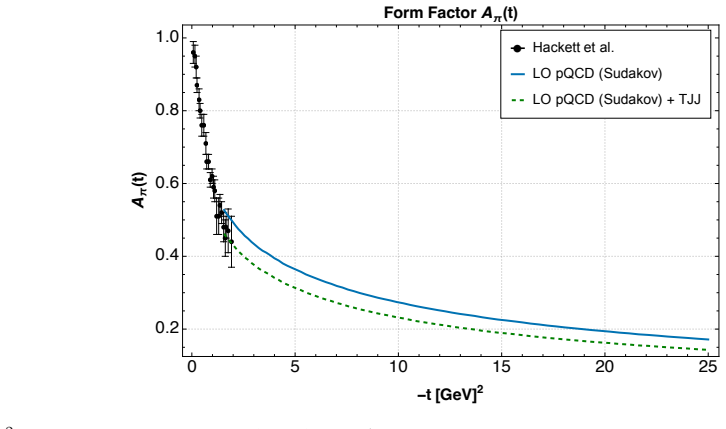
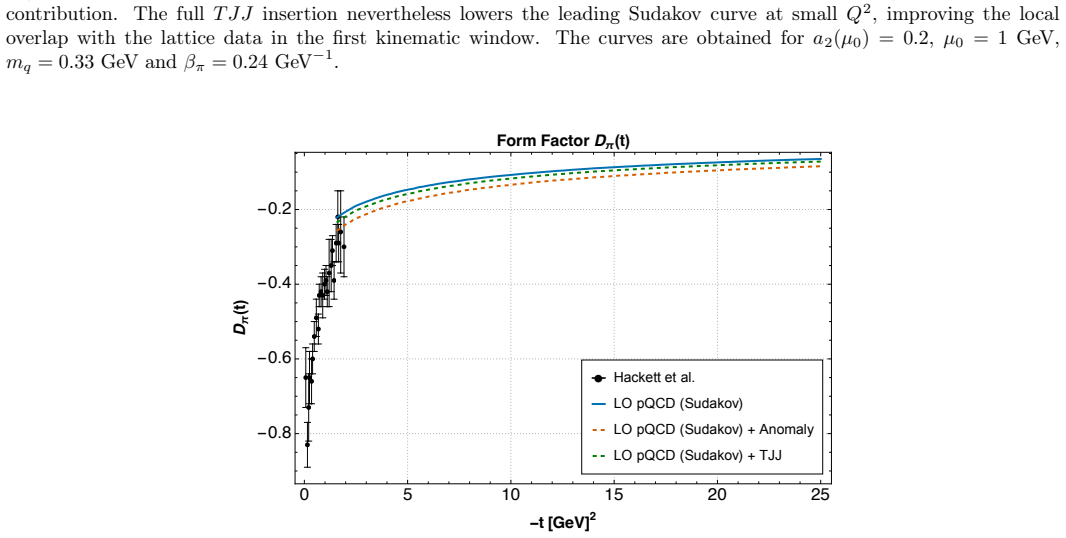
We investigate the pion gravitational form factors (GFFs) at intermediate and large momentum transfer within the framework of QCD factorization. Our analysis centers on the non-Abelian $TJJ$ correlator, which couples the local QCD energy-momentum tensor to two external gluon fields and explicitly encodes the perturbative effects of the trace anomaly. We demonstrate how this quantum anomaly induces a scalar, dilaton-like contribution to the hard-scattering kernel. To ensure field-theoretic consistency, a careful separation of the quark and gluon sectors is performed, accounting for the modifications introduced by gauge-fixing terms and Slavnov-Taylor identities on the off-shell gluonic structure. To obtain realistic phenomenological predictions and regulate soft-gluon endpoint divergences in the hard kernel, we implement the Sudakov resummation framework coupled with a Gaussian model for the pion's transverse-momentum-dependent wave function. We show that the resulting anomaly-induced corrections significantly modify the behavior of the pion GFFs at large momentum transfer, leaving a unique imprint on the trace sector and the $D$-term.
Editorial analysis
A structured set of objections, weighed in public.
Referee Report
Summary. The manuscript investigates the pion gravitational form factors (GFFs) in perturbative QCD factorization, focusing on the non-Abelian TJJ correlator that encodes the trace anomaly. It introduces a scalar, dilaton-like contribution to the hard-scattering kernel, performs a separation of quark and gluon sectors consistent with gauge-fixing and Slavnov-Taylor identities, and employs Sudakov resummation together with a Gaussian model for the pion TMD wave function to regulate soft-gluon endpoint divergences. The central claim is that the resulting anomaly-induced corrections significantly modify the GFFs at large momentum transfer, producing a distinctive imprint on the trace sector and the D-term.
Significance. If the derivation and numerical implementation hold, the work would supply a concrete mechanism by which the QCD trace anomaly leaves an observable signature in hadronic GFFs at accessible momentum transfers. The explicit treatment of the TJJ correlator and the separation of sectors constitute a technical strength; the combination of factorization with Sudakov resummation is a standard and controlled approach when the wave-function model is independently validated.
major comments (2)
- [phenomenological implementation and numerical results] The central claim that anomaly-induced corrections produce a 'significant' and 'unique' modification to the trace-sector GFFs and D-term at large Q² rests on the Gaussian TMD ansatz both regulating endpoint divergences and preserving the correct power counting after Sudakov resummation. No robustness test against alternative transverse-momentum profiles (e.g., power-law tails) is presented; a different endpoint behavior would alter the relative weight of the dilaton-like scalar piece in the hard kernel.
- [TMD model and parameter choice] The Gaussian TMD wave-function parameters are introduced both to tame soft-gluon divergences and to generate phenomenological predictions. It is not shown whether these parameters are determined from independent observables or whether they are effectively tuned to the same GFF data against which the anomaly imprint is later compared, raising a potential circularity issue for the claimed modification.
minor comments (2)
- [Abstract] The abstract states that corrections 'significantly modify' the GFFs but supplies neither explicit expressions for the modified hard kernel nor numerical values or plots; the reader must reach the body of the paper to locate the quantitative evidence.
- [formalism] Notation for the separation of quark and gluon sectors and the precise definition of the dilaton-like scalar contribution should be collected in a single equation or table for clarity.
Simulated Author's Rebuttal
We thank the referee for the careful reading of our manuscript and the constructive comments. We address each major comment below and indicate the revisions made to the manuscript.
read point-by-point responses
-
Referee: [phenomenological implementation and numerical results] The central claim that anomaly-induced corrections produce a 'significant' and 'unique' modification to the trace-sector GFFs and D-term at large Q² rests on the Gaussian TMD ansatz both regulating endpoint divergences and preserving the correct power counting after Sudakov resummation. No robustness test against alternative transverse-momentum profiles (e.g., power-law tails) is presented; a different endpoint behavior would alter the relative weight of the dilaton-like scalar piece in the hard kernel.
Authors: The Gaussian TMD ansatz is a standard choice in the Sudakov-resummed factorization framework for the pion, as it ensures the correct exponential suppression of the soft endpoint region while preserving the leading power counting. The dominant regulation of endpoint divergences arises from the Sudakov factor itself rather than the specific transverse profile. Nevertheless, we acknowledge that an explicit robustness check would strengthen the presentation. In the revised manuscript we have added a paragraph discussing the stability of the anomaly-induced correction under moderate variations of the TMD width parameter (within the range constrained by independent observables) and note that the qualitative imprint on the trace sector persists for profiles that maintain the same leading-power behavior after resummation. revision: partial
-
Referee: [TMD model and parameter choice] The Gaussian TMD wave-function parameters are introduced both to tame soft-gluon divergences and to generate phenomenological predictions. It is not shown whether these parameters are determined from independent observables or whether they are effectively tuned to the same GFF data against which the anomaly imprint is later compared, raising a potential circularity issue for the claimed modification.
Authors: The Gaussian parameters are taken from independent determinations in the literature, specifically from global fits to the pion electromagnetic form factor and the leading-twist pion distribution amplitude performed in earlier works using the same Sudakov framework. They are not adjusted to reproduce the gravitational form factors. We have inserted a new paragraph in Section 3 of the revised manuscript that explicitly states the provenance of these parameters, quotes the numerical values and their sources, and verifies consistency with other low-energy observables, thereby eliminating any appearance of circularity. revision: yes
Circularity Check
No significant circularity in the derivation chain.
full rationale
The paper derives the scalar dilaton-like contribution to the hard kernel from the non-Abelian TJJ correlator and trace anomaly in perturbative QCD, with separation of quark/gluon sectors via gauge-fixing and Slavnov-Taylor identities. Sudakov resummation plus Gaussian TMD wave function is introduced explicitly as a regulator for soft-gluon endpoints to enable phenomenology; this is a standard ansatz choice, not a parameter fitted to the GFF outputs or the anomaly modification itself. No equations reduce the claimed large-Q^2 imprint on trace-sector GFFs and D-term to the model inputs by construction, and no load-bearing self-citations or uniqueness theorems are invoked in the provided text. The framework remains self-contained against external benchmarks.
Axiom & Free-Parameter Ledger
free parameters (1)
- Gaussian TMD wave-function parameters
axioms (2)
- domain assumption QCD factorization applies to the off-shell TJJ correlator at intermediate and large momentum transfer
- domain assumption Sudakov resummation plus Gaussian model sufficiently regulates soft-gluon divergences
invented entities (1)
-
dilaton-like scalar contribution
no independent evidence
Reference graph
Works this paper leans on
-
[1]
Burkert, L
V.D. Burkert, L. Elouadrhiri and F.X. Girod,The pressure distribution inside the proton,Nature557(2018) 396
2018
-
[2]
B. Duran et al.,Determining the gluonic gravitational form factors of the proton,Nature615(2023) 813 [2207.05212]. [3]Bellecollaboration,Study ofπ 0 pair production in single-tag two-photon collisions,Phys. Rev. D93(2016) 032003 [1508.06757]. [4]Bellecollaboration,Measurement ofγγ ∗ →π 0 transition form factor at Belle,Nucl. Phys. B Proc. Suppl.234 (2013) 287
arXiv 2023
-
[3]
S. Kumano, Q.-T. Song and O.V. Teryaev,Hadron tomography by generalized distribution amplitudes in pion-pair production processγ∗γ→π 0π0 and gravitational form factors for pion,Phys. Rev. D97(2018) 014020 [1711.08088]. [6]Jefferson Lab Hall Acollaboration,Deeply Virtual Compton Scattering Cross Section at High Bjorken xB, Phys. Rev. Lett.128(2022) 252002 ...
Pith/arXiv arXiv 2018
-
[4]
R. Abdul Khalek et al.,Science Requirements and Detector Concepts for the Electron-Ion Collider: EIC Yellow Report,Nucl. Phys. A1026(2022) 122447 [2103.05419]
Pith/arXiv arXiv 2022
-
[5]
P. Amore, C. Corianò and M. Guzzi,Deeply virtual neutrino scattering (DVNS),JHEP02(2005) 038 [hep-ph/0404121]
Pith/arXiv arXiv 2005
-
[6]
X.-B. Tong, J.-P. Ma and F. Yuan,Gluon gravitational form factors at large momentum transfer,Phys. Lett. B823 (2021) 136751 [2101.02395]
arXiv 2021
-
[7]
X.-B. Tong, J.-P. Ma and F. Yuan,Perturbative calculations of gravitational form factors at large momentum transfer,JHEP10(2022) 046 [2203.13493]. 44
arXiv 2022
-
[8]
C. Corianò, A. Radyushkin and G.F. Sterman,QCD sum rules and Compton scattering,Nucl. Phys. B405(1993) 481 [hep-ph/9301274]
Pith/arXiv arXiv 1993
-
[9]
Ji,Gauge-Invariant Decomposition of Nucleon Spin,Phys
X. Ji,Gauge-Invariant Decomposition of Nucleon Spin,Phys. Rev. Lett.78(1997) 610 [hep-ph/9603249]
Pith/arXiv arXiv 1997
-
[10]
Radyushkin,Asymmetric gluon distributions and hard diffractive electroproduction,Phys
A.V. Radyushkin,Asymmetric gluon distributions and hard diffractive electroproduction,Phys. Lett. B385(1996) 333 [hep-ph/9604317]
Pith/arXiv arXiv 1996
-
[11]
Radyushkin,Scaling Limit of Deeply Virtual Compton Scattering,Phys
A.V. Radyushkin,Scaling Limit of Deeply Virtual Compton Scattering,Phys. Lett. B380(1996) 417 [hep-ph/9605431]
Pith/arXiv arXiv 1996
-
[12]
Ji,Deeply virtual Compton scattering,Phys
X. Ji,Deeply virtual Compton scattering,Phys. Rev. D55(1997) 7114 [hep-ph/9609381]
Pith/arXiv arXiv 1997
-
[13]
J.C. Collins and A. Freund,Proof of factorization for deeply virtual Compton scattering in QCD,Phys. Rev. D59 (1999) 074009 [hep-ph/9611369]
Pith/arXiv arXiv 1999
-
[14]
Radyushkin,Nonforward parton distributions,Phys
A.V. Radyushkin,Nonforward parton distributions,Phys. Rev. D56(1997) 5524 [hep-ph/9704207]
Pith/arXiv arXiv 1997
-
[15]
M. Vanderhaeghen, P.A.M. Guichon and M. Guidal,Hard electroproduction of photons and mesons on the nucleon, Phys. Rev. Lett.80(1998) 5064 [hep-ph/9806305]
Pith/arXiv arXiv 1998
-
[16]
C. Corianò, S. Lionetti, D. Melle and R. Tommasi,The Gravitational Form Factors of Hadrons from CFT in Momentum Space and the Dilaton in Perturbative QCD,Eur. Phys. J. C85(2025) 498 [2409.05609]
arXiv 2025
-
[17]
A. Bzowski, P. McFadden and K. Skenderis,Implications of conformal invariance in momentum space,JHEP03 (2014) 111 [1304.7760]
Pith/arXiv arXiv 2014
-
[18]
A. Bzowski, P. McFadden and K. Skenderis,Renormalised CFT 3-point functions of scalars, currents and stress tensors,JHEP11(2018) 159 [1805.12100]
Pith/arXiv arXiv 2018
-
[19]
Sterman,Summation of large corrections to short distance hadronic cross-sections,Nucl
G. Sterman,Summation of large corrections to short distance hadronic cross-sections,Nucl. Phys. B281(1987) 310
1987
-
[20]
Botts and G
J. Botts and G. Sterman,Hard elastic scattering in qcd: Leading behavior,Nucl. Phys. B325(1989) 62
1989
-
[21]
Li and G
H.-n. Li and G. Sterman,The perturbative pion form factor with sudakov suppression,Nucl. Phys. B381(1992) 129
1992
-
[22]
H.-n. Li and H.-L. Yu,Perturbative qcd analysis of pion electromagnetic form factor,Phys. Rev. D53(1996) 2480 [hep-ph/9411308]
Pith/arXiv arXiv 1996
-
[23]
Lepage and S.J
G.P. Lepage and S.J. Brodsky,Exclusive processes in perturbative quantum chromodynamics,Phys. Rev. D22 (1980) 2157
1980
-
[24]
Efremov and A.V
A.V. Efremov and A.V. Radyushkin,Factorization and asymptotical behavior of pion form factor in qcd,Phys. Lett. B94(1980) 245
1980
-
[25]
Chernyak and A.R
V.L. Chernyak and A.R. Zhitnitsky,Asymptotic behavior of exclusive processes in qcd,Phys. Rept.112(1984) 173
1984
-
[26]
Braun and I.E
V.M. Braun and I.E. Filyanov,Qcd sum rules in exclusive kinematics and pion wave function,Z. Phys. C44(1989) 157
1989
-
[27]
P. Ball, V.M. Braun and A. Lenz,Higher-twist distribution amplitudes of the pion in qcd,JHEP05(2006) 004 [hep-ph/0603063]. 45
Pith/arXiv arXiv 2006
-
[28]
R. Jakob and P. Kroll,The pion form factor: Sudakov suppressions and intrinsic transverse momentum,Phys. Lett. B315(1993) 463 [hep-ph/9306259]
Pith/arXiv arXiv 1993
-
[29]
Huang and Q.-X
T. Huang and Q.-X. Shen,The perturbative qcd prediction for the pion form factor revisited,Z. Phys. C50(1991) 139
1991
-
[30]
Bakulev, S
A. Bakulev, S. Mikhailov and N. Stefanis,Qcd-based pion distribution amplitudes confronting experimental data, Physics Letters B508(2001) 279
2001
-
[31]
D.C. Hackett, P.R. Oare, D.A. Pefkou and P.E. Shanahan,Gravitational form factors of the pion from lattice qcd, Phys. Rev. D108(2023) 114504 [2307.11707]
arXiv 2023
-
[32]
W.-Y. Liu, E. Shuryak and I. Zahed,Pion gravitational form factors in the qcd instanton vacuum. ii,Phys. Rev. D 110(2024) 054022
2024
-
[33]
R. Armillis, C. Corianò and L. Delle Rose,Conformal Anomalies and the Gravitational Effective Action: TheT J J Correlator for a Dirac Fermion,Phys. Rev.D81(2010) 085001 [0910.3381]
Pith/arXiv arXiv 2010
-
[34]
R. Armillis, C. Corianò and L. Delle Rose,Trace Anomaly, Massless Scalars and the Gravitational Coupling of QCD,Phys. Rev.D82(2010) 064023 [1005.4173]
Pith/arXiv arXiv 2010
-
[35]
C. Corianò and M.M. Maglio,Renormalization, Conformal Ward Identities and the Origin of a Conformal Anomaly Pole,Phys. Lett.B781(2018) 283 [1802.01501]
Pith/arXiv arXiv 2018
-
[36]
C. Corianò and M.M. Maglio,Exact Correlators from Conformal Ward Identities in Momentum Space and the PerturbativeT J JVertex,Nucl. Phys.B938(2019) 440 [1802.07675]
Pith/arXiv arXiv 2019
-
[37]
C. Corianò and M.M. Maglio,Conformal field theory in momentum space and anomaly actions in gravity: The analysis of three- and four-point function,Phys. Rept.952(2022) 2198 [2005.06873]
arXiv 2022
-
[38]
C. Corianò, S. Lionetti, D. Melle and L. Torcellini,A dilaton sum rule for the conformal anomaly form factor in QCD at orderαs,Eur. Phys. J. C85(2025) 983 [2504.01904]
arXiv 2025
-
[39]
C. Corianò, S. Lionetti, D. Melle and L. Torcellini,Anomaly-mediated Scalar Gravitational Interactions and the Coupling of Conformal Sectors,2603.28966
-
[40]
M. Giannotti and E. Mottola,The Trace Anomaly and Massless Scalar Degrees of Freedom in Gravity,Phys. Rev. D79(2009) 045014 [0812.0351]
Pith/arXiv arXiv 2009
-
[41]
C. Corianò, M.M. Maglio and E. Mottola,TTT in CFT: Trace Identities and the Conformal Anomaly Effective Action,Nucl. Phys.B942(2019) 303 [1703.08860]
arXiv 2019
-
[42]
C. Corianò, A. Costantini, L. Delle Rose and M. Serino,Superconformal sum rules and the spectral density flow of the composite dilaton (ADD) multiplet inN= 1theories,JHEP06(2014) 136 [1402.6369]. 46
Pith/arXiv arXiv 2014
discussion (0)
Sign in with ORCID, Apple, or X to comment. Anyone can read and Pith papers without signing in.