Bosonic Cyclic Codes: Trading Stabilizers for Gaussian Non-Clifford Phase Gates
Pith reviewed 2026-06-27 13:18 UTC · model grok-4.3
The pith
Bosonic cyclic codes trade single-photon-loss detection for multiple logical phase gates via passive Gaussian rotations.
A machine-rendered reading of the paper's core claim, the machinery that carries it, and where it could break.
Core claim
Bosonic cyclic codes generalize rotation-symmetric codes so that sacrificing detectability of one photon loss produces a number of logical phase gates equal to the original rotation symmetry order, all realized by passive Gaussian rotations. The cyclic cat and Vandermonde codes inherit key protection and controllability properties from their rotation-symmetric parents. Larger SU(2) symmetry supplies additional stabilizers and logical Pauli gates, new non-Clifford gates appear for the smallest binomial code, and a new error-detection protocol is given. The work presents a general paradigm that converts higher-order stabilizers into logical gates and applies it to several multimode bosonic cod
What carries the argument
The bosonic cyclic code construction, which lowers rotation-symmetry order to convert stabilizers into logical phase gates achievable by Gaussian unitaries.
If this is right
- Cyclic cat codes and Vandermonde codes retain loss and dephasing protection while supporting multiple phase gates.
- The larger SU(2) symmetry supplies extra stabilizers and logical Pauli gates.
- The smallest binomial code acquires new non-Clifford gates.
- A new error detection protocol becomes available.
- The stabilizer-to-gate conversion paradigm extends directly to multimode bosonic codes.
Where Pith is reading between the lines
- Hardware that already supports Gaussian rotations could implement the new gates without additional nonlinear elements.
- Similar symmetry reductions might simplify gate sets in other continuous-variable encodings.
- Small cyclic codes could be tested first on existing superconducting or optical platforms to check the Gaussian gate fidelity.
- The approach might lower the total number of non-Gaussian operations needed across an entire fault-tolerant circuit.
Load-bearing premise
The cyclic versions retain enough of the original error-protection and controllability advantages that the added gates improve overall performance in fault-tolerant quantum computing.
What would settle it
A calculation or small-scale simulation showing that the added phase gates cannot compensate for the lost single-photon-loss detection in a realistic error model for a full algorithm.
Figures

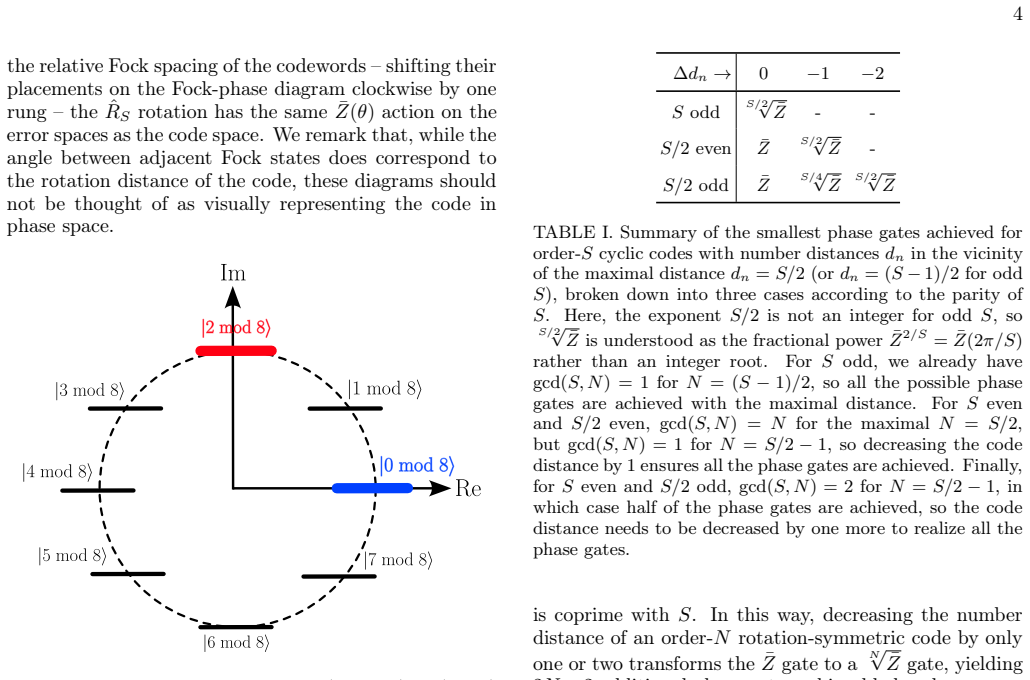
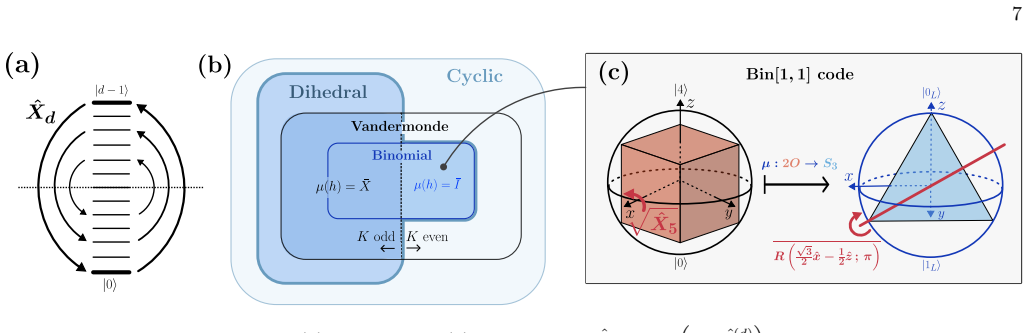
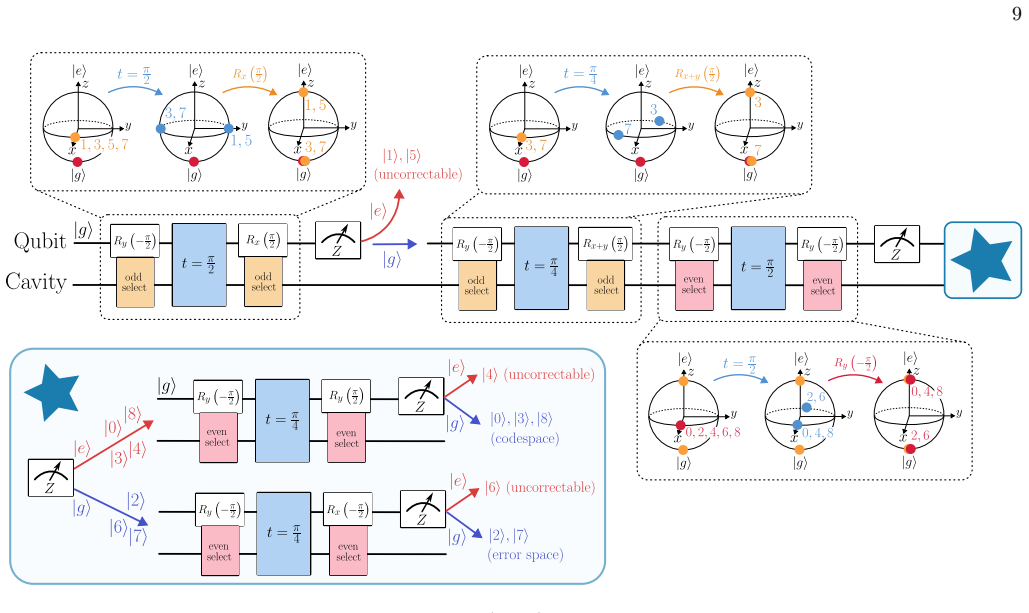
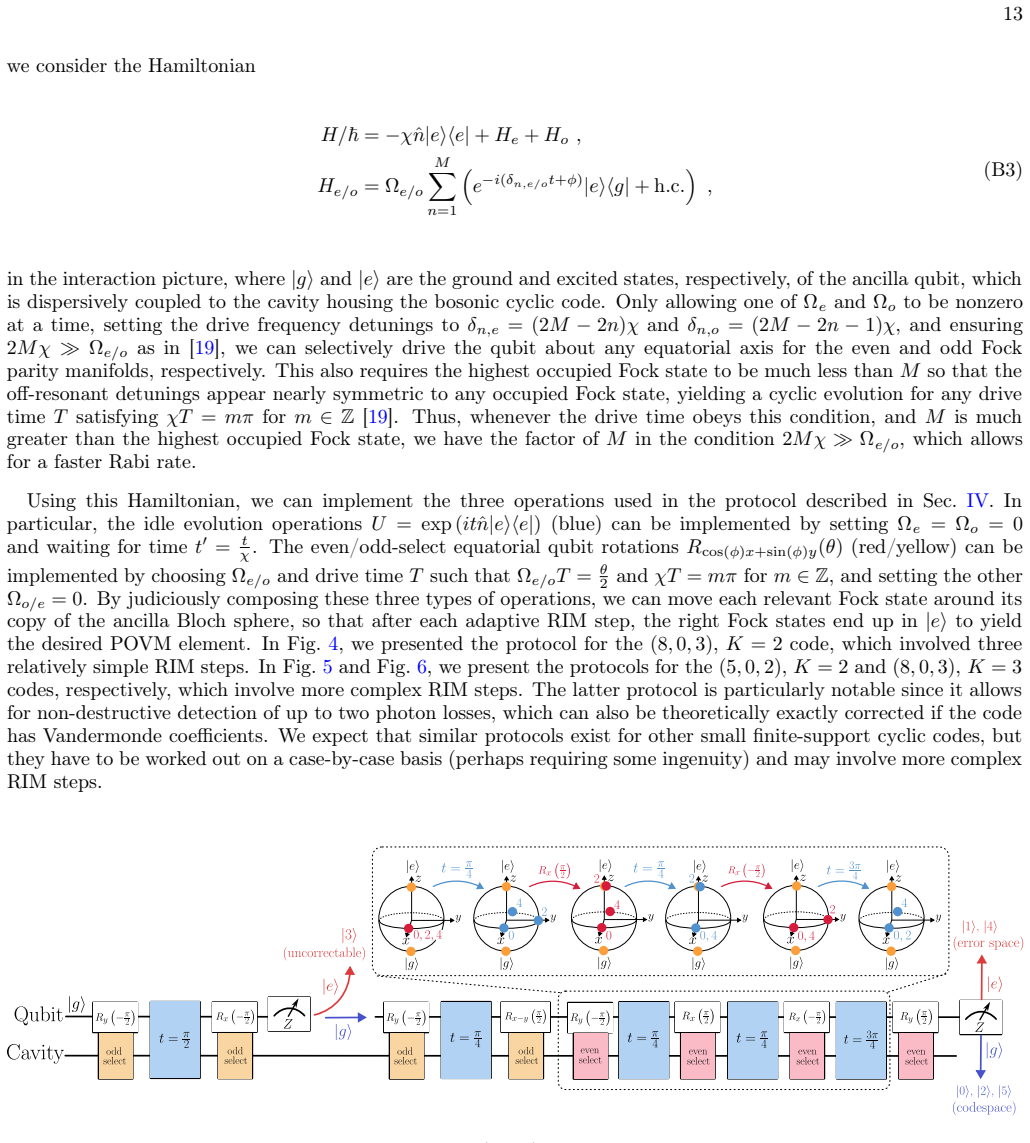
read the original abstract
Bosonic codes offer hardware-efficient approaches to quantum error correction, with the best encodings offering effective protection of idle quantum information against loss and dephasing - particularly rotation-symmetric codes, which include the cat and binomial code families. However, rotation-symmetric codes are only naturally endowed with a single logical Pauli gate, while other logical gates require the use of non-linear operations, obstructing the utility of these codes for realizing quantum algorithms. Here, we balance error protection with controllability by introducing bosonic cyclic codes: a generalization of rotation-symmetric codes that enable the measured tradeoff of error protection properties for fault-tolerant logical phase gates. Through our general construction, we find that sacrificing the detectability of a single photon loss relative to a rotation-symmetric code can yield a number of logical phase gates commensurate with the original rotation symmetry order of the code, all achievable via passive Gaussian rotations. Giving the corresponding generalizations of cat and binomial codes - which we dub cyclic cat and Vandermonde codes, respectively - we further find that many of the desirable properties of these codes transfer to the bosonic cyclic code setting. We go on to discuss the larger $SU(2)$ symmetry and rotation gates of the codes, which yield additional stabilizers and logical Pauli gates, as well as new non-Clifford gates for the smallest `kitten' binomial code, and provide a new error detection protocol. Finally, we introduce a general paradigm for converting higher-order stabilizers to logical gates, as in our generalization of rotation-symmetric codes, and apply it to several multimode bosonic codes.
Editorial analysis
A structured set of objections, weighed in public.
Referee Report
Summary. The manuscript introduces bosonic cyclic codes as a generalization of rotation-symmetric bosonic codes (cat and binomial families). By sacrificing single-photon-loss detectability, these codes enable a number of logical phase gates equal to the original rotation symmetry order, all realized via passive Gaussian rotations. It presents explicit constructions called cyclic cat and Vandermonde codes, claims that many desirable error-protection properties transfer, discusses the larger SU(2) symmetry yielding additional stabilizers and Pauli gates plus new non-Clifford gates for the kitten code, introduces a new error detection protocol, and proposes a general paradigm for converting higher-order stabilizers into logical gates that is applied to several multimode bosonic codes.
Significance. If the cyclic constructions retain sufficient idle-error protection against loss and dephasing while delivering the claimed Gaussian phase gates, the stabilizer-for-gates tradeoff would provide a concrete route to more controllable bosonic encodings for fault-tolerant quantum computing. The general paradigm for higher-order-stabilizer conversion is a methodological contribution that could extend to other multimode codes. The explicit symmetry analysis and kitten-code example supply testable constructions.
major comments (3)
- [Abstract and generalizations section] Abstract and section on generalizations of cat and binomial codes: The central claim that 'many of the desirable properties transfer' to the cyclic setting is load-bearing for the utility of the tradeoff in fault-tolerant computing, yet the manuscript supplies no quantitative comparison (e.g., logical error rates under photon-loss channels or code-distance calculations) between cyclic cat/Vandermonde codes and their rotation-symmetric parents.
- [General paradigm section] Section introducing the general paradigm for converting higher-order stabilizers to logical gates: The paradigm is asserted to apply to several multimode bosonic codes, but no explicit verification is given that the resulting gates preserve the original code distance or avoid introducing new uncorrectable error channels, which is required to substantiate the broader applicability.
- [SU(2) symmetry and kitten code section] Section on new non-Clifford gates for the kitten binomial code: The claim of additional non-Clifford gates arising from SU(2) symmetry lacks an explicit circuit decomposition or resource analysis showing advantage over existing implementations, undermining assessment of the controllability gain.
minor comments (2)
- [Notation and definitions] The notation for the cyclic order parameter and its relation to the stabilizer generators should be introduced with an explicit equation in the first section defining the codes.
- [Figures] Figure captions for any codeword plots or symmetry diagrams should explicitly label the cyclic parameter values and error channels shown.
Simulated Author's Rebuttal
We thank the referee for the constructive report. We address each major comment below and indicate where revisions will be made to strengthen the manuscript.
read point-by-point responses
-
Referee: [Abstract and generalizations section] Abstract and section on generalizations of cat and binomial codes: The central claim that 'many of the desirable properties transfer' to the cyclic setting is load-bearing for the utility of the tradeoff in fault-tolerant computing, yet the manuscript supplies no quantitative comparison (e.g., logical error rates under photon-loss channels or code-distance calculations) between cyclic cat/Vandermonde codes and their rotation-symmetric parents.
Authors: We agree that explicit quantitative comparisons would strengthen the claim. While the analytic structure of the stabilizers and the preserved rotation symmetry order allow derivation of code distance bounds without simulation, the manuscript does not include numerical logical-error-rate comparisons. In revision we will add a new subsection providing distance calculations for representative parameters and a brief comparison of loss-channel performance under the same noise model used for the parent codes. revision: yes
-
Referee: [General paradigm section] Section introducing the general paradigm for converting higher-order stabilizers to logical gates: The paradigm is asserted to apply to several multimode bosonic codes, but no explicit verification is given that the resulting gates preserve the original code distance or avoid introducing new uncorrectable error channels, which is required to substantiate the broader applicability.
Authors: The paradigm is illustrated in detail for the rotation-symmetric family and sketched for multimode codes. We acknowledge that explicit verification of distance preservation for each cited multimode example is absent. In the revised manuscript we will supply a short verification for one additional multimode code (the two-mode binomial code), confirming that the converted gates do not reduce distance or introduce new weight-1 errors. revision: partial
-
Referee: [SU(2) symmetry and kitten code section] Section on new non-Clifford gates for the kitten binomial code: The claim of additional non-Clifford gates arising from SU(2) symmetry lacks an explicit circuit decomposition or resource analysis showing advantage over existing implementations, undermining assessment of the controllability gain.
Authors: The manuscript identifies the new gates via the enlarged symmetry but does not furnish an explicit decomposition or resource count. We will add, in the revised version, an explicit circuit decomposition for the kitten-code non-Clifford gate together with a gate-count comparison against standard decompositions that rely on higher-order nonlinear operations. revision: yes
Circularity Check
No circularity: construction and claims are independent of fitted inputs or self-referential reductions
full rationale
The paper introduces bosonic cyclic codes as a generalization of rotation-symmetric codes (cat and binomial families) and presents a paradigm for converting higher-order stabilizers to logical gates. The abstract asserts that sacrificing single-photon-loss detectability yields commensurate logical phase gates via passive Gaussian rotations, and that many desirable properties transfer. No quoted equations, parameters, or steps reduce a claimed prediction or gate count to a quantity defined by the authors' own prior fits or self-citations; the transfer of properties is stated as an empirical finding rather than a definitional equivalence. The derivation chain remains self-contained against external benchmarks with no load-bearing self-citation or ansatz smuggling exhibited in the provided text.
Axiom & Free-Parameter Ledger
axioms (1)
- domain assumption Standard properties of rotation-symmetric bosonic codes and Gaussian operations hold in the cyclic generalization.
Reference graph
Works this paper leans on
-
[1]
Octahedron drum code In this section, we introduce a code derived from an octahedral constellation and show how it can be converted into a drum code that supports a Gaussian2π 3 -phase gate. We begin with an octahedral-constellation code whose logical states are |+L⟩ ∝ 2X j=0 |ωjα1, α2⟩+|−ω jα1,−α 2⟩, |−L⟩ ∝ 2X j=0 |−ωjα1, α2⟩+|ω jα1,−α 2⟩, |0L⟩ ∝ X n,m≥0...
-
[2]
W. Cai, Y. Ma, W. Wang, C.-L. Zou, and L. Sun, Bosonic quantum error correction codes in superconducting quan- tum circuits, Fundamental Research1, 50 (2021)
2021
-
[3]
B. M. Terhal, J. Conrad, and C. Vuillot, Towards scalable bosonic quantum error correction, Quantum Science and Technology5, 043001 (2020)
2020
-
[4]
Y. Liu, S. Singh, K. C. Smith, E. Crane, J. M. Martyn, A. Eickbusch, A. Schuckert, R. D. Li, J. Sinanan-Singh, M. B. Soley, T. Tsunoda, I. L. Chuang, N. Wiebe, and S. M. Girvin, Hybrid Oscillator-Qubit Quantum Proces- sors: Instruction Set Architectures, Abstract Machine Models, and Applications, PRX Quantum7, 010201 (2026)
2026
-
[5]
H. J. Kimble, Strong interactions of single atoms and photons in cavity QED, Physica Scripta1998, 127 (1998)
1998
-
[6]
Mabuchi and A
H. Mabuchi and A. C. Doherty, Cavity Quantum Elec- trodynamics: Coherence in Context, Science298, 1372 (2002)
2002
-
[7]
Leibfried, R
D. Leibfried, R. Blatt, C. Monroe, and D. Wineland, Quantum dynamics of single trapped ions, Reviews of Modern Physics75, 281 (2003)
2003
-
[8]
Monroe and J
C. Monroe and J. Kim, Scaling the Ion Trap Quantum Processor, Science339, 1164 (2013)
2013
-
[9]
Flühmann, T
C. Flühmann, T. L. Nguyen, M. Marinelli, V. Negnevit- sky, K. Mehta, and J. P. Home, Encoding a qubit in a trapped-ion mechanical oscillator, Nature566, 513 (2019)
2019
-
[10]
Reagor, W
M. Reagor, W. Pfaff, C. Axline, R. W. Heeres, N. Ofek, K. Sliwa, E. Holland, C. Wang, J. Blumoff, K. Chou, M. J. Hatridge, L. Frunzio, M. H. Devoret, L. Jiang, and R. J. Schoelkopf, Quantum memory with millisecond coherence in circuit QED, Physical Review B94, 014506 (2016)
2016
-
[11]
C. U. Lei, L. Krayzman, S. Ganjam, L. Frunzio, and R. J. Schoelkopf, High coherence superconducting microwave cavitieswithindiumbumpbonding,AppliedPhysicsLet- ters116, 154002 (2020)
2020
-
[12]
Milul, B
O. Milul, B. Guttel, U. Goldblatt, S. Hazanov, L. M. Joshi, D. Chausovsky, N. Kahn, E. Çiftyürek, F. Lafont, and S. Rosenblum, Superconducting Cavity Qubit with Tens of Milliseconds Single-Photon Coherence Time, PRX Quantum4, 030336 (2023)
2023
-
[13]
Ganjam, Y
S. Ganjam, Y. Wang, Y. Lu, A. Banerjee, C. U. Lei, L. Krayzman, K. Kisslinger, C. Zhou, R. Li, Y. Jia, M. Liu, L. Frunzio, and R. J. Schoelkopf, Surpassing mil- lisecond coherence in on chip superconducting quantum memories by optimizing materials and circuit design, Na- ture Communications15, 3687 (2024)
2024
-
[14]
I. L. Chuang, D. W. Leung, and Y. Yamamoto, Bosonic 18 quantum codes for amplitude damping, Physical Review A56, 1114 (1997)
1997
-
[15]
Gottesman, A
D. Gottesman, A. Kitaev, and J. Preskill, Encoding a qubit in an oscillator, Physical Review A64, 012310 (2001)
2001
-
[16]
P. T. Cochrane, G. J. Milburn, and W. J. Munro, Macro- scopically distinct quantum-superposition states as a bosonic code for amplitude damping, Physical Review A59, 2631 (1999)
1999
-
[17]
Mirrahimi, Z
M. Mirrahimi, Z. Leghtas, V. V. Albert, S. Touzard, R. J. Schoelkopf, L. Jiang, and M. H. Devoret, Dynamically protected cat-qubits: a new paradigm for universal quan- tum computation, New Journal of Physics16, 045014 (2014)
2014
-
[18]
M. H. Michael, M. Silveri, R. T. Brierley, V. V. Albert, J. Salmilehto, L. Jiang, and S. M. Girvin, New Class of Quantum Error-Correcting Codes for a Bosonic Mode, Physical Review X6, 031006 (2016)
2016
-
[19]
L. Hu, Y. Ma, W. Cai, X. Mu, Y. Xu, W. Wang, Y. Wu, H. Wang, Y. P. Song, C.-L. Zou, S. M. Girvin, L.-M. Duan, and L. Sun, Quantum error correction and univer- sal gate set operation on a binomial bosonic logical qubit, Nature Physics15, 503 (2019)
2019
-
[20]
Z. Ni, S. Li, X. Deng, Y. Cai, L. Zhang, W. Wang, Z.- B. Yang, H. Yu, F. Yan, S. Liu, C.-L. Zou, L. Sun, S.- B. Zheng, Y. Xu, and D. Yu, Beating the break-even point with a discrete-variable-encoded logical qubit, Na- ture616, 56 (2023)
2023
-
[21]
V. V. Sivak, A. Eickbusch, B. Royer, S. Singh, I. Tsiout- sios, S. Ganjam, A. Miano, B. L. Brock, A. Z. Ding, L. Frunzio, S. M. Girvin, R. J. Schoelkopf, and M. H. De- voret, Real-time quantum error correction beyond break- even, Nature616, 50 (2023)
2023
-
[22]
N. Ofek, A. Petrenko, R. Heeres, P. Reinhold, Z. Leghtas, B. Vlastakis, Y. Liu, L. Frunzio, S. M. Girvin, L. Jiang, M. Mirrahimi, M. H. Devoret, and R. J. Schoelkopf, Ex- tending the lifetime of a quantum bit with error correc- tion in superconducting circuits, Nature536, 441 (2016)
2016
-
[23]
A. L. Grimsmo, J. Combes, and B. Q. Baragiola, Quantum Computing with Rotation-Symmetric Bosonic Codes, Physical Review X10, 011058 (2020)
2020
-
[24]
J. A. Gross, Designing Codes around Interactions: The Case of a Spin, Physical Review Letters127, 010504 (2021)
2021
-
[25]
S. P. Jain, J. T. Iosue, A. Barg, and V. V. Albert, Quan- tum spherical codes, Nature Physics20, 1300 (2024)
2024
- [26]
-
[27]
Y. Wang, Y. Xu, and Z.-W. Liu, Tessellation codes: En- coded quantum gates by geometric rotation, Phys. Rev. Lett.135, 140602 (2025)
2025
-
[28]
Denys and A
A. Denys and A. Leverrier, Quantum Error-Correcting Codes with a Covariant Encoding, Physical Review Let- ters133, 240603 (2024)
2024
-
[29]
L. Sun, A. Petrenko, Z. Leghtas, B. Vlastakis, G. Kirch- mair, K. M. Sliwa, A. Narla, M. Hatridge, S. Shankar, J.Blumoff, L.Frunzio, M.Mirrahimi, M.H.Devoret,and R. J. Schoelkopf, Tracking photon jumps with repeated quantum non-demolition parity measurements, Nature 511, 444 (2014)
2014
-
[30]
Y.-D. Jin, General Approach to Error Detection of Bosonic Codes via Phase Estimation, Physical Review Letters135, 10.1103/h6rv-hz81 (2025)
-
[31]
By convention, we requireˆRS to be the smallest rotation which acts as a logical¯Z(θ)on the codespace, so thatS is the maximum order of the code
-
[32]
To yield nonzero codewords,|Θ⟩must have support on at least one of the|n0 modS⟩Fock states and one of the |n1 modS⟩Fock states
-
[33]
Li, C.-L
L. Li, C.-L. Zou, V. V. Albert, S. Muralidharan, S. M. Girvin, and L. Jiang, Cat Codes with Optimal Decoher- ence Suppression for a Lossy Bosonic Channel, Physical Review Letters119, 030502 (2017)
2017
-
[34]
Macon and A
N. Macon and A. Spitzbart, Inverses of Vandermonde Matrices, The American Mathematical Monthly65, 95 (1958)
1958
-
[35]
O. C. Wetherbee, S. Roy, B. Royer, and V. Fatemi, A Mathematical Structure for Amplitude-Mixing Error- Transparent Gates for Binomial Codes, Quantum9, 1890 (2025)
2025
-
[36]
X. Yu, B. Wilhelm, D. Holmes, A. Vaartjes, D. Schwien- bacher, M.Nurizzo, A.Kringhøj, M.R.vanBlankenstein, A. M. Jakob, P. Gupta, F. E. Hudson, K. M. Itoh, R. J. Murray, R. Blume-Kohout, T. D. Ladd, N. Anand, A. S. Dzurak, B. C. Sanders, D. N. Jamieson, and A. Morello, Schrödinger cat states of a nuclear spin qudit in silicon, Nature Physics21, 362 (2025)
2025
-
[37]
S. Roy, A. Senanian, C. S. Wang, O. C. Wetherbee, L. Zhang, B. Cole, C. Larson, E. Yelton, K. Arora, P. L. McMahon, B. Plourde, B. Royer, and V. Fatemi, Syn- thetic High Angular Momentum Spin Dynamics in a Mi- crowaveOscillator, PhysicalReview X15, 021009(2025)
2025
-
[38]
Champion, Z
E. Champion, Z. Wang, R. W. Parker, and M. S. Blok, Efficient Control of a Transmon Qudit Using Effec- tive Spin-7/2 Rotations, Physical Review X15, 021096 (2025)
2025
-
[39]
These are called binary dihedral groups when the total spinjis half-integer, but this distinction is not relevant to the encodings since representations of the two groups are the same up to global phase
-
[40]
Wigner,Gruppentheorie und ihre Anwendung auf die Quantenmechanik der Atomspektren(Vieweg+Teubner Verlag, Wiesbaden, 1931)
E. Wigner,Gruppentheorie und ihre Anwendung auf die Quantenmechanik der Atomspektren(Vieweg+Teubner Verlag, Wiesbaden, 1931)
1931
-
[41]
Edén, Computer simulations in solid-state NMR
M. Edén, Computer simulations in solid-state NMR. I. Spin dynamics theory, Concepts in Magnetic Resonance Part A17A, 117 (2003)
2003
-
[42]
E. Kubischta and I. Teixeira, Intrinsic Quantum Codes (2025), arXiv:2511.14840 [quant-ph]
arXiv 2025
-
[43]
If|0 L⟩and|1 L⟩are the standard computational basis of the order-Nrotation-symmetric codeC, then the result- ing bosonic cyclic code instead has order2Ndue to the logical ¯Zgate action of ˆR2N onCin this basis
-
[44]
Rojkov, M
I. Rojkov, M. Simoni, E. Zapusek, F. Reiter, and J.Home,StabilizationofCat-StateManifoldsUsingNon- linear Reservoir Engineering, Physical Review X16, 011056 (2026)
2026
-
[45]
Y. Ma, Y. Xu, X. Mu, W. Cai, L. Hu, W. Wang, X. Pan, H. Wang, Y. P. Song, C.-L. Zou, and L. Sun, Error- transparent operations on a logical qubit protected by quantum error correction, Nature Physics16, 827 (2020)
2020
-
[46]
S. Roy, O. C. Wetherbee, and V. Fatemi, Error semi- transparent universal control of a bosonic logical qubit (2026)
2026
-
[47]
The term “drum” refers to the geometric resemblance be- tween these regular prism structures and the shape of a 19 drum
-
[48]
Delsarte, J.-M
P. Delsarte, J.-M. Goethals, and J. J. Seidel, Spherical codes and designs, inGeometry and Combinatorics(El- sevier, 1991) pp. 68–93
1991
-
[49]
Roy and S
A. Roy and S. Suda, Complex spherical designs and codes, Journal of Combinatorial Designs22, 105 (2014)
2014
-
[50]
Mohammadpour and S
M. Mohammadpour and S. Waldron, Complex spheri- cal designs from group orbits, Journal of Approximation Theory301, 106047 (2024)
2024
discussion (0)
Sign in with ORCID, Apple, or X to comment. Anyone can read and Pith papers without signing in.