A data-driven method for measuring corner-clipping probabilities in segmented particle detectors
Pith reviewed 2026-06-27 11:28 UTC · model grok-4.3
The pith
A timing-based method measures corner-clipping probabilities directly from data in segmented detectors.
A machine-rendered reading of the paper's core claim, the machinery that carries it, and where it could break.
Core claim
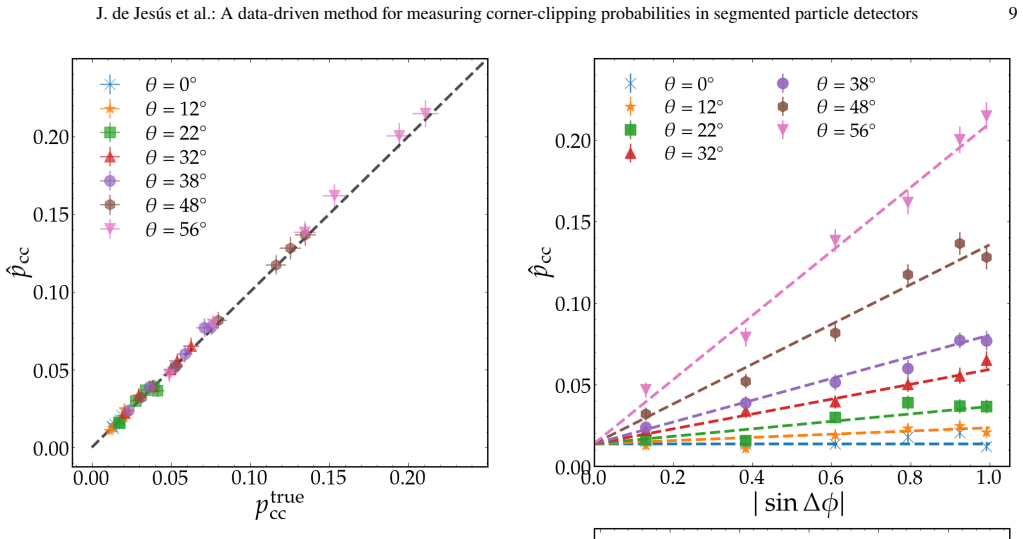
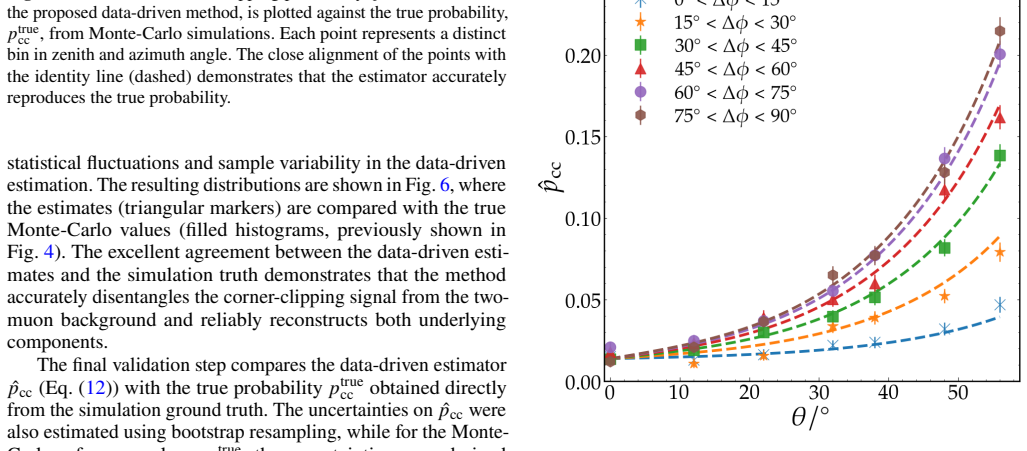
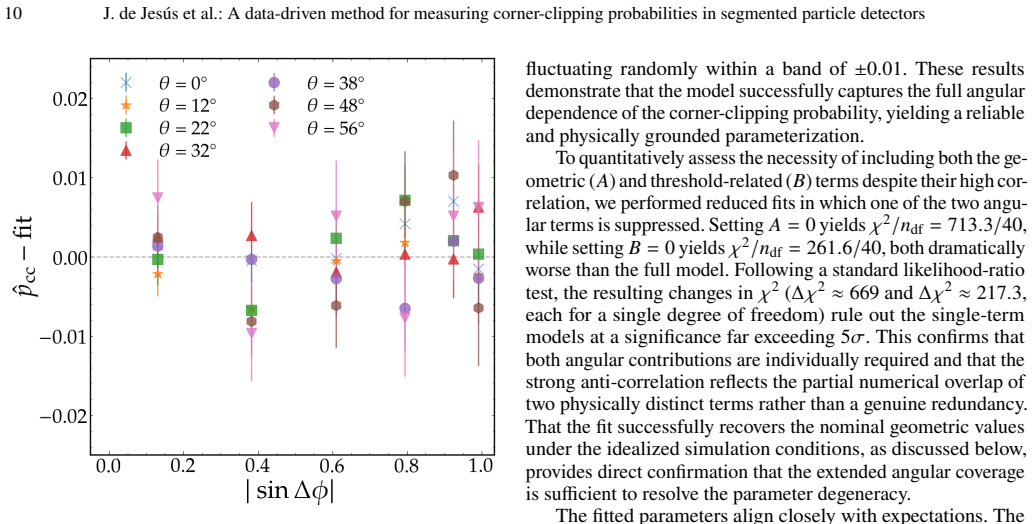
The authors establish that a fully data-driven method, relying on nanosecond timing to statistically separate genuine corner-clipping events from random coincidences with non-neighboring elements as control, can measure the corner-clipping probability and reproduce its angular dependence with absolute deviations below 0.01 in simulations of the Underground Muon Detector.
What carries the argument
The statistical distinction of corner-clipping events using timing resolution and an intrinsic control sample from non-neighboring detection elements.
If this is right
- The corner-clipping probability can be measured without Monte Carlo simulations, reducing modeling uncertainties.
- Data-driven corrections can be incorporated into reconstruction algorithms for particle counting.
- The analytical model allows parameterization incorporating detector geometry and minimum path length.
- This leads to more accurate determination of the muonic component of extensive air showers.
- The method applies to any segmented detector with sufficient timing resolution.
Where Pith is reading between the lines
- Other experiments with segmented detectors could adopt this to improve their particle identification accuracy.
- The method might enable on-the-fly corrections during data taking if timing is good enough.
- It could be extended to measure other types of multi-hit probabilities in detectors.
- This connects to improving muon flux measurements in cosmic ray studies.
Load-bearing premise
The approach relies on non-neighboring detection elements providing an accurate control sample for random coincidences and on the detector timing being fine enough to separate genuine events statistically.
What would settle it
A direct comparison between the data-driven probability measurement and the known true probability from detailed simulations or controlled tests, where the absolute difference exceeds 0.01 for some angles, would falsify the claim of accurate reproduction.
Figures

read the original abstract
The accuracy of particle counting in highly segmented detectors is limited by the corner-clipping effect, in which a single ionizing particle generates signals in adjacent detection elements. This phenomenon introduces a direction-dependent overcounting bias that distorts reconstructed observables and is commonly corrected using Monte-Carlo simulations, thereby inheriting modeling uncertainties. We present a fully data-driven method to directly measure the single-particle corner-clipping probability, exploiting the nanosecond timing resolution of modern detectors to statistically distinguish genuine corner-clipping events from random coincidences, with non-neighboring detection elements serving as an intrinsic control sample. The technique is validated using detailed simulations of the Underground Muon Detector of the Pierre Auger Observatory, reproducing the true angular dependence of the corner-clipping probability with absolute deviations below 0.01. To parameterize the results, we introduce a compact analytical model incorporating detector geometry, minimum detectable path length, and orientation-independent contributions. The proposed methodology and parameterization enable the direct incorporation of data-driven corner-clipping corrections into reconstruction algorithms, mitigating the overcounting bias and ultimately yielding a more accurate determination of the muonic component of extensive air showers. These developments are broadly applicable to any segmented detector with sufficient timing resolution, making them relevant to a wide range of experiments in high-energy and astroparticle physics.
Editorial analysis
A structured set of objections, weighed in public.
Referee Report
Summary. The manuscript presents a data-driven method to measure single-particle corner-clipping probabilities in segmented detectors. It exploits nanosecond timing resolution to statistically separate genuine corner-clipping events from random coincidences, using signals in non-neighboring elements as an intrinsic control sample. The technique is validated in detailed Monte Carlo simulations of the Pierre Auger Underground Muon Detector, reproducing the true angular dependence with absolute deviations below 0.01. An analytical parameterization incorporating detector geometry, minimum path length, and an orientation-independent term is introduced to facilitate incorporation into reconstruction algorithms for extensive air showers.
Significance. If the method can be shown to work on real data, it would enable direct, simulation-independent corrections for overcounting bias in highly segmented detectors, improving accuracy in muonic component measurements of air showers. The timing-based statistical separation is a clever approach with potential applicability across other high-energy physics and astroparticle experiments that have sufficient timing resolution.
major comments (2)
- [Abstract and validation section] Abstract and validation section: The central claim that the method reproduces the true angular dependence with absolute deviations below 0.01 is load-bearing for the headline result, yet the manuscript provides no details on event selection, background subtraction procedure, or how statistical uncertainties are propagated in the simulation comparison. This absence prevents assessment of whether the reported agreement could be affected by analysis choices.
- [Method and control-sample description] Method and control-sample description: The assumption that non-neighboring detection elements furnish a valid control sample for random coincidences, and that timing resolution suffices to separate genuine corner-clipping events, is only verified inside the Monte Carlo where the modeled physics matches the simulation exactly. Any unmodeled real-detector effects (position-dependent efficiency, correlated noise, or timing jitter) would invalidate the subtraction without being detected by the reported test.
minor comments (2)
- [Analytical model section] Analytical model section: Clarify the status of the orientation-independent contribution—whether it is extracted directly from data or introduced as a free parameter—as this directly affects the strength of the 'fully data-driven' claim.
- [Method description] The manuscript would benefit from a brief statement on the minimum timing resolution required for the statistical separation to remain effective.
Simulated Author's Rebuttal
We thank the referee for the constructive comments, which highlight important aspects of clarity and scope. We address each major comment below and will revise the manuscript to strengthen the presentation while remaining within the scope of a simulation-based validation study.
read point-by-point responses
-
Referee: [Abstract and validation section] Abstract and validation section: The central claim that the method reproduces the true angular dependence with absolute deviations below 0.01 is load-bearing for the headline result, yet the manuscript provides no details on event selection, background subtraction procedure, or how statistical uncertainties are propagated in the simulation comparison. This absence prevents assessment of whether the reported agreement could be affected by analysis choices.
Authors: We agree that these procedural details are necessary for a complete evaluation. The original manuscript focused on the overall method and results but omitted explicit descriptions of event selection, the precise background subtraction using the non-neighboring control sample, and uncertainty propagation. In the revised manuscript we will add a dedicated subsection in the validation section covering these elements, including how the timing-based separation is implemented and how statistical errors are calculated for the deviation metric. revision: yes
-
Referee: [Method and control-sample description] Method and control-sample description: The assumption that non-neighboring detection elements furnish a valid control sample for random coincidences, and that timing resolution suffices to separate genuine corner-clipping events, is only verified inside the Monte Carlo where the modeled physics matches the simulation exactly. Any unmodeled real-detector effects (position-dependent efficiency, correlated noise, or timing jitter) would invalidate the subtraction without being detected by the reported test.
Authors: The referee correctly identifies that the validation is performed entirely within the Monte Carlo framework, where the detector model is self-consistent by construction. The method itself is formulated to be data-driven and relies on observable timing and spatial correlations that are intrinsic to the detector readout. We will revise the text to explicitly state the assumptions underlying the control-sample approach and to discuss how unmodeled effects could be diagnosed or mitigated when the method is applied to real data. A quantitative assessment of all possible real-detector systematics, however, requires experimental data that are not part of the present study. revision: partial
- Demonstration that the method functions on actual experimental data, as the current work is restricted to Monte Carlo validation of the Pierre Auger Underground Muon Detector.
Circularity Check
No circularity: data-driven measurement validated externally against simulation truth; analytical model is post-hoc parameterization.
full rationale
The paper's core claim is a data-driven extraction of corner-clipping probability using timing and non-neighboring control samples, validated by direct comparison to known truth in Monte Carlo (deviations <0.01). The subsequent analytical model is introduced only to parameterize those measured results and incorporates geometry and path-length terms as inputs, not as a self-referential loop that forces the reported angular dependence. No step reduces a prediction to a fitted parameter by construction, no self-citation chain is load-bearing for the central result, and the derivation remains self-contained against the external simulation benchmark. This is the expected non-finding for a methods paper whose primary output is an empirical extraction rather than a closed-form derivation.
Axiom & Free-Parameter Ledger
free parameters (1)
- orientation-independent contribution
axioms (1)
- domain assumption Non-neighboring detection elements provide an intrinsic control sample for random coincidences
Reference graph
Works this paper leans on
-
[1]
Chiba et al., Akeno Giant Air Shower Array (AGASA) cov- ering 100 km2 area
N. Chiba et al., Akeno Giant Air Shower Array (AGASA) cov- ering 100 km2 area. Nucl. Instrum. Methods A311, 338 (1992). https://doi.org/10.1016/0168-9002(92)90882-5
-
[2]
A.Borioneetal.,Alargeairshowerarraytosearchforastrophysical sources emitting gamma-rays with energies>10 14 eV. Nucl. Instrum.MethodsA346,329(1994).https://doi.org/10.1016/0168- 9002(94)90722-6
-
[3]
N. Hayashida et al., Muons ( ≥ 1 GeV) in large extensive air showers of energies between1016.5 eV and 1019.5 eV ob- served at Akeno. J. Phys. G: Nucl. Part. Phys.21, 1101 (1995). https://doi.org/10.1088/0954-3899/21/8/008
-
[4]
Glasmacher et al., The cosmic ray composition be- tween 1014 and 1016 eV
M. Glasmacher et al., The cosmic ray composition be- tween 1014 and 1016 eV. Astropart. Phys.12, 1 (1999). https://doi.org/10.1016/S0927-6505(99)00076-6
-
[5]
Pierre Auger Collaboration, Prototype muon detectors for the AMIGA component of the Pierre Auger Observatory. JINST11, P02012 (2016). https://doi.org/10.1088/1748-0221/11/02/P02012
-
[6]
A. D. Supanitsky et al., Underground muon counters as a tool for composition analyses. Astropart. Phys.29, 461 (2008). https://doi.org/10.1016/j.astropartphys.2008.05.003
-
[7]
D. Ravignani, A. D. Supanitsky, A new method for re- constructing the muon lateral distribution with an array of segmented counters. Astropart. Phys.65, 1 (2015). https://doi.org/10.1016/j.astropartphys.2014.11.007
-
[8]
A. D. Supanitsky, Estimation of the number of muons with muon counters. Astropart. Phys.127, 102535 (2021). https://doi.org/10.1016/j.astropartphys.2020.102535
-
[9]
F. Gesualdi, A. D. Supanitsky, Estimation of the number of counts onaparticlecounterdetectorwithfulltimeresolution.Eur.Phys.J. C82, 925 (2022). https://doi.org/10.1140/epjc/s10052-022-10895- 9
-
[10]
V. V. K. Covilakam, A. D. Supanitsky, D. Ravignani, Recon- struction of air shower muon lateral distribution functions using integrator and binary modes of underground muon detectors. Eur. Phys. J. C83, 1157 (2023). https://doi.org/10.1140/epjc/s10052- 023-12344-7
-
[11]
M. Scornavacche et al., Effect of the knock-on electrons in the calorimetric mode of an underground muon detector, in Proceedings of 7th International Symposium on Ultra High Energy Cosmic Rays. PoS(UHECR2024)484, 116 (2025). https://doi.org/10.22323/1.484.0116
-
[12]
Pierre Auger Collaboration, Direct measurement of the muonic content of extensive air showers between2×10 17 and 2×10 18 eV at the Pierre Auger Observatory. Eur. Phys. J. C80, 751 (2020). https://doi.org/10.1140/epjc/s10052-020-8055-y
-
[13]
J. M. Figueira for the Pierre Auger Collaboration, An improved reconstruction method for the AMIGA detectors, inProceedings of 35th International Cosmic Ray Conference. PoS(ICRC2017) 301, 396 (2017). https://doi.org/10.22323/1.301.0396
-
[14]
M. Scornavacche for the Pierre Auger Collaboration, Muon count- ing with the underground muon detector of the Pierre Auger Observatory, inProceedings of 6th International Symposium on Ultra High Energy Cosmic Rays.EPJWebConf.283,06012(2023). https://doi.org/10.1051/epjconf/202328306012
-
[15]
https://doi.org/10.22323/1.484.0077
J.deJesúsforthePierreAugerCollaboration,Improvedcalibration methods and reconstruction of the Underground Muon Detector of the Pierre Auger Observatory, inProceedings of 7th International Symposium on Ultra High Energy Cosmic Rays.PoS(UHECR2024) 484, 077 (2025). https://doi.org/10.22323/1.484.0077
-
[16]
Pierre Auger Collaboration, The Pierre Auger cosmic ray Observatory. Nucl. Instrum. Methods A798, 172 (2015). https://doi.org/10.1016/j.nima.2015.06.058
-
[17]
Pierre Auger Collaboration, Constraining models for the origin of ultra-high-energy cosmic rays with a novel combined analysis of arrival directions, spectrum, and composition data measured at the Pierre Auger Observatory. J. Cosmol. Astropart. Phys.01, 022 (2024). https://doi.org/10.1088/1475-7516/2024/01/022
-
[18]
PierreAugerCollaboration,Searchforadiffusefluxofphotonswith energiesabovetensofPeVatthePierreAugerObservatory.J.Cos- mol.Astropart.Phys.05,061(2025).https://doi.org/10.1088/1475- 7516/2025/05/061
-
[19]
Pierre Auger Collaboration, The Pierre Auger Obser- vatory open data. Eur. Phys. J. C85, 70 (2025). https://doi.org/10.1140/epjc/s10052-024-13560-5
-
[20]
https://doi.org/10.1088/1748-0221/16/04/P04003
Pierre Auger Collaboration, Calibration of the underground muon detectorofthePierreAugerObservatory.JINST16,P04003(2021). https://doi.org/10.1088/1748-0221/16/04/P04003
-
[21]
M. A. Scornavacche for the Pierre Auger Collaboration, Muon signal charge in the Underground Muon Detec- tor of AugerPrime, inProceedings of 39th International Cosmic Ray Conference. PoS(ICRC2025)501, 389 (2025). https://doi.org/10.22323/1.501.0389 12 J. de Jesús et al.: A data-driven method for measuring corner-clipping probabilities in segmented particl...
-
[22]
PierreAugerCollaboration,Reconstructionofeventsrecordedwith the surface detector of the Pierre Auger Observatory. JINST15, P10021 (2020). https://doi.org/10.1088/1748-0221/15/10/P10021
-
[23]
Pierre Auger Collaboration, The energy spectrum of cosmic rays beyondtheturn-downaround 1017 eVasmeasuredwiththesurface detector of the Pierre Auger Observatory. Eur. Phys. J. C81, 966 (2021). https://doi.org/10.1140/epjc/s10052-021-09700-w
-
[24]
Pierre Auger Collaboration, The scintillator surface detector of the Pierre Auger Observatory. JINST20, P08002 (2025). https://doi.org/10.1088/1748-0221/20/08/P08002
-
[25]
Heck et al., CORSIKA: A Monte Carlo code to simulate extensiveairshowers.Tech.Rep.FZKA6019,Forschungszentrum Karlsruhe (1998)
D. Heck et al., CORSIKA: A Monte Carlo code to simulate extensiveairshowers.Tech.Rep.FZKA6019,Forschungszentrum Karlsruhe (1998). https://www.iap.kit.edu/corsika/70.php
1998
-
[26]
EPOS LHC: Test of collective hadronization with data measured at the CERN Large Hadron Collider.Phys
T. Pierog et al., EPOS LHC: Test of collective hadronization with data measured at the CERN Large Hadron Collider. Phys. Rev. C 92, 034906 (2015). https://doi.org/10.1103/PhysRevC.92.034906
-
[27]
Agostinelli et al., Geant4 – a simulation toolkit
S. Agostinelli et al., Geant4 – a simulation toolkit. Nucl. In- strum. Methods A506, 250 (2003). https://doi.org/10.1016/S0168- 9002(03)01368-8
-
[28]
A. M Botti, F. Sánchez, M. Roth, A. Etchegoyen, Development and validation of the signal simulation for the underground muon detectorofthePierreAugerObservatory.JINST16,P07059(2021). https://doi.org/10.1088/1748-0221/16/07/P07059
-
[29]
Argiro et al., The Offline software framework of the Pierre Auger Observatory
S. Argiro et al., The Offline software framework of the Pierre Auger Observatory. Nucl. Instrum. Methods A580, 1485 (2007). https://doi.org/10.1016/j.nima.2007.07.010
-
[30]
B. Efron, Bootstrap methods: Another look at the jackknife. Ann. Statist.7, 1 (1979). https://doi.org/10.1214/aos/1176344552
-
[31]
Kulesa et al., Sampling distributions and the bootstrap
A. Kulesa et al., Sampling distributions and the bootstrap. Nat. Methods12, 477 (2015). https://doi.org/10.1038/nmeth.3414
discussion (0)
Sign in with ORCID, Apple, or X to comment. Anyone can read and Pith papers without signing in.