Rolling Stock Planning Using the Quantum Approximate Optimization Algorithm
Pith reviewed 2026-06-27 13:05 UTC · model grok-4.3
The pith
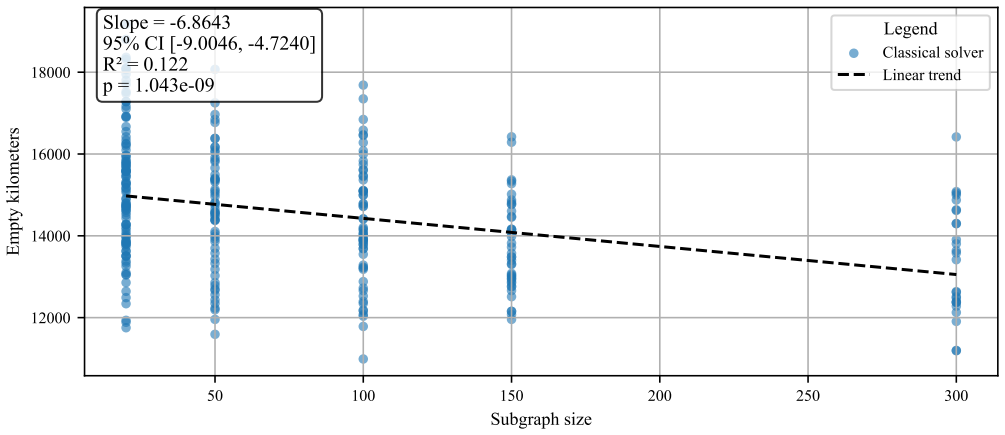
A hybrid divide-and-conquer solver using QAOA finds higher-quality rolling stock plans as subgraph size grows.
A machine-rendered reading of the paper's core claim, the machinery that carries it, and where it could break.
Core claim
The hybrid framework iteratively selects subgraphs and solves the MWIS problem using QAOA or exact classical methods; solution quality improves as subgraph size is increased, allowing the method to bridge polynomial-time approximate solvers and exponential-time exact methods on the 190-trip instance.
What carries the argument
The hybrid divide-and-conquer algorithm that decomposes the MWIS graph into subgraphs solved by QAOA or classical exact solvers.
If this is right
- Solution quality scales positively with the size of the subgraphs that are solved exactly or with QAOA.
- QAOA can be embedded inside an existing classical planning workflow without replacing the entire solver.
- The same decomposition works when the subgraph solver is swapped between simulation, exact classical code, and real quantum hardware.
- The gap between fast approximate and slow exact methods narrows as larger subproblems become tractable.
Where Pith is reading between the lines
- The same subgraph decomposition could be applied to other transportation scheduling problems that reduce to weighted independent sets.
- If the subgraph selector itself is made adaptive, the number of expensive exact or quantum calls might drop further.
- Running the same pipeline on instances with several hundred trips would test whether the observed scaling continues or saturates.
Load-bearing premise
The MWIS formulation on the cycle graph fully encodes every operational constraint without losing feasible solutions or admitting invalid ones.
What would settle it
On the 190-trip instance, increasing subgraph size produces no measurable rise in solution quality or yields plans that violate maintenance or compatibility rules when checked against the original problem data.
Figures

read the original abstract
Rolling stock planning is a complex optimization problem in railway management that involves assigning physical trains to scheduled trips while minimizing operational costs. In this work, we address a specific instance of this problem featuring 190 trips over two days, subject to constraints such as mandatory maintenance stops. We reformulate the problem as a Maximum-Weight Independent Set (MWIS) problem on a graph where nodes represent feasible train cycles. To handle the computational complexity of the large search space, we propose a hybrid divide-and-conquer algorithm. This approach iteratively selects subgraphs and solves the MWIS problem using various solvers, including exact classical methods and the Quantum Approximate Optimization Algorithm (QAOA). We evaluate the algorithm's performance by comparing these methods and analyzing the scaling with respect to subgraph size, with QAOA assessed through both classical simulation and execution on a quantum device (IQM Emerald). Our results indicate that increasing the subgraph size generally improves solution quality, demonstrating that the hybrid framework can effectively bridge the gap between polynomial-time approximate solvers and exponential-time exact methods.
Editorial analysis
A structured set of objections, weighed in public.
Referee Report
Summary. The paper reformulates rolling-stock planning (190 trips, maintenance constraints) as a Maximum-Weight Independent Set (MWIS) instance whose nodes are feasible train cycles, then applies a hybrid divide-and-conquer procedure that extracts subgraphs and solves the MWIS subproblems with exact classical methods and with QAOA (simulated and on IQM Emerald hardware). It reports that solution quality improves with subgraph size and concludes that the framework bridges polynomial-time approximate solvers and exponential-time exact methods.
Significance. If the MWIS encoding is shown to be faithful, the work supplies a concrete, hardware-executed demonstration of QAOA on a structured real-world combinatorial problem together with an empirical scaling study on subgraphs; the hybrid divide-and-conquer template itself is reusable for other large MWIS instances.
major comments (2)
- [Abstract] Abstract: the claim that nodes are “feasible train cycles” and that the graph “encodes constraints such as mandatory maintenance stops” supplies no explicit construction showing how train compatibility, depot capacity, or time-window constraints are captured by node weights or by the independence condition. Without this mapping, measured improvements on the MWIS instance do not establish validity for the original rolling-stock problem.
- [Abstract] Abstract / evaluation section: performance trends versus subgraph size are presented without quantitative error bars, without an explicit statement of how maintenance constraints are encoded in the MWIS formulation, and without a direct baseline comparison against a commercial MIP solver on the identical 190-trip instance.
Simulated Author's Rebuttal
We thank the referee for their careful reading and constructive comments on our manuscript. We address each major comment below and indicate the revisions we will undertake.
read point-by-point responses
-
Referee: [Abstract] Abstract: the claim that nodes are “feasible train cycles” and that the graph “encodes constraints such as mandatory maintenance stops” supplies no explicit construction showing how train compatibility, depot capacity, or time-window constraints are captured by node weights or by the independence condition. Without this mapping, measured improvements on the MWIS instance do not establish validity for the original rolling-stock problem.
Authors: We acknowledge that the abstract is too concise and does not supply the explicit mapping. The manuscript body (Section 2) defines nodes as feasible cycles that already incorporate maintenance stops and compatibility rules, with weights encoding operational cost and the independence condition enforcing non-overlapping assignments. To address the referee’s concern directly, we will expand the abstract with a short description of this construction and add a clarifying paragraph or small diagram in the main text that shows how the listed constraints map to the MWIS instance. revision: yes
-
Referee: [Abstract] Abstract / evaluation section: performance trends versus subgraph size are presented without quantitative error bars, without an explicit statement of how maintenance constraints are encoded in the MWIS formulation, and without a direct baseline comparison against a commercial MIP solver on the identical 190-trip instance.
Authors: We agree that error bars are needed and will recompute and display them for all subgraph-size scaling plots. The explicit encoding statement will be added as noted in the first response. For the MIP baseline, we will include direct comparisons against a commercial solver on the same subgraphs used in the QAOA experiments. On the full 190-trip instance we will add a discussion of why an exact MIP solve is intractable within reasonable time limits and report any feasible bounds or partial solutions obtained; a complete optimal solution for the full instance may remain out of reach, which is precisely why the hybrid approach is proposed. revision: partial
Circularity Check
No circularity: solution quality measured by direct external comparison on MWIS instances
full rationale
The paper reformulates rolling-stock planning as MWIS on a cycle graph whose nodes are feasible train cycles, then evaluates QAOA (and classical solvers) on induced subgraphs by comparing output weights against exact solvers on the identical subgraphs. No equation reduces reported quality gains to a fitted parameter, no self-citation supplies a load-bearing uniqueness theorem, and no ansatz is smuggled in. The scaling result is therefore an empirical observation against an independent benchmark rather than a definitional identity.
Axiom & Free-Parameter Ledger
axioms (2)
- domain assumption The rolling-stock constraints can be exactly encoded as conflicts in an MWIS instance on a cycle graph.
- domain assumption QAOA on subgraphs of increasing size produces monotonically improving global solutions when stitched together.
Reference graph
Works this paper leans on
-
[1]
Design and application of quantum algorithms for railway optimisation problems,
C. Grange, “Design and application of quantum algorithms for railway optimisation problems,” Theses, Universit ´e de Montpellier, Jul. 2024. [Online]. Available: https://hal.science/tel-04671228
2024
-
[2]
P. Bickert, C. Grozea, R. Hans, M. Koch, C. Riehn, and A. Wolf, “Optimising rolling stock planning including maintenance with constraint programming and quantum annealing,” 2023. [Online]. Available: https://arxiv.org/abs/2109.07212
arXiv 2023
-
[3]
Quadratic and higher-order unconstrained binary optimization of railway rescheduling for quantum computing,
K. Domino, A. Kundu, ¨O. Salehi, and K. Krawiec, “Quadratic and higher-order unconstrained binary optimization of railway rescheduling for quantum computing,”Quantum Information Processing, vol. 21, no. 9, p. 337, Sep 2022. [Online]. Available: https://doi.org/10.1007/ s11128-022-03670-y
2022
-
[4]
Quantum annealing in the nisq era: Railway conflict management,
K. Domino, M. Koniorczyk, K. Krawiec, K. Jałowiecki, S. Deffner, and B. Gardas, “Quantum annealing in the nisq era: Railway conflict management,”Entropy, vol. 25, no. 2, 2023. [Online]. Available: https://www.mdpi.com/1099-4300/25/2/191
2023
-
[5]
Applying the quantum approximate optimization algorithm to the tail-assignment problem,
P. Vikst ˚al, M. Gr ¨onkvist, M. Svensson, M. Andersson, G. Johansson, and G. Ferrini, “Applying the quantum approximate optimization algorithm to the tail-assignment problem,”Phys. Rev. Appl., vol. 14, p. 034009, Sep 2020. [Online]. Available: https://link.aps.org/doi/10.1103/ PhysRevApplied.14.034009
2020
-
[6]
M. Gili, P. S. Sebastian, and A. Bl ´azquez-Garc´ıa, “Optimization of flight routes: Quantum approximate optimization algorithm for the tail assignment problem,” 2024. [Online]. Available: https: //arxiv.org/abs/2412.12773
arXiv 2024
-
[7]
E. Wybo and M. Leib, “Missing puzzle pieces in the performance landscape of the quantum approximate optimization algorithm,” Quantum, vol. 9, p. 1892, Oct. 2025. [Online]. Available: http: //dx.doi.org/10.22331/q-2025-10-22-1892
-
[8]
A scalable quantum-enhanced greedy algorithm for maximum independent set problems,
E. Wybo, J. R ¨onkk¨o, O. Hirviniemi, J. R. Fin ˇzgar, and M. Leib, “A scalable quantum-enhanced greedy algorithm for maximum independent set problems,” 2026. [Online]. Available: https://arxiv.org/ abs/2601.21923
arXiv 2026
-
[9]
A note on greedy algorithms for the maximum weighted independent set problem,
S. Sakai, M. Togasaki, and K. Yamazaki, “A note on greedy algorithms for the maximum weighted independent set problem,”Discrete Applied Mathematics, vol. 126, no. 2, pp. 313–322, 2003. [Online]. Available: https://www.sciencedirect.com/science/article/pii/S0166218X02002056
2003
-
[10]
A quantum approximate optimization algorithm,
E. Farhi, J. Goldstone, and S. Gutmann, “A quantum approximate optimization algorithm,” 2014. [Online]. Available: https://arxiv.org/abs/ 1411.4028
Pith/arXiv arXiv 2014
-
[11]
T. Kadowaki and H. Nishimori, “Quantum annealing in the transverse ising model,”Phys. Rev. E, vol. 58, pp. 5355–5363, Nov 1998. [Online]. Available: https://link.aps.org/doi/10.1103/PhysRevE.58.5355
-
[12]
Optimizing variational quantum algorithms using pontryagin’s mini- mum principle,
Z.-C. Yang, A. Rahmani, A. Shabani, H. Neven, and C. Chamon, “Optimizing variational quantum algorithms using pontryagin’s mini- mum principle,”Phys. Rev. X, vol. 7, p. 021027, May 2017. [Online]. Available: https://link.aps.org/doi/10.1103/PhysRevX.7.021027
-
[13]
Exploring network structure, dynamics, and function using networkx,
A. A. Hagberg, D. A. Schult, and P. J. Swart, “Exploring network structure, dynamics, and function using networkx,” inProceedings of the 7th Python in Science Conference, G. Varoquaux, T. Vaught, and J. Millman, Eds., Pasadena, CA USA, 2008, pp. 11 – 15
2008
-
[14]
A. Ozaeta, W. van Dam, and P. L. McMahon, “Expectation values from the single-layer quantum approximate optimization algorithm on ising problems,”Quantum Science and Technology, vol. 7, no. 4, p. 045036, sep 2022. [Online]. Available: https://doi.org/10.1088/2058-9565/ac9013
-
[15]
J. A. Monta ˜nez-Barrera and K. Michielsen, “Toward a linear-ramp qaoa protocol: evidence of a scaling advantage in solving some combinatorial optimization problems,”npj Quantum Information, vol. 11, no. 1, p. 131, Aug 2025. [Online]. Available: https: //doi.org/10.1038/s41534-025-01082-1
-
[16]
Completeness in standard and differential approximation classes: Poly-(d)apx- and (d)ptas-completeness,
C. Bazgan, B. Escoffier, and V . T. Paschos, “Completeness in standard and differential approximation classes: Poly-(d)apx- and (d)ptas-completeness,”Theoretical Computer Science, vol. 339, no. 2, pp. 272–292, 2005. [Online]. Available: https://www.sciencedirect.com/ science/article/pii/S030439750500126X APPENDIX Here we consider how many cycles there are...
2005
-
[17]
First, we expand the variabled≈ nt′ mT ′ (ignoring rounding up/down)
Leading Term inn:Now we focus on the scaling with n, so we need to isolate any dependency on it. First, we expand the variabled≈ nt′ mT ′ (ignoring rounding up/down). This allows us to simplify the upper limit of the sum to j n/m+d−1 d k ≈ n/m+ nt′ mT ′ −1 nt′ mT ′ ≈ T ′ t′ + 1 Similarly, the upper term in the binomial coefficient is simplified as n m −(k...
discussion (0)
Sign in with ORCID, Apple, or X to comment. Anyone can read and Pith papers without signing in.