Dark Matter with a Drag at Low Redshift
Pith reviewed 2026-06-27 08:37 UTC · model grok-4.3
The pith
Dark matter that decays into radiation at late times experiences a drag force that slows the growth of cosmic structures at low redshifts.
A machine-rendered reading of the paper's core claim, the machinery that carries it, and where it could break.
Core claim
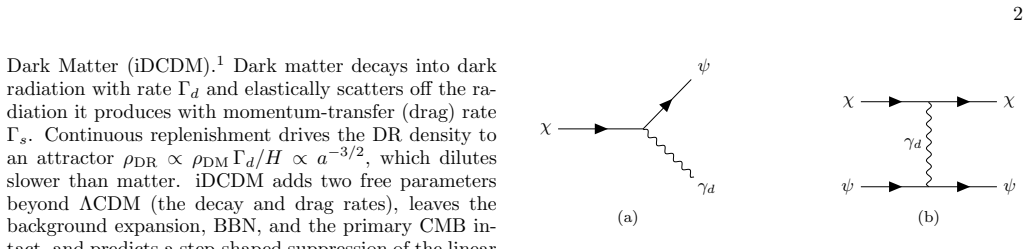
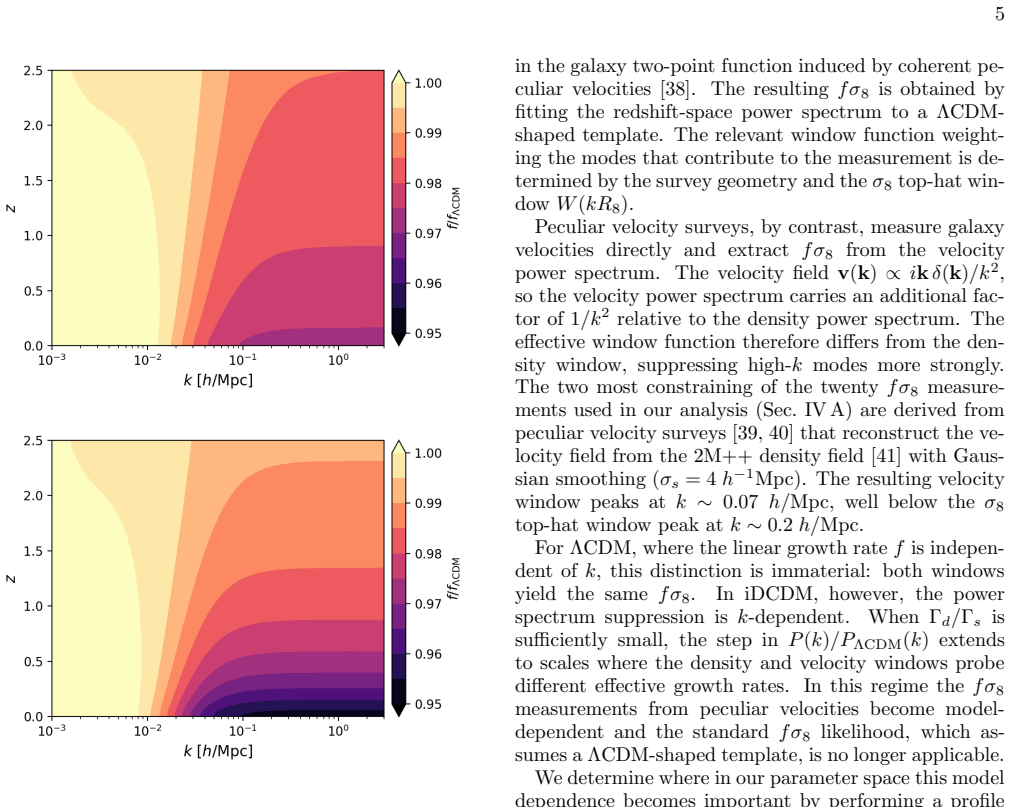
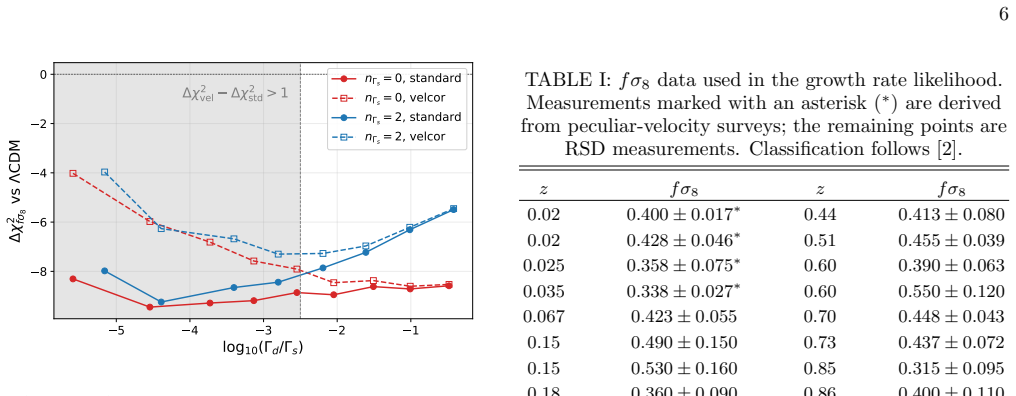
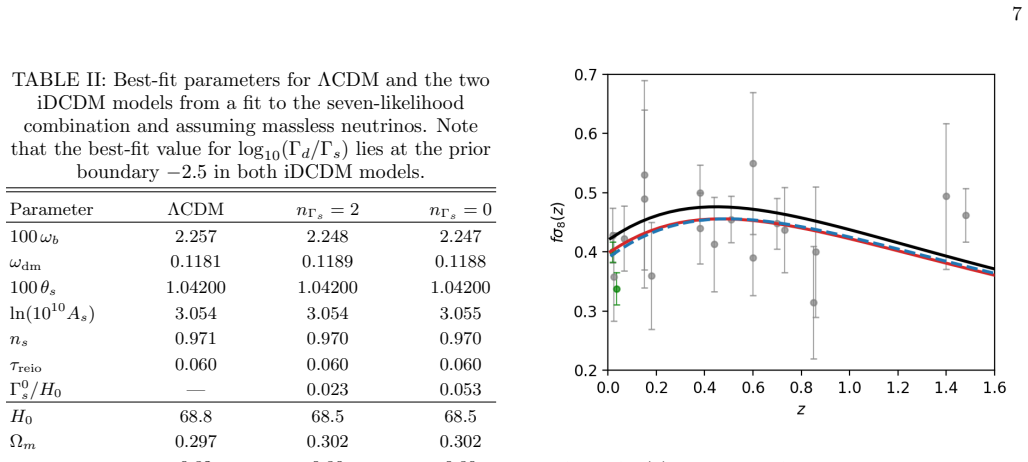
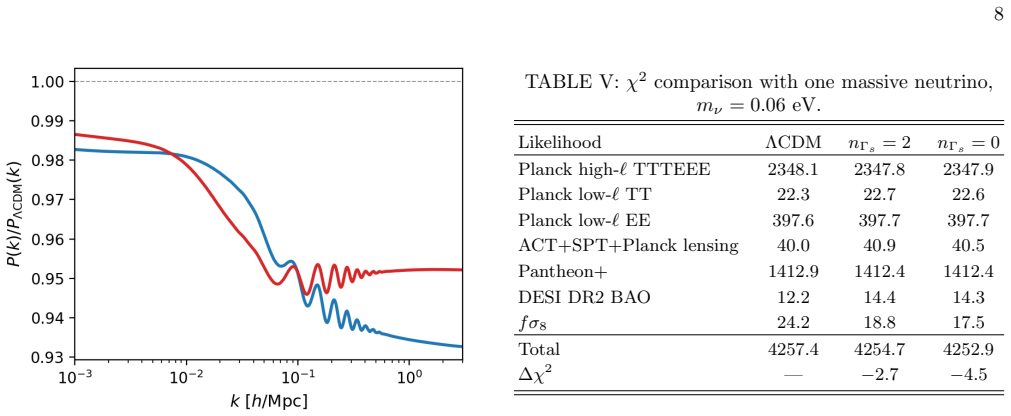
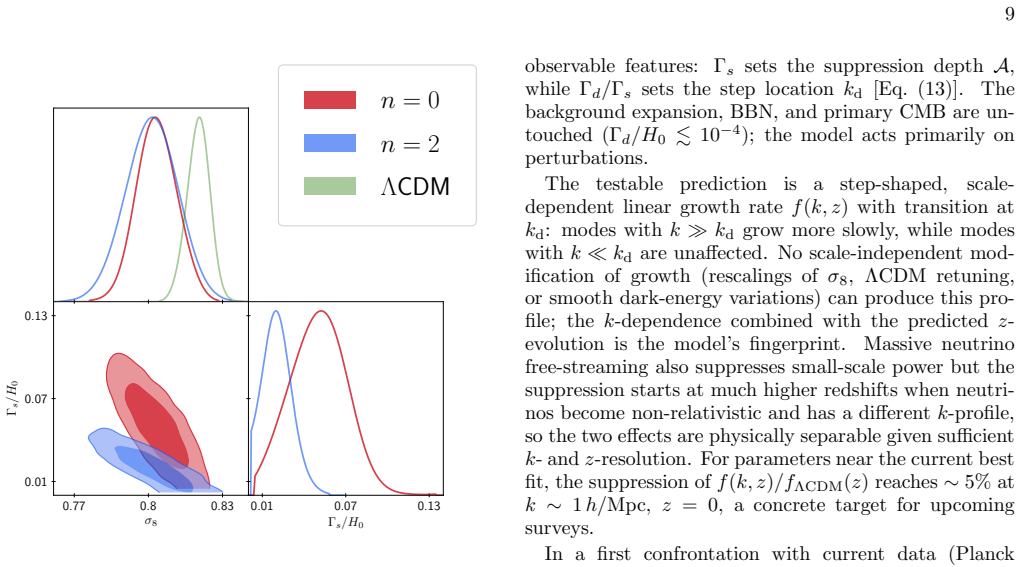
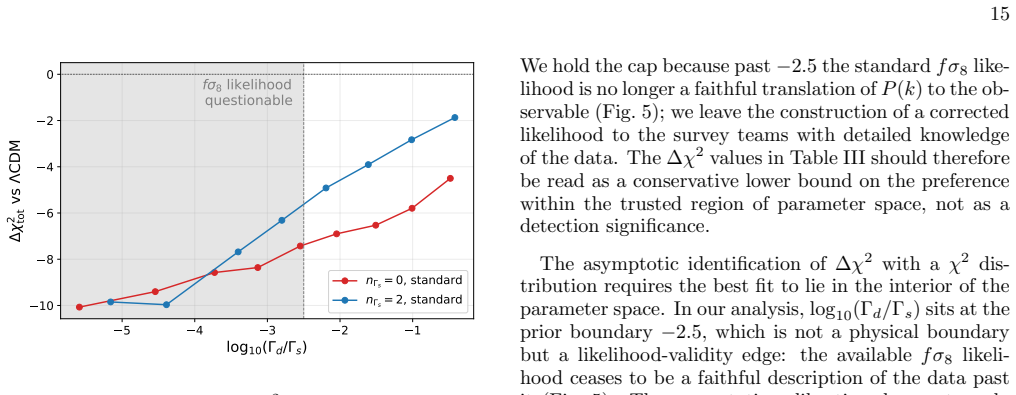
An explicit interacting Decaying Cold Dark Matter (iDCDM) model adds two parameters beyond LambdaCDM while leaving the background, BBN, and primary CMB intact. It predicts a step-shaped suppression of the linear growth rate f(k,z) and shows a modest preference over LambdaCDM with Delta chi squared between -2.7 and -7.6 when confronted with current f sigma8 data.
What carries the argument
The iDCDM model where dark matter decays to produce dark radiation that exerts a drag force on the remaining dark matter, with the interaction strength growing at late times.
If this is right
- The growth rate f(k,z) is suppressed in a step shape at low redshifts.
- Current f sigma8 data is fit better than LambdaCDM by Delta chi^2 of -2.7 to -7.6.
- Early universe observables like BBN and primary CMB are unaffected.
- Future k- and z-resolved measurements from DESI, Euclid, and Rubin will provide decisive tests.
Where Pith is reading between the lines
- If the drag is confirmed, it could explain the growth tension without new early-universe physics.
- The late-time production of dark radiation might have observable effects in other cosmological probes if the decay products are detectable.
- Extensions could explore different redshift scalings of the drag to optimize fits.
Load-bearing premise
The radiation that interacts with dark matter is produced at late times from dark matter decay, allowing the drag to grow with redshift without changing early-universe observables.
What would settle it
A high-precision measurement of the growth rate f sigma8 at low redshifts showing no improvement in fit or the absence of the predicted step-shaped suppression in f(k,z).
Figures
read the original abstract
Recent analyses of $f\sigma_8$ and weak-lensing data indicate that the linear growth rate at $z\lesssim 1$ may be lower than predicted by $\Lambda$CDM. This motivates models of dark matter in which large scale structure growth slows relative to $\Lambda$CDM at late times. We construct particle models in which dark matter experiences a drag with dark radiation that grows at late times, unlike conventional DM--DR interactions, which fade as the universe expands. A key ingredient is that the radiation interacting with the dark matter is produced at late times from dark matter decay. An explicit model, interacting Decaying Cold Dark Matter (iDCDM), adds two parameters beyond $\Lambda$CDM while leaving the background, BBN, and primary CMB intact. But it predicts a step-shaped suppression of the linear growth rate $f(k,z)$, a distinctive target for DESI, Euclid, and Rubin. Confronted with current data, iDCDM shows a modest preference over $\Lambda$CDM, driven by $f\sigma_8$, with $\Delta\chi^2$ between $-2.7$ and $-7.6$ depending on the assumed scaling of the drag with redshift and on neutrino masses. The decisive test will come from upcoming $k$- and $z$-resolved growth measurements.
Editorial analysis
A structured set of objections, weighed in public.
Referee Report
Summary. The paper proposes an interacting Decaying Cold Dark Matter (iDCDM) model with two additional free parameters (decay rate and drag coupling strength) beyond ΛCDM. Dark matter decays at late times into dark radiation that interacts with the remaining DM, producing a redshift-growing drag that suppresses the linear growth rate f(k,z) in a step-like manner at z≲1. The model is constructed to leave the background expansion, BBN, and primary CMB unchanged, and is shown to yield Δχ² improvements of -2.7 to -7.6 over ΛCDM when fit to current fσ8 data, with the preference depending on the assumed drag scaling and neutrino masses. Distinctive predictions are made for future k- and z-resolved growth measurements from DESI, Euclid, and Rubin.
Significance. If the central construction holds—that late-time DM decay can source interacting DR yielding a growing drag without perturbing early-universe observables—the model offers a particle-physics-motivated mechanism for late-time growth suppression with a distinctive step-shaped signature. This would be a substantive addition to the literature on growth-rate tensions, providing falsifiable targets for upcoming surveys. The modest data preference and explicit two-parameter extension are strengths, though the result's robustness hinges on the unshown early-universe decoupling.
major comments (2)
- [abstract and model-construction paragraph] Abstract and model-construction paragraph: The claim that the model 'leaves the background, BBN, and primary CMB intact' is load-bearing for the central assertion of a late-time-only effect, yet no explicit derivation, perturbation equations, or numerical checks are referenced showing that the decay products and chosen interaction-rate scaling leave the sound horizon, baryon loading, and pre-recombination evolution unaltered. Without these, the separation between early and late physics cannot be verified.
- [data-confrontation section] Data-confrontation section (implied by the reported Δχ² values): The preference over ΛCDM (Δχ² between -2.7 and -7.6) is stated to depend on the assumed scaling of the drag with redshift and on neutrino masses; because the two free parameters are fitted directly to the same fσ8 data used to claim the improvement, the step-shaped suppression feature is not an independent prediction but is tied to the fit, weakening the claim of a 'modest preference' as a genuine model advantage.
minor comments (1)
- [abstract] The abstract refers to 'the assumed dr' without defining the acronym on first use; expand to 'dark radiation' for clarity.
Simulated Author's Rebuttal
We thank the referee for their careful reading and constructive comments on our manuscript. We respond point-by-point to the major comments below. We agree that additional explicit checks on the early-universe behavior will strengthen the paper and plan to incorporate them.
read point-by-point responses
-
Referee: [abstract and model-construction paragraph] Abstract and model-construction paragraph: The claim that the model 'leaves the background, BBN, and primary CMB intact' is load-bearing for the central assertion of a late-time-only effect, yet no explicit derivation, perturbation equations, or numerical checks are referenced showing that the decay products and chosen interaction-rate scaling leave the sound horizon, baryon loading, and pre-recombination evolution unaltered. Without these, the separation between early and late physics cannot be verified.
Authors: We agree that the manuscript would benefit from explicit verification. The model is constructed so that the decay rate is negligible prior to recombination (due to the redshift dependence of the decay and interaction terms), leaving the background expansion, sound horizon, and pre-recombination evolution identical to ΛCDM. To address the concern, we will add an appendix containing the relevant perturbation equations and a brief demonstration (via modified Boltzmann code output) that the CMB power spectra and BBN abundances remain unchanged at the level of current precision. revision: yes
-
Referee: [data-confrontation section] Data-confrontation section (implied by the reported Δχ² values): The preference over ΛCDM (Δχ² between -2.7 and -7.6) is stated to depend on the assumed scaling of the drag with redshift and on neutrino masses; because the two free parameters are fitted directly to the same fσ8 data used to claim the improvement, the step-shaped suppression feature is not an independent prediction but is tied to the fit, weakening the claim of a 'modest preference' as a genuine model advantage.
Authors: The two additional parameters set the amplitude and the characteristic redshift at which the drag becomes important, but the step-like functional form of the suppression in f(k,z) is fixed by the underlying physics: interacting dark radiation is sourced only at late times by DM decay, producing a drag that strengthens toward z=0. This shape is a genuine prediction of the construction rather than a free functional choice. The fit to fσ8 data then tests whether this physically motivated form improves the description relative to ΛCDM. We will add clarifying text in the data section to emphasize the distinction between the predicted shape and the fitted parameters. We therefore maintain that the reported preference reflects a genuine model advantage with a distinctive, falsifiable signature. revision: partial
Circularity Check
Two free parameters fitted to fσ8 data presented as independent prediction of step-shaped suppression
specific steps
-
fitted input called prediction
[Abstract]
"An explicit model, interacting Decaying Cold Dark Matter (iDCDM), adds two parameters beyond ΛCDM while leaving the background, BBN, and primary CMB intact. But it predicts a step-shaped suppression of the linear growth rate f(k,z), a distinctive target for DESI, Euclid, and Rubin. Confronted with current data, iDCDM shows a modest preference over ΛCDM, driven by fσ8, with Δχ² between −2.7 and −7.6 depending on the assumed scaling of the drag with redshift and on neutrino masses."
The two added parameters directly set the drag scaling and amplitude that produce the step-shaped suppression. The paper then fits those parameters to the fσ8 data set and reports the resulting Δχ² as evidence of preference; the distinctive shape is therefore the fitted output, not an independent prediction.
full rationale
The paper constructs iDCDM by adding two parameters that control the late-time DM-DR drag strength and redshift scaling. These parameters are varied to match the observed fσ8 suppression, yielding the quoted Δχ² improvement. The claimed 'prediction' of a step-shaped f(k,z) feature is therefore the direct output of the same fit, rather than an a priori consequence independent of the data used for the preference claim. No other circular steps (self-citation chains or definitional loops) are exhibited in the provided text.
Axiom & Free-Parameter Ledger
free parameters (2)
- decay rate parameter
- drag coupling strength
axioms (1)
- domain assumption Standard LambdaCDM background evolution and recombination physics remain valid when the new interaction is active only after recombination.
invented entities (1)
-
late-time produced dark radiation
no independent evidence
Reference graph
Works this paper leans on
-
[1]
standard
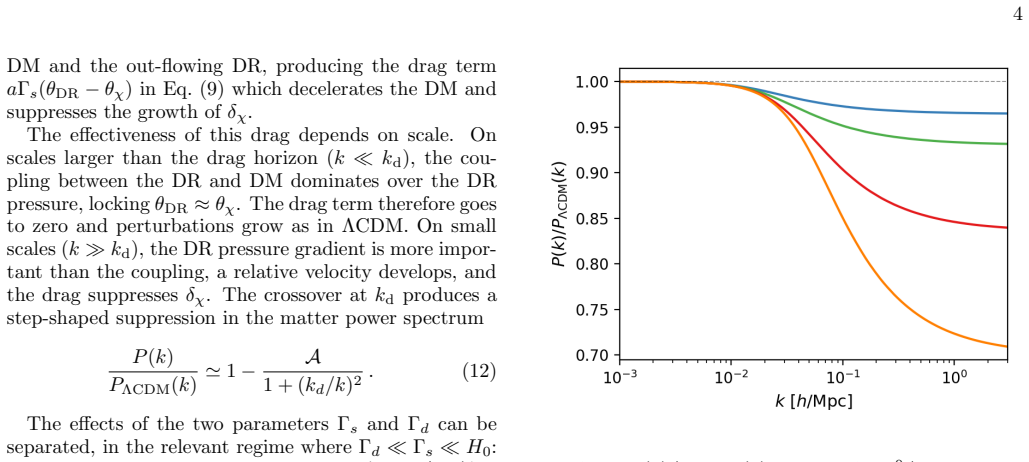
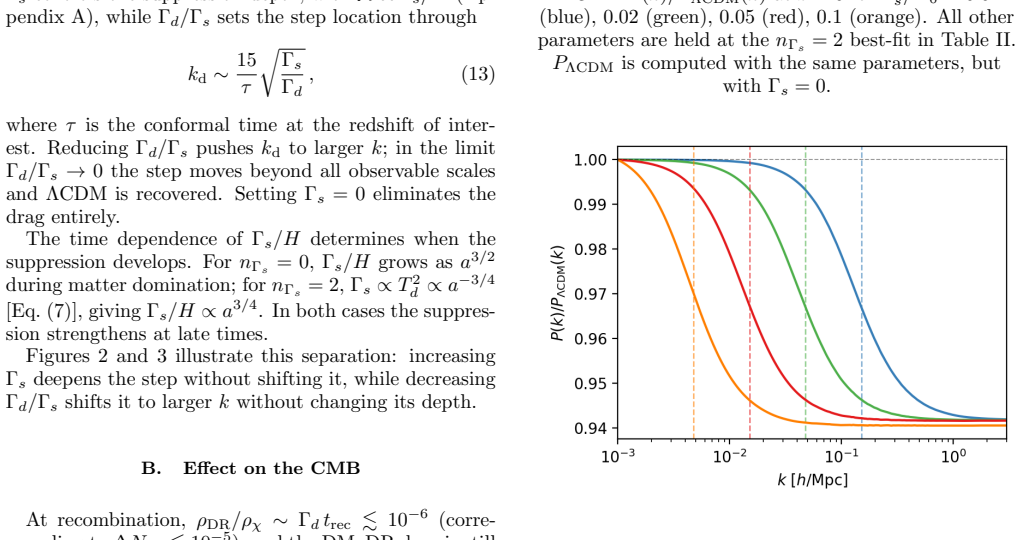
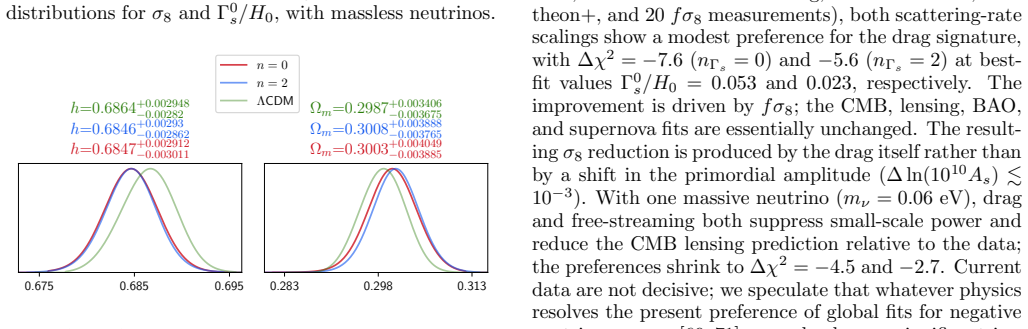
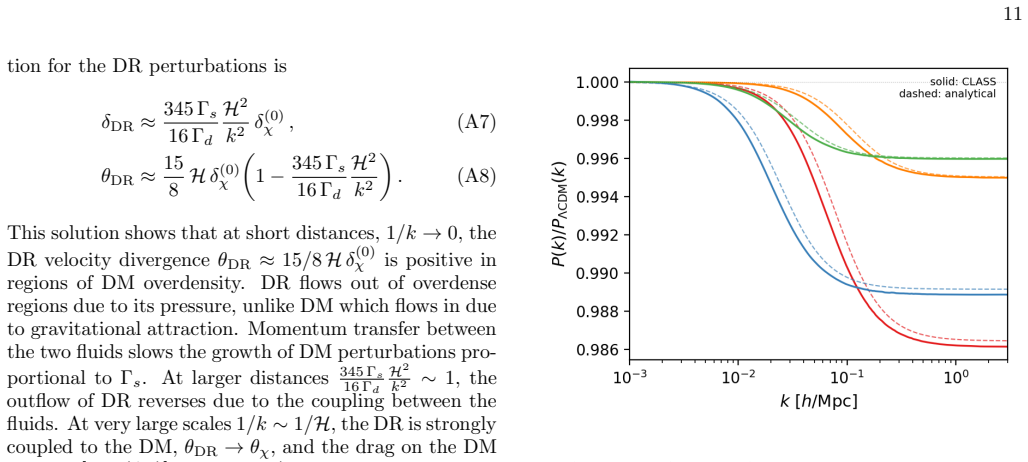
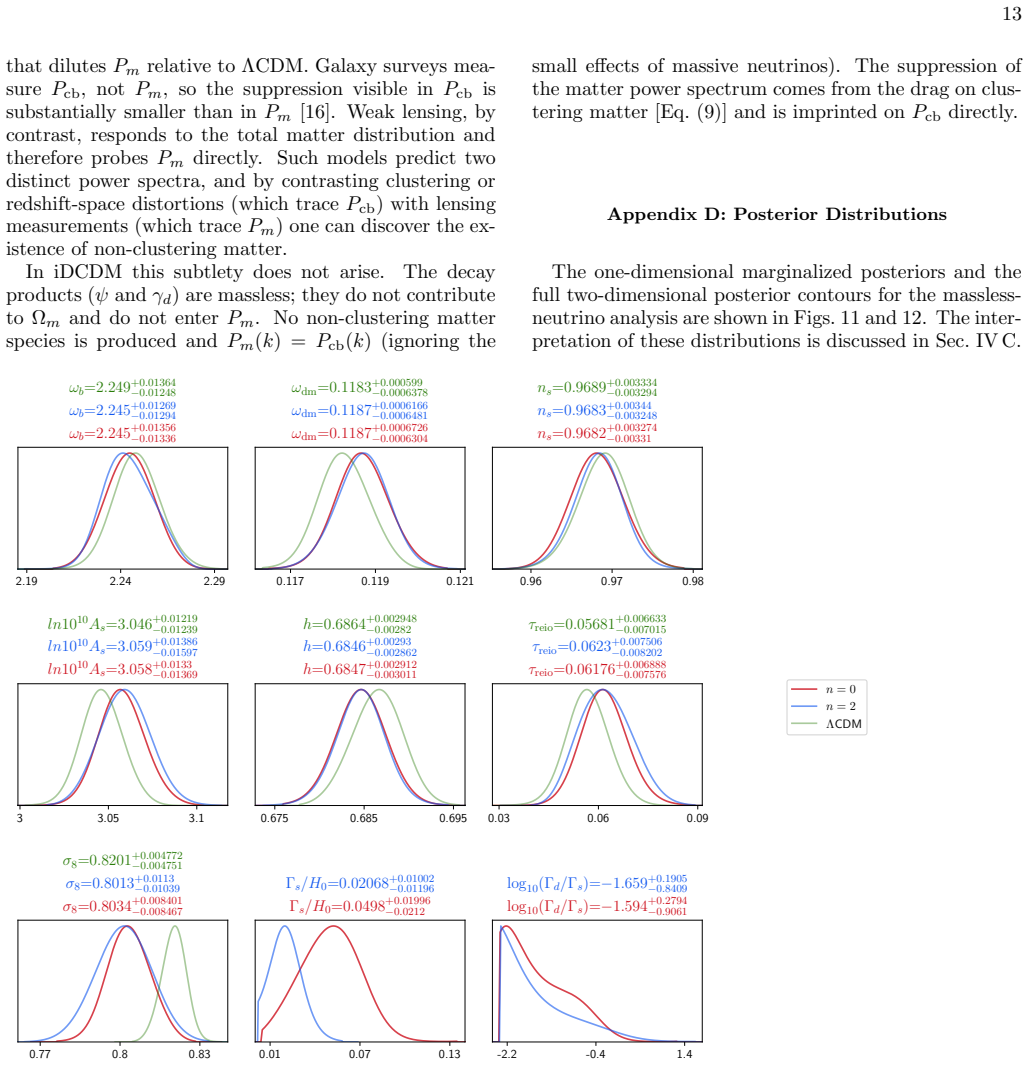
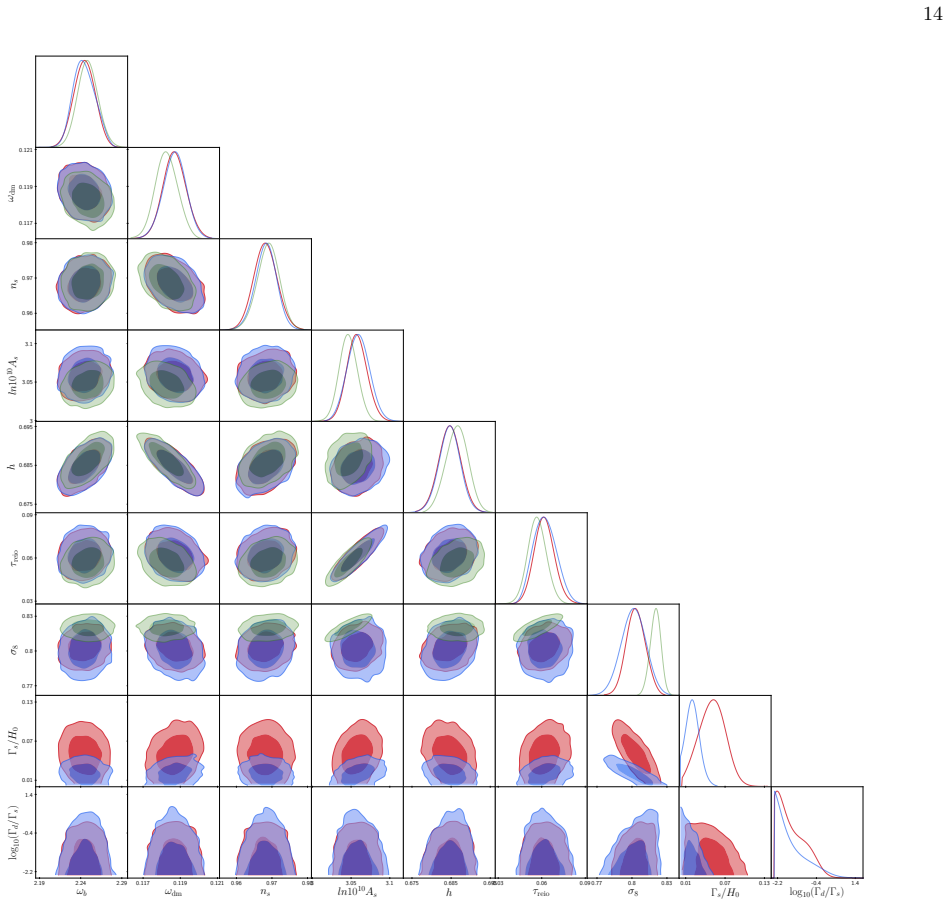
Both effects are small at the best-fit values of Γ s and Γd (∼1% forn Γs = 0,∼2.5% forn Γs = 2). The CMB therefore does not strongly constrain Γ s in this region of parameter space. FIG. 2:P(k)/P ΛCDM(k) atz= 0 for Γ 0 s/H0 = 0.01 (blue), 0.02 (green), 0.05 (red), 0.1 (orange). All other parameters are held at then Γs = 2 best-fit in Table II. PΛCDM is co...
2018
-
[2]
Background during matter domination During matter domination the DR density is governed by the attractor solution ¯ρ DR ≈ 2 5 ¯ρχ Γd/H[Eq. (7)]. Thus we may approximate the ratio 3¯ρχ 4¯ρDR ≈ 15 8 H Γd ≫1,(A1) which appears as a large prefactor in the DR Euler equa- tion [Eq. (11)]
-
[3]
Sub-horizon perturbation equations On sub-horizon scales (k≫ H) during matter domi- nation, with Ψ = Φ, keeping only potential terms which are enhanced byk 2, and the background DR density at- tractor substituted, the perturbation equations simplify to k2Φ =− 3 2 H2(rχ δχ +r b δb),(A2) ˙δχ =−θ χ ,(A3) ˙θχ =−Hθ χ +k 2Φ +aΓ s(θDR −θ χ),(A4) ˙δDR =− 4 3 θDR ...
-
[4]
(A4) couples the DM pertur- bations to the DR velocityθ DR
Perturbative solution for the DR The drag term in Eq. (A4) couples the DM pertur- bations to the DR velocityθ DR. Since Γ s/H≪1, the backreaction on DM is a small correction, and we can solve the DR equations to zeroth order in Γ s/Husing the standard ΛCDM growing mode as input:δ (0) χ ∝a, θ(0) χ ≈ −Hδ (0) χ , andk 2Φ(0) ≈ − 3 2 H2 δ(0) χ . Substituting i...
-
[5]
Substi- tuting the approximate DR solution [Eq
Growth equation with scattering source The total cold matter perturbationδ m =r χ δχ +r b δb satisfies the sourced growth equation ¨δm +H ˙δm − 3 2 H2 δm =−r χ ·aΓ s θDR −θ (0) χ .(A9) The right-hand side is the drag-induced source, propor- tional to the difference in DM-DR fluid velocities. Substi- tuting the approximate DR solution [Eq. (A8)] and solv- ...
-
[6]
Light-particle thermalization The massless speciesψandγ d self-interact with various 2 to 2 processes whose momentum transfer rates scale like Γγγ ∼α 2 d Td ,Γ ψγ ∼α 2 d Td .(B1) Number-changing 2→3 processes (e.g. double Compton) carry a naive extraα d suppression, but an IR diver- gence from the massless fermion propagator, regulated 12 by a thermal Deb...
-
[7]
(2)] Γs(Td)∼α 2 d T 2 d Mχ ,(B2) suppressed relative to DR-DR momentum transfer by a factor ofT d/Mχ ≪1
DM–DR scattering The DM–DR momentum transfer rate fromχ ψ→χ ψ scattering via dark photon exchange is [Eq. (2)] Γs(Td)∼α 2 d T 2 d Mχ ,(B2) suppressed relative to DR-DR momentum transfer by a factor ofT d/Mχ ≪1. Thus as long as the dark sector is cold compared with the mass of the dark matter, DR-DR interactions can easily be in equilibrium while DM-DR int...
-
[8]
which guarantees two essential properties
Rate hierarchy Summarizing, we require the three rates to satisfy the ordering α2 d Td ≫H≳α 2 d T 2 d Mχ ,(B5) 3 Logarithmic factors log(1/α d) further enhance some estimates; we ignore them since they are not important. which guarantees two essential properties. First, the DR thermalizes on timescales much shorter than a Hubble time, validating the perfe...
1905
-
[9]
E. Macaulay, I. K. Wehus, and H. K. Eriksen, A Lower Growth Rate from Recent Redshift Space Distortion Measurements than Expected from Planck, Phys. Rev. Lett.111, 161301 (2013), arXiv:1303.6583 [astro-ph.CO]
Pith/arXiv arXiv 2013
- [10]
-
[11]
R. Terasawa, M. Takada, T. Kurita, and S. Sugiyama, Late-time suppression of structure growth as a solution for theS 8 tension, Phys. Rev. D112, 083556 (2025), arXiv:2505.09176 [astro-ph.CO]
arXiv 2025
-
[12]
M.-X. Lin, B. Jain, M. Raveri, E. J. Baxter, C. Chang, M. Gatti, S. Lee, and J. Muir, Late time modification of structure growth and theS 8 tension, Phys. Rev. D109, 063523 (2024), arXiv:2308.16183 [astro-ph.CO]
arXiv 2024
-
[13]
S. A. Adil, ¨O. Akarsu, M. Malekjani, E. ´O. Colg´ ain, S. Pourojaghi, A. A. Sen, and M. M. Sheikh-Jabbari, S8 increases with effective redshift in ΛCDM cosmol- ogy, Mon. Not. Roy. Astron. Soc.528, L20 (2023), arXiv:2303.06928 [astro-ph.CO]
arXiv 2023
-
[14]
L. A. Escamilla, ¨O. Akarsu, E. Di Valentino, E. ¨Oz¨ ulker, and J. A. Vazquez, Exploring the Growth-Index (γ) Tension with ΛsCDM, (2025), arXiv:2503.12945 [astro- ph.CO]
arXiv 2025
-
[15]
Y. Laiet al., The DESI DR1 Peculiar Velocity Survey: Growth Rate Measurements from the Maximum Likeli- hood Fields Method, JCAP04, 026, arXiv:2512.03229 [astro-ph.CO]
-
[16]
F. Qinet al., The DESI DR1 Peculiar Velocity Sur- vey: Growth Rate Measurements from the Galaxy Power Spectrum, Astron. Astrophys.708, A219 (2026), arXiv:2512.03231 [astro-ph.CO]
arXiv 2026
-
[17]
Koyama, Cosmological Tests of Modified Gravity, 16 Rept
K. Koyama, Cosmological Tests of Modified Gravity, 16 Rept. Prog. Phys.79, 046902 (2016), arXiv:1504.04623 [astro-ph.CO]
Pith/arXiv arXiv 2016
-
[18]
S. Nesseris, G. Pantazis, and L. Perivolaropoulos, Ten- sion and constraints on modified gravity parametriza- tions ofG eff(z) from growth rate and Planck data, Phys. Rev. D96, 023542 (2017), arXiv:1703.10538 [astro- ph.CO]
Pith/arXiv arXiv 2017
-
[19]
L. Kazantzidis and L. Perivolaropoulos, Is gravity getting weaker at lowz? Observational evidence and theoret- ical implications 10.1007/978-3-030-83715-0 33 (2019), arXiv:1907.03176 [astro-ph.CO]
-
[20]
F. Skara and L. Perivolaropoulos, Tension of the EG statistic and redshift space distortion data with the Planck ΛCDM model and implications for weak- ening gravity, Phys. Rev. D101, 063521 (2020), arXiv:1911.10609 [astro-ph.CO]
arXiv 2020
-
[21]
Abdul Karimet al.(DESI), Desi dr2 results
M. Abdul Karimet al.(DESI), Desi dr2 results. ii. mea- surements of baryon acoustic oscillations and cosmologi- cal constraints, Phys. Rev. D112, 083515 (2025)
2025
-
[22]
Adameet al.(DESI), Desi 2024 v: Full-shape galaxy clustering from galaxies and quasars, Journal of Cosmol- ogy and Astroparticle Physics2025(09), 008
A. Adameet al.(DESI), Desi 2024 v: Full-shape galaxy clustering from galaxies and quasars, Journal of Cosmol- ogy and Astroparticle Physics2025(09), 008
2024
-
[23]
K. Enqvist, S. Nadathur, T. Sekiguchi, and T. Takahashi, Decaying dark matter and the tension inσ 8, JCAP2015 (09), 067, arXiv:1505.05511 [astro-ph.CO]
-
[24]
G. F. Abell´ an, R. Murgia, V. Poulin, and J. Lavalle, Im- plications of theS 8 tension for decaying dark matter with warm decay products, Phys. Rev. D105, 063525 (2022)
2022
-
[25]
G. F. Abell´ an, R. Murgia, and V. Poulin, Linear cos- mological constraints on two-body decaying dark matter scenarios and theS 8 tension, Phys. Rev. D104, 123533 (2021)
2021
-
[26]
M. A. Buen-Abad, G. Marques-Tavares, and M. Schmaltz, Non-abelian dark matter and dark radiation, Phys. Rev. D92, 023531 (2015)
2015
-
[27]
J. Lesgourgues, G. Marques-Tavares, and M. Schmaltz, Evidence for dark matter interactions in cosmological precision data?, JCAP02, 037, arXiv:1507.04351 [astro- ph.CO]
-
[28]
M. A. Buen-Abad, M. Schmaltz, J. Lesgourgues, and T. Brinckmann, Interacting Dark Sector and Preci- sion Cosmology, JCAP01, 008, arXiv:1708.09406 [astro- ph.CO]
- [29]
- [30]
-
[31]
M. A. Buen-Abad, Z. Chacko, I. Flood, C. Kilic, G. Marques-Tavares, and T. Youn, Dark Matter-Dark Radiation Interactions and the Hubble Tension, (2025), arXiv:2511.16554 [astro-ph.CO]
arXiv 2025
- [32]
-
[33]
A. Mazounet al.(SPT, DES), Interacting dark sec- tor within ETHOS: Cosmological constraints from SPT cluster abundance with DES and HST weak lensing data, Phys. Rev. D111, 083543 (2025), arXiv:2411.19911 [astro-ph.CO]
arXiv 2025
- [34]
-
[35]
H. Bagherian, M. Joseph, M. Schmaltz, and E. N. Sivara- jan, Confronting interacting radiation models for the Hubble tension with Lyman-αdata, Phys. Rev. D111, 043513 (2025), arXiv:2405.17554 [astro-ph.CO]
arXiv 2025
-
[36]
E. Dallari, F. Castagna, E. Castorina, M. Archidia- cono, and E. Salvioni, Dark Matter Recoupling, (2026), arXiv:2603.09969 [astro-ph.CO]
arXiv 2026
-
[37]
F.-Y. Cyr-Racine, K. Sigurdson, J. Zavala, T. Bring- mann, M. Vogelsberger, and C. Pfrommer, ETHOS—an effective theory of structure formation: From dark par- ticle physics to the matter distribution of the Universe, Phys. Rev. D93, 123527 (2016), arXiv:1512.05344 [astro- ph.CO]
Pith/arXiv arXiv 2016
-
[38]
M. Vogelsberger, J. Zavala, F.-Y. Cyr-Racine, C. Pfrom- mer, T. Bringmann, and K. Sigurdson, ETHOS – an effective theory of structure formation: dark matter physics as a possible explanation of the small-scale CDM problems, Mon. Not. Roy. Astron. Soc.460, 1399 (2016), arXiv:1512.05349 [astro-ph.CO]
Pith/arXiv arXiv 2016
-
[39]
E. Abdallaet al., Cosmology intertwined: A review of the particle physics, astrophysics, and cosmology associated with the cosmological tensions and anomalies, JHEAp 34, 49 (2022), arXiv:2203.06142 [astro-ph.CO]
Pith/arXiv arXiv 2022
-
[40]
T. M. C. Abbottet al.(DES), Dark Energy Survey Year 3 results: Cosmological constraints from galaxy cluster- ing and weak lensing, Phys. Rev. D105, 023520 (2022), arXiv:2105.13549 [astro-ph.CO]
Pith/arXiv arXiv 2022
-
[41]
C. Heymanset al., KiDS-1000 Cosmology: Multi-probe weak gravitational lensing and spectroscopic galaxy clus- tering constraints on cosmological parameters, A&A646, A140 (2021), arXiv:2007.15632 [astro-ph.CO]
arXiv 2021
-
[42]
J. U. Langeet al., Cosmological Constraints from Full- Scale Clustering and Galaxy-Galaxy Lensing with DESI DR1, (2025), arXiv:2512.15962 [astro-ph.CO]
arXiv 2025
-
[43]
A. H. Wrightet al., KiDS-Legacy: Cosmological con- straints from cosmic shear with the complete Kilo-Degree Survey, A&A (2025), arXiv:2503.19441 [astro-ph.CO]
Pith/arXiv arXiv 2025
-
[44]
B. Audren, J. Lesgourgues, G. Mangano, P. D. Serpico, and T. Tram, Strongest model-independent bound on the lifetime of Dark Matter, JCAP12, 028, arXiv:1407.2418 [astro-ph.CO]
-
[45]
D. Blas, J. Lesgourgues, and T. Tram, The cosmic lin- ear anisotropy solving system (class) ii: Approximation schemes, JCAP2011(07), 034, arXiv:1104.2933 [astro- ph.CO]
-
[46]
Kaiser, Clustering in real space and in redshift space, MNRAS227, 1 (1987)
N. Kaiser, Clustering in real space and in redshift space, MNRAS227, 1 (1987)
1987
-
[47]
K. Said, M. Colless, C. Magoulas, J. R. Lucey, and M. J. Hudson, Joint analysis of 6dfgs and sdss peculiar veloc- ities for the growth rate of cosmic structure and tests of gravity, Monthly Notices of the Royal Astronomical Society497, 1275 (2020)
2020
-
[48]
S. S. Boruah, M. J. Hudson, and G. Lavaux, Cosmic flows in the nearby universe: new peculiar velocities from sne and cosmological constraints, Monthly Notices of the Royal Astronomical Society498, 2703 (2020)
2020
-
[49]
J. Carrick, S. J. Turnbull, G. Lavaux, and M. J. Hud- son, Cosmological parameters from the comparison of peculiar velocities with predictions from the 2m++ den- sity field, Mon. Not. Roy. Astron. Soc.450, 317 (2015), arXiv:1504.04627 [astro-ph.CO]
Pith/arXiv arXiv 2015
-
[50]
Aghanimet al.(Planck), Planck 2018 results
N. Aghanimet al.(Planck), Planck 2018 results. 17 VI. Cosmological parameters, AAP641, A6 (2020), arXiv:1807.06209 [astro-ph.CO]
Pith/arXiv arXiv 2018
-
[51]
E. Calabreseet al.(ACT), The atacama cosmology tele- scope: Dr6 constraints on extended cosmological models (2025), arXiv:2503.14454 [astro-ph.CO]
Pith/arXiv arXiv 2025
-
[52]
T. Louiset al.(ACT), The atacama cosmology telescope: Dr6 power spectra, likelihoods and ΛCDM parameters (2025), arXiv:2503.14452 [astro-ph.CO]
Pith/arXiv arXiv 2025
-
[53]
M. S. Madhavacherilet al.(ACT), The Atacama Cos- mology Telescope: DR6 Gravitational Lensing Map and Cosmological Parameters, Astrophys. J.962, 113 (2024), arXiv:2304.05203 [astro-ph.CO]
Pith/arXiv arXiv 2024
-
[54]
F. J. Quet al.(ACT), The Atacama Cosmology Tele- scope: A Measurement of the DR6 CMB Lensing Power Spectrum and Its Implications for Structure Growth, Astrophys. J.962, 112 (2024), arXiv:2304.05202 [astro- ph.CO]
Pith/arXiv arXiv 2024
-
[55]
N. MacCrannet al.(ACT), The atacama cosmology tele- scope: Mitigating the impact of extragalactic foregrounds for the dr6 cmb lensing analysis (2023), arXiv:2304.05196 [astro-ph.CO]
arXiv 2023
-
[56]
F. Geet al.(SPT-3G), Cosmology from cmb lensing and delensedeepower spectra using 2019–2020 spt-3g polarization data, Phys. Rev. D111, 083534 (2025), arXiv:2411.06000 [astro-ph.CO]
arXiv 2019
-
[57]
J. Carron, M. Mirmelstein, and A. Lewis, CMB lens- ing from Planck PR4 maps, JCAP2022(9), 039, arXiv:2206.07773 [astro-ph.CO]
-
[58]
F. J. Quet al.(ACT, SPT), Unified and consistent struc- ture growth measurements from joint act, spt andPlanck cmb lensing, Physical Review Letters136, 10.1103/k5yr- 3h6d (2026), arXiv:2504.20038 [astro-ph.CO]
-
[59]
Scolnicet al., The Pantheon+ Analysis: The Full Data Set and Light-curve Release, Astrophys
D. Scolnicet al., The Pantheon+ Analysis: The Full Data Set and Light-curve Release, Astrophys. J.938, 113 (2022), arXiv:2112.03863 [astro-ph.CO]
Pith/arXiv arXiv 2022
- [60]
-
[61]
Beutler, C
F. Beutler, C. Blake, M. Colless, D. H. Jones, L. Staveley- Smith, G. B. Poole, L. Campbell, Q. Parker, W. Saun- ders, and F. Watson, The 6df galaxy survey:z≈0 mea- surement of the growth rate andσ 8, Monthly Notices of the Royal Astronomical Society423, 3430 (2012)
2012
-
[62]
Howlett, A
C. Howlett, A. J. Ross, L. Samushia, W. J. Percival, and M. Manera, The clustering of the sdss main galaxy sample – ii. mock galaxy catalogues and a measurement of the growth of structure from redshift space distortions at z = 0.15, Monthly Notices of the Royal Astronomical Society449, 848 (2015)
2015
-
[63]
C. Blakeet al.(GAMA), Galaxy and mass assembly (gama): improved cosmic growth measurements using multiple tracers of large-scale structure, Monthly Notices of the Royal Astronomical Society436, 3089 (2013)
2013
-
[64]
C. Blakeet al.(WiggleZ), The wigglez dark energy sur- vey: joint measurements of the expansion and growth his- tory atz¡ 1: Wigglez survey: expansion history, Monthly Notices of the Royal Astronomical Society425, 405 (2012)
2012
-
[65]
A. Pezzottaet al.(VIPERS), The vimos public extra- galactic redshift survey (vipers): The growth of struc- ture at 0.5< z <1.2 from redshift-space distortions in the clustering of the pdr-2 final sample, Astronomy and Astrophysics604, A33 (2017)
2017
-
[66]
Okumuraet al.(FastSound), The subaru fmos galaxy redshift survey (fastsound)
T. Okumuraet al.(FastSound), The subaru fmos galaxy redshift survey (fastsound). iv. new constraint on gravity theory from redshift space distortions atz∼1.4, Pub- lications of the Astronomical Society of Japan68, 38 (2016)
2016
-
[67]
Huterer, D
D. Huterer, D. L. Shafer, D. M. Scolnic, and F. Schmidt, Testingλcdm at the lowest redshifts with sn ia and galaxy velocities, Journal of Cosmology and Astropar- ticle Physics2017(05), 015
-
[68]
R. J. Turner, C. Blake, and R. Ruggeri, A local mea- surement of the growth rate from peculiar velocities and galaxy clustering correlations in the 6df galaxy survey, Monthly Notices of the Royal Astronomical Society518, 2436 (2023)
2023
-
[69]
T. Brinckmann and J. Lesgourgues, MontePython 3: boosted MCMC sampler and other features, Phys. Dark Univ.24, 100260 (2019), arXiv:1804.07261 [astro- ph.CO]
Pith/arXiv arXiv 2019
-
[70]
B. Audren, J. Lesgourgues, K. Benabed, and S. Prunet, Conservative Constraints on Early Cosmology: an illus- tration of the Monte Python cosmological parameter in- ference code, JCAP1302, 001, arXiv:1210.7183 [astro- ph.CO]
-
[71]
R. E. Smith, J. A. Peacock, A. Jenkins, S. D. M. White, C. S. Frenk, F. R. Pearce, P. A. Thomas, G. Efstathiou, and H. M. P. Couchmann (VIRGO Consortium), Sta- ble clustering, the halo model and nonlinear cosmologi- cal power spectra, Mon. Not. Roy. Astron. Soc.341, 1311 (2003), arXiv:astro-ph/0207664
Pith/arXiv arXiv 2003
-
[72]
R. Takahashi, M. Sato, T. Nishimichi, A. Taruya, and M. Oguri, Revising the Halofit Model for the Nonlinear Matter Power Spectrum, Astrophys. J.761, 152 (2012), arXiv:1208.2701 [astro-ph.CO]
Pith/arXiv arXiv 2012
-
[73]
A. Mead, J. Peacock, C. Heymans, S. Joudaki, and A. Heavens, An accurate halo model for fitting non- linear cosmological power spectra and baryonic feedback models, Mon. Not. Roy. Astron. Soc.454, 1958 (2015), arXiv:1505.07833 [astro-ph.CO]
Pith/arXiv arXiv 1958
-
[74]
A. Mead, S. Brieden, T. Tr¨ oster, and C. Heymans, hmcode-2020: improved modelling of non-linear cosmo- logical power spectra with baryonic feedback, Mon. Not. Roy. Astron. Soc.502, 1401 (2021), arXiv:2009.01858 [astro-ph.CO]
arXiv 2020
-
[75]
E. Castorina, E. Sefusatti, R. K. Sheth, F. Villaescusa- Navarro, and M. Viel, Cosmology with massive neutrinos II: on the universality of the halo mass function and bias, JCAP02, 049, arXiv:1311.1212 [astro-ph.CO]
-
[76]
M. Costanzi, F. Villaescusa-Navarro, M. Viel, J.-Q. Xia, S. Borgani, E. Castorina, and E. Sefusatti, Cosmol- ogy with massive neutrinos III: the halo mass function and an application to galaxy clusters, JCAP12, 012, arXiv:1311.1514 [astro-ph.CO]
- [77]
-
[78]
D. Green and J. Meyers, Cosmological preference for a negative neutrino mass, Phys. Rev. D111, 083507 (2025), arXiv:2407.07878 [astro-ph.CO]
arXiv 2025
-
[79]
P. W. Graham, D. Green, and J. Meyers, New inter- pretations of the cosmological preference for a nega- tive neutrino mass, Phys. Rev. D113, 043514 (2026), arXiv:2508.20999 [astro-ph.CO]
arXiv 2026
-
[80]
E. Castorina, C. Carbone, J. Bel, E. Sefusatti, and 18 K. Dolag, Demnuni: The clustering of large-scale struc- tures in the presence of massive neutrinos, JCAP07, 043, arXiv:1505.07148 [astro-ph.CO]
discussion (0)
Sign in with ORCID, Apple, or X to comment. Anyone can read and Pith papers without signing in.