Vacuum photon emission and mean electromagnetic field in pair-creating external backgrounds
Pith reviewed 2026-06-27 08:46 UTC · model grok-4.3
The pith
The mean photon number density in pair-creating QED backgrounds is derived to order α² using real-time methods.
A machine-rendered reading of the paper's core claim, the machinery that carries it, and where it could break.
Core claim
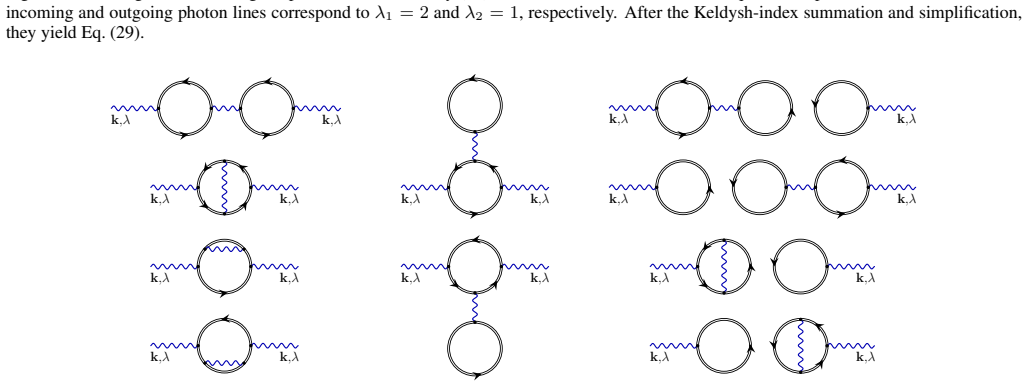
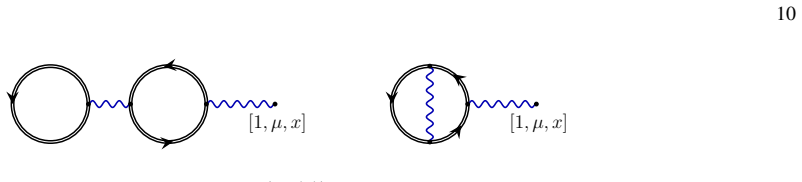
Using the Keldysh-Schwinger-Fradkin nonequilibrium technique, the mean number density of emitted photons is derived through the second nonvanishing order in the fine-structure constant, with the leading term of order α reproducing the known vertex and tadpole mechanisms while the complete order-α² correction contains interference, loop, and induced-current contributions; an independent derivation based on the spectral decomposition of the identity operator in the in-Fock space is supplied, and the mean electromagnetic field is computed through order e³ including the electromagnetic dressing of the induced vacuum current, with verification via the corresponding Schwinger-Dyson equations.
What carries the argument
The Keldysh-Schwinger-Fradkin nonequilibrium technique applied to exact solutions and propagators of the Dirac equation in the external background.
If this is right
- The leading term of order α reproduces the known vertex and tadpole mechanisms for photon emission.
- The order-α² correction includes interference, loop, and induced-current contributions that must be retained for consistency.
- The mean electromagnetic field through order e³ incorporates the electromagnetic dressing of the induced vacuum current.
- The final formulas apply directly to general spacetime-dependent field configurations without further specialization.
Where Pith is reading between the lines
- The same real-time propagators could be used to extract higher-order corrections or to compute correlation functions beyond the mean field.
- Application to specific time-dependent backgrounds such as pulsed laser fields would yield testable predictions for photon yields in laboratory settings.
- The optical-theorem generalization to unstable vacua may link this approach to nonequilibrium processes in other gauge theories.
Load-bearing premise
The initial vacuum is unstable and the in- and out-vacua are inequivalent, so radiative observables require a real-time formulation beyond the ordinary in-out approach of vacuum-stable QED.
What would settle it
Explicit evaluation of the photon number density formula for a constant electric field background using known exact solutions of the Dirac equation, followed by numerical comparison against the spectrum obtained from real-time evolution of the quantized field operators.
Figures

read the original abstract
We develop a perturbative description of vacuum radiative processes in quantum electrodynamics with a prescribed external electromagnetic background capable of producing electron-positron pairs. Since the initial vacuum is then unstable and the in- and out-vacua are inequivalent, radiative observables require a real-time formulation beyond the ordinary in-out approach of vacuum-stable QED. Using the Keldysh-Schwinger-Fradkin nonequilibrium technique, we derive the mean number density of emitted photons through the second nonvanishing order in the fine-structure constant. The leading term, of order $\alpha$, reproduces the known vertex and tadpole mechanisms, while the complete order-$\alpha^2$ correction contains interference, loop, and induced-current contributions. We also give an independent derivation based on the spectral decomposition of the identity operator in the in-Fock space, where the photon number density is represented as a sum of squared transition amplitudes and vacuum-disconnected terms are canceled by the optical theorem generalized to an unstable vacuum. In addition, we compute the mean electromagnetic field through order $e^3$, including the electromagnetic dressing of the induced vacuum current, and verify it using the corresponding Schwinger-Dyson equations. The final formulas are expressed in terms of exact solutions and propagators of the Dirac equation in the external background and apply to general spacetime-dependent field configurations.
Editorial analysis
A structured set of objections, weighed in public.
Referee Report
Summary. The paper develops a perturbative real-time framework for vacuum radiative processes in QED with pair-producing external electromagnetic backgrounds, where in- and out-vacua are inequivalent. Using the Keldysh-Schwinger-Fradkin technique, it derives the mean emitted photon number density to O(α²), with the O(α) term reproducing known vertex and tadpole mechanisms and the O(α²) term including interference, loop, and induced-current contributions. An independent derivation is given via spectral decomposition of the identity in the in-Fock space, representing the photon density as squared transition amplitudes with vacuum-disconnected terms canceled by a generalized optical theorem. The mean electromagnetic field is also computed to O(e³), including dressing of the induced current, and verified via Schwinger-Dyson equations. All expressions are written in terms of exact Dirac solutions and propagators for general spacetime-dependent backgrounds.
Significance. If the derivations are valid, the work supplies a systematic, background-independent method for computing radiative observables in unstable vacua, relevant to strong-field QED phenomena such as multiphoton pair production. Expressing results via exact propagators is a strength, as is the cross-check between the nonequilibrium technique and the spectral-decomposition route, together with the Schwinger-Dyson verification of the mean-field result.
major comments (1)
- [independent derivation via spectral decomposition] The independent derivation (described in the abstract and the corresponding section) invokes a generalized optical theorem to cancel vacuum-disconnected contributions when in- and out-vacua are inequivalent. No explicit steps are supplied showing that this generalization follows from the same axioms used for stable vacua or that it preserves order-by-order cancellation and unitarity for arbitrary spacetime-dependent backgrounds. Because the claimed equivalence of the two derivations rests on this step, the O(α²) photon-density formula cannot be considered fully secured without that demonstration.
Simulated Author's Rebuttal
We thank the referee for the careful reading of the manuscript and for the positive assessment of its significance. We address the single major comment below.
read point-by-point responses
-
Referee: The independent derivation (described in the abstract and the corresponding section) invokes a generalized optical theorem to cancel vacuum-disconnected contributions when in- and out-vacua are inequivalent. No explicit steps are supplied showing that this generalization follows from the same axioms used for stable vacua or that it preserves order-by-order cancellation and unitarity for arbitrary spacetime-dependent backgrounds. Because the claimed equivalence of the two derivations rests on this step, the O(α²) photon-density formula cannot be considered fully secured without that demonstration.
Authors: We agree that the manuscript sketches the application of the generalized optical theorem but does not supply a self-contained derivation from the underlying axioms of the in-Fock space. In the revised version we will add a dedicated subsection (or appendix) that starts from the spectral decomposition of the identity in the in-Fock space, defines the S-matrix elements between in- and out-states for an unstable vacuum, and explicitly demonstrates the cancellation of vacuum-disconnected diagrams order by order while preserving unitarity for arbitrary spacetime-dependent backgrounds. This addition will make the equivalence of the two derivations fully rigorous. revision: yes
Circularity Check
No circularity: two independent derivations rely on external nonequilibrium techniques without self-referential reduction
full rationale
The paper derives the O(α²) photon number density via the Keldysh-Schwinger-Fradkin formalism and supplies a second derivation using spectral decomposition of the in-Fock-space identity, with vacuum-disconnected terms canceled by a generalized optical theorem. Neither route is shown to reduce by construction to its own fitted inputs or prior self-citations; the formulas are expressed in terms of exact Dirac solutions and propagators for arbitrary backgrounds. The provided text contains no self-definitional loops, fitted-input predictions, or load-bearing self-citations that would force the central result. This is the expected non-finding for a paper whose central claims rest on standard real-time QED methods applied to unstable vacua.
Axiom & Free-Parameter Ledger
axioms (2)
- domain assumption The Keldysh-Schwinger-Fradkin nonequilibrium technique is valid for radiative processes in unstable vacua with inequivalent in- and out-states.
- domain assumption Exact solutions and propagators of the Dirac equation exist for the prescribed external background and can be used to express all observables.
Reference graph
Works this paper leans on
-
[1]
= 0, X λ1,λ2 Dλ1λ2 µ1µ2(x′ 1, x′
-
[2]
This is a general property of the nonequilibrium technique and follows from the fact that each perturbative termZ (k) withk⩾1vanishes atI=η= η= 0
Tr γµ1 Sλ1λ2(x′ 1, x′ 2)γµ2 Sλ2λ1(x′ 2, x′ 1) = 0.(23) The first identity removes terms containing a disconnected dumbbell diagram, while the second cancels a disconnected fermionic loop with an internal photon line. This is a general property of the nonequilibrium technique and follows from the fact that each perturbative termZ (k) withk⩾1vanishes atI=η=...
-
[3]
Schwinger-Dyson equations Let □βγ ≡ □0 0−□ βγ .(B1) All differential operators in this appendix act on thexvariable of the corresponding function. For the causal photon Green’s function,□D µν(x, y) =g µνδ(x−y), and the matrix relation is □βγ Dγδ µν(x, y) =g µνδ(x−y)δ βδ .(B2) The corresponding Dirac operator is Dαλ(A)≡ D(A) 0 0−D(A) αλ ,(B3) where D(A) = ...
-
[4]
System of integral equations and the mean field To eliminate the functional derivativesδ/δI, we introduce the polarization and mass operators Πµν λγ(x, y)≡ −ie 2 Tr γµ Z d4z Z d4z′ Sλα(x, z) ×Γ ν αβγ(z, z′, y)Sβλ(z′, x) ,(B14) Σλγ(x, y)≡ −ie 2γµ Z d4z Z d4z′ Sλα(x, z) ×Γ ν αγβ(z, y, z′)Dβλ νµ(z′, x).(B15) HereΓdenotes the full vertex operator. These defin...
-
[5]
Euler and B
H. Euler and B. Kockel, ¨Uber die Streuung von Licht an Licht nach der Diracschen Theorie, Naturwiss.23, 246 (1935)
1935
-
[6]
Heisenberg and H
W. Heisenberg and H. Euler, Folgerungen aus der Diracschen Theorie des Positrons, Z. Phys.98, 714 (1936)
1936
-
[7]
Schwinger, On gauge invariance and vacuum polarization, Phys
J. Schwinger, On gauge invariance and vacuum polarization, Phys. Rev.82, 664 (1951)
1951
-
[8]
A. I. Nikishov and V . I. Ritus, Quantum processes in the field of a plane electromagnetic wave and in a constant field. I, Zh. Eksp. Teor. Fiz.46, 776 (1963) [Sov. Phys. JETP19, 529 (1964)]
1963
-
[9]
L. S. Brown and T. W. B. Kibble, Interaction of intense laser beams with electrons, Phys. Rev.133, A705 (1964)
1964
-
[10]
Di Piazza, C
A. Di Piazza, C. M ¨uller, K. Z. Hatsagortsyan, and C. H. Kei- tel, Extremely high-intensity laser interactions with fundamen- tal quantum systems, Rev. Mod. Phys.84, 1177 (2012)
2012
-
[11]
Gonoskov, T
A. Gonoskov, T. G. Blackburn, M. Marklund, and S. S. Bu- lanov, Charged particle motion and radiation in strong electro- magnetic fields, Rev. Mod. Phys.94, 045001 (2022)
2022
-
[12]
Fedotov, A
A. Fedotov, A. Ilderton, F. Karbstein, B. King, D. Seipt, H. Taya, and G. Torgrimsson, Advances in QED with intense background fields, Phys. Rep.1010, 1 (2023)
2023
-
[13]
S. V . Popruzhenko and A. M. Fedotov, Dynamics and radiation of charged particles in ultra-intense laser fields, Phys. Usp.66, 460 (2023)
2023
-
[14]
I. Y . Kostyukov, Physics of extremely strong electromagnetic field: Status and prospects, Bull. Lebedev Phys. Inst.51, S653 (2024)
2024
-
[15]
Greiner, B
W. Greiner, B. M¨uller, and J. Rafelski,Quantum Electrodynam- ics of Strong Fields(Springer-Verlag, Berlin, 1985)
1985
-
[16]
I. A. Maltsev, V . M. Shabaev, R. V . Popov, Y . S. Kozhedub, G. Plunien, X. Ma, Th. St ¨ohlker, and D. A. Tumakov, How to observe the vacuum decay in low-energy heavy-ion collisions, Phys. Rev. Lett.123, 113401 (2019)
2019
-
[17]
R. V . Popov, V . M. Shabaev, D. A. Telnov, I. I. Tupitsyn, I. A. Maltsev, Y . S. Kozhedub, A. I. Bondarev, N. V . Kozin, X. Ma, G. Plunien, Th. St¨ohlker, D. A. Tumakov, and V . A. Za- ytsev, How to access QED at a supercritical Coulomb field, Phys. Rev. D102, 076005 (2020)
2020
-
[18]
E. S. Fradkin, D. M. Gitman, and S. M. Shvartsman,Quan- tum Electrodynamics with Unstable V acuum(Springer-Verlag, Berlin, 1991)
1991
-
[19]
Di Piazza, K
A. Di Piazza, K. Z. Hatsagortsyan, and C. H. Keitel, Harmonic generation from laser-driven vacuum, Phys. Rev. D72, 085005 (2005)
2005
-
[20]
Otto and B
A. Otto and B. K¨ampfer, Afterglow of the dynamical Schwinger process: Soft photons amass, Phys. Rev. D95, 125007 (2017)
2017
-
[21]
I. A. Aleksandrov, G. Plunien, and V . M. Shabaev, Photon emis- sion in strong fields beyond the locally-constant field approxi- mation, Phys. Rev. D100, 116003 (2019)
2019
-
[22]
I. A. Aleksandrov, A. Di Piazza, G. Plunien, and V . M. Shabaev, Stimulated vacuum emission and photon absorption in strong electromagnetic fields, Phys. Rev. D105, 116005 (2022)
2022
-
[23]
A. M. Fedotov and N. B. Narozhny, Generation of harmonics by a focused laser beam in the vacuum, Phys. Lett. A362, 1 (2007)
2007
-
[24]
Karbstein and R
F. Karbstein and R. Shaisultanov, Stimulated photon emission from the vacuum, Phys. Rev. D91, 113002 (2015)
2015
-
[25]
H. Gies, F. Karbstein, and C. Kohlf ¨urst, All-optical signatures of strong-field QED in the vacuum emission picture, Phys. Rev. D97, 036022 (2018)
2018
-
[26]
B. King, H. Hu, and B. Shen, Three-pulse photon-photon scat- tering, Phys. Rev. A98, 023817 (2018). 15
2018
-
[27]
Karbstein, A
F. Karbstein, A. Blinne, H. Gies, and M. Zepf, Boosting quan- tum vacuum signatures by coherent harmonic focusing, Phys. Rev. Lett.123, 091802 (2019)
2019
-
[28]
I. A. Aleksandrov, A. D. Panferov, and S. A. Smolyansky, Ra- diation signal accompanying the Schwinger effect, Phys. Rev. A103, 053107 (2021)
2021
-
[29]
Gies and F
H. Gies and F. Karbstein, An addendum to the Heisenberg- Euler effective action beyond one loop, J. High Energy Phys. 03 (2017) 108
2017
-
[30]
Karbstein, Tadpole diagrams in constant electromagnetic fields, J
F. Karbstein, Tadpole diagrams in constant electromagnetic fields, J. High Energy Phys. 10 (2017) 075
2017
-
[31]
Ahmadiniaz, J
N. Ahmadiniaz, J. P. Edwards, and A. Ilderton, Reducible con- tributions to quantum electrodynamics in external fields, J. High Energy Phys. 05 (2019) 038
2019
-
[32]
Schwinger, Brownian motion of a quantum oscillator, J
J. Schwinger, Brownian motion of a quantum oscillator, J. Math. Phys.2, 407 (1961)
1961
-
[33]
L. V . Keldysh, Diagram technique for nonequilibrium pro- cesses, Zh. Eksp. Teor. Fiz.47, 1515 (1964) [Sov. Phys. JETP 20, 1018 (1965)]
1964
-
[34]
E. S. Fradkin and D. M. Gitman, Furry picture for quan- tum electrodynamics with pair-creating external field, Fortschr. Phys.29, 381 (1981)
1981
-
[35]
E. T. Akhmedov, N. Astrakhantsev, and F. K. Popov, Secularly growing loop corrections in strong electric fields, J. High En- ergy Phys. 09 (2014) 071
2014
-
[36]
E. T. Akhmedov, P. S. Zavgorodny, D. I. Sadekov, and K. A. Kazarnovskii, Loop corrections to the current of pairs created in a lengthy electric pulse, Phys. Rev. D107, 125006 (2023)
2023
-
[37]
Copinger, J
P. Copinger, J. P. Edwards, A. Ilderton, and K. Rajeev, Pair creation, backreaction, and resummation in strong fields, Phys. Rev. D111, 036009 (2025)
2025
-
[38]
P. Copinger and S. Pu, In-in worldline formalism in pair creat- ing fields, arXiv:2512.19264
-
[39]
F. J. Dyson, TheSmatrix in quantum electrodynamics, Phys. Rev.75, 1736 (1949)
1949
-
[40]
Schwinger, On the Green’s functions of quantized fields
J. Schwinger, On the Green’s functions of quantized fields. I, Proc. Natl. Acad. Sci. U.S.A.37, 452 (1951)
1951
-
[41]
W. H. Furry, On bound states and scattering in positron theory, Phys. Rev.81, 115 (1951)
1951
-
[42]
I. A. Aleksandrov and D. V . Chubukov, Optical theorem and vacuum dichroism in electromagnetic fields producing pairs, Opt. Spektr.133, 657 (2025)
2025
- [43]
discussion (0)
Sign in with ORCID, Apple, or X to comment. Anyone can read and Pith papers without signing in.