Asymmetric quantum steering harvested near a Lorentz-violating BTZ black hole
Pith reviewed 2026-06-27 06:44 UTC · model grok-4.3
The pith
In a Lorentz-violating BTZ black hole the detector with higher effective temperature exhibits stronger quantum steering.
A machine-rendered reading of the paper's core claim, the machinery that carries it, and where it could break.
Core claim
Quantum steering harvested by the two detectors is asymmetric: the detector at smaller radius, which experiences higher effective temperature from gravitational redshift, displays greater steerability than the detector at larger radius, even though both couple to the same underlying quantum field; Lorentz violation reduces both the magnitude and the directional preference of this steering.
What carries the argument
Position-dependent effective temperatures induced by gravitational redshift in the Lorentz-violating BTZ metric, acting on the standard Unruh-DeWitt detector response functions.
Load-bearing premise
The only source of difference between the two detectors is the gravitational redshift factor evaluated at their respective radial coordinates.
What would settle it
Direct computation or measurement showing that steerability is always stronger or equal for the lower-temperature detector across the full range of energy gaps would falsify the inversion result.
Figures

read the original abstract
We investigate the harvesting of quantum steering and its directional asymmetry between two Unruh-DeWitt detectors in a Lorentz-violating BTZ black hole spacetime. Since the detectors are located at different radial positions outside the black hole, they experience inequivalent local environments induced by gravitational redshift, causing Alice to undergo stronger effective thermal noise than Bob. Remarkably, we uncover a counterintuitive phenomenon in which the detector subjected to a higher effective temperature exhibits stronger steerability than the other one, revealing a nontrivial inversion of thermal intuition in curved spacetime. Furthermore, quantum steering survives only within a finite window of detector energy gaps and reaches its maximum within an optimal regime. We find that Lorentz violation suppresses steering most strongly near this optimal energy gap, indicating an enhanced sensitivity of maximal correlation extraction to symmetry breaking effects. Our results demonstrate that Lorentz violation acts as a geometric constraint on the quantum information capacity of spacetime, simultaneously restricting both the strength and the directionality of quantum correlations.
Editorial analysis
A structured set of objections, weighed in public.
Referee Report
Summary. The manuscript studies the harvesting of quantum steering between two Unruh-DeWitt detectors placed at different radial positions outside a Lorentz-violating BTZ black hole. Detectors experience inequivalent local environments due to gravitational redshift, with the inner detector (Alice) subject to higher effective temperature. The central claim is a counterintuitive inversion: the higher-temperature detector exhibits stronger steerability. Steering persists only within a finite window of energy gaps, reaches a maximum at an optimal gap, and is most strongly suppressed by the Lorentz-violation parameter near that optimum. The authors interpret this as Lorentz violation acting as a geometric constraint on the strength and directionality of quantum correlations.
Significance. If the numerical results hold, the reported inversion of thermal intuition for steering provides a concrete example of how position-dependent Wightman functions on a modified black-hole metric can produce nontrivial quantum-information effects. The explicit dependence on the Lorentz-violation parameter and the identification of an optimal energy-gap window constitute falsifiable predictions within the UDW framework. Credit is due for the reproducible numerical evaluation of the steering parameter on the LV BTZ background, which permits direct comparison with existing BTZ steering studies.
minor comments (3)
- The abstract states that steering 'survives only within a finite window of detector energy gaps,' yet the precise numerical criterion used to define this window (e.g., a threshold value of the steering parameter) is not stated in the abstract or the provided summary of results.
- Notation for the steering parameter (commonly denoted S or similar) and its relation to the concurrence or other correlation measures should be defined explicitly in the methods section before the numerical plots are presented.
- The manuscript would benefit from a short paragraph comparing the LV-BTZ Wightman function to the standard BTZ case, highlighting the additional terms introduced by the Lorentz-violation parameter.
Simulated Author's Rebuttal
We thank the referee for the positive summary of our manuscript on asymmetric quantum steering in Lorentz-violating BTZ spacetime and for recommending minor revision. No specific major comments were provided in the report.
Circularity Check
No significant circularity identified
full rationale
The paper computes quantum steering via the standard Unruh-DeWitt detector response functions evaluated on the Wightman two-point function of the Lorentz-violating BTZ spacetime. The central numerical result (asymmetric steerability with inversion of thermal intuition) follows from direct integration against the position-dependent metric without any parameter fitting, self-referential definitions, or load-bearing self-citations that reduce the output to the input by construction. The modeling assumptions (redshift plus UDW responses) are conventional and externally falsifiable; no quoted step equates a derived quantity to a fitted or renamed input.
Axiom & Free-Parameter Ledger
free parameters (1)
- Lorentz violation parameter
axioms (2)
- domain assumption Unruh-DeWitt detectors couple linearly to the scalar field via the standard monopole interaction
- domain assumption The modified BTZ metric correctly encodes the Lorentz violation
Reference graph
Works this paper leans on
-
[1]
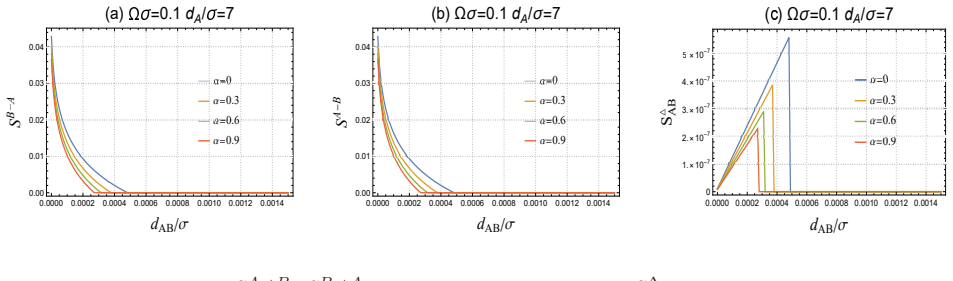
2: Quantum steering SA→ B, SB→ A, and the steering asymmetry S∆ AB between two detectors as a function of the detector separation dAB/σ with Ω σ = 0
× 10-7 5 × 10⁻⁷ dAB/σ SAB △ (c ) Ωσ=0.1 dA/σ=7 FIG. 2: Quantum steering SA→ B, SB→ A, and the steering asymmetry S∆ AB between two detectors as a function of the detector separation dAB/σ with Ω σ = 0. 1 and dA/σ = 7. α=0 α=0.3 α=0.6 α=0.9 0 10 1 20 2 30 0.000 0 0 0 0.010 0 0 1 0.020 0 0 2 0.030 0 0 dA/σ SB-A (a ) Ωσ=0.1 d A /σ= 10 α=0 α=0.3 α=0.6 α=0.9 ...
-
[2]
× 10-8 4 × 10⁻⁸ 6 × 10-8 × 10-8
-
[3]
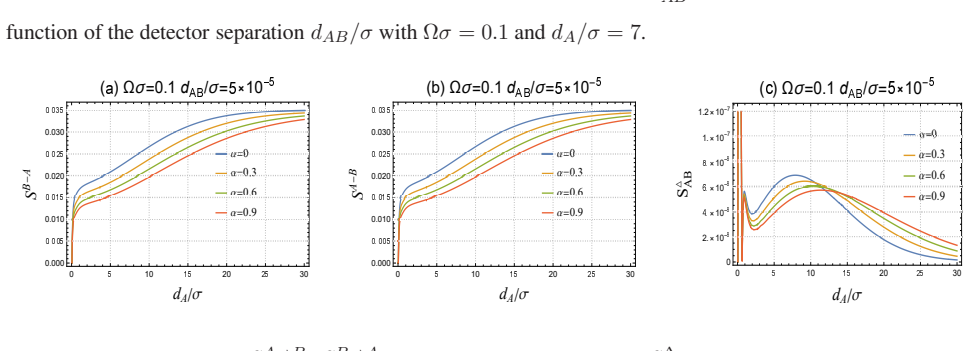
3: Quantum steering SA→ B, SB→ A, and the steering asymmetry S∆ AB between two detectors as a function of the distance detector Alice from the horizon dA/σ with Ω σ = 0
× 10-7 1.2 × 10⁻⁷ dA/σ SAB △ ( ) Ωσ=0.1 d /σ= 10- FIG. 3: Quantum steering SA→ B, SB→ A, and the steering asymmetry S∆ AB between two detectors as a function of the distance detector Alice from the horizon dA/σ with Ω σ = 0. 1 and dAB/σ = 5 × 10− 5. constrained by the noise affecting the steered party, Bob’s lower-noise environment renders him more susce...
-
[4]
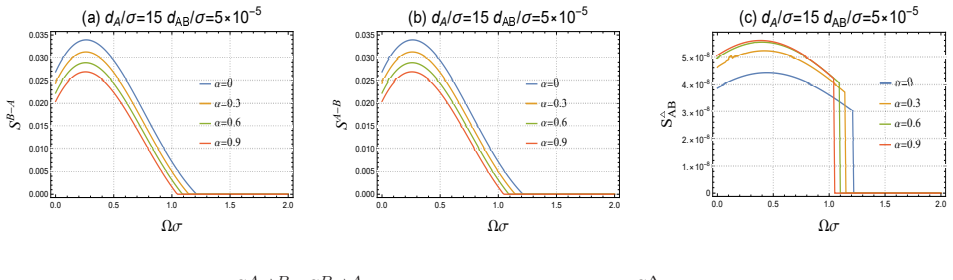
4: Quantum steering SA→ B, SB→ A, and the steering asymmetry S∆ AB between two detectors as a function of the energy gap Ω σ with dA/σ = 15 and dAB/σ = 5 × 10− 5
× 10-8 Ωσ SAB! (c) dA/σ=15 dAB/σ=510-5 FIG. 4: Quantum steering SA→ B, SB→ A, and the steering asymmetry S∆ AB between two detectors as a function of the energy gap Ω σ with dA/σ = 15 and dAB/σ = 5 × 10− 5. which enhances thermal noise and degrades quantum correlat ions. Consequently, the ability to extract steering from the field becomes progressively we...
-
[5]
R. Uola, A. C. S. Costa, H. C. Nguyen, and O. G¨ uhne, Quantu m steering, Rev. Mod. Phys. 92, 015001 (2020)
2020
-
[6]
Schr¨ odinger, Discussion of probability relations b etween separated systems, Math
E. Schr¨ odinger, Discussion of probability relations b etween separated systems, Math. Proc. Cam- bridge Philos. Soc. 31, 555 (1935)
1935
-
[7]
Schr¨ odinger, Probability relations between separated systems, Math
E. Schr¨ odinger, Probability relations between separated systems, Math. Proc. Cambridge Philos. Soc. 32, 446 (1936)
1936
-
[8]
H. M. Wiseman, S. J. Jones and A. C. Doherty, Steering, ent anglement, nonlocality, and the Einstein- Podolsky-Rosen paradox, Phys. Rev. Lett. 98, 140402 (2007)
2007
-
[9]
Sekatski, F
P . Sekatski, F. Giraud, R. Uola, N. Brunner, Unlimited On e-Way Steering, Phys. Rev. Lett. 131, 110201 (2023)
2023
-
[10]
Z. Y . Hao, Y . Wang, J. K. Li, Y . Xiang, Q. Y . He, Z. H. Liu, M. Y ang, K. Sun, J. S. Xu, et al ., Filtering one-way Einstein-Podolsky-Rosen steering, Phy s. Rev. A 109, 022411 ( 2024)
2024
-
[11]
Huang, H
X. Huang, H. Wu, S. Wu, Generated genuine tripartite stee ring and its monogamy in the background of a Kerr-Newman black hole, Chin. Phys. C 48, 115106 (2024)
2024
-
[12]
Wollmann, N
S. Wollmann, N. Walk, A. J. Bennet, H. M. Wiseman and G. J. P ryde, Observation of Genuine One-Way Einstein-Podolsky-Rosen Steering, Phys. Rev. Lett. 116, 160403 (2016)
2016
-
[13]
S. Y . Guan, H. F. Wang and X. Yi, Manipulation of tunable no nreciprocal entanglement and one-way steering induced by two-photon driving, Phys. Rev. A 109, 062423 (2024)
2024
-
[14]
M. X. Li, Y . Li, Y . Xi, C. Y . Zhang, Y . Z. Wang, R. B. Xu, S. M. Fei and Z. J. Zheng, Detecting quantum steering in networks, Phys. Rev. A 111, 012624 (2025). 16
2025
-
[15]
Y . Fan, C. Jia and L. Qiu, Quantum steering as resource of quantum teleportation, Phys. Rev. A 106, 012433 (2022)
2022
-
[16]
L. M. Seifert, K. Beyer, K. Luoma and W. T. Strunz, Quantu m steering on IBM quantum processors, Phys. Rev. A 105, 042413 (2022)
2022
-
[17]
Wang, et al
M. Wang, et al. , Deterministic Distribution of Multipartite Entanglemen t and Steering in a Quantum Network by Separable States, Phys. Rev. Lett. 125, 260506 (2020)
2020
-
[18]
Sarkar, Distrustful quantum steering, Phys
S. Sarkar, Distrustful quantum steering, Phys. Rev. A 108, L040401 (2023)
2023
-
[19]
A. B. Sainz, L. Aolita, N. Brunner, R. Gallego and P . Skrz ypczyk, Classical communication cost of quantum steering, Phys. Rev. A 94, 012308 (2016)
2016
-
[20]
P . J. Cavalcanti et al. , Post-quantum steering is a stronger-than-quantum resour ce for information processing, npj Quantum Inf. 8, 76 (2022)
2022
-
[21]
W. Liu, C. Wen, J. Wang, Lorentz violation alleviates gr avitationally induced entanglement degrada- tion, J. High Energy Phys. 2025, 184 (2025)
2025
-
[22]
S. Sen, A. Mukherjee and S. Gangopadhyay, Entanglement degradation as a tool to detect signatures of modified gravity, Phys. Rev. D 109, 046012 (2024)
2024
-
[23]
Fuentes-Schuller and R
I. Fuentes-Schuller and R. B. Mann, Alice falls into a bl ack hole: Entanglement in non-inertial frames, Phys. Rev. Lett. 95, 120404 (2005)
2005
-
[24]
Pan and J
Q. Pan and J. Jing, Hawking radiation, entanglement, an d teleportation in the background of an asymptotically flat static black hole, Phys. Rev. D 78, 065015 (2008)
2008
-
[25]
Wu and L
H. Wu and L. Chen, Orbital angular momentum entanglemen t in noninertial reference frame, Phys. Rev. D 107, 065006 (2023)
2023
-
[26]
S. M. Wu, X. W. Fan, R. D. Wang, H. Y . Wu, X. L. Huang and H. S. Zeng, Does Hawking effect always degrade fidelity of quantum teleportation in Schwarz schild spacetime?, J. High Energy Phys. 2023, 232 (2023)
2023
-
[27]
Mart´ ın-Mart´ ınez, L
E. Mart´ ın-Mart´ ınez, L. J. Garay and J. Le´ on, Unveiling quantum entanglement degradation near a Schwarzschild black hole, Phys. Rev. D 82, 064006 (2010)
2010
-
[28]
P . M. Alsing, I. Fuentes-Schuller, R. B. Mann and T. E. Te ssier, Entanglement of Dirac fields in noninertial frames, Phys. Rev. A 74, 032326 (2006)
2006
-
[29]
W. M. Li, S. M. Wu, Bosonic and fermionic coherence of N-p artite states in the background of a dilaton black hole, J. High Energy Phys. 2024, 144 (2024)
2024
-
[30]
M. M. Du, H. W. Li, S. T. Shen, X. J. Y an, X. Y . Li, L. Zhou, W. Zhong and Y . B. Sheng, Maximal 17 steered coherence in the background of Schwarzschild space -time, Eur. Phys. J. C 84, 450 (2024)
2024
-
[31]
Elghaayda, A
S. Elghaayda, A. Ali, S. Al-Kuwari and M. Mansour, Physi cally accessible and inaccessible quantum correlations of Dirac fields in Schwarzschild spacetime, Ph ys. Lett. A 525, 129915 (2024)
2024
-
[32]
J. K. Basak, D. Giataganas, S. Mondal and W. Y . Wen, Reflec ted entropy and Markov gap in nonin- ertial frames, Phys. Rev. D 108, 125009 (2023)
2023
-
[33]
A. Ali, S. Al-Kuwari, M. Ghominejad, M. T. Rahim, D. Wang and S. Haddadi, Quantum character- istics near event horizons, Phys. Rev. D 110, 064001 (2024)
2024
-
[34]
C. Y . Liu, Z. W. Long and Q. L. He, Quantum coherence and qu antum Fisher information of Dirac particles in curved spacetime under decoherence, Phys. Let t. B 857, 138991 (2024)
2024
-
[35]
Zhang, X
T. Zhang, X. Wang and S. M. Fei, Hawking effect can genera te physically inaccessible genuine tripartite nonlocality, Eur. Phys. J. C 83, 607 (2023)
2023
-
[36]
S. M. Wu, H. Y . Wu, Y . X. Wang, J. Wang, Gaussian tripartit e steering in Schwarzschild black hole, Phys. Lett. B 865, 139493 (2025)
2025
-
[37]
Adesso, I
G. Adesso, I. Fuentes-Schuller and M. Ericsson, Contin uous-variable entanglement sharing in non- inertial frames, Phys. Rev. A 76, 062112 (2007)
2007
-
[38]
S. M. Wu, X. W. Teng, W. M. Li, Y . X. Wang, J. Lu, Nonseparab ility of multipartite systems in dilaton black hole, JCAP 09, 030 (2025)
2025
-
[39]
G. W. Mi, X. Huang, S. M. Fei, T. Zhang, Quantumness near t he Schwarzschild black hole based on W-state, Ann. Phys. (Berlin) 537, e00397 (2025)
2025
-
[40]
Harikrishnan, S
S. Harikrishnan, S. Jambulingam, P . P . Rohde and C. Radh akrishnan, Accessible and inaccessible quantum coherence in relativistic quantum systems, Phys. R ev. A 105, 052403 (2022)
2022
-
[41]
G. W. Mi, X. Huang, S. M. Fei, T. Zhang, Genuine four-part ite Bell nonlocality in the curved space- time, Eur. Phys. J. C 85, 354 (2025)
2025
-
[42]
T. Y . Wang and D. Wang, Entropic uncertainty relations i n Schwarzschild space-time, Phys. Lett. B 855, 138876 (2024)
2024
-
[43]
Xiong, Z
Y . Xiong, Z. Pi, T. Zhang, X. Huang, Quantum discord of mi xed states under noisy channels in the curved spacetime, Eur. Phys. J. C 86, 317 (2026)
2026
-
[44]
G. W. Mi, X. Huang, S. M. Fei, T. Zhang, Impact of the Hawki ng Effect on the fully entangled fraction of three-qubit states in Schwarzschild spacetime , Ann. Phys. (Berlin) 537, 2400308 (2024)
2024
-
[45]
H. E. Camblong, A. Chakraborty, P . Lopez-Duque, C. R. Or d´ o˜ nez, Entanglement degradation in causal diamonds, Phys. Rev. D 109, 105003 (2024). 18
2024
-
[46]
L. J. Li, F. Ming, X. K. Song, L. Y e and D. Wang, Quantumnes s and entropic uncertainty in curved space-time, Eur. Phys. J. C 82, 726 (2022)
2022
-
[47]
Belfiglio, O
A. Belfiglio, O. Luongo, S. Mancini, Quantum entangleme nt in cosmology, Phys. Rep. 1146, 1-47 (2025)
2025
-
[48]
S. M. Wu, C. X. Wang, D. D. Liu, X. L. Huang, H. S. Zeng, Woul d quantum coherence be increased by curvature effect in de Sitter space?, J. High Energy Phys. 2023, 115 (2023)
2023
-
[49]
M. M. Du, H. W. Li, Z. Tao, S. T. Shen, X. J. Y an, X. Y . Li, W. Z hong, Y . B. Sheng and L. Zhou, Basis-independent quantum coherence and its distribution under relativistic motion, Eur. Phys. J. C 84, 838 (2024)
2024
-
[50]
Q. Liu, T. Liu, C. Wen, J. Wang, Optimal quantum strategy for locating Unruh channels, Phys. Rev. A 110, 022428 (2024)
2024
-
[51]
Y . K. Zhang, L. J. Li, X. K. Song, L. Y e and D. Wang, Entropi c uncertainty and quantum non- classicality of Unruh-DeWitt detectors in relativity, Phy s. Lett. B 858, 139063 (2024)
2024
-
[52]
S. H. Li, S. H. Shang, S. M. Wu, Does acceleration always d egrade quantum entanglement for tetra- partite Unruh-DeWitt detectors?, J. High Energy Phys. 2025, 214 (2025)
2025
-
[53]
Gonzalez-Raya, S
T. Gonzalez-Raya, S. Pirandola and M. Sanz, Satellite- based entanglement distribution and quantum teleportation with continuous variables, Commun. Phys. 7, 126 (2024)
2024
-
[54]
Ciliberto, S
G. Ciliberto, S. Emig, N. Pavloff, M. Isoard, Violation of Bell inequalities in an analog black hole, Phys. Rev. A 109, 063325 (2024)
2024
-
[55]
X. Liu, Z. Tian, J. Jing, Entanglement dynamics in κ-deformed spacetime, Sci. China Phys. Mech. Astron. 67, 100411 (2024)
2024
-
[56]
Barman, I
S. Barman, I. Chakraborty, S. Mukherjee, Signatures of gravitational wave memory in the radiative process of entangled quantum probes, Phys. Rev. D 111, 025021 (2025)
2025
-
[57]
X. Liu, Z. Tian, J. Jing, Dissipation suppression for an Unruh-DeWitt battery with a reflecting bound- ary. Sci. China Phys. Mech. Astron. 68, 100412 (2025)
2025
-
[58]
Z. Liu, Y . Li, Z. Tian, J. Wang, Scrambling-Enhanced Qua ntum Battery Charging in Black Hole Analogues, Adv. Sci. e20281 (2025)
2025
-
[59]
X. Liu, Z. Tian, J. Wang, J. Jing, Protecting quantum coh erence of two-level atoms from vacuum fluctuations of electromagnetic field, Ann. Phys. 366, 102-112 (2016)
2016
-
[60]
Q. Xiao, Y . Chen, T. Liu, Effects of Lorentz symmetry bre aking on quantum coherence in an expand- ing universe, Phys. Lett. B 872, 140133 (2026). 19
2026
-
[61]
Agullo, A
I. Agullo, A. Delhom, ´A. Parra-L´ opez, Toward the observation of entangled pairs in BEC analog expanding universes, Phys. Rev. D 110, 125023 (2024)
2024
-
[62]
Belgiorno, S
F. Belgiorno, S. L. Cacciatori, A. Vigan` o, Analog Hawk ing effect: A master equation, Phys. Rev. D 102, 105003 (2020)
2020
-
[63]
Cheng, Y
X. Cheng, Y . Li, Z. Tian, X. Zhao, X. Qin, Y . Lin, Quantum s imulation of oscillatory Unruh effect with superposed trajectories, Sci. China Phys. Mech. Astro n. 69, 230411 (2026)
2026
-
[64]
J. Hu, L. Feng, Z. Zhang, C. Chin, Quantum simulation of U nruh radiation, Nature Physics 15, 785 (2019)
2019
-
[65]
Belgiorno, S
F. Belgiorno, S. L. Cacciatori, A. Farahat and A. Vigan` o, Analog Hawking effect: BEC and surface waves, Phys. Rev. D 102, 105004 (2020)
2020
-
[66]
Z. Liu, R. Q. Y ang, H. Fan, J. Wang, Simulation of the mass less Dirac field in 1+1D curved space- time, Sci. China Phys. Mech. Astron. 68, 290411 (2025)
2025
-
[67]
H. T. Zheng, X. F. Zhou, G. C. Guo, Z. W. Zhou, Enhancing an alog Unruh effect via superradiance in a cylindrical cavity, Phys. Rev. Research 7, 013027 (2025)
2025
-
[68]
K. B. Tallent, D. E. Sheehy, Analog Unruh effect of inhom ogeneous one-dimensional Dirac fermions, Phys. Rev. B 112, 104306 (2025)
2025
-
[69]
Gooding, S
C. Gooding, S. Biermann, S. Erne, J. Louko, W. G. Unruh, J . Schmiedmayer and S. Weinfurtner, In- terferometric Unruh Detectors for Bose-Einstein Condensa tes, Phys. Rev. Lett. 125, 213603 (2020)
2020
-
[70]
ˇSoda, V
B. ˇSoda, V . Sudhir, A. Kempf, Acceleration-Induced Effects inStimulated Light-Matter Interactions, Phys. Rev. Lett. 128, 163603 (2022)
2022
-
[71]
S. J. Summers and R. Werner, The vacuum violates Bell’s i nequalities, Phys. Lett. A 110, 257 (1985)
1985
-
[72]
S. J. Summers and R. Werner, Bell inequalities and quant um field theory. II. Bell inequalities are maximally violated in the vacuum, J. Math. Phys. 28, 2448 (1987)
1987
-
[73]
S. J. Summers and R. Werner, Bell’s inequalities and qua ntum field theory. I. General setting, J. Math. Phys. 28, 2440 (1987)
1987
-
[74]
Izquierdo, J
W. Izquierdo, J. Beltran, E. Arias, Enhancement of harv esting vacuum entanglement in Cosmic String Spacetime, J. High Energy Phys. 2025, 49 (2025)
2025
-
[75]
Z. Liu, W. Liu, X. Liu, J. Wang, Wormhole-Induced correl ation: A Link Between Two Universes, arXiv:2510.04005
-
[76]
X. Liu, W. Liu, Z. Liu, J. Wang, Harvesting correlations from BTZ black hole coupled to a Lorentz- violating vector field, J. High Energy Phys. 2025, 94 (2025). 20
2025
-
[77]
Chakraborty, L
A. Chakraborty, L. Hackl, M. Zych, Entanglement harves ting in quantum superposed spacetime, Phys. Rev. D 111, 104052 (2025)
2025
-
[78]
S. M. Wu, R. D. Wang, X. L. Huang, Z. Wang, Does gravitatio nal wave assist vacuum steering and Bell nonlocality?, J. High Energy Phys. 2024, 155 (2024)
2024
-
[79]
J. Foo, R. B. Mann, M. Zych, Entanglement amplification b etween superposed detectors in flat and curved spacetimes, Phys. Rev. D 103, 065013 (2021)
2021
-
[80]
Y . Ji, J. Zhang and H. Y u, Entanglement harvesting in cosmic string spacetime, J. High Energy Phys. 2024, 161 (2024)
2024
discussion (0)
Sign in with ORCID, Apple, or X to comment. Anyone can read and Pith papers without signing in.