Constraining Kerr supermassive black hole properties using gravitational waves from inspiraling stellar-mass binary black holes
Pith reviewed 2026-06-27 06:39 UTC · model grok-4.3
The pith
Inspiraling stellar black hole pairs around a supermassive black hole can let space-based detectors measure the large hole's mass to relative precision of 10 to the minus 5 and its spin to a few percent.
A machine-rendered reading of the paper's core claim, the machinery that carries it, and where it could break.
Core claim
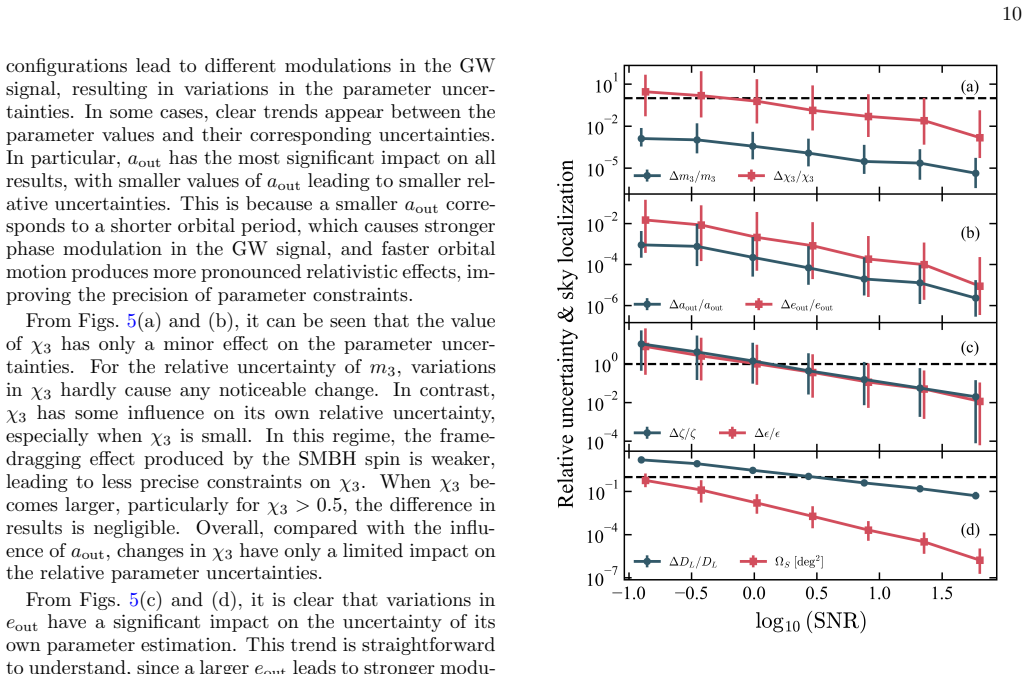
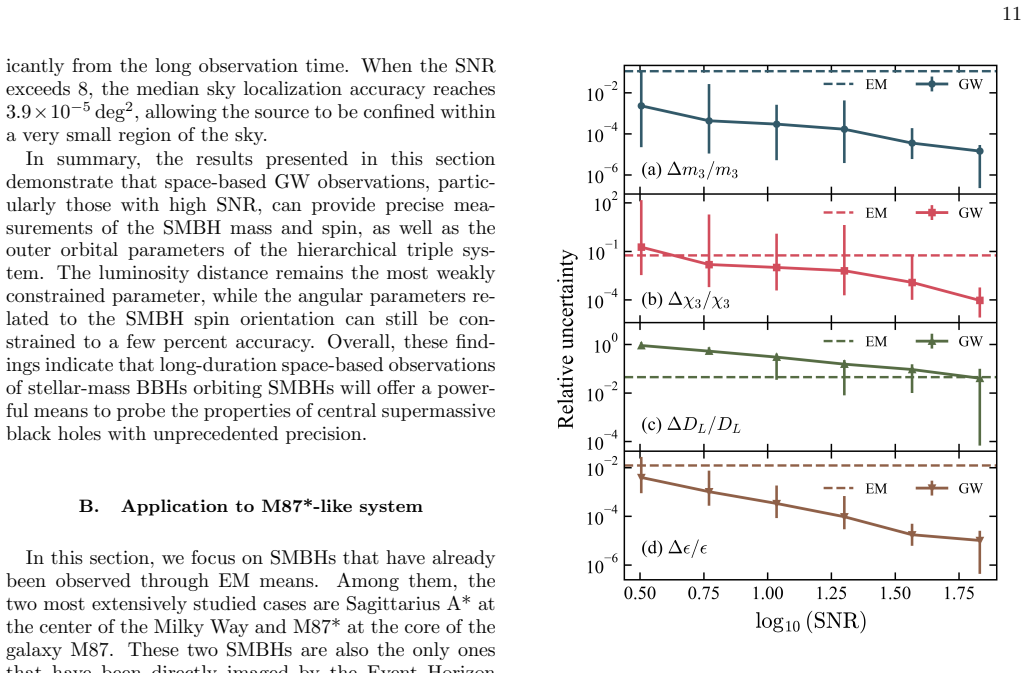
By modeling binary black hole inspirals around a Kerr supermassive black hole and using the Fisher information matrix on LISA-like detector data, the SMBH mass and orbital parameters can be recovered with relative uncertainties of order 10^{-5} and the spin parameters to a few percent accuracy, yielding tighter bounds than electromagnetic observations for an M87*-like system.
What carries the argument
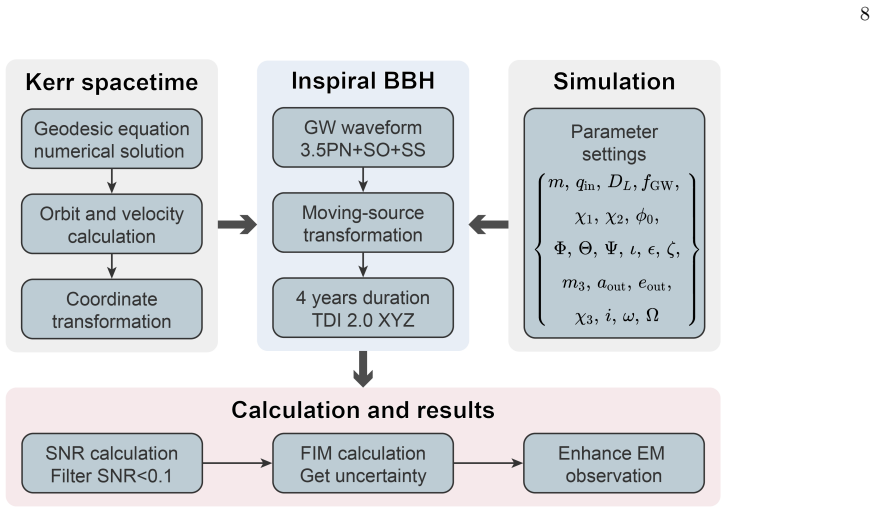
Fisher information matrix applied to post-Newtonian waveforms of the binary black hole with moving-source transformation in Kerr spacetime.
If this is right
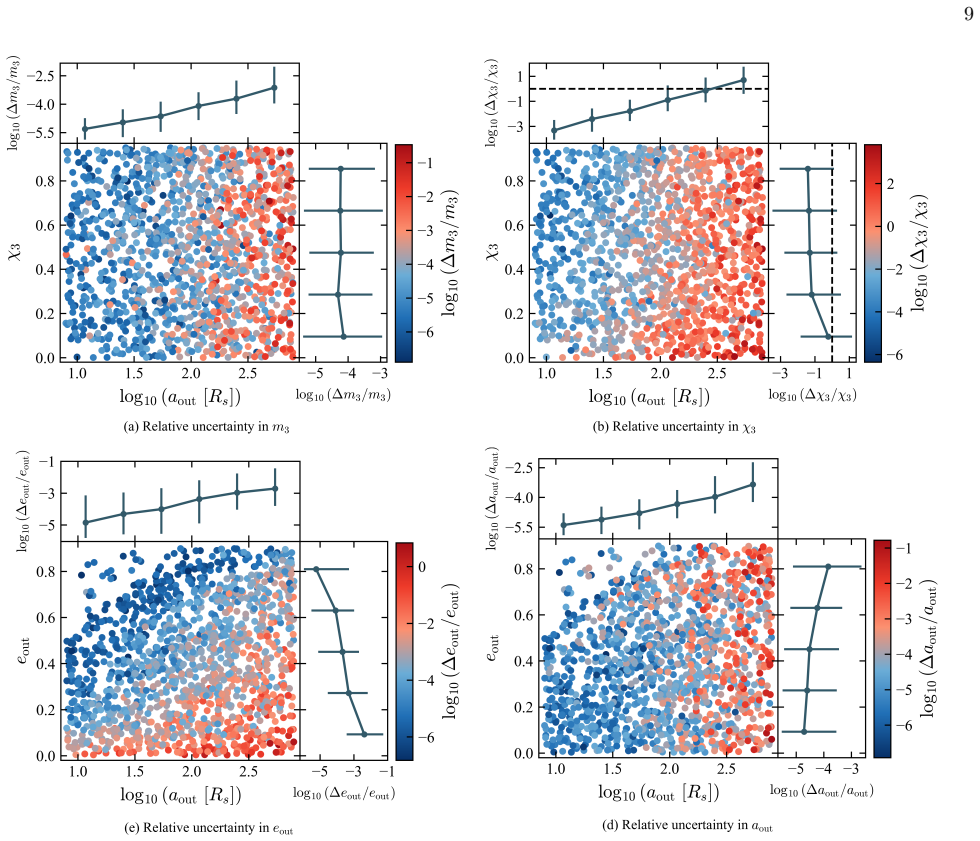
- The outer semimajor axis of the orbit around the supermassive black hole exerts the strongest influence on how precisely all parameters can be recovered.
- The supermassive black hole spin magnitude and orientation uncertainties depend primarily on the values of the spin itself and the eccentricity.
- For an M87*-like system, gravitational wave data would deliver tighter constraints on both mass and spin than current electromagnetic observations.
- High signal-to-noise ratio events are required to reach the 10^{-5} level for mass and orbital parameters.
Where Pith is reading between the lines
- If multiple such triple systems are observed, the method could be used to test whether the central object obeys the Kerr metric by checking consistency across events.
- The same signals might also reveal the population and stability of stellar binaries in galactic nuclei, which is not addressed in the analysis.
- Extending the calculation beyond the post-Newtonian approximation would be needed before applying the method to the strongest signals.
Load-bearing premise
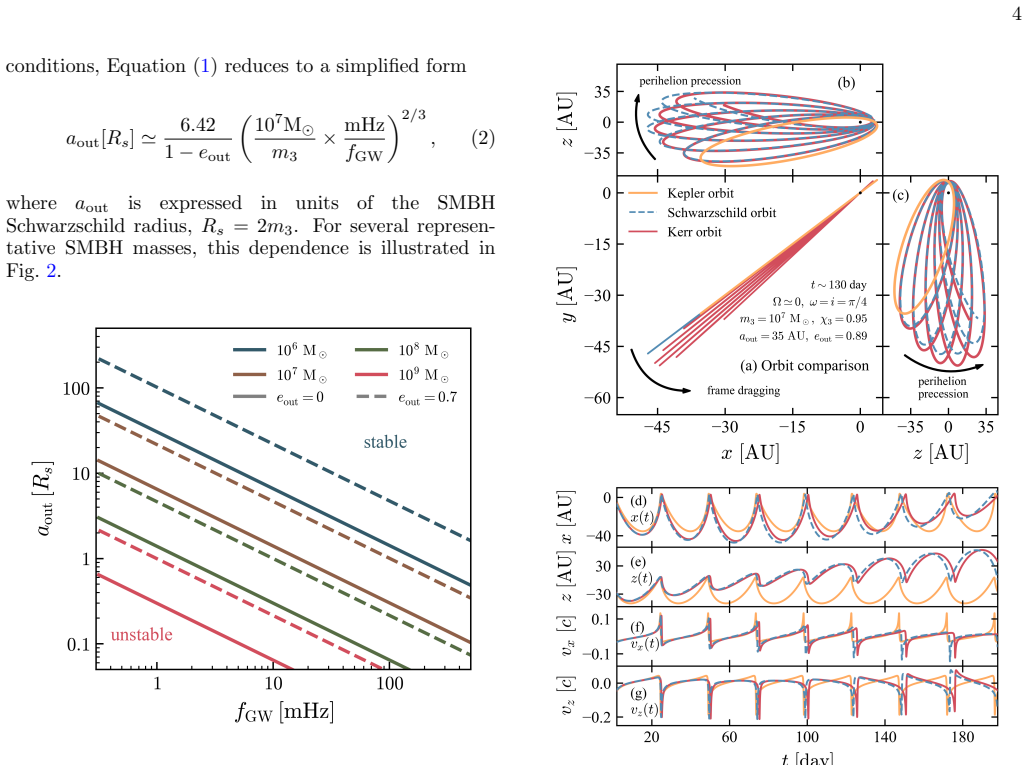
The small binary must remain in a stable orbit around the supermassive black hole long enough for the signal to be observed, and the post-Newtonian waveform plus moving-source transformation must accurately describe the emitted gravitational waves.
What would settle it
A detected gravitational wave signal from a stellar-mass binary around an M87*-like supermassive black hole whose recovered spin uncertainty exceeds roughly 10 percent would show the forecasted precision does not hold.
Figures

read the original abstract
We study the capability of future space-based gravitational-wave (GW) detectors to constrain supermassive black hole (SMBH) properties through observations of inspiraling stellar-mass binary black holes (BBHs) orbiting them. Focusing on stable hierarchical triple systems, we model the BBH motion in Kerr spacetime and compute the modulated GW signals using the post Newtonian waveform combined with moving-source transformation. Based on the LISA configuration and second-generation time delay interferometry technology, we estimate parameter uncertainties with the Fisher information matrix. Our results show that the outer semimajor axis has the strongest influence on parameter precision, while the SMBH spin and eccentricity mainly affect their own uncertainties. For high-SNR signals, the SMBH mass and orbital parameters can be measured with relative uncertainties on the order of $10^{-5}$, while the spin magnitude and its orientation can be constrained to within a few percentages. Applying the method to an M87*-like system, GW observations provide more precise measurements of the SMBH mass and spin compared with current electromagnetic observations, highlighting the potential of space-based GW astronomy to probe SMBH properties with high accuracy.
Editorial analysis
A structured set of objections, weighed in public.
Referee Report
Summary. The manuscript presents a study on using gravitational waves from stellar-mass binary black holes inspiraling around a supermassive Kerr black hole to constrain the SMBH's mass, spin, and orbital parameters. The analysis employs post-Newtonian waveforms with moving-source transformation for signals in hierarchical triple systems, estimates uncertainties via the Fisher information matrix for LISA-like detectors, and concludes that high-SNR events can achieve relative uncertainties of order 10^{-5} for mass and orbital parameters, few percent for spin, outperforming electromagnetic observations for systems like M87*.
Significance. If the modeling assumptions hold, the results highlight the potential of space-based GW detectors to provide precise measurements of SMBH properties, offering a complementary or superior probe to electromagnetic methods and advancing multi-messenger studies of black hole physics in galactic centers. The use of the Fisher matrix on a standard LISA configuration is a conventional and reproducible approach for forecasting.
major comments (2)
- [Abstract and waveform modeling section] Abstract and waveform modeling: The central precision claims (relative uncertainties of order 10^{-5} on SMBH mass/orbit and few-percent constraints on spin) rest on the post-Newtonian inner-binary waveform combined with moving-source transformation faithfully reproducing the modulated signal generated by geodesic motion in Kerr spacetime. No error budget or mismatch quantification against a more accurate outer-orbit model is supplied.
- [Application to M87*-like system] M87* application: The claim that GW observations provide more precise measurements of SMBH mass and spin than current electromagnetic observations for an M87*-like system assumes both waveform fidelity and the existence of stable hierarchical triples; without quantified stability criteria or systematic-error tests, this comparative conclusion is not load-bearing supported.
minor comments (1)
- [Methods] Clarify the exact definition and range of the outer semimajor axis parameter in the Fisher matrix setup to ensure reproducibility.
Simulated Author's Rebuttal
We thank the referee for their careful reading and constructive comments. We respond point by point to the major comments below, indicating planned revisions to strengthen the manuscript.
read point-by-point responses
-
Referee: [Abstract and waveform modeling section] Abstract and waveform modeling: The central precision claims (relative uncertainties of order 10^{-5} on SMBH mass/orbit and few-percent constraints on spin) rest on the post-Newtonian inner-binary waveform combined with moving-source transformation faithfully reproducing the modulated signal generated by geodesic motion in Kerr spacetime. No error budget or mismatch quantification against a more accurate outer-orbit model is supplied.
Authors: We agree that an explicit error budget or mismatch quantification would strengthen the central claims. The adopted post-Newtonian inner-binary waveform plus moving-source transformation is a standard approximation in the literature for hierarchical systems in the weak-field, slow-motion regime relevant to LISA forecasts. In the revised manuscript we will add a dedicated paragraph in the waveform modeling section that discusses the expected accuracy, including an order-of-magnitude estimate of truncation error based on the post-Newtonian parameter and the separation of inner/outer timescales, thereby supplying the requested error-budget discussion. revision: yes
-
Referee: [Application to M87*-like system] M87* application: The claim that GW observations provide more precise measurements of SMBH mass and spin than current electromagnetic observations for an M87*-like system assumes both waveform fidelity and the existence of stable hierarchical triples; without quantified stability criteria or systematic-error tests, this comparative conclusion is not load-bearing supported.
Authors: The M87* comparison is presented as an illustrative application rather than a definitive result. The manuscript already restricts attention to stable hierarchical triples, but does not supply new stability criteria. We will revise the relevant section to moderate the comparative language, explicitly state the stability assumption, and add references to existing analytic and numerical studies of hierarchical-triple stability in Kerr spacetime. We will also note the inherent limitation of the Fisher-matrix approach with respect to unmodeled systematic errors. These changes address the concern while remaining within the scope of a forecast study. revision: partial
Circularity Check
No circularity; Fisher uncertainties computed from explicit waveform model
full rationale
The derivation uses an explicit post-Newtonian waveform plus moving-source transformation in Kerr spacetime, then applies the Fisher information matrix to obtain parameter covariances for assumed high-SNR signals. This is a forward calculation of expected measurement precision under the stated model assumptions; the output uncertainties are not equivalent to any fitted input by construction, nor do they rely on load-bearing self-citations or ansatzes imported from prior author work. The chain remains self-contained against external benchmarks (LISA configuration, PN waveform) and does not rename known results or smuggle uniqueness theorems.
Axiom & Free-Parameter Ledger
axioms (2)
- domain assumption The spacetime around the supermassive black hole is described by the Kerr metric.
- domain assumption The post-Newtonian approximation combined with moving-source transformation is sufficient for generating the modulated GW signals.
Reference graph
Works this paper leans on
-
[1]
T. L. S. Collaboration, the Virgo Collaboration, and the KAGRA Collaboration, Gwtc-4.0: Updating the gravitational-wave transient catalog with observations from the first part of the fourth ligo-virgo-kagra observ- ing run (2025), arXiv:2508.18082 [gr-qc]
Pith/arXiv arXiv 2025
-
[2]
T. L. S. Collaboration, the Virgo Collaboration, and the KAGRA Collaboration, Gwtc-4.0: Population properties of merging compact binaries (2025), arXiv:2508.18083 [astro-ph.HE]
Pith/arXiv arXiv 2025
-
[3]
A. G. Abacet al.(LIGO Scientific, Virgo, KAGRA), GW250114: Testing Hawking’s Area Law and the Kerr Nature of Black Holes, Phys. Rev. Lett.135, 111403 (2025), arXiv:2509.08054 [gr-qc]
Pith/arXiv arXiv 2025
-
[4]
B. P. Abbottet al.(LIGO Scientific, Virgo), Observation of Gravitational Waves from a Binary Black Hole Merger, Phys. Rev. Lett.116, 061102 (2016), arXiv:1602.03837 [gr-qc]
Pith/arXiv arXiv 2016
-
[5]
Baracket al., Black holes, gravitational waves and fundamental physics: a roadmap, Class
L. Baracket al., Black holes, gravitational waves and fundamental physics: a roadmap, Class. Quant. Grav. 36, 143001 (2019), arXiv:1806.05195 [gr-qc]
Pith/arXiv arXiv 2019
-
[6]
G. Caneva Santoro, S. Roy, R. Vicente, M. Haney, O. J. Piccinni, W. Del Pozzo, and M. Martinez, First Constraints on Compact Binary Environments from LIGO-Virgo Data, Phys. Rev. Lett.132, 251401 (2024), arXiv:2309.05061 [gr-qc]
arXiv 2024
-
[7]
B. P. Abbottet al.(LIGO Scientific, Virgo), Binary Black Hole Mergers in the first Advanced LIGO Observing Run, Phys. Rev. X6, 041015 (2016), [Erratum: Phys.Rev.X 8, 039903 (2018)], arXiv:1606.04856 [gr-qc]
Pith/arXiv arXiv 2016
-
[8]
Amaro-Seoaneet al., Laser interferometer space an- 14 tenna (2017), arXiv:1702.00786 [astro-ph.IM]
P. Amaro-Seoaneet al., Laser interferometer space an- 14 tenna (2017), arXiv:1702.00786 [astro-ph.IM]
Pith/arXiv arXiv 2017
-
[9]
Hu and Y.-L
W.-R. Hu and Y.-L. Wu, The Taiji Program in Space for gravitational wave physics and the nature of gravity, Natl. Sci. Rev.4, 685 (2017)
2017
-
[10]
Luoet al.(TianQin), TianQin: a space-borne gravi- tational wave detector, Class
J. Luoet al.(TianQin), TianQin: a space-borne gravi- tational wave detector, Class. Quant. Grav.33, 035010 (2016), arXiv:1512.02076 [astro-ph.IM]
Pith/arXiv arXiv 2016
- [11]
-
[12]
A. Toubianaet al., Detectable environmental effects in GW190521-like black-hole binaries with LISA, Phys. Rev. Lett.126, 101105 (2021), arXiv:2010.06056 [astro- ph.HE]
arXiv 2021
-
[13]
R. Chen, R. S. Chandramouli, F. Pozzoli, R. Buscic- chio, and E. Barausse, Environmental effects in the LISA stochastic signal from stellar-mass black hole binaries, Phys. Rev. D112, 084053 (2025), arXiv:2507.00694 [gr- qc]
arXiv 2025
-
[14]
K. Inayoshi, N. Tamanini, C. Caprini, and Z. Haiman, Probing stellar binary black hole formation in galactic nuclei via the imprint of their center of mass accelera- tion on their gravitational wave signal, Phys. Rev. D96, 063014 (2017), arXiv:1702.06529 [astro-ph.HE]
Pith/arXiv arXiv 2017
-
[15]
J. Samsing, I. Bartos, D. J. D’Orazio, Z. Haiman, B. Koc- sis, N. W. C. Leigh, B. Liu, M. E. Pessah, and H. Tagawa, AGN as potential factories for eccentric black hole merg- ers, Nature603, 237 (2022), arXiv:2010.09765 [astro- ph.HE]
arXiv 2022
-
[16]
X. Chen, S. Li, and Z. Cao, Mass–redshift degeneracy for the gravitational-wave sources in the vicinity of su- permassive black holes, Mon. Not. Roy. Astron. Soc.485, L141 (2019), arXiv:1703.10543 [astro-ph.HE]
Pith/arXiv arXiv 2019
- [17]
-
[18]
T. A. Apostolatos, C. Cutler, G. J. Sussman, and K. S. Thorne, Spin induced orbital precession and its modula- tion of the gravitational wave forms from merging bina- ries, Phys. Rev. D49, 6274 (1994)
1994
-
[19]
B. Liu, D. Lai, and Y.-H. Wang, Binary Mergers near a Supermassive Black Hole: Relativistic Effects in Triples, Astrophys. J. Lett.883, L7 (2019), arXiv:1906.07726 [astro-ph.HE]
arXiv 2019
-
[20]
L. Randall and Z.-Z. Xianyu, A Direct Probe of Mass Density Near Inspiraling Binary Black Holes, Astrophys. J.878, 75 (2019), arXiv:1805.05335 [gr-qc]
Pith/arXiv arXiv 2019
-
[21]
V. Cardoso, F. Duque, and G. Khanna, Gravitational tuning forks and hierarchical triple systems, Phys. Rev. D103, L081501 (2021), arXiv:2101.01186 [gr-qc]
arXiv 2021
-
[22]
J. Kormendy and L. C. Ho, Coevolution (Or Not) of Su- permassive Black Holes and Host Galaxies, Ann. Rev. As- tron. Astrophys.51, 511 (2013), arXiv:1304.7762 [astro- ph.CO]
Pith/arXiv arXiv 2013
-
[23]
R. C. Hickox and D. M. Alexander, Obscured Active Galactic Nuclei, Ann. Rev. Astron. Astrophys.56, 625 (2018), arXiv:1806.04680 [astro-ph.GA]
Pith/arXiv arXiv 2018
-
[24]
L. C. Ho and M. Kim, THE BLACK HOLE MASS SCALE OF CLASSICAL AND PSEUDO BULGES IN ACTIVE GALAXIES, Astrophys. J.789, 17 (2014), arXiv:1406.6137 [astro-ph.GA]
Pith/arXiv arXiv 2014
-
[25]
C. S. Reynolds, Observational Constraints on Black Hole Spin, Ann. Rev. Astron. Astrophys.59, 117 (2021), arXiv:2011.08948 [astro-ph.HE]
arXiv 2021
-
[26]
X. Chen and W.-B. Han, A New Type of Extreme- mass-ratio Inspirals Produced by Tidal Capture of Bi- nary Black Holes, Communications Physics1, 53 (2018), arXiv:1801.05780 [astro-ph.HE]
Pith/arXiv arXiv 2018
-
[27]
J. S. Santos, V. Cardoso, J. Nat´ ario, and M. van de Meent, Gravitational waves from b-emris: Doppler shift and beaming, resonant excitation, helicity oscillations and self-lensing (2025), arXiv:2506.14868 [gr-qc]
arXiv 2025
-
[28]
K. Meng, H. Zhang, X.-L. Fan, Y. Yong, and F. Du, Gravitational waves excited by binary stars orbiting around a supermassive black hole (2024), arXiv:2405.07113 [gr-qc]
arXiv 2024
-
[29]
K. Hendriks, D. Atallah, M. Martinez, M. Zevin, L. Zwick, A. A. Trani, P. Saini, J. Tak´ atsy, and J. Sam- sing, Large gravitational wave phase shifts from strong 3-body interactions in dense stellar clusters (2025), arXiv:2411.08572 [astro-ph.HE]
arXiv 2025
- [30]
- [31]
-
[32]
Kuntz, Precession resonances in hierarchical triple systems, Phys
A. Kuntz, Precession resonances in hierarchical triple systems, Phys. Rev. D105, 024017 (2022), arXiv:2112.05167 [gr-qc]
arXiv 2022
- [33]
-
[34]
Y. Fang, X. Chen, and Q.-G. Huang, Impact of a spinning supermassive black hole on the orbit and gravitational waves of a nearby compact binary, The Astrophysical Journal887, 210 (2019)
2019
-
[35]
A. Laeuger, B. Seymour, Y. Chen, and H. Yu, Mea- suring supermassive black hole properties via gravita- tional radiation from eccentrically orbiting stellar mass black hole binaries, Phys. Rev. D109, 064086 (2024), arXiv:2310.16799 [gr-qc]
arXiv 2024
-
[36]
Y. Yin, J. Mathews, A. J. K. Chua, and X. Chen, Rela- tivistic model of binary extreme-mass-ratio inspiral sys- tems and their gravitational radiation, Phys. Rev. D111, 103007 (2025), arXiv:2410.09796 [gr-qc]
arXiv 2025
-
[37]
A. Kuntz and K. Leyde, Transverse Doppler effect and parameter estimation of LISA three-body systems, Phys. Rev. D108, 024002 (2023), arXiv:2212.09753 [gr-qc]
arXiv 2023
-
[38]
Sbernaet al., Observing GW190521-like binary black holes and their environment with LISA, Phys
L. Sbernaet al., Observing GW190521-like binary black holes and their environment with LISA, Phys. Rev. D 106, 064056 (2022), arXiv:2205.08550 [gr-qc]
arXiv 2022
-
[39]
Alexander, Stellar processes near the massive black hole in the Galactic Center, Phys
T. Alexander, Stellar processes near the massive black hole in the Galactic Center, Phys. Rept.419, 65 (2005), arXiv:astro-ph/0508106
Pith/arXiv arXiv 2005
-
[40]
Eggleton and L
P. Eggleton and L. Kiseleva, An empirical condition for stability of hierarchical triple systems, The Astrophysical Journal455, 640 (1995)
1995
-
[41]
Vynatheya, A
P. Vynatheya, A. S. Hamers, R. A. Mardling, and E. P. Bellinger, Algebraic and machine learning approach to hierarchical triple-star stability, Monthly Notices of the Royal Astronomical Society516, 4146 (2022). 15
2022
-
[42]
R. P. Kerr, Gravitational field of a spinning mass as an example of algebraically special metrics, Phys. Rev. Lett. 11, 237 (1963)
1963
-
[43]
R. H. Boyer and R. W. Lindquist, Maximal analytic extension of the kerr metric, Journal of Mathematical Physics8, 265 (1967)
1967
-
[44]
Visser, The kerr spacetime: A brief introduction (2008), arXiv:0706.0622 [gr-qc]
M. Visser, The kerr spacetime: A brief introduction (2008), arXiv:0706.0622 [gr-qc]
Pith/arXiv arXiv 2008
-
[45]
S. A. Teukolsky, The kerr metric, Classical and Quantum Gravity32, 124006 (2015)
2015
-
[46]
Yao and X
J.-T. Yao and X. Li, Inferring a spinning black hole in an expanding universe via the S2 star around the galactic center*, Chin. Phys. C49, 045106 (2025)
2025
-
[47]
Yao, Q.-H
J.-T. Yao, Q.-H. Zhu, and X. Li, Identifying axially sym- metric Finslerian extensions of Schwarzschild black hole via the S2 star orbiting Sagittarius A⋆, Phys. Rev. D 111, 084083 (2025)
2025
-
[48]
X. Li, X. Zhang, and H.-N. Lin, Probing a Finslerian Schwarzschild black hole with the orbital precession of Sagittarius A*, Phys. Rev. D106, 064043 (2022)
2022
-
[49]
S. M. Carroll,Spacetime and Geometry: An Introduc- tion to General Relativity(Cambridge University Press, 2019)
2019
-
[50]
S. Prodan, F. Antonini, and H. B. Perets, Secular Evolu- tion Of Binaries Near Massive Black Holes: Formation of compact binaries, merger/collision products and G2-like objects, Astrophys. J.799, 118 (2015), arXiv:1405.6029 [astro-ph.GA]
Pith/arXiv arXiv 2015
-
[51]
E.-K. Liet al., GWSpace: a multi-mission science data simulator for space-based gravitational wave detection, Class. Quant. Grav.42, 165005 (2025), arXiv:2309.15020 [gr-qc]
arXiv 2025
-
[52]
Z. Ren, T. Zhao, Z. Cao, Z.-K. Guo, W.-B. Han, H.- B. Jin, and Y.-L. Wu, Taiji data challenge for exploring gravitational wave universe, Front. Phys. (Beijing)18, 64302 (2023), arXiv:2301.02967 [gr-qc]
arXiv 2023
-
[53]
J. Wu, J. Li, X. Liu, and Z. Cao, Comparison and application of different post-Newtonian models for in- spiralling stellar-mass binary black holes with space- based GW detectors, Phys. Rev. D109, 104014 (2024), arXiv:2401.03113 [gr-qc]
arXiv 2024
-
[54]
J. Wu, J. Li, and Q.-Q. Jiang, Application of Newtonian approximate model to LIGO gravitational wave data pro- cessing, Chin. Phys. B32, 090401 (2023)
2023
-
[55]
L. Blanchet, Gravitational Radiation from Post- Newtonian Sources and Inspiralling Compact Binaries, Living Rev. Rel.17, 2 (2014), arXiv:1310.1528 [gr-qc]
Pith/arXiv arXiv 2014
-
[56]
L. Blanchet, Analyzing Gravitational Waves with Gen- eral Relativity, Comptes Rendus Physique20, 507 (2019), arXiv:1902.09801 [gr-qc]
arXiv 2019
-
[57]
G. Cho, R. A. Porto, and Z. Yang, Gravitational radia- tion from inspiralling compact objects: Spin effects to the fourth post-Newtonian order, Phys. Rev. D106, L101501 (2022), arXiv:2201.05138 [gr-qc]
arXiv 2022
-
[58]
J. Wu, M. Sun, X. Ma, X. Liu, J. Li, and Z. Cao, Ef- fect of kick velocity on gravitational wave detection of binary black holes with space- and ground-based detec- tors, Phys. Rev. D112, 024040 (2025), arXiv:2502.13710 [gr-qc]
arXiv 2025
-
[59]
J. Wu, Y. Xiao, M. Sun, and J. Li, Probing globular clusters using modulated gravitational waves from binary black holes (2025), arXiv:2508.04021 [gr-qc]
arXiv 2025
-
[60]
X. He, X. Liu, and Z. Cao, Lorentz transformation of three dimensional gravitational wave tensor, Class. Quant. Grav.39, 195020 (2022), arXiv:2302.07532 [gr- qc]
arXiv 2022
-
[61]
J. M. Bardeen, W. H. Press, and S. A. Teukolsky, Ro- tating black holes: Locally nonrotating frames, energy extraction, and scalar synchrotron radiation, Astrophys. J.178, 347 (1972)
1972
-
[62]
J. Wu, M. Sun, and J. Li, Constraints and detection capa- bilities of gw polarizations with space-based detectors in different tdi combinations (2024), arXiv:2411.03631 [gr- qc]
arXiv 2024
- [63]
-
[64]
Kawamuraet al., The Japanese space gravitational wave antenna: DECIGO, Class
S. Kawamuraet al., The Japanese space gravitational wave antenna: DECIGO, Class. Quant. Grav.28, 094011 (2011)
2011
-
[65]
S. V. Dhurandhar, K. Rajesh Nayak, S. Koshti, and J. Y. Vinet, Fundamentals of the LISA stable flight formation, Class. Quant. Grav.22, 481 (2005), arXiv:gr-qc/0410093
Pith/arXiv arXiv 2005
-
[66]
T. Robson, N. J. Cornish, and C. Liu, The construction and use of LISA sensitivity curves, Class. Quant. Grav. 36, 105011 (2019), arXiv:1803.01944 [astro-ph.HE]
Pith/arXiv arXiv 2019
-
[67]
Cutler, Angular resolution of the LISA gravitational wave detector, Phys
C. Cutler, Angular resolution of the LISA gravitational wave detector, Phys. Rev. D57, 7089 (1998), arXiv:gr- qc/9703068
arXiv 1998
-
[68]
M. Vallisneri, Use and abuse of the Fisher infor- mation matrix in the assessment of gravitational- wave parameter-estimation prospects, Phys. Rev. D77, 042001 (2008), arXiv:gr-qc/0703086
Pith/arXiv arXiv 2008
-
[69]
S.-J. Huang, Y.-M. Hu, V. Korol, P.-C. Li, Z.-C. Liang, Y. Lu, H.-T. Wang, S. Yu, and J. Mei, Science with the TianQin Observatory: Preliminary results on Galactic double white dwarf binaries, Phys. Rev. D102, 063021 (2020), arXiv:2005.07889 [astro-ph.HE]
arXiv 2020
- [70]
-
[71]
F. Iacovelli, M. Mancarella, S. Foffa, and M. Maggiore, GWFAST: A Fisher Information Matrix Python Code for Third-generation Gravitational-wave Detectors, As- trophys. J. Supp.263, 2 (2022), arXiv:2207.06910 [astro- ph.IM]
arXiv 2022
- [72]
-
[73]
Aghanimet al.(Planck), Planck 2018 results
N. Aghanimet al.(Planck), Planck 2018 results. VI. Cosmological parameters, Astron. Astrophys.641, A6 (2020), [Erratum: Astron.Astrophys. 652, C4 (2021)], arXiv:1807.06209 [astro-ph.CO]
Pith/arXiv arXiv 2018
-
[74]
B. P. Abbottet al.(LIGO Scientific, Virgo), GW170817: Observation of Gravitational Waves from a Binary Neu- tron Star Inspiral, Phys. Rev. Lett.119, 161101 (2017), arXiv:1710.05832 [gr-qc]
Pith/arXiv arXiv 2017
-
[75]
Akiyamaet al.(Event Horizon Telescope), First M87 Event Horizon Telescope Results
K. Akiyamaet al.(Event Horizon Telescope), First M87 Event Horizon Telescope Results. I. The Shadow of the Supermassive Black Hole, Astrophys. J. Lett.875, L1 (2019), arXiv:1906.11238 [astro-ph.GA]
Pith/arXiv arXiv 2019
-
[76]
Akiyamaet al.(Event Horizon Telescope), First Sagittarius A* Event Horizon Telescope Results
K. Akiyamaet al.(Event Horizon Telescope), First Sagittarius A* Event Horizon Telescope Results. I. The 16 Shadow of the Supermassive Black Hole in the Center of the Milky Way, Astrophys. J. Lett.930, L12 (2022), arXiv:2311.08680 [astro-ph.HE]
Pith/arXiv arXiv 2022
-
[77]
R. Emami and A. Loeb, Probingintermediate-mass black holes in M87 through multiwavelength gravitational wave observations, Mon. Not. Roy. Astron. Soc.495, 536 (2020), [Erratum: Mon.Not.Roy.Astron.Soc. 541, 28 (2025)], arXiv:1910.04828 [astro-ph.GA]
arXiv 2020
-
[78]
Akiyamaet al.(Event Horizon Telescope), First M87 Event Horizon Telescope Results
K. Akiyamaet al.(Event Horizon Telescope), First M87 Event Horizon Telescope Results. VI. The Shadow and Mass of the Central Black Hole, Astrophys. J. Lett.875, L6 (2019), arXiv:1906.11243 [astro-ph.GA]
Pith/arXiv arXiv 2019
-
[79]
F. Tamburini, B. Thid´ e, and M. Della Valle, Measure- ment of the spin of the M87 black hole from its ob- served twisted light, Mon. Not. Roy. Astron. Soc.492, L22 (2020), arXiv:1904.07923 [astro-ph.HE]
arXiv 2020
discussion (0)
Sign in with ORCID, Apple, or X to comment. Anyone can read and Pith papers without signing in.