QuBE/Qubex: an integrated hardware-software system for superconducting qubit experiments with broadband control
Pith reviewed 2026-06-27 06:44 UTC · model grok-4.3
The pith
An integrated hardware-software system supplies broadband microwave control and automated workflows for superconducting qubit arrays up to 64 qubits.
A machine-rendered reading of the paper's core claim, the machinery that carries it, and where it could break.
Core claim
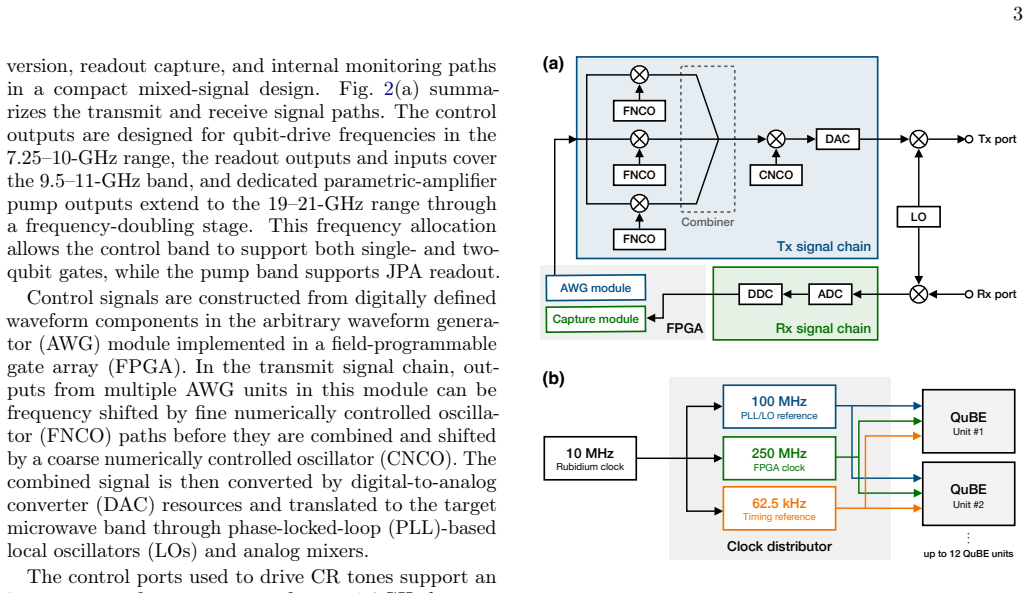
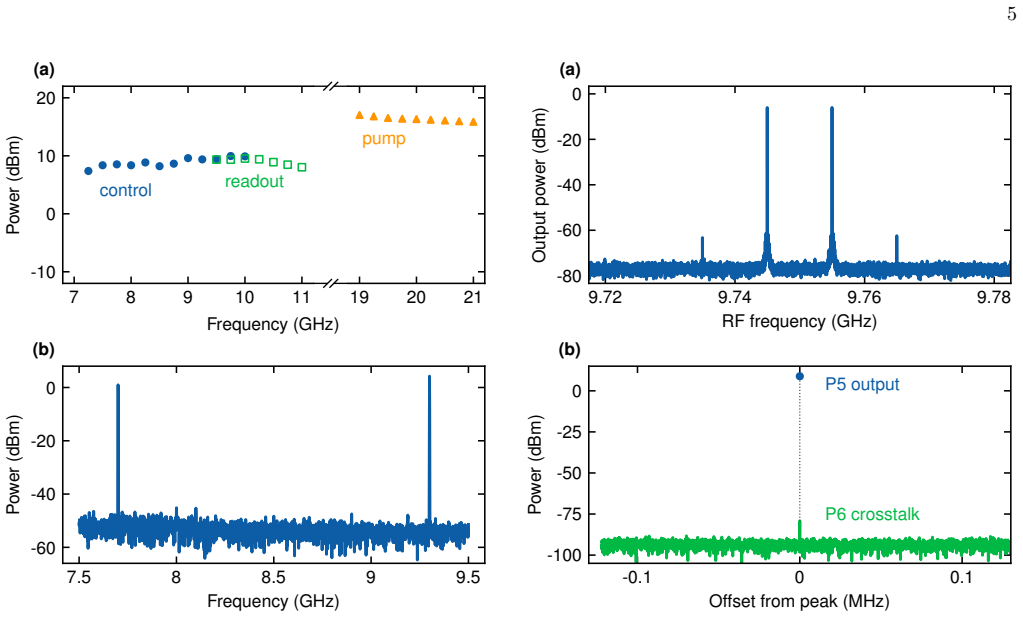
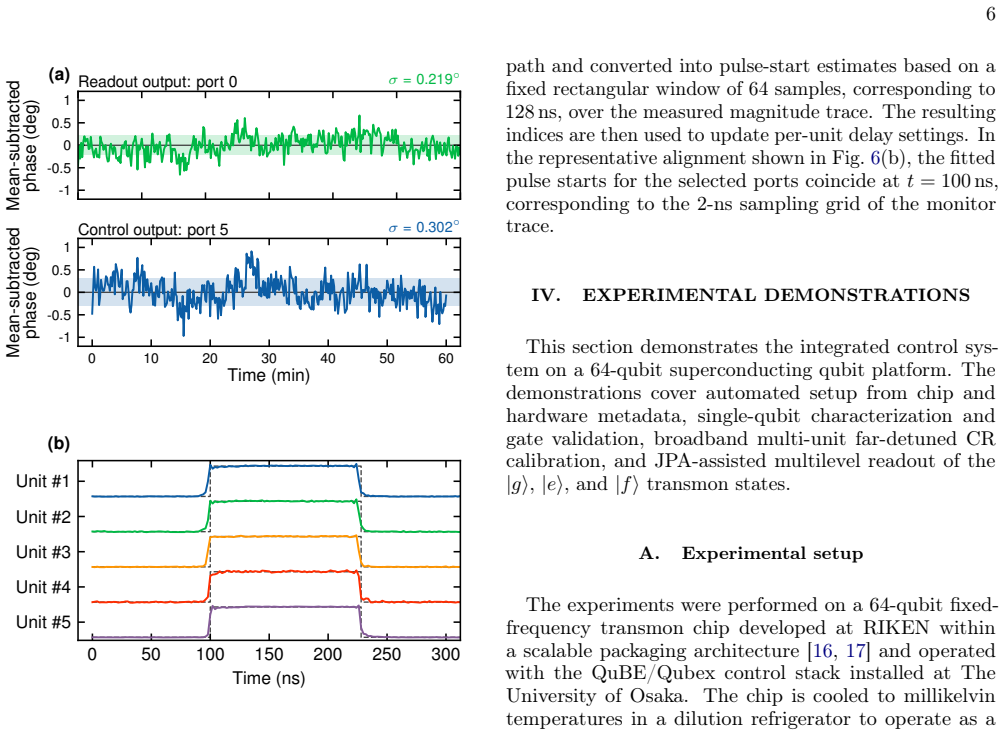
The paper introduces an integrated qubit-control system that pairs broadband microwave hardware with a pulse-level software stack. The hardware supplies instantaneous frequency coverage up to 1.6 GHz from each control output together with tight synchronization and low crosstalk. The software reduces setup overhead by automating system configuration, experiment execution, and data analysis through built-in workflows. Validation on a 64-qubit fixed-frequency transmon chip includes complete frequency identification across the array, multi-unit far-detuned cross-resonance calibration that reaches 98.34 percent two-qubit gate fidelity, and readout that extends beyond the computational subspace. T
What carries the argument
The broadband microwave hardware that provides up to 1.6 GHz instantaneous span per control output, coordinated by a pulse-level software stack that automates configuration and experiment workflows.
If this is right
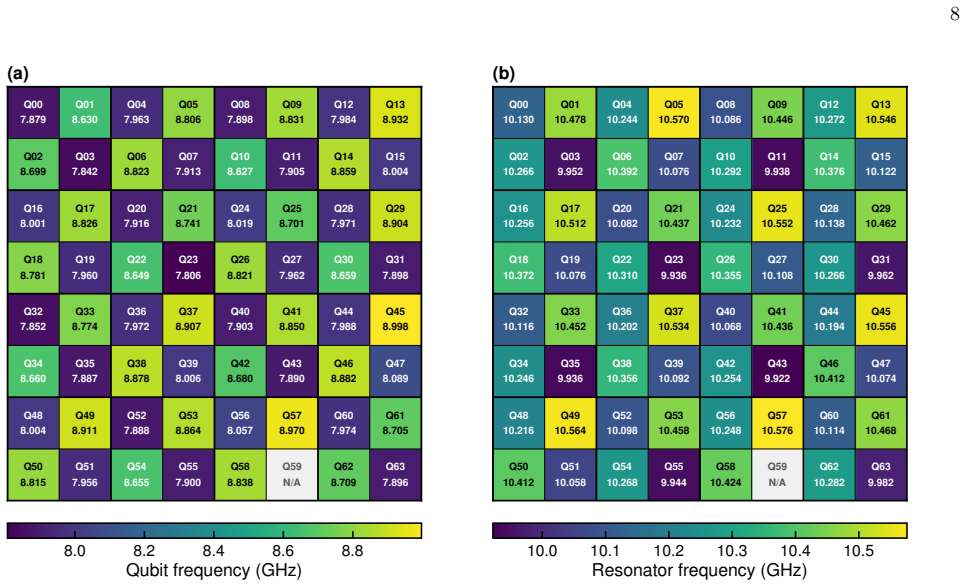
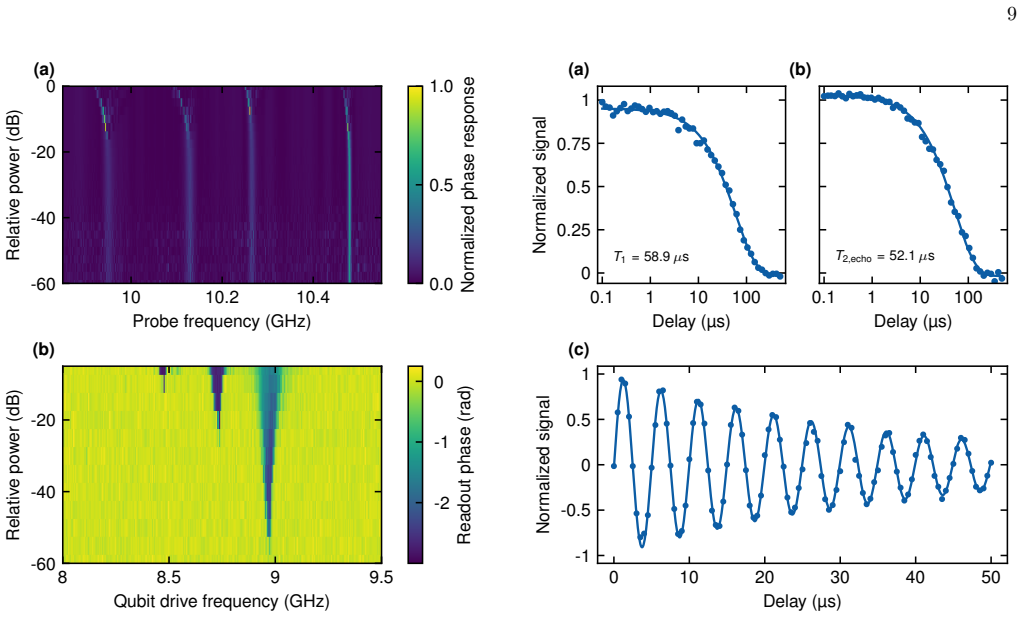
- Full frequency identification of every qubit on a 64-qubit chip becomes routine rather than a manual bottleneck.
- Cross-resonance gates between far-detuned qubits can be calibrated and benchmarked across multiple control units in a single automated run.
- Two-qubit gate fidelities of 98.34 percent are obtained on a fixed-frequency transmon array using the integrated control path.
- Readout that resolves states outside the computational subspace is supported on the same hardware-software platform.
- Open-source release of the software stack allows other groups to replicate the control architecture and extend the experiment library.
Where Pith is reading between the lines
- The automation layer could shorten the time between receiving a new qubit chip and obtaining calibrated gates from days to hours.
- Broadband coverage on each channel may allow simultaneous control of qubits at widely separated frequencies without additional hardware.
- Releasing the software as open source creates an opportunity for community additions such as new pulse-shaping routines or error-mitigation sequences.
- If synchronization remains tight at larger scales, the same architecture could support chips with hundreds of qubits provided crosstalk stays low.
Load-bearing premise
The hardware continues to deliver its claimed broadband coverage and low crosstalk when all 64 qubits operate at once, and the software performs the automated workflows without requiring unstated manual corrections.
What would settle it
A direct measurement showing that two-qubit gate fidelity falls substantially below 98 percent or that crosstalk errors rise when all 64 qubits are driven simultaneously, compared with the same operations on smaller subsets, would falsify the scalability claim.
Figures






read the original abstract
Achieving high-fidelity operation in large-scale superconducting qubit systems requires not only control hardware with broad frequency coverage, low crosstalk, and tight synchronization but also software that coordinates system configuration, experiment execution, and data analysis. Here we present an integrated qubit-control system that combines broadband microwave hardware with a pulse-level software stack for scalable superconducting qubit experiments. The hardware provides broadband microwave coverage, including an instantaneous span of up to 1.6 GHz from a control output, while the software reduces setup and calibration overhead through automated configuration and built-in experiment workflows. We validate the system on a 64-qubit fixed-frequency transmon chip through full-chip frequency identification and representative demonstrations, including multi-unit far-detuned cross-resonance calibration and benchmarking that yields a measured two-qubit gate fidelity of 98.34%, and multilevel readout beyond the computational subspace. By disclosing the hardware architecture and releasing the software stack as open source, this work provides an inspectable hardware-software foundation for scalable superconducting qubit control experiments.
Editorial analysis
A structured set of objections, weighed in public.
Referee Report
Summary. The manuscript presents QuBE/Qubex, an integrated hardware-software system for superconducting qubit experiments. The hardware component delivers broadband microwave control with an instantaneous span of up to 1.6 GHz per output, while the software stack automates system configuration, pulse-level experiment execution, and data analysis. Validation is reported on a 64-qubit fixed-frequency transmon chip, including full-chip frequency identification, multi-unit far-detuned cross-resonance calibration and benchmarking that achieves a measured two-qubit gate fidelity of 98.34%, and multilevel readout beyond the computational subspace. The hardware architecture is disclosed and the software is released as open source.
Significance. If the reported performance holds under scrutiny, the work supplies a concrete, inspectable hardware-software platform that directly targets the synchronization, crosstalk, and calibration overhead challenges in scaling superconducting processors. The open-source release of the software stack is a clear strength, enabling independent verification of the automation workflows and facilitating community adoption or extension. This combination of broadband coverage and automated workflows could serve as a practical foundation for larger-scale experiments.
minor comments (2)
- The abstract and validation summary state that full-chip frequency identification and multi-unit calibrations succeeded on the 64-qubit device, but the manuscript would benefit from explicit quantitative bounds on crosstalk and synchronization jitter across the full array to substantiate the broadband scaling claim.
- Figure captions and methods descriptions should include the number of repetitions and statistical uncertainties for the 98.34% fidelity benchmark to allow direct comparison with other cross-resonance implementations.
Simulated Author's Rebuttal
We thank the referee for their positive summary and recommendation for minor revision. No specific major comments were provided in the report, so we have no individual points to address. We are happy to incorporate any minor suggestions from the editor or additional feedback if provided.
Circularity Check
No significant circularity detected
full rationale
The paper describes an integrated hardware-software system for qubit control and validates it via direct experimental measurements on a 64-qubit chip (full-chip frequency identification, cross-resonance calibrations, and 98.34% two-qubit gate fidelity). No derivation chains, equations, fitted-parameter predictions, or self-citation load-bearing steps appear in the provided material. Claims rest on empirical results and open-source release rather than any self-referential reduction of outputs to inputs.
Axiom & Free-Parameter Ledger
Reference graph
Works this paper leans on
-
[1]
19 summarizes the cryostat wiring used in the 64-qubit experiment
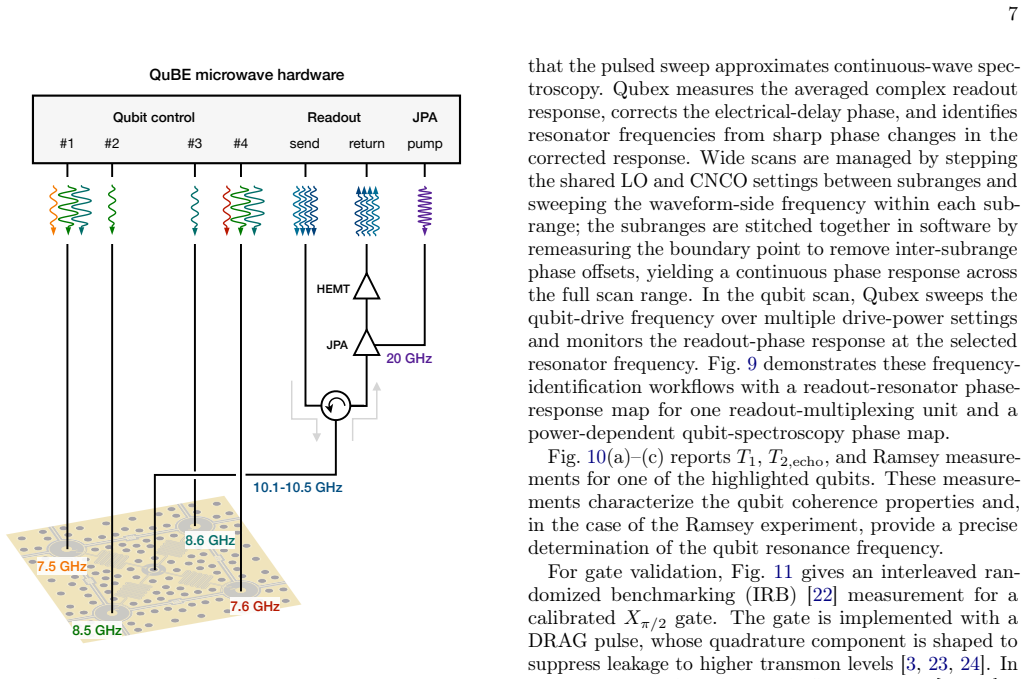
Cryostat wiring Fig. 19 summarizes the cryostat wiring used in the 64-qubit experiment. The cryostat inputs consist of qubit- control, readout-send, and JPA-pump lines, and the cryo- stat output is the readout-return line. Each qubit has a dedicated control line, whereas the readout-send, readout- return, and JPA-pump paths are shared within each four- qu...
-
[2]
The de- composition follows Eq.(1), with the LO, CNCO, FNCO, andAWGtermschosensothatthegeneratedtoneremains phase reproducible and avoids unwanted aliasing or image tones
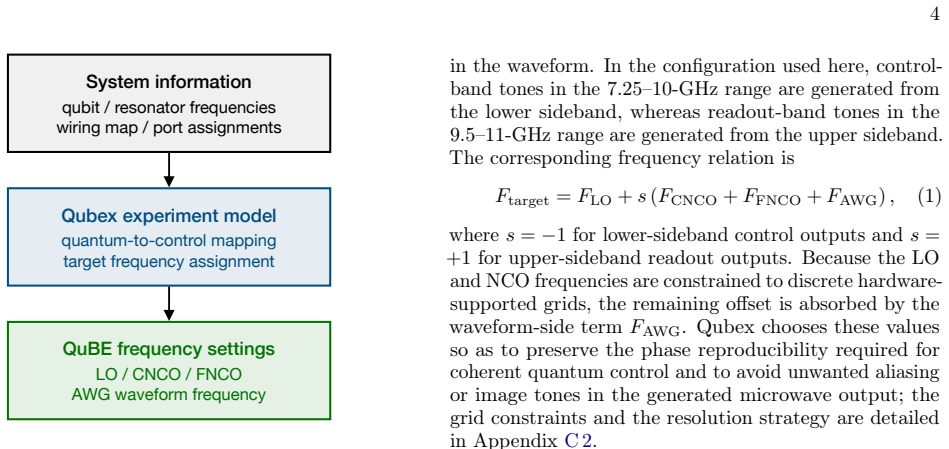
Resolved hardware frequency settings Qubex resolves each logical target frequency into a hard- ware frequency setting that satisfies the discrete grids and bandwidth limits of the QuBE microwave path. The de- composition follows Eq.(1), with the LO, CNCO, FNCO, andAWGtermschosensothatthegeneratedtoneremains phase reproducible and avoids unwanted aliasing ...
-
[3]
12, the drive applied to the control qubit induces not only the de- sired conditional interaction on the target qubit but also unwanted single-qubit and crosstalk terms [5, 27]
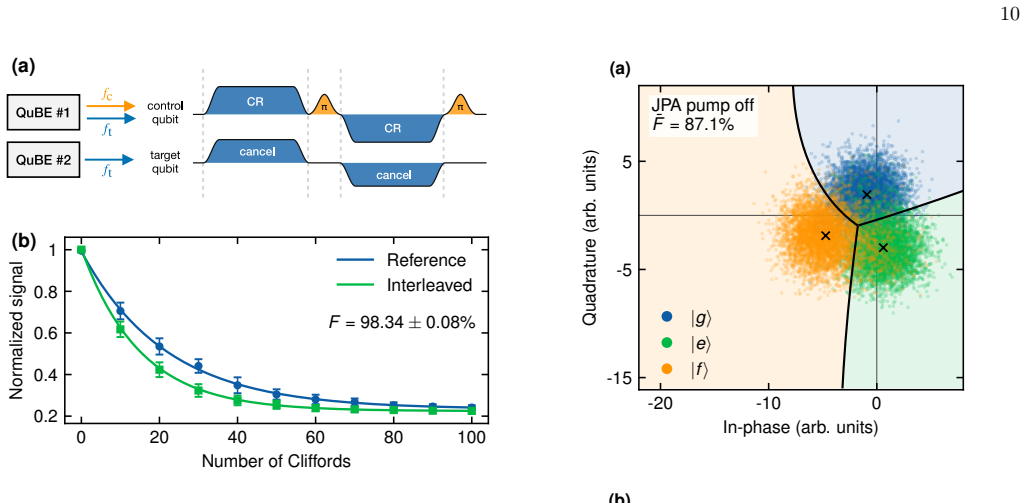
Cross-resonance model and calibration For the far-detuned CR gate used in Fig. 12, the drive applied to the control qubit induces not only the de- sired conditional interaction on the target qubit but also unwanted single-qubit and crosstalk terms [5, 27]. In prac- tice, the calibration therefore aims to isolate the useful conditional rotation while suppr...
2062
-
[4]
Quantum computer control device
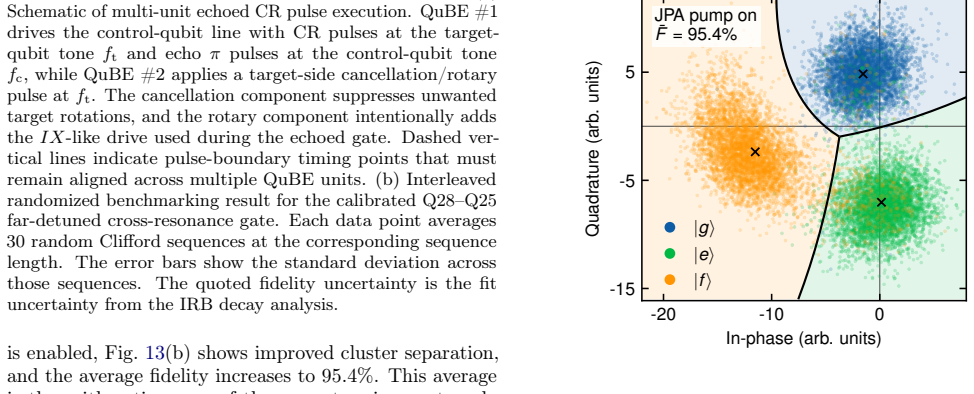
Multilevel-readout assignment and error analysis To construct the qubit-state classifier, Qubex prepares |g⟩, |e⟩, and |f⟩ separately for the measured qubit and records the integrated complex I/Q values for each pre- pared state. The data in Fig. 13 were acquired with a readout pulse of1.024µs. For each pump condition, 5000 shots were acquired for each pr...
-
[5]
Krantz, M
P. Krantz, M. Kjaergaard, F. Yan, T. P. Orlando, S. Gus- tavsson, and W. D. Oliver, A quantum engineer’s guide to superconducting qubits, Applied Physics Reviews6, 021318 (2019)
2019
-
[6]
Kjaergaard, M
M. Kjaergaard, M. E. Schwartz, J. Braumüller, P. Krantz, J. I.-J. Wang, S. Gustavsson, and W. D. Oliver, Super- conducting qubits: current state of play, Annual Review of Condensed Matter Physics11, 369 (2020)
2020
-
[7]
Motzoi, J
F. Motzoi, J. M. Gambetta, P. Rebentrost, and F. K. Wilhelm,Simplepulsesforeliminationofleakageinweakly nonlinear qubits, Physical Review Letters103, 110501 (2009)
2009
-
[8]
N. R. Rizvi, M. Ahmad, A. Shafique, H. Heidari, M. Wei- des, M. A. Imran, and A. R. Jafri, A survey of microwave- implemented superconducting qubit control and readout circuits, IEEE Transactions on Quantum Engineering7, 6000152 (2026)
2026
-
[9]
J. M. Chow, A. D. Córcoles, J. M. Gambetta, C. Rigetti, B. R. Johnson, J. A. Smolin, J. R. Rozen, G. A. Keefe, M. B. Rothwell, M. B. Ketchen, and M. Steffen, Simple all-microwave entangling gate for fixed-frequency super- conducting qubits, Physical Review Letters107, 080502 (2011)
2011
-
[10]
Morvan, L
A. Morvan, L. Chen, J. M. Larson, D. I. Santiago, and I. Siddiqi, Optimizing frequency allocation for fixed- frequency superconducting quantum processors, Physical Review Research4, 023079 (2022)
2022
-
[11]
J. B. Hertzberget al., Laser-annealing josephson junc- tions for yielding scaled-up superconducting quantum processors, npj Quantum Information7, 129 (2021)
2021
- [12]
-
[13]
S. Inoue, S. Shirai, S. Tamate, S. Watanabe, K. Matsuura, R. Li, and Y. Nakamura, Systematic frequency-collision analysis of the cross-resonance gate outside the straddling regime (2026), arXiv:2605.07868 [quant-ph]
Pith/arXiv arXiv 2026
-
[14]
Magnard, P
P. Magnard, P. Kurpiers, B. Royer, T. Walter, J.-C. Besse, S. Gasparinetti, M. Pechal, J. Heinsoo, S. Storz, A. Blais, and A. Wallraff, Fast and unconditional all-microwave reset of a superconducting qubit, Physical Review Letters 121, 060502 (2018)
2018
-
[15]
P. Liu, R. Wang, J.-N. Zhang, Y. Zhang, X. Cai, H. Xu, Z. Li, J. Han, X. Li, G. Xue, W. Liu, L. You, Y. Jin, and H. Yu, PerformingSU(d)operations and rudimentary algorithms in a superconducting transmon qudit ford = 3 andd= 4, Physical Review X13, 021028 (2023)
2023
-
[16]
Stefanazziet al., The QICK (quantum instrumentation control kit): readout and control for qubits and detectors, Review of Scientific Instruments93, 044709 (2022)
L. Stefanazziet al., The QICK (quantum instrumentation control kit): readout and control for qubits and detectors, Review of Scientific Instruments93, 044709 (2022)
2022
-
[17]
Y. Xu, G. Huang, J. Balewski, R. Naik, A. Morvan, B. Mitchell, K. Nowrouzi, D. I. Santiago, and I. Siddiqi, QubiC: an open-source fpga-based control and measure- ment system for superconducting quantum information processors, IEEE Transactions on Quantum Engineering 2, 1 (2021)
2021
-
[18]
K. H. Parket al., ICARUS-Q: integrated control and readout unit for scalable quantum processors, Review of Scientific Instruments93, 104704 (2022)
2022
-
[19]
Efthymiouet al., Qibolab: an open-source hybrid quan- tum operating system, Quantum8, 1247 (2024)
S. Efthymiouet al., Qibolab: an open-source hybrid quan- tum operating system, Quantum8, 1247 (2024)
2024
-
[20]
Tamate, Y
S. Tamate, Y. Tabuchi, and Y. Nakamura, Toward real- ization of scalable packaging and wiring for large-scale superconductingquantumcomputers,IEICETransactions on ElectronicsE105.C, 290 (2022)
2022
-
[21]
P. A. Spring, L. Milanovic, Y. Sunada, S. Wang, A. F. van Loo, S. Tamate, and Y. Nakamura, Fast multiplexed superconducting-qubit readout with intrinsic Purcell fil- tering using a multiconductor transmission line, PRX Quantum6, 020345 (2025)
2025
-
[22]
Matsuda, R
R. Matsuda, R. Ohira, T. Sumida, H. Shiomi, A. Machino, S. Morisaka, K. Koike, T. Miyoshi, Y. Kurimoto, Y. Sugita, Y. Ito, Y. Suzuki, P. A. Spring, S. Wang, S. Tamate, Y. Tabuchi, Y. Nakamura, K. Ogawa, and M. Negoro, Selective excitation of superconducting qubits with a shared control line through pulse shaping, Physical Review Research8, L012003 (2026)
2026
-
[23]
Kurimoto, D
Y. Kurimoto, D. Lee, K. Ban, S. Morisaka, T. Sumida, H. Shiomi, Y. Ito, Y. Sugita, M. Negoro, R. Ohira, and T. Miyoshi, Microwave output stabilization of a qubit controller via device-level temperature control, Review of Scientific Instruments97, 034715 (2026). 20
2026
-
[24]
Yamamoto, K
T. Yamamoto, K. Inomata, M. Watanabe, K. Matsuba, T. Miyazaki, W. D. Oliver, Y. Nakamura, and J. S. Tsai, Flux-driven Josephson parametric amplifier, Ap- plied Physics Letters93, 042510 (2008)
2008
-
[25]
Z. R. Lin, K. Inomata, W. D. Oliver, K. Koshino, Y. Naka- mura, J. S. Tsai, and T. Yamamoto, Single-shot readout of a superconducting flux qubit with a flux-driven Joseph- son parametric amplifier, Applied Physics Letters103, 132602 (2013)
2013
-
[26]
Magesan, J
E. Magesan, J. M. Gambetta, B. R. Johnson, C. A. Ryan, J. M. Chow, S. T. Merkel, M. P. da Silva, G. A. Keefe, M. B. Rothwell, T. A. Ohki, M. B. Ketchen, and M. Stef- fen, Efficient measurement of quantum gate error by inter- leaved randomized benchmarking, Physical Review Let- ters109, 080505 (2012)
2012
-
[27]
J. M. Chow, L. DiCarlo, J. M. Gambetta, F. Motzoi, L. Frunzio, S. M. Girvin, and R. J. Schoelkopf, Optimized driving of superconducting artificial atoms for improved single-qubit gates, Physical Review A82, 040305 (2010)
2010
-
[28]
J. M. Gambetta, F. Motzoi, S. T. Merkel, and F. K. Wilhelm, Analytic control methods for high-fidelity uni- tary operations in a weakly nonlinear oscillator, Physical Review A83, 012308 (2011)
2011
-
[29]
Knill, D
E. Knill, D. Leibfried, R. Reichle, J. Britton, R. B. Blakestad, J. D. Jost, C. Langer, R. Ozeri, S. Seidelin, and D. J. Wineland, Randomized benchmarking of quantum gates, Physical Review A77, 012307 (2008)
2008
-
[30]
Magesan, J
E. Magesan, J. M. Gambetta, and J. Emerson, Scalable and robust randomized benchmarking of quantum pro- cesses, Physical Review Letters106, 180504 (2011)
2011
-
[31]
Sheldon, E
S. Sheldon, E. Magesan, J. M. Chow, and J. M. Gam- betta, Procedure for systematically tuning up cross-talk in the cross-resonance gate, Physical Review A93, 060302 (2016)
2016
-
[32]
Sundaresan, I
N. Sundaresan, I. Lauer, E. Pritchett, E. Magesan, P. Ju- rcevic, and J. M. Gambetta, Reducing unitary and specta- tor errors in cross resonance with optimized rotary echoes, PRX Quantum1, 020318 (2020)
2020
-
[33]
Chenet al., Transmon qubit readout fidelity at the threshold for quantum error correction without a quantum-limited amplifier, npj Quantum Information9, 26 (2023)
L. Chenet al., Transmon qubit readout fidelity at the threshold for quantum error correction without a quantum-limited amplifier, npj Quantum Information9, 26 (2023)
2023
-
[34]
Kakuko, S
N. Kakuko, S. Gokita, N. Masumoto, K. Matsumoto, K. Miyaji, T. Miyanaga, T. Mori, H. Nakayama, K. Sasada, Y. Takamiya, S. Tsukano, R. Uchida, and M. Yamaguchi, A practical open-source software stack for a cloud-based quantum computing system, in2025 IEEE International Conference on Quantum Computing and Engineering (QCE)(2025) pp. 797–803
2025
-
[35]
Y. Yoshida, L. Erhart, T. Murokoshi, R. Nakagawa, C. Mori, T. Miyanaga, T. Mori, and W. Mizukami, Auxiliary-field quantum Monte Carlo method with quantum selected configuration interaction (2025), arXiv:2502.21081 [quant-ph]
arXiv 2025
-
[36]
T. M. Do, Y. Yoshida, T. Shiota, and W. Mizukami, Quantum computing for accurate large-scale electronic- structure calculations: DFT-embedded, post-processed quantum-selected configuration interaction (2026), arXiv:2606.06015 [physics.chem-ph]
Pith/arXiv arXiv 2026
-
[37]
NVIDIA Corporation, Quantum Calibration Agent Blueprint (2026)
2026
-
[38]
Pedregosa, G
F. Pedregosa, G. Varoquaux, A. Gramfort, V. Michel, B. Thirion, O. Grisel, M. Blondel, P. Prettenhofer, R. Weiss, V. Dubourg, J. Vanderplas, A. Passos, D. Cour- napeau, M. Brucher, M. Perrot, and É. Duchesnay, Scikit- learn: Machine learning in python, Journal of Machine Learning Research12, 2825 (2011)
2011
-
[39]
K. X. Wei, E. Pritchett, D. M. Zajac, D. C. McKay, and S. Merkel, Characterizing non-markovian off-resonant errors in quantum gates, Physical Review Applied21, 024018 (2024)
2024
discussion (0)
Sign in with ORCID, Apple, or X to comment. Anyone can read and Pith papers without signing in.