Chiral Long-Range Order in three Euclidean Lattice Gross-Neveu Models
Pith reviewed 2026-06-27 05:46 UTC · model grok-4.3
The pith
Three lattice versions of the two-dimensional Gross-Neveu model exhibit long-range order in the chiral fermion-mass bilinear at weak coupling and large flavor number.
A machine-rendered reading of the paper's core claim, the machinery that carries it, and where it could break.
Core claim
By performing a Hubbard-Stratonovich transformation, we map the fermionic systems to bosonic ones and establish Reflection Positivity for the resulting measures. Exploiting this structure, we combine Chessboard Estimates with a Peierls-type contour argument to prove Long-Range Order for the chirally charged fermion-mass bilinear at sufficiently small coupling and sufficiently large flavor number. Our analysis is robust with respect to the choice of lattice discretization and applies uniformly across different realizations of the same underlying continuum model. Moreover, we obtain uniform pointwise bounds on the bosonic two-point function, equivalently on the fermionic mass-mass correlator,
What carries the argument
Hubbard-Stratonovich transformation to bosonic measures that satisfy uniform reflection positivity, which enables chessboard estimates and a Peierls contour argument to bound the chiral bilinear order parameter from below.
If this is right
- Long-range order holds uniformly for naive, staggered, and a third standard lattice discretization.
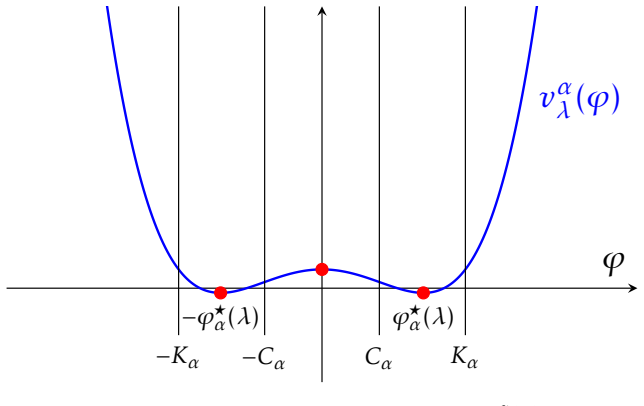
- The fermionic mass-mass correlator receives uniform pointwise bounds controlled by the effective-potential minimizers.
- The result supplies a rigorous non-perturbative link between the lattice models and their large-N mean-field predictions.
- The argument applies to any even number of flavors once that number is taken sufficiently large.
Where Pith is reading between the lines
- The same reflection-positivity and contour technique could be tested on other two-dimensional fermionic models whose Hubbard-Stratonovich measures remain positive.
- If the lower bound on the order parameter survives the continuum limit, it would give a lattice proof of chiral symmetry breaking in the corresponding quantum field theory.
- The uniform control on two-point functions suggests that correlation lengths stay finite while spontaneous order persists in the infinite-volume limit.
Load-bearing premise
The bosonic measures obtained after the Hubbard-Stratonovich transformation satisfy reflection positivity uniformly for the three lattice discretizations.
What would settle it
An explicit computation or Monte Carlo measurement showing that the order parameter for the bilinear falls to zero as the number of flavors grows while the coupling is held fixed and small would falsify the claimed lower bound.
Figures



read the original abstract
We prove the existence of Long-Range Order in a class of two-dimensional Euclidean lattice Gross-Neveu models with an even number of fermion flavors, covering three standard lattice discretizations, including naive and staggered fermions widely used in numerical studies. By performing a Hubbard-Stratonovich transformation, we map the fermionic systems to bosonic ones and establish Reflection Positivity for the resulting measures. Exploiting this structure, we combine Chessboard Estimates with a Peierls-type contour argument to prove Long-Range Order for the chirally charged fermion-mass bilinear $\overline{\psi}\psi$ at sufficiently small coupling and sufficiently large flavor number. Our analysis is robust with respect to the choice of lattice discretization and applies uniformly across different realizations of the same underlying continuum model. Moreover, we obtain uniform pointwise bounds on the bosonic two-point function, equivalently on the fermionic mass-mass correlator, showing that it is quantitatively controlled by the minimizers of the effective potential. This provides a fully rigorous and non-perturbative demonstration of Long-Range Order in lattice Gross-Neveu models and establishes a direct connection between the rigorous theory and its large-$N$ (mean-field) predictions.
Editorial analysis
A structured set of objections, weighed in public.
Referee Report
Summary. The manuscript proves the existence of long-range order (LRO) for the chirally charged bilinear ψ̅ψ in three Euclidean lattice discretizations (naive, staggered, and one additional) of the two-dimensional Gross-Neveu model with even number of flavors. After a Hubbard-Stratonovich transformation mapping the fermionic theory to a bosonic one, reflection positivity (RP) of the resulting measures is established; chessboard estimates and a Peierls contour argument then yield a strictly positive lower bound on the order parameter at sufficiently small coupling and large flavor number. Uniform pointwise bounds on the bosonic two-point function (equivalently the fermionic mass-mass correlator) are also obtained, controlled by the minimizers of the effective potential.
Significance. If the reflection-positivity step holds uniformly, the result supplies a fully rigorous, non-perturbative existence proof of chiral LRO that is discretization-independent and directly links the lattice models to their large-N mean-field predictions. This is a substantive advance for constructive quantum field theory and lattice fermion models, as it furnishes the first such proof covering multiple standard discretizations used in numerical work.
major comments (1)
- [Hubbard-Stratonovich transformation and reflection-positivity section] The uniform reflection positivity of the post-Hubbard-Stratonovich bosonic measures is the load-bearing step for the entire argument (abstract and the section deriving the bosonic action). The manuscript asserts that the quadratic form induced by the fermion determinant satisfies the reflection-positivity condition for naive, staggered, and the third discretization, but must supply explicit verification that no additional sign factors arise under lattice reflection for any of the three choices; without this, the chessboard estimates cannot be launched and the Peierls contour argument fails to produce the claimed strictly positive lower bound.
minor comments (2)
- Notation for the three discretizations should be introduced with explicit definitions of the Dirac operators before the HS step to make the uniformity claim easier to follow.
- The statement that the two-point function is 'quantitatively controlled by the minimizers of the effective potential' would benefit from a precise inequality relating the correlator to the potential minima.
Simulated Author's Rebuttal
We thank the referee for the careful reading and constructive comments on our manuscript. We address the single major comment below.
read point-by-point responses
-
Referee: [Hubbard-Stratonovich transformation and reflection-positivity section] The uniform reflection positivity of the post-Hubbard-Stratonovich bosonic measures is the load-bearing step for the entire argument (abstract and the section deriving the bosonic action). The manuscript asserts that the quadratic form induced by the fermion determinant satisfies the reflection-positivity condition for naive, staggered, and the third discretization, but must supply explicit verification that no additional sign factors arise under lattice reflection for any of the three choices; without this, the chessboard estimates cannot be launched and the Peierls contour argument fails to produce the claimed strictly positive lower bound.
Authors: We agree that an explicit, case-by-case verification of reflection positivity (including confirmation that no extraneous sign factors appear under lattice reflections) is required to make the argument fully rigorous. The current manuscript states that the quadratic form satisfies the condition for each of the three discretizations but does not display the detailed sign checks. In the revised version we will add a dedicated subsection that carries out these calculations explicitly for the naive, staggered, and additional discretizations, thereby justifying the subsequent chessboard estimates and Peierls contour argument. revision: yes
Circularity Check
No significant circularity; derivation is a self-contained mathematical proof.
full rationale
The paper derives long-range order for the chiral bilinear via Hubbard-Stratonovich mapping to a bosonic measure, followed by an explicit claim to establish reflection positivity, then chessboard estimates and a Peierls contour argument. These steps are presented as direct applications of standard lattice techniques to the model definitions, with no reduction of any central quantity to a fitted parameter, self-referential definition, or load-bearing self-citation. The result is obtained from the assumptions on the measures and the contour argument without the output being equivalent to the input by construction.
Axiom & Free-Parameter Ledger
axioms (2)
- domain assumption The Hubbard-Stratonovich transformed measures are reflection positive for the three lattice discretizations
- domain assumption Chessboard estimates and Peierls contour argument apply at large even flavor number and small coupling
Reference graph
Works this paper leans on
-
[1]
Resurgence analysis of the Nambu-Jona-Lasinio model at large charge
[Ber+25] Jahmall Bersini et al. “Resurgence analysis of the Nambu-Jona-Lasinio model at large charge”. In:JHEP09 (2025), p
2025
-
[2]
doi:10.1007/JHEP09(2025)159. arXiv:2505. 21631 [hep-th]. [Bis+09] Marek Biskup et al.Methods of Contemporary Mathematical Statistical Physics. Ed. by Roman Kotecký. Springer Berlin Heidelberg,
-
[3]
url:http://dx.doi.org/10.1007/978- 3- 540- 92796-9. [BM05] Giuseppe Benfatto and Vieri Mastropietro. “Ward identities and chiral anomaly in the Luttinger liquid”. In:Communications in mathematical physics258.3 (2005), pp. 609–
-
[4]
Fermion Interactions and Universal Behavior in Strongly Interacting Theories
[Bra12] Jens Braun. “Fermion Interactions and Universal Behavior in Strongly Interacting The- ories”. In:J. Phys. G39 (2012), p. 033001. doi:10.1088/0954-3899/39/3/033001. arXiv:1108.4449 [hep-ph]. [BTW02] J. Berges, N. T etradis, and C. Wetterich. “Non-perturbative renormalizationflow in quantumfield theory and statistical physics”. In:Phys. Rept.363 (2002...
work page internal anchor Pith review Pith/arXiv arXiv doi:10.1088/0954-3899/39/3/033001 2012
-
[5]
Structural Stability of the RG Flow in the Gross-Neveu Model
arXiv:2406.16799 [math-ph]. url:https://arxiv.org/abs/2406.16799. [DY24] J. Dimock and Cheng Y uan. “Structural Stability of the RG Flow in the Gross-Neveu Model”. In:Annales Henri Poincaré25.12 (Dec. 2024), pp. 5113–5186. doi:10.1007/ s00023-024-01427-0. arXiv:2303.07916 [math-ph]. [FL78] Jürg Fröhlich and Elliott H Lieb. “Phase transitions in anisotropi...
-
[6]
Spontaneous Mass Generation and Chiral Symmetry Breaking in a Lattice Nambu–Jona-Lasinio Model
[GK23] Y ukimi Goto and T ohru Koma. “Spontaneous Mass Generation and Chiral Symmetry Breaking in a Lattice Nambu–Jona-Lasinio Model”. In:Communications in Mathematical Physics404.3 (Oct. 2023), pp. 1463–1493. issn: 1432-0916. doi:10.1007/s00220-023- 04858-8. url:http://dx.doi.org/10.1007/s00220-023-04858-8. [GK80] F. Guerin and R.D. Kenway. “A strong-cou...
-
[7]
Gross-Neveu model through convergent per- turbation expansions
url:https : / / www . sciencedirect . com / science / article / pii / 0550321380900693. [GK85] Krysztof Gawçdzki and Antti Kupiainen. “Gross-Neveu model through convergent per- turbation expansions”. In:Communications in mathematical physics102.1 (1985), pp. 1–
1985
-
[8]
QCD Phenomenology based on a Chiral Effective Lagrangian
isbn: 978-3-642-01849-7, 978-3-642-01850-3. doi: 10.1007/978-3-642-01850-3. [GMP12] Alessandro Giuliani, Vieri Mastropietro, and Marcello Porta. “Universality of conduc- tivity in interacting graphene”. In:Communications in Mathematical Physics311.2 (2012), pp. 317–355. 79 [GMP17] Alessandro Giuliani, Vieri Mastropietro, and Marcello Porta. “Universality ...
work page internal anchor Pith review Pith/arXiv arXiv doi:10.1007/978-3-642-01850-3 2012
-
[9]
The Nambu–Jona-Lasinio model of quantum chromodynamics
url:https : / / www . sciencedirect . com / science/article/pii/0370269386914346. [Kle92] S. P. Klevansky. “The Nambu–Jona-Lasinio model of quantum chromodynamics”. In: Rev. Mod. Phys.64 (1992), pp. 649–708. doi:10.1103/RevModPhys.64.649. [KMR89] C. Kopper, J. Magnen, and V . Rivasseau. “Mass generation in the large-NGross–Neveu model”. In:Commun. Math. P...
-
[10]
Inhomogeneous phases in the Gross-Neveu model in1+1dimensions atfinite number offlavors
url:https://link.aps.org/doi/10.1103/PhysRevD.11.395. [Len+20] Julian Lenz et al. “Inhomogeneous phases in the Gross-Neveu model in1+1dimensions atfinite number offlavors”. In:Phys. Rev. D101 (9 May 2020), p. 094512. doi:10.1103/ PhysRevD.101.094512. url:https://link.aps.org/doi/10.1103/PhysRevD. 101.094512. [LL93] Elliott H. Lieb and Michael Loss. “Fluxes,...
-
[11]
sciencedirect.com/science/article/pii/0550321381905241
url:https : / / www . sciencedirect.com/science/article/pii/0550321381905241. [Sal99] M. Salmhofer.Renormalization: An Introduction. Springer,
-
[12]
Generative learning for the problem of critical slowing down in lattice Gross-Neveu model
80 [SCA22] Ankur Singha, Dipankar Chakrabarti, and Vipul Arora. “Generative learning for the problem of critical slowing down in lattice Gross-Neveu model”. In:SciPost Phys. Core5 (2022), p
2022
-
[13]
doi:10.21468/SciPostPhysCore.5.4.052. url:https://scipost. org/10.21468/SciPostPhysCore.5.4.052. [Sei82] E. Seiler.Gauge Theories as a Problem of Constructive Quantum Field Theory and Statisti- cal Mechanics. Springer,
-
[14]
Proof of chiral symmetry breaking in strongly coupled lattice gauge theory
[SS91] Manfred Salmhofer and Erhard Seiler. “Proof of chiral symmetry breaking in strongly coupled lattice gauge theory”. In:Communications in mathematical physics139.2 (1991), pp. 395–431. [Sus77] Leonard Susskind. “Lattice fermions”. In:Phys. Rev. D16 (10 Nov. 1977), pp. 3031–3039. doi:10.1103/PhysRevD.16.3031. url:https://link.aps.org/doi/10.1103/ Phys...
-
[15]
doi:10.22323/1.032.0152. 81
discussion (0)
Sign in with ORCID, Apple, or X to comment. Anyone can read and Pith papers without signing in.