Hadron polarization and equation of state at FAIR/RHIC-BES energies
Pith reviewed 2026-06-27 05:23 UTC · model grok-4.3
The pith
Lambda polarization in heavy-ion collisions depends on the stiffness of the nuclear equation of state, with softer equations yielding smaller values.
A machine-rendered reading of the paper's core claim, the machinery that carries it, and where it could break.
Core claim
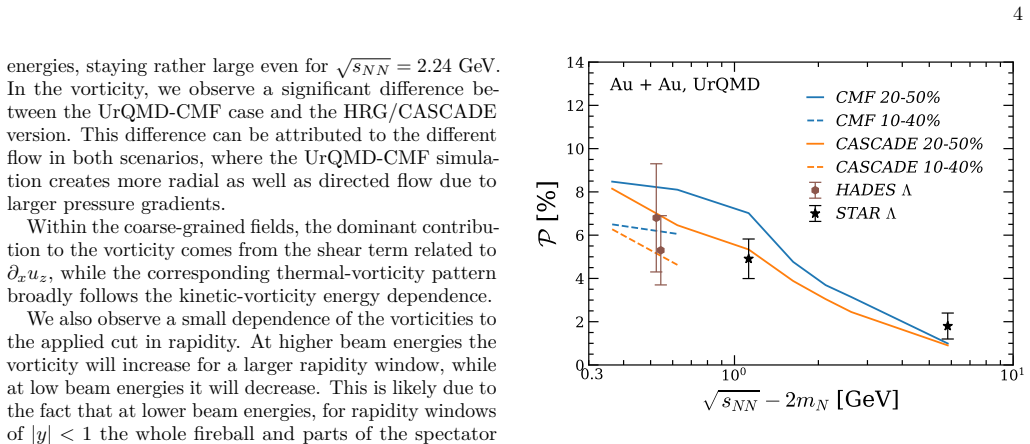
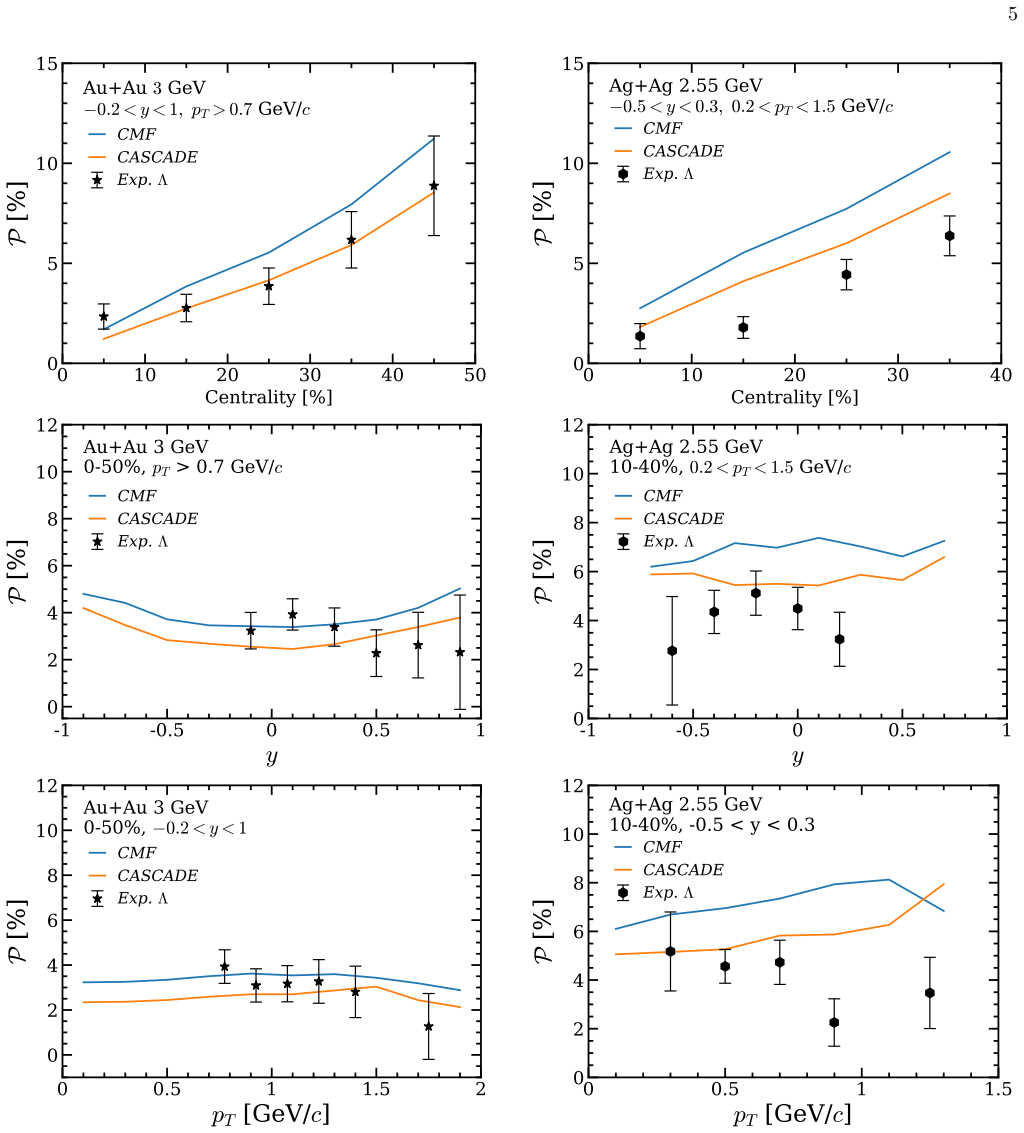
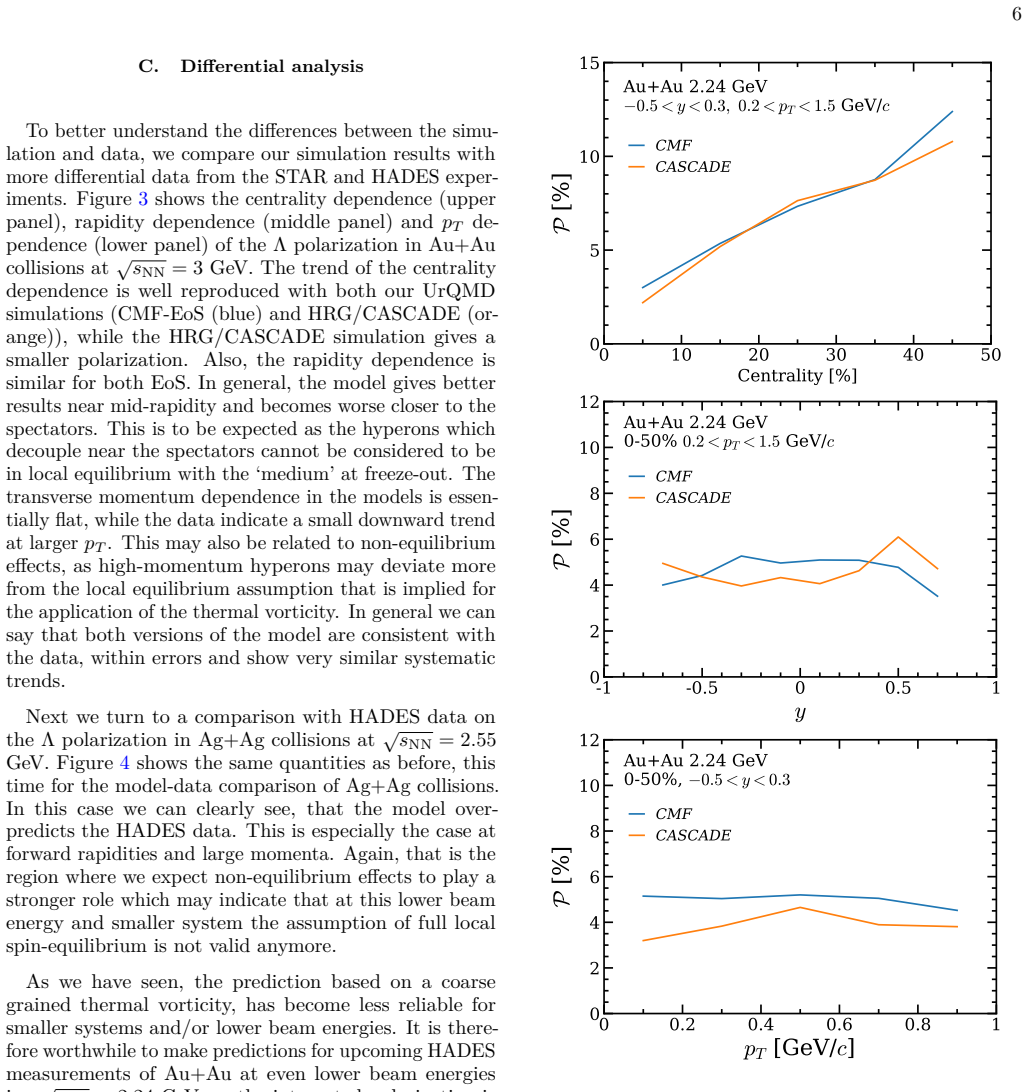
Using the UrQMD transport model with two different equations of state, the thermal vorticity-induced Lambda polarization is found to be sensitive to the equation of state, with a softer EoS producing smaller polarization values. The Lambda polarization within experimental acceptance and centrality cuts does not decrease at even lower beam energies. The large vorticity arises from the shear in the baryon current created by baryon stopping.
What carries the argument
Thermal vorticity-induced polarization of Lambdas calculated in the UrQMD model under two equations of state (hadron resonance gas versus chiral mean-field).
If this is right
- Polarization measurements can distinguish between stiff and soft equations of state in the baryon-rich regime.
- The absence of a decrease in polarization at lower energies implies that vorticity remains large even as beam energy drops.
- Baryon stopping is identified as the dominant source of the shear that generates the observed vorticity.
- The chiral mean-field equation of state, which includes a lattice-consistent transition, yields systematically different polarization than a pure hadron resonance gas.
Where Pith is reading between the lines
- If the relation holds, future polarization data at FAIR could constrain the location of the chiral transition in dense matter.
- The stopping-induced shear mechanism may also affect other observables such as directed flow or elliptic flow at the same energies.
- Extending the calculation to include additional hadrons or different centrality bins could test whether the polarization signal is robust across species.
Load-bearing premise
The UrQMD transport model with the two chosen equations of state correctly produces the thermal vorticity and the resulting polarization from baryon stopping without dominant contributions from other mechanisms.
What would settle it
An experimental measurement at these energies showing Lambda polarization that is either independent of equation-of-state stiffness or that decreases sharply below 2.24 GeV would contradict the central claim.
Figures

read the original abstract
The $\Lambda$ global polarization indicates that hot and dense matter created in non-central heavy-ion collisions carries large orbital angular momentum. However, the relation between hadronic polarization and the medium's collective rotation remains to be validated. Using the UrQMD transport model, we calculate the thermal vorticity-induced polarization of $\Lambda$s in Ag+Ag and Au+Au collisions from $\sqrt{s_{\rm NN}}=2.24$-$7.7$ GeV and a range of centralities. Two different equations of state used in the UrQMD simulation are compared: one resembles a hadron resonance gas, while the other is based on the chiral mean field (CMF) model, providing a more realistic description of dense nuclear matter including a chiral transition that is consistent with lattice QCD expectations. The polarization is sensitive to the equation of state and a softer EoS leads to smaller values. In addition, we show that the $\Lambda$ polarization in the experimental acceptance and centrality selection does not decrease for even lower beam energies. Our results indicate that the process leading to the large vorticity is a result of the large shear in the baryon current created by its stopping.
Editorial analysis
A structured set of objections, weighed in public.
Referee Report
Summary. The manuscript employs the UrQMD transport model to compute thermal vorticity-induced global polarization of Λ hyperons in Ag+Ag and Au+Au collisions at √sNN = 2.24–7.7 GeV across centralities. Two equations of state are compared: a hadron resonance gas and a chiral mean field (CMF) model incorporating a chiral transition. The polarization is reported to be sensitive to the EoS (softer EoS yields smaller values), does not decrease at lower energies within experimental acceptance, and is attributed to shear in the baryon current arising from stopping.
Significance. If the thermal vorticity to polarization mapping is robust, the EoS sensitivity and non-decreasing low-energy behavior could provide a new observable for dense nuclear matter at FAIR/RHIC-BES energies. The mechanistic link to baryon stopping offers a testable interpretation of vorticity generation.
major comments (2)
- [Abstract] Abstract: the text explicitly states that 'the relation between hadronic polarization and the medium's collective rotation remains to be validated,' yet proceeds to report quantitative EoS dependence and a specific shear mechanism without supplying validation against data, alternative polarization mechanisms, or model cross-checks; this assumption is load-bearing for all headline claims.
- [Results] Results section (comparison of EoS implementations): the reported sensitivity of polarization to the CMF versus HRG EoS lacks accompanying error bars, explicit centrality cuts, or quantitative model validation metrics, making it impossible to assess whether the difference exceeds statistical or systematic uncertainties.
minor comments (1)
- Notation for thermal vorticity and polarization definitions should be cross-referenced to prior UrQMD literature for clarity.
Simulated Author's Rebuttal
We thank the referee for the constructive comments, which help improve the clarity of our manuscript. We respond to each major comment below.
read point-by-point responses
-
Referee: [Abstract] Abstract: the text explicitly states that 'the relation between hadronic polarization and the medium's collective rotation remains to be validated,' yet proceeds to report quantitative EoS dependence and a specific shear mechanism without supplying validation against data, alternative polarization mechanisms, or model cross-checks; this assumption is load-bearing for all headline claims.
Authors: The abstract already states that the polarization-rotation relation remains to be validated, and our work operates strictly within the standard thermal-vorticity framework employed throughout the literature. The quantitative EoS dependence and shear interpretation are presented as model predictions under that assumption, not as experimentally validated results. To address the concern we will revise the abstract and introduction to explicitly note that the mapping is an assumption (with references to its use at higher energies) and that alternative mechanisms are outside the present scope. revision: partial
-
Referee: [Results] Results section (comparison of EoS implementations): the reported sensitivity of polarization to the CMF versus HRG EoS lacks accompanying error bars, explicit centrality cuts, or quantitative model validation metrics, making it impossible to assess whether the difference exceeds statistical or systematic uncertainties.
Authors: We agree that the presentation can be improved. In the revised manuscript we will add statistical error bars to all polarization results, state the exact centrality intervals used for each data set, and include a short discussion quantifying the size of the EoS-induced difference relative to the statistical uncertainties. Because both EoS implementations are run inside the identical UrQMD code, the comparison is internal; we will clarify this point to avoid implying external validation. revision: yes
Circularity Check
No circularity; polarization computed directly from UrQMD thermal vorticity with independent EoS inputs
full rationale
The paper runs UrQMD transport simulations for two distinct EoS (hadron resonance gas vs. chiral mean field) and extracts thermal vorticity-induced Λ polarization as a numerical output. No parameter is fitted to polarization observables and then relabeled as a prediction. No self-citation chain justifies a uniqueness theorem or smuggles an ansatz. The relation between vorticity and polarization is treated as an input assumption (explicitly noted as remaining to be validated), not derived from the paper's own equations. Results are therefore independent of the target observables and score 0.
Axiom & Free-Parameter Ledger
Reference graph
Works this paper leans on
-
[1]
Adamet al.(STAR), GlobalΛhyperon polarization in nuclear collisions: evidence for the most vortical fluid, Nature548, 62 (2017)
J. Adamet al.(STAR), GlobalΛhyperon polarization in nuclear collisions: evidence for the most vortical fluid, Nature548, 62 (2017)
2017
-
[2]
Adamet al.(STAR), Global polarization ofΛhyperons in Au+Au collisions at√sN N = 200 GeV, Phys
J. Adamet al.(STAR), Global polarization ofΛhyperons in Au+Au collisions at√sN N = 200 GeV, Phys. Rev. C 98, 014910 (2018)
2018
-
[3]
Adamet al.(STAR), Global Polarization ofΞandΩ Hyperons in Au+Au Collisions at√sN N = 200 GeV, Phys
J. Adamet al.(STAR), Global Polarization ofΞandΩ Hyperons in Au+Au Collisions at√sN N = 200 GeV, Phys. Rev. Lett.126, 162301 (2021), [Erratum: Phys.Rev.Lett. 131, 089901 (2023)]
2021
-
[4]
Li, X.-L
H. Li, X.-L. Xia, X.-G. Huang, and H. Z. Huang, Global spin polarization of multistrange hyperons and feed-down effect in heavy-ion collisions, Phys. Lett. B827, 136971 (2022)
2022
-
[5]
Liang and X.-N
Z.-T. Liang and X.-N. Wang, Globally polarized quark- gluon plasma in non-central A+A collisions, Phys. Rev. Lett.94, 102301 (2005), [Erratum: Phys.Rev.Lett. 96, 039901 (2006)]
2005
-
[6]
Liang and X.-N
Z.-T. Liang and X.-N. Wang, Spin alignment of vector mesons in non-central A+A collisions, Phys. Lett. B629, 20 (2005)
2005
-
[7]
Becattini, V
F. Becattini, V. Chandra, L. Del Zanna, and E. Grossi, Relativistic distribution function for particles with spin at local thermodynamical equilibrium, Annals Phys.338, 32 (2013)
2013
-
[8]
Becattini, L
F. Becattini, L. Csernai, and D. J. Wang,Λpolarization in peripheral heavy ion collisions, Phys. Rev. C88, 034905 (2013), [Erratum: Phys.Rev.C 93, 069901 (2016)]
2013
-
[9]
L. P. Csernai, D. J. Wang, M. Bleicher, and H. Stöcker, VorticityinperipheralcollisionsattheFacilityforAntipro- ton and Ion Research and at the JINR Nuclotron-based Ion Collider fAcility, Phys. Rev. C90, 021904 (2014)
2014
-
[10]
Y. L. Xie, M. Bleicher, H. Stöcker, D. J. Wang, and L. P. Csernai,Λpolarization in peripheral collisions at moderate relativistic energies, Phys. Rev. C94, 054907 (2016), arXiv:1610.08678 [nucl-th]
work page internal anchor Pith review Pith/arXiv arXiv 2016
-
[11]
Becattini, I
F. Becattini, I. Karpenko, M. Lisa, I. Upsal, and S. Voloshin, Global hyperon polarization at local thermo- dynamic equilibrium with vorticity, magnetic field and feed-down, Phys. Rev. C95, 054902 (2017)
2017
-
[12]
Adamet al.(STAR), Polarization ofΛ( ¯Λ) hyperons along the beam direction in Au+Au collisions at√sN N = 200 GeV, Phys
J. Adamet al.(STAR), Polarization ofΛ( ¯Λ) hyperons along the beam direction in Au+Au collisions at√sN N = 200 GeV, Phys. Rev. Lett.123, 132301 (2019)
2019
-
[13]
S. Acharyaet al.(ALICE), Evidence of Spin-Orbital Angular Momentum Interactions in Relativistic Heavy- Ion Collisions, Phys. Rev. Lett.125, 012301 (2020), arXiv:1910.14408 [nucl-ex]
-
[14]
N. Weickgenannt, E. Speranza, X.-L. Sheng, Q. Wang, and D. H. Rischke, Generating Spin Polarization from Vorticity through Nonlocal Collisions, Phys. Rev. Lett. 127, 052301 (2021), arXiv:2005.01506 [hep-ph]
-
[15]
M. S. Abdallahet al.(STAR), Pattern of global spin alignment ofϕand K∗0mesons in heavy-ion collisions, Nature614, 244 (2023)
2023
-
[16]
Becattini, M
F. Becattini, M. Buzzegoli, T. Niida, S. Pu, A.-H. Tang, and Q. Wang, Spin polarization in relativistic heavy-ion collisions, Int. J. Mod. Phys. E33, 2430006 (2024)
2024
-
[17]
Niida and S
T. Niida and S. A. Voloshin, Polarization phenomenon in heavy-ion collisions, Int. J. Mod. Phys. E33, 2430010 (2024)
2024
-
[18]
J.-H. Chen, Z.-T. Liang, Y.-G. Ma, X.-L. Sheng, and Q. Wang, Vector meson’s spin alignments in high energy reactions, Sci. China Phys. Mech. Astron.68, 211001 (2025), arXiv:2407.06480 [hep-ph]. 8
-
[19]
Huang, An introduction to relativistic spin hydrody- namics, Nucl
X.-G. Huang, An introduction to relativistic spin hydrody- namics, Nucl. Sci. Tech.36, 208 (2025), arXiv:2411.11753 [nucl-th]
-
[20]
Sun, D.-N
K.-J. Sun, D.-N. Liu, Y.-P. Zheng, J.-H. Chen, C. M. Ko, and Y.-G. Ma, Deciphering Hypertriton and Antihypertri- ton Spins from Their Global Polarizations in Heavy-Ion Collisions, Phys. Rev. Lett.134, 022301 (2025)
2025
- [21]
-
[22]
Z. T. Liang, Q. H. Xu, and J. L. Zhang, Probing qcd confinement with spin-spin correlation in proton-proton collisions, Nucl. Sci. Tech.37, 86 (2026)
2026
-
[23]
Zheng, D.-N
Y.-P. Zheng, D.-N. Liu, L.-W. Chen,et al., Global spin alignment of (anti-)4Li in noncentral heavy-ion collisions, Phys. Rev. C113, 054906 (2026)
2026
- [24]
- [25]
-
[26]
Florkowski, A
W. Florkowski, A. Kumar, and R. Ryblewski, Relativistic hydrodynamics for spin-polarized fluids, Prog. Part. Nucl. Phys.108, 103709 (2019)
2019
-
[27]
Becattini, M
F. Becattini, M. Buzzegoli, G. Inghirami, I. Karpenko, and A. Palermo, Local Polarization and Isothermal Local Equilibrium in Relativistic Heavy Ion Collisions, Phys. Rev. Lett.127, 272302 (2021)
2021
-
[28]
R. J. Liu, J. Xu, and Y. G. Ma, Spin polarization from nucleon-nucleon scatterings in intermediate-energy heavy- ion collisions, Phys. Lett. B868, 139703 (2025)
2025
-
[29]
Bunceet al., Lambda0 Hyperon Polarization in Inclu- sive Production by 300-GeV Protons on Beryllium., Phys
G. Bunceet al., Lambda0 Hyperon Polarization in Inclu- sive Production by 300-GeV Protons on Beryllium., Phys. Rev. Lett.36, 1113 (1976)
1976
-
[30]
B. E. Aboonaet al.(STAR), Measurement of transverse polarizationofΛand ¯Λ hyperonsinsidejetsin ppcollisions at√s= 200GeV, arXiv (2025), 2509.17487 [hep-ex]
work page internal anchor Pith review Pith/arXiv arXiv 2025
- [31]
-
[32]
V. P. Janzenet al., New features of collective nuclear rotation at very high frequency in Sb-109, Phys. Rev. Lett.72, 1160 (1994)
1994
-
[33]
Ciemałaet al., Giant dipole resonance built on hot rotating nuclei produced during evaporation of light par- ticles from the88Mo compound nucleus, Phys
M. Ciemałaet al., Giant dipole resonance built on hot rotating nuclei produced during evaporation of light par- ticles from the88Mo compound nucleus, Phys. Rev. C91, 054313 (2015)
2015
-
[34]
Deng, X.-G
X.-G. Deng, X.-G. Huang, and Y.-G. Ma, Lambda po- larization in 108Ag+108Ag and 197Au+197Au collisions around a few GeV, Phys. Lett. B835, 137560 (2022)
2022
-
[35]
Y. Guo, J. Liao, E. Wang, H. Xing, and H. Zhang, Hy- peron polarization from the vortical fluid in low-energy nuclear collisions, Phys. Rev. C104, L041902 (2021)
2021
-
[36]
Abou Yassineet al.(HADES), Measurement of global polarization ofΛhyperons in few-GeV heavy-ion collisions, Phys
R. Abou Yassineet al.(HADES), Measurement of global polarization ofΛhyperons in few-GeV heavy-ion collisions, Phys. Lett. B835, 137506 (2022)
2022
-
[37]
Karpenko and F
I. Karpenko and F. Becattini, Study ofΛpolarization in relativistic nuclear collisions at√sNN = 7.7–200 GeV, Eur. Phys. J. C77, 213 (2017)
2017
-
[38]
Y. Xie, D. Wang, and L. P. Csernai, GlobalΛpolarization in high energy collisions, Phys. Rev. C95, 031901 (2017)
2017
-
[39]
B. Fu, K. Xu, X.-G. Huang, and H. Song, Hydrodynamic study of hyperon spin polarization in relativistic heavy ion collisions, Phys. Rev. C103, 024903 (2021)
2021
- [40]
-
[41]
Rotating quark-gluon plasma in relativistic heavy ion collisions
Y. Jiang, Z.-W. Lin, and J. Liao, Rotating quark-gluon plasma in relativistic heavy ion collisions, Phys. Rev. C 94, 044910 (2016), [Erratum: Phys.Rev.C 95, 049904 (2017)], arXiv:1602.06580 [hep-ph]
work page internal anchor Pith review Pith/arXiv arXiv 2016
-
[42]
Li, L.-G
H. Li, L.-G. Pang, Q. Wang, and X.-L. Xia, GlobalΛpo- larization in heavy-ion collisions from a transport model, Phys. Rev. C96, 054908 (2017)
2017
-
[43]
Wei, W.-T
D.-X. Wei, W.-T. Deng, and X.-G. Huang, Thermal vor- ticity and spin polarization in heavy-ion collisions, Phys. Rev. C99, 014905 (2019)
2019
-
[44]
S. Shi, K. Li, and J. Liao, Searching for the Subatomic Swirls in the CuCu and CuAu Collisions, Phys. Lett. B 788, 409 (2019), arXiv:1712.00878 [nucl-th]
work page internal anchor Pith review Pith/arXiv arXiv 2019
- [45]
-
[46]
Deng, X.-G
X.-G. Deng, X.-G. Huang, Y.-G. Ma, and S. Zhang, Vor- ticity in low-energy heavy-ion collisions, Phys. Rev. C 101, 064908 (2020)
2020
-
[47]
Huang, J
X.-G. Huang, J. Liao, Q. Wang, and X.-L. Xia, Vorticity and Spin Polarization in Heavy Ion Collisions: Transport Models, Lect. Notes Phys.987, 281 (2021)
2021
- [48]
-
[49]
M. A. Lisa, U. W. Heinz, and U. A. Wiedemann, Tilted pion sources from azimuthally sensitive HBT interferome- try, Phys. Lett. B489, 287 (2000), arXiv:nucl-th/0003022
work page internal anchor Pith review Pith/arXiv arXiv 2000
-
[50]
M. A. Lisa, S. Pratt, R. Soltz, and U. Wiedemann, Fem- toscopy in relativistic heavy ion collisions, Ann. Rev. Nucl. Part. Sci.55, 357 (2005), arXiv:nucl-ex/0505014
work page internal anchor Pith review Pith/arXiv arXiv 2005
-
[51]
Y. Khyzhniak and M. A. Lisa, Pair momentum depen- dence of a tilted source in heavy-ion collisions, Phys. Rev. C111, 024902 (2025), arXiv:2410.15134 [nucl-th]
-
[52]
Directed flow in ultrarelativistic heavy-ion collisions
P. Bozek and I. Wyskiel, Directed flow in ultrarelativistic heavy-ion collisions, Phys. Rev. C81, 054902 (2010), arXiv:1002.4999 [nucl-th]
work page internal anchor Pith review Pith/arXiv arXiv 2010
-
[53]
F. Retiere and M. A. Lisa, Observable implications of geometrical and dynamical aspects of freeze out in heavy ion collisions, Phys. Rev. C70, 044907 (2004), arXiv:nucl- th/0312024
-
[54]
M. A. Lisa, E. Frodermann, G. Graef, M. Mitrovski, E. Mount, H. Petersen, and M. Bleicher, Shape analysis of strongly-interacting systems: The Heavy ion case, New J. Phys.13, 065006 (2011), arXiv:1104.5267 [nucl-th]
work page internal anchor Pith review Pith/arXiv arXiv 2011
-
[55]
Correspondence between HBT radii and the emission zone in non-central heavy ion collisions
E. Mount, G. Graef, M. Mitrovski, M. Bleicher, and M. A. Lisa, Correspondence between HBT radii and the emission zone in non-central heavy ion collisions, Phys. Rev. C84, 014908 (2011), arXiv:1012.5941 [nucl-th]
work page internal anchor Pith review Pith/arXiv arXiv 2011
-
[56]
A twisted emission geometry in non-central Pb+Pb collisions measurable via azimuthally sensitive HBT
G. Graef, M. Lisa, and M. Bleicher, Twisted emission geometry in noncentral Pb + Pb collisions measurable via azimuthally sensitive Hanbury-Brown–Twiss correlations, Phys. Rev. C89, 014903 (2014), arXiv:1302.3408 [hep-ph]
work page internal anchor Pith review Pith/arXiv arXiv 2014
- [57]
-
[58]
O. Savchuk, P. Danielewicz, D. Kincses, and A. Sorensen, Probing vorticity through femtoscopic correlations, arXiv (2025), arXiv:2510.10795 [nucl-th]
-
[59]
S. A. Basset al., Microscopic models for ultrarelativistic heavy ion collisions, Prog. Part. Nucl. Phys.41, 255 (1998), arXiv:nucl-th/9803035
work page internal anchor Pith review Pith/arXiv arXiv 1998
-
[60]
M. Bleicheret al., Relativistic hadron hadron collisions in the ultrarelativistic quantum molecular dynamics model, J. Phys. G25, 1859 (1999), arXiv:hep-ph/9909407
work page internal anchor Pith review Pith/arXiv arXiv 1999
- [61]
-
[62]
Xi, X.-G
B.-S. Xi, X.-G. Deng, S. Zhang, and Y.-G. Ma, Vorticity in isobar collisions of96 44Ru + 96 44Ru and 96 40Zr + 96 40Zr at√sNN = 200 GeV, Eur. Phys. J. A59, 33 (2023)
2023
-
[63]
D. H. Rischke, S. Bernard, and J. A. Maruhn, Relativistic hydrodynamics for heavy ion collisions. 1. General aspects and expansion into vacuum, Nucl. Phys. A595, 346 (1995), arXiv:nucl-th/9504018
work page internal anchor Pith review Pith/arXiv arXiv 1995
-
[64]
J. Steinheimer, T. Reichert, Y. Nara, and M. Bleicher, Momentum dependent potentials from a parity doubling CMF model in UrQMD: results on flow and particle pro- duction, J. Phys. G52, 035103 (2025), arXiv:2410.01742 [hep-ph]
-
[65]
J. Steinheimer, M. Omana Kuttan, T. Reichert, Y. Nara, and M. Bleicher, Simultaneous description of high den- sity QCD matter in heavy ion collisions and neutron star observations, Phys. Lett. B867, 139605 (2025), arXiv:2501.12849 [hep-ph]
-
[66]
R. Negreiros, L. Brodie, J. Steinheimer, V. Dexheimer, and R. D. Pisarski, Enhanced Neutrino Cooling from Parity-Doubled Nucleons in Neutron Star Cooling Simu- lations, arXiv (2026), arXiv:2603.06789 [astro-ph.HE]
-
[67]
X.-L. Xia, H. Li, X.-G. Huang, and H. Z. Huang, Feed- down effect onΛspin polarization, Phys. Rev. C100, 014913 (2019)
2019
-
[68]
Becattini, G
F. Becattini, G. Cao, and E. Speranza, Polarization trans- fer in hyperon decays and its effect in relativistic nuclear collisions, Eur. Phys. J. C79, 741 (2019)
2019
-
[69]
H. Sung, C. M. Ko, and S. H. Lee, Hadronic scattering effects onΛpolarization in relativistic heavy ion collisions, Phys. Lett. B858, 139004 (2024)
2024
-
[70]
J. Steinheimer, S. Schramm, and H. Stocker, The hadronic SU(3) Parity Doublet Model for Dense Matter, its exten- sion to quarks and the strange equation of state, Phys. Rev. C84, 045208 (2011), arXiv:1108.2596 [hep-ph]
work page internal anchor Pith review Pith/arXiv arXiv 2011
-
[71]
B. I. Abelevet al.(STAR), Systematic Measurements of Identified Particle Spectra inpp,d + Au and Au+Au Collisions from STAR, Phys. Rev. C79, 034909 (2009), arXiv:0808.2041 [nucl-ex]
work page internal anchor Pith review Pith/arXiv arXiv 2009
-
[72]
Adamczyket al.(STAR), Bulk Properties of the Medium Produced in Relativistic Heavy-Ion Collisions from the Beam Energy Scan Program, Phys
L. Adamczyket al.(STAR), Bulk Properties of the Medium Produced in Relativistic Heavy-Ion Collisions from the Beam Energy Scan Program, Phys. Rev. C96, 044904 (2017)
2017
- [73]
-
[74]
G. Inghirami, P. Hillmann, B. Tomášik, and M. Bleicher, Temperatures and chemical potentials at kinetic freeze- out in relativistic heavy ion collisions from coarse grained transport simulations, J. Phys. G47, 025104 (2020), arXiv:1909.00643 [hep-ph]
-
[75]
Centrality determination of Au+Au collisions at 1.23A GeV with HADES
J. Adamczewski-Muschet al.(HADES), Centrality de- termination of Au + Au collisions at 1.23A GeV with HADES, Eur. Phys. J. A54, 85 (2018), arXiv:1712.07993 [nucl-ex]
work page internal anchor Pith review Pith/arXiv arXiv 2018
- [76]
-
[77]
STAR, Tilted geometry of the pion emission source in Au+Au collisions in the RHIC Beam Energy Scan, (2026), arXiv:2605.15013 [nucl-ex]
work page internal anchor Pith review Pith/arXiv arXiv 2026
discussion (0)
Sign in with ORCID, Apple, or X to comment. Anyone can read and Pith papers without signing in.