A refined thermodynamic analysis of nonsecular master equations
Pith reviewed 2026-06-27 06:37 UTC · model grok-4.3
The pith
Nonsecular master equations reach non-Gibbs steady states but allow no cyclic work extraction from a single thermal bath.
A machine-rendered reading of the paper's core claim, the machinery that carries it, and where it could break.
Core claim
Despite the non-Gibbs form of the steady state reached under nonsecular dynamics, the difference between the microscopic entropy production and the Spohn inequality is purely transient for a single thermal bath. Consequently, no work can be cyclically extracted from that steady state. The analysis incorporates the system-bath interaction energy and the Lamb shift into the energy balance, which perform work when the system is out of equilibrium.
What carries the argument
Microscopic second-law expression based on system-environment correlations, treated with systematic perturbation theory to preserve positivity
If this is right
- System-bath interaction energy and Lamb-shift terms participate in the energy balance and contribute to work when the system is out of equilibrium.
- Microscopic entropy production and the Spohn inequality differ because of non-vanishing stationary coherences in the energy eigenbasis.
- The difference between the two entropy production rates is purely transient when only one thermal bath is present.
- No cyclic work can be extracted from the steady state even though that state is not Gibbs.
Where Pith is reading between the lines
- The result indicates that approximate Markovian dynamics can remain thermodynamically consistent at long times for single-bath systems even when the steady state is non-thermal.
- Stationary coherences affect entropy production only during the transient, so they do not open a route to perpetual work cycles.
- The same microscopic-correlation approach could be applied to other positivity-preserving approximations that violate the secular condition.
Load-bearing premise
Systematic perturbation theory applied to the microscopic second-law expression keeps the entropy production positive even after the dynamics are approximated.
What would settle it
Observation of sustained cyclic work extraction from the steady state, or a non-transient difference between microscopic and Spohn entropy production rates, in a single-bath nonsecular setup would falsify the claim.
Figures

read the original abstract
We present a systematic thermodynamic analysis of nonsecular master equations. We consider master equations resulting either from the partial secular and the geometric-arithmetic approximations, two approximations ensuring the positivity of the system's dynamics when some of its transition frequencies are too small to enable the full secular approximation. Both cause the system to relax towards a steady state which is not the Gibbs state of its bare Hamiltonian. Nonetheless, we build a unified, consistent thermodynamic framework for those dynamics. Starting from a microscopic expression of the second law based on system-environment correlations, we employ a systematic perturbation theory to preserve the positivity of the second law despite the approximations done on the dynamics. We show that, in spite of the weak system-bath coupling, the system-bath interaction energy participates to the energy balance, as well as the Lamb-shift. Those extra contributions give rise to work performed by the system on the bath when the former is out of equilibrium. We compare this microscopic entropy production with the definition based on the contractivity of the reduced system dynamics (Spohn inequality). We show that, unlike for secular master equations, the two entropy production rates differ because of the presence of non-vanishing stationary coherences in the energy eigenbasis. However, in the case of a single thermal bath, the difference is purely transient, and no work can be cyclically extracted from the steady-state despite its non-Gibbs form. Finally, we illustrate our results with a simple example, clarifying and completing the thermodynamic picture of Markovian dynamics in the quantum regime.
Editorial analysis
A structured set of objections, weighed in public.
Referee Report
Summary. The manuscript develops a unified thermodynamic framework for nonsecular master equations obtained from partial-secular and geometric-arithmetic approximations. These approximations ensure complete positivity of the dynamics but drive the system to a non-Gibbs steady state. Starting from a microscopic expression for entropy production based on system-bath correlations, the authors apply systematic perturbation theory to maintain non-negativity of the approximated entropy production. They incorporate system-bath interaction energy and Lamb-shift contributions into the energy balance, compare the microscopic entropy production to the Spohn inequality based on contractivity of the reduced dynamics, and conclude that for a single thermal bath the two expressions differ only transiently due to stationary coherences, implying that no cyclic work can be extracted from the non-Gibbs steady state.
Significance. If the claimed perturbation consistency holds, the work supplies a concrete route to thermodynamically consistent analysis of Markovian quantum dynamics that retain stationary coherences. It clarifies that non-Gibbs steady states arising from positivity-preserving approximations do not permit cyclic work extraction in the single-bath case, thereby strengthening the applicability of such master equations in quantum thermodynamics.
major comments (2)
- [Abstract] Abstract and the perturbation-theory section: the central claim that the entropy-production difference is purely transient (hence no cyclic work from the non-Gibbs steady state) rests on the assertion that a systematic perturbation preserves positivity of the second law after the partial-secular or geometric-arithmetic replacements. The manuscript must explicitly demonstrate that the expansion order applied to the system-bath correlation functions is commensurate with the order at which the Liouvillian is modified; otherwise the positivity guarantee can fail for finite coupling when stationary coherences are retained.
- [Energy balance] Energy-balance derivation: the claim that system-bath interaction energy and the Lamb shift participate in the first-law balance is load-bearing for the work term that appears in the entropy-production comparison. The derivation should state the perturbative order at which these contributions are retained relative to the master-equation generator, and verify that the resulting work term remains consistent with the microscopic correlation expression used for the second law.
minor comments (2)
- [Introduction] Notation for the geometric-arithmetic approximation should be introduced with an explicit equation reference when first used, to avoid ambiguity with the partial-secular case.
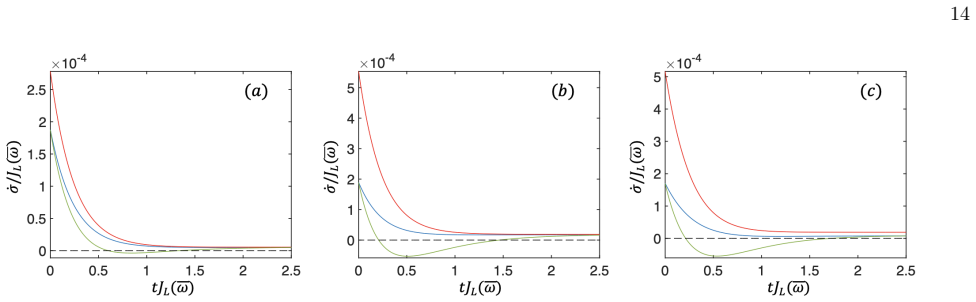
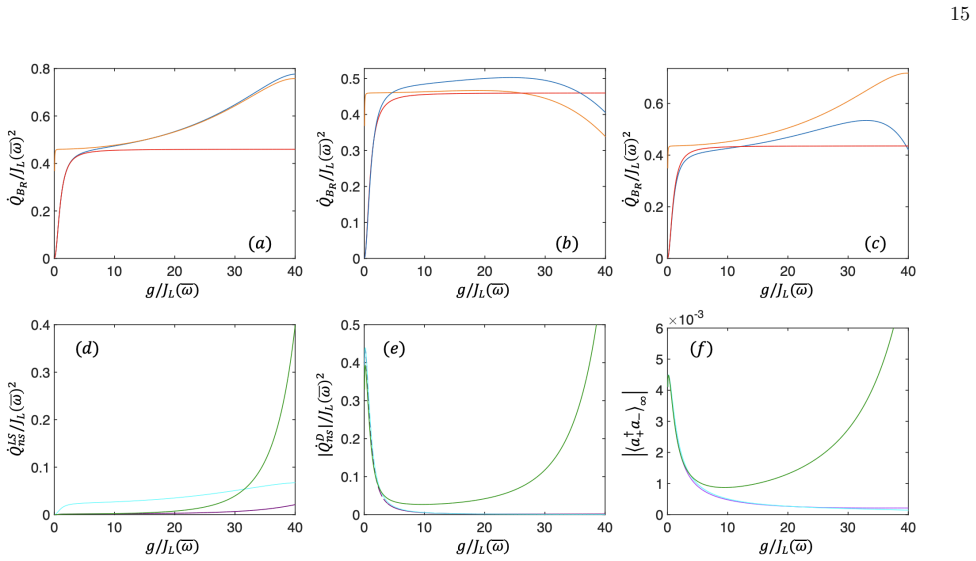
- [Example section] Figure captions for the illustrative example should indicate the parameter regime (coupling strength, temperature) used to generate the plotted trajectories.
Simulated Author's Rebuttal
We thank the referee for the careful reading and constructive comments on our manuscript. We address each major comment below and will revise the manuscript to provide the requested explicit demonstrations of perturbative consistency.
read point-by-point responses
-
Referee: [Abstract] Abstract and the perturbation-theory section: the central claim that the entropy-production difference is purely transient (hence no cyclic work from the non-Gibbs steady state) rests on the assertion that a systematic perturbation preserves positivity of the second law after the partial-secular or geometric-arithmetic replacements. The manuscript must explicitly demonstrate that the expansion order applied to the system-bath correlation functions is commensurate with the order at which the Liouvillian is modified; otherwise the positivity guarantee can fail for finite coupling when stationary coherences are retained.
Authors: We agree that explicit demonstration of order matching is necessary for rigor. The manuscript applies the same perturbative expansion (to second order in the system-bath coupling) to both the correlation functions entering the entropy production and the modifications to the Liouvillian under the partial-secular and geometric-arithmetic approximations. This matching is what allows the positivity of the approximated entropy production to be preserved. In the revision we will add a dedicated paragraph in the perturbation-theory section that states the orders explicitly and sketches the substitution showing that the non-negativity holds at the retained order even when stationary coherences appear. revision: yes
-
Referee: [Energy balance] Energy-balance derivation: the claim that system-bath interaction energy and the Lamb shift participate in the first-law balance is load-bearing for the work term that appears in the entropy-production comparison. The derivation should state the perturbative order at which these contributions are retained relative to the master-equation generator, and verify that the resulting work term remains consistent with the microscopic correlation expression used for the second law.
Authors: The energy-balance contributions from the system-bath interaction energy and the Lamb shift are retained at the same second-order perturbative level used to obtain the master-equation generator. The work term is constructed directly by substituting the microscopic correlation functions that underlie the entropy-production expression, ensuring consistency by construction. In the revised manuscript we will insert an explicit statement of this order in the energy-balance derivation and add a short verification paragraph confirming agreement with the second-law microscopic expression. revision: yes
Circularity Check
Independent microscopic second law anchors thermodynamic consistency
full rationale
The paper begins with a microscopic expression for the second law based on system-environment correlations (an external input independent of the reduced master equation). It then applies systematic perturbation theory to maintain non-negativity after the partial-secular or geometric-arithmetic approximations to the dynamics. This construction does not reduce any prediction or entropy-production difference to a fit or self-definition by construction. The claim that the difference is purely transient for a single bath follows directly from the structure of the approximated equations without circular reduction to the dynamics themselves. No load-bearing self-citations, uniqueness theorems, or ansatzes imported from prior author work are required for the central results.
Axiom & Free-Parameter Ledger
axioms (2)
- domain assumption A microscopic expression of the second law based on system-environment correlations exists and remains valid under weak coupling.
- domain assumption Systematic perturbation theory can be applied while preserving positivity of the approximated dynamics and of the entropy production.
Reference graph
Works this paper leans on
-
[1]
Breuer and F
H.-P. Breuer and F. Petruccione, The theory of Open Quantum Systems (Oxford University Press, 2002)
2002
-
[2]
Schlosshauer, ed., ”Decoherence and the Quantum-To-Classical Transition” (Springer Berlin, Heidelberg, 2007)
M. Schlosshauer, ed., ”Decoherence and the Quantum-To-Classical Transition” (Springer Berlin, Heidelberg, 2007)
2007
-
[3]
G. T. Landi and M. Paternostro, Irreversible entropy production: From classical to quantum, Rev. Mod. Phys.93, 035008 (2021)
2021
-
[4]
Esposito, K
M. Esposito, K. Lindenberg, and C. Van den Broeck, Entropy production as correlation between system and reservoir, New Journal of Physics12, 013013 (2010)
2010
-
[5]
Spohn, Entropy production for quantum dynamical semigroups, Journal of Mathematical Physics19, 1227 (1978)
H. Spohn, Entropy production for quantum dynamical semigroups, Journal of Mathematical Physics19, 1227 (1978)
1978
-
[6]
Spohn and J
H. Spohn and J. L. Lebowitz, Irreversible thermodynamics for quantum systems weakly coupled to thermal reservoirs, in Advances in Chemical Physics (John Wiley and Sons, Ltd, 1978) pp. 109–142
1978
-
[7]
Alicki, The quantum open system as a model of the heat engine, Journal of Physics A: Mathematical and General12, L103 (1979)
R. Alicki, The quantum open system as a model of the heat engine, Journal of Physics A: Mathematical and General12, L103 (1979)
1979
-
[8]
Introduction to Quantum Thermodynamics: History and Prospects
R. Alicki and R. Kosloff, Introduction to quantum thermodynamics: History and prospects (2018), arXiv:1801.08314 [quant-ph]
work page internal anchor Pith review Pith/arXiv arXiv 2018
-
[9]
E. B. Davies, Markovian master equations, Communications in Mathematical Physics39, 91 (1974)
1974
-
[10]
E. B. Davies, Markovian master equations. ii, Mathematische Annalen219, 147 (1976)
1976
-
[11]
Lindblad, On the generators of quantum dynamical semigroups, Communications in Mathematical Physics 48, 119 (1976)
G. Lindblad, On the generators of quantum dynamical semigroups, Communications in Mathematical Physics 48, 119 (1976)
1976
-
[12]
Gorini, A
V. Gorini, A. Kossakowski, and E. C. G. Sudarshan, Completely positive dynamical semigroups of n-level systems, Journal of Mathematical Physics17, 821 (1976)
1976
-
[13]
Redfield, The theory of relaxation processes, in Advances in Magnetic Resonance, Advances in Magnetic and Optical Resonance, Vol
A. Redfield, The theory of relaxation processes, in Advances in Magnetic Resonance, Advances in Magnetic and Optical Resonance, Vol. 1, edited by J. S. Waugh (Academic Press, 1965) pp. 1–32
1965
-
[14]
Li, X.-Y
Z.-Z. Li, X.-Y. Pan, and X.-T. Liang, Study of the decoherence of a double quantum dot charge qubit via the redfield equation, Physica E: Low-dimensional Systems and Nanostructures41, 220 (2008)
2008
-
[15]
D. O. Soares-Pinto, M. H. Y. Moussa, J. Maziero, E. R. deAzevedo, T. J. Bonagamba, R. M. Serra, and L. C. C´ eleri, Equivalence between redfield- and master-equation approaches for a time-dependent quantum system and coherence control, Phys. Rev. A 83, 062336 (2011)
2011
-
[16]
Ishizaki and G
A. Ishizaki and G. R. Fleming, On the adequacy of the redfield equation and related approaches to the study of quantum dynamics in electronic energy transfer, The Journal of Chemical Physics130, 234110 (2009)
2009
-
[17]
Yang and G
M. Yang and G. R. Fleming, Influence of phonons on exciton transfer dynamics: comparison of the redfield, f¨ orster, and modified redfield equations, Chemical Physics275, 355 (2002), photoprocesses in Multichromophoric Molecular Assemblies
2002
-
[18]
D¨ umcke and H
R. D¨ umcke and H. Spohn, The proper form of the generator in the weak coupling limit, Zeitschrift f¨ ur Physik B Condensed Matter34, 419 (1979)
1979
-
[19]
Su´ arez, R
A. Su´ arez, R. Silbey, and I. Oppenheim, Memory effects in the relaxation of quantum open systems, The Journal of Chemical Physics97, 5101 (1992)
1992
-
[20]
Pechukas, Reduced dynamics need not be completely positive, Phys
P. Pechukas, Reduced dynamics need not be completely positive, Phys. Rev. Lett.73, 1060 (1994)
1994
-
[21]
Schaller and T
G. Schaller and T. Brandes, Preservation of positivity by dynamical coarse graining, Phys. Rev. A78, 022106 (2008)
2008
-
[22]
Majenz, T
C. Majenz, T. Albash, H.-P. Breuer, and D. A. Lidar, Coarse graining can beat the rotating-wave approximation in quantum markovian master equations, Phys. Rev. A88, 012103 (2013)
2013
-
[23]
J. D. Cresser and C. Facer, Coarse-graining in the derivation of markovian master equations and its significance in quantum thermodynamics (2017), arXiv:1710.09939 [quant-ph]
work page internal anchor Pith review Pith/arXiv arXiv 2017
-
[24]
Farina and V
D. Farina and V. Giovannetti, Open-quantum-system dynamics: Recovering positivity of the redfield equation via the partial secular approximation, Phys. Rev. A 100, 012107 (2019)
2019
-
[25]
Mozgunov and D
E. Mozgunov and D. Lidar, Completely positive master equation for arbitrary driving and small level spacing, Quantum4, 227 (2020)
2020
-
[26]
Cattaneo, G
M. Cattaneo, G. L. Giorgi, S. Maniscalco, and R. Zambrini, Local versus global master equation with common and separate baths: superiority of the global approach in partial secular approximation, New Journal of Physics21, 113045 (2019)
2019
-
[27]
Elouard, D
C. Elouard, D. Herrera-Mart´ ı, M. Esposito, and A. Auff` eves, Thermodynamics of optical bloch equations, New Journal of Physics22, 103039 (2020)
2020
-
[28]
Davidovi´ c, Completely Positive, Simple, and Possibly Highly Accurate Approximation of the Redfield Equation, Quantum4, 326 (2020)
D. Davidovi´ c, Completely Positive, Simple, and Possibly Highly Accurate Approximation of the Redfield Equation, Quantum4, 326 (2020)
2020
-
[29]
Jeske, D
J. Jeske, D. J. Ing, M. B. Plenio, S. F. Huelga, and J. H. Cole, Bloch-redfield equations for modeling light-harvesting complexes, The Journal of Chemical Physics142, 064104 (2015)
2015
-
[30]
Kirˇ sanskas, M
G. Kirˇ sanskas, M. Francki´ e, and A. Wacker, Phenomenological position and energy resolving lindblad approach to quantum kinetics, Phys. Rev. B 97, 035432 (2018)
2018
-
[31]
McCauley, B
G. McCauley, B. Cruikshank, D. I. Bondar, and K. Jacobs, Accurate lindblad-form master equation for weakly damped quantum systems across all regimes, npj Quantum Information6, 74 (2020)
2020
-
[32]
Nathan and M
F. Nathan and M. S. Rudner, Universal lindblad equation for open quantum systems, Phys. Rev. B102, 115109 (2020)
2020
-
[33]
Trushechkin, Unified gorini-kossakowski-lindblad-sudarshan quantum master equation beyond the secular approximation, Phys
A. Trushechkin, Unified gorini-kossakowski-lindblad-sudarshan quantum master equation beyond the secular approximation, Phys. Rev. A103, 062226 (2021)
2021
-
[34]
P. P. Potts, A. A. S. Kalaee, and A. Wacker, A thermodynamically consistent markovian master equation beyond the secular approximation, New Journal of Physics23, 123013 (2021). 19
2021
-
[35]
Soret, V
A. Soret, V. Cavina, and M. Esposito, Thermodynamic consistency of quantum master equations, Phys. Rev. A 106, 062209 (2022)
2022
-
[36]
Mari and J
A. Mari and J. Eisert, Cooling by heating: Very hot thermal light can significantly cool quantum systems, Phys. Rev. Lett.108, 120602 (2012)
2012
-
[37]
Wichterich, M
H. Wichterich, M. J. Henrich, H.-P. Breuer, J. Gemmer, and M. Michel, Modeling heat transport through completely positive maps, Phys. Rev. E76, 031115 (2007)
2007
-
[38]
De¸ cordi and A
G. De¸ cordi and A. Vidiella-Barranco, Two coupled qubits interacting with a thermal bath: A comparative study of different models, Optics Communications387, 366 (2017)
2017
-
[39]
J. O. Gonz´ alez, L. A. Correa, G. Nocerino, J. P. Palao, D. Alonso, and G. Adesso, Testing the validity of the ‘local’ and ‘global’ gkls master equations on an exactly solvable model, Open Systems & Information Dynamics 24, 1740010 (2017)
2017
-
[40]
A. I. Trubilko and A. M. Basharov, Theory of relaxation and pumping of quantum oscillator non-resonantly coupled with the other oscillator, Physica Scripta95, 045106 (2020)
2020
-
[41]
Scali, J
S. Scali, J. Anders, and L. A. Correa, Local master equations bypass the secular approximation, Quantum 5, 451 (2021)
2021
-
[42]
P. P. Hofer, M. Perarnau-Llobet, L. D. M. Miranda, G. Haack, R. Silva, J. B. Brask, and N. Brunner, Markovian master equations for quantum thermal machines: local versus global approach, New Journal of Physics19, 123037 (2017)
2017
-
[43]
Levy and R
A. Levy and R. Kosloff, The local approach to quantum transport may violate the second law of thermodynamics, Europhysics Letters107, 20004 (2014)
2014
-
[44]
A. S. Trushechkin and I. V. Volovich, Perturbative treatment of inter-site couplings in the local description of open quantum networks, Europhysics Letters113, 30005 (2016)
2016
-
[45]
M. T. Mitchison and M. B. Plenio, Non-additive dissipation in open quantum networks out of equilibrium, New Journal of Physics20, 033005 (2018)
2018
-
[46]
Soret and M
A. Soret and M. Esposito, Thermodynamics of coherent energy exchanges between lasers and two-level systems, Phys. Rev. A111, 062205 (2025)
2025
-
[47]
De Chiara, G
G. De Chiara, G. Landi, A. Hewgill, B. Reid, A. Ferraro, A. J. Roncaglia, and M. Antezza, Reconciliation of quantum local master equations with thermodynamics, New Journal of Physics20, 113024 (2018)
2018
-
[48]
Hewgill, G
A. Hewgill, G. De Chiara, and A. Imparato, Quantum thermodynamically consistent local master equations, Phys. Rev. Res.3, 013165 (2021)
2021
-
[49]
Dann and R
R. Dann and R. Kosloff, Open system dynamics from thermodynamic compatibility, Phys. Rev. Res.3, 023006 (2021)
2021
-
[50]
G. Schaller and J. Ablaßmayer, Thermodynamics of the coarse-graining master equation, Entropy22, 10.3390/e22050525 (2020)
-
[51]
Elouard and C
C. Elouard and C. Lombard Latune, Extending the laws of thermodynamics for arbitrary autonomous quantum systems, PRX Quantum4, 020309 (2023)
2023
-
[52]
M. F. Ludovico, J. S. Lim, M. Moskalets, L. Arrachea, and D. S´ anchez, Dynamical energy transfer in ac-driven quantum systems, Phys. Rev. B89, 161306 (2014)
2014
-
[53]
Esposito, M
M. Esposito, M. A. Ochoa, and M. Galperin, Nature of heat in strongly coupled open quantum systems, Phys. Rev. B92, 235440 (2015)
2015
-
[54]
Esposito, M
M. Esposito, M. A. Ochoa, and M. Galperin, Quantum thermodynamics: A nonequilibrium green’s function approach, Phys. Rev. Lett.114, 080602 (2015)
2015
-
[55]
The Second Law of Steady State Thermodynamics for Nonequilibrium Quantum Dynamics
S. Yukawa, The second law of steady state thermodynamics for nonequilibrium quantum dynamics (2001), arXiv:cond-mat/0108421 [cond-mat.stat-mech]
work page internal anchor Pith review Pith/arXiv arXiv 2001
-
[56]
J. M. Horowitz and T. Sagawa, Equivalent definitions of the quantum nonadiabatic entropy production, Journal of Statistical Physics156, 55 (2014)
2014
-
[57]
Manzano, J
G. Manzano, J. M. Horowitz, and J. M. R. Parrondo, Quantum fluctuation theorems for arbitrary environments: Adiabatic and nonadiabatic entropy production, Phys. Rev. X8, 031037 (2018)
2018
-
[58]
Cohen-Tannoudji, J
C. Cohen-Tannoudji, J. Dupont-Roc, and G. Grynberg, Radiation considered as a reservoir: Master equation for the particles, in Atom—Photon Interactions (John Wiley and Sons, Ltd, 1998) Chap. 4, pp. 257–351
1998
-
[59]
S. P. Prasad, M. Maffei, P. A. Camati, C. Elouard, and A. Auff` eves, Thermodynamics of autonomous optical Bloch equations, SciPost Phys.20, 112 (2026)
2026
-
[60]
Winczewski, A
M. Winczewski, A. Mandarino, G. Suarez, R. Alicki, and M. Horodecki, Intermediate-times dilemma for open quantum system: Filtered approximation to the refined weak-coupling limit, Phys. Rev. E110, 024110 (2024)
2024
- [61]
-
[62]
Thingna, J.-S
J. Thingna, J.-S. Wang, and P. H¨ anggi, Generalized gibbs state with modified redfield solution: Exact agreement up to second order, The Journal of Chemical Physics136, 194110 (2012)
2012
-
[63]
Thingna, J.-S
J. Thingna, J.-S. Wang, and P. H¨ anggi, Reduced density matrix for nonequilibrium steady states: A modified redfield solution approach, Phys. Rev. E88, 052127 (2013)
2013
-
[64]
J. S. Lee and J. Yeo, Perturbative steady states of completely positive quantum master equations, Phys. Rev. E106, 054145 (2022)
2022
-
[65]
Lobejko, M
M. Lobejko, M. Winczewski, G. Su´ arez, R. Alicki, and M. Horodecki, Corrections to the hamiltonian induced by finite-strength coupling to the environment, Phys. Rev. E110, 014144 (2024)
2024
-
[66]
T. Mori and S. Miyashita, Dynamics of the density matrix in contact with a thermal bath and the quantum master equation, Journal of the Physical Society of Japan77, 124005 (2008), https://doi.org/10.1143/JPSJ.77.124005
-
[67]
C. H. Fleming and N. I. Cummings, Accuracy of perturbative master equations, Phys. Rev. E83, 031117 (2011)
2011
-
[68]
Esposito and C
M. Esposito and C. Van den Broeck, Three detailed fluctuation theorems, Phys. Rev. Lett.104, 090601 (2010)
2010
-
[69]
Esposito and C
M. Esposito and C. Van den Broeck, Three faces of the second law. i. master equation formulation, Phys. Rev. E82, 011143 (2010)
2010
-
[70]
Oono and M
Y. Oono and M. Paniconi, Steady state thermodynamics, Progress of Theoretical Physics Supplement130, 29 (1998). 20
1998
-
[71]
Saito and H
K. Saito and H. Tasaki, Extended clausius relation and entropy for nonequilibrium steady states in heat conducting quantum systems, Journal of Statistical Physics145, 1275 (2011)
2011
-
[72]
T. Yuge, T. Sagawa, A. Sugita, and H. Hayakawa, Geometrical excess entropy production in nonequilibrium quantum systems, Journal of Statistical Physics153, 412 (2013)
2013
-
[73]
Elouard and M
C. Elouard and M. H. Mohammady, Work, heat and entropy production along quantum trajectories, in Thermodynamics in the Quantum Regime, edited by F. Binder, L. A. Correa, C. Gogolin, J. Anders, and G. Adesso (Springer International Publishing, Cham,
-
[74]
G. E. Crooks, Quantum operation time reversal, Phys. Rev. A77, 034101 (2008)
2008
-
[75]
Weedbrook, S
C. Weedbrook, S. Pirandola, R. Garc´ ıa-Patr´ on, N. J. Cerf, T. C. Ralph, J. H. Shapiro, and S. Lloyd, Gaussian quantum information, Rev. Mod. Phys.84, 621 (2012)
2012
-
[76]
G. Adesso, S. Ragy, and A. R. Lee, Continuous variable quantum information: Gaussian states and beyond, Open Systems & Information Dynamics21, 1440001 (2014), https://doi.org/10.1142/S1230161214400010. Appendix A: Microscopic derivation of the CGME Let us noteρ SB the density matrix that describes the joint state system+bath. We assume the system and the ...
-
[77]
For that we consider the dynamics provided by the CGME (Eq
Energy rate of the system Here we provide the detailed calculation of the energy rate of the system. For that we consider the dynamics provided by the CGME (Eq. (2)) to show that our result is quite general for nonsecular master equations, then we can simply apply the geometric approximation (Eq. (16)) in order to write it for the GAME. The energy rate of...
-
[78]
Energy rate of the bath Here we calculate the energy rate of the bath induced by the coarse-grained evolution of the joint system 22 dE∆t B dt ≈Tr HB ˜ρSB(t+ ∆t)−˜ρ SB(t) ∆t .(B4) We can then apply the same approximations as in the derivation of CGME dE∆t B dt ≈ − 1 ∆t Z ∆t 0 dτ Z t+∆t t+τ Tr HB h ˜A(t′) ˜B(t′), h ˜A(t′ −τ) ˜B(t′ −τ),˜ρS(t′ −τ)ρ B ii dt′....
-
[79]
(B12) By using the approximation ˜ρSB(t)≈˜ρS(t)ρB and the assumption TrB( ˜B(t)ρB) = 0 we can deduce that Tr h HS, ˜HI(t′) i ˜ρSB(t) = 0
Energy rate of the coupling term Let us start from the exact expression of the energy rate dEI dt = Tr d ˜HI dt ˜ρSB(t) ! +Tr ˜HI(t) d˜ρSB(t) dt .(B11) Then the coarse grained rate is given by dE∆t I dt = 1 ∆t Z t+∆t t dEI dt′ dt′ = 1 ∆t Z t+∆t t Tr d ˜HI dt′ ˜ρSB(t′) ! + Tr ˜HI(t′) d˜ρSB dt′ dt′ = 1 ∆t iTr Z t+∆t t h HS +H B, ˜HI(t′) i ˜ρSB(t′)dt′ ...
-
[80]
We will now exploit its simple structure in order to get its expression with the second relation of Eq
Determination of the dominant termρ (0) ∞ As shown in III B, the dominant term is diagonal in the basis ofH S and we can write it asρ (0) ∞ =P n p(0) n |n⟩ ⟨n|. We will now exploit its simple structure in order to get its expression with the second relation of Eq. (36). We simply project it in the diagonal elements ofH S (therefore the commutator terms va...
discussion (0)
Sign in with ORCID, Apple, or X to comment. Anyone can read and Pith papers without signing in.