Approximate quantum error correction theory of non-isometric codes
Pith reviewed 2026-06-27 06:27 UTC · model grok-4.3
The pith
Non-isometric encodings impose measurable limits on quantum error correction accuracy and logical operation fidelity.
A machine-rendered reading of the paper's core claim, the machinery that carries it, and where it could break.
Core claim
Non-isometric encoding arises in finite-energy, non-ideal codewords of continuous-variable codes and in holographic quantum gravity. A systematic theory of non-isometric quantum error-correcting codes employs the approximate quantum error correction framework to quantify the fundamental limitations that non-isometric encodings place on error-correction accuracy and on the implementation of logical operations. The theory is applied to GKP and tiger codes under energy constraints and yields implications for holography.
What carries the argument
The approximate quantum error correction framework extended to non-isometric encodings, used to bound the drop in fidelity caused by the deviation from isometry.
If this is right
- Non-isometric encodings reduce the maximum achievable accuracy of quantum error correction relative to isometric encodings.
- Logical operations implemented on non-isometric codes inherit corresponding accuracy restrictions.
- Explicit bounds derived for GKP codes show how energy constraints tighten the error-correction performance.
- The same quantitative approach supplies concrete limits on code performance in holographic models.
- The framework supplies a uniform language for comparing different non-isometric constructions.
Where Pith is reading between the lines
- The bounds could be used to optimize energy budgets in near-term continuous-variable experiments.
- Holographic code constructions might be ranked by how severely their non-isometry limits logical operations.
- Explicit distance or threshold calculations for additional non-isometric families would test the generality of the derived limits.
Load-bearing premise
The approximate quantum error correction framework extends directly to non-isometric encodings without further assumptions on code structure or noise models.
What would settle it
A calculation or experiment that demonstrates non-isometric encodings can achieve the same error-correction accuracy and logical-gate fidelity as isometric encodings under identical noise and energy constraints would falsify the claimed limitations.
Figures

read the original abstract
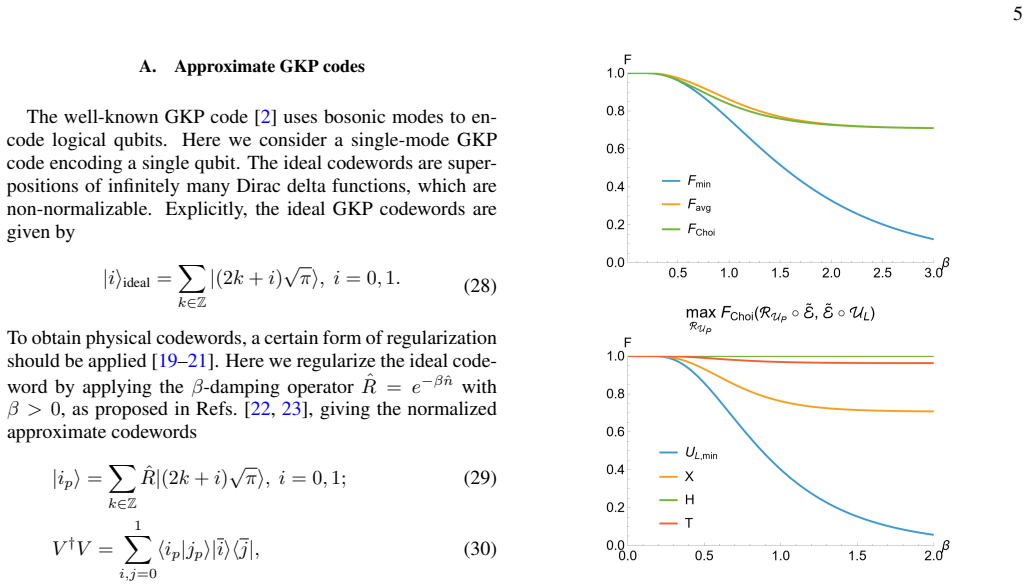
Non-isometric encoding arises in various important contexts in quantum error correction, most notably in the finite-energy, non-ideal codewords inevitable in experimental realizations of continuous-variable codes, and holographic quantum gravity. In this work, we present a general and systematic theory of non-isometric quantum error-correcting codes. In particular, we employ the approximate quantum error correction framework to quantitatively study the fundamental limitations imposed by non-isometric encodings on the accuracy of quantum error correction and implementation of logical operations. We apply our theory to analyze GKP and tiger codes under energy constraints, and discuss the implications to holography.
Editorial analysis
A structured set of objections, weighed in public.
Referee Report
Summary. The manuscript develops a general theory of non-isometric quantum error-correcting codes by extending the approximate quantum error correction (AQEC) framework. It uses this to derive quantitative bounds on the accuracy of error correction and the fidelity of logical operations imposed by non-isometric encodings, then applies the results to finite-energy GKP and tiger codes and discusses implications for holography.
Significance. If the extension of AQEC conditions to non-isometric maps is shown to be valid without additional unstated assumptions, the work would supply a systematic tool for bounding performance in experimentally relevant continuous-variable codes and in holographic models, where perfect isometries are unavailable.
major comments (2)
- [§3] §3 (definition of the non-isometric encoding map and extension of the approximate Knill-Laflamme conditions): the claim that the standard AQEC framework directly quantifies the effects of non-isometry requires an explicit verification that the recovery map construction remains valid when the singular values of the encoding operator are bounded away from unity; without this check the derived accuracy and logical-operation bounds may not be general.
- [§4.2] §4.2 (GKP analysis under energy constraints): the quantitative limitations on logical gate fidelity are obtained by applying the non-isometric AQEC conditions, yet the manuscript does not demonstrate that norm non-preservation does not generate additional error terms outside the approximate error operators already considered; this step is load-bearing for the central claim that the framework captures the fundamental limitations.
minor comments (2)
- [Abstract] The term 'tiger codes' is used in the abstract and §4 without a one-sentence definition or citation, which reduces accessibility for readers outside the immediate subfield.
- [§2] Notation for the approximate distance and recovery fidelity is introduced in §2 but reused with slight variations in later sections; a consolidated table of symbols would improve clarity.
Simulated Author's Rebuttal
We thank the referee for their thorough review and insightful comments, which have helped us clarify key aspects of the manuscript. We address each major comment point by point below. Revisions have been made to incorporate explicit verifications as requested.
read point-by-point responses
-
Referee: [§3] §3 (definition of the non-isometric encoding map and extension of the approximate Knill-Laflamme conditions): the claim that the standard AQEC framework directly quantifies the effects of non-isometry requires an explicit verification that the recovery map construction remains valid when the singular values of the encoding operator are bounded away from unity; without this check the derived accuracy and logical-operation bounds may not be general.
Authors: We appreciate the referee's emphasis on this foundational point. The AQEC framework applies to general encoding maps without requiring isometry, as the approximate Knill-Laflamme conditions are stated in terms of the encoding operator's action on the code subspace. To make this explicit, we have added a dedicated paragraph and supporting lemma in the revised §3. The lemma verifies that the Petz recovery map (or its approximate variant) remains valid when singular values are bounded away from unity but positive, by showing that the recovery fidelity deviation is controlled by the operator-norm distance from isometry, which is already parameterized in our bounds. This holds under the finite-energy constraints used throughout, without introducing new assumptions. revision: yes
-
Referee: [§4.2] §4.2 (GKP analysis under energy constraints): the quantitative limitations on logical gate fidelity are obtained by applying the non-isometric AQEC conditions, yet the manuscript does not demonstrate that norm non-preservation does not generate additional error terms outside the approximate error operators already considered; this step is load-bearing for the central claim that the framework captures the fundamental limitations.
Authors: We agree that an explicit demonstration is needed here. In the revised §4.2, we have inserted a short calculation showing that any error contributions from norm non-preservation are fully absorbed into the effective approximate error operators already defined via the non-isometric encoding map. Specifically, the deviation from trace preservation is bounded by the same AQEC distance parameter δ that governs the logical gate fidelity bounds, ensuring no independent error terms arise. This step confirms that the framework captures the fundamental limitations without omission. revision: yes
Circularity Check
No circularity: approximate QEC extension presented as direct application without self-referential reductions
full rationale
The abstract and description present a general theory extending the existing approximate quantum error correction framework to non-isometric encodings, applied to GKP and tiger codes. No equations, fitted parameters, or self-citations are provided that reduce predictions to inputs by construction. The central claim relies on the standard approximate Knill-Laflamme conditions being applicable without new assumptions, which is an independent methodological extension rather than a definitional loop or fitted-input prediction. Without load-bearing self-citations or ansatzes smuggled via prior work, the derivation chain is self-contained against external benchmarks.
Axiom & Free-Parameter Ledger
Reference graph
Works this paper leans on
-
[1]
Mirrahimi, Z
M. Mirrahimi, Z. Leghtas, V . V . Albert, S. Touzard, R. J. Schoelkopf, L. Jiang, and M. H. Devoret, Dynamically pro- tected cat-qubits: a new paradigm for universal quantum com- putation, New Journal of Physics16, 045014 (2014)
2014
-
[2]
Gottesman, A
D. Gottesman, A. Kitaev, and J. Preskill, Encoding a qubit in an oscillator, Phys. Rev. A64, 012310 (2001)
2001
-
[3]
Y . Xu, Y . Wang, C. Vuillot, and V . V . Albert, Letting the tiger out of its cage: Bosonic coding without concatenation, Phys. Rev. X15, 041025 (2025)
2025
-
[4]
I. H. Kim, E. Tang, and J. Preskill, The ghost in the radia- tion: Robust encodings of the black hole interior, J. High Energ. Phys.2020(6), 031
2020
-
[5]
Akers, N
C. Akers, N. Engelhardt, D. Harlow, G. Penington, and S. Vard- han, The black hole interior from non-isometric codes and com- plexity, J. High Energ. Phys.2024(6), 155
2024
-
[6]
Kar, Non-isometric quantum error correction in gravity, J
A. Kar, Non-isometric quantum error correction in gravity, J. High Energ. Phys.2023(2), 195
2023
-
[7]
DeWolfe and K
O. DeWolfe and K. Higginbotham, Non-isometric codes for the black hole interior from fundamental and effective dynamics, J. High Energ. Phys.2023(9), 068
2023
-
[8]
C. Cao, W. Chemissany, A. Jahn, and Z. Zimborás, Overlapping qubits from non-isometric maps and de Sitter tensor networks, Nat. Commun.16, 163 (2025)
2025
-
[9]
Antonini, M
S. Antonini, M. Sasieta, and B. Swingle, Cosmology from ran- dom entanglement, J. High Energ. Phys.2023(11), 188
2023
-
[10]
Akers, G
C. Akers, G. Bueller, O. DeWolfe, K. Higginbotham, J. Reink- ing, and R. Rodriguez, On observers in holographic maps, J. High Energ. Phys.2025(5), 201
2025
-
[11]
T. Faulkner and M. Li, Asymptotically isometric codes for holography (2022), arXiv:2211.12439, arXiv:2211.12439 [hep- th]
arXiv 2022
-
[12]
Papadodimas and S
K. Papadodimas and S. Raju, State-dependent bulk-boundary maps and black hole complementarity, Phys. Rev. D89, 086010 (2014)
2014
-
[13]
Antonini, V
S. Antonini, V . Balasubramanian, N. Bao, C. Cao, and W. Che- missany, Non-isometry, state dependence and holography, J. High Energ. Phys.2025(2), 150
2025
-
[14]
Bény and O
C. Bény and O. Oreshkov, General conditions for approximate quantum error correction and near-optimal recovery channels, Phys. Rev. Lett.104, 120501 (2010)
2010
-
[15]
Gilchrist, N
A. Gilchrist, N. K. Langford, and M. A. Nielsen, Distance mea- sures to compare real and ideal quantum processes, Phys. Rev. A71, 062310 (2005)
2005
-
[16]
Horodecki, P
M. Horodecki, P. Horodecki, and R. Horodecki, General tele- portation channel, singlet fraction, and quasidistillation, Phys. Rev. A60, 1888 (1999). 8
1999
-
[17]
Kong and Z.-W
L. Kong and Z.-W. Liu, Near-optimal covariant quantum error- correcting codes from random unitaries with symmetries, PRX Quantum3, 020314 (2022)
2022
-
[18]
Knill and R
E. Knill and R. Laflamme, Theory of quantum error-correcting codes, Phys. Rev. A55, 900 (1997)
1997
-
[19]
Tzitrin, J
I. Tzitrin, J. E. Bourassa, N. C. Menicucci, and K. K. Saba- pathy, Progress towards practical qubit computation using ap- proximate Gottesman-Kitaev-Preskill codes, Phys. Rev. A101, 032315 (2020)
2020
-
[20]
Eaton, R
M. Eaton, R. Nehra, and O. Pfister, Non-gaussian and Gottesman-Kitaev-Preskill state preparation by photon cataly- sis, New J. Phys.21, 113034 (2019)
2019
-
[21]
L. Brenner, B. Dias, and R. Koenig, Composable logical gate error in approximate quantum error correction: reexamining gate implementations in gottesman-kitaev-preskill codes, arXiv preprint arXiv:2509.14658 (2025)
arXiv 2025
-
[22]
N. C. Menicucci, Fault-tolerant measurement-based quantum computing with continuous-variable cluster states, Phys. Rev. Lett.112, 120504 (2014)
2014
-
[23]
Jafarzadeh, J
M. Jafarzadeh, J. Conrad, R. N. Alexander, and B. Q. Baragiola, Logical channels in approximate Gottesman-Kitaev-Preskill er- ror correction, Phys. Rev. A112, 062413 (2025)
2025
-
[24]
Penington, S
G. Penington, S. H. Shenker, D. Stanford, and Z. Yang, Replica wormholes and the black hole interior, J. High Energ. Phys. 2022(3), 205
2022
-
[25]
R. Chao, B. W. Reichardt, C. Sutherland, and T. Vidick, Over- lapping qubits, in8th Innovations in Theoretical Computer Sci- ence Conference (ITCS 2017), Leibniz International Proceed- ings in Informatics (LIPIcs), V ol. 67 (2017) pp. 48:1–48:21
2017
-
[26]
Nayak, Optimal lower bounds for quantum automata and random access codes, inProceedings of the 40th Annual Sym- posium on Foundations of Computer Science(1999) pp
A. Nayak, Optimal lower bounds for quantum automata and random access codes, inProceedings of the 40th Annual Sym- posium on Foundations of Computer Science(1999) pp. 369– 376
1999
-
[27]
Dalibard, Y
J. Dalibard, Y . Castin, and K. Mølmer, Wave-function approach to dissipative processes in quantum optics, Phys. Rev. Lett.68, 580 (1992)
1992
-
[28]
M. B. Plenio and P. L. Knight, The quantum-jump approach to dissipative dynamics in quantum optics, Rev. Mod. Phys.70, 101 (1998)
1998
-
[29]
Verstraete, M
F. Verstraete, M. M. Wolf, and J. I. Cirac, Quantum computation and quantum-state engineering driven by dissipation, Nat. Phys. 5, 633 (2009)
2009
-
[30]
Pastawski, L
F. Pastawski, L. Clemente, and J. I. Cirac, Quantum memo- ries based on engineered dissipation, Phys. Rev. A83, 012304 (2011)
2011
-
[31]
Nathan, L
F. Nathan, L. O’Brien, K. Noh, M. H. Matheny, A. L. Grimsmo, L. Jiang, and G. Refael, Self-correcting gottesman-kitaev- preskill qubit and gates in a driven-dissipative circuit, PRX Quantum6, 030352 (2025)
2025
-
[32]
Rymarz, S
M. Rymarz, S. Bosco, A. Ciani, and D. P. DiVincenzo, Hardware-encoding grid states in a nonreciprocal supercon- ducting circuit, Phys. Rev. X11, 011032 (2021)
2021
-
[33]
X. C. Kolesnikow, R. W. Bomantara, A. C. Doherty, and A. L. Grimsmo, Gottesman-kitaev-preskill state preparation us- ing periodic driving, Phys. Rev. Lett.132, 130605 (2024)
2024
-
[34]
Sion, On general minimax theorems, Pacific J
M. Sion, On general minimax theorems, Pacific J. Math.8, 171 (1958)
1958
-
[35]
Araki, On an inequality of lieb and thirring, Lett
H. Araki, On an inequality of lieb and thirring, Lett. Math. Phys. 19, 167 (1990)
1990
-
[36]
K. M. R. Audenaert, On the Araki-Lieb-Thirring inequality, Int. J. Inf. Syst. Sci.4, 78 (2008). Appendix A: An information-disturbance theorem for non-isometric encodings We formulate the following result, which relates the optimal recovered fidelity of a pair of maps to the corresponding fidelity between their complementary maps. If a general map can be ...
2008
-
[37]
Worst-case fidelity Applying Theorem S1 for the case(n 1, n2) = (1,0), with N= ˜E, M= idand Mc = trS, we obtain Fmin = max R F(R ◦ ˜E,id) = max R′ F( ˜Ec,R ′ ◦tr S) = max R′ min ρ Fρ( ˜Ec,R ′ ◦tr S). (B1) The output states are ˜Ec ⊗id(|ψ ρ⟩⟨ψρ|SP ) = trS(V|ψ ρ⟩⟨ψρ|SP V †) tr(V ρV †) ⊗ |0⟩⟨0|E,(B2) (R′)◦tr S ⊗id(|ψ ρ⟩⟨ψρ|SP ) = trS(|ψρ⟩⟨ψρ|SP )⊗ R ′(|0⟩⟨0|...
-
[38]
We repeat the procedure and achieve a similar equation to Eq
Choi fidelity Using Theorem S1 for the case N= ˜E, M= idand Mc = trS, the calculation ofF Choi is similar to that ofF min. We repeat the procedure and achieve a similar equation to Eq. (B8). FChoi = tr( p ρChoiV †V ρChoi)p tr(V ρChoiV †) = tr( √ V †V)p d·tr(V †V) = Pd−1 i=0 λ 1 2 i√ d(Pd−1 i=0 λi) 1 2 . (B19) Here we useρ Choi = trP (|ψc⟩⟨ψc|) = 1 L d , w...
-
[39]
Average fidelity Writing out Eq. (8) explicitly, it is F 2 avg = max {Ek} Z Haar dψ X k ⟨ψ|EkV|ψ⟩⟨ψ|V †E† k|ψ⟩ ⟨ψ|V †V|ψ⟩ = max {Ek} tr(OEOψ), (B21) where R dψis an integral over the Haar measure in the logical Hilbert space, and we have defined OE ≡ X k EkV⊗V †E† k, O ψ ≡ Z Haar dψ |ψ⟩⟨ψ| ⊗ |ψ⟩⟨ψ| ⟨ψ|V †V|ψ⟩ . (B22) We first calculateO ψ. Under the basis...
-
[40]
Proof.Suppose the error channelNcan be written in terms of the Kraus operatorsN(·) = P l Nl(·)N † l
An inequality between average and Choi optimal fidelities under noise Here we prove a simple relation thatF (N)2 avg ≥F (N)2 Choi , which impliesϵ (N) Choi ≥ϵ (N) avg . Proof.Suppose the error channelNcan be written in terms of the Kraus operatorsN(·) = P l Nl(·)N † l . ForF (N)2 Choi , we assume that the optimal recovery channel is achieved with a set of...
-
[41]
Then R(N) o ◦ Ncan be seen as a particular recovery channel of ˜E
Proof of Proposition 2 Proof.(a): Suppose that the optimal recovery channels ofF min andF (N) min are attained byR o andR (N) o , respectively. Then R(N) o ◦ Ncan be seen as a particular recovery channel of ˜E. Since this candidate channel is not necessarily optimal compared withRo, we haveF (N) min ≤F min and henceϵ (N) min ≥ϵ min. Similarly, we can prov...
-
[42]
The calculation is overall similar to that ofF min
Proposition 4 We then present the details for Proposition 4. The calculation is overall similar to that ofF min. We use Theorem S1 for the case(n 1, n2) = (1,1),N 1 = idL,N 2 = idP ,M 1 =U L,M 2 = idP . ˜Ec ⊗id(|ψ ρ⟩⟨ψρ|SP ) = trS(V|ψ ρ⟩⟨ψρ|SP V †) tr(V ρV †) ⊗ |0⟩⟨0|E,(C3) (R′)◦( ˜E ◦ U L)c ⊗id(|ψ ρ⟩⟨ψρ|SP ) = trS(V UL|ψρ⟩⟨ψρ|SP U † LV †) tr(V ULρU † LV ...
-
[43]
(23) can be viewed as the fidelity between two density matricesρ 1 = V †V d andρ 2 =U † Lρ1UL
Proposition 5 Eq. (23) can be viewed as the fidelity between two density matricesρ 1 = V †V d andρ 2 =U † Lρ1UL. Therefore, the maximal fidelity is1and is achieved if and only ifρ 1 =ρ 2, thus[U L, V †V] = 0. For the minimal fidelity, we have F(ρ 1, ρ2) =∥ √ρ1 √ρ2∥1 ≥tr( √ρ1 √ρ2) = 1 dtr( √ V †V U † L √ V †V UL).(C10) In the eigen-basis ofV †V, we have 1 ...
-
[44]
Therefore, FChoi = 1√ d ∥V∥ 1 ∥V∥ 2 ≥ 1√ d ∥V∥ 2 2 ∥V∥ 2 4 = 1p 1 +dD(V) .(D3) Written in terms ofϵ Choi, we have ϵ2 Choi = 1−F 2 Choi ≤ dD(V) 1 +dD(V) ≤dD(V).(D4) Ref. [13] uses the following quantity to quantify the deviation from the exact state-independent reconstruction ofU L min UP Z Haar dψ∥(UP V−V U L)|ψ⟩∥2 = 2−max UP Re Å2 dtr(V †UP V UL) ã .(D5)...
discussion (0)
Sign in with ORCID, Apple, or X to comment. Anyone can read and Pith papers without signing in.