First Measurement of Sub-GeV ν_(μ) Charged-Current Coherent Pion Production on Argon in MicroBooNE
Pith reviewed 2026-06-27 04:52 UTC · model grok-4.3
The pith
MicroBooNE measures the charged-current coherent pion production cross section on argon at 0.8 GeV mean energy as (9.1 ± 1.2_stat ± 1.2_syst) × 10^{-40} cm²/Ar.
A machine-rendered reading of the paper's core claim, the machinery that carries it, and where it could break.
Core claim
The flux-averaged cross section for charged-current coherent pion production on argon is (9.1 ± 1.2_stat ± 1.2_syst) × 10^{-40} cm²/Ar at a mean neutrino energy of 0.8 GeV. This constitutes the first measurement of the process on argon below 1 GeV and exploits the clean kinematics in which the neutrino interacts coherently with the entire nucleus.
What carries the argument
Clean two-body kinematics of coherent pion production, in which a neutrino interacts with the whole argon nucleus to produce a forward muon and pion without nuclear breakup, identified in the MicroBooNE LArTPC.
If this is right
- Supplies an experimental anchor for neutrino flux predictions used in long-baseline oscillation analyses such as DUNE.
- Tests nuclear models of coherent pion production on argon at sub-GeV energies.
- Establishes a reference value against which larger liquid-argon detectors can compare future measurements.
Where Pith is reading between the lines
- The result can be folded into global fits of neutrino interaction generators to reduce flux-related systematics across multiple experiments.
- Repeating the measurement with different beam energies or target nuclei would test the scaling of coherent production with atomic mass.
- If the cross section holds, it directly tightens the uncertainty budget for CP-violation searches that rely on precise flux knowledge.
Load-bearing premise
Events selected by forward muon-pion topology are assumed to be true coherent production with negligible residual background or nuclear breakup contamination.
What would settle it
A measured cross section differing by more than combined uncertainties from 9.1 × 10^{-40} cm²/Ar, or direct observation of significant nuclear breakup products in the selected sample, would contradict the coherent-production interpretation.
Figures
read the original abstract
We report a measurement of the charged-current coherent pion production cross section on argon using the MicroBooNE liquid argon time projection chamber exposed to the Booster Neutrino Beam at Fermilab. The measurement uses the MicroBooNE data set corresponding to $1.26 \times 10^{21}$ protons on target with a mean neutrino energy of $0.8$~GeV. The flux-averaged cross section is measured to be $(9.1 \pm 1.2_{\text{stat}} \pm 1.2_\text{syst}) \times 10^{-40}\,\text{cm}^2/\text{Ar}$. This result represents the first measurement of charged-current coherent pion production on argon at sub-GeV neutrino energies. Due to its clean two-body kinematics, where the neutrino interacts coherently with the entire nucleus producing a forward muon and pion with no nuclear breakup, this process provides a useful tool for constraining neutrino flux uncertainties in current and future oscillation experiments such as DUNE.
Editorial analysis
A structured set of objections, weighed in public.
Referee Report
Summary. The manuscript reports the first measurement of sub-GeV ν_μ charged-current coherent pion production on argon in MicroBooNE, using 1.26 × 10^{21} POT data at mean energy 0.8 GeV. The flux-averaged cross section is extracted as (9.1 ± 1.2_stat ± 1.2_syst) × 10^{-40} cm²/Ar, with the result justified by the clean two-body kinematics of the forward muon-pion topology and absence of nuclear breakup.
Significance. If the result holds after detailed validation, it supplies the first experimental datum for this process on argon below 1 GeV and could serve as a flux constraint for DUNE and similar experiments. The equal statistical and systematic uncertainties already indicate that efficiency corrections and background modeling contribute at the same level as the statistical precision.
major comments (1)
- [Abstract] Abstract: the central claim that the forward muon-pion topology isolates coherent production with negligible contamination or nuclear breakup is load-bearing for both the signal definition and the flux-constraint utility, yet the abstract supplies no quantitative information on selection efficiency, background rejection power, residual contamination, or data-MC agreement in control regions. The fact that stat and syst uncertainties are equal signals that these effects are comparable to the reported precision; without explicit numbers the extracted value cannot be shown to be background-subtracted at the claimed accuracy.
Simulated Author's Rebuttal
We thank the referee for the detailed review and constructive feedback on our manuscript. We address the major comment point-by-point below, providing the strongest honest response based on the content of the paper.
read point-by-point responses
-
Referee: [Abstract] Abstract: the central claim that the forward muon-pion topology isolates coherent production with negligible contamination or nuclear breakup is load-bearing for both the signal definition and the flux-constraint utility, yet the abstract supplies no quantitative information on selection efficiency, background rejection power, residual contamination, or data-MC agreement in control regions. The fact that stat and syst uncertainties are equal signals that these effects are comparable to the reported precision; without explicit numbers the extracted value cannot be shown to be background-subtracted at the claimed accuracy.
Authors: The abstract is a concise summary of the key result and its motivation; quantitative details on event selection efficiency, background rejection, residual contamination, and data-MC agreement in control regions are provided in the body of the manuscript (in the sections on event selection, efficiency corrections, and systematic uncertainties). The equal stat and syst uncertainties are a feature of the achieved precision after all corrections and validations. We agree that adding a brief quantitative statement to the abstract would improve clarity and address the concern directly, so we will revise the abstract accordingly while preserving its length and focus. revision: yes
Circularity Check
No circularity: direct experimental measurement from data
full rationale
The paper reports a flux-averaged cross-section measurement extracted directly from MicroBooNE detector data corresponding to 1.26e21 POT. The reported value (9.1 ± 1.2_stat ± 1.2_syst) × 10^{-40} cm²/Ar is obtained via event selection on forward muon+pion topology in the LArTPC, with no equations or derivations that reduce a claimed prediction or first-principles result to fitted inputs or self-citations by construction. No self-definitional steps, fitted-input-called-prediction, or ansatz smuggling via citation appear in the abstract or described analysis chain. The result is self-contained as a data-driven extraction against external benchmarks.
Axiom & Free-Parameter Ledger
Reference graph
Works this paper leans on
-
[1]
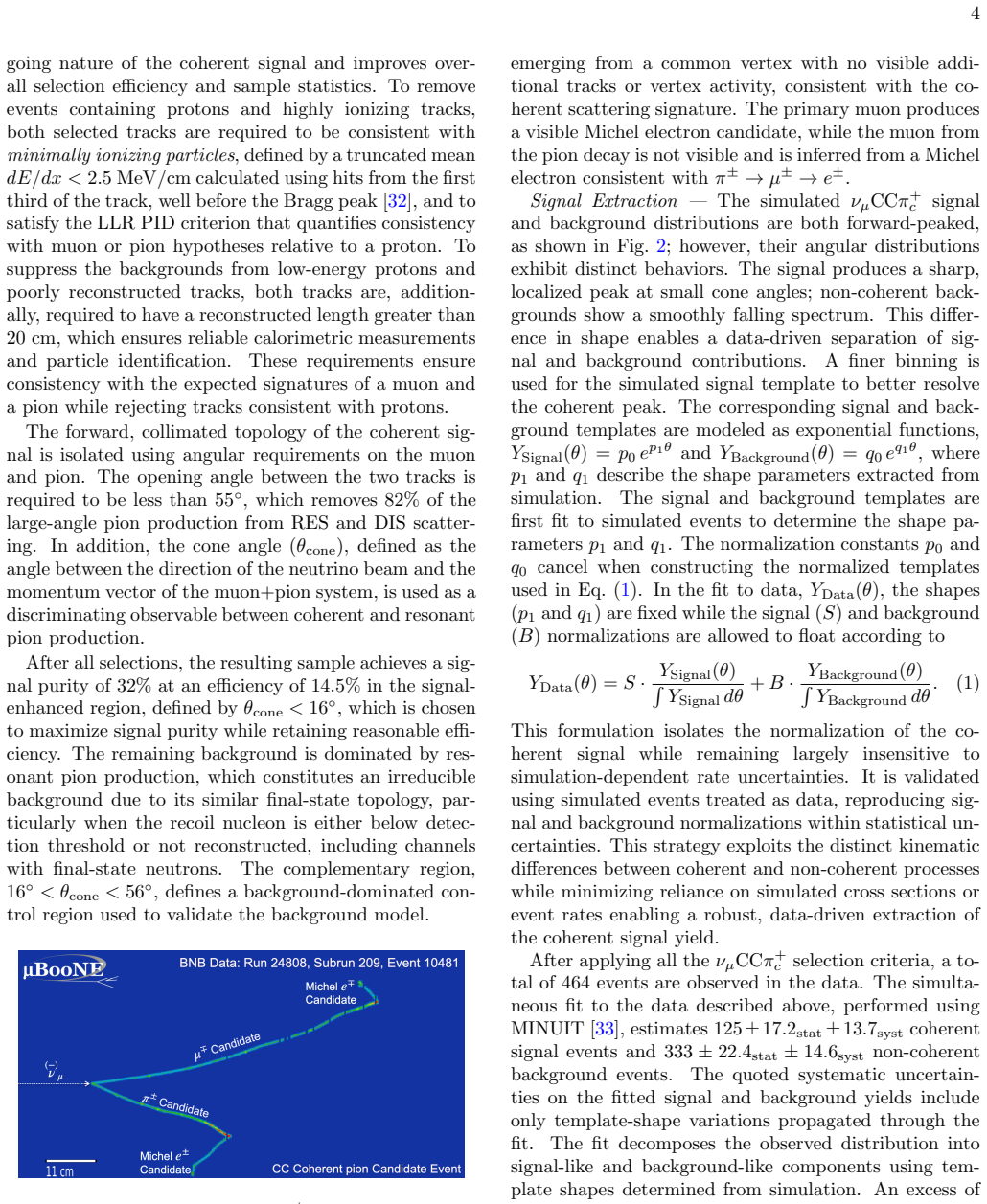
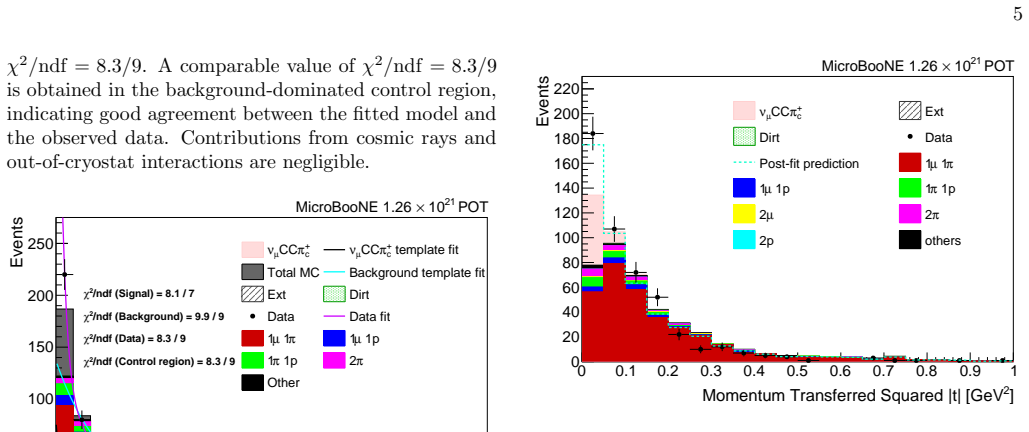
in the detector are evaluated by varying the relevant parameters and propagating these variations through the analysis. Ensembles of systematically varied simulation samples are generated to capture correlated effects aris- ing from hadron production, neutrino interaction models, and intranuclear transport processes. The central value (CV) fit to simulati...
2020
-
[2]
Abiet al.(DUNE Collaboration), Long-baseline neu- trino oscillation physics potential of the DUNE experi- ment, Eur
B. Abiet al.(DUNE Collaboration), Long-baseline neu- trino oscillation physics potential of the DUNE experi- ment, Eur. Phys. J. C80, 978 (2020)
2020
-
[3]
M. J. Jung, V. Pandey, G. Putnam, and D. W. Schmitz, Neutrino Induced Charged Current Coherent Pion Pro- duction for Constraining the Muon Neutrino Flux at DUNE, arXiv preprint (2025), arXiv:2502.02576 [hep- ph]
arXiv 2025
-
[4]
S. L. Adler, Tests of the Conserved Vector Current and Partially Conserved Axial-Vector Current Hypotheses in High-Energy Neutrino Reactions, Phys. Rev.135, B963 (1964)
1964
-
[5]
J. E. Amaro, E. Hern´ andez, J. Nieves, and M. Valverde, Theoretical study of neutrino-induced coherent pion pro- duction off nuclei at T2K and MiniBooNE energies, Phys. Rev. D79, 013002 (2009)
2009
-
[6]
Rein and L
D. Rein and L. M. Sehgal, Coherentπ 0 production in neutrino reactions, Nucl. Phys. B223, 29 (1983)
1983
-
[7]
Berger and L
C. Berger and L. M. Sehgal, Lepton mass effects in single pion production by neutrinos, Phys. Rev. D76, 113004 (2007)
2007
-
[8]
Berger and L
C. Berger and L. M. Sehgal, Partially conserved axial vec- tor current and coherent pion production by low energy neutrinos, Phys. Rev. D79, 053003 (2009)
2009
-
[9]
M. A. Ram´ ırezet al.(MINERvA Collaboration), Neutrino-Induced Coherentπ + Production in C, CH, Fe, and Pb at<E ν >∼6 GeV, Phys. Rev. Lett.131, 051801 (2023)
2023
-
[10]
Abeet al.(T2K Collaboration), First measurement of theν µ charged-current singleπ + cross section on water with the T2K near detector, Phys
K. Abeet al.(T2K Collaboration), First measurement of theν µ charged-current singleπ + cross section on water with the T2K near detector, Phys. Rev. D95, 012010 (2017)
2017
-
[11]
Abeet al.(T2K Collaboration), Measurements of theν µ and νµ-induced coherent charged pion production cross sections on 12C by the T2K experiment, Phys
K. Abeet al.(T2K Collaboration), Measurements of theν µ and νµ-induced coherent charged pion production cross sections on 12C by the T2K experiment, Phys. Rev. D108, 092009 (2023)
2023
-
[12]
Kullenberget al., A measurement of coherent neu- tral pion production in neutrino neutral current interac- tions in the NOMAD experiment, Phys
C. Kullenberget al., A measurement of coherent neu- tral pion production in neutrino neutral current interac- tions in the NOMAD experiment, Phys. Lett. B682, 177 (2009)
2009
-
[13]
Adamsonet al.(MINOS Collaboration), Measurement of singleπ 0 production by coherent neutral-currentνFe interactions in the MINOS Near Detector, Phys
P. Adamsonet al.(MINOS Collaboration), Measurement of singleπ 0 production by coherent neutral-currentνFe interactions in the MINOS Near Detector, Phys. Rev. D 94, 072006 (2016)
2016
-
[14]
M. A. Aceroet al.(NOvA Collaboration), Measurement of neutrino-induced neutral-current coherentπ 0 produc- tion in the NOvA near detector, Phys. Rev. D102, 012004 (2020)
2020
-
[15]
Acciarriet al.(ArgoNeuT Collaboration), First Measurement of Neutrino and Antineutrino Coherent Charged Pion Production on Argon, Phys
R. Acciarriet al.(ArgoNeuT Collaboration), First Measurement of Neutrino and Antineutrino Coherent Charged Pion Production on Argon, Phys. Rev. Lett. 113, 261801 (2014)
2014
-
[16]
Acciarriet al.(MicroBooNE Collaboration), Design and Construction of the MicroBooNE Detector, J
R. Acciarriet al.(MicroBooNE Collaboration), Design and Construction of the MicroBooNE Detector, J. In- strum.12, P02017 (2017)
2017
-
[17]
A. A. Aguilar-Arevaloet al.(MiniBooNE Collaboration), The Neutrino Flux Prediction at MiniBooNE, Phys. Rev. D79, 072002 (2009)
2009
-
[18]
M. G. Catanesiet al.(HARP Collaboration), Measure- ment of the production cross-section of positive pions in the collision of 8.9-GeV/cprotons on beryllium, Eur. Phys. J. C52, 29 (2007)
2007
-
[19]
Chenget al.(SciBooNE Collaboration), Measurement ofK + production cross section by 8 GeV protons using high energy neutrino interactions in the SciBooNE de- tector, Phys
G. Chenget al.(SciBooNE Collaboration), Measurement ofK + production cross section by 8 GeV protons using high energy neutrino interactions in the SciBooNE de- tector, Phys. Rev. D84, 012009 (2011)
2011
-
[20]
Andreopouloset al., The GENIE neutrino Monte Carlo generator, Nucl
C. Andreopouloset al., The GENIE neutrino Monte Carlo generator, Nucl. Instrum. Meth. A614, 87 (2010)
2010
-
[21]
Abratenkoet al.(MicroBooNE Collaboration), New CC0πGENIE model tune for MicroBooNE, Phys
P. Abratenkoet al.(MicroBooNE Collaboration), New CC0πGENIE model tune for MicroBooNE, Phys. Rev. D105, 072001 (2022)
2022
-
[22]
J. A. Nowaket al.(MiniBooNE Collaboration), Four Mo- mentum Transfer Discrepancy in the Charged Current π+; Production in the MiniBooNE: Data vs. Theory, AIP Conf. Proc.1189, 243 (2009)
2009
-
[23]
K. S. Kuzmin, V. V. Lyubushkin, and V. A. Nau- mov, Lepton polarization in neutrino-nucleon interac- tions, Modern Physics Letters A19, 2815 (2004)
2004
-
[24]
K. M. Graczyk and J. T. Sobczyk, Form factors in the quark resonance model, Phys. Rev. D77, 053001 (2008)
2008
-
[25]
Agostinelliet al.(GEANT4 Collaboration), Geant4— a simulation toolkit, Nucl
S. Agostinelliet al.(GEANT4 Collaboration), Geant4— a simulation toolkit, Nucl. Instrum. Meth. A506, 250 (2003)
2003
-
[26]
Allisonet al., Geant4 developments and applications, IEEE Trans
J. Allisonet al., Geant4 developments and applications, IEEE Trans. Nucl. Sci.53, 270 (2006)
2006
-
[27]
Allisonet al., Recent developments in Geant4, Nucl
J. Allisonet al., Recent developments in Geant4, Nucl. Instrum. Meth. A835, 186 (2016)
2016
-
[28]
Adamset al.(MicroBooNE Collaboration), Ionization electron signal processing in single phase LArTPCs
C. Adamset al.(MicroBooNE Collaboration), Ionization electron signal processing in single phase LArTPCs. Part I. Algorithm description and quantitative evaluation with MicroBooNE simulation, J. Instrum.13, P07006 (2018)
2018
-
[29]
Adamset al.(MicroBooNE Collaboration), Ionization electron signal processing in single phase LArTPCs
C. Adamset al.(MicroBooNE Collaboration), Ionization electron signal processing in single phase LArTPCs. Part II. Data/simulation comparison and performance in Mi- croBooNE, J. Instrum.13, P07007 (2018)
2018
-
[30]
R. Acciarriet al.(MicroBooNE Collaboration), The Pan- dora multi-algorithm approach to automated pattern recognition of cosmic-ray muon and neutrino events in the MicroBooNE detector, Eur. Phys. J. C78, 82 (2018)
2018
-
[31]
Abratenkoet al.(MicroBooNE Collaboration), Calori- metric classification of track-like signatures in liquid ar- gon TPCs using MicroBooNE data, J
P. Abratenkoet al.(MicroBooNE Collaboration), Calori- metric classification of track-like signatures in liquid ar- gon TPCs using MicroBooNE data, J. High Energy Phys. 12, 153 (2021)
2021
-
[32]
Abratenkoet al., Determination of muon momentum in the MicroBooNE LArTPC using an improved model of multiple Coulomb scattering, J
P. Abratenkoet al., Determination of muon momentum in the MicroBooNE LArTPC using an improved model of multiple Coulomb scattering, J. Instrum.12, P10010 (2017)
2017
-
[33]
Abratenkoet al.(MicroBooNE Collaboration), Mea- surement of single charged pion production in charged- currentν µ-Ar interactions with the MicroBooNE detec- tor, Phys
P. Abratenkoet al.(MicroBooNE Collaboration), Mea- surement of single charged pion production in charged- currentν µ-Ar interactions with the MicroBooNE detec- tor, Phys. Rev. D113, 032007 (2026)
2026
-
[34]
Hatlo, F
M. Hatlo, F. James, P. Mato, L. Moneta, M. Winkler, and A. Zsenei, Developments of mathematical software libraries for the LHC experiments, IEEE Trans. Nucl. Sci.52, 2818 (2005)
2005
-
[35]
P. Abratenkoet al.(MicroBooNE Collaboration), Scin- tillation light calibrations, systematic uncertainties, and triggering efficiency in the MicroBooNE detector, arXiv preprint (2026), arXiv:2603.23691 [physics.ins-det]
arXiv 2026
-
[36]
Abratenkoet al.(MicroBooNE Collaboration), Mea- surement of space charge effects in the MicroBooNE LArTPC using cosmic muons, J
P. Abratenkoet al.(MicroBooNE Collaboration), Mea- surement of space charge effects in the MicroBooNE LArTPC using cosmic muons, J. Instrum.15, P12037 (2020)
2020
-
[37]
Abratenkoet al.(MicroBooNE Collaboration), Novel 8 Approach for Evaluating Detector-Related Uncertainties in a LArTPC Using MicroBooNE Data, Eur
P. Abratenkoet al.(MicroBooNE Collaboration), Novel 8 Approach for Evaluating Detector-Related Uncertainties in a LArTPC Using MicroBooNE Data, Eur. Phys. J. C 82, 454 (2022)
2022
-
[38]
MicroBooNE Collaboration,Booster Neutrino Flux Pre- diction at MicroBooNE, Tech. Rep. (Fermilab, 2018) MICROBOONE-NOTE-1031-PUB
2018
-
[39]
Calcutt and C
J. Calcutt and C. Thorpe and K. Mahn and L. Fields, Geant4Reweight: A framework for evaluating and prop- agating hadronic interaction uncertainties in Geant4, J. Instrum.16, P08042 (2021)
2021
-
[40]
Hayato and L
Y. Hayato and L. Pickering, The NEUT neutrino interac- tion simulation program library, Eur. Phys. J. Spec. Top. 230, 4469 (2021)
2021
-
[41]
Golan, C
T. Golan, C. Juszczak and J. T. Sobczyk, Final state in- teractions effects in neutrino-nucleus interactions, Phys. Rev. C86, 015505 (2012)
2012
-
[42]
Stowellet al., NUISANCE: a neutrino cross-section generator tuning and comparison framework, J
P. Stowellet al., NUISANCE: a neutrino cross-section generator tuning and comparison framework, J. Instrum. 12, P01016 (2017)
2017
-
[43]
R. Acciarriet al.(SBND Collaboration), The Short- Baseline Near Detector at Fermilab, arXiv preprint (2025), arXiv:2504.00245 [hep-ex]
arXiv 2025
-
[44]
Torrettaet al.(ICARUS Collaboration), Status and perspectives of the ICARUS experiment at the Fermilab Short Baseline Neutrino program, J
D. Torrettaet al.(ICARUS Collaboration), Status and perspectives of the ICARUS experiment at the Fermilab Short Baseline Neutrino program, J. Instrum.19, C04061 (2024)
2024
discussion (0)
Sign in with ORCID, Apple, or X to comment. Anyone can read and Pith papers without signing in.