Robust Control of ECH Deposition Profiles on DIII-D
Pith reviewed 2026-06-27 05:03 UTC · model grok-4.3
The pith
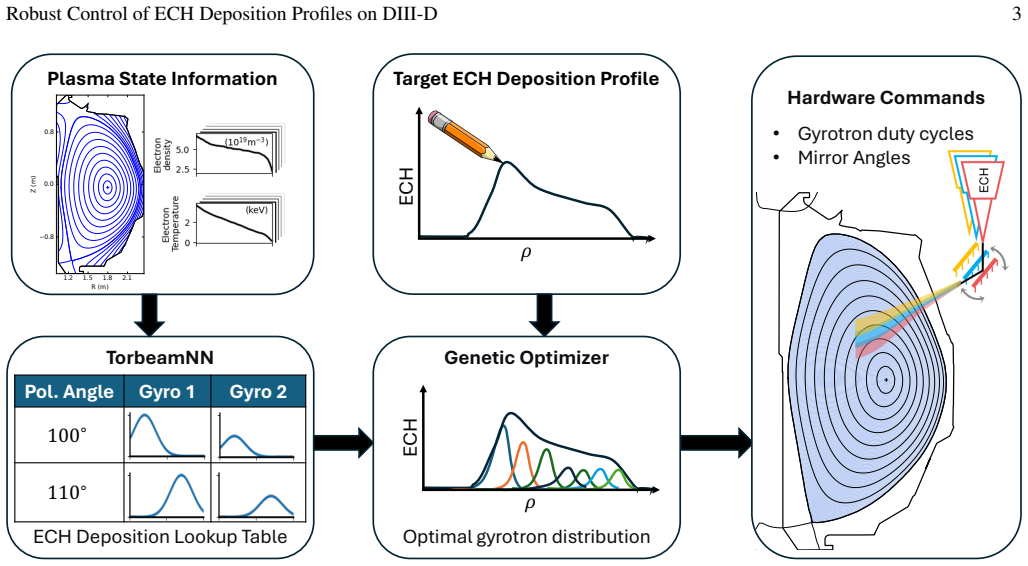
The ECHO algorithm uses a neural network surrogate of TORBEAM and a genetic optimizer to set gyrotron angles and powers for target ECH deposition profiles in real time.
A machine-rendered reading of the paper's core claim, the machinery that carries it, and where it could break.
Core claim
The central claim is that a parallelized neural-network surrogate of the TORBEAM code, paired with a genetic optimizer, can determine optimal gyrotron mirror angles and powers fast enough for real-time use, and that this combination remains reliable when individual gyrotrons are lost or plasma conditions vary, as shown by direct ECE measurements and post-shot ray-tracing validation on DIII-D.
What carries the argument
The ECHO algorithm, which combines a neural-network surrogate of TORBEAM ray tracing with a genetic optimizer to choose gyrotron settings.
If this is right
- The algorithm can update ECH settings within a single plasma discharge without waiting for full physics simulations.
- Control remains possible even if one or more gyrotrons stop working during the shot.
- The same surrogate-plus-optimizer structure could be applied to other tokamak actuators once suitable fast models exist.
- Real-time profile targeting becomes practical for routine use in scenario development and stability control.
Where Pith is reading between the lines
- Surrogate accuracy could be monitored in real time by occasional full TORBEAM calls to detect when retraining is needed.
- The approach might extend to joint optimization of ECH with other heating systems if cross-system surrogates are developed.
- Integration with existing plasma control systems could allow automatic adjustment of multiple actuators toward a single target profile.
Load-bearing premise
The neural-network surrogate of TORBEAM remains accurate enough across the plasma conditions and gyrotron states that occur in the experiment for the optimizer to find usable solutions.
What would settle it
An experiment in which the deposition profile measured by ECE after ECHO settings are applied deviates from the target profile by more than the experimental tolerance, even when full TORBEAM calculations are rerun with the same settings.
Figures



read the original abstract
Electron Cyclotron Heating (ECH) is a key actuator in DIII-D and future tokamaks that provides auxiliary heating, localized current drive for scenario development and MHD stability, and even impurity pump-out. Due to its control flexibility and applications, a gyrotron optimization algorithm was developed to multitask and fine-tune the deposition location and heating power of each gyrotron while providing robustness to hardware failure. The ECH Optimization (ECHO) algorithm finds the optimal gyrotron mirror angle and power to achieve a target ECH radial deposition profile. This optimization is accomplished in real-time using a parallelized neural network surrogate of the TORBEAM code combined with a genetic optimizer. This has been deployed in a DIII-D experiment and has been validated with experimental ECE measurements and post-experiment offline ray tracing, showing the algorithm's reliability despite gyrotron failures and significant changes to plasma parameters.
Editorial analysis
A structured set of objections, weighed in public.
Referee Report
Summary. The manuscript presents the ECH Optimization (ECHO) algorithm for real-time control of electron cyclotron heating (ECH) deposition profiles on DIII-D. ECHO employs a parallelized neural-network surrogate of the TORBEAM ray-tracing code together with a genetic optimizer to determine optimal gyrotron mirror angles and power levels that match a target radial deposition profile. The system was deployed in DIII-D experiments and validated using experimental ECE measurements plus post-shot offline TORBEAM runs, with claims of robustness to gyrotron failures and plasma-parameter changes.
Significance. If the central claims hold, the work provides a concrete demonstration of real-time, failure-tolerant ECH control in an operating tokamak, which is directly relevant to scenario development and MHD control in present and future devices. The experimental deployment itself constitutes a strength, as does the integration of a neural-network surrogate for computational speed.
major comments (2)
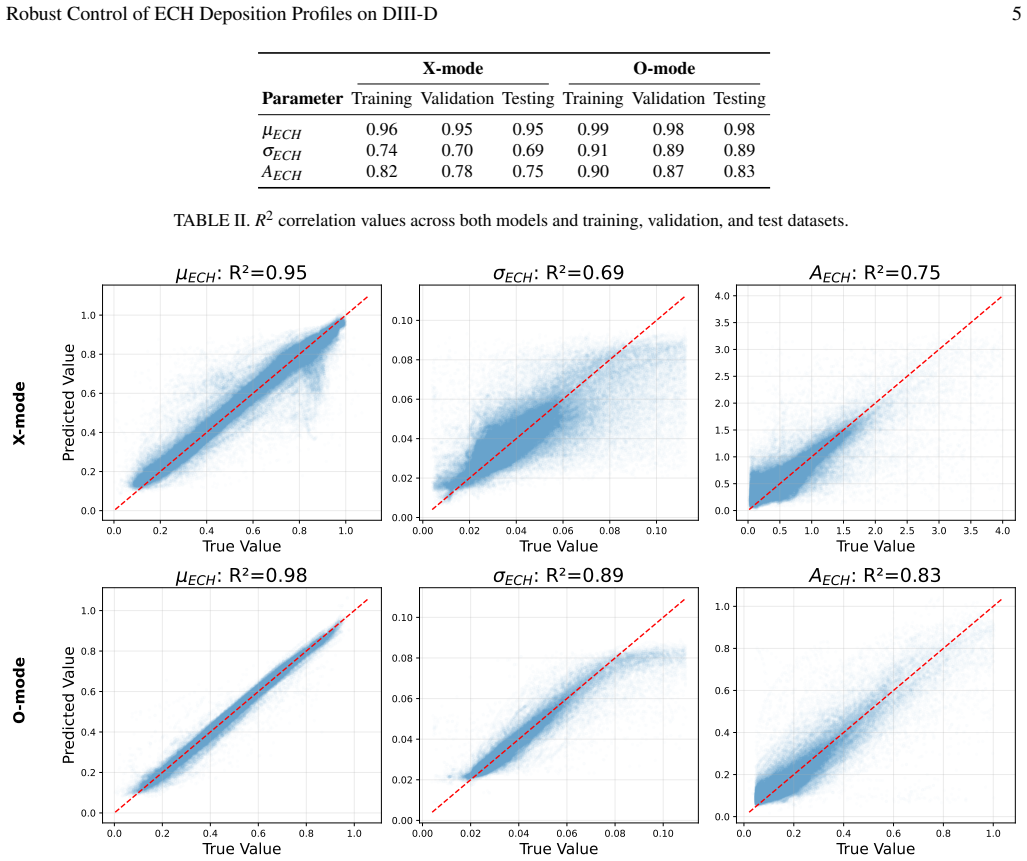
- [Section describing the neural-network surrogate and its training/validation] The reliability of the genetic optimizer depends on the neural-network surrogate of TORBEAM producing deposition profiles accurate enough to distinguish usable from unusable mirror-angle/power commands. No quantitative surrogate validation metrics (e.g., RMS error in deposition location or power, maximum peak-shift error, or accuracy stratified by plasma density, temperature, and gyrotron on/off states) are supplied for the range of conditions encountered in the experiment.
- [Results section on experimental deployment and validation] The experimental validation (ECE + post-experiment TORBEAM) confirms only the final deployed outcome. The manuscript does not report a direct comparison between the surrogate predictions used by the optimizer at run time and the corresponding TORBEAM evaluations for the same commands, nor does it quantify how any surrogate error propagated into the achieved deposition profiles.
minor comments (2)
- [Abstract] The abstract states that the algorithm shows 'reliability despite gyrotron failures' without accompanying numerical measures (e.g., fraction of shots meeting target profile within a stated tolerance, or profile-matching error statistics under failure conditions).
- [Figure captions] Figure captions and axis labels should explicitly state whether plotted deposition profiles are surrogate predictions, experimental ECE inversions, or offline TORBEAM results, and should include uncertainty bands where available.
Simulated Author's Rebuttal
We thank the referee for the constructive feedback on our manuscript describing the ECHO algorithm. The comments highlight important aspects of surrogate validation that were not sufficiently quantified in the original submission. We address each major comment below and will revise the manuscript to incorporate the requested details.
read point-by-point responses
-
Referee: [Section describing the neural-network surrogate and its training/validation] The reliability of the genetic optimizer depends on the neural-network surrogate of TORBEAM producing deposition profiles accurate enough to distinguish usable from unusable mirror-angle/power commands. No quantitative surrogate validation metrics (e.g., RMS error in deposition location or power, maximum peak-shift error, or accuracy stratified by plasma density, temperature, and gyrotron on/off states) are supplied for the range of conditions encountered in the experiment.
Authors: We agree that explicit quantitative metrics for the neural-network surrogate were omitted from the original manuscript. The surrogate was trained and tested offline on a broad dataset spanning the plasma conditions and gyrotron configurations relevant to the DIII-D experiments. In the revised manuscript we will add a new subsection reporting RMS errors in deposition location and power, maximum peak-shift errors, and performance stratified by density, temperature, and gyrotron on/off states. These metrics will be computed on the held-out validation set and will directly address the referee's concern about the surrogate's ability to support reliable optimization. revision: yes
-
Referee: [Results section on experimental deployment and validation] The experimental validation (ECE + post-experiment TORBEAM) confirms only the final deployed outcome. The manuscript does not report a direct comparison between the surrogate predictions used by the optimizer at run time and the corresponding TORBEAM evaluations for the same commands, nor does it quantify how any surrogate error propagated into the achieved deposition profiles.
Authors: The primary validation presented was end-to-end, using independent ECE measurements and offline TORBEAM runs on the final commands. We acknowledge that a direct, shot-by-shot comparison between the real-time surrogate outputs and TORBEAM for the exact commands issued during the experiment was not included. In the revision we will add this comparison for the presented discharges, together with a brief propagation analysis showing the impact of any surrogate discrepancies on the achieved deposition profiles. This will be performed by re-evaluating the optimized mirror angles and powers with the full TORBEAM code. revision: yes
Circularity Check
No circularity; claims rest on experimental deployment and external validation
full rationale
The paper presents an engineering control algorithm (ECHO) that combines a neural-network surrogate of TORBEAM with a genetic optimizer, then reports its real-time deployment on DIII-D with validation via ECE diagnostics and offline TORBEAM ray tracing. No derivation chain, fitted parameters renamed as predictions, or self-citation load-bearing steps are described. The central reliability claim is grounded in hardware-in-the-loop testing under varying plasma conditions and gyrotron failures, not in any equation that reduces to its own inputs by construction.
Axiom & Free-Parameter Ledger
Reference graph
Works this paper leans on
-
[1]
Computer Physics Communications , author =. 2018 , pages =. doi:10.1016/j.cpc.2017.12.018 , abstract =
-
[2]
A sustained high-temperature fusion plasma regime facilitated by fast ions , volume =. Nature , author =. 2022 , pages =. doi:10.1038/s41586-022-05008-1 , language =
-
[3]
External heating and current drive source requirements towards steady-state operation in. Nuclear Fusion , author =. 2014 , pages =. doi:10.1088/0029-5515/54/7/073007 , abstract =
-
[4]
Overview of the. Nuclear Fusion , author =. 2022 , pages =. doi:10.1088/1741-4326/ac1654 , abstract =
-
[5]
Fusion Engineering and Design , author =
Overview of the. Fusion Engineering and Design , author =. 2011 , pages =. doi:10.1016/j.fusengdes.2011.02.040 , abstract =
-
[6]
Electron cyclotron heating and current drive in. Nuclear Fusion , author =. 1997 , pages =. doi:10.1088/0029-5515/37/1/I06 , abstract =
-
[7]
IEEE Transactions on Plasma Science , author =
Status and. IEEE Transactions on Plasma Science , author =. 2020 , pages =. doi:10.1109/TPS.2020.2978828 , abstract =
-
[8]
EPJ Web of Conferences , author =. 2024 , pages =. doi:10.1051/epjconf/202431302006 , abstract =
-
[9]
The design of an. Nuclear Fusion , author =. 2003 , pages =. doi:10.1088/0029-5515/43/11/020 , abstract =
-
[10]
F. Leuterer and S. Günter and M. Maraschek and F. Ryter and W. Suttrop and R. Wolf and G. Gantenbein and H. Zohm , keywords =. ECRH experiments in ASDEX upgrade , journal =. 2001 , issn =. doi:https://doi.org/10.1016/S0920-3796(00)00504-4 , url =
-
[11]
Plasma Science and Technology , author =
Development and. Plasma Science and Technology , author =. 2016 , pages =. doi:10.1088/1009-0630/18/4/19 , abstract =
-
[12]
Neutral beam injection for fusion reactors: technological constraints versus functional requirements , volume =. Nuclear Fusion , author =. 2021 , pages =. doi:10.1088/1741-4326/ac227a , abstract =
-
[13]
Fusion Engineering and Design , author =
Operation of the negative ion-based neutral beam injection system during. Fusion Engineering and Design , author =. 2001 , pages =. doi:10.1016/S0920-3796(01)00344-1 , abstract =
-
[14]
Fusion Engineering and Design , author =
Operation of the negative-ion based. Fusion Engineering and Design , author =. 1998 , pages =. doi:10.1016/S0920-3796(98)00183-5 , abstract =
-
[15]
Simulation and experiment of
Choi, W and Baek, S G and Zhang, B and Bonoli, P T and Ding, S and Garofalo, A and Gong, X and Huang, J and Li, M and Lin, S Y and Qian, J and Wallace, G M , year =. Simulation and experiment of
-
[16]
Fusion Science and Technology , author =. 2007 , pages =. doi:10.13182/FST07-A1498 , abstract =
-
[17]
Fusion Engineering and Design , author =
Design of a limiter for the. Fusion Engineering and Design , author =. 2005 , pages =. doi:10.1016/j.fusengdes.2005.06.257 , abstract =
-
[18]
Plasma Physics and Controlled Fusion , author =
Progress in. Plasma Physics and Controlled Fusion , author =. 1993 , pages =. doi:10.1088/0741-3335/35/SA/005 , abstract =
-
[19]
EPJ Web of Conferences , author =
High. EPJ Web of Conferences , author =. 2017 , pages =. doi:10.1051/epjconf/201715702012 , abstract =
-
[20]
Fusion Engineering and Design , author =
High field side. Fusion Engineering and Design , author =. 2019 , pages =. doi:10.1016/j.fusengdes.2018.12.078 , abstract =
-
[21]
Plasma Physics and Controlled Fusion , author =
High-field side scrape-off layer density profile measurements and implications for high-field side. Plasma Physics and Controlled Fusion , author =. 2025 , pages =. doi:10.1088/1361-6587/ade6a8 , abstract =
-
[22]
Plasma Physics and Controlled Fusion , author =
Progress in. Plasma Physics and Controlled Fusion , author =. 2005 , pages =. doi:10.1088/0741-3335/47/12B/S26 , language =
-
[23]
Predictive multi-channel flux-driven modelling to optimise. Nuclear Fusion , author =. 2020 , pages =. doi:10.1088/1741-4326/ab833f , abstract =
-
[24]
Plasma Physics and Controlled Fusion , author =
Assessment of the. Plasma Physics and Controlled Fusion , author =. 2025 , pages =. doi:10.1088/1361-6587/ad9e73 , abstract =
-
[25]
and Benjamin, S.S
Rutherford, G. and Benjamin, S.S. and La Haye, R.J. and Rothstein, A. and Wukitch, S.J. , title =. 2025 , journal =
2025
-
[26]
1997 , month =
Prater, R and Grunloh, H J and Moeller, C P and Doane, J L and Olstad, R A and Makowski, M A and Harvey, R W , title =. 1997 , month =
1997
-
[27]
Multi-frequency, megawatt-power gyrotron to facilitate a wide range of operations at. Nuclear Fusion , author =. 2023 , pages =. doi:10.1088/1741-4326/accdeb , abstract =
-
[28]
The ITER magnet system , journal =
M Huguet , abstract =. The ITER magnet system , journal =. 1997 , issn =. doi:https://doi.org/10.1016/S0920-3796(97)00009-4 , url =
-
[29]
Control of. Nuclear Fusion , author =. 2007 , pages =. doi:10.1088/0029-5515/47/3/010 , abstract =
-
[30]
Plasma Physics and Controlled Fusion , author =
On the requirements to control neoclassical tearing modes in burning plasmas , volume =. Plasma Physics and Controlled Fusion , author =. 2010 , pages =. doi:10.1088/0741-3335/52/2/025002 , abstract =
-
[31]
Fusion Engineering and Design , author =
Real-time mirror steering for improved closed loop neoclassical tearing mode suppression by electron cyclotron current drive in. Fusion Engineering and Design , author =. 2013 , pages =. doi:10.1016/j.fusengdes.2013.02.168 , abstract =
-
[32]
Plasma start-up results with electron cyclotron assisted breakdown on. Nuclear Fusion , author =. 2011 , pages =. doi:10.1088/0029-5515/51/7/073042 , abstract =
-
[33]
Fusion Science and Technology , author =
Plasma. Fusion Science and Technology , author =. 2010 , pages =. doi:10.13182/FST10-A9266 , language =
-
[34]
Nuclear Fusion , author =. 2024 , pages =. doi:10.1088/1741-4326/ad8c62 , abstract =
-
[35]
Fusion Science and Technology , author =
Recent. Fusion Science and Technology , author =. 2011 , pages =. doi:10.13182/FST11-A11695 , abstract =
-
[36]
Active control of. Nuclear Fusion , author =. 2005 , pages =. doi:10.1088/0029-5515/45/11/018 , abstract =
-
[37]
Integrated real-time control of. Nuclear Fusion , author =. 2012 , pages =. doi:10.1088/0029-5515/52/7/074001 , abstract =
-
[38]
Fusion Engineering and Design , author =
Integrated current profile, normalized beta and. Fusion Engineering and Design , author =. 2019 , pages =. doi:10.1016/j.fusengdes.2019.01.022 , abstract =
-
[39]
Effects of edge-localized electron cyclotron current drive on edge-localized mode suppression by resonant magnetic perturbations in. Nuclear Fusion , author =. 2024 , pages =. doi:10.1088/1741-4326/ad2ca8 , abstract =
-
[40]
Access to stable, high pressure tokamak pedestals using local electron cyclotron current drive , volume =. Nuclear Fusion , author =. 2024 , pages =. doi:10.1088/1741-4326/ad0fbe , abstract =
-
[41]
Particle transport with high power central. Nuclear Fusion , author =. 2001 , pages =. doi:10.1088/0029-5515/41/9/311 , abstract =
-
[42]
Fusion Engineering and Design , author =
Experimental study on density pump-out due to electron cyclotron heating in the compact helical system heliotron - torsatron , volume =. Fusion Engineering and Design , author =. 1995 , pages =. doi:10.1016/0920-3796(94)00182-7 , abstract =
-
[43]
Understanding. Nuclear Fusion , author =. 2017 , pages =. doi:10.1088/1741-4326/aa7f99 , abstract =
-
[44]
Observation of the. Physics of Plasmas , author =. 2017 , pages =. doi:10.1063/1.4983626 , abstract =
-
[45]
Interplay between central. Nuclear Fusion , author =. 2015 , pages =. doi:10.1088/0029-5515/55/11/113029 , abstract =
-
[46]
Plasma Physics and Controlled Fusion , author =
Simulation of the time behaviour of impurities in. Plasma Physics and Controlled Fusion , author =. 2003 , pages =. doi:10.1088/0741-3335/45/12/003 , abstract =
-
[47]
T.C. LUCE , title =. Electron Cyclotron Emission and Electron Cyclotron Resonance Heating (EC-16) , chapter =. doi:10.1142/9789814340274_0002 , URL =. https://www.worldscientific.com/doi/pdf/10.1142/9789814340274_0002 , abstract =
-
[48]
Fusion Science and Technology , author =
Noninductive. Fusion Science and Technology , author =. 2002 , pages =. doi:10.13182/FST02-A228 , abstract =
-
[49]
Assessment of current drive efficiency and the synergetic effect for. Nuclear Fusion , author =. 2008 , pages =. doi:10.1088/0029-5515/48/1/015002 , abstract =
-
[50]
Fusion Science and Technology , author =
Current. Fusion Science and Technology , author =. 2006 , pages =. doi:10.13182/FST06-5 , abstract =
-
[51]
Wesson, John and Campbell, D. J. , year =. Tokamaks , isbn =
-
[52]
EPJ Web of Conferences , author =
A model of multi-pass absorption of external. EPJ Web of Conferences , author =. 2015 , pages =. doi:10.1051/epjconf/20158703005 , abstract =
-
[53]
Farina, D and Poli, E and Figini, L and Maj, O and Mariani, A and Weber, H and Goodman, T and Sauter, O and Cavinato, M and Saibene, G and Henderson, M , journal =
-
[54]
Journal of Physics: Conference Series , author =
Crucial issues of multi-beam feed-back control with. Journal of Physics: Conference Series , author =. 2005 , pages =. doi:10.1088/1742-6596/25/1/027 , abstract =
-
[55]
Fusion Science and Technology , author =
Surrogate. Fusion Science and Technology , author =. 2025 , pages =. doi:10.1080/15361055.2025.2476829 , abstract =
-
[56]
Plasma Physics and Controlled Fusion , author =. 2025 , pages =. doi:10.1088/1361-6587/add08b , abstract =
-
[57]
Benchmarking of codes for electron cyclotron heating and electron cyclotron current drive under. Nuclear Fusion , author =. 2008 , pages =. doi:10.1088/0029-5515/48/3/035006 , abstract =
-
[58]
A.T. Vu and P.C. Progress in the ITER Plasma Control System design , journal =. 2026 , issn =. doi:https://doi.org/10.1016/j.fusengdes.2025.115501 , url =
-
[59]
Real time equilibrium reconstruction for tokamak discharge control , volume =. Nuclear Fusion , author =. 1998 , pages =. doi:10.1088/0029-5515/38/7/308 , abstract =
-
[60]
Machine learning-based real-time kinetic profile reconstruction in
Shousha, Ricardo and Seo, Jaemin and Erickson, Keith and Xing, Zichuan and Kim, SangKyeun and Abbate, Joseph and Kolemen, Egemen , year =. Machine learning-based real-time kinetic profile reconstruction in. Nuclear Fusion , publisher =. doi:10.1088/1741-4326/ad142f , abstract =
-
[61]
Engineering Applications of Artificial Intelligence , author =
Keras2c:. Engineering Applications of Artificial Intelligence , author =. 2021 , pages =. doi:10.1016/j.engappai.2021.104182 , abstract =
-
[62]
Fusion Engineering and Design , author =
Parallelized real-time physics codes for plasma control on. Fusion Engineering and Design , author =. 2026 , pages =. doi:10.1016/j.fusengdes.2026.115699 , abstract =
-
[63]
Quantifying electron cyclotron power deposition broadening in DIII-D and the potential consequences for the ITER EC system , volume =. Nuclear Fusion , author =. 2023 , pages =. doi:10.1088/1741-4326/acaedc , language =
-
[64]
Rothstein, Andrew and Farre-Kaga, Hiro Joseph and Butt, Jalal and Shousha, Ricardo and Erickson, Keith and Wakatsuki, Takuma and Jalalvand, Azarakhsh and Steiner, Peter and Kim, Sangkyeun and Kolemen, Egemen , month = nov, year =. Enabling. doi:10.48550/arXiv.2511.08818 , abstract =
-
[65]
Interpreting. Physics of Plasmas , author =. 2026 , pages =. doi:10.1063/5.0311201 , abstract =
-
[66]
Application of very high harmonic fast waves for off-axis current drive in the. Nuclear Fusion , author =. 2014 , pages =. doi:10.1088/0029-5515/54/8/083024 , abstract =
-
[67]
First high-power helicon results from. Nuclear Fusion , author =. 2024 , pages =. doi:10.1088/1741-4326/ad78e8 , abstract =
-
[68]
Plasma Physics and Controlled Fusion , author =
The effects of electron cyclotron heating and current drive on toroidal. Plasma Physics and Controlled Fusion , author =. 2018 , pages =. doi:10.1088/1361-6587/aa90ee , abstract =
-
[69]
Plasma Physics and Controlled Fusion , author =
Reversed shear. Plasma Physics and Controlled Fusion , author =. 2008 , pages =. doi:10.1088/0741-3335/50/3/035009 , abstract =
-
[70]
APS Division of Plasma Physics Meeting Abstracts , year = 2019, series =
Absorption and Current Drive With Top Launch ECH on DIII-D. APS Division of Plasma Physics Meeting Abstracts , year = 2019, series =
2019
-
[71]
Citrin, Jonathan and Goodfellow, Ian and Raju, Akhil and Chen, Jeremy and Degrave, Jonas and Donner, Craig and Felici, Federico and Hamel, Philippe and Huber, Andrea and Nikulin, Dmitry and Pfau, David and Tracey, Brendan and Riedmiller, Martin and Kohli, Pushmeet , month = jun, year =
-
[72]
Plasma Physics and Controlled Fusion , author =
Non-linear model-based optimization of actuator trajectories for tokamak plasma profile control , volume =. Plasma Physics and Controlled Fusion , author =. 2012 , pages =. doi:10.1088/0741-3335/54/2/025002 , abstract =
-
[73]
Meneghini, O and Slendebroek, T and Lyons, B C and McLaughlin, K and McClenaghan, J and Stagner, L and Harvey, J and Neiser, T F and Ghiozzi, A and Dose, G and Guterl, J and Zalzali, A and Cote, T and Shi, N and Weisberg, D and Smith, S P and Grierson, B A and Candy, J , year =
discussion (0)
Sign in with ORCID, Apple, or X to comment. Anyone can read and Pith papers without signing in.