Scaling of the Surface Free Energy as a Probe of the QCD Critical Region
Pith reviewed 2026-06-27 02:43 UTC · model grok-4.3
The pith
Surface energy in the QCD equation of state restricts the critical region to temperatures within 1 percent of the critical value.
A machine-rendered reading of the paper's core claim, the machinery that carries it, and where it could break.
Core claim
With this construction and with the chosen background equation of state, the temperature must be within one percent of its critical value to observe the critical exponents. This makes it doubtful that the critical exponents can be measured in heavy ion collisions, though it may still be feasible to observe signatures of a first-order phase transition. The method presented here is general and can be utilized with any given equation of state to test the viability of observing critical exponents in experiments.
What carries the argument
The coefficient of surface energy added to the equation of state, which sets the width of the critical region by penalizing mixed-phase configurations.
If this is right
- Critical exponents appear only inside a temperature interval of roughly one percent around the critical value.
- Signatures of a first-order phase transition remain potentially observable even if critical exponents are not.
- The same surface-energy construction can be attached to any other background equation of state to repeat the test.
- The size of the critical region scales directly with the value chosen for the surface-energy coefficient.
Where Pith is reading between the lines
- Heavy-ion experiments may need to prioritize searches for first-order transition signals over critical-exponent measurements.
- Refining the background equation of state could shift the estimated size of the critical region.
- Alternative observables sensitive to the critical point might be required if temperature control is limited.
Load-bearing premise
The chosen background equation of state accurately represents the non-critical behavior of QCD matter away from the critical point.
What would settle it
Detection of critical scaling in heavy-ion data at temperatures more than one percent away from the critical temperature would show the surface-energy term does not shrink the critical region as claimed.
Figures

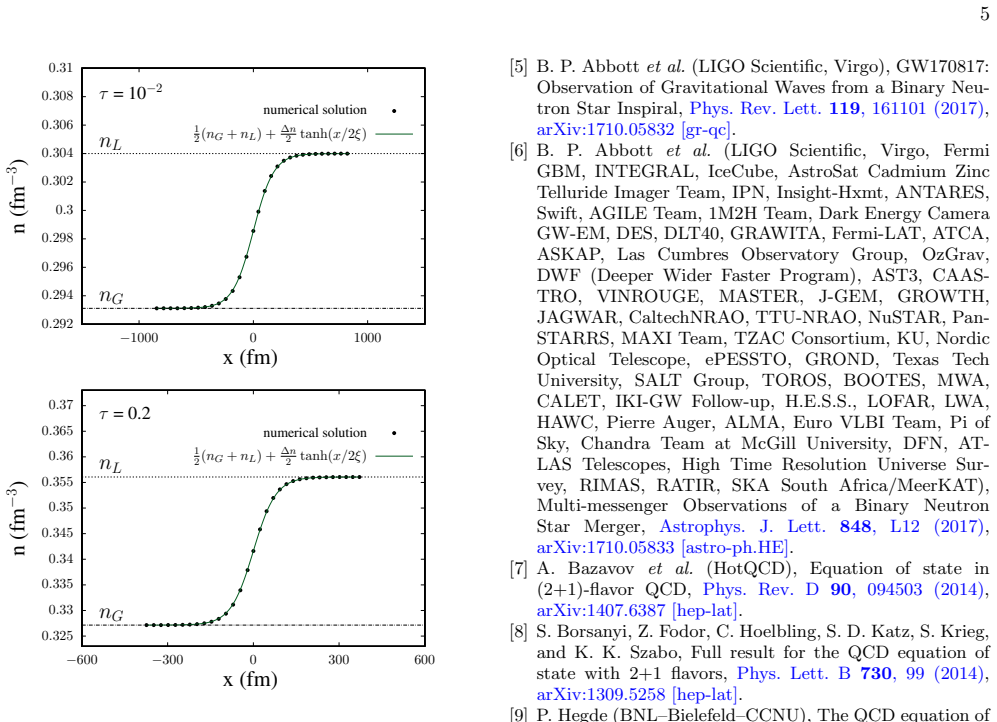
read the original abstract
The QCD phase diagram is expected to have a critical point that separates the crossover and first-order transition lines. A realistic model that incorporates phase boundary effects is essential for heavy ion simulations to isolate the experimental signatures of a critical point. We discuss how to construct such an equation of state, and study its critical behavior. The effect of the coefficient of surface energy on the size of the critical region is investigated. We found that with this construction and with the chosen background equation of state, the temperature must be within one percent of its critical value to observe the critical exponents. This makes it doubtful that the critical exponents can be measured in heavy ion collisions, though it may still be feasible to observe signatures of a first-order phase transition. The method presented here is general and can be utilized with any given equation of state to test the viability of observing critical exponents in experiments.
Editorial analysis
A structured set of objections, weighed in public.
Referee Report
Summary. The manuscript constructs an equation of state for QCD matter near the critical point by augmenting a background EoS with a surface free-energy term. It examines the dependence of the critical-region size on the surface-energy coefficient and reports that, for the chosen background, critical exponents become visible only for |T−Tc|/Tc≲0.01. The authors conclude that measuring critical exponents in heavy-ion collisions is therefore doubtful, while signatures of a first-order transition may remain feasible; the construction is presented as applicable to any background EoS.
Significance. If the central result is robust, the work would constrain expectations for critical-scaling searches in heavy-ion data and provide a practical test for the viability of critical-exponent measurements with any given EoS. The generality of the method is a positive feature.
major comments (1)
- [Abstract and model construction] Abstract (and the paragraph on model construction): the headline claim that critical exponents require |T−Tc|/Tc≲0.01 is explicitly qualified as holding only “with the chosen background equation of state.” No variation of the background EoS, no comparison with alternative non-critical thermodynamics, and no test of how the crossover width or would-be first-order line location affects the temperature window are reported. Because the surface term’s dominance is set by the relative size of the singular and regular parts, the 1 % figure is sensitive to this untested modeling choice and cannot be taken as a general bound.
Simulated Author's Rebuttal
We thank the referee for the careful reading and constructive comments. We address the single major comment below.
read point-by-point responses
-
Referee: [Abstract and model construction] Abstract (and the paragraph on model construction): the headline claim that critical exponents require |T−Tc|/Tc≲0.01 is explicitly qualified as holding only “with the chosen background equation of state.” No variation of the background EoS, no comparison with alternative non-critical thermodynamics, and no test of how the crossover width or would-be first-order line location affects the temperature window are reported. Because the surface term’s dominance is set by the relative size of the singular and regular parts, the 1 % figure is sensitive to this untested modeling choice and cannot be taken as a general bound.
Authors: We agree that the specific 1% window is tied to the single background EoS selected for the study and that no explicit variations of the background, crossover width, or first-order line location were performed. The abstract already qualifies the result as holding only 'with the chosen background equation of state,' and the paper presents the construction as a general method that can be applied to any EoS. To prevent misreading the 1% figure as a universal bound, we will revise the abstract and the model-construction paragraph to state explicitly that the temperature window depends on the relative size of the singular and regular contributions in the background and that the method is intended to let users test their own EoS. A short additional remark will note that different backgrounds could produce different windows. These changes clarify the scope without altering the reported calculation or the central conclusion for the chosen EoS. revision: yes
Circularity Check
No significant circularity; result is a direct model computation
full rationale
The paper constructs an EOS by supplementing a chosen background equation of state with an explicit surface-energy term, then computes the temperature interval in which the singular part dominates sufficiently for critical exponents to be visible. This interval is reported as a numerical outcome of that specific construction rather than a quantity derived by re-arranging or fitting the same inputs. The abstract and method statement explicitly qualify the 1 % figure as holding only for the chosen background and present the approach as reusable with any background EOS, confirming that the central claim rests on an independent (if model-dependent) calculation instead of self-definition, fitted-input renaming, or load-bearing self-citation chains.
Axiom & Free-Parameter Ledger
free parameters (1)
- surface energy coefficient
axioms (1)
- domain assumption A realistic model that incorporates phase boundary effects is essential for heavy ion simulations
Reference graph
Works this paper leans on
-
[1]
K. Fukushima and T. Hatsuda, The phase diagram of dense QCD, Rept. Prog. Phys.74, 014001 (2011), arXiv:1005.4814 [hep-ph]
Pith/arXiv arXiv 2011
-
[2]
K. Fukushima and C. Sasaki, The phase diagram of nu- clear and quark matter at high baryon density, Prog. Part. Nucl. Phys.72, 99 (2013), arXiv:1301.6377 [hep- ph]
Pith/arXiv arXiv 2013
-
[3]
C. S. Fischer, QCD at finite temperature and chemical potential from Dyson–Schwinger equations, Prog. Part. Nucl. Phys.105, 1 (2019), arXiv:1810.12938 [hep-ph]
Pith/arXiv arXiv 2019
-
[4]
Y. Aoki, G. Endrodi, Z. Fodor, S. D. Katz, and K. K. Sz- abo, The Order of the quantum chromodynamics transi- tion predicted by the standard model of particle physics, Nature443, 675 (2006), arXiv:hep-lat/0611014
Pith/arXiv arXiv 2006
-
[5]
B. P. Abbottet al.(LIGO Scientific, Virgo), GW170817: Observation of Gravitational Waves from a Binary Neu- tron Star Inspiral, Phys. Rev. Lett.119, 161101 (2017), arXiv:1710.05832 [gr-qc]
Pith/arXiv arXiv 2017
-
[6]
B. P. Abbottet al.(LIGO Scientific, Virgo, Fermi GBM, INTEGRAL, IceCube, AstroSat Cadmium Zinc Telluride Imager Team, IPN, Insight-Hxmt, ANTARES, Swift, AGILE Team, 1M2H Team, Dark Energy Camera GW-EM, DES, DLT40, GRAWITA, Fermi-LAT, ATCA, ASKAP, Las Cumbres Observatory Group, OzGrav, DWF (Deeper Wider Faster Program), AST3, CAAS- TRO, VINROUGE, MASTER, J...
Pith/arXiv arXiv 2017
-
[7]
Bazavovet al.(HotQCD), Equation of state in (2+1)-flavor QCD, Phys
A. Bazavovet al.(HotQCD), Equation of state in (2+1)-flavor QCD, Phys. Rev. D90, 094503 (2014), arXiv:1407.6387 [hep-lat]
Pith/arXiv arXiv 2014
-
[8]
S. Borsanyi, Z. Fodor, C. Hoelbling, S. D. Katz, S. Krieg, and K. K. Szabo, Full result for the QCD equation of state with 2+1 flavors, Phys. Lett. B730, 99 (2014), arXiv:1309.5258 [hep-lat]
Pith/arXiv arXiv 2014
-
[9]
Hegde (BNL–Bielefeld–CCNU), The QCD equation of state toO(µ 4 B) from lattice QCD, Nucl
P. Hegde (BNL–Bielefeld–CCNU), The QCD equation of state toO(µ 4 B) from lattice QCD, Nucl. Phys. A931, 851 (2014), arXiv:1408.6305 [hep-lat]
Pith/arXiv arXiv 2014
-
[10]
J. N. Guenther, R. Bellwied, S. Borsanyi, Z. Fodor, S. D. Katz, A. Pasztor, C. Ratti, and K. K. Szab´ o, The QCD equation of state at finite density from analytical contin- uation, Nucl. Phys. A967, 720 (2017), arXiv:1607.02493 [hep-lat]
Pith/arXiv arXiv 2017
-
[11]
Bazavovet al., The QCD Equation of State toO(µ 6 B) from Lattice QCD, Phys
A. Bazavovet al., The QCD Equation of State toO(µ 6 B) from Lattice QCD, Phys. Rev. D95, 054504 (2017), arXiv:1701.04325 [hep-lat]
Pith/arXiv arXiv 2017
- [12]
-
[13]
J. Noronha-Hostler, P. Parotto, C. Ratti, and J. M. Stafford, Lattice-based equation of state at finite baryon number, electric charge and strangeness chemical poten- tials, Phys. Rev. C100, 064910 (2019), arXiv:1902.06723 [hep-ph]
arXiv 2019
-
[14]
S. Bors´ anyi, Z. Fodor, J. N. Guenther, R. Kara, S. D. Katz, P. Parotto, A. P´ asztor, C. Ratti, and K. K. Szab´ o, Lattice QCD equation of state at finite chemical potential from an alternative expansion scheme, Phys. Rev. Lett. 126, 232001 (2021), arXiv:2102.06660 [hep-lat]
arXiv 2021
-
[15]
M. Kahangirwe, S. A. Bass, E. Bratkovskaya, J. Jahan, P. Moreau, P. Parotto, D. Price, C. Ratti, O. Soloveva, and M. Stephanov, Finite density QCD equation of state: Critical point and lattice-based T’ expansion, Phys. Rev. D109, 094046 (2024), arXiv:2402.08636 [nucl-th]
arXiv 2024
-
[16]
M. Albright, J. Kapusta, and C. Young, Matching Ex- cluded Volume Hadron Resonance Gas Models and Per- turbative QCD to Lattice Calculations, Phys. Rev. C90, 6 024915 (2014), arXiv:1404.7540 [nucl-th]
Pith/arXiv arXiv 2014
-
[17]
A. Kurkela, P. Romatschke, and A. Vuorinen, Cold Quark Matter, Phys. Rev. D81, 105021 (2010), arXiv:0912.1856 [hep-ph]
Pith/arXiv arXiv 2010
-
[18]
I. Tews, T. Kr¨ uger, K. Hebeler, and A. Schwenk, Neu- tron matter at next-to-next-to-next-to-leading order in chiral effective field theory, Phys. Rev. Lett.110, 032504 (2013), arXiv:1206.0025 [nucl-th]
Pith/arXiv arXiv 2013
-
[19]
Sorensenet al., Dense nuclear matter equation of state from heavy-ion collisions, Prog
A. Sorensenet al., Dense nuclear matter equation of state from heavy-ion collisions, Prog. Part. Nucl. Phys.134, 104080 (2024), arXiv:2301.13253 [nucl-th]
arXiv 2024
-
[20]
R. Kumaret al.(MUSES), Theoretical and experimental constraints for the equation of state of dense and hot matter, Living Rev. Rel.27, 3 (2024), arXiv:2303.17021 [nucl-th]
arXiv 2024
-
[21]
J. M. Alarc´ on, E. Lope-Oter, and Y. Cano, Effective Field Theories for Neutron Stars Physics, Eur. Phys. J. Spec. Top. 10.1140/epjs/s11734-025-02026-8 (2025), arXiv:2511.04737 [hep-ph]
-
[22]
A. C. Semposki, C. Drischler, R. J. Furnstahl, J. A. Me- lendez, and D. R. Phillips, From chiral effective field the- ory to perturbative QCD: A Bayesian model mixing ap- proach to symmetric nuclear matter, Phys. Rev. C111, 035804 (2025), arXiv:2404.06323 [nucl-th]
arXiv 2025
-
[23]
Reinke Peliceret al., Building neutron stars with the MUSES calculation engine, Phys
M. Reinke Peliceret al., Building neutron stars with the MUSES calculation engine, Phys. Rev. D111, 103037 (2025), arXiv:2502.07902 [nucl-th]
arXiv 2025
-
[24]
J. Berges and K. Rajagopal, Color superconductivity and chiral symmetry restoration at nonzero baryon den- sity and temperature, Nucl. Phys. B538, 215 (1999), arXiv:hep-ph/9804233
Pith/arXiv arXiv 1999
-
[25]
A. M. Halasz, A. D. Jackson, R. E. Shrock, M. A. Stephanov, and J. J. M. Verbaarschot, On the phase diagram of QCD, Phys. Rev. D58, 096007 (1998), arXiv:hep-ph/9804290
Pith/arXiv arXiv 1998
-
[26]
R. Guida and J. Zinn-Justin, 3-D Ising model: The Scal- ing equation of state, Nucl. Phys. B489, 626 (1997), arXiv:hep-th/9610223
Pith/arXiv arXiv 1997
-
[27]
C. Nonaka and M. Asakawa, Hydrodynamical evolution near the QCD critical end point, Phys. Rev. C71, 044904 (2005), arXiv:nucl-th/0410078
Pith/arXiv arXiv 2005
-
[28]
P. Parotto, M. Bluhm, D. Mroczek, M. Nahrgang, J. Noronha-Hostler, K. Rajagopal, C. Ratti, T. Sch¨ afer, and M. Stephanov, QCD equation of state matched to lattice data and exhibiting a critical point singularity, Phys. Rev. C101, 034901 (2020), arXiv:1805.05249 [hep- ph]
arXiv 2020
-
[29]
J. Kapusta, T. Welle, and C. Plumberg, Embedding a Critical Point in a Hadron to Quark–Gluon Crossover Equation of State, Phys. Rev. C106, 014909 (2022), arXiv:2112.07563 [nucl-th]
arXiv 2022
-
[30]
J. I. Kapusta and T. Welle, Extending a scaling equa- tion of state to QCD, Phys. Rev. C106, 044901 (2022), arXiv:2205.12150 [nucl-th]
arXiv 2022
-
[31]
Randrup, Phase transition dynamics for baryon-dense matter, Phys
J. Randrup, Phase transition dynamics for baryon-dense matter, Phys. Rev. C79, 054911 (2009), arXiv:0903.4736 [nucl-th]
Pith/arXiv arXiv 2009
-
[32]
J. I. Kapusta, M. Singh, and T. Welle, Covariant for- mulation of spinodal decomposition in rapidly expanding quark gluon plasma, Phys. Rev. C110, 054902 (2024), arXiv:2407.16963 [hep-ph]
arXiv 2024
-
[33]
M. A. Stephanov, K. Rajagopal, and E. V. Shuryak, Sig- natures of the tricritical point in QCD, Phys. Rev. Lett. 81, 4816 (1998), arXiv:hep-ph/9806219
Pith/arXiv arXiv 1998
-
[34]
M. A. Stephanov, K. Rajagopal, and E. V. Shuryak, Event-by-event fluctuations in heavy ion collisions and the QCD critical point, Phys. Rev. D60, 114028 (1999), arXiv:hep-ph/9903292
Pith/arXiv arXiv 1999
-
[35]
Y. Hatta and T. Ikeda, Universality, the QCD critical / tricritical point and the quark number susceptibility, Phys. Rev. D67, 014028 (2003), arXiv:hep-ph/0210284
Pith/arXiv arXiv 2003
-
[36]
M. A. Stephanov, Non-Gaussian fluctuations near the QCD critical point, Phys. Rev. Lett.102, 032301 (2009), arXiv:0809.3450 [hep-ph]
Pith/arXiv arXiv 2009
-
[37]
J. I. Kapusta and S. Wan, Variations of the crossover and first-order phase transition curve in modeling the QCD equation of state, Phys. Rev. C113, 035207 (2026), arXiv:2508.02845 [nucl-th]
arXiv 2026
-
[38]
This critical exponent is usually calledµbut to avoid confusion with a chemical potential it is sometimes called ¯µ, which is what we do here
-
[39]
Brezin and S
E. Brezin and S. Feng, Amplitude of the surface tension near the critical point, Phys. Rev. B29, 472 (1984)
1984
-
[40]
S. El-Showk, M. F. Paulos, D. Poland, S. Rychkov, D. Simmons-Duffin, and A. Vichi, Solving the 3d Ising Model with the Conformal Bootstrap II. c-Minimization and Precise Critical Exponents, J. Stat. Phys.157, 869 (2014), arXiv:1403.4545 [hep-th]
Pith/arXiv arXiv 2014
-
[41]
D. Simmons-Duffin, A Semidefinite Program Solver for the Conformal Bootstrap, JHEP06, 174, arXiv:1502.02033 [hep-th]
-
[42]
A. Pelissetto and E. Vicari, Critical phenomena and renormalization group theory, Phys. Rept.368, 549 (2002), arXiv:cond-mat/0012164
Pith/arXiv arXiv 2002
-
[43]
Fisk and B
S. Fisk and B. Widom, Structure and free energy of the interface between fluid phases in equilibrium near the critical point, The Journal of Chemical Physics50, 3219 (1969)
1969
-
[44]
A. De, J. I. Kapusta, M. Singh, and T. Welle, Com- prehensive simulation of heavy-ion collisions at nonzero baryon chemical potential, Phys. Rev. C106, 054906 (2022), arXiv:2206.02655 [nucl-th]
arXiv 2022
discussion (0)
Sign in with ORCID, Apple, or X to comment. Anyone can read and Pith papers without signing in.