Shadow, Emission, and Strong-Field Lensing of Dilatonic Black Holes
Pith reviewed 2026-06-27 02:26 UTC · model grok-4.3
The pith
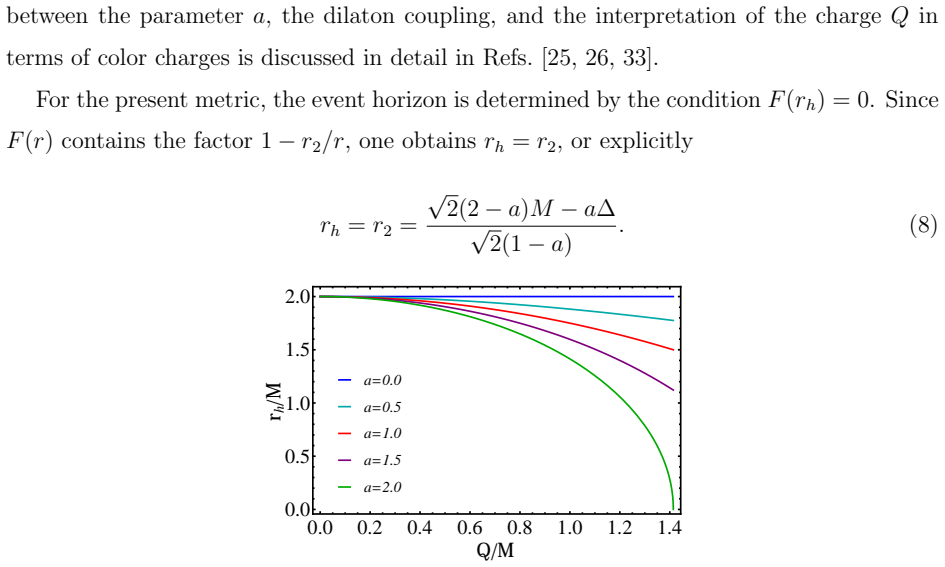
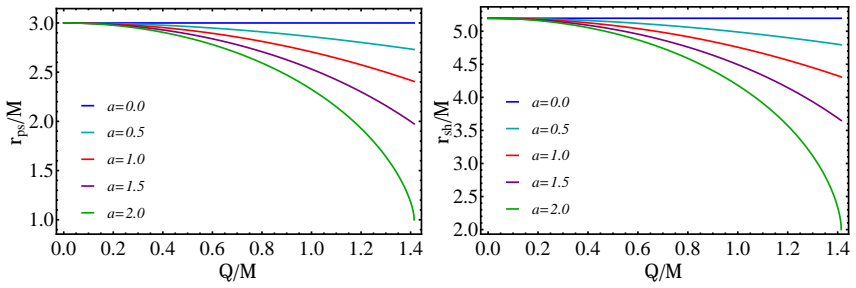
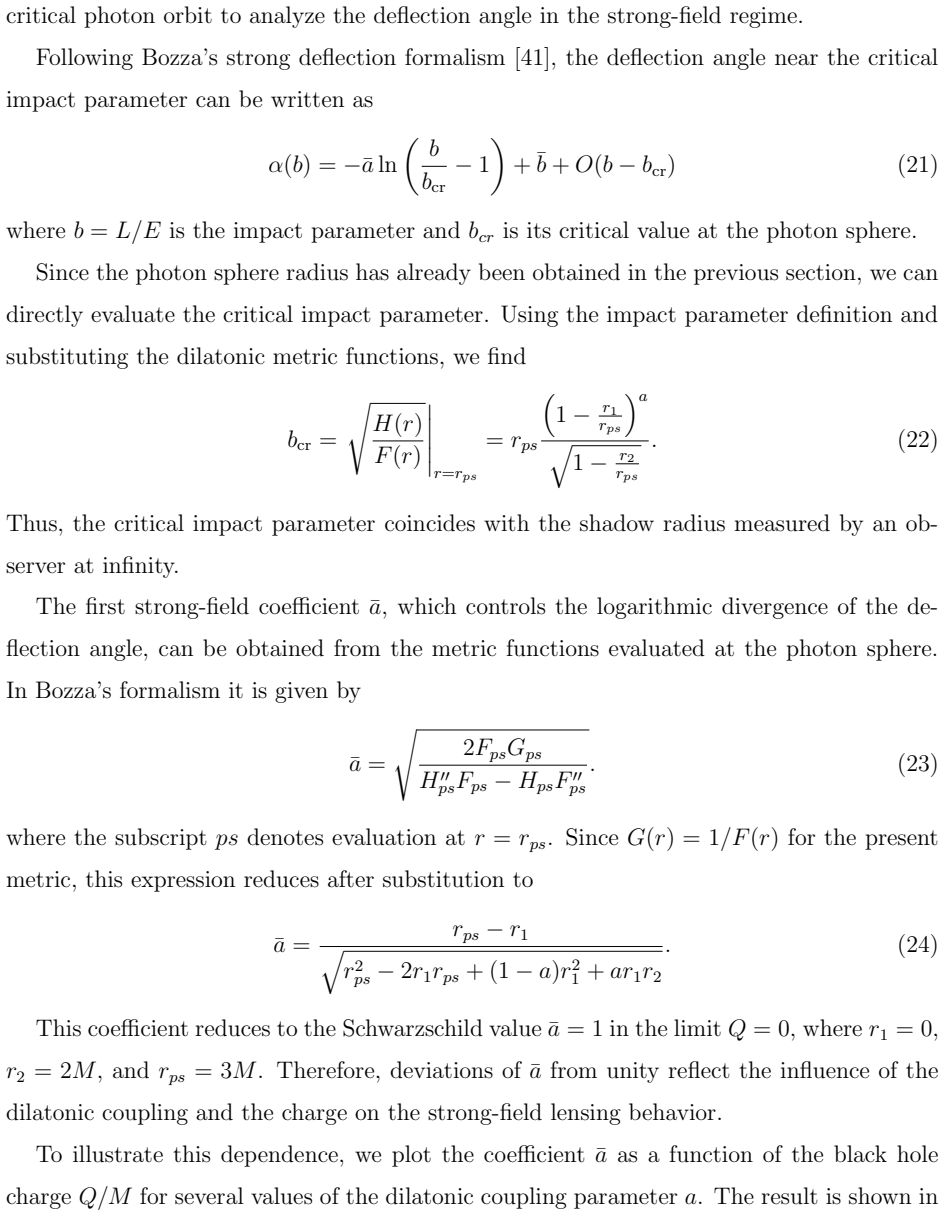
Increasing charge and dilatonic coupling shrinks the shadow radius of a black hole.
A machine-rendered reading of the paper's core claim, the machinery that carries it, and where it could break.
Core claim
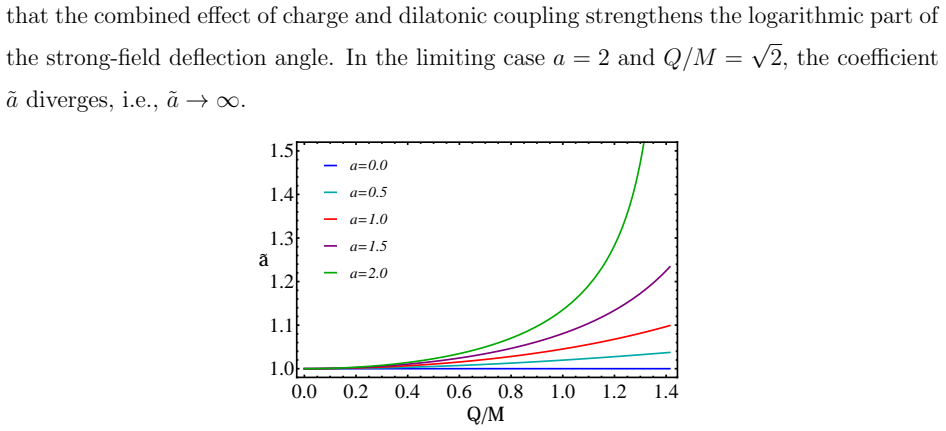
In the dyon-like dilatonic black hole spacetime the photon-sphere radius, critical impact parameter and shadow radius all become smaller when the charge Q or the dilatonic coupling a is increased. Consequently the angular size of the shadow is reduced relative to the Schwarzschild case. The model parameters are bounded by requiring that the predicted angular diameters match the Event Horizon Telescope data for M87* and SgrA*. The high-frequency energy emission rate follows from the critical impact parameter in the geometric-optics approximation, and the leading Bozza coefficient ā is obtained for the strong-field deflection angle.
What carries the argument
The static spherically symmetric dyon-like dilatonic metric, whose parameters Q and a control the size of the photon sphere and the boundary of the shadow formed by unstable light orbits.
If this is right
- Shadow radius decreases with increasing Q and a.
- Angular diameter constraints from M87* and SgrA* limit allowed values of Q and a.
- High-frequency energy emission rate is determined by the critical impact parameter.
- The strong deflection angle exhibits logarithmic divergence characterized by the coefficient ā that depends on Q and a.
Where Pith is reading between the lines
- Future observations with improved angular resolution could further tighten or rule out ranges of the dilatonic parameters.
- Rotating versions of the dilatonic solution would be needed to compare with the spin of real black holes.
- Multi-messenger data on emission could test the geometric-optics emission estimates independently of the shadow size.
Load-bearing premise
The spacetime around real astrophysical black holes is accurately described by the static spherically symmetric dyon-like dilatonic metric so that shadow radii can be compared directly to observed angular diameters.
What would settle it
An observed angular diameter for M87* or SgrA* that cannot be reproduced by any values of Q and a within the model.
Figures


read the original abstract
We study the shadow and strong-field optical properties of a static, spherically symmetric dyon-like dilatonic black hole. The photon sphere radius, critical impact parameter, and shadow radius are obtained and analyzed in terms of the charge $Q$ and the dilatonic coupling parameter $a$. We show that increasing these parameters decreases the photon sphere and shadow radii, leading to a smaller apparent shadow. The predicted angular diameter is compared with the observational data for M87$^{*}$ and SgrA$^{*}$, and the model parameters are constrained. We also estimate the high-frequency energy emission rate in the geometric-optics approximation and derive the leading Bozza coefficient $\bar{a}$, which characterizes the logarithmic behavior of the deflection angle in the strong-field regime. Astrophysical implication of the obtained outcomes are discussed.
Editorial analysis
A structured set of objections, weighed in public.
Referee Report
Summary. The manuscript studies the shadow, emission, and strong-field lensing of a static spherically symmetric dyon-like dilatonic black hole. It derives the photon sphere radius, critical impact parameter b_c, and shadow radius as functions of charge Q and dilatonic coupling a, showing that both radii decrease with increasing Q and a. The predicted angular diameter θ = 2 b_c / D is compared to EHT data for M87* and SgrA* to constrain the parameters. It also estimates the high-frequency energy emission rate in the geometric-optics limit and computes the leading Bozza coefficient ā for the strong-field deflection angle.
Significance. If the direct vacuum-to-observation mapping holds, the work supplies explicit analytical expressions for shadow observables in dilatonic gravity and places bounds on Q and a from existing EHT angular-diameter measurements. The emission-rate estimate and ā coefficient are concrete, reusable results. The significance is reduced because the reported constraints are obtained by fitting Q and a to the same data used for comparison rather than by independent prediction, and the static spherical metric is applied without quantitative assessment of spin or plasma corrections.
major comments (3)
- [Observational comparison] Observational comparison (abstract and final section): the bounds on Q and a are obtained by equating the vacuum critical impact parameter b_c to the observed angular diameters via θ = 2 b_c / D. This procedure renders the constraints data-dependent fits rather than falsifiable predictions independent of the EHT measurements; no error propagation or sensitivity analysis to the assumed distance D is shown.
- [Photon sphere and shadow radius] Photon-sphere and shadow calculation (section deriving r_ph and b_c): the central claim that increasing Q and a decreases the shadow relies on the geodesic expressions for the unstable null orbit. The manuscript must display the explicit steps from the metric line element through the effective potential to the final formulae for r_ph(Q,a) and b_c(Q,a) so that the claimed monotonic decrease can be verified without post-hoc adjustment.
- [Astrophysical implications] Applicability to real black holes (discussion of astrophysical implications): the direct use of the static spherical metric to interpret EHT angular diameters assumes that frame-dragging, disk emission, and refractive plasma effects shift the apparent boundary by less than the EHT uncertainty. No quantitative estimate of these corrections is provided, yet they are comparable in size to the reported parameter bounds and therefore load-bearing for the constraints.
minor comments (2)
- [Metric and field equations] The notation for the dilatonic coupling a should be introduced with an explicit reference to the action or field equations in the metric section to prevent confusion with the spin parameter used in other shadow papers.
- [Figures] Figure captions for the shadow-radius plots should state the fixed values of M and the range of a used, and should include the Schwarzschild and Reissner-Nordström limits for direct visual comparison.
Simulated Author's Rebuttal
We thank the referee for the constructive comments on our manuscript. We address each major comment point by point below and indicate the corresponding revisions.
read point-by-point responses
-
Referee: [Observational comparison] Observational comparison (abstract and final section): the bounds on Q and a are obtained by equating the vacuum critical impact parameter b_c to the observed angular diameters via θ = 2 b_c / D. This procedure renders the constraints data-dependent fits rather than falsifiable predictions independent of the EHT measurements; no error propagation or sensitivity analysis to the assumed distance D is shown.
Authors: We acknowledge that the reported constraints on Q and a are obtained by direct comparison to EHT angular-diameter data. This is standard for placing bounds in such models, but to address the concern we will add explicit error propagation on θ and a sensitivity analysis to variations in D within its observational range in the revised manuscript. revision: yes
-
Referee: [Photon sphere and shadow radius] Photon-sphere and shadow calculation (section deriving r_ph and b_c): the central claim that increasing Q and a decreases the shadow relies on the geodesic expressions for the unstable null orbit. The manuscript must display the explicit steps from the metric line element through the effective potential to the final formulae for r_ph(Q,a) and b_c(Q,a) so that the claimed monotonic decrease can be verified without post-hoc adjustment.
Authors: The expressions for r_ph and b_c are derived from the conditions V_eff = 0 and dV_eff/dr = 0 on the effective potential for null geodesics. To improve verifiability we will expand the relevant section to include all intermediate algebraic steps from the line element to the final closed-form expressions for r_ph(Q,a) and b_c(Q,a). revision: yes
-
Referee: [Astrophysical implications] Applicability to real black holes (discussion of astrophysical implications): the direct use of the static spherical metric to interpret EHT angular diameters assumes that frame-dragging, disk emission, and refractive plasma effects shift the apparent boundary by less than the EHT uncertainty. No quantitative estimate of these corrections is provided, yet they are comparable in size to the reported parameter bounds and therefore load-bearing for the constraints.
Authors: We agree that spin, disk, and plasma corrections can be comparable to the reported bounds. A quantitative assessment would require full numerical ray-tracing in GRMHD, which lies outside the scope of this analytic vacuum study. In revision we will add an explicit discussion of these limitations and state that the constraints apply strictly within the static spherical vacuum approximation. revision: partial
Circularity Check
No significant circularity; standard geodesic derivation compared to external EHT data.
full rationale
The paper derives photon-sphere radius, critical impact parameter, and shadow radius from the given static spherically symmetric metric via standard null geodesic equations. These expressions depend on Q and a by construction of the metric, but the subsequent step compares the resulting angular diameter θ = 2 b_c / D against independent observational values for M87* and Sgr A* to obtain constraints on Q and a. This is ordinary model fitting to external benchmarks rather than any self-definitional loop, fitted-input-renamed-as-prediction, or self-citation chain. No load-bearing premise reduces to the paper's own inputs by definition.
Axiom & Free-Parameter Ledger
free parameters (2)
- charge Q
- dilatonic coupling a
axioms (2)
- domain assumption The spacetime is described by the static spherically symmetric dyon-like dilatonic black hole metric
- domain assumption The geometric-optics approximation is valid for estimating the high-frequency energy emission rate
Reference graph
Works this paper leans on
-
[1]
First m87 event horizon telescope results
K. Akiyama, et al., Astrophys. J. Lett.875, L1 (2019). DOI 10.3847/2041-8213/ab0ec7
-
[2]
K. Akiyama, et al., Astrophys. J. Lett.930(2), L12 (2022). DOI 10.3847/2041-8213/ac6674
-
[3]
Luminet, Astronomy & Astrophysics75, 228 (1979)
J.P. Luminet, Astronomy & Astrophysics75, 228 (1979)
1979
-
[4]
Bardeen, B
J.M. Bardeen, B. Carter, S.W. Hawking, Communications in mathematical physics31(2), 161 (1973)
1973
-
[5]
Cunha, C.A
P.V. Cunha, C.A. Herdeiro, General Relativity and Gravitation50(4), 42 (2018)
2018
-
[7]
Bambi,Black holes: a laboratory for testing strong gravity, vol
C. Bambi,Black holes: a laboratory for testing strong gravity, vol. 10 (Springer, 2017)
2017
-
[8]
Cardoso, P
V. Cardoso, P. Pani, Living Reviews in Relativity22(1), 4 (2019) 15
2019
-
[9]
Bronnikov, G.N
K.A. Bronnikov, G.N. Shikin, Soviet Physics Journal20(9), 1138 (1977). DOI 10.1007/ BF00897114
1977
-
[10]
Gibbons, D.L
G.W. Gibbons, D.L. Wiltshire, Nuclear Physics B287, 717 (1987). DOI 10.1016/ 0550-3213(87)90125-8
1987
-
[11]
Gibbons, K.I
G.W. Gibbons, K.I. Maeda, Nuclear Physics B298(4), 741 (1988). DOI 10.1016/ 0550-3213(88)90006-5
1988
-
[12]
Garfinkle, G.T
D. Garfinkle, G.T. Horowitz, A. Strominger, Phys. Rev. D43(10), 3140 (1991). DOI 10.1103/ PhysRevD.43.3140
1991
-
[13]
G.J. Cheng, R.R. Hsu, W.F. Lin, J. Math. Phys.35, 4839 (1994). DOI 10.1063/1.530817
-
[14]
U. Bleyer, V.N. Melnikov, K.A. Bronnikov, S.B. Fadeev, Astronomische Nachrichten315(6), 399 (1994). DOI 10.1002/asna.2103150602
-
[15]
Bleyer, V.D
U. Bleyer, V.D. Ivashchuk, Physics Letters B332(3-4), 292 (1994). DOI 10.1016/ 0370-2693(94)91256-4
1994
-
[16]
S.J. Poletti, J. Twamley, D.L. Wiltshire, Classical and Quantum Gravity12(7), 1753 (1995). DOI 10.1088/0264-9381/12/7/017
-
[17]
ON SPHERICALLY SYMMETRIC SOLUTIONS IN D-DIMENSIONAL DILATON GRAVITY
K.A. Bronnikov, Gravitation and Cosmology1, 67 (1995). DOI 10.48550/arXiv.gr-qc/9505020
work page internal anchor Pith review Pith/arXiv arXiv doi:10.48550/arxiv.gr-qc/9505020 1995
-
[18]
V.D. Ivashchuk, V.N. Melnikov, Classical and Quantum Gravity17(10), 2073 (2000). DOI 10.1088/0264-9381/17/10/303
-
[19]
H. L¨ u, W. Yang, Class. Quant. Grav.30, 235021 (2013). DOI 10.1088/0264-9381/30/23/ 235021
-
[20]
Ivashchuk, Journal of Geometry and Physics86, 101 (2014)
V.D. Ivashchuk, Journal of Geometry and Physics86, 101 (2014). DOI 10.1016/j.geomphys. 2014.07.015
-
[21]
M.E. Abishev, K.A. Boshkayev, V.D. Dzhunushaliev, V.D. Ivashchuk, Classical and Quantum Gravity32(16), 165010 (2015). DOI 10.1088/0264-9381/32/16/165010
-
[22]
M.E. Abishev, K.A. Boshkayev, V.D. Ivashchuk, European Physical Journal C77(3), 180 (2017). DOI 10.1140/epjc/s10052-017-4749-1
-
[23]
M.E. Abishev, V.D. Ivashchuk, A.N. Malybayev, S. Toktarbay, Gravitation and Cosmology 25(4), 374 (2019). DOI 10.1134/S0202289319040029
-
[24]
A. Zadora, D.V. Gal’tsov, C.M. Chen, Physics Letters B779, 249 (2018). DOI 10.1016/j. physletb.2018.02.017
work page doi:10.1016/j 2018
-
[25]
Malybayev, K
A. Malybayev, K. Boshkayev, V. Ivashchuk, The European Physical Journal C81(5), 475 16 (2021)
2021
-
[26]
Boshkayev, G
K. Boshkayev, G. Suliyeva, V. Ivashchuk, A. Urazalina, The European Physical Journal C 84(1), 19 (2024)
2024
-
[27]
K. Boshkayev, G. Takey, V.D. Ivashchuk, A.N. Malybayev, G.S. Nurbakova, A. Urazalina, Physics of the Dark Universe48, 101862 (2025). DOI 10.1016/j.dark.2025.101862
-
[28]
V.D. Ivashchuk, U.S. Kayumov, A.N. Malybayev, G.S. Nurbakova, Gravitation and Cosmology 31(4), 591 (2025). DOI 10.1134/S0202289325700471
-
[29]
V.D. Ivashchuk, A.N. Malybayev, G.S. Nurbakova, G. Takey, Gravitation and Cosmology 29(4), 411 (2023). DOI 10.1134/S0202289323040114
-
[30]
Boshkayev, inJournal of Physics Conference Series,Journal of Physics Conference Series, vol
K. Boshkayev, inJournal of Physics Conference Series,Journal of Physics Conference Series, vol. 3089 (IOP, 2025),Journal of Physics Conference Series, vol. 3089, p. 012012. DOI 10.1088/1742-6596/3089/1/012012
-
[31]
A. Sen, Phys. Rev. Lett.69(7), 1006 (1992). DOI 10.1103/PhysRevLett.69.1006
-
[32]
Boshkayev, M
K. Boshkayev, M. Muccino, European Physical Journal C85(12), 1477 (2025). DOI 10.1140/ epjc/s10052-025-15167-w
2025
-
[33]
F.B. Belissarova, K.A. Boshkayev, V.D. Ivashchuk, A.N. Malybayev, inJournal of Physics Conference Series,Journal of Physics Conference Series, vol. 1690 (IOP, 2020),Journal of Physics Conference Series, vol. 1690, p. 012143. DOI 10.1088/1742-6596/1690/1/012143
-
[34]
Z. Beisenbekova, A. Urazalina, M. Khassanov, D. Utepova, H. Quevedo, International Journal of Mathematics and Physics17(1), 65–73 (2026). DOI 10.26577/ijmph.20261716
-
[35]
M. Khodadi, G. Lambiase, Phys. Rev. D106(10), 104050 (2022). DOI 10.1103/PhysRevD. 106.104050
-
[36]
Bernardo, C.Y
R.C. Bernardo, C.Y. Chen, General Relativity and Gravitation55(1), 23 (2023)
2023
-
[37]
V. Perlick, O.Y. Tsupko, ”Physics Reports”947, 1 (2022). DOI 10.1016/j.physrep.2021.10.004
-
[38]
Banerjee, S
I. Banerjee, S. Chakraborty, S. SenGupta, Phys. Rev. D101(4), 041301 (2020). DOI 10.1103/ PhysRevD.101.041301
2020
-
[39]
Wei, Y.X
S.W. Wei, Y.X. Liu, Physical Review D101(10), 104018 (2020)
2020
-
[40]
S.W. Wei, Y.X. Liu, JCAP11, 063 (2013). DOI 10.1088/1475-7516/2013/11/063
-
[41]
Bozza, Physical Review D66(10), 103001 (2002)
V. Bozza, Physical Review D66(10), 103001 (2002)
2002
-
[42]
M. Azreg-A¨ ınou, Phys. Rev. D90(6), 064041 (2014). DOI 10.1103/PhysRevD.90.064041
-
[43]
M. Azreg-A¨ ınou, European Physical Journal C74(5), 2865 (2014). DOI 10.1140/epjc/ 17 s10052-014-2865-8
-
[44]
Azreg-A¨ ınou, Physics Letters B730, 95 (2014)
M. Azreg-A¨ ınou, Physics Letters B730, 95 (2014). DOI 10.1016/j.physletb.2014.01.041 18
discussion (0)
Sign in with ORCID, Apple, or X to comment. Anyone can read and Pith papers without signing in.