From Period Finding to Lattice Sampling: Experimental Insights into Shor's and Regev's Factoring Algorithms
Pith reviewed 2026-06-27 00:37 UTC · model grok-4.3
The pith
Experiments on N=15 show Shor's and Regev's factoring algorithms respond differently to NISQ noise but neither gains a practical edge.
A machine-rendered reading of the paper's core claim, the machinery that carries it, and where it could break.
Core claim
Parallel execution of the quantum circuits for Shor's and Regev's factoring algorithms on the same NISQ hardware for N=15 reveals distinct patterns of interaction with noise that trace back to their respective one- and higher-dimensional Fourier sampling strategies, without either algorithm showing a clear practical advantage in the small-N regime.
What carries the argument
The side-by-side hardware execution and noise-response comparison of the two factoring circuits, each encoding arithmetic via Fourier sampling in a different number of dimensions.
If this is right
- Differences in dimensional structure of Fourier sampling produce measurable differences in how each algorithm degrades under NISQ noise.
- Neither algorithm yet shows a practical factoring advantage on current devices for N=15.
- Experimental benchmarking of alternative factoring algorithms can expose which design choices affect real-device behavior.
- Failure-mode data from these runs can inform choices between algorithms or motivate hybrid approaches on NISQ hardware.
Where Pith is reading between the lines
- Regev's higher-dimensional sampling may exhibit different scaling of noise tolerance once hardware error rates drop below current levels.
- Similar head-to-head hardware tests could be applied to other quantum algorithms whose theoretical resource trade-offs differ.
- The absence of advantage at small N implies that any eventual superiority will appear only after hardware reaches a threshold size or coherence time.
- Error-mitigation techniques could be tested selectively on the more noise-sensitive steps of each algorithm to see whether the robustness gap narrows.
Load-bearing premise
The implementations of both algorithms were compiled and run on the hardware without hidden compilation, calibration, or sampling errors that would distort the noise comparison.
What would settle it
A follow-up run on the same or comparable hardware in which one algorithm consistently produces higher success probability or lower effective error rate than the other across multiple N values while matching ideal simulation more closely.
Figures

read the original abstract
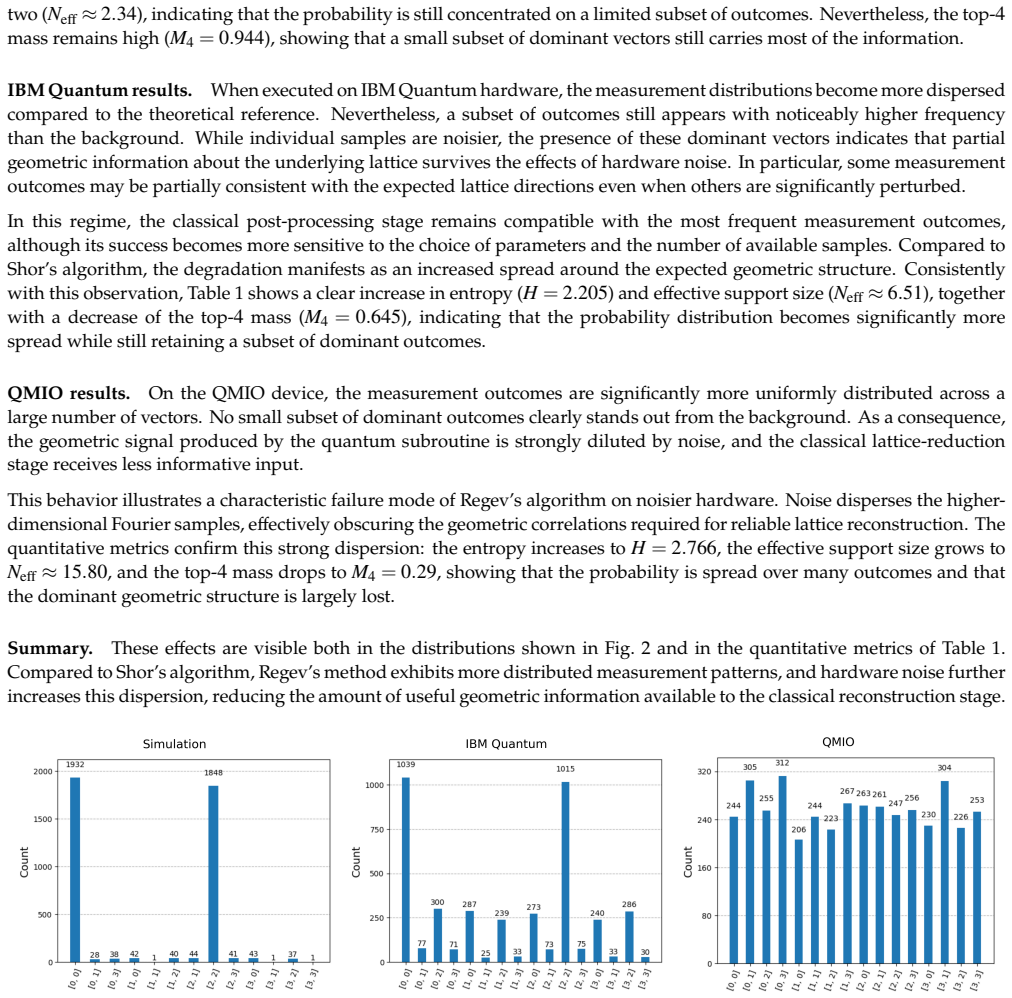
Quantum algorithms for integer factorization represent one of the most prominent applications of quantum computation, with far-reaching implications for modern cryptography. While Shor's algorithm provides a polynomial-time solution in the ideal quantum model, its practical implementation is severely constrained by the limitations of current noisy intermediate-scale quantum (NISQ) hardware. These constraints have motivated the exploration of alternative factoring algorithms with different structural and resource trade-offs. In this work, we present an experimental study of Regev's quantum factoring algorithm, implemented on real quantum hardware, and compare its behavior with that of Shor's algorithm under analogous conditions. Focusing on the case N = 15, we execute both algorithms on the QMIO quantum computer at the Centro de Supercomputacion de Galicia (CESGA) and contrast the results with one of IBM's open-access quantum computers and ideal simulations. This parallel execution enables a low-level comparison of the two algorithms, highlighting how their respective quantum implementations interact with hardware noise, limited circuit depth, and finite sampling. Our analysis emphasizes the different ways in which Shor's and Regev's algorithms encode arithmetic structure into quantum states through Fourier sampling in one and higher dimensions, respectively, and how these differences manifest in experimental outcomes. Although neither algorithm demonstrates a practical advantage in the small N regime, the results provide insight into their relative robustness and failure modes on contemporary quantum devices. This study illustrates the value of experimental benchmarking of alternative quantum factoring algorithms as a means of understanding the practical implications of algorithmic design choices in the NISQ era.
Editorial analysis
A structured set of objections, weighed in public.
Referee Report
Summary. The manuscript presents an experimental study comparing Shor's and Regev's quantum factoring algorithms for the case N=15. Both are executed on the QMIO quantum computer and an IBM device, with results contrasted against ideal simulations to analyze how their respective Fourier sampling methods (one-dimensional vs. higher-dimensional) interact with hardware noise and limited circuit depth.
Significance. If the reported executions accurately reflect the theoretical algorithms without unaccounted implementation discrepancies, the study provides useful empirical data on the relative robustness of these algorithms on contemporary NISQ hardware, informing algorithmic design choices beyond theoretical resource counts.
major comments (2)
- [Abstract] Abstract: the central claim that the experiments yield insight into relative robustness and failure modes requires that observed differences arise from the algorithmic distinction (1D Fourier sampling vs higher-dimensional lattice sampling) rather than from differences in circuit compilation, qubit mapping, gate decomposition, or sampling strategy; no such implementation details are provided, rendering the attribution unverifiable.
- [Results/Methods (implied by abstract claims)] Experimental execution description: no error bars, raw data, shot counts, or circuit resource metrics (depth, gate count) are reported for the QMIO or IBM runs, which is load-bearing for any claim of comparative robustness on real hardware.
minor comments (1)
- [Abstract] Abstract: the term 'analogous conditions' is imprecise and should be replaced by explicit statements of the circuit depths, qubit counts, and sampling parameters used for each algorithm.
Simulated Author's Rebuttal
We thank the referee for the constructive feedback highlighting the need for implementation transparency and quantitative metrics. We address each major comment below and will revise the manuscript to incorporate the requested details, strengthening the verifiability of our claims regarding algorithmic robustness.
read point-by-point responses
-
Referee: [Abstract] Abstract: the central claim that the experiments yield insight into relative robustness and failure modes requires that observed differences arise from the algorithmic distinction (1D Fourier sampling vs higher-dimensional lattice sampling) rather than from differences in circuit compilation, qubit mapping, gate decomposition, or sampling strategy; no such implementation details are provided, rendering the attribution unverifiable.
Authors: We agree that explicit implementation details are required to attribute observed differences to the 1D versus higher-dimensional Fourier sampling rather than to compilation or mapping choices. In the revised manuscript, we will add a new subsection (likely under Methods or a dedicated Implementation Details section) that specifies the qubit mapping strategies, gate decompositions, compilation passes, and sampling procedures applied to both algorithms on the QMIO and IBM hardware. This will allow independent verification that the reported robustness differences originate from the algorithmic structure. revision: yes
-
Referee: [Results/Methods (implied by abstract claims)] Experimental execution description: no error bars, raw data, shot counts, or circuit resource metrics (depth, gate count) are reported for the QMIO or IBM runs, which is load-bearing for any claim of comparative robustness on real hardware.
Authors: We concur that the absence of these quantitative elements limits the strength of hardware-robustness claims. The revised manuscript will include: (i) shot counts for all QMIO and IBM executions, (ii) error bars on all reported success probabilities and sampled distributions, (iii) tables listing circuit depth and two-qubit gate counts for the compiled circuits of both algorithms, and (iv) a statement on data availability (raw counts or a repository link where feasible). These additions will be placed in the Results section and supplementary material. revision: yes
Circularity Check
No circularity: experimental benchmarking with no derivation chain
full rationale
The manuscript is an experimental study executing Shor's and Regev's circuits for N=15 on QMIO and IBM hardware, comparing noise responses and failure modes. No theoretical derivation, first-principles prediction, or parameter fit is claimed; the central statements concern observed hardware outcomes and their attribution to algorithmic structure (1D vs. higher-dimensional Fourier sampling). Because the work contains no equations or claims that reduce by construction to fitted inputs, self-citations, or ansatzes, the derivation chain is empty and the result is self-contained against external hardware benchmarks.
Axiom & Free-Parameter Ledger
axioms (1)
- domain assumption Quantum hardware can faithfully execute the compiled circuits for both algorithms under the stated noise and depth constraints
Reference graph
Works this paper leans on
-
[1]
Peter W. Shor. Polynomial-time algorithms for prime factorization and discrete logarithms on a quantum computer. SIAM Journal on Computing, 26(5):1484–1509, October 1997
1997
-
[2]
Modifying shor’s algorithm to compute short discrete logarithms
Martin Ekerå. Modifying shor’s algorithm to compute short discrete logarithms. Cryptology ePrint Archive, Paper 2016/1128, 2016
2016
-
[3]
Cybersecurityinanerawithquantumcomputers: Willwebeready?IEEESecurity&Privacy,16:38–41, 09 2018
MicheleMosca. Cybersecurityinanerawithquantumcomputers: Willwebeready?IEEESecurity&Privacy,16:38–41, 09 2018
2018
-
[4]
The future of cybersecurity in the age of quantum computers.Future Internet, 14(11):335, 2022
Fazal Raheman. The future of cybersecurity in the age of quantum computers.Future Internet, 14(11):335, 2022
2022
-
[5]
How to factor 2048 bit rsa integers in 8 hours using 20 million noisy qubits.Quantum, 5:433, 2021
Craig Gidney and Martin Ekerå. How to factor 2048 bit rsa integers in 8 hours using 20 million noisy qubits.Quantum, 5:433, 2021
2048
-
[6]
Space-efficient and noise-robust quantum factoring.arXiv preprint arXiv:2304.00662, 2023
Craig Gidney. Space-efficient and noise-robust quantum factoring.arXiv preprint arXiv:2304.00662, 2023
arXiv 2023
-
[7]
Circuit for shor’s algorithm using 2n+3 qubits, 2003
Stephane Beauregard. Circuit for shor’s algorithm using 2n+3 qubits, 2003
2003
-
[8]
Stephen Parker and Martin B. Plenio. Efficient factorization with a single pure qubit and lognmixed qubits.Physical Review Letters, 85(14):3049–3052, 2000. arXiv:quant-ph/0001066
Pith/arXiv arXiv 2000
-
[9]
Quantum computing in the nisq era and beyond.Quantum, 2:79, August 2018
John Preskill. Quantum computing in the nisq era and beyond.Quantum, 2:79, August 2018
2018
-
[10]
An efficient quantum factoring algorithm.arXiv preprint arXiv:2308.06572, 2023
Oded Regev. An efficient quantum factoring algorithm.arXiv preprint arXiv:2308.06572, 2023
arXiv 2023
-
[11]
A comprehensive analysis of regev’s quantum algorithm
Razvan Barbulescu, Mugurel Barcau, and Vicentiu Pasol. A comprehensive analysis of regev’s quantum algorithm. Cryptology ePrint Archive, Paper 2024/1758, 2024
2024
-
[12]
Cryptology ePrint Archive, Paper 2024/629, 2024
CédricPilatte.Unconditionalcorrectnessofrecentquantumalgorithmsforfactoringandcomputingdiscretelogarithms. Cryptology ePrint Archive, Paper 2024/629, 2024
2024
-
[13]
Implementation and analysis of regev’s quantum factorization algorithm, 2025
Przemysław Pawlitko, Natalia Moćko, Marcin Niemiec, and Piotr Chołda. Implementation and analysis of regev’s quantum factorization algorithm, 2025
2025
-
[14]
Przemysław Pawlitko, Natalia Moćko, Marcin Niemiec, and Piotr Chołda. Implementation and analysis of regev’s quantum factorization algorithm.arXiv preprint arXiv:2502.09772, 2025. 10
Pith/arXiv arXiv 2025
discussion (0)
Sign in with ORCID, Apple, or X to comment. Anyone can read and Pith papers without signing in.