Probing the QCD Phase Structure with Dileptons from SIS to LHC Energies
Pith reviewed 2026-06-26 22:09 UTC · model grok-4.3
The pith
Thermal QGP dilepton radiation exceeds charm decays below 25-30 GeV in central Au+Au collisions.
A machine-rendered reading of the paper's core claim, the machinery that carries it, and where it could break.
Core claim
The equilibrium QGP is described within the Dynamical QuasiParticle Model (DQPM), which reproduces the lattice-QCD equation of state and provides μ_B-dependent quasiparticle properties, transport coefficients, and thermal dilepton rates, including elastic and inelastic partonic processes. The dynamical evolution is modeled with the off-shell Parton-Hadron-String Dynamics (PHSD) transport approach, which consistently propagates partonic and hadronic degrees of freedom and incorporates chiral-symmetry restoration effects. A small deconfined QGP core can already emerge at √s_NN ≃ 3.5 GeV. The excitation function indicates that thermal QGP radiation can exceed dileptons from correlated charm dec
What carries the argument
The Dynamical QuasiParticle Model (DQPM) supplying μ_B-dependent thermal dilepton rates, embedded in the PHSD transport approach for dynamical evolution of partonic and hadronic degrees of freedom.
If this is right
- A deconfined QGP core forms already at √s_NN ≃ 3.5 GeV.
- The baryon-chemical-potential dependence of QGP dilepton radiation grows stronger toward lower collision energies.
- RHIC beam-energy-scan and FAIR energies are the most favorable for isolating electromagnetic signals from the QGP.
- Direct observation of QGP radiation becomes feasible once heavy-flavor and Drell-Yan backgrounds are subtracted.
Where Pith is reading between the lines
- Dilepton spectra at these energies could serve as a practical probe for locating the onset of deconfinement in the QCD phase diagram.
- The same framework might be used to test how chiral symmetry restoration alters dilepton emission rates in the hadronic phase.
- Extending the calculation to even lower SIS energies would predict whether a measurable QGP signal persists below 3.5 GeV.
Load-bearing premise
The DQPM supplies accurate μ_B-dependent quasiparticle properties and thermal dilepton rates that match lattice QCD, while PHSD correctly propagates these degrees of freedom and includes chiral-symmetry restoration.
What would settle it
An experimental measurement at √s_NN ≈ 25 GeV showing that, after standard subtraction of charm and Drell-Yan contributions, the remaining dilepton yield lies below the calculated QGP thermal rate would falsify the dominance claim.
Figures

read the original abstract
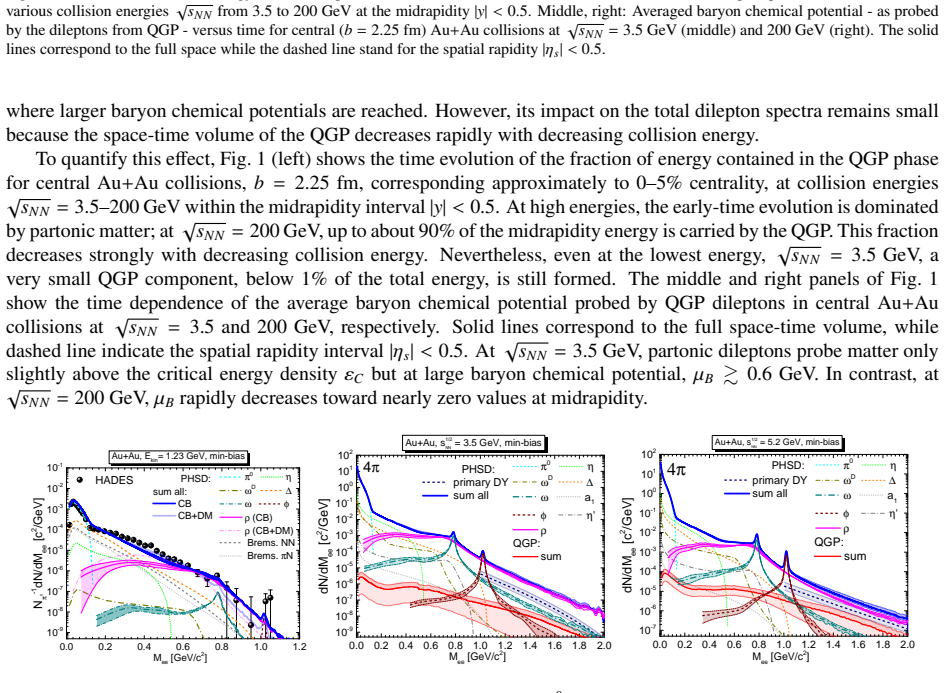
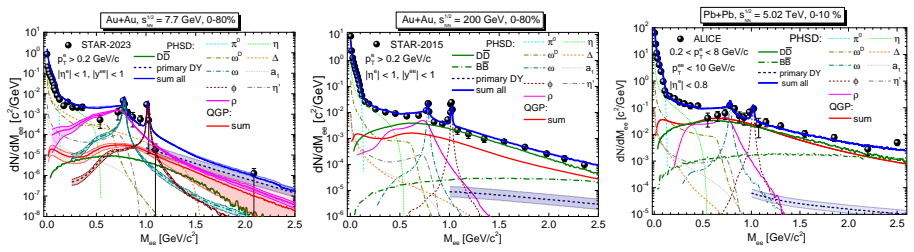
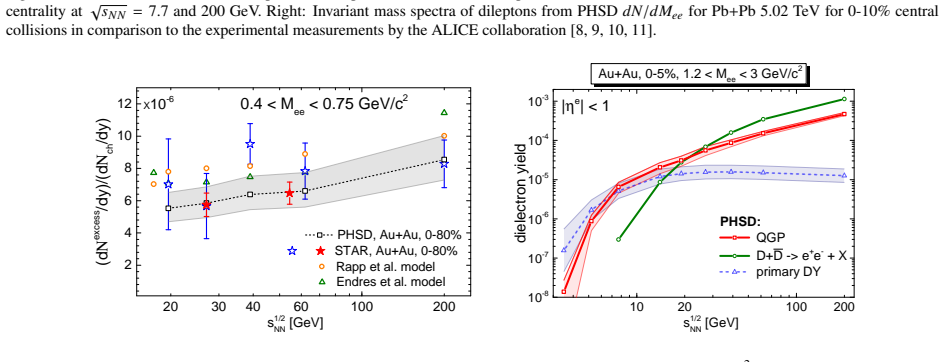
We study the properties of strongly interacting matter at finite temperature and baryon chemical potential in relativistic heavy-ion collisions, with emphasis on dilepton probes of the QCD phase structure. The equilibrium QGP is described within the Dynamical QuasiParticle Model (DQPM), which reproduces the lattice-QCD equation of state and provides $\mu_B$-dependent quasiparticle properties, transport coefficients, and thermal dilepton rates, including elastic and inelastic partonic processes. The dynamical evolution is modeled with the off-shell Parton--Hadron--String Dynamics (PHSD) transport approach, which consistently propagates partonic and hadronic degrees of freedom and incorporates chiral-symmetry restoration effects. We discuss the space--time evolution of heavy-ion collisions over a broad energy range and show that a small deconfined QGP core can already emerge at $\sqrt{s_{NN}}\simeq 3.5$ GeV. We present, for the first time, the baryon-chemical-potential dependence of QGP thermal dilepton radiation in PHSD and demonstrate that its influence increases toward lower collision energies. The excitation function indicates that thermal QGP radiation can exceed dileptons from correlated charm decays in central Au+Au collisions at $\sqrt{s_{NN}}\lesssim 25$--$30$ GeV, making RHIC--BES and FAIR energies particularly promising for the direct observation of QGP electromagnetic radiation after subtraction of heavy-flavor and Drell--Yan contributions.
Editorial analysis
A structured set of objections, weighed in public.
Referee Report
Summary. The manuscript investigates dilepton production as a probe of the QCD phase structure in heavy-ion collisions from SIS to LHC energies. It employs the Dynamical QuasiParticle Model (DQPM) to describe the equilibrium QGP, which reproduces the lattice-QCD equation of state and supplies μ_B-dependent quasiparticle properties, transport coefficients, and thermal dilepton rates including elastic and inelastic partonic processes. The dynamical evolution is handled by the off-shell Parton-Hadron-String Dynamics (PHSD) transport approach, which propagates partonic and hadronic degrees of freedom and incorporates chiral-symmetry restoration. Key results include the emergence of a small deconfined QGP core at √s_NN ≃ 3.5 GeV, the increasing influence of μ_B dependence toward lower energies, and the excitation function showing that thermal QGP radiation can exceed dileptons from correlated charm decays in central Au+Au collisions at √s_NN ≲ 25--30 GeV, making RHIC-BES and FAIR energies promising for direct observation of QGP electromagnetic radiation after subtraction of heavy-flavor and Drell-Yan contributions.
Significance. If the central claim holds, the work supplies a broad excitation function for dilepton yields that identifies specific energies where QGP thermal radiation may become experimentally accessible after standard subtractions. The consistent off-shell propagation in PHSD and the explicit μ_B-dependent QGP rates constitute a coherent dynamical framework spanning more than an order of magnitude in collision energy. Credit is due for the first explicit presentation of the μ_B dependence of QGP thermal dilepton radiation within the PHSD approach.
major comments (1)
- [Abstract] Abstract (and the DQPM/PHSD rate implementation): The claim that thermal QGP radiation exceeds correlated charm decays for √s_NN ≲ 25--30 GeV is load-bearing for the recommendation of RHIC-BES and FAIR energies. This crossing point is determined by the DQPM thermal dilepton rates (elastic + inelastic) at finite μ_B. Because DQPM quasiparticle parameters are adjusted to reproduce the lattice-QCD equation of state, the μ_B dependence of the electromagnetic emissivity at μ_B ~ 300--600 MeV lacks independent validation; an overestimate of the QGP rate by a factor of ~2 would shift the reported crossing point to higher energies.
minor comments (1)
- [Abstract] Abstract: the phrase 'for the first time' is used for the μ_B dependence; a brief comparison to earlier PHSD dilepton studies would clarify the precise novelty.
Simulated Author's Rebuttal
We thank the referee for the careful reading of our manuscript and the constructive comments. We address the single major comment below and have revised the manuscript accordingly.
read point-by-point responses
-
Referee: [Abstract] Abstract (and the DQPM/PHSD rate implementation): The claim that thermal QGP radiation exceeds correlated charm decays for √s_NN ≲ 25--30 GeV is load-bearing for the recommendation of RHIC-BES and FAIR energies. This crossing point is determined by the DQPM thermal dilepton rates (elastic + inelastic) at finite μ_B. Because DQPM quasiparticle parameters are adjusted to reproduce the lattice-QCD equation of state, the μ_B dependence of the electromagnetic emissivity at μ_B ~ 300--600 MeV lacks independent validation; an overestimate of the QGP rate by a factor of ~2 would shift the reported crossing point to higher energies.
Authors: We agree that the reported crossing energy is sensitive to the absolute normalization of the DQPM dilepton rates at finite μ_B and that these rates lack independent validation beyond the lattice-QCD EoS constraints used to fix the quasiparticle parameters. The DQPM spectral functions are determined solely by matching the lattice pressure, energy density and quark-number susceptibilities; no additional lattice data on electromagnetic correlators at μ_B ≳ 300 MeV exist to cross-check the rates. In the revised manuscript we have (i) qualified the abstract statement to read “within the DQPM framework” and (ii) added a dedicated paragraph in Sec. IV together with a supplementary figure that shows the shift of the crossing point when the QGP rate is scaled by factors 0.5 and 2.0. These changes make the model dependence explicit while preserving the qualitative conclusion that RHIC-BES and FAIR energies remain the most promising range for isolating thermal QGP radiation. revision: yes
Circularity Check
No significant circularity detected
full rationale
The paper's derivation computes the energy-dependent crossing between thermal QGP dilepton yields and correlated charm decays by feeding DQPM quasiparticle properties (calibrated to the lattice QCD equation of state) into the PHSD transport code and integrating the resulting rates. This produces an output—the location of the 25–30 GeV crossing—that is not identical to the EOS fit by construction; the electromagnetic rates involve additional modeling of spectral functions and vertices whose mu_B dependence is not forced to reproduce the thermodynamic input. No quoted equation equates a fitted parameter to the reported prediction, no self-citation chain is invoked as a uniqueness theorem, and the central claim remains independently testable against heavy-ion data or alternative models. The approach is therefore self-contained against external lattice benchmarks.
Axiom & Free-Parameter Ledger
free parameters (1)
- DQPM quasiparticle parameters
axioms (2)
- domain assumption DQPM reproduces the lattice-QCD equation of state
- domain assumption PHSD correctly propagates partonic and hadronic degrees of freedom including chiral-symmetry restoration
Reference graph
Works this paper leans on
-
[1]
W. Cassing, E. L. Bratkovskaya, Parton transport and hadronization from the dynamical quasiparticle point of view, Phys. Rev. C 78 (2008) 034919. arXiv:0808.0022
Pith/arXiv arXiv 2008
- [2]
-
[3]
A. W. R. Jorge, T. Song, Q. Zhou, E. Bratkovskaya, Electromagnetic emission from strongly interacting hadronic and partonic matter created in heavy-ion collisions, Phys. Rev. C 111 (6) (2025) 064904. arXiv:2503.05253, doi:10.1103/PhysRevC.111.064904
-
[4]
Adamczewski-Musch, et al., Probing dense baryon-rich matter with virtual photons, Nature Phys
J. Adamczewski-Musch, et al., Probing dense baryon-rich matter with virtual photons, Nature Phys. 15 (10) (2019) 1040–1045. doi:10.1038/s41567-019-0583-8
-
[5]
M. I. Abdulhamid, et al., Measurements of dielectron production in Au+Au collisions at sNN=27, 39, and 62.4 GeV from the STAR experiment, Phys. Rev. C 107 (6) (2023) L061901. doi:10.1103/PhysRevC.107.L061901
-
[6]
Han, Thermal dielectron measurements in Au+Au collisions at √sNN =14.6, and 19.6 GeV with the STAR experiment, EPJ Web Conf
Y . Han, Thermal dielectron measurements in Au+Au collisions at √sNN =14.6, and 19.6 GeV with the STAR experiment, EPJ Web Conf. 296 (2024) 07004
2024
-
[7]
L. Adamczyk, et al., Measurements of Dielectron Production in Au+Au Collisions at √sNN =200 GeV from the STAR Experiment, Phys. Rev. C 92 (2) (2015) 024912. arXiv:1504.01317, doi:10.1103/PhysRevC.92.024912
work page internal anchor Pith review Pith/arXiv arXiv doi:10.1103/physrevc.92.024912 2015
-
[8]
S. Acharya, et al., Measurement of dielectron production in central Pb-Pb collisions at √sNN =2.76 TeV, Phys. Rev. C 99 (2) (2019) 024002. arXiv:1807.00923, doi:10.1103/PhysRevC.99.024002
work page internal anchor Pith review Pith/arXiv arXiv doi:10.1103/physrevc.99.024002 2019
-
[9]
Acharya, et al., Dielectron production in central Pb−Pb collisions at √sNN =5.02 TeV (8 2023)
S. Acharya, et al., Dielectron production in central Pb−Pb collisions at √sNN =5.02 TeV (8 2023). arXiv:2308.16704
arXiv 2023
-
[10]
T. Gunji, Low mass dielectron measurements in pp, p-Pb, and Pb-Pb collisions with ALICE at the LHC, Nucl. Part. Phys. Proc. 289-290 (2017) 181–184. doi:10.1016/j.nuclphysbps.2017.05.039
-
[11]
Meninno, Dilepton measurements with the ALICE experiment at the LHC, J
E. Meninno, Dilepton measurements with the ALICE experiment at the LHC, J. Phys. Conf. Ser. 1602 (1) (2020) 012016. doi:10.1088/1742-6596/1602/1/012016
-
[12]
B. E. Aboona, et al., Temperature measurement of Quark-Gluon plasma at different stages, Nature Commun. 16 (1) (2025) 9098. arXiv:2402.01998, doi:10.1038/s41467-025-63216-5
-
[13]
R. Rapp, H. van Hees, Thermal Dileptons as Fireball Thermometer and Chronometer, Phys. Lett. B 753 (2016) 586–590. arXiv:1411.4612, doi:10.1016/j.physletb.2015.12.065
work page internal anchor Pith review Pith/arXiv arXiv doi:10.1016/j.physletb.2015.12.065 2016
-
[14]
S. Endres, H. van Hees, M. Bleicher, Energy, centrality and momentum dependence of dielectron production at collider energies in a coarse-grained transport approach, Phys. Rev. C 94 (2) (2016) 024912. arXiv:1604.06415, doi:10.1103/PhysRevC.94.024912
work page internal anchor Pith review Pith/arXiv arXiv doi:10.1103/physrevc.94.024912 2016
-
[15]
T. Song, W. Cassing, P. Moreau, E. Bratkovskaya, Open charm and dileptons from relativistic heavy-ion colli- sions, Phys. Rev. C 97 (6) (2018) 064907. arXiv:1803.02698, doi:10.1103/PhysRevC.97.064907. 4
work page internal anchor Pith review Pith/arXiv arXiv doi:10.1103/physrevc.97.064907 2018
discussion (0)
Sign in with ORCID, Apple, or X to comment. Anyone can read and Pith papers without signing in.