Robust Signatures of Fragile Topology
Pith reviewed 2026-06-26 22:54 UTC · model grok-4.3
The pith
Fragile topology forces bulk Dirac cones in 2D materials with time-reversal and twofold rotation symmetry.
A machine-rendered reading of the paper's core claim, the machinery that carries it, and where it could break.
Core claim
In systems with time-reversal and twofold rotation symmetry, fragile topology is captured by an index that forces gap-closing points to exist in the band structure of two-dimensional materials with arbitrarily many bands; first-principles calculations confirm such Dirac points appear in all five tested materials.
What carries the argument
The fragile topological index defined under time-reversal and twofold rotation symmetry, which counts obstructions that force gap closings.
If this is right
- Fragile topology produces directly measurable bulk Dirac cones rather than only fragile boundary features.
- The index works for materials containing any number of bands.
- First-principles band-structure calculations can locate the guaranteed Dirac points in candidate materials.
- The same index supplies an alternate route to discovering Dirac cones without exhaustive band searches.
- Materials identified this way may exhibit nonlinear transport tied to the Dirac points.
Where Pith is reading between the lines
- The guaranteed Dirac points could serve as a practical search filter when screening large material databases for topological candidates.
- The index might be extended to other crystal symmetries that also protect gap closings.
- Spectroscopic observation of these Dirac cones could distinguish fragile from stable topology in the same sample.
Load-bearing premise
The index stays non-trivial and forces gap closings only when the system respects time-reversal and twofold rotation symmetry and extra bands do not cancel the obstruction.
What would settle it
A two-dimensional material obeying time-reversal and twofold rotation symmetry whose computed fragile index is non-zero yet whose band structure shows no gap-closing points at the predicted locations.
Figures

read the original abstract
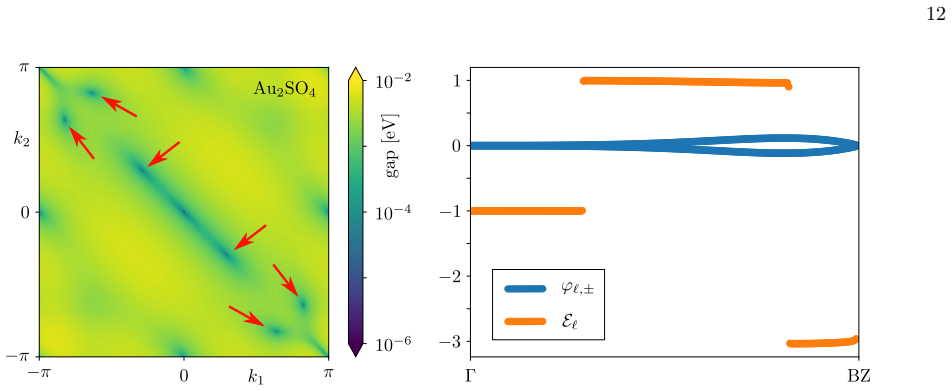
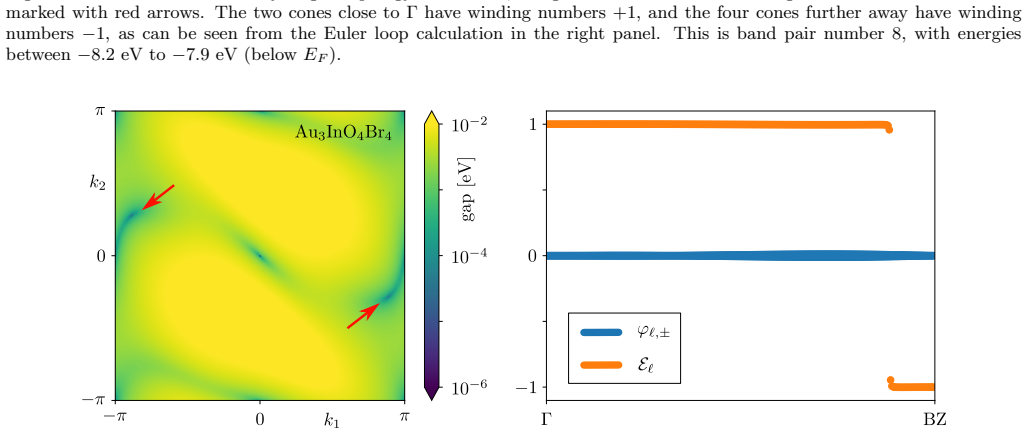
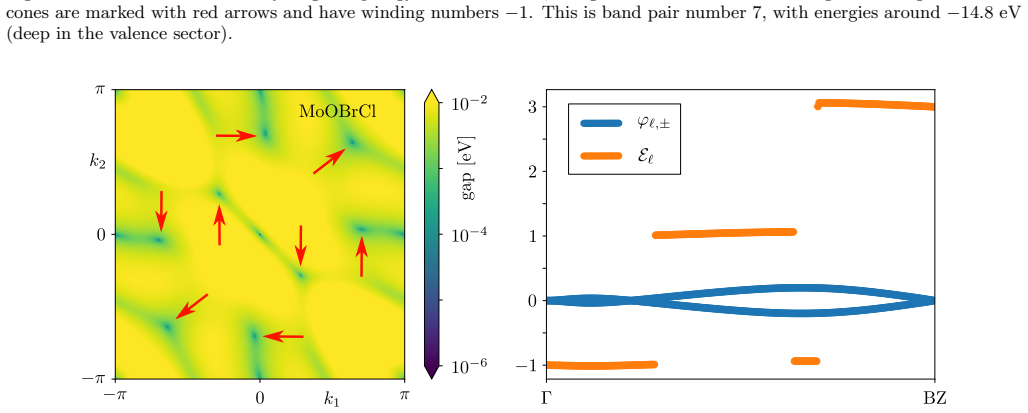
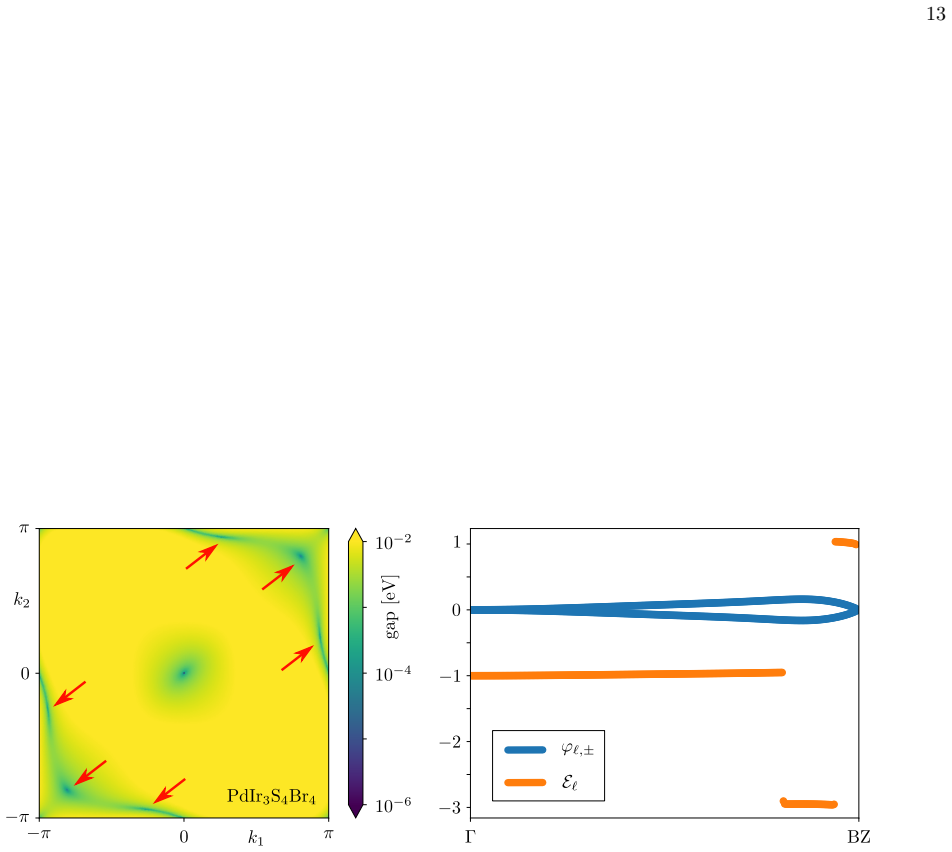
Some topological phases of matter are called fragile. They do not generically host protected gapless boundary states and they can be trivialized by adding additional valence bands. Here we show that fragile topology nevertheless has robust signatures: it yields bulk Dirac cones in two-dimensional materials with arbitrarily many bands. In systems with time-reversal and twofold rotation symmetry, we establish a fragile topological index which guarantees the presence of gap closing points in the band structure. We test this prediction using first-principles calculations in five materials and find that all of them host such Dirac points, suggesting that this is a widespread phenomenon. Our results provide a robust spectroscopic signature of fragile topology which can be directly accessed in experiment. Further, they enable an alternate method for finding Dirac cones in ab-initio simulations, and may be used as a route towards identifying materials with nonlinear transport properties.
Editorial analysis
A structured set of objections, weighed in public.
Referee Report
Summary. The paper claims that in 2D materials respecting time-reversal and twofold rotation symmetry, a fragile topological index can be defined that guarantees the presence of bulk Dirac points (gap closings) even when the system has arbitrarily many bands. This is supported by first-principles calculations on five materials, all of which exhibit such Dirac points, providing a proposed robust spectroscopic signature of fragile topology.
Significance. If the result holds, the work supplies a bulk experimental signature for fragile topology and an alternate route to locating Dirac cones in simulations, with possible relevance to nonlinear transport. The multi-material verification adds weight to the claim that the phenomenon is widespread.
major comments (2)
- [Abstract and index definition section] Abstract and the section defining the index: the central claim that the index 'guarantees' gap closings for arbitrarily many bands is load-bearing, yet the explicit construction of the index and the demonstration that band addition cannot trivialize it without forcing a gap closing are not provided in sufficient detail for verification.
- [Section establishing the guarantee] The section establishing the guarantee under TR + C2: the argument must explicitly rule out the possibility that additional valence bands trivialize the index while the gap remains open, as this directly addresses whether the 'arbitrarily many bands' protection holds.
minor comments (2)
- [Figures showing band structures] The band-structure figures would benefit from explicit labeling of high-symmetry points and indication of the computed gap-closing locations.
- [Materials section] A short table summarizing the five materials, their space groups, and the computed Dirac-point locations would improve readability.
Simulated Author's Rebuttal
We thank the referee for their careful reading of the manuscript and for identifying areas where additional detail would strengthen the presentation. We address the major comments point by point below.
read point-by-point responses
-
Referee: [Abstract and index definition section] Abstract and the section defining the index: the central claim that the index 'guarantees' gap closings for arbitrarily many bands is load-bearing, yet the explicit construction of the index and the demonstration that band addition cannot trivialize it without forcing a gap closing are not provided in sufficient detail for verification.
Authors: We agree that the explicit construction and the proof of stability under band addition require more detail for independent verification. In the revised manuscript we will expand the index-definition section to include the full mathematical construction of the fragile index from the C2 and TR symmetry representations, together with a self-contained argument showing that any band addition that trivializes the index must induce a gap closing. This will be presented as a sequence of lemmas with explicit symmetry-indicator formulas. revision: yes
-
Referee: [Section establishing the guarantee] The section establishing the guarantee under TR + C2: the argument must explicitly rule out the possibility that additional valence bands trivialize the index while the gap remains open, as this directly addresses whether the 'arbitrarily many bands' protection holds.
Authors: We concur that an explicit exclusion of gap-preserving trivialization by added bands is necessary to substantiate the claim for arbitrarily many bands. The revised version will contain a dedicated subsection that directly addresses this point: we will prove that, under the assumed symmetries, a non-trivial value of the index cannot be canceled by additional valence bands without forcing at least one gap closing. The argument will be formulated in terms of the obstruction in the equivariant K-theory group and will be cross-checked against the five DFT examples. revision: yes
Circularity Check
No circularity: index is independent construction validated externally
full rationale
The paper defines a fragile topological index under time-reversal and C2 symmetry that is claimed to guarantee gap closings for arbitrarily many bands. This index is presented as a theoretical construction whose predictions are then tested against independent first-principles calculations on five real materials. No equations or self-citations reduce the guarantee to a definition of the Dirac points themselves, a fitted parameter renamed as prediction, or a load-bearing self-citation chain. The derivation chain remains self-contained against external benchmarks.
Axiom & Free-Parameter Ledger
axioms (1)
- domain assumption Time-reversal and twofold rotation symmetries are preserved in the target 2D materials.
Reference graph
Works this paper leans on
-
[1]
M. Z. Hasan and C. L. Kane, Colloquium: Topological insulators, Rev. Mod. Phys.82, 3045–3067 (2010)
2010
-
[2]
Qi and S.-C
X.-L. Qi and S.-C. Zhang, Topological insulators and su- perconductors, Rev. Mod. Phys.83, 1057–1110 (2011)
2011
-
[3]
Kitaev, V
A. Kitaev, V. Lebedev, and M. Feigel’man, Periodic table for topological insulators and superconductors, inAIP Conf. Proc.(AIP, 2009) p. 22–30
2009
-
[4]
P. W. Brouwer and V. Dwivedi, Homotopic classifica- tion of band structures: Stable, fragile, delicate, and sta- ble representation-protected topology, Phys. Rev. B108, 155137 (2023)
2023
-
[5]
H. C. Po, H. Watanabe, and A. Vishwanath, Fragile Topology and Wannier Obstructions, Phys. Rev. Lett. 121, 126402 (2018)
2018
-
[6]
Z.-D. Song, L. Elcoro, Y.-F. Xu, N. Regnault, and B. A. Bernevig, Fragile Phases as Affine Monoids: Classifica- tion and Material Examples, Phys. Rev. X10, 031001 (2020)
2020
-
[7]
Bouhon, T
A. Bouhon, T. Bzduˇ sek, and R.-J. Slager, Geometric ap- proach to fragile topology beyond symmetry indicators, Phys. Rev. B102, 115135 (2020)
2020
-
[8]
K. Y. Lee, S. Wong, S. Vaidya, T. A. Loring, and A. Cer- jan, Classification of fragile topology enabled by matrix homotopy, Phys. Rev. Research7, 033235 (2025)
2025
-
[9]
W. A. Benalcazar, T. Li, and T. L. Hughes, Quantiza- tion of fractional corner charge inC n-symmetric higher- order topological crystalline insulators, Phys. Rev. B99, 245151 (2019)
2019
-
[10]
B. J. Wieder, Z. Wang, J. Cano, X. Dai, L. M. Schoop, B. Bradlyn, and B. A. Bernevig, Strong and fragile topo- logical Dirac semimetals with higher-order Fermi arcs, Nat. Commun.11, 627 (2020)
2020
-
[11]
S. Kooi, G. van Miert, and C. Ortix, The bulk-corner cor- respondence of time-reversal symmetric insulators, npj Quantum Mater.6, 1 (2021)
2021
-
[12]
Z.-D. Song, L. Elcoro, and B. A. Bernevig, Twisted bulk-boundary correspondence of fragile topology, Sci- ence367, 794–797 (2020)
2020
-
[13]
Bistritzer and A
R. Bistritzer and A. H. MacDonald, Moir´ e bands in twisted double-layer graphene, Proc. Natl. Acad. Sci. U. S. A.108, 12233–12237 (2011)
2011
-
[14]
Y. Cao, V. Fatemi, A. Demir, S. Fang, S. L. Tomarken, J. Y. Luo, J. D. Sanchez-Yamagishi, K. Watanabe, T. Taniguchi, E. Kaxiras, R. C. Ashoori, and P. Jarillo- Herrero, Correlated insulator behaviour at half-filling in magic-angle graphene superlattices, Nature556, 80–84 (2018)
2018
-
[15]
Y. Cao, V. Fatemi, S. Fang, K. Watanabe, T. Taniguchi, E. Kaxiras, and P. Jarillo-Herrero, Unconventional super- conductivity in magic-angle graphene superlattices, Na- ture556, 43–50 (2018)
2018
-
[16]
B. Lian, F. Xie, and B. A. Bernevig, Landau level of fragile topology, Phys. Rev. B102, 041402 (2020)
2020
-
[17]
Y. Guan, A. Bouhon, and O. V. Yazyev, Landau levels of the Euler class topology, Phys. Rev. Research4, 023188 (2022)
2022
-
[18]
Kobayashi and A
S. Kobayashi and A. Furusaki, Fragile topological insula- tors protected by rotation symmetry without spin-orbit coupling, Phys. Rev. B104, 195114 (2021)
2021
-
[19]
M. Sato, S. Kobayashi, M. Hirayama, and A. Furusaki, Three-dimensional spinless Euler insulators with rota- tional symmetry, Phys. Rev. B112, 195108 (2025)
2025
-
[20]
Y. Tanaka and S. Kobayashi, Euler band topology and multiple hinge modes in three-dimensional insulators, arXiv:2603.26271 (2026)
arXiv 2026
-
[21]
Peri, Z.-D
V. Peri, Z.-D. Song, M. Serra-Garcia, P. Engeler, R. Queiroz, X. Huang, W. Deng, Z. Liu, B. A. Bernevig, and S. D. Huber, Experimental characterization of frag- ile topology in an acoustic metamaterial, Science367, 797–800 (2020)
2020
-
[22]
Zhao, Y.-B
W. Zhao, Y.-B. Yang, Y. Jiang, Z. Mao, W. Guo, L. Qiu, G. Wang, L. Yao, L. He, Z. Zhou, Y. Xu, and L. Duan, Quantum simulation for topological Euler insu- lators, Commun. Phys.5, 223 (2022)
2022
-
[23]
Jiang, A
B. Jiang, A. Bouhon, S.-Q. Wu, Z.-L. Kong, Z.-K. Lin, R.-J. Slager, and J.-H. Jiang, Observation of an acoustic topological Euler insulator with meronic waves, Sci. Bull. 69, 1653–1659 (2024)
2024
-
[24]
Wu, Z.-K
Y. Wu, Z.-K. Lin, Y. Yang, Z. Song, F. Li, and J.-H. Jiang, Probing fragile topology with dislocations, Sci. Bull.69, 3657–3660 (2024)
2024
-
[25]
Bradlyn, Z
B. Bradlyn, Z. Wang, J. Cano, and B. A. Bernevig, Dis- connected elementary band representations, fragile topol- ogy, and Wilson loops as topological indices: An example on the triangular lattice, Phys. Rev. B99, 045140 (2019)
2019
-
[26]
Bouhon, A
A. Bouhon, A. M. Black-Schaffer, and R.-J. Slager, Wil- son loop approach to fragile topology of split elemen- tary band representations and topological crystalline in- sulators with time-reversal symmetry, Phys. Rev. B100, 195135 (2019)
2019
-
[27]
Henke, M
J. Henke, M. Kurttutan, J. Kruthoff, and J. van Wezel, Topological invariants of rotationally symmetric crystals, Phys. Rev. B104, L201110 (2021)
2021
-
[28]
X. Li, L. Eek, J. van Wezel, and C. M. Smith, Frag- ile topology for six-fold rotation symmetry indicated by the concentric Wilson loop spectrum, arXiv:2603.24412 (2026)
arXiv 2026
-
[29]
F. N. ¨Unal, A. Bouhon, and R.-J. Slager, Topological Eu- ler Class as a Dynamical Observable in Optical Lattices, Phys. Rev. Lett.125, 053601 (2020)
2020
-
[30]
J. Ahn, S. Park, and B.-J. Yang, Failure of Nielsen- Ninomiya Theorem and Fragile Topology in Two- Dimensional Systems with Space-Time Inversion Symme- try: Application to Twisted Bilayer Graphene at Magic Angle, Phys. Rev. X9, 021013 (2019)
2019
-
[31]
Haastrup, M
S. Haastrup, M. Strange, M. Pandey, T. Deilmann, P. S. Schmidt, N. F. Hinsche, M. N. Gjerding, D. Torelli, P. M. Larsen, A. C. Riis-Jensen, J. Gath, K. W. Jacobsen, J. Jørgen Mortensen, T. Olsen, and K. S. Thygesen, The Computational 2D Materials Database: high-throughput modeling and discovery of atomically thin crystals, 2D Mater.5, 042002 (2018)
2018
-
[32]
M. N. Gjerding, A. Taghizadeh, A. Rasmussen, S. Ali, F. Bertoldo, T. Deilmann, N. R. Knøsgaard, M. Kruse, A. H. Larsen, S. Manti, T. G. Pedersen, U. Petralanda, T. Skovhus, M. K. Svendsen, J. J. Mortensen, T. Olsen, and K. S. Thygesen, Recent progress of the Computa- tional 2D Materials Database (C2DB), 2D Materials8, 044002 (2021)
2021
-
[33]
J. A. Sobota, Y. He, and Z.-X. Shen, Angle-resolved photoemission studies of quantum materials, Rev. Mod. Phys.93, 025006 (2021). 15
2021
-
[34]
Gresch, G
D. Gresch, G. Aut` es, O. V. Yazyev, M. Troyer, D. Van- derbilt, B. A. Bernevig, and A. A. Soluyanov, Z2Pack: Numerical implementation of hybrid Wannier centers for identifying topological materials, Phys. Rev. B95, 075146 (2017)
2017
-
[35]
Sodemann and L
I. Sodemann and L. Fu, Quantum Nonlinear Hall Effect Induced by Berry Curvature Dipole in Time-Reversal In- variant Materials, Phys. Rev. Lett.115, 216806 (2015)
2015
-
[36]
Y. X. Zhao and Y. Lu, PT-Symmetric Real Dirac Fermions and Semimetals, Phys. Rev. Lett.118, 056401 (2017)
2017
-
[37]
Bouhon, Q
A. Bouhon, Q. Wu, R.-J. Slager, H. Weng, O. V. Yazyev, and T. Bzduˇ sek, Non-Abelian reciprocal braiding of Weyl points and its manifestation in ZrTe, Nat. Phys.16, 1137–1143 (2020)
2020
-
[38]
Jiang, A
B. Jiang, A. Bouhon, Z.-K. Lin, X. Zhou, B. Hou, F. Li, R.-J. Slager, and J.-H. Jiang, Experimental observation of non-Abelian topological acoustic semimetals and their phase transitions, Nat. Phys.17, 1239–1246 (2021)
2021
-
[39]
Slager, A
R.-J. Slager, A. Bouhon, and F. N. ¨Unal, Non-Abelian Floquet braiding and anomalous Dirac string phase in periodically driven systems, Nat. Commun.15, 1144 (2024)
2024
-
[40]
Breach, R.-J
O. Breach, R.-J. Slager, and F. N. ¨Unal, Interferome- try of Non-Abelian Band Singularities and Euler Class Topology, Phys. Rev. Lett.133, 093404 (2024)
2024
-
[41]
S. H. Lee, Y. Qian, and B.-J. Yang, Euler band topology in spin-orbit coupled magnetic systems, arXiv:2404.16383 (2024)
arXiv 2024
-
[42]
R. Yu, X. L. Qi, A. Bernevig, Z. Fang, and X. Dai, Equiv- alent expression ofZ 2 topological invariant for band in- sulators using the non-Abelian Berry connection, Phys. Rev. B84, 075119 (2011)
2011
-
[43]
Itani, Y
S. Itani, Y. Zhang, and J. Zang, The northeast materials database for magnetic materials, Nat. Commun.16, 9415 (2025). [44]https://c2db.fysik.dtu.dk/material/1SAu2O4-1. [45]https://c2db.fysik.dtu.dk/material/ 1InAu3Br4O4-1. [46]https://c2db.fysik.dtu.dk/material/2BrClMoO-1. [47]https://c2db.fysik.dtu.dk/material/1MoAg2Te4-1. [48]https://c2db.fysik.dtu.dk/...
2025
-
[44]
V. K¨ onye, I. Nimyi, O. Janson, J. van den Brink, J. van Wezel, and C. Fulga, Robust signatures of fragile topol- ogy, https://doi.org/10.5281/zenodo.20020781 (2026)
-
[45]
C. W. Groth, M. Wimmer, A. R. Akhmerov, and X. Waintal, Kwant: a software package for quantum transport, New J. Phys.16, 063065 (2014)
2014
-
[46]
A. Lau, J. van den Brink, and C. Ortix, Topological mir- ror insulators in one dimension, Phys. Rev. B94, 165164 (2016)
2016
-
[47]
Kruthoff, J
J. Kruthoff, J. de Boer, J. van Wezel, C. L. Kane, and R.-J. Slager, Topological Classification of Crystalline In- sulators through Band Structure Combinatorics, Phys. Rev. X7, 041069 (2017)
2017
-
[48]
C. L. Kane and E. J. Mele,Z 2 Topological Order and the Quantum Spin Hall Effect, Phys. Rev. Lett.95, 146802 (2005)
2005
-
[49]
Koepernik and H
K. Koepernik and H. Eschrig, Full-potential nonorthog- onal local-orbital minimum-basis band-structure scheme, Phys. Rev. B59, 1743 (1999)
1999
-
[50]
J. P. Perdew, K. Burke, and M. Ernzerhof, Generalized gradient approximation made simple, Phys. Rev. Lett. 77, 3865 (1996)
1996
-
[51]
H. T. Stokes and D. M. Hatch, Program for identifying the space group symmetry of a crystal, J. Appl. Cryst. 38, 237 (2005)
2005
-
[52]
Koepernik, O
K. Koepernik, O. Janson, Y. Sun, and J. van den Brink, Symmetry-conserving maximally projected Wan- nier functions, Phys. Rev. B107, 235135 (2023)
2023
discussion (0)
Sign in with ORCID, Apple, or X to comment. Anyone can read and Pith papers without signing in.