Weak-lensing mass calibration of Planck Sunyaev--Zel'dovich clusters with HSC-SSP Year~3
Pith reviewed 2026-06-26 23:37 UTC · model grok-4.3
The pith
Weak lensing calibration of Planck SZ clusters yields mass bias 1-b = 0.73
A machine-rendered reading of the paper's core claim, the machinery that carries it, and where it could break.
Core claim
Integrating the observed stacked weak-lensing signal with the halo mass function, Planck SZ selection function, log-normal scatter in the SZ-mass proxy, and miscentering effects produces a constraint 1-b = 0.73^{+0.10}_{-0.11} when four parameters are varied over the radial range 0.5-5.0 h^{-1} Mpc, with chi-squared over dof equal to 5.2/5 at z_eff approximately 0.24.
What carries the argument
Forward-modeling integral over the halo mass function that incorporates the Planck SZ selection function, Eddington bias from log-normal scatter in the SZ-mass proxy, and cluster miscentering.
If this is right
- Cluster abundance measurements require upward mass corrections to reconcile with primary cosmic microwave background constraints on cosmology.
- The obtained bias value is consistent with other recent weak-lensing calibrations of SZ-selected clusters.
- The four-parameter fit simultaneously constrains the miscentered fraction, offset scale, and SZ scatter in addition to the mass bias.
Where Pith is reading between the lines
- If the bias is redshift- or mass-dependent, cosmological inferences drawn from higher-redshift SZ samples would shift accordingly.
- Repeating the same stacking and forward-modeling pipeline on an independent lensing survey would test whether the bias value is survey-independent.
- Extending the analysis to include X-ray mass proxies on the same clusters could reveal whether the bias is tied to the SZ observable itself.
Load-bearing premise
The forward-modeling integral over the halo mass function, Planck SZ selection function, and log-normal scatter in the SZ-mass proxy is assumed to be correctly specified and free of unmodeled systematics.
What would settle it
A stacked weak-lensing signal measured in the same radial range that lies outside the model prediction for 1-b equal to 0.73 at the reported uncertainty would falsify the calibration.
Figures




read the original abstract
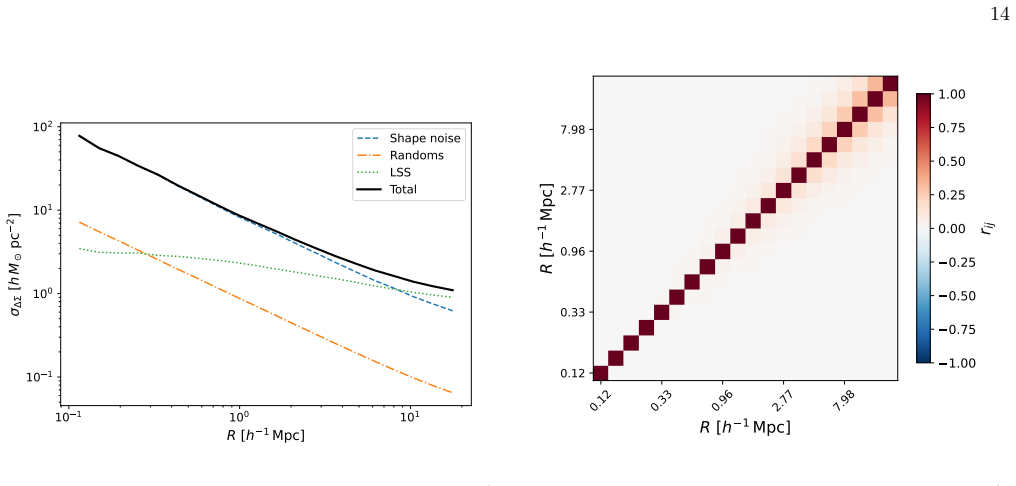
We present a weak gravitational lensing mass calibration of 19 \textit{Planck} Sunyaev--Zel'dovich (SZ) selected galaxy clusters using shape measurements from the Hyper Suprime-Cam Subaru Strategic Program (HSC-SSP) Year 3 shape catalog. We measure the stacked weak-lensing signal $\Delta\Sigma(R)$ using per-cluster lensing weights that match the measurement pipeline's stacking scheme, and construct an analytical covariance matrix that includes shape noise and projected large-scale structure contributions. Our primary constraint on the SZ mass bias comes from a forward-modeling approach that integrates over the halo mass function while accounting for the \textit{Planck} SZ selection function, Eddington bias from log-normal scatter in the SZ mass proxy, and cluster miscentering. Fitting four free parameters, the log mass bias $\ln(1-b)$, the miscentered fraction $f_{\rm mis}$, the offset scale $\sigma_{\rm off}$, and the SZ scatter $\sigma_{\ln M}$, over the radial range $0.5$--$5.0\,h^{-1}\,\mathrm{Mpc}$, we obtain $1-b = 0.73^{+0.10}_{-0.11}$ with $\chi^2/\mathrm{dof} = 5.2/5$ at an effective redshift $z_{\rm eff}\simeq 0.24$. This measurement is consistent with recent weak-lensing calibrations of SZ-selected clusters and supports the picture that significant mass bias corrections are required to reconcile cluster abundance measurements with primary cosmic microwave background constraints on cosmological parameters.
Editorial analysis
A structured set of objections, weighed in public.
Referee Report
Summary. The manuscript reports a weak-lensing mass calibration of 19 Planck SZ-selected clusters using stacked ΔΣ(R) measurements from the HSC-SSP Year 3 shape catalog. A forward-modeling approach integrates over the halo mass function while incorporating the Planck SZ selection function, Eddington bias from log-normal scatter σ_lnM, and miscentering (parameters f_mis and σ_off), yielding a primary constraint 1-b = 0.73^{+0.10}_{-0.11} with χ²/dof = 5.2/5 over 0.5–5.0 h^{-1} Mpc at z_eff ≃ 0.24.
Significance. If the modeling assumptions hold, the result supplies an independent weak-lensing anchor for the SZ mass bias at low redshift, reinforcing the requirement for substantial bias corrections when using cluster abundances to constrain cosmology. The per-cluster lensing weights and analytical covariance that includes shape noise plus projected LSS are positive technical features.
major comments (2)
- [primary constraint (abstract and forward-modeling description)] The headline constraint on ln(1-b) is obtained by fitting inside a forward model that assumes the halo mass function, Planck SZ selection function, and log-normal scatter model are correctly specified. With only 19 clusters the data have limited power to self-calibrate these ingredients; any mismatch would directly shift the reported 1-b value. This assumption is load-bearing for the central claim.
- [covariance and miscentering modeling] The analytical covariance construction, radial binning choices, and validation of the miscentering model (f_mis, σ_off) are not fully verifiable from the abstract-level description, yet they directly affect the reported χ²/dof and the four-parameter posterior.
minor comments (1)
- [results paragraph] The effective redshift z_eff ≃ 0.24 is stated without an explicit definition or weighting scheme; a short clarifying sentence would improve reproducibility.
Simulated Author's Rebuttal
We thank the referee for their constructive comments and for recognizing the technical aspects of our analysis. We address each major comment below and have revised the manuscript to improve clarity on modeling assumptions and methodological details.
read point-by-point responses
-
Referee: [primary constraint (abstract and forward-modeling description)] The headline constraint on ln(1-b) is obtained by fitting inside a forward model that assumes the halo mass function, Planck SZ selection function, and log-normal scatter model are correctly specified. With only 19 clusters the data have limited power to self-calibrate these ingredients; any mismatch would directly shift the reported 1-b value. This assumption is load-bearing for the central claim.
Authors: We agree that the forward-modeling framework relies on the assumed halo mass function, Planck SZ selection function, and log-normal scatter model, and that a sample of 19 clusters offers limited power for self-calibration of these components. The reported constraint does marginalize over the scatter parameter σ_lnM as one of the four free parameters, providing some flexibility. The Planck selection function is taken directly from the official Planck 2015/2016 releases, and the halo mass function follows the Tinker et al. (2008) parametrization. To address the referee's concern, we will add a dedicated subsection in the revised manuscript that quantifies the sensitivity of 1-b to reasonable variations in the mass function and selection function, including explicit tests with alternative parametrizations. revision: yes
-
Referee: [covariance and miscentering modeling] The analytical covariance construction, radial binning choices, and validation of the miscentering model (f_mis, σ_off) are not fully verifiable from the abstract-level description, yet they directly affect the reported χ²/dof and the four-parameter posterior.
Authors: The analytical covariance matrix, which includes both shape noise and the projected large-scale structure term, is derived in Section 3.3 with the explicit formula provided in Equation (7). The radial range 0.5–5.0 h^{-1} Mpc (six logarithmic bins) is selected to exclude the innermost scales where miscentering and baryonic effects dominate while retaining sufficient signal-to-noise. The miscentering parameters f_mis and σ_off are varied as free parameters in the fit; their posterior distributions and the impact on χ² are shown in Figure 5 and Appendix B. Validation against mock catalogs is presented in Appendix B.2. We will expand the main-text description of the covariance construction and binning rationale, and add a short summary of the mock validation results, to make these elements more self-contained without relying solely on the appendices. revision: yes
Circularity Check
No significant circularity; result is explicit fit to external lensing data
full rationale
The paper reports a direct measurement of the SZ mass bias (1-b) obtained by fitting four parameters to the observed stacked ΔΣ(R) signal from HSC weak lensing. The forward-modeling integral is used to relate the data to the parameter, but the output is explicitly the fitted value rather than a claimed independent prediction or first-principles derivation. No self-definitional loops, fitted inputs renamed as predictions, or load-bearing self-citations appear in the provided text. The analysis is self-contained as a calibration exercise against external shape measurements.
Axiom & Free-Parameter Ledger
free parameters (4)
- ln(1-b)
- f_mis
- sigma_off
- sigma_lnM
axioms (2)
- domain assumption The Planck SZ selection function and halo mass function are known accurately from prior literature.
- domain assumption The analytical covariance matrix correctly captures shape noise plus projected large-scale structure.
Forward citations
Cited by 1 Pith paper
-
CHEX-MATE: AMALGAM weak-lensing analysis of 41 Planck Sunyaev-Zel'dovich-selected galaxy clusters
Weak-lensing analysis of 41 SZ clusters yields c200=3.53±0.71 at 10^15 Msun z=0.25 and MSZ/M500=0.83±0.09 with 8% systematic uncertainty and intrinsic scatters.
Reference graph
Works this paper leans on
-
[1]
24) and the conservative fit rangeR∈[0.5,5.0]h −1 Mpc
Results Our headline constraint on the mass bias parameter is 1−b= 0.73 +0.10 −0.11 ,(30) withχ 2/dof = 5.2/5 for the covariance (Eq. 24) and the conservative fit rangeR∈[0.5,5.0]h −1 Mpc. The SZ scatter is constrained toσ lnM = 0.25 +0.10 −0.10, con- sistent with the prior (Table II). The best-fit miscen- tering parameters aref mis = 0.28 +0.10 −0.10 and...
-
[2]
The inferred (1−b) is stable to the choice of maxi- mum fitting radius (Rmax = 5 versus 10h −1 Mpc) and to the covariance model (shape-noise-only versus baseline)
Robustness We systematically vary analysis choices to assess the sensitivity of the (1−b) constraint (Table IV). The inferred (1−b) is stable to the choice of maxi- mum fitting radius (Rmax = 5 versus 10h −1 Mpc) and to the covariance model (shape-noise-only versus baseline). Table IV shows that the results are also robust to the width of the Gaussian pri...
-
[3]
calibrated the full weak-lensing-to-halo-mass rela- tion using hydrodynamical simulations that include ob- servational systematics (shear bias, photometric redshift uncertainties, miscentering, member contamination, and projection effects), obtaining intrinsic scatter values in the rangeσ lnM ≈0.20–0.30 depending on the mini- mum fitting radius. Our prior...
-
[4]
from the ACT DR5×DES Y3 analysis, (1−b) = A−1 mass[(1 +z)/(1 + 0.45)] −ζ withA mass = 1.56+0.11 −0.13 and ζ= 2.0 +0.4 −0.7, and the value 1−b≃0.58±0.04 required to reconcilePlanckprimary CMB anisotropies with the SZ cluster abundance [39]. Our measurement of 1−b= 0.73 +0.10 −0.11 atz eff ≃0.24 is consistent within 1σwith earlierPlanck×HSC re- sults from M...
-
[5]
found a∼7% effect in the ACT DR5×DES Y3 anal- ysis. Baryonic feedback processes, such as AGN-driven gas expulsion and star formation, can redistribute mat- ter within halos, modifying the density profile relative to dark-matter-only predictions [79]. While this effect is smaller than our∼14% statistical uncertainty, it will be- come increasingly important...
2025
-
[6]
NNX08AR22G is- sued through the Planetary Science Division of the NASA Science Mission Directorate, the National Science Foun- dation grant No
and the PS1 public science archive have been made possible through contributions by the Institute for As- tronomy, the University of Hawaii, the Pan-STARRS Project Office, the Max Planck Society and its par- ticipating institutes, the Max Planck Institute for As- tronomy, Heidelberg, and the Max Planck Institute for Extraterrestrial Physics, Garching, The...
-
[7]
N. A. Bahcall and X. Fan, The Most Massive Distant Clusters: Determining Ω andσ 8, Astrophys. J.504, 1 (1998), arXiv:astro-ph/9803277 [astro-ph]
Pith/arXiv arXiv 1998
-
[8]
T. H. Reiprich and H. B¨ ohringer, The Mass Function of an X-Ray Flux-limited Sample of Galaxy Clusters, Astro- phys. J.567, 716 (2002), arXiv:astro-ph/0111285 [astro- ph]
Pith/arXiv arXiv 2002
-
[9]
G. M. Voit, Tracing cosmic evolution with clusters of galaxies, Reviews of Modern Physics77, 207 (2005), arXiv:astro-ph/0410173 [astro-ph]
Pith/arXiv arXiv 2005
-
[10]
S. W. Allen, A. E. Evrard, and A. B. Mantz, Cosmolog- ical Parameters from Observations of Galaxy Clusters, ARA&A49, 409 (2011), arXiv:1103.4829 [astro-ph.CO]
Pith/arXiv arXiv 2011
-
[11]
A. V. Kravtsov and S. Borgani, Formation of Galaxy Clusters, ARA&A50, 353 (2012), arXiv:1205.5556 [astro-ph.CO]
Pith/arXiv arXiv 2012
-
[12]
F. Pacaud, N. Clerc, P. A. Giles, C. Adami, T. Sadibekova, M. Pierre, B. J. Maughan, M. Lieu, J. P. Le F` evre, S. Alis, B. Altieri, F. Ardila, I. Baldry, C. Benoist, M. Birkinshaw, L. Chiappetti, J. D´ emocl` es, D. Eckert, A. E. Evrard, L. Faccioli, F. Gastaldello, L. Guennou, C. Horellou, A. Iovino, E. Koulouridis, V. Le Brun, C. Lidman, J. Liske, S. M...
Pith/arXiv arXiv 2016
-
[13]
M. Oguri, S. Miyazaki, X. Li, W. Luo, I. Mitsuishi, H. Miyatake, S. More, A. J. Nishizawa, N. Okabe, N. Ota, A. A. Plazas Malag´ on, and Y. Utsumi, Hundreds of weak lensing shear-selected clusters from the Hyper Suprime- Cam Subaru Strategic Program S19A data, PASJ73, 817 (2021), arXiv:2103.15016 [astro-ph.CO]
arXiv 2021
-
[14]
S. Miyazaki, M. Oguri, T. Hamana, M. Shirasaki, M. Koike, Y. Komiyama, K. Umetsu, Y. Utsumi, N. Ok- abe, S. More, E. Medezinski, Y.-T. Lin, H. Miyatake, H. Murayama, N. Ota, and I. Mitsuishi, A large sample of shear-selected clusters from the Hyper Suprime-Cam Subaru Strategic Program S16A Wide field mass maps, PASJ70, S27 (2018), arXiv:1802.10290 [astro-ph.CO]
Pith/arXiv arXiv 2018
-
[17]
E. S. Rykoff, E. Rozo, M. T. Busha, C. E. Cunha, A. Finoguenov, A. Evrard, J. Hao, B. P. Koester, A. Leauthaud, B. Nord, M. Pierre, R. Reddick, T. Sadibekova, E. S. Sheldon, and R. H. Wechsler, redMaPPer. I. Algorithm and SDSS DR8 Catalog, Astro- phys. J.785, 104 (2014), arXiv:1303.3562 [astro-ph.CO]
Pith/arXiv arXiv 2014
-
[18]
R. A. Sunyaev and Y. B. Zeldovich, The Observations of Relic Radiation as a Test of the Nature of X-Ray Radia- tion from the Clusters of Galaxies, Comments on Astro- physics and Space Physics4, 173 (1972)
1972
-
[19]
Carlstrom, P
J. Carlstrom, P. Ade, and K. e. a. Aird, The 10 Meter South Pole Telescope, PASP123, 568 (2011)
2011
-
[20]
R. J. Thornton, P. A. R. Ade, S. Aiola, F. E. Angil` e, M. Amiri, J. A. Beall, D. T. Becker, H.-M. Cho, S. K. Choi, P. Corlies, K. P. Coughlin, R. Datta, M. J. Devlin, S. R. Dicker, R. D¨ unner, J. W. Fowler, A. E. Fox, P. A. Gallardo, J. Gao, E. Grace, M. Halpern, M. Hasselfield, S. W. Henderson, G. C. Hilton, A. D. Hincks, S. P. Ho, J. Hubmayr, K. D. Ir...
Pith/arXiv arXiv 2016
-
[21]
Planck Collaboration, P. A. R. Ade, N. Aghanim, M. Ar- naud, M. Ashdown, J. Aumont, C. Baccigalupi, A. J. Banday, R. B. Barreiro, R. Barrena, J. G. Bartlett, N. Bartolo, E. Battaner, R. Battye, K. Benabed, A. Benoˆ ıt, A. Benoit-L´ evy, J. P. Bernard, M. Bersanelli, P. Bielewicz, I. Bikmaev, H. B¨ ohringer, A. Bonaldi, L. Bonavera, J. R. Bond, J. Borrill,...
Pith/arXiv arXiv 2015
-
[22]
S. Bocquet, J. P. Dietrich, T. Schrabback, L. E. Bleem, M. Klein, S. W. Allen, D. E. Applegate, M. L. N. Ashby, M. Bautz, M. Bayliss, B. A. Benson, M. Brodwin, E. Bul- bul, R. E. A. Canning, R. Capasso, J. E. Carlstrom, C. L. Chang, I. Chiu, H. M. Cho, A. Clocchiatti, T. M. Craw- ford, A. T. Crites, T. de Haan, S. Desai, M. A. Dobbs, R. J. Foley, W. R. Fo...
Pith/arXiv arXiv 2019
-
[23]
M. Hilton, C. Sif´ on, S. Naess, M. Madhavacheril, M. Oguri, E. Rozo, E. Rykoff, T. M. C. Abbott, S. Ad- hikari, M. Aguena, S. Aiola, S. Allam, S. Amodeo, A. Amon, J. Annis, B. Ansarinejad, C. Aros-Bunster, J. E. Austermann, S. Avila, D. Bacon, N. Battaglia, J. A. Beall, D. T. Becker, G. M. Bernstein, E. Bertin, T. Bhan- darkar, S. Bhargava, J. R. Bond, D...
arXiv 2021
-
[24]
ACTDESHSC Collaboration, M. Aguena, S. Aiola, S. Allam, F. Andrade-Oliveira, D. Bacon, N. Bahcall, N. Battaglia, E. S. Battistelli, S. Bocquet, B. Bolliet, J. R. Bond, D. Brooks, E. Calabrese, J. Carretero, S. K. Choi, L. N. da Costa, M. Costanzi, W. Coul- ton, T. M. Davis, S. Desai, M. J. Devlin, S. Dicker, P. Doel, A. J. Duivenvoorden, J. Dunkley, S. Fe...
arXiv 2025
-
[25]
A. E. Evrard, Formation and Evolution of X-Ray Clus- ters: A Hydrodynamic Simulation of the Intracluster Medium, Astrophys. J.363, 349 (1990)
1990
-
[26]
E. Rasia, M. Meneghetti, R. Martino, S. Borgani, A. Bonafede, K. Dolag, S. Ettori, D. Fabjan, C. Gio- coli, P. Mazzotta, J. Merten, M. Radovich, and L. Tor- natore, Lensing and x-ray mass estimates of clusters (sim- ulations), New Journal of Physics14, 055018 (2012), arXiv:1201.1569 [astro-ph.CO]
Pith/arXiv arXiv 2012
-
[27]
H. Miyatake, A. J. Nishizawa, M. Takada, R. Mandel- baum, S. Mineo, H. Aihara, D. N. Spergel, S. J. Bicker- ton, J. R. Bond, M. Gralla, A. Hajian, M. Hilton, A. D. Hincks, J. P. Hughes, L. Infante, Y.-T. Lin, R. H. Lupton, T. A. Marriage, D. Marsden, F. Menanteau, S. Miyazaki, K. Moodley, M. D. Niemack, M. Oguri, P. A. Price, E. D. Reese, C. Sif´ on, E. J...
Pith/arXiv arXiv 2013
-
[28]
Battaglia, The tau of galaxy clusters, JCAP2016, 058 (2016), arXiv:1607.02442 [astro-ph.CO]
N. Battaglia, The tau of galaxy clusters, JCAP2016, 058 (2016), arXiv:1607.02442 [astro-ph.CO]
Pith/arXiv arXiv 2016
-
[29]
H. Miyatake, N. Battaglia, M. Hilton, E. Medezinski, A. J. Nishizawa, S. More, S. Aiola, N. Bahcall, J. R. Bond, E. Calabrese, S. K. Choi, M. J. Devlin, J. Dunk- ley, R. Dunner, B. Fuzia, P. Gallardo, M. Gralla, M. Has- selfield, M. Halpern, C. Hikage, J. C. Hill, A. D. Hincks, R. Hloˇ zek, K. Huffenberger, J. P. Hughes, B. Koop- man, A. Kosowsky, T. Loui...
Pith/arXiv arXiv 2019
-
[30]
N. C. Robertson, C. Sif´ on, M. Asgari, N. Battaglia, M. Bilicki, J. R. Bond, and et al., ACT-DR5 Sunyaev– Zel’dovich clusters: Weak lensing mass calibration with KiDS, Astron. Astrophys.681, A87 (2024), arXiv:2304.10219 [astro-ph.CO]
arXiv 2024
-
[31]
M. Shirasaki, C. Sif´ on, H. Miyatake, E. Lau, Z. Zhang, N. Bahcall, N. Battaglia, M. Devlin, J. Dunkley, A. Farahi, M. Hilton, Y.-T. Lin, D. Nagai, S. T. Staggs, T. Sunayama, D. Spergel, and E. J. Wollack, Masses of Sunyaev-Zel’dovich galaxy clusters detected by the At- acama Cosmology Telescope: Stacked lensing measure- ments with Subaru HSC year 3 data...
arXiv 2024
-
[32]
T. Shin, E. J. Baxter, E. Lee, N. Battaglia, A. Alarcon, A. Amon, M. Becker, G. Bernstein, J. R. Bond, A. Cam- pos, C. Chang, R. Chen, A. Choi, J. DeRose, S. Dodel- son, C. Doux, J. Dunkley, J. Elvin-Poole, J. H. Esteves, S. Everett, A. Fert´ e, M. Gatti, S. Grandis, D. Gruen, I. Harrison, J. C. Hill, M. Hilton, M. Jarvis, N. Mac- Crann, J. McCullough, K....
arXiv 2025
-
[33]
T. Schrabback, D. Applegate, J. P. Dietrich, H. Hoek- stra, S. Bocquet, A. H. Gonzalez, A. von der Linden, M. McDonald, C. B. Morrison, S. F. Raihan, S. W. Allen, M. Bayliss, B. A. Benson, L. E. Bleem, I. Chiu, S. Desai, R. J. Foley, T. de Haan, F. W. High, S. Hilbert, A. B. Mantz, R. Massey, J. Mohr, C. L. Reichardt, A. Saro, P. Simon, C. Stern, C. W. St...
Pith/arXiv arXiv 2018
-
[34]
C. Stern, J. P. Dietrich, S. Bocquet, D. Applegate, J. J. Mohr, S. L. Bridle, M. Carrasco Kind, D. Gruen, M. Jarvis, T. Kacprzak, A. Saro, E. Sheldon, M. A. Troxel, J. Zuntz, B. A. Benson, R. Capasso, I. Chiu, S. Desai, D. Rapetti, C. L. Reichardt, B. Saliwanchik, T. Schrabback, N. Gupta, T. M. C. Abbott, F. B. Ab- dalla, S. Avila, E. Bertin, D. Brooks, D...
Pith/arXiv arXiv 2019
-
[35]
T. Schrabback, S. Bocquet, M. Sommer, H. Zohren, J. L. van den Busch, B. Hern´ andez-Mart´ ın, H. Hoekstra, S. F. Raihan, M. Schirmer, D. Applegate, M. Bayliss, B. A. Benson, L. E. Bleem, J. P. Dietrich, B. Floyd, S. Hilbert, J. Hlavacek-Larrondo, M. McDonald, A. Saro, A. A. Stark, and N. Weissgerber, Mass calibration of dis- tant SPT galaxy clusters thro...
arXiv 2021
-
[36]
A. von der Linden, A. Mantz, S. W. Allen, D. E. Ap- plegate, R. G. Morris, M. T. Allen, P. L. Kelly, D. L. Burke, H. Ebeling, P. R. Burchat, D. Donovan, and R. W. Schmidt, Robust weak-lensing mass calibration of Planck galaxy clusters, Mon. Not. R. Astron. Soc.443, 1973 (2014), arXiv:1402.2670 [astro-ph.CO]
Pith/arXiv arXiv 1973
-
[37]
Hoekstra, R
H. Hoekstra, R. Herbonnet, A. Muzzin, A. Babul, A. Mahdavi, M. Viola, and M. Cacciato, The Canadian Cluster Comparison Project: detailed study of system- atics and updated weak lensing masses, Mon. Not. R. Astron. Soc.449, 685 (2015)
2015
-
[38]
Sereno, G
M. Sereno, G. Covone, L. Izzo, S. Ettori, J. Coupon, and M. Lieu, PSZ2LenS: Weak lensing analysis of the Planck clusters in the CFHTLenS and RCSLenS, Mon. Not. R. Astron. Soc.472, 1946 (2017)
1946
-
[39]
E. Medezinski, N. Battaglia, K. Umetsu, M. Oguri, H. Miyatake, A. J. Nishizawa, C. Sif´ on, D. N. Spergel, I. N. Chiu, Y.-T. Lin, N. Bahcall, and Y. Komiyama, Planck Sunyaev-Zel’dovich cluster mass calibration using Hyper Suprime-Cam weak lensing, PASJ70, S28 (2018), arXiv:1706.00434 [astro-ph.CO]
Pith/arXiv arXiv 2018
-
[40]
Penna-Lima, J
M. Penna-Lima, J. G. Bartlett, E. Rozo, J.-B. Melin, J. Merten, A. E. Evrard, M. Postman, and E. Rykoff, Calibrating the Planck cluster mass scale with CLASH, Astron. Astrophys.604, A89 (2017)
2017
-
[41]
G. Aymerich, S. Grandis, M. Douspis, G. W. Pratt, L. Salvati, F. Andrade-Santos, S. Bocquet, M. Costanzi, W. R. Forman, C. Jones, M. Aguena, F. Andrade- Oliveira, D. Bacon, D. Brooks, D. L. Burke, J. Car- retero, L. N. da Costa, M. E. da Silva Pereira, T. M. Davis, J. De Vicente, S. Desai, H. T. Diehl, P. Doel, S. Everett, B. Flaugher, J. Frieman, E. Gazt...
arXiv 2025
-
[42]
D. Gruen, S. Seitz, M. R. Becker, O. Friedrich, and A. Mana, Cosmic variance of the galaxy clus- ter weak lensing signal, MNRAS449, 4264 (2015), arXiv:1501.01632 [astro-ph.CO]
Pith/arXiv arXiv 2015
-
[43]
Smith, P
G. Smith, P. Mazzotta, and N. e. a. Okabe, LoCuSS: Testing hydrostatic equilibrium in galaxy clusters, MN- RAS456, L74 (2016)
2016
-
[44]
N. Battaglia, A. Leauthaud, H. Miyatake, M. Hasselfield, M. B. Gralla, R. Allison, J. R. Bond, E. Calabrese, D. Crichton, M. J. Devlin, J. Dunkley, R. D¨ unner, T. Er- ben, S. Ferrara, M. Halpern, M. Hilton, J. C. Hill, A. D. Hincks, R. Hloˇ zek, K. M. Huffenberger, J. P. Hughes, J. P. Kneib, A. Kosowsky, M. Makler, T. A. Marriage, F. Menanteau, L. Miller...
Pith/arXiv arXiv 2016
-
[45]
Planck Collaboration, P. A. R. Ade, N. Aghanim, M. Arnaud, M. Ashdown, J. Aumont, C. Bacci- galupi, A. J. Banday, R. B. Barreiro, J. G. Bartlett, N. Bartolo, E. Battaner, R. Battye, K. Benabed, A. Benoˆ ıt, A. Benoit-L´ evy, J.-P. Bernard, M. Bersanelli, P. Bielewicz, J. J. Bock, A. Bonaldi, L. Bonavera, J. R. Bond, J. Borrill, F. R. Bouchet, M. Bucher, C...
Pith/arXiv arXiv 2015
-
[46]
Planck Collaboration, P. A. R. Ade, N. Aghanim, M. Arnaud, M. Ashdown, J. Aumont, C. Bacci- galupi, A. J. Banday, R. B. Barreiro, J. G. Bartlett, N. Bartolo, E. Battaner, R. Battye, K. Benabed, A. Benoˆ ıt, A. Benoit-L´ evy, J.-P. Bernard, M. Bersanelli, P. Bielewicz, J. J. Bock, A. Bonaldi, L. Bonavera, J. R. Bond, J. Borrill, F. R. Bouchet, F. Boulanger...
Pith/arXiv arXiv 2015
-
[47]
H. Aihara, N. Arimoto, R. Armstrong, S. Arnouts, N. A. Bahcall, S. Bickerton, J. Bosch, K. Bundy, P. L. Ca- pak, J. H. H. Chan, M. Chiba, J. Coupon, E. Egami, M. Enoki, F. Finet, H. Fujimori, S. Fujimoto, H. Fu- rusawa, J. Furusawa, T. Goto, J. Greco, J. E. Greene, J. E. Gunn, T. Hamana, Y. Harikane, Y. Hashimoto, T. Hattori, M. Hayashi, Y. Hayashi, K. G....
Pith/arXiv arXiv 2018
-
[48]
Miyazaki, Y
S. Miyazaki, Y. Komiyama, S. Kawanomoto, Y. Doi, H. Furusawa, T. Hamana, Y. Hayashi, H. Ikeda, Y. Ka- mata, H. Karoji, M. Koike, T. Kurakami, S. Miyama, T. Morokuma, F. Nakata, K. Namikawa, H. Nakaya, K. Nariai, Y. Obuchi, Y. Oishi, N. Okada, Y. Okura, P. Tait, T. Takata, Y. Tanaka, M. Tanaka, T. Terai, D. Tomono, F. Uraguchi, T. Usuda, Y. Utsumi, Y. Ya- ...
2018
-
[49]
X. Li, H. Miyatake, W. Luo, S. More, M. Oguri, T. Hamana, R. Mandelbaum, M. Shirasaki, M. Takada, R. Armstrong, A. Kannawadi, S. Takita, S. Miyazaki, A. J. Nishizawa, A. A. Plazas Malagon, M. A. Strauss, M. Tanaka, and N. Yoshida, The three-year shear cata- log of the Subaru Hyper Suprime-Cam SSP Survey, PASJ 74, 421 (2022), arXiv:2107.00136 [astro-ph.CO]
arXiv 2022
-
[50]
M. Arnaud, G. W. Pratt, R. Piffaretti, H. B¨ ohringer, J. H. Croston, and E. Pointecouteau, The universal galaxy cluster pressure profile from a representative sam- ple of nearby systems (REXCESS) and the Y SZ - M500 relation, A&A517, A92 (2010), arXiv:0910.1234 [astro- ph.CO]
Pith/arXiv arXiv 2010
-
[51]
M. Oguri, A cluster finding algorithm based on the multi- band identification of red sequence galaxies, MNRAS 444, 147 (2014), arXiv:1407.4693 [astro-ph.CO]
Pith/arXiv arXiv 2014
-
[52]
M. Oguri, Y.-T. Lin, S.-C. Lin, A. J. Nishizawa, A. More, S. More, B.-C. Hsieh, E. Medezinski, H. Miyatake, H.- Y. Jian, L. Lin, M. Takada, N. Okabe, J. S. Speagle, J. Coupon, A. Leauthaud, R. H. Lupton, S. Miyazaki, P. A. Price, M. Tanaka, I. N. Chiu, Y. Komiyama, Y. Okura, M. M. Tanaka, and T. Usuda, An optically- selected cluster catalog at redshift 0....
Pith/arXiv arXiv 2018
-
[53]
E. S. Rykoff, E. Rozo, D. Hollowood, A. Bermeo- Hernandez, T. Jeltema, J. Mayers, A. K. Romer, P. Rooney, A. Saro, C. Vergara Cervantes, R. H. Wechsler, H. Wilcox, T. M. C. Abbott, F. B. Ab- 25 dalla, S. Allam, J. Annis, A. Benoit-L´ evy, G. M. Bern- stein, E. Bertin, D. Brooks, D. L. Burke, D. Capozzi, A. Carnero Rosell, M. Carrasco Kind, F. J. Castander...
Pith/arXiv arXiv 2016
-
[54]
J. Bosch, R. Armstrong, S. Bickerton, H. Furusawa, H. Ikeda, M. Koike, R. Lupton, S. Mineo, P. Price, T. Takata, M. Tanaka, N. Yasuda, Y. AlSayyad, A. C. Becker, W. Coulton, J. Coupon, J. Garmilla, S. Huang, K. S. Krughoff, D. Lang, A. Leauthaud, K.-T. Lim, N. B. Lust, L. A. MacArthur, R. Mandelbaum, H. Miyatake, S. Miyazaki, R. Murata, S. More, Y. Okura,...
Pith/arXiv arXiv 2018
-
[55]
Rubin Observatory, PSTN-019: The LSST Science Pipelines Software: Optical Survey Pipeline Reduction and Analysis Environment, NSF- DOE Vera C
NSF-DOE Vera C. Rubin Observatory, PSTN-019: The LSST Science Pipelines Software: Optical Survey Pipeline Reduction and Analysis Environment, NSF- DOE Vera C. Rubin Observatory Technical Report (2025)
2025
-
[56]
J. Bosch, Y. AlSayyad, R. Armstrong, E. Bellm, H.-F. Chiang, S. Eggl, K. Findeisen, M. Fisher-Levine, L. P. Guy, A. Guyonnet, ˇZ. Ivezi´ c, T. Jenness, G. Kov´ acs, K. S. Krughoff, R. H. Lupton, N. B. Lust, L. A. MacArthur, J. Meyers, F. Moolekamp, C. B. Morrison, T. D. Morton, W. O’Mullane, J. K. Parejko, A. A. Plazas, P. A. Price, M. L. Rawls, S. L. Ree...
Pith/arXiv arXiv 2019
-
[57]
M. Juri´ c, J. Kantor, K.-T. Lim, R. H. Lupton, G. Dubois- Felsmann, T. Jenness, T. S. Axelrod, J. Aleksi´ c, R. A. Allsman, Y. AlSayyad, J. Alt, R. Armstrong, J. Basney, A. C. Becker, J. Becla, R. Biswas, J. Bosch, D. Boutigny, M. C. Kind, D. R. Ciardi, A. J. Connolly, S. F. Daniel, G. E. Daues, F. Economou, H.-F. Chiang, A. Fausti, M. Fisher-Levine, D. ...
arXiv 2017
-
[58]
ˇZ. Ivezi´ c, S. M. Kahn, J. A. Tyson, B. Abel, E. Acosta, R. Allsman, D. Alonso, Y. AlSayyad, S. F. Anderson, J. Andrew, and et al., LSST: From Science Drivers to Reference Design and Anticipated Data Products, As- trophys. J.873, 111 (2019), arXiv:0805.2366
Pith/arXiv arXiv 2019
-
[59]
R. Mandelbaum, H. Miyatake, T. Hamana, M. Oguri, M. Simet, R. Armstrong, J. Bosch, R. Murata, F. Lanusse, A. Leauthaud, J. Coupon, S. More, M. Takada, S. Miyazaki, J. S. Speagle, M. Shirasaki, C. Sif´ on, S. Huang, A. J. Nishizawa, E. Medezinski, Y. Okura, N. Okabe, N. Czakon, R. Takahashi, W. R. Coulton, C. Hikage, Y. Komiyama, R. H. Lupton, M. A. Straus...
Pith/arXiv arXiv 2018
-
[60]
A. J. Nishizawa, B.-C. Hsieh, M. Tanaka, and T. Takata, Photometric Redshifts for the Hyper Suprime-Cam Sub- aru Strategic Program Data Release 2, arXiv e-prints , arXiv:2003.01511 (2020), arXiv:2003.01511 [astro- ph.GA]
arXiv 2003
-
[61]
C. Hirata and U. Seljak, Shear calibration biases in weak- lensing surveys, MNRAS343, 459 (2003), arXiv:astro- ph/0301054 [astro-ph]
arXiv 2003
-
[62]
S. More, S. Sugiyama, H. Miyatake, M. M. Rau, M. Shi- rasaki, X. Li, A. J. Nishizawa, K. Osato, T. Zhang, M. Takada, T. Hamana, R. Takahashi, R. Dalal, R. Man- delbaum, M. A. Strauss, Y. Kobayashi, T. Nishimichi, M. Oguri, W. Luo, A. Kannawadi, B.-C. Hsieh, R. Arm- strong, J. Bosch, Y. Komiyama, R. H. Lupton, N. B. Lust, L. A. MacArthur, S. Miyazaki, H. M...
arXiv 2023
-
[63]
E. Medezinski, T. Broadhurst, K. Umetsu, N. Ben´ ıtez, and A. Taylor, A weak lensing detection of the cosmolog- ical distance-redshift relation behind three massive clus- ters, MNRAS414, 1840 (2011), arXiv:1101.1955 [astro- ph.CO]
Pith/arXiv arXiv 2011
-
[64]
Tanaka, Photometric Redshift with Bayesian Priors on Physical Properties of Galaxies, Astrophys
M. Tanaka, Photometric Redshift with Bayesian Priors on Physical Properties of Galaxies, Astrophys. J.801, 20 (2015), arXiv:1501.02047 [astro-ph.GA]
Pith/arXiv arXiv 2015
-
[65]
M. Tanaka, J. Coupon, B.-C. Hsieh,et al., Photomet- ric redshifts for hyper suprime-cam subaru strategic pro- gram data release 1, Publications of the Astronomical Society of Japan70, S9 (2018), arXiv:1704.05988 [astro- ph.GA]
Pith/arXiv arXiv 2018
-
[66]
Mandelbaum, U
R. Mandelbaum, U. Seljak, G. Kauffmann, C. M. Hirata, and J. Brinkmann, Galaxy halo masses and satellite frac- tions from galaxy-galaxy lensing in the sloan digital sky survey, MNRAS368, 715 (2006)
2006
-
[67]
Hirata and U
C. Hirata and U. Seljak, Intrinsic alignment-lensing in- terference as a contaminant of cosmic shear, Phys. Rev. D70, 063526 (2004). 26
2004
-
[68]
E. S. Sheldon, D. E. Johnston, J. A. Frieman, R. Scran- ton, T. A. McKay, A. J. Connolly, T. Budav´ ari, I. Ze- havi, N. A. Bahcall, J. Brinkmann, and M. Fukugita, The galaxy-mass correlation function measured from weak lensing in the sloan digital sky survey, AJ127, 2544 (2004), arXiv:astro-ph/0312036 [astro-ph]
Pith/arXiv arXiv 2004
-
[69]
J. F. Navarro, C. S. Frenk, and S. D. White, Simulations of x-ray clusters, Monthly Notices of the Royal Astro- nomical Society275, 720 (1995)
1995
-
[70]
B. Diemer, COLOSSUS: A Python Toolkit for Cosmol- ogy, Large-scale Structure, and Dark Matter Halos, ApJS 239, 35 (2018), arXiv:1712.04512 [astro-ph.CO]
Pith/arXiv arXiv 2018
-
[71]
D. Foreman-Mackey, D. W. Hogg, D. Lang, and J. Good- man, emcee: The MCMC Hammer, PASP125, 306 (2013), arXiv:1202.3665 [astro-ph.IM]
Pith/arXiv arXiv 2013
-
[72]
T. Nishimichi, M. Takada, R. Takahashi, K. Osato, M. Shirasaki, T. Oogi, H. Miyatake, M. Oguri, R. Mu- rata, Y. Kobayashi, and N. Yoshida, Dark Quest. I. Fast and Accurate Emulation of Halo Clustering Statistics and Its Application to Galaxy Clustering, Astrophys. J.884, 29 (2019), arXiv:1811.09504 [astro-ph.CO]
arXiv 2019
-
[73]
Tinker, A
J. Tinker, A. V. Kravtsov, A. Klypin, K. Abazajian, M. Warren, G. Yepes, S. Gottl¨ ober, and D. E. Holz, To- ward a Halo Mass Function for Precision Cosmology: The Limits of Universality, ApJ688, 709 (2008)
2008
-
[74]
B. Diemer and A. V. Kravtsov, A Universal Model for Halo Concentrations, Astrophys. J.799, 108 (2015), arXiv:1407.4730 [astro-ph.CO]
Pith/arXiv arXiv 2015
-
[75]
H.-Y. Wu, D. H. Weinberg, A. N. Salcedo, B. D. Wibking, and Y. Zu, Covariance of the galaxy cluster weak lens- ing profiles, MNRAS490, 2606 (2019), arXiv:1812.07732 [astro-ph.CO]
arXiv 2019
-
[76]
N. E. Chisari, D. Alonso, E. Krause, C. D. Leonard, P. Bull, J. Nev´ eu,et al., Core Cosmology Library: Pre- cision Cosmological Predictions for LSST, ApJS242, 2 (2019), arXiv:1812.05995 [astro-ph.CO]
arXiv 2019
-
[77]
P. Schneider, L. van Waerbeke, B. Jain, and G. Kruse, A new measure for cosmic shear, MNRAS296, 873 (1998), arXiv:astro-ph/9708143 [astro-ph]
Pith/arXiv arXiv 1998
-
[78]
H. Hoekstra, How well can we determine cluster mass profiles from weak lensing?, MNRAS339, 1155 (2003), arXiv:astro-ph/0208351 [astro-ph]
Pith/arXiv arXiv 2003
-
[79]
N. Battaglia, J. R. Bond, C. Pfrommer, and J. L. Siev- ers, On the Cluster Physics of Sunyaev-Zel’dovich and X- Ray Surveys. I. The Influence of Feedback, Non-thermal Pressure, and Cluster Shapes on Y-M Scaling Relations, Astrophys. J.758, 74 (2012), arXiv:1109.3709 [astro- ph.CO]
Pith/arXiv arXiv 2012
-
[80]
M. R. Becker and A. V. Kravtsov, On the Accuracy of Weak-lensing Cluster Mass Reconstructions, Astrophys. J.740, 25 (2011), arXiv:1011.1681 [astro-ph.CO]
Pith/arXiv arXiv 2011
-
[81]
L. Salvati, M. Douspis, and N. Aghanim, Constraints from thermal Sunyaev-Zel’dovich cluster counts and power spectrum combined with CMB, A&A614, A13 (2018), arXiv:1708.00697 [astro-ph.CO]
Pith/arXiv arXiv 2018
-
[82]
S. Grandis, S. Bocquet, J. P. Dietrich, T. Schrabback, K. Hyeonghan, and S. W. Allen, Calibration of bias and scatter involved in cluster mass measurements using opti- cal weak gravitational lensing, MNRAS507, 5671 (2021), arXiv:2106.13783 [astro-ph.CO]
arXiv 2021
discussion (0)
Sign in with ORCID, Apple, or X to comment. Anyone can read and Pith papers without signing in.