Bidirectional motion of antiferromagnetic skyrmions driven by competing spin torques
Pith reviewed 2026-06-26 20:11 UTC · model grok-4.3
The pith
Antiferromagnetic skyrmions reverse their motion direction above a current threshold due to competing torques.
A machine-rendered reading of the paper's core claim, the machinery that carries it, and where it could break.
Core claim
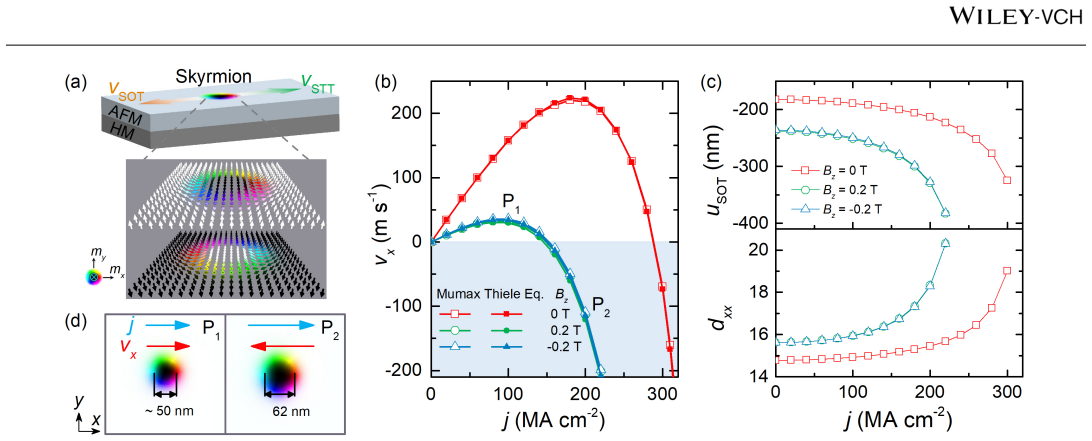
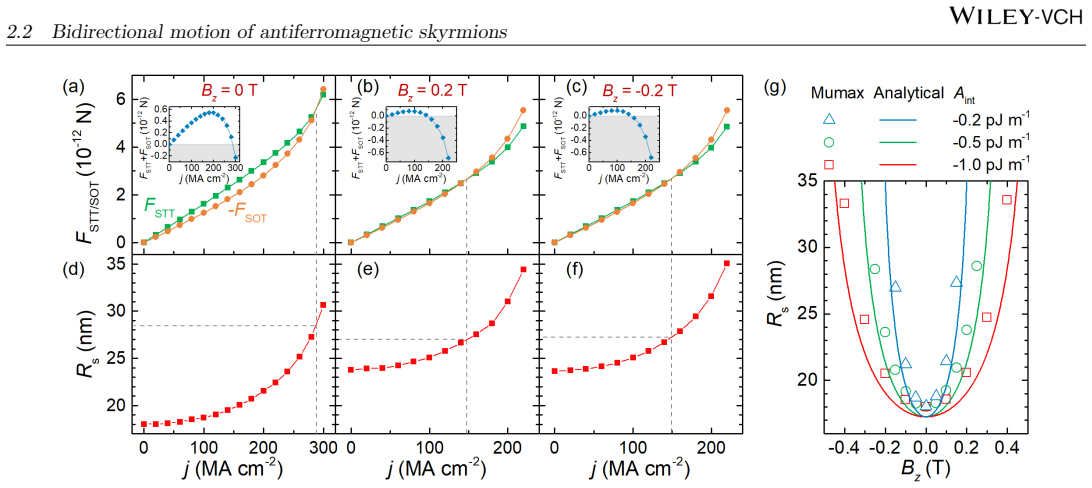
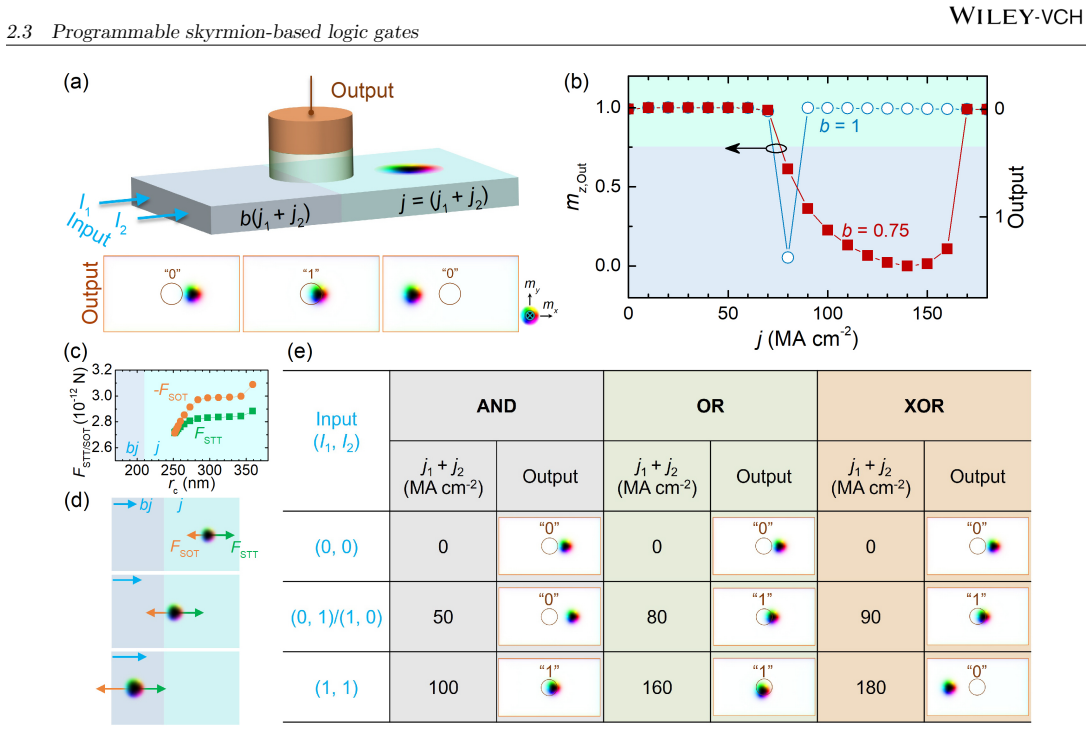
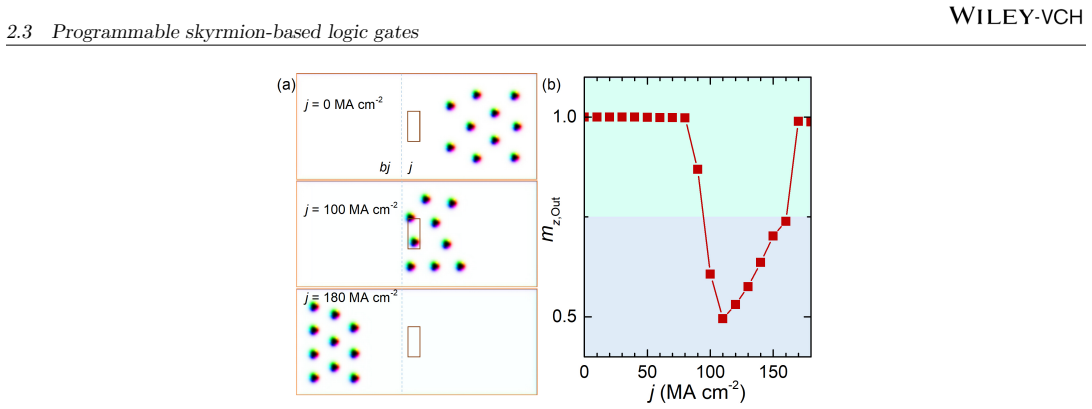
We computationally demonstrate that antiferromagnetic skyrmions moving in one direction at low current densities can reverse their motion direction when the driving current is above a threshold. Based on the Thiele approach analysis, we show that this bidirectional motion originates from a change in the relative strengths of two effective forces arising from spin-transfer and spin-orbit torques. Furthermore, exploiting this bidirectional motion on a single racetrack, we design programmable logic gates.
What carries the argument
Competing effective forces from spin-transfer torque and spin-orbit torque on rigid antiferromagnetic skyrmions, analyzed through the Thiele equation.
Load-bearing premise
The Thiele approach accurately models the skyrmion dynamics as rigid particles without significant deformation, pinning, or other unaccounted effects at the currents studied.
What would settle it
An experiment that tracks antiferromagnetic skyrmion velocity direction versus increasing current density and finds no reversal at the predicted threshold current would falsify the central claim.
Figures
read the original abstract
Antiferromagnetic skyrmions are swirling topological spin textures with rich dynamics and intriguing transport properties, yet their bidirectional dynamics remain largely unexplored. Here, we investigate the dynamics of antiferromagnetic skyrmions driven by current-induced spin-transfer and spin-orbit torques. We computationally demonstrate that antiferromagnetic skyrmions moving in one direction at low current densities can reverse their motion direction when the driving current is above a threshold. Based on the Thiele approach analysis, we show that this bidirectional motion originates from a change in the relative strengths of two effective forces arising from spin-transfer and spin-orbit torques. Furthermore, exploiting this bidirectional motion on a single racetrack, we design programmable logic gates. Our results not only uncover a hidden mechanism for bidirectional skyrmion motion but also facilitate the development of antiferromagnet-based logic devices.
Editorial analysis
A structured set of objections, weighed in public.
Referee Report
Summary. The manuscript computationally demonstrates that antiferromagnetic skyrmions driven by combined spin-transfer torque (STT) and spin-orbit torque (SOT) exhibit bidirectional motion: they move in one direction at low current densities but reverse direction above a threshold current. Thiele-equation analysis attributes this reversal to a crossover in the relative magnitudes of two opposing effective forces arising from STT and SOT. The work further proposes exploiting the bidirectional motion to realize programmable logic gates on a single racetrack.
Significance. If the central claim is robust, the result identifies a current-density-controlled mechanism for reversing AFM skyrmion velocity without polarity reversal, which could be useful for antiferromagnetic spintronic devices. The combination of micromagnetic simulations with Thiele collective-coordinate analysis is a strength, as it supplies both numerical evidence and an analytic explanation of the force competition.
major comments (2)
- [Thiele approach analysis] Thiele analysis section: the derivation of opposing effective forces and the predicted reversal threshold treats the skyrmion as a rigid particle whose collective coordinates obey a closed set of ODEs. The manuscript does not report quantitative checks (e.g., time evolution of the Néel-vector profile, breathing-mode amplitude, or topological charge conservation) confirming that the texture remains rigid at currents above the reversal threshold; without such validation the observed reversal in simulations could arise from unaccounted deformation or magnon coupling rather than the STT–SOT force crossover alone.
- [Micromagnetic results] Micromagnetic results section: the central claim that reversal occurs precisely where the Thiele-derived force ratio changes sign requires a direct, quantitative comparison between the simulated velocity-versus-current curve and the analytic threshold. No such overlay or parameter table is provided, leaving open whether the numerical reversal matches the rigid-particle prediction or is influenced by pinning, damping, or discretization effects.
minor comments (1)
- Figure captions and axis labels should explicitly state the current-density units and the sign convention for velocity to allow immediate comparison with the Thiele force expressions.
Simulated Author's Rebuttal
We thank the referee for the detailed and constructive report. The two major comments highlight important aspects of validating the Thiele analysis and its connection to the micromagnetic results. We address each point below and indicate the revisions we will make.
read point-by-point responses
-
Referee: [Thiele approach analysis] Thiele analysis section: the derivation of opposing effective forces and the predicted reversal threshold treats the skyrmion as a rigid particle whose collective coordinates obey a closed set of ODEs. The manuscript does not report quantitative checks (e.g., time evolution of the Néel-vector profile, breathing-mode amplitude, or topological charge conservation) confirming that the texture remains rigid at currents above the reversal threshold; without such validation the observed reversal in simulations could arise from unaccounted deformation or magnon coupling rather than the STT–SOT force crossover alone.
Authors: We agree that explicit validation of the rigid-particle assumption strengthens the Thiele analysis. In the revised manuscript we will add supplementary figures showing the time evolution of the Néel-vector profile and the breathing-mode amplitude for currents both below and above the reversal threshold, together with confirmation that the topological charge remains conserved. These checks will be performed on the same parameter sets used for the velocity curves. revision: yes
-
Referee: [Micromagnetic results] Micromagnetic results section: the central claim that reversal occurs precisely where the Thiele-derived force ratio changes sign requires a direct, quantitative comparison between the simulated velocity-versus-current curve and the analytic threshold. No such overlay or parameter table is provided, leaving open whether the numerical reversal matches the rigid-particle prediction or is influenced by pinning, damping, or discretization effects.
Authors: We accept that a direct overlay is necessary for quantitative validation. The revised version will include a new figure (or panel) that overlays the simulated velocity-versus-current data with the analytic threshold obtained from the Thiele force balance, using the exact material parameters of the simulations. A supplementary table will also list the damping, pinning, and discretization parameters to allow readers to assess their influence. revision: yes
Circularity Check
No circularity: standard Thiele analysis applied to simulation results
full rationale
The paper reports micromagnetic simulations demonstrating current-dependent reversal of antiferromagnetic skyrmion velocity and invokes the Thiele collective-coordinate equation to attribute the reversal to the crossing of opposing STT and SOT force terms. Both steps are independent of the target result: the simulations are direct numerical integration of the Landau-Lifshitz-Gilbert equation, and the Thiele framework is a long-established rigid-particle reduction whose force expressions are derived from the same micromagnetic energy without reference to the reversal phenomenon itself. No fitted parameters are relabeled as predictions, no self-citation supplies a uniqueness theorem, and no ansatz is smuggled through prior work by the same authors. The derivation chain therefore remains self-contained against external benchmarks.
Axiom & Free-Parameter Ledger
Reference graph
Works this paper leans on
-
[1]
Skyrmion. Science , author =. 2009 , pages =. doi:10.1126/science.1166767 , abstract =
-
[2]
Beyond skyrmions:. Phys. Rep. , author =. 2021 , pages =. doi:10.1016/j.physrep.2020.10.001 , abstract =
-
[3]
Topological properties and dynamics of magnetic skyrmions , volume =. Nat. Nanotechnol. , author =. 2013 , pages =. doi:10.1038/nnano.2013.243 , number =
-
[4]
Static and. Phys. Rev. Lett. , author =. 2016 , pages =. doi:10.1103/PhysRevLett.116.147203 , number =
-
[5]
Direct observation of the skyrmion. Nat. Phys. , author =. 2017 , pages =. doi:10.1038/nphys3883 , language =
-
[6]
Antiferromagnetic. Sci. Rep. , author =. 2016 , pages =. doi:10.1038/srep24795 , language =
-
[7]
Dynamics of antiferromagnetic skyrmion driven by the spin. Appl. Phys. Lett. , author =. 2016 , pages =. doi:10.1063/1.4967006 , language =
-
[8]
Magnetic skyrmions: advances in physics and potential applications , volume =. Nat. Rev. Mater. , author =. 2017 , pages =. doi:10.1038/natrevmats.2017.31 , abstract =
-
[9]
Perspective:. J. Appl. Phys. , author =. 2018 , pages =. doi:10.1063/1.5048972 , number =
-
[10]
Nucleation, stability and current-induced motion of isolated magnetic skyrmions in nanostructures , volume =. Nat. Nanotechnol. , author =. 2013 , pages =. doi:10.1038/nnano.2013.210 , number =
-
[11]
Magnetic skyrmion logic gates: conversion, duplication and merging of skyrmions , volume =. Sci. Rep. , author =. 2015 , pages =. doi:10.1038/srep09400 , language =
-
[12]
Current-. Phys. Rev. Applied , author =. 2019 , pages =. doi:10.1103/PhysRevApplied.12.064033 , language =
-
[13]
Current-driven dynamics and inhibition of the skyrmion. Nat. Commun. , author =. 2018 , pages =. doi:10.1038/s41467-018-03378-7 , language =
-
[14]
Steady-. Phys. Rev. Lett. , author =. 1973 , pages =. doi:10.1103/PhysRevLett.30.230 , language =
-
[15]
A thermodynamic theory of “weak” ferromagnetism of antiferromagnetics , volume =. J. Phys. Chem. Solids , author =. 1958 , pages =. doi:10.1016/0022-3697(58)90076-3 , abstract =
-
[16]
Anisotropic. Phys. Rev. , author =. 1960 , pages =. doi:10.1103/PhysRev.120.91 , number =
-
[17]
Skyrmion dynamics in chiral ferromagnets , volume =. Phys. Rev. B , author =. 2015 , pages =. doi:10.1103/PhysRevB.92.064412 , number =
-
[18]
Skyrmion fractionalization and merons in chiral magnets with easy-plane anisotropy , volume =. Phys. Rev. B , author =. 2015 , pages =. doi:10.1103/PhysRevB.91.224407 , number =
-
[19]
Skyrmion-electronics: writing, deleting, reading and processing magnetic skyrmions toward spintronic applications , volume =. J. Phys.: Condens. Matter. , author =. 2020 , pages =. doi:10.1088/1361-648X/ab5488 , abstract =
-
[20]
Zhou, Y. , year =. Magnetic skyrmions: intriguing physics and new spintronic device concepts , volume =. doi:https://doi.org/10.1093/nsr/nwy109 , journal =
-
[21]
Magnetic skyrmion bundles and their current-driven dynamics , volume =. Nat. Nanotechnol. , author =. 2021 , pages =. doi:10.1038/s41565-021-00954-9 , number =
-
[22]
The design and verification of. AIP Adv. , author =. 2014 , pages =. doi:10.1063/1.4899186 , number =
-
[23]
Skyrmion-. Phys. Rev. Applied , author =. 2021 , pages =. doi:10.1103/PhysRevApplied.15.064004 , language =
-
[24]
Skyrmions-based logic gates in one single nanotrack completely reconstructed via chirality barrier , volume =. Natl. Sci. Rev. , author =. 2022 , pages =. doi:10.1093/nsr/nwac021 , abstract =
-
[25]
Reconfigurable. Nano Lett. , author =. 2018 , pages =. doi:10.1021/acs.nanolett.7b04722 , abstract =
-
[26]
Stochastic. Phys. Rev. Applied , author =. 2020 , pages =. doi:10.1103/PhysRevApplied.13.054049 , language =
-
[27]
A. IEEE Trans. Magn. , author =. 2004 , pages =. doi:10.1109/TMAG.2004.836740 , abstract =
-
[28]
Skyrmion. Nat. Phys. , author =. 2017 , pages =. doi:10.1038/nphys4000 , number =
-
[29]
Helium. Nano Lett. , author =. 2021 , pages =. doi:10.1021/acs.nanolett.1c00136 , abstract =
-
[30]
Spin torque nano-oscillators based on antiferromagnetic skyrmions , volume =. Appl. Phys. Lett. , author =. 2019 , pages =. doi:10.1063/1.5080302 , abstract =
-
[31]
A theory on skyrmion size , volume =. Commun. Phys. , author =. 2018 , pages =. doi:10.1038/s42005-018-0029-0 , language =
-
[32]
Robust and. Phys. Rev. Applied , author =. 2022 , pages =. doi:10.1103/PhysRevApplied.18.014025 , language =
-
[33]
Spontaneous skyrmion ground states in magnetic metals , volume =. Nature , author =. 2006 , pages =. doi:10.1038/nature05056 , language =
-
[34]
Magnetic. Science , author =. 2008 , pages =. doi:10.1126/science.1145799 , abstract =
-
[35]
Skyrmion-. Proc. IEEE , author =. 2016 , pages =. doi:10.1109/JPROC.2016.2591578 , language =
-
[36]
Magnetic skyrmions: from fundamental to applications , volume =. J. Phys. D: Appl. Phys. , author =. 2016 , pages =. doi:10.1088/0022-3727/49/42/423001 , abstract =
-
[37]
Statics and dynamics of skyrmions interacting with disorder and nanostructures , volume =. Rev. Mod. Phys. , author =. 2022 , pages =. doi:10.1103/RevModPhys.94.035005 , language =
-
[38]
The 2020 skyrmionics roadmap , volume =. J. Phys. D: Appl. Phys. , author =. 2020 , pages =. doi:10.1088/1361-6463/ab8418 , abstract =
-
[39]
Current-. Phys. Rev. Lett. , author =. 2020 , pages =. doi:10.1103/PhysRevLett.124.037202 , language =
-
[40]
Programmable skyrmion-based logic gates in a single nanotrack , volume =. Phys. Rev. B , author =. 2023 , pages =. doi:10.1103/PhysRevB.107.054437 , language =
-
[41]
Fast current-induced skyrmion motion in synthetic antiferromagnets , volume =. Science , author =. 2024 , pages =. doi:10.1126/science.add5751 , abstract =
-
[42]
vortices
Thermodynamically stable “vortices” in magnetically ordered crystals. Sov. Phys. JETP , author =. 1989 , pages =
1989
-
[43]
A reversible conversion between a skyrmion and a domain-wall pair in a junction geometry , volume =. Nat. Commun. , author =. 2014 , pages =. doi:10.1038/ncomms5652 , language =
-
[44]
Realization of skyrmion shift register , volume =. Sci. Bull. , author =. 2024 , pages =. doi:10.1016/j.scib.2024.05.035 , language =
-
[45]
High-frequency spin transfer nano-oscillator based on the motion of skyrmions in an annular groove , volume =. New J. Phys. , author =. 2020 , pages =. doi:10.1088/1367-2630/ab7258 , abstract =
-
[46]
Positive and negative drag, dynamic phases, and commensurability in coupled one-dimensional channels of particles with. Phys. Rev. E , author =. 2011 , pages =. doi:10.1103/PhysRevE.83.061404 , language =
-
[47]
Structure, control, and dynamics of altermagnetic textures , volume =. npj Spintronics , author =. 2024 , pages =. doi:10.1038/s44306-024-00042-3 , abstract =
-
[48]
Skyrmion. Phys. Rev. Lett. , author =. 2024 , pages =
2024
-
[49]
and Gurung, Shivraj and Rai, D
Tamang, R. and Gurung, Shivraj and Rai, D. P. and Brahimi, Samy and Lounis, Samir , month = dec, year =. Newly discovered magnetic phase:. doi:10.48550/arXiv.2412.05377 , abstract =
-
[50]
Spin current generation in organic antiferromagnets , volume =. Nat Commun , author =. 2019 , pages =. doi:10.1038/s41467-019-12229-y , abstract =
-
[51]
Efficient. Phys. Rev. Lett. , author =. 2021 , pages =. doi:10.1103/PhysRevLett.126.127701 , language =
-
[52]
Observation of. Phys. Rev. Lett. , author =. 2022 , pages =. doi:10.1103/PhysRevLett.129.137201 , language =
-
[53]
Spontaneous. Phys. Rev. Lett. , author =. 2023 , pages =. doi:10.1103/PhysRevLett.130.036702 , language =
-
[54]
Beyond. Phys. Rev. X , author =. 2022 , pages =. doi:10.1103/PhysRevX.12.031042 , language =
-
[55]
Emerging. Phys. Rev. X , author =. 2022 , pages =. doi:10.1103/PhysRevX.12.040501 , language =
-
[56]
Giant and. Phys. Rev. X , author =. 2022 , pages =. doi:10.1103/PhysRevX.12.011028 , language =
-
[57]
Skyrmion-based chaotic oscillator driven by a constant current , volume =. Phys. Rev. B , author =. 2024 , pages =. doi:10.1103/PhysRevB.109.014422 , language =
-
[58]
Kravchuk, Volodymyr P. and Yershov, Kostiantyn V. and Facio, Jorge I. and Guo, Yaqian and Janson, Oleg and Gomonay, Olena and Sinova, Jairo and Brink, Jeroen van den , month = may, year =. Chiral magnetic excitations and domain textures of g-wave altermagnets , url =. doi:10.48550/arXiv.2504.05241 , abstract =
-
[59]
Curvature-. Phys. Rev. Lett. , author =. 2025 , pages =. doi:10.1103/PhysRevLett.134.116701 , abstract =
-
[60]
Spin-. Phys. Rev. Lett. , author =. 2025 , pages =. doi:10.1103/PhysRevLett.134.176401 , language =
-
[61]
A practical method for calculating largest. Physica D , author =. 1993 , pages =. doi:10.1016/0167-2789(93)90009-P , language =
-
[62]
Bidirectional. Current Biology , author =. 2004 , pages =. doi:10.1016/j.cub.2004.06.045 , language =
-
[63]
Altermagnets as a new class of functional materials , volume =. Nat. Rev. Mater. , author =. 2025 , pages =. doi:10.1038/s41578-025-00779-1 , language =
-
[64]
Altermagnetism and. Magnetism , author =. 2025 , pages =. doi:10.3390/magnetism5030017 , abstract =
-
[65]
Anomalous. Nat Rev Mater , author =. 2022 , pages =. doi:10.1038/s41578-022-00430-3 , abstract =
-
[66]
Emerging. Advanced Materials , author =. 2024 , pages =. doi:10.1002/adma.202310379 , abstract =
-
[67]
Altermagnetism:. Adv. Funct. Mater. , author =. 2024 , pages =. doi:10.1002/adfm.202409327 , abstract =
-
[68]
Tunneling. Phys. Rev. Lett. , author =. 2025 , pages =. doi:10.1103/nrk5-5zrj , language =
-
[69]
Spin-neutral currents for spintronics , volume =. Nat. Commun. , author =. 2021 , pages =. doi:10.1038/s41467-021-26915-3 , abstract =
-
[70]
Terahertz. Adv. Sci. , author =. 2023 , pages =. doi:10.1002/advs.202300512 , abstract =
-
[71]
Spin-. Phys. Rev. Lett. , author =. 2025 , pages =. doi:10.1103/l8d1-gpgr , language =
-
[72]
Observation of. Phys. Rev. Lett. , author =. 2022 , pages =. doi:10.1103/PhysRevLett.128.197202 , language =
-
[73]
Observation of time-reversal symmetry breaking in the band structure of altermagnetic. Sci. Adv. , author =. 2024 , pages =. doi:10.1126/sciadv.adj4883 , abstract =
-
[74]
Manipulation of the altermagnetic order in. Nature , author =. 2025 , pages =. doi:10.1038/s41586-024-08436-3 , language =
-
[75]
Unconventional magnons in collinear magnets dictated by spin space groups , volume =. Nature , author =. 2025 , pages =. doi:10.1038/s41586-025-08715-7 , language =
-
[76]
Ferroelectric. Phys. Rev. Lett. , author =. 2025 , pages =. doi:10.1103/PhysRevLett.134.106802 , language =
-
[77]
Altermagnetic lifting of. Nature , author =. 2024 , pages =. doi:10.1038/s41586-023-06907-7 , abstract =
-
[78]
Three-dimensional mapping of the altermagnetic spin splitting in. Nat. Commun. , author =. 2025 , pages =. doi:10.1038/s41467-025-56647-7 , abstract =
-
[79]
Nanoscale imaging and control of altermagnetism in. Nature , author =. 2024 , pages =. doi:10.1038/s41586-024-08234-x , abstract =
-
[80]
Altermagnet skyrmions:. Phys. Rev. B , author =. 2025 , pages =. doi:10.1103/xtcd-t47t , language =
discussion (0)
Sign in with ORCID, Apple, or X to comment. Anyone can read and Pith papers without signing in.