Quantum simulation of neutrino oscillations with bosonic encoding
Pith reviewed 2026-06-26 20:45 UTC · model grok-4.3
The pith
Cavity bosonic modes simulate neutrino oscillations with probabilities matching theory.
A machine-rendered reading of the paper's core claim, the machinery that carries it, and where it could break.
Core claim
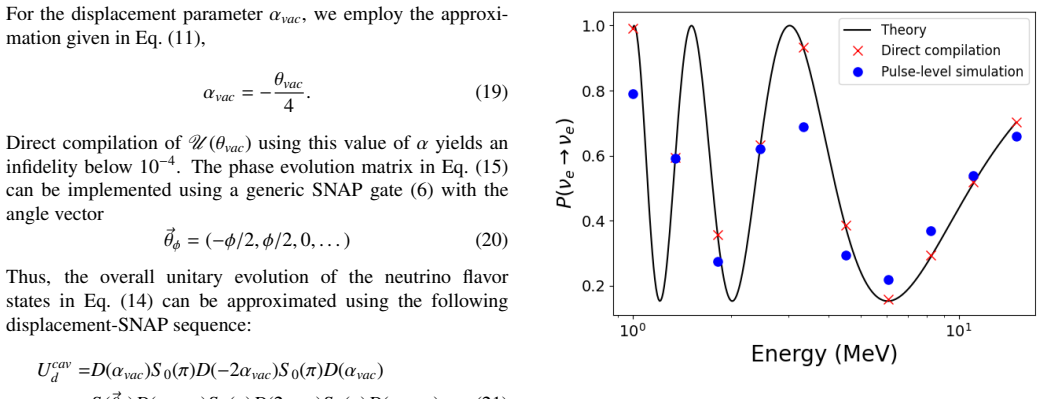
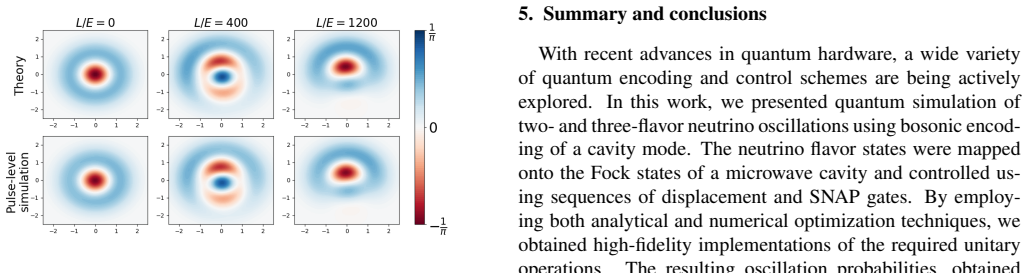
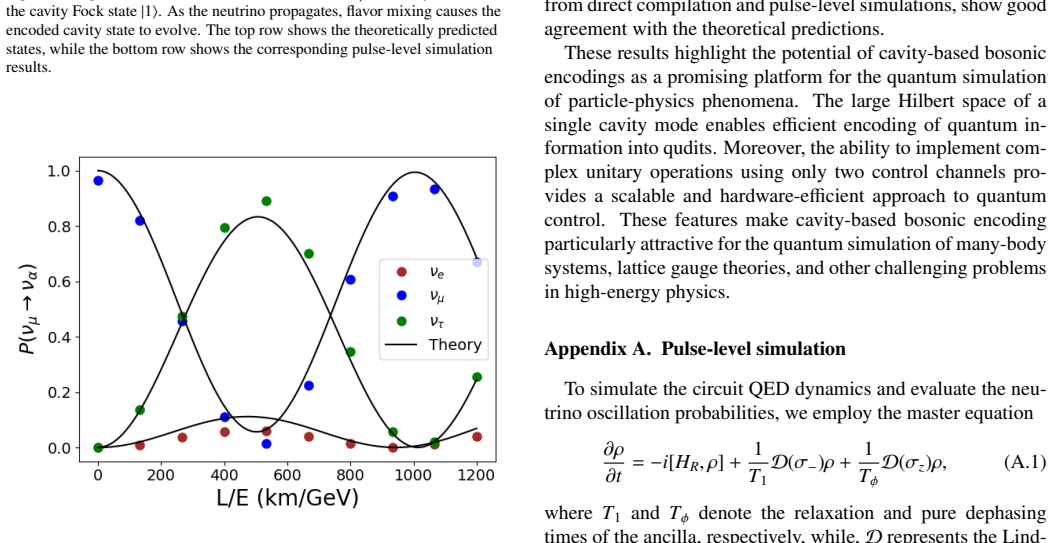
We investigate the quantum simulation of two- and three-flavor neutrino oscillations using Fock-basis encoding of a cavity mode. We design pulse sequences for implementing the required unitary operations through selective number-dependent arbitrary phase (SNAP) and displacement gates. Pulse-level control is employed to realize high-fidelity gate operations on the encoded cavity mode. The resulting neutrino oscillation probabilities obtained from quantum simulation exhibit close agreement with the corresponding theoretical predictions, demonstrating the feasibility of cavity-based bosonic encoding schemes for quantum simulation.
What carries the argument
Fock-basis encoding of the cavity bosonic mode manipulated by SNAP and displacement gates via pulse sequences from a single ancillary qubit.
If this is right
- Two-flavor and three-flavor neutrino oscillation probabilities can be obtained directly from measurements on the cavity mode.
- A single ancillary qubit suffices to control the entire simulation of the oscillation dynamics.
- High-fidelity SNAP and displacement gates produce results close enough to theory to validate the encoding approach.
- The cavity architecture provides a concrete route to bosonic quantum simulation of mixing phenomena.
Where Pith is reading between the lines
- The same encoding could be tested on multi-mode cavities to handle more than three flavors without adding extra qubits.
- If gate errors remain low, the method might extend to simulating neutrino propagation in matter or other interaction Hamiltonians.
- Hardware experiments that vary the gate duration or cavity lifetime would directly test how far the agreement holds before decoherence dominates.
Load-bearing premise
The pulse sequences for SNAP and displacement gates can be executed on the physical cavity mode with sufficiently low error and decoherence that the simulated probabilities remain faithful to the ideal unitary evolution.
What would settle it
Executing the designed pulse sequences on real cavity hardware and obtaining oscillation probabilities that deviate by more than a few percent from the theoretical curves for the same mixing angles and baselines.
Figures

read the original abstract
Superconducting qubits offer a versatile platform for quantum simulation. In this architecture, quantum information can be encoded in the bosonic modes of a microwave cavity, offering an alternative to conventional qubit-based encoding schemes. These cavity bosonic modes can be manipulated using a single ancillary qubit. In this work, we investigate the quantum simulation of two- and three-flavor neutrino oscillations using Fock-basis encoding of a cavity mode. We design pulse sequences for implementing the required unitary operations through selective number-dependent arbitrary phase (SNAP) and displacement gates. Pulse-level control is employed to realize high-fidelity gate operations on the encoded cavity mode. The resulting neutrino oscillation probabilities obtained from quantum simulation exhibit close agreement with the corresponding theoretical predictions, demonstrating the feasibility of cavity-based bosonic encoding schemes for quantum simulation.
Editorial analysis
A structured set of objections, weighed in public.
Referee Report
Summary. The manuscript reports a quantum simulation of two- and three-flavor neutrino oscillations on a superconducting cavity platform. Neutrino flavor states are encoded in the Fock basis of a microwave cavity mode, with the required mixing unitaries realized via pulse-level SNAP and displacement gates driven by an ancillary transmon qubit. The resulting oscillation probabilities are stated to exhibit close agreement with independent analytic predictions obtained from the standard PMNS matrix, thereby demonstrating the feasibility of cavity-based bosonic encoding for such simulations.
Significance. If the reported agreement is shown to be quantitative and free of post-selection or calibration artifacts, the work would provide a concrete experimental benchmark for bosonic encodings in quantum simulation. The approach exploits the large Hilbert space of a single cavity mode and avoids the overhead of multi-qubit decompositions for the neutrino mixing Hamiltonian; this is a genuine technical contribution to the cavity-QED simulation literature. The absence of numerical fidelity metrics, however, prevents a firm assessment of how far the result advances the state of the art.
major comments (3)
- [Abstract / Results] Abstract and results section: the central claim that 'the resulting neutrino oscillation probabilities obtained from quantum simulation exhibit close agreement with the corresponding theoretical predictions' is not accompanied by any quantitative fidelity numbers, error bars, or an error budget. Without these data it is impossible to judge whether the observed agreement supports the feasibility assertion or could be consistent with substantial gate infidelity.
- [Methods] Methods / experimental implementation: no description is given of how post-selection, readout calibration, or state-preparation fidelity were handled. These details are load-bearing for the claim that the physical pulse sequences realize the ideal unitary evolution of the neutrino mixing Hamiltonian.
- [Experimental implementation] The manuscript states that SNAP and displacement gates were implemented at the pulse level, yet provides neither the measured gate fidelities nor a comparison of the executed pulse sequences against the ideal operators used in the simulation. This omission directly affects the weakest assumption identified in the review (low-error execution of the gates).
minor comments (2)
- [Theory] Notation for the three-flavor PMNS matrix and the mapping between flavor states and Fock levels should be stated explicitly in a single location for clarity.
- [Figures] Figure captions should include the number of experimental shots or averaging procedure used to extract the reported probabilities.
Simulated Author's Rebuttal
We thank the referee for the careful review and constructive feedback. We address each major comment below and have revised the manuscript to incorporate quantitative metrics and additional experimental details as requested.
read point-by-point responses
-
Referee: [Abstract / Results] Abstract and results section: the central claim that 'the resulting neutrino oscillation probabilities obtained from quantum simulation exhibit close agreement with the corresponding theoretical predictions' is not accompanied by any quantitative fidelity numbers, error bars, or an error budget. Without these data it is impossible to judge whether the observed agreement supports the feasibility assertion or could be consistent with substantial gate infidelity.
Authors: We agree that quantitative metrics strengthen the claim. The original figures demonstrate visual agreement, but in the revised manuscript we now report the average fidelity (with statistical error bars from repeated experimental runs) between the measured oscillation probabilities and the theoretical predictions from the PMNS matrix. An error budget section has also been added, estimating contributions from gate errors, decoherence, and readout noise. revision: yes
-
Referee: [Methods] Methods / experimental implementation: no description is given of how post-selection, readout calibration, or state-preparation fidelity were handled. These details are load-bearing for the claim that the physical pulse sequences realize the ideal unitary evolution of the neutrino mixing Hamiltonian.
Authors: We have expanded the Methods section to include these details: state-preparation fidelity is characterized via quantum state tomography on the cavity mode; readout calibration uses reference measurements on known Fock states; and the presented data involve no post-selection—all experimental shots are retained and reported. revision: yes
-
Referee: [Experimental implementation] The manuscript states that SNAP and displacement gates were implemented at the pulse level, yet provides neither the measured gate fidelities nor a comparison of the executed pulse sequences against the ideal operators used in the simulation. This omission directly affects the weakest assumption identified in the review (low-error execution of the gates).
Authors: We have added the measured gate fidelities for SNAP and displacement operations, obtained via interleaved randomized benchmarking on the cavity-transmon system. We also include a direct comparison of the implemented pulse sequences to the ideal unitaries, obtained by numerically integrating the time-dependent drive Hamiltonian and quantifying the resulting operator infidelity. revision: yes
Circularity Check
No significant circularity
full rationale
The paper implements SNAP and displacement gates on a cavity mode to simulate the neutrino mixing Hamiltonian, then compares the resulting oscillation probabilities to independent analytic predictions derived from the standard PMNS matrix. No step reduces a claimed prediction to a fitted parameter or self-citation by construction; the agreement serves as external validation of the gate implementation rather than a tautology. The derivation chain is self-contained against the external benchmark of known neutrino oscillation formulas.
Axiom & Free-Parameter Ledger
axioms (2)
- domain assumption The time-evolution operator for neutrino oscillations is given by the standard PMNS mixing matrix and mass-squared differences.
- domain assumption SNAP and displacement gates can be composed to implement the required unitary without additional error channels beyond those already calibrated.
Reference graph
Works this paper leans on
-
[1]
C. W. Bauer, Z. Davoudi, N. Klco, M. J. Savage, Quantum simulation of fundamental particles and forces, Nature Rev. Phys. 5 (7) (2023) 420–432.arXiv:2404.06298, doi:10.1038/s42254-023-00599-8
-
[2]
C. W. Bauer, et al., Quantum Simulation for High-Energy Physics, PRX Quantum 4 (2) (2023) 027001.arXiv: 2204.03381,doi:10.1103/PRXQuantum.4.027001
-
[3]
Quantum computing for high-energy physics: State of the art and challenges,
A. Di Meglio, et al., Quantum Computing for High- Energy Physics: State of the Art and Challenges, PRX Quantum 5 (3) (2024) 037001.arXiv:2307.03236, doi:10.1103/PRXQuantum.5.037001
-
[4]
Lloyd, Universal Quantum Simulators, Science 273 (5278) (1996) 1073.doi:10.1126/science.273
S. Lloyd, Universal Quantum Simulators, Science 273 (5278) (1996) 1073.doi:10.1126/science.273. 5278.1073
-
[5]
I. M. Georgescu, S. Ashhab, F. Nori, Quantum Simula- tion, Rev. Mod. Phys. 86 (2014) 153.arXiv:1308.6253, doi:10.1103/RevModPhys.86.153
work page internal anchor Pith review Pith/arXiv arXiv doi:10.1103/revmodphys.86.153 2014
-
[6]
C. Noh, B. Rodríguez-Lara, D. Angelakis, Quantum sim- ulation of neutrino oscillations with trapped ions, New Journal of Physics 14 (3) (2012) 033028
2012
-
[7]
A. K. Jha, A. Chatla, Quantum studies of neutrinos on IBMQ processors, Eur. Phys. J. ST 231 (2) (2022) 141– 149.doi:10.1140/epjs/s11734-021-00358-9
- [8]
-
[9]
B. Hall, A. Roggero, A. Baroni, J. Carlson, Simulation of collective neutrino oscillations on a quantum com- puter, Phys. Rev. D 104 (6) (2021) 063009.arXiv: 2102.12556,doi:10.1103/PhysRevD.104.063009. 6
-
[10]
K. Yeter-Aydeniz, S. Bangar, G. Siopsis, R. C. Pooser, Collective neutrino oscillations on a quantum computer, Quant. Inf. Proc. 21 (3) (2022) 84.arXiv:2104.03273, doi:10.1007/s11128-021-03348-x
-
[11]
A. B. Balantekin, M. J. Cervia, A. V . Patwardhan, E. Rra- paj, P. Siwach, Quantum information and quantum sim- ulation of neutrino physics, Eur. Phys. J. A 59 (8) (2023) 186.arXiv:2305.01150,doi:10.1140/epja/ s10050-023-01092-7
-
[12]
V . Amitrano, A. Roggero, P. Luchi, F. Turro, L. Vespucci, F. Pederiva, Trapped-ion quantum simulation of col- lective neutrino oscillations, Phys. Rev. D 107 (2) (2023) 023007.arXiv:2207.03189,doi:10.1103/ PhysRevD.107.023007
arXiv 2023
-
[13]
S. Tripathi, S. Joshi, G. Rajpoot, P. Shukla, Quan- tum simulation of collective neutrino oscillations in dense neutrino environment, Quant. Inf. Proc. 25 (5) (2026) 163.arXiv:2508.11610,doi:10.1007/ s11128-026-05151-y
arXiv 2026
-
[14]
C. A. Argüelles, B. J. P. Jones, Neutrino Oscilla- tions in a Quantum Processor, Phys. Rev. Research. 1 (2019) 033176.arXiv:1904.10559,doi:10.1103/ PhysRevResearch.1.033176
arXiv 2019
-
[15]
G. Singh, Arvind, K. Dorai, Simulating Three-Flavor Neutrino Oscillations on an NMR Quantum Processor (12 2024).arXiv:2412.15617
arXiv 2024
-
[16]
H. C. Nguyen, B. G. Bach, T. D. Nguyen, D. M. Tran, D. V . Nguyen, H. Q. Nguyen, Simulating neutrino oscilla- tions on a superconducting qutrit, Phys. Rev. D 108 (2) (2023) 023013.arXiv:2212.14170,doi:10.1103/ PhysRevD.108.023013
arXiv 2023
-
[17]
L. Spagnoli, et al., Collective neutrino oscillations in three flavors on qubit and qutrit processors, Phys. Rev. D 111 (10) (2025) 103054.arXiv:2503.00607,doi: 10.1103/gjr1-lf8s
-
[18]
J. Koch, T. M. Yu, J. Gambetta, A. A. Houck, D. I. Schus- ter, J. Majer, A. Blais, M. H. Devoret, S. M. Girvin, R. J. Schoelkopf, Charge-insensitive qubit design derived from the Cooper pair box, Phys. Rev. A 76 (4) (2007) 042319.arXiv:cond-mat/0703002,doi:10.1103/ physreva.76.042319
Pith/arXiv arXiv 2007
- [19]
-
[20]
D. M. Kurkcuoglu, M. S. Alam, J. A. Job, A. C. Y . Li, A. Macridin, G. N. Perdue, S. Providence, Quantum sim- ulation ofϕ 4 theories in qudit systems (8 2021).arXiv: 2108.13357
arXiv 2021
-
[21]
R. Dutta, N. P. Vu, C. Xu, D. G. A. Cabral, N. Lyu, A. V . Soudackov, X. Dan, H. Li, C. Wang, V . S. Batista, Sim- ulating Electronic Structure on Bosonic Quantum Com- puters, J. Chem. Theor. Comput. 21 (5) (2025) 2281– 2300.arXiv:2404.10222,doi:10.1021/acs.jctc. 4c01400
-
[22]
Y . Liu, et al., Hybrid Oscillator-Qubit Quantum Pro- cessors: Instruction Set Architectures, Abstract Ma- chine Models, and Applications, PRX Quantum 7 (1) (2026) 010201.arXiv:2407.10381,doi:10.1103/ 4rf7-9tfx
arXiv 2026
-
[23]
A. Joshi, K. Noh, Y . Y . Gao, Quantum information pro- cessing with bosonic qubits in circuit QED, Quantum Sci. Technol. 6 (3) (2021) 033001.arXiv:2008.13471, doi:10.1088/2058-9565/abe989
-
[24]
W. Cai, Y . Ma, W. Wang, C.-L. Zou, L. Sun, Bosonic quantum error correction codes in superconducting quan- tum circuits, Fund. Res. 1 (1) (2021) 50–67.arXiv: 2010.08699,doi:10.1016/j.fmre.2020.12.006
-
[25]
Vlastakis, G
B. Vlastakis, G. Kirchmair, Z. Leghtas, S. E. Nigg, L. Frunzio, S. M. Girvin, M. Mirrahimi, M. H. Devoret, R. J. Schoelkopf, Deterministically Encoding Quantum Information Using 100-Photon Schrödinger Cat States, Science 342 (6158) (2013) 607–610.doi:10.1126/ science.1243289
2013
-
[26]
M. H. Michael, M. Silveri, R. . Brierley, V . V . Albert, J. Salmilehto, L. Jiang, S. . Girvin, New Class of Quan- tum Error-Correcting Codes for a Bosonic Mode, Phys. Rev. X 6 (3) (2016) 031006.arXiv:1602.00008,doi: 10.1103/PhysRevX.6.031006
work page internal anchor Pith review Pith/arXiv arXiv doi:10.1103/physrevx.6.031006 2016
-
[27]
M. S. Alam, et al., Quantum computing hardware for HEP algorithms and sensing, in: Snowmass 2021, 2022. arXiv:2204.08605
arXiv 2021
-
[28]
W.-L. Ma, S. Puri, R. J. Schoelkopf, M. H. Devoret, S. M. Girvin, L. Jiang, Quantum control of bosonic modes with superconducting circuits, Sci. Bull. 66 (2021) 1789–1805. arXiv:2102.09668,doi:10.1016/j.scib.2021.05. 024
-
[29]
Universal Control of an Oscillator with Dispersive Coupling to a Qubit
S. Krastanov, V . V . Albert, C. Shen, C.-L. Zou, R. W. Heeres, B. Vlastakis, R. J. Schoelkopf, L. Jiang, Universal control of an oscillator with dispersive coupling to a qubit, Phys. Rev. A 92 (4) (2015) 040303.arXiv:1502.08015, doi:10.1103/PhysRevA.92.040303
work page internal anchor Pith review Pith/arXiv arXiv doi:10.1103/physreva.92.040303 2015
-
[30]
R. W. Heeres, B. Vlastakis, E. Holland, S. Kras- tanov, V . V . Albert, L. Frunzio, L. Jiang, R. J. Schoelkopf, Cavity State Manipulation Using Photon- Number Selective Phase Gates, Phys. Rev. Lett. 115 (13) (2015) 137002.arXiv:1503.01496,doi:10.1103/ physrevlett.115.137002. 7
Pith/arXiv arXiv 2015
-
[31]
N. Bornman, T. Roy, J. A. Job, N. Anand, G. N. Perdue, S. Zorzetti, M. Sohaib Alam, Benchmarking the perfor- mance of a high-Q cavity qudit using random unitaries, Quantum Sci. Technol. 10 (2) (2025) 025062.arXiv: 2408.13317,doi:10.1088/2058-9565/adc47c
-
[32]
Job, Efficient, direct compilation of SU(N) operations into SNAP & Displacement gates (7 2023).arXiv:2307
J. Job, Efficient, direct compilation of SU(N) operations into SNAP & Displacement gates (7 2023).arXiv:2307. 11900
2023
-
[33]
Fösel, S
T. Fösel, S. Krastanov, F. Marquardt, L. Jiang, Efficient cavity control with SNAP gates (4 2020).arXiv:2004. 14256
2020
-
[34]
M. Kudra, et al., Robust Preparation of Wigner-Negative States with Optimized SNAP-Displacement Sequences, PRX Quantum 3 (3) (2022) 030301.arXiv:2111. 07965,doi:10.1103/PRXQuantum.3.030301
-
[35]
C. Giunti, C. W. Kim, Fundamentals of Neutrino Physics and Astrophysics, 2007.doi:10.1093/acprof:oso/ 9780198508717.001.0001
-
[36]
A. Krasnok, P. Dhakal, A. Fedorov, P. Frigola, M. Kelly, S. Kutsaev, Superconducting microwave cavities and qubits for quantum information systems, Applied Physics Reviews 11 (1) (2024) 011302.arXiv:2304.09345
arXiv 2024
-
[37]
N. Lambert, E. Gigu‘ere, P. Menczel, B. Li, P. Hopf, G. Su’arez, M. Gali, J. Lishman, R. Gadhvi, R. Agarwal, A. Galicia, N. Shammah, P. Nation, J. R. Johansson, S. Ahmed, S. Cross, A. Pitchford, F. Nori, Qutip 5: The quantum toolbox in Python, Physics Reports 1153 (2026) 1–62.doi:10.1016/j.physrep.2025.10.001. URLhttps://www.sciencedirect.com/science/ art...
-
[38]
M. Bal, et al., Systematic improvements in transmon qubit coherence enabled by niobium surface encapsulation, npj Quantum Inf. 10 (1) (2024) 43.arXiv:2304.13257, doi:10.1038/s41534-024-00840-x
-
[39]
C. Wang, et al., Transmon qubit with relaxation time ex- ceeding 0.5 milliseconds (5 2021).arXiv:2105.09890, doi:10.1038/s41534-021-00510-2. 8
discussion (0)
Sign in with ORCID, Apple, or X to comment. Anyone can read and Pith papers without signing in.