Field Demonstration of a Multi-User Continuous-Variable Quantum Access Network for Quantum-to-the-Home
Pith reviewed 2026-06-26 20:36 UTC · model grok-4.3
The pith
A 1:16 field trial achieves Mbit/s-level asymptotic secure key rates in a multi-user continuous-variable quantum access network over commercial fiber.
A machine-rendered reading of the paper's core claim, the machinery that carries it, and where it could break.
Core claim
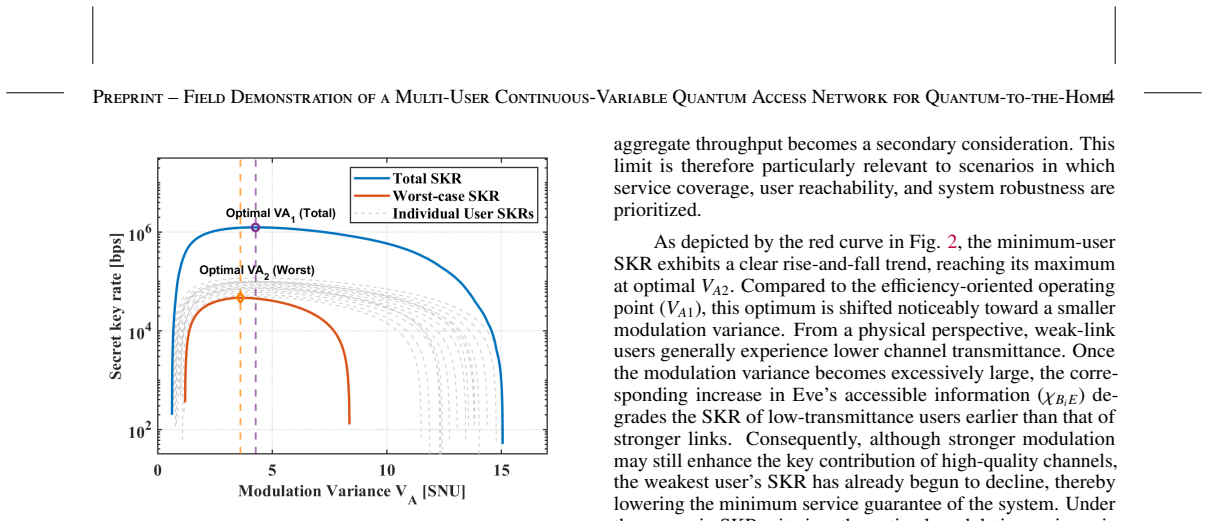
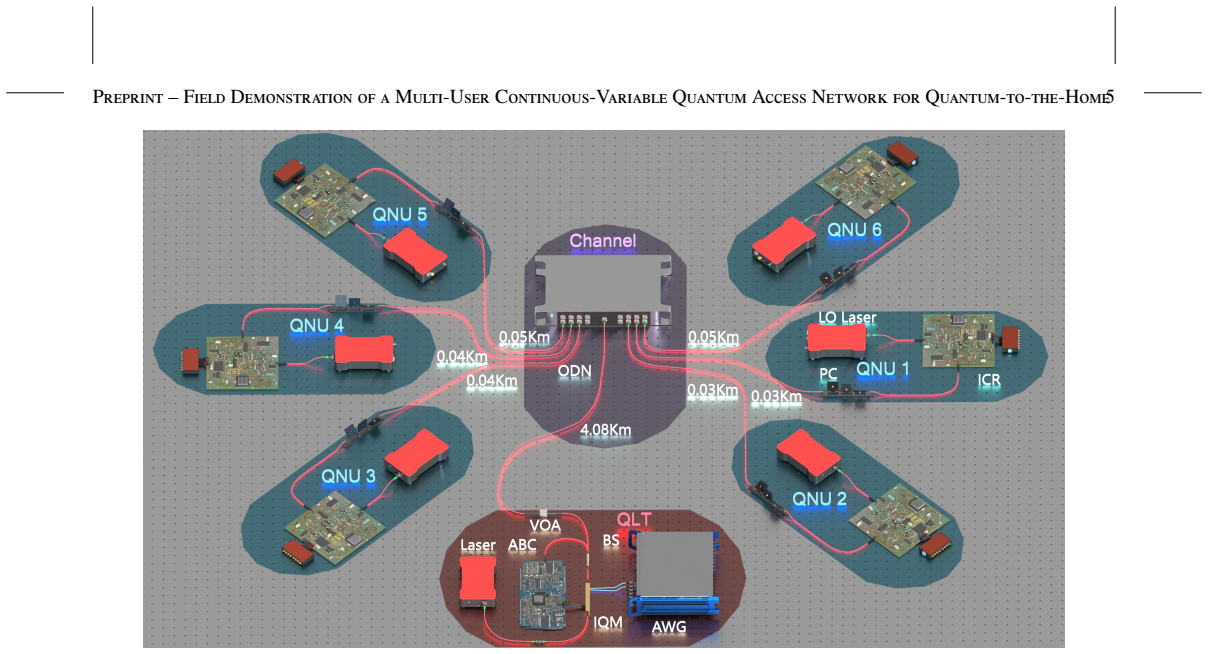
The paper establishes that a downstream broadcast continuous-variable quantum access network can deliver Mbit/s-level asymptotic secure key rates in a 1:16 field trial over commercial fiber by using a multi-user utility model to select an optimal shared modulation variance inside a trusted local network domain, thereby balancing network efficiency and user fairness.
What carries the argument
The multi-user utility model that selects one globally optimal shared modulation variance to balance efficiency and fairness.
If this is right
- Multi-user continuous-variable quantum access networks become feasible for broadcast operation over existing commercial fiber.
- Mbit/s-level secure key rates are attainable in a 1:16 configuration under real-world conditions.
- A single shared modulation variance chosen by the utility model suffices for both network efficiency and user fairness.
- Digital signal processing can be made robust enough to support the full downstream broadcast architecture.
- The demonstration supplies concrete guidance for designing larger-scale Quantum-to-the-Home access networks.
Where Pith is reading between the lines
- The same utility-model approach could be tested at higher splitting ratios to check scalability limits.
- Similar field trials could measure how the trusted-domain assumption affects coexistence with classical traffic on the same fiber.
- Per-user variance tuning might become unnecessary in other multi-user quantum protocols if the trusted-domain premise holds.
- Key-rate gains from improved signal processing could be quantified by re-running the trial with upgraded DSP blocks.
Load-bearing premise
The assumption that a trusted local network domain allows selection of one globally optimal shared modulation variance without security vulnerabilities or per-user adjustments.
What would settle it
A repeat of the 1:16 field trial in which measured asymptotic secure key rates fall below Mbit/s levels or security is lost when the shared variance is applied.
Figures


read the original abstract
Realizing scalable Quantum-to-the-Home (QTTH) faces a bottleneck: link asymmetry in broadcast continuous-variable quantum access networks (CV-QANs) hinders the selection of a globally optimal modulation variance. We demonstrate a downstream broadcast CV-QAN connecting a Quantum Line Terminal (QLT) to multiple Quantum Network Units (QNUs) over commercial fiber. Operating within a trusted local network domain, we establish a multi-user utility model to select the optimal shared variance, balancing network efficiency and user fairness. Supported by robust digital signal processing, our 1:16 field trial achieves Mbit/s-level asymptotic secure key rates, bridging theoretical protocols with Fiber-to-the-Home reality and guiding future scalable access architectures.
Editorial analysis
A structured set of objections, weighed in public.
Referee Report
Summary. The manuscript reports a field demonstration of a downstream 1:16 broadcast continuous-variable quantum access network (CV-QAN) over commercial fiber, connecting a Quantum Line Terminal to multiple Quantum Network Units. Within a trusted local network domain, a multi-user utility model is used to select a single shared modulation variance that balances efficiency and fairness, enabling Mbit/s-level asymptotic secure key rates despite link asymmetry.
Significance. If the central security and performance claims hold, the work is significant for bridging theoretical CV-QKD protocols with practical Fiber-to-the-Home deployments. It supplies experimental evidence that a utility-model approach can handle broadcast asymmetry in a multi-user setting and offers concrete guidance for scalable QTTH architectures. The use of commercial fiber and robust DSP is a practical strength.
major comments (2)
- [Security analysis] Security analysis section: the claim that the trusted-domain utility model permits a globally optimal shared variance without invalidating per-user Holevo bounds is load-bearing for the key-rate results, yet the manuscript does not explicitly derive or verify that the chosen variance preserves the individual security bounds under unequal downstream losses (see the skeptic note on link asymmetry). A concrete check against the CV-QKD security proof is required.
- [Results] Results section, key-rate table or figure: the abstract states Mbit/s asymptotic rates but the provided text supplies no numerical values, error bars, or exclusion criteria; the central performance claim cannot be evaluated without these data and the explicit mapping from measured parameters to the reported rates.
minor comments (2)
- [Figures] Figure captions: several panels lack explicit labels for the different QNUs or loss values, making it difficult to correlate the utility-model output with individual link performance.
- [Methods] Notation: the definition of the multi-user utility function should be stated as an equation rather than described only in prose to allow direct comparison with standard CV-QKD variance optimization.
Simulated Author's Rebuttal
We thank the referee for their constructive and detailed comments. We address each major point below and have revised the manuscript to strengthen the presentation of both the security analysis and the experimental results.
read point-by-point responses
-
Referee: [Security analysis] Security analysis section: the claim that the trusted-domain utility model permits a globally optimal shared variance without invalidating per-user Holevo bounds is load-bearing for the key-rate results, yet the manuscript does not explicitly derive or verify that the chosen variance preserves the individual security bounds under unequal downstream losses (see the skeptic note on link asymmetry). A concrete check against the CV-QKD security proof is required.
Authors: We agree that an explicit derivation is necessary to fully substantiate the claim. In the revised manuscript we have added a new subsection that derives the preservation of individual Holevo bounds under the shared variance chosen by the utility model. The derivation starts from the standard Gaussian CV-QKD security proof, incorporates the trusted-domain assumption, and shows that the common variance remains compatible with per-user security even when downstream losses differ. We include a concrete numerical verification using the measured loss values from the field trial. revision: yes
-
Referee: [Results] Results section, key-rate table or figure: the abstract states Mbit/s asymptotic rates but the provided text supplies no numerical values, error bars, or exclusion criteria; the central performance claim cannot be evaluated without these data and the explicit mapping from measured parameters to the reported rates.
Authors: We acknowledge that the numerical values, error bars, and explicit mapping were not sufficiently prominent in the text. In the revised manuscript we have added a dedicated results table that reports the achieved asymptotic key rates together with their statistical uncertainties, the exclusion criteria applied to the data, and the step-by-step mapping from the measured quadrature variances, channel transmittances, and excess noise to the final key rates via the Devetak-Winter bound adapted for the multi-user setting. revision: yes
Circularity Check
No significant circularity in derivation chain
full rationale
The paper reports an experimental 1:16 field trial of a downstream broadcast CV-QAN over commercial fiber, achieving Mbit/s asymptotic secure key rates via a multi-user utility model that selects a shared modulation variance inside a trusted local network domain. The central result is an empirical demonstration supported by DSP, with key rates derived from measured data using standard CV-QKD Holevo bounds rather than any self-referential definition, fitted parameter renamed as prediction, or self-citation chain. No load-bearing step reduces the reported rates or the utility model to its own inputs by construction; the derivation remains self-contained against external experimental benchmarks.
Axiom & Free-Parameter Ledger
axioms (1)
- domain assumption Operation within a trusted local network domain
Reference graph
Works this paper leans on
-
[1]
Quantum internet: A vision for the road ahead.Science, 362(6412):eaam9288, 2018
Stephanie Wehner, David Elkouss, and Ronald Hanson. Quantum internet: A vision for the road ahead.Science, 362(6412):eaam9288, 2018
2018
-
[2]
Advances in quantum cryptography.Advances in optics and photonics, 12(4):1012–1236, 2020
Stefano Pirandola, Ulrik L Andersen, Leonardo Banchi, Mario Berta, Darius Bunandar, Roger Colbeck, Dirk En- glund, Tobias Gehring, Cosmo Lupo, Carlo Ottaviani, et al. Advances in quantum cryptography.Advances in optics and photonics, 12(4):1012–1236, 2020
2020
-
[3]
Quantum cryptography.Reviews of modern physics, 74(1):145, 2002
Nicolas Gisin, Grégoire Ribordy, Wolfgang Tittel, and Hugo Zbinden. Quantum cryptography.Reviews of modern physics, 74(1):145, 2002
2002
-
[4]
Quantum cryptography: a view from classical cryptography.Quantum science and technology, 2(2):020502, 2017
Johannes Buchmann, Johannes Braun, Denise Demirel, and Matthias Geihs. Quantum cryptography: a view from classical cryptography.Quantum science and technology, 2(2):020502, 2017
2017
-
[5]
Quantum cryptog- raphy: Public key distribution and coin tossing.Theoretical computer science, 560:7–11, 2014
Charles H Bennett and Gilles Brassard. Quantum cryptog- raphy: Public key distribution and coin tossing.Theoretical computer science, 560:7–11, 2014
2014
-
[6]
A single quantum cannot be cloned.Nature, 299(5886):802–803, 1982
William K Wootters and Wojciech H Zurek. A single quantum cannot be cloned.Nature, 299(5886):802–803, 1982
1982
-
[7]
Information exclusion principle for complementary observables.Physical review letters, 74 (17):3307, 1995
Michael JW Hall. Information exclusion principle for complementary observables.Physical review letters, 74 (17):3307, 1995
1995
-
[8]
The quantum internet.Nature, 453(7198): 1023–1030, 2008
H JeffKimble. The quantum internet.Nature, 453(7198): 1023–1030, 2008
2008
-
[9]
Decoy state quantum key distribution.Physical review letters, 94 (23):230504, 2005
Hoi-Kwong Lo, Xiongfeng Ma, and Kai Chen. Decoy state quantum key distribution.Physical review letters, 94 (23):230504, 2005
2005
-
[10]
Measurement- device-independent quantum key distribution.Physical review letters, 108(13):130503, 2012
Hoi-Kwong Lo, Marcos Curty, and Bing Qi. Measurement- device-independent quantum key distribution.Physical review letters, 108(13):130503, 2012
2012
-
[11]
Overcoming the rate–distance limit of quantum key distribution without quantum repeaters
Marco Lucamarini, Zhiliang L Yuan, James F Dynes, and Andrew J Shields. Overcoming the rate–distance limit of quantum key distribution without quantum repeaters. Nature, 557(7705):400–403, 2018
2018
-
[12]
Experimental quantum key distribution with decoy states.Physical review letters, 96(7):070502, 2006
Yi Zhao, Bing Qi, Xiongfeng Ma, Hoi-Kwong Lo, and Li Qian. Experimental quantum key distribution with decoy states.Physical review letters, 96(7):070502, 2006
2006
-
[13]
Secure quantum key distribution over 421 km of optical fiber.Physical review letters, 121(19):190502, 2018
Alberto Boaron, Gianluca Boso, Davide Rusca, Cédric Vulliez, Claire Autebert, Misael Caloz, Matthieu Perre- noud, Gaëtan Gras, Félix Bussières, Ming-Jun Li, et al. Secure quantum key distribution over 421 km of optical fiber.Physical review letters, 121(19):190502, 2018
2018
-
[14]
A device-independent quantum key distribution system for distant users.Nature, 607(7920):687–691, 2022
Wei Zhang, Tim van Leent, Kai Redeker, Robert Garthoff, René Schwonnek, Florian Fertig, Sebastian Eppelt, Wen- jamin Rosenfeld, Valerio Scarani, Charles C-W Lim, et al. A device-independent quantum key distribution system for distant users.Nature, 607(7920):687–691, 2022
2022
-
[15]
Simple security proof of quantum key distribution based on complementarity.New Journal of Physics, 11(4):045018, 2009
Masato Koashi. Simple security proof of quantum key distribution based on complementarity.New Journal of Physics, 11(4):045018, 2009
2009
-
[16]
The security of practical quantum key distribution
Valerio Scarani, Helle Bechmann-Pasquinucci, Nicolas J Cerf, Miloslav Dušek, Norbert Lütkenhaus, and Momtchil Peev. The security of practical quantum key distribution. Reviews of modern physics, 81(3):1301–1350, 2009
2009
-
[17]
Continuous variable entanglement swapping.Physical review letters, 83(11): 2095, 1999
RES Polkinghorne and TC Ralph. Continuous variable entanglement swapping.Physical review letters, 83(11): 2095, 1999
2095
-
[18]
Continuous variable quantum cryptography using coherent states.Phys- ical review letters, 88(5):057902, 2002
Frédéric Grosshans and Philippe Grangier. Continuous variable quantum cryptography using coherent states.Phys- ical review letters, 88(5):057902, 2002
2002
-
[19]
Experimental demonstration of long-distance continuous-variable quan- tum key distribution.Nature photonics, 7(5):378–381, 2013
Paul Jouguet, Sébastien Kunz-Jacques, Anthony Lever- rier, Philippe Grangier, and Eleni Diamanti. Experimental demonstration of long-distance continuous-variable quan- tum key distribution.Nature photonics, 7(5):378–381, 2013. Preprint– FieldDemonstration of aMulti-UserContinuous-VariableQuantumAccessNetwork forQuantum-to-the-Home9
2013
-
[20]
Security of continuous-variable quan- tum cryptography.Physical review A, 62(6):062306, 2000
Timothy C Ralph. Security of continuous-variable quan- tum cryptography.Physical review A, 62(6):062306, 2000
2000
-
[21]
Frédéric Grosshans and Philippe Grangier. Reverse recon- ciliation protocols for quantum cryptography with continu- ous variables.arXiv preprint quant-ph/0204127, 2002
Pith/arXiv arXiv 2002
-
[22]
Quan- tum key distribution using gaussian-modulated coherent states.Nature, 421(6920):238–241, 2003
Frédéric Grosshans, Gilles Van Assche, Jérôme Wenger, Rosa Brouri, Nicolas J Cerf, and Philippe Grangier. Quan- tum key distribution using gaussian-modulated coherent states.Nature, 421(6920):238–241, 2003
2003
-
[23]
Gaussian quantum information
Christian Weedbrook, Stefano Pirandola, Raúl García- Patrón, Nicolas J Cerf, Timothy C Ralph, Jeffrey H Shapiro, and Seth Lloyd. Gaussian quantum information. Reviews of modern physics, 84(2):621–669, 2012
2012
-
[24]
Long-distance continuous- variable quantum key distribution over 202.81 km of fiber
Yichen Zhang, Ziyang Chen, Stefano Pirandola, Xiangyu Wang, Chao Zhou, Binjie Chu, Yijia Zhao, Bingjie Xu, Song Yu, and Hong Guo. Long-distance continuous- variable quantum key distribution over 202.81 km of fiber. Physical review letters, 125(1):010502, 2020
2020
-
[25]
Composable security proof for continuous-variable quantum key distribution with coher- ent states.Physical review letters, 114(7):070501, 2015
Anthony Leverrier. Composable security proof for continuous-variable quantum key distribution with coher- ent states.Physical review letters, 114(7):070501, 2015
2015
-
[26]
Experimental demonstration of continuous-variable measurement-device-independent quantum key distribu- tion over optical fiber.Optica, 9(5):492–500, 2022
Yan Tian, Pu Wang, Jianqiang Liu, Shanna Du, Wenyuan Liu, Zhenguo Lu, Xuyang Wang, and Yongmin Li. Experimental demonstration of continuous-variable measurement-device-independent quantum key distribu- tion over optical fiber.Optica, 9(5):492–500, 2022
2022
-
[27]
Metropolitan all-pass and inter-city quantum communication network.Optics express, 18(26):27217– 27225, 2010
Teng-Yun Chen, Jian Wang, Hao Liang, Wei-Yue Liu, Yang Liu, Xiao Jiang, Yuan Wang, Xu Wan, Wen-Qi Cai, Lei Ju, et al. Metropolitan all-pass and inter-city quantum communication network.Optics express, 18(26):27217– 27225, 2010
2010
-
[28]
Field test of wavelength- saving quantum key distribution network.Optics letters, 35(14):2454–2456, 2010
Shuang Wang, Wei Chen, Zhen-Qiang Yin, Yang Zhang, Tao Zhang, Hong-Wei Li, Fang-Xing Xu, Zheng Zhou, Yang Yang, Da-Jun Huang, et al. Field test of wavelength- saving quantum key distribution network.Optics letters, 35(14):2454–2456, 2010
2010
-
[29]
Large scale quantum key distribution: challenges and solutions.Optics express, 26(18):24260– 24273, 2018
Qiang Zhang, Feihu Xu, Yu-Ao Chen, Cheng-Zhi Peng, and Jian-Wei Pan. Large scale quantum key distribution: challenges and solutions.Optics express, 26(18):24260– 24273, 2018
2018
-
[30]
Measurement- device-independent quantum key distribution over untrust- ful metropolitan network.Physical Review X, 6(1):011024, 2016
Yan-Lin Tang, Hua-Lei Yin, Qi Zhao, Hui Liu, Xiang- Xiang Sun, Ming-Qi Huang, Wei-Jun Zhang, Si-Jing Chen, Lu Zhang, Li-Xing You, et al. Measurement- device-independent quantum key distribution over untrust- ful metropolitan network.Physical Review X, 6(1):011024, 2016
2016
-
[31]
Field trial of a three-state quantum key distribution scheme in the florence metropolitan area.EPJ Quantum Technology, 6(1):5, 2019
Davide Bacco, Ilaria Vagniluca, Beatrice Da Lio, Nicola Biagi, Adriano Della Frera, Davide Calonico, Costanza Toninelli, Francesco S Cataliotti, Marco Bellini, Leif K Oxenløwe, et al. Field trial of a three-state quantum key distribution scheme in the florence metropolitan area.EPJ Quantum Technology, 6(1):5, 2019
2019
-
[32]
Field test of classical symmetric encryption with continuous variables quantum key distri- bution.Optics Express, 20(13):14030–14041, 2012
Paul Jouguet, Sébastien Kunz-Jacques, Thierry Debuiss- chert, Simon Fossier, Eleni Diamanti, Romain Alléaume, Rosa Tualle-Brouri, Philippe Grangier, Anthony Leverrier, Philippe Pache, et al. Field test of classical symmetric encryption with continuous variables quantum key distri- bution.Optics Express, 20(13):14030–14041, 2012
2012
-
[33]
Implementation of a 46-node quantum metropolitan area network.npj Quantum Infor- mation, 7(1):134, 2021
Teng-Yun Chen, Xiao Jiang, Shi-Biao Tang, Lei Zhou, Xiao Yuan, Hongyi Zhou, Jian Wang, Yang Liu, Luo-Kan Chen, Wei-Yue Liu, et al. Implementation of a 46-node quantum metropolitan area network.npj Quantum Infor- mation, 7(1):134, 2021
2021
-
[34]
Field demonstration of a continuous-variable quantum key distribution network
Duan Huang, Peng Huang, Huasheng Li, Tao Wang, Ying- ming Zhou, and Guihua Zeng. Field demonstration of a continuous-variable quantum key distribution network. Optics letters, 41(15):3511–3514, 2016
2016
-
[35]
Long-term performance of the swissquantum quantum key distribution network in a field environment.New Journal of Physics, 13(12):123001, 2011
Damien Stucki, Matthieu Legre, Francois Buntschu, B Clausen, Nadine Felber, Nicolas Gisin, Luca Henzen, Pascal Junod, Gérald Litzistorf, Patrick Monbaron, et al. Long-term performance of the swissquantum quantum key distribution network in a field environment.New Journal of Physics, 13(12):123001, 2011
2011
-
[36]
Field test of quantum key distribution in the tokyo qkd network.Optics express, 19(11):10387– 10409, 2011
Masahide Sasaki, Mikio Fujiwara, H Ishizuka, W Klaus, K Wakui, M Takeoka, S Miki, T Yamashita, Z Wang, A Tanaka, et al. Field test of quantum key distribution in the tokyo qkd network.Optics express, 19(11):10387– 10409, 2011
2011
-
[37]
Cambridge quantum network.npj Quantum Information, 5(1):101, 2019
JF Dynes, Adrian Wonfor, WW-S Tam, AW Sharpe, R Takahashi, M Lucamarini, A Plews, ZL Yuan, AR Dixon, J Cho, et al. Cambridge quantum network.npj Quantum Information, 5(1):101, 2019
2019
-
[38]
Passive optical networks: In- troduction, 2018
Jose Antonio Altabas, Samael Sarmiento Hernández, and José Antonio Lázaro Villa. Passive optical networks: In- troduction, 2018
2018
-
[39]
Quantum cryptography on multiuser optical fibre networks.Nature, 385(6611):47–49, 1997
Paul D Townsend. Quantum cryptography on multiuser optical fibre networks.Nature, 385(6611):47–49, 1997
1997
-
[40]
Quantum information to the home.New Journal of Physics, 13(6): 063039, 2011
Iris Choi, Robert J Young, and Paul D Townsend. Quantum information to the home.New Journal of Physics, 13(6): 063039, 2011
2011
-
[41]
Practical quantum access network over a 10 gbit/s ethernet passive optical network.Optics Express, 29(23): 38582–38590, 2021
Bi-Xiao Wang, Shi-Biao Tang, Yingqiu Mao, Wenhua Xu, Ming Cheng, Jun Zhang, Teng-Yun Chen, and Jian-Wei Pan. Practical quantum access network over a 10 gbit/s ethernet passive optical network.Optics Express, 29(23): 38582–38590, 2021
2021
-
[42]
A cost-efficient quantum access network with qubit-based synchronization
Chunfeng Huang, Ye Chen, Tingting Luo, Wenjie He, Xin Liu, Zhenrong Zhang, and Kejin Wei. A cost-efficient quantum access network with qubit-based synchronization. Science China Physics, Mechanics&Astronomy, 67(4): 240312, 2024
2024
-
[43]
Integrated quantum communica- tion network and vibration sensing in optical fibers.Optica, 11(12):1762–1772, 2024
Shuaishuai Liu, Yan Tian, Yu Zhang, Zhenguo Lu, Xuyang Wang, and Yongmin Li. Integrated quantum communica- tion network and vibration sensing in optical fibers.Optica, 11(12):1762–1772, 2024
2024
-
[44]
Round-trip multi-band quantum access net- work.Photonics Research, 11(8):1449–1464, 2023
Yuehan Xu, Tao Wang, Huanxi Zhao, Peng Huang, and Guihua Zeng. Round-trip multi-band quantum access net- work.Photonics Research, 11(8):1449–1464, 2023
2023
-
[45]
Experimental upstream trans- mission of continuous variable quantum key distribution access network.Optics Letters, 48(12):3327–3330, 2023
Xiangyu Wang, Ziyang Chen, Zhenghua Li, Dengke Qi, Song Yu, and Hong Guo. Experimental upstream trans- mission of continuous variable quantum key distribution access network.Optics Letters, 48(12):3327–3330, 2023
2023
-
[46]
Yiming Bian, Yi-Chen Zhang, Chao Zhou, Song Yu, Zhengyu Li, and Hong Guo. High-rate point-to-multipoint quantum key distribution using coherent states.arXiv preprint arXiv:2302.02391, 2023. Preprint– FieldDemonstration of aMulti-UserContinuous-VariableQuantumAccessNetwork forQuantum-to-the-Home10
arXiv 2023
-
[47]
Usenko, and Tobias Gehring
Adnan AE Hajomer, Ivan Derkach, Radim Filip, Ulrik L Andersen, Vladyslav C. Usenko, and Tobias Gehring. Continuous-variable quantum passive optical network. Light: Science&Applications, 13(1):291, 2024
2024
-
[48]
High- rate 16-node quantum access network based on a passive optical network.Optica, 12(7):953–960, 2025
Yan Pan, Yiming Bian, Yang Li, Xuesong Xu, Li Ma, Heng Wang, Yujie Luo, Ting Ye, Yaodi Pi, Jie Yang, et al. High- rate 16-node quantum access network based on a passive optical network.Optica, 12(7):953–960, 2025
2025
-
[49]
Approaching the key rate limit in continuous- variable quantum key distribution network.Physical Re- view Letters, 136(8):080801, 2026
Yiming Bian, Yichen Zhang, Song Yu, Zhengyu Li, and Hong Guo. Approaching the key rate limit in continuous- variable quantum key distribution network.Physical Re- view Letters, 136(8):080801, 2026
2026
-
[50]
High-rate continuous-variable quantum key distribution over 100 km fiber with composable security.Optica, 12 (10):1657–1667, 2025
Heng Wang, Yang Li, Ting Ye, Li Ma, Yan Pan, Mingze Wu, Junhui Li, Yiming Bian, Yun Shao, Yaodi Pi, et al. High-rate continuous-variable quantum key distribution over 100 km fiber with composable security.Optica, 12 (10):1657–1667, 2025
2025
discussion (0)
Sign in with ORCID, Apple, or X to comment. Anyone can read and Pith papers without signing in.