Bayesian optimization of stellarator alpha-particle confinement using data-informed parameter spaces and dimensionality reduction
Pith reviewed 2026-06-26 18:39 UTC · model grok-4.3
The pith
Stellarators optimized via data-informed parameter spaces achieve excellent alpha-particle confinement even far from quasisymmetry.
A machine-rendered reading of the paper's core claim, the machinery that carries it, and where it could break.
Core claim
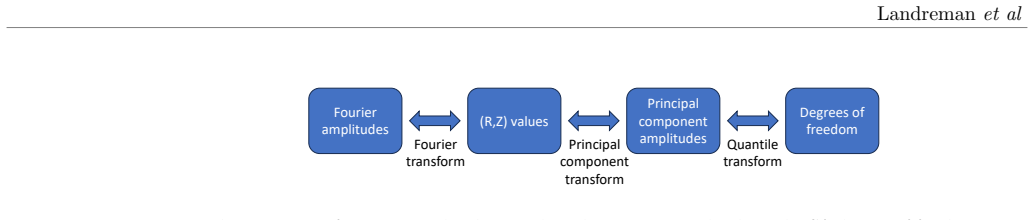
By transforming Fourier amplitudes of stellarator boundaries using quantile maps from existing designs, or by applying PCA to boundary points and then quantiles, the degrees of freedom become naturally bounded. This enables efficient Bayesian optimization of alpha-particle confinement through guiding-center tracing. The resulting configurations demonstrate excellent confinement in magnetic fields that deviate substantially from quasisymmetry or quasi-isodynamicity.
What carries the argument
Quantile-transformed Fourier parameters and PCA-quantile reduced parameter spaces derived from a dataset of existing stellarator boundaries, which provide scaled and bounded variables for the optimization.
Load-bearing premise
The collection of existing stellarator boundaries used to build the transformations is representative of the valid shapes that can be encountered during optimization.
What would settle it
Finding that a significant fraction of points in the new parameter spaces produce self-intersecting boundaries or MHD equilibrium failures would indicate the method does not reliably generate usable surfaces.
Figures





read the original abstract
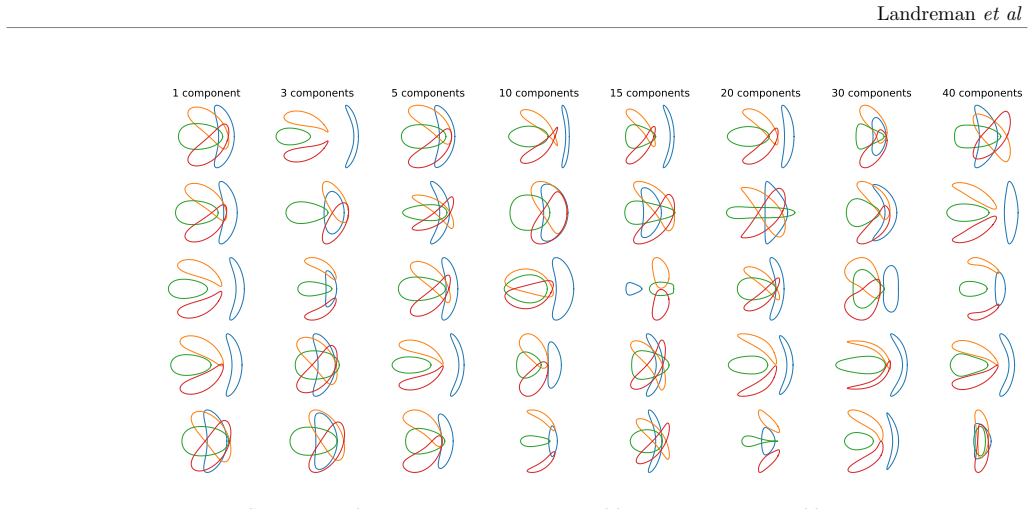
Modern stellarators are typically designed by optimizing the shape of the plasma boundary surface, with the parameters taken to be Fourier amplitudes. Many promising optimization algorithms such as Bayesian methods require bound constraints on the parameters and are most efficient when each parameter is scaled similarly to the others. With the typical Fourier parameterization, it is unclear how to set these bounds: wide constraints lead to self-intersecting boundaries and frequent failures of the MHD equilibrium calculation, while tight bound constraints limit expressiveness. To address these issues, here we propose two new parameter spaces for stellarator optimization. Both begin with a dataset of existing stellarator boundaries. In the first approach, a quantile transformation is applied to each Fourier degree of freedom, mapping the data distribution to a uniform distribution on the unit interval. In the second approach, principal component analysis (PCA) is applied to points on the boundaries, followed by a quantile transformation. For both approaches, the transformed variables become the degrees of freedom, naturally bounded to [0, 1]. The PCA method has the additional benefit of dimensionality reduction, with high expressiveness for a small number of parameters. The methods are demonstrated via Bayesian optimization for good alpha-particle confinement with guiding-center tracing inside the optimization loop, using asynchronous parallelization. These optimizations yield stellarator configurations with excellent fast-particle confinement in fields that can be far from quasisymmetric or quasi-isodynamic.
Editorial analysis
A structured set of objections, weighed in public.
Referee Report
Summary. The paper proposes two data-informed parameter spaces for stellarator boundary optimization: (1) per-Fourier-coefficient quantile transforms mapping existing stellarator data to [0,1], and (2) PCA on boundary points followed by quantile transforms, which also reduces dimensionality. These bounded spaces are used inside a Bayesian optimization loop that minimizes guiding-center alpha-particle losses, with asynchronous parallelization. The central claim is that the resulting configurations achieve excellent fast-particle confinement even when the fields are far from quasisymmetric or quasi-isodynamic.
Significance. If validated, the approach would address a practical bottleneck in stellarator design by supplying natural [0,1] bounds and optional dimensionality reduction without sacrificing expressiveness, while integrating guiding-center tracing directly in the loop. Credit is due for constructing the transforms from an external dataset of boundaries and for demonstrating the method on a concrete confinement objective.
major comments (3)
- [Abstract] Abstract: the claim that the optimizations 'yield stellarator configurations with excellent fast-particle confinement' is unsupported by any quantitative metrics (loss fractions, comparison baselines, or uncertainty estimates), which is load-bearing for the central result.
- [Abstract] Abstract and methods description: no quantitative report is given on the fraction of proposals that produced self-intersecting surfaces or caused VMEC (or equivalent) equilibrium failures during the Bayesian search; without this, it is impossible to confirm that the quantile/PCA transforms keep the optimizer inside the valid domain.
- [Methods (PCA+quantile space)] PCA approach: the manuscript does not state how many principal components are retained, what fraction of variance they explain, or how the reduced space is inverted back to boundary Fourier coefficients, leaving the dimensionality-reduction benefit unquantified.
minor comments (2)
- Notation for the quantile and PCA transforms should be defined with explicit equations rather than prose descriptions.
- The dataset of existing stellarator boundaries used to fit the transforms should be referenced with a table or citation so readers can assess its coverage.
Simulated Author's Rebuttal
We thank the referee for the constructive comments. We address each major point below and will revise the manuscript to strengthen the presentation of our results.
read point-by-point responses
-
Referee: [Abstract] Abstract: the claim that the optimizations 'yield stellarator configurations with excellent fast-particle confinement' is unsupported by any quantitative metrics (loss fractions, comparison baselines, or uncertainty estimates), which is load-bearing for the central result.
Authors: We agree the abstract would benefit from explicit quantitative support. The manuscript body reports loss fractions and comparisons for the optimized configurations; we will revise the abstract to include specific metrics such as achieved loss fractions, baseline comparisons, and uncertainty estimates drawn from the optimization results. revision: yes
-
Referee: [Abstract] Abstract and methods description: no quantitative report is given on the fraction of proposals that produced self-intersecting surfaces or caused VMEC (or equivalent) equilibrium failures during the Bayesian search; without this, it is impossible to confirm that the quantile/PCA transforms keep the optimizer inside the valid domain.
Authors: This is a fair point. The transforms are constructed from the existing dataset to favor valid boundaries, but the current draft lacks a reported success rate. We will add the observed fraction of invalid proposals (self-intersections or equilibrium failures) to the methods section in revision, based on the optimization logs. revision: yes
-
Referee: [Methods (PCA+quantile space)] PCA approach: the manuscript does not state how many principal components are retained, what fraction of variance they explain, or how the reduced space is inverted back to boundary Fourier coefficients, leaving the dimensionality-reduction benefit unquantified.
Authors: We will update the methods section to specify the number of retained principal components, the fraction of variance explained, and the explicit inversion procedure from the reduced space to Fourier coefficients. This will quantify the dimensionality reduction. revision: yes
Circularity Check
No circularity detected; parameter spaces built from external dataset via standard transforms, objective evaluated independently via guiding-center tracing.
full rationale
The paper constructs new bounded parameter spaces by applying quantile transforms (and optionally PCA) to a dataset of existing stellarator boundaries, then performs Bayesian optimization whose objective (alpha-particle losses) is computed afresh inside the loop using guiding-center tracing. No derivation step reduces to a fitted parameter being renamed as a prediction, no self-citation is load-bearing for the central result, and no uniqueness theorem or ansatz is smuggled in. The reported configurations are outputs of the optimization, not equivalent to the input dataset by construction. This is the normal case of an independent computational search.
Axiom & Free-Parameter Ledger
axioms (2)
- standard math Principal component analysis applied to sampled boundary points yields a reduced basis that preserves sufficient expressiveness for optimization.
- domain assumption Quantile transformation of Fourier coefficients maps the empirical distribution to uniform [0,1] bounds while retaining optimization utility.
Reference graph
Works this paper leans on
-
[1]
Jang B, Landreman M and Conlin R 2026Journal of Plasma Physics92E15
-
[2]
Landreman M and Paul E 2022Physical Review Letters128035001
-
[3]
Goodman A G, Mata K C, Henneberg S A, Jorge R, Landreman M, Plunk G, Smith H, Mack- enbach R, Beidler C and Helander P 2023Journal of Plasma Physics89905890504
-
[4]
Giuliani A 2024Journal of Plasma Physics90905900303
-
[5]
Dudt D W, Goodman A G, Conlin R, Panici D and Kolemen E 2024Journal of Plasma Physics 90905900120 23 Landremanet al
-
[6]
Liu H, Yu G, Zhu C, Velasco J L, Gaur R, Panici D, Kolemen E, Yu M, Ding W, Wang S and Zhuang G 2026 Optimizing stellarators with hidden symmetry (Preprint2502.09350) URL https://arxiv.org/abs/2502.09350
arXiv 2026
-
[7]
Bader A, Anderson D, Drevlak M, Faber B, Hegna C, Henneberg S, Landreman M, Schmitt J, Suzuki Y and Ware A 2021Nuclear Fusion61116060
-
[8]
Paul E J, Bhattacharjee A, Landreman M, Alex D, Velasco J and Nies R 2022Nuclear Fusion 62126054
-
[9]
Wiedman A, Buller S and Landreman M 2024Journal of Plasma Physics90905900307
-
[10]
Hegna C, Anderson D, Andrew E, Ayilaran A, Bader A, Bohm T, Mata K C, Canik J, Carbajal L, Cerfon Aet al.2025Journal of Plasma Physics91E76
-
[11]
Landreman M, Choi J Y, Alves C, Balaprakash P, Churchill M, Conlin R and Roberg-Clark G 2025Journal of Plasma Physics91
-
[12]
Czekanski M, Knyazev A R, Bindel D and Paul E J 2026 CATAPULT: A CUDA-Accelerated Timestepper for Alpha Particles Using Local Tricubics (Preprint2604.07617) URLhttps: //arxiv.org/abs/2604.07617
Pith/arXiv arXiv 2026
-
[13]
Bindel D, Landreman M and Padidar M 2023Plasma Physics and Controlled Fusion65065012
-
[14]
Velasco J, Calvo I, Escoto F, S´ anchez E, Thienpondt H and Parra F 2024Physical review letters 133185101
-
[15]
Giuliani A, Rodr´ ıguez E and Spivak M 2025Journal of Plasma Physics91E128
-
[16]
Cadena S A, Merlo A, Laude E, Bauer A, Agrawal A, Pascu M, Savtchouk M, Guiraud E, Bonauer L, Hudson Set al.2026Advances in Neural Information Processing Systems38
-
[17]
Wei X, Huang H, Chen H, Zhu H, Bai Z, Williams S and Lin Z 2026arXiv preprint arXiv:2603.17366
-
[18]
Ali I, Goodman A and Zingg D 2025 A B-spline parametrization for stellarator boundary opti- mization Poster presented at the 67th APS Division of Plasma Physics Meeting
2025
-
[19]
Glas S, Padidar M, Kellison A and Bindel D 2022Journal of Plasma Physics88905880208
-
[20]
Gori S, N¨ uhrenberg J, Zille R, Okamura S, Matsuoka K and Murakami S 2001Plasma physics and controlled fusion43137–144
-
[21]
Ku L P, Garabedian P, Lyon J, Turnbull A, Grossman A, Mau T, Zarnstorff M and Team A 2008Fusion Science and Technology54673–693
-
[22]
Pedregosa F, Varoquaux G, Gramfort A, Michel V, Thirion B, Grisel O, Blondel M, Prettenhofer P, Weiss R, Dubourg V, Vanderplas J, Passos A, Cournapeau D, Brucher M, Perrot M and Duchesnay E 2011Journal of Machine Learning Research122825–2830
-
[23]
Anderson D T and Garabedian P R 1994Nuclear Fusion34881–885
-
[24]
Garabedian P and Gardner H 1995Physics of Plasmas22020–2025
2025
-
[25]
Dudt D and Kolemen E 2020Physics of Plasmas27
-
[26]
Schilling J 2025arXiv preprint arXiv:2502.04374
-
[27]
Kappel J, Landreman M and Malhotra D 2024Plasma Physics and Controlled Fusion66025018
-
[28]
S´ anchez E, Velasco J, Calvo I and Mulas S 2023Nuclear Fusion63066037
-
[29]
Hirshman S and Meier H 1985The Physics of Fluids281387–1391
-
[30]
Jorge R, Plunk G, Drevlak M, Landreman M, Lobsien J F, Mata K C and Helander P 2022 Journal of Plasma Physics88175880504
2022
-
[31]
Alonso J, Calvo I, Carralero D, Velasco J, Garc´ ıa-Rega˜ na J, Palermo I and Rapisarda D 2022 Nuclear Fusion62036024 24 Landremanet al
2022
-
[32]
Lion J, Angl` es J C, Bonauer L, Navarro A B, Ceron S C, Davies R, Drevlak M, Foppiani N, Geiger J, Goodman Aet al.2025Fusion Engineering and Design214114868
-
[33]
Guttenfelder W, Mandell N, Le Bars G, Singh L, Bader A, Mata K C, Canik J, Carbajal L, Cerfon A, Davila Net al.2025Journal of Plasma Physics91E83
-
[34]
Schmitt J, Anderson D, Andrew E, Bader A, Mata K C, Canik J, Carbajal L, Cerfon A, Cooper W, Davila Net al.2025Journal of Plasma Physics91E88
-
[35]
Landreman M, Torreblanca H and Cerfon A 2026Fusion Engineering and Design224115627
-
[36]
Swanson C, Kumar S, Dudt D, Flom E, Kalb W, Kruger T, Martin M, Olatunji J, Pasmann S, Tang Let al.2025arXiv preprint arXiv:2512.08027
-
[37]
Najmabadi F, Raffray A, Abdel-Khalik S, Bromberg L, Crosatti L, El-Guebaly L, Garabedian P, Grossman A, Henderson D, Ibrahim Aet al.2008Fusion Science and Technology54655–672
-
[38]
Schuett T M and Henneberg S A 2024Physical Review Research6L042052
-
[39]
Olson M, Santorella E, Tiao L C, Cakmak S, Garrard M, Daulton S, Lin Z J, Ament S, Beck- erman B, Onofrey E, Igusti P, Lara C, Letham B, Cardoso C, Shen S S, Lin A C, Grange M, Kashtelyan E, Eriksson D, Balandat M and Bakshy E 2025 Ax: A Platform for Adaptive ExperimentationAutoML 2025 ABCD Track
2025
-
[40]
Hvarfner C, Hellsten E O and Nardi L 2024 Vanilla bayesian optimization performs great in high dimensionsProceedings of the 41st International Conference on Machine Learningpp 20793– 20817
2024
-
[41]
Eriksson D, Pearce M, Gardner J, Turner R D and Poloczek M 2019Advances in neural infor- mation processing systems32
-
[42]
Landreman M 2026https: // doi. org/ 10. 5281/ zenodo. 20733436
-
[43]
Velasco J, S´ anchez E and Calvo I 2025Nuclear Fusion65056012
-
[44]
Liu H, Yu G, Velasco J L and Zhu C 2026arXiv preprint arXiv:2603.12139
-
[45]
Velasco J L, Calvo I, Fern´ andez-Pacheco V, Padidar M, Liu H, S´ anchez E, Yu G and Zhu C 2026arXiv preprint arXiv:2603.12377
-
[46]
Goodman A G, Xanthopoulos P, Plunk G G, Smith H, N¨ uhrenberg C, Beidler C D, Henneberg S A, Roberg-Clark G, Drevlak M and Helander P 2024PRX Energy3023010
-
[47]
Law F, Cerfon A and Peherstorfer B 2022Nuclear Fusion62076019
-
[48]
Landreman M and Jorge R 2020Journal of Plasma Physics86905860510
-
[49]
Panici D, Conlin R, Dudt D W, Unalmis K and Kolemen E 2023Journal of Plasma Physics89 955890303 25
discussion (0)
Sign in with ORCID, Apple, or X to comment. Anyone can read and Pith papers without signing in.