Real and Virtual Propagation in Neutrino Oscillations
Pith reviewed 2026-06-26 19:54 UTC · model grok-4.3
The pith
Neutrino flavor oscillations appear only after the propagation time exceeds a threshold fixed by energy uncertainty and decay width.
A machine-rendered reading of the paper's core claim, the machinery that carries it, and where it could break.
Core claim
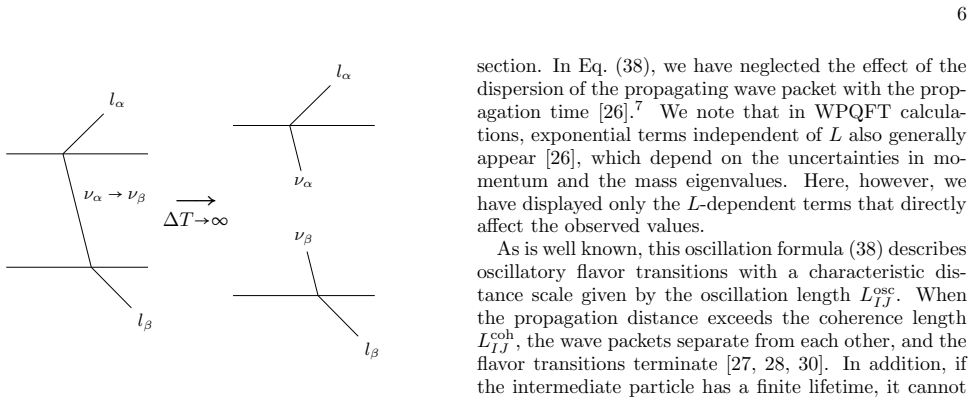
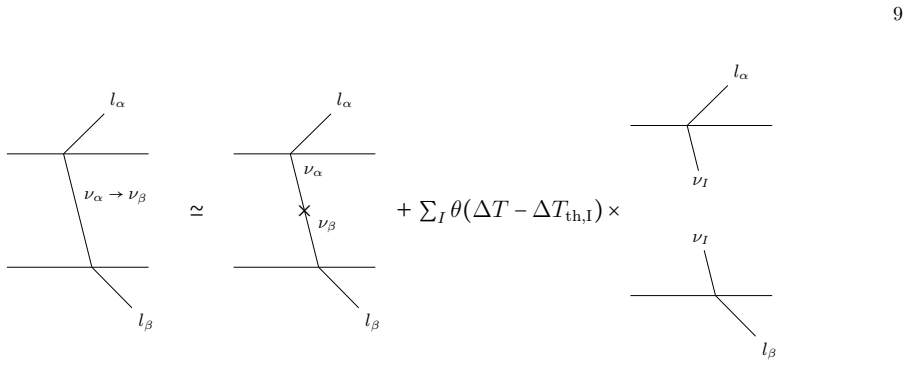
By evaluating the integrals in the wave-packet quantum field theory amplitude with the saddle-point method, an extended expression for the flavor-changing amplitude is obtained that is valid for arbitrary propagation times. Oscillations appear only when the propagation time exceeds a threshold fixed by the energy uncertainty of the external wave packets and the decay width of the propagating particle; for shorter times the intermediate state remains purely virtual and cannot reach macroscopic distances.
What carries the argument
The extended flavor-changing amplitude obtained from the saddle-point approximation to the wave-packet integrals, which encodes the switch between virtual and real propagation regimes.
If this is right
- The Jacob-Sachs theorem holds to higher accuracy than previously expected even at short propagation times.
- The same threshold condition governs real versus virtual propagation for any unstable particle, not only neutrinos.
- Improvements in energy resolution of external wave packets could bring the virtual-to-real transition into experimental reach.
- Oscillation probabilities at macroscopic distances remain unaffected by the short-time correction.
Where Pith is reading between the lines
- Short-baseline experiments with better energy resolution might begin to see deviations from standard oscillation formulas at the smallest distances.
- The same virtual-real distinction could appear in other processes that involve unstable intermediate states, such as certain resonance decays.
- The threshold supplies a concrete scale separating the regime where quantum-field-theory propagation is indistinguishable from classical particle motion.
Load-bearing premise
The saddle-point method supplies an accurate approximation to the relevant integrals even for short propagation times.
What would settle it
Measure the oscillation probability at a propagation time deliberately chosen below the calculated threshold and verify whether the probability follows the non-oscillatory virtual-state form or already exhibits sinusoidal dependence on distance.
Figures


read the original abstract
We revisit flavor oscillations in vacuum in terms of the propagation time of intermediate states. In the limit of a long propagation time (or distance), degenerate intermediate states exhibit oscillatory behavior, as described by the Jacob--Sachs (or Grimus--Stockinger) theorem within wave-packet quantum field theory. By explicitly evaluating the relevant integrals using the saddle-point method, we derive an extended expression for the flavor-changing amplitude that remains valid even for shorter propagation times. We show that oscillations occur only when the propagation time exceeds a threshold set by the energy uncertainty of the external wave packets and by the decay width of the propagating particle. For shorter propagation, the intermediate particle behaves as a purely virtual state, in the sense that it cannot propagate over a macroscopic distance. Although a direct experimental test of the transition from virtual to real propagation is challenging, since it typically occurs at microscopic scales, our result implies that the Jacob--Sachs theorem holds to higher accuracy than previously expected, even at short propagation times. Our formalism applies not only to neutrinos but also to other propagating particles, and future improvements in energy resolution may make this threshold observable.
Editorial analysis
A structured set of objections, weighed in public.
Referee Report
Summary. The paper revisits vacuum flavor oscillations in wave-packet quantum field theory by focusing on the propagation time of intermediate states. It applies the saddle-point method to evaluate the relevant integrals, extending the amplitude beyond the long-distance limit of the Jacob-Sachs theorem. The central claim is that oscillations appear only when the propagation time exceeds a threshold fixed by the external wave-packet energy uncertainty and the intermediate-particle decay width; below this threshold the intermediate state remains purely virtual and cannot propagate macroscopically.
Significance. If the saddle-point extension is rigorously controlled, the result would tighten the domain of validity of the Jacob-Sachs theorem and supply an explicit criterion separating virtual from real propagation. The formalism is stated to apply to neutrinos and other unstable or oscillating particles, and the authors note that improved energy resolution could render the threshold observable.
major comments (2)
- [Abstract and saddle-point section] Abstract and the saddle-point derivation (main text, around the evaluation of the propagation integrals): the claim that the extended amplitude remains valid for propagation times shorter than or comparable to 1/σ_E or 1/Γ rests on the saddle-point method being accurate in the regime where the stationary-phase contribution is no longer dominant. No error bound, asymptotic remainder estimate, or direct numerical comparison to the exact integral is supplied, which is load-bearing for the assertion that oscillations are absent below the threshold.
- [Abstract and concluding discussion] The statement that 'oscillations occur only when the propagation time exceeds a threshold' (abstract and concluding discussion) is derived from the saddle-point result; without a controlled demonstration that endpoint or non-stationary contributions remain negligible at short times, the transition from virtual to real behavior is not yet established.
minor comments (2)
- The abstract refers to 'explicitly evaluating the relevant integrals' but the manuscript should display the explicit integral expressions and the resulting closed-form extended amplitude so that the threshold condition can be traced to concrete parameters.
- Notation for the energy uncertainty σ_E and decay width Γ should be introduced once and used consistently when defining the threshold.
Simulated Author's Rebuttal
We thank the referee for the careful reading of the manuscript and the detailed comments. The concerns focus on the justification of the saddle-point method in the short-time regime. We address each point below and commit to revisions that strengthen the presentation without altering the central results.
read point-by-point responses
-
Referee: [Abstract and saddle-point section] Abstract and the saddle-point derivation (main text, around the evaluation of the propagation integrals): the claim that the extended amplitude remains valid for propagation times shorter than or comparable to 1/σ_E or 1/Γ rests on the saddle-point method being accurate in the regime where the stationary-phase contribution is no longer dominant. No error bound, asymptotic remainder estimate, or direct numerical comparison to the exact integral is supplied, which is load-bearing for the assertion that oscillations are absent below the threshold.
Authors: We agree that an explicit remainder estimate would make the argument more rigorous. In the revised manuscript we will add a standard asymptotic error bound for the saddle-point contribution, derived from the analytic continuation of the integrand and the separation between the saddle and the integration contour. We will also include a direct numerical comparison between the saddle-point result and the exact integral for a representative Gaussian wave-packet model, confirming that non-stationary terms remain negligible below the stated threshold. revision: yes
-
Referee: [Abstract and concluding discussion] The statement that 'oscillations occur only when the propagation time exceeds a threshold' (abstract and concluding discussion) is derived from the saddle-point result; without a controlled demonstration that endpoint or non-stationary contributions remain negligible at short times, the transition from virtual to real behavior is not yet established.
Authors: The threshold arises because the oscillatory phase factor only acquires a stationary point once the propagation time exceeds the inverse width set by σ_E and Γ; below that scale the integral is dominated by the endpoint (virtual) contribution. The added error bound and numerical check in the revision will explicitly quantify that the oscillatory piece is suppressed by an exponentially small factor when the time is below threshold, thereby establishing the virtual-to-real transition on a controlled footing. revision: yes
Circularity Check
No circularity; derivation is explicit integral evaluation on external theorem
full rationale
The paper starts from the established Jacob-Sachs theorem for long propagation times and performs new saddle-point evaluations of the wave-packet integrals to obtain an extended amplitude valid at shorter times. No quoted step equates a derived quantity to a fitted parameter or to a self-citation chain; the threshold condition emerges directly from the stationary-phase analysis rather than being presupposed by definition or by renaming. The central claim therefore remains independent of the paper's own inputs.
Axiom & Free-Parameter Ledger
axioms (2)
- domain assumption Jacob-Sachs (Grimus-Stockinger) theorem within wave-packet quantum field theory
- standard math Saddle-point method accurately approximates the relevant integrals at short propagation times
Reference graph
Works this paper leans on
-
[1]
Evaluation of the internal energy integration When performing the integration over the internal energy, we encounter integrals of the following form: ∫ dp0 νI exp[F(p0 νI)]G(p0 νI ,p νI) Q(p0 νI) ,(D1) where F(p0 νI) =−ip0 νI ∆T − ∑ R=S,D σt,R 2 ((−1)R p0 νI −P 0R0−qR(pνI)) 2 ,(D2) andQ (p0 νI) denotes the internal-energy–dependent factors other than the ...
-
[2]
Evaluation of the internal three momentum integration After performing the integration over the internal energy, one must evaluate the momentum integral. In doing so, the contribution from the poles (corresponding to real propagation) and the contribution from the saddle point (corresponding to virtual propagation) should be treated separately. We first c...
-
[3]
The third term describes flavor oscillations and the decoherence effect due to intermediate particle decay
The second term suppresses the oscillation probability when L≳Lcoh IJ ∶=4 √σS+D ∆m2 IJ ∣Pν∣2 (E23) is satisfied. The third term describes flavor oscillations and the decoherence effect due to intermediate particle decay. From this term, the oscillation length can be read off as Losc IJ ∶=4π∣Pν∣ ∆m2 IJ ,(E24) and the oscillation probability is suppressed w...
-
[4]
Pontecorvo,Mesonium and Antimesonium, Sov
B. Pontecorvo,Mesonium and Antimesonium, Sov. Phys. JETP6(1958) 429–431
1958
-
[5]
Pontecorvo,Inverse Beta Processes and Nonconservation of Lepton Charge, Sov
B. Pontecorvo,Inverse Beta Processes and Nonconservation of Lepton Charge, Sov. Phys. JETP7 (1958) 172–173
1958
-
[6]
Katayama, K
Y. Katayama, K. Matumoto, S. Tanaka, and E. Yamada,Possible unified models of elementary particles with two neutrinos, Prog. Theor. Phys.28 (1962) 675
1962
-
[7]
Z. Maki, M. Nakagawa, and S. Sakata,Remarks on the unified model of elementary particles, Prog. Theor. Phys.28(1962) 870–880
1962
-
[8]
V. N. Gribov and B. Pontecorvo,Neutrino astronomy and lepton charge, Phys. Lett. B28(1969) 493
1969
-
[9]
Eliezer and A
S. Eliezer and A. R. Swift,Experimental Consequences of electron Neutrino-Muon-neutrino Mixing in Neutrino Beams, Nucl. Phys. B105(1976) 45–51
1976
-
[10]
Fritzsch and P
H. Fritzsch and P. Minkowski,Vector-Like Weak Currents, Massive Neutrinos, and Neutrino Beam Oscillations, Phys. Lett. B62(1976) 72–76
1976
-
[11]
S. M. Bilenky and B. Pontecorvo,The Quark-Lepton Analogy and the Muonic Charge, Yad. Fiz.24(1976) 603–608
1976
-
[12]
S. M. Bilenky and B. Pontecorvo,Quark-Lepton Analogy and Neutrino Oscillations, Phys. Lett. B61 (1976) 248
1976
-
[13]
S. M. Bilenky and B. Pontecorvo,Again on Neutrino Oscillations, Lett. Nuovo Cim.17(1976) 569. [11]Super-KamiokandeCollaboration,Evidence for oscillation of atmospheric neutrinos, Phys. Rev. Lett. 81(1998) 1562–1567[hep-ex/9807003]. [12]Super-KamiokandeCollaboration,Evidence for an oscillatory signature in atmospheric neutrino oscillation, Phys. Rev. Lett....
Pith/arXiv arXiv 1976
-
[14]
I. Esteban,et al.,NuFit-6.0: updated global analysis of three-flavor neutrino oscillations, JHEP12(2024) 216 [arXiv:2410.05380]. [17]JUNOCollaboration,First measurement of reactor neutrino oscillations at JUNO,arXiv:2511.14593 (2025). [18]Particle Data GroupCollaboration,Review of particle physics, Phys. Rev. D110(2024) 030001
Pith/arXiv arXiv 2024
-
[15]
C. Giunti, C. W. Kim, J. A. Lee, and U. W. Lee,On the treatment of neutrino oscillations without resort to weak eigenstates, Phys. Rev. D48(1993) 4310–4317 [hep-ph/9305276]
Pith/arXiv arXiv 1993
-
[16]
W. Grimus and P. Stockinger,Real oscillations of virtual neutrinos, Phys. Rev. D54(1996) 3414–3419 [hep-ph/9603430]
Pith/arXiv arXiv 1996
-
[17]
C. Giunti, C. W. Kim, and U. W. Lee,When do neutrinos cease to oscillate?, Phys. Lett. B421(1998) 237–244[hep-ph/9709494]
Pith/arXiv arXiv 1998
-
[18]
W. Grimus, P. Stockinger, and S. Mohanty,The Field theoretical approach to coherence in neutrino oscillations, Phys. Rev. D59(1999) 013011 [hep-ph/9807442]
Pith/arXiv arXiv 1999
-
[19]
C. Giunti and C. W. Kim,Coherence of neutrino oscillations in the wave packet approach, Phys. Rev. D 58(1998) 017301[hep-ph/9711363]
Pith/arXiv arXiv 1998
-
[20]
C. Y. Cardall,Coherence of neutrino flavor mixing in quantum field theory, Phys. Rev. D61(2000) 073006 [hep-ph/9909332]
Pith/arXiv arXiv 2000
-
[21]
W. Grimus, S. Mohanty, and P. Stockinger,Neutrino oscillations and the effect of the finite lifetime of the neutrino source, Phys. Rev. D61(2000) 033001 [hep-ph/9904285]
Pith/arXiv arXiv 2000
-
[22]
Beuthe,Oscillations of neutrinos and mesons in quantum field theory, Phys
M. Beuthe,Oscillations of neutrinos and mesons in quantum field theory, Phys. Rept.375(2003) 105–218 [hep-ph/0109119]
Pith/arXiv arXiv 2003
-
[23]
Nussinov,Solar Neutrinos and Neutrino Mixing, Phys
S. Nussinov,Solar Neutrinos and Neutrino Mixing, Phys. Lett. B63(1976) 201–203
1976
-
[24]
Kayser,On the Quantum Mechanics of Neutrino Oscillation, Phys
B. Kayser,On the Quantum Mechanics of Neutrino Oscillation, Phys. Rev. D24(1981) 110
1981
-
[25]
I. Y. Kobzarev, B. V. Martemyanov, L. B. Okun, and M. G. Shchepkin,Sum Rules for Neutrino Oscillations, Sov. J. Nucl. Phys.35(1982) 708
1982
-
[26]
Giunti, C
C. Giunti, C. W. Kim, and U. W. Lee,When do neutrinos really oscillate?: Quantum mechanics of neutrino oscillations, Phys. Rev. D44(1991) 3635–3640
1991
-
[27]
Giunti, C
C. Giunti, C. W. Kim, and U. W. Lee,Coherence of neutrino oscillations in vacuum and matter in the wave packet treatment, Phys. Lett. B274(1992) 87–94
1992
-
[28]
Rich,The Quantum mechanics of neutrino oscillations, Phys
J. Rich,The Quantum mechanics of neutrino oscillations, Phys. Rev. D48(1993) 4318–4325
1993
-
[29]
K. Kiers, S. Nussinov, and N. Weiss,Coherence effects in neutrino oscillations, Phys. Rev. D53(1996) 537–547[hep-ph/9506271]
Pith/arXiv arXiv 1996
-
[30]
Y. Grossman and H. J. Lipkin,Flavor oscillations from a spatially localized source: A Simple general treatment, Phys. Rev. D55(1997) 2760–2767 [hep-ph/9607201]
Pith/arXiv arXiv 1997
-
[31]
Campagne,Neutrino oscillations from pion decay in flight, Phys
J.-E. Campagne,Neutrino oscillations from pion decay in flight, Phys. Lett. B400(1997) 135–144
1997
-
[32]
K. Kiers and N. Weiss,Neutrino oscillations in a model with a source and detector, Phys. Rev. D57 (1998) 3091–3105[hep-ph/9710289]
Pith/arXiv arXiv 1998
-
[33]
H. Burkhardt, J. Lowe, G. J. Stephenson, Jr., and J. T. Goldman,Oscillations of recoil particles against mixed states, Phys. Rev. D59(1999) 054018 [hep-ph/9803365]
Pith/arXiv arXiv 1999
-
[34]
A. Ioannisian and A. Pilaftsis,Neutrino oscillations in space within a solvable model, Phys. Rev. D59(1999) 053003[hep-ph/9809503]
Pith/arXiv arXiv 1999
-
[35]
C. Giunti and C. W. Kim,Quantum mechanics of neutrino oscillations, Found. Phys. Lett.14(2001) 213–229[hep-ph/0011074]
Pith/arXiv arXiv 2001
-
[36]
Beuthe,Towards a unique formula for neutrino oscillations in vacuum, Phys
M. Beuthe,Towards a unique formula for neutrino oscillations in vacuum, Phys. Rev. D66(2002) 013003 [hep-ph/0202068]
Pith/arXiv arXiv 2002
-
[37]
Zralek,From kaons to neutrinos: Quantum mechanics of particle oscillations, Acta Phys
M. Zralek,From kaons to neutrinos: Quantum mechanics of particle oscillations, Acta Phys. Polon. B 29(1998) 3925–3956[hep-ph/9810543]
Pith/arXiv arXiv 1998
-
[38]
H. J. Lipkin 1999.hep-ph/9901399
Pith/arXiv arXiv 1999
-
[39]
Giunti and C
C. Giunti and C. W. Kim,Fundamentals of Neutrino Physics and Astrophysics. 2007
2007
-
[40]
Xing and S
Z.-z. Xing and S. Zhou,Neutrinos in particle physics, astronomy and cosmology. Advanced Topics in Science and Technology in China. Springer Berlin, Heidelberg, 2011
2011
-
[41]
Giunti,Neutrino wave packets in quantum field theory, JHEP11(2002) 017[hep-ph/0205014]
C. Giunti,Neutrino wave packets in quantum field theory, JHEP11(2002) 017[hep-ph/0205014]
Pith/arXiv arXiv 2002
-
[42]
H. J. Lipkin,What is coherent in neutrino oscillations, Phys. Lett. B579(2004) 355–360[hep-ph/0304187]
Pith/arXiv arXiv 2004
-
[43]
M. Garbutt and B. H. J. McKellar,Neutrino production, oscillation and detection in the presence of general four fermion interactions,hep-ph/0308111 (2003)
Pith/arXiv arXiv 2003
-
[44]
A. Asahara, K. Ishikawa, T. Shimomura, and T. Yabuki,Neutrino oscillations in intermediate states. II. Wave packets, Prog. Theor. Phys.113 (2005) 385–411[hep-ph/0406141]
Pith/arXiv arXiv 2005
-
[45]
K. Fujii and T. Shimomura,Expectation values of flavor neutrino currents in field theoretical approach to oscillation problem: Formulation,hep-ph/0402274 (2004)
Pith/arXiv arXiv 2004
-
[46]
C. C. Nishi,First quantized approaches to neutrino oscillations and second quantization, Phys. Rev. D73 (2006) 053013[hep-ph/0506109]
Pith/arXiv arXiv 2006
-
[47]
A. E. Bernardini, M. M. Guzzo, and F. R. Torres, Second-order corrections to neutrino two-flavor oscillation parameters in the wave packet approach, Eur. Phys. J. C48(2006) 613[hep-ph/0612001]
Pith/arXiv arXiv 2006
-
[48]
D. Boyanovsky and C. M. Ho,Production of a sterile species: Quantum kinetics, Phys. Rev. D76(2007) 085011[arXiv:0705.0703]
Pith/arXiv arXiv 2007
-
[49]
L. Visinelli and P. Gondolo,Neutrino Oscillations and Decoherence,arXiv:0810.4132(2008)
Pith/arXiv arXiv 2008
-
[50]
A. G. Cohen, S. L. Glashow, and Z. Ligeti, Disentangling Neutrino Oscillations, Phys. Lett. B 678(2009) 191–196[arXiv:0810.4602]
Pith/arXiv arXiv 2009
-
[51]
A. E. Bernardini, M. M. Guzzo, and C. C. Nishi, Quantum flavor oscillations extended to the Dirac theory, Fortsch. Phys.59(2011) 372 [arXiv:1004.0734]
Pith/arXiv arXiv 2011
-
[52]
E. K. Akhmedov and A. Y. Smirnov,Paradoxes of neutrino oscillations, Phys. Atom. Nucl.72(2009) 1363–1381[arXiv:0905.1903]
Pith/arXiv arXiv 2009
-
[53]
E. K. Akhmedov and J. Kopp,Neutrino Oscillations: 27 Quantum Mechanics vs. Quantum Field Theory, JHEP 04(2010) 008[arXiv:1001.4815]. [Erratum: JHEP 10, 052 (2013)]
Pith/arXiv arXiv 2010
-
[54]
J. Wu, J. A. Hutasoit, D. Boyanovsky, and R. Holman, Neutrino Oscillations, Entanglement and Coherence: A Quantum Field theory Study in Real Time, Int. J. Mod. Phys. A26(2011) 5261–5297 [arXiv:1002.2649]
Pith/arXiv arXiv 2011
-
[55]
J. Wu, J. A. Hutasoit, D. Boyanovsky, and R. Holman, Dynamics of disentanglement, density matrix and coherence in neutrino oscillations, Phys. Rev. D82 (2010) 013006[arXiv:1005.3260]
Pith/arXiv arXiv 2010
-
[56]
D. V. Naumov and V. A. Naumov,A Diagrammatic treatment of neutrino oscillations, J. Phys. G37 (2010) 105014[arXiv:1008.0306]
Pith/arXiv arXiv 2010
-
[57]
E. K. Akhmedov and A. Y. Smirnov,Neutrino oscillations: Entanglement, energy-momentum conservation and QFT, Found. Phys.41(2011) 1279–1306[arXiv:1008.2077]
Pith/arXiv arXiv 2011
-
[58]
Boyanovsky,Short baseline neutrino oscillations: when entanglement suppresses coherence, Phys
D. Boyanovsky,Short baseline neutrino oscillations: when entanglement suppresses coherence, Phys. Rev. D 84(2011) 065001[arXiv:1106.6248]
Pith/arXiv arXiv 2011
-
[59]
E. Akhmedov, D. Hernandez, and A. Smirnov, Neutrino production coherence and oscillation experiments, JHEP04(2012) 052[arXiv:1201.4128]
Pith/arXiv arXiv 2012
-
[60]
V. A. Naumov and D. S. Shkirmanov,Extended Grimus-Stockinger theorem and inverse square law violation in quantum field theory, Eur. Phys. J. C73 (2013) 2627[arXiv:1309.1011]
Pith/arXiv arXiv 2013
-
[61]
D. V. Naumov,On the Theory of Wave Packets, Phys. Part. Nucl. Lett.10(2013) 642–650 [arXiv:1309.1717]
Pith/arXiv arXiv 2013
-
[62]
R. S. L. Hansen and A. Y. Smirnov,The Liouville equation for flavour evolution of neutrinos and neutrino wave packets, JCAP12(2016) 019 [arXiv:1610.00910]
Pith/arXiv arXiv 2016
-
[63]
Karlovets,Scattering of wave packets with phases, JHEP03(2017) 049[arXiv:1611.08302]
D. Karlovets,Scattering of wave packets with phases, JHEP03(2017) 049[arXiv:1611.08302]
Pith/arXiv arXiv 2017
-
[64]
Akhmedov,Do non-relativistic neutrinos oscillate?, JHEP07(2017) 070[arXiv:1703.08169]
E. Akhmedov,Do non-relativistic neutrinos oscillate?, JHEP07(2017) 070[arXiv:1703.08169]
Pith/arXiv arXiv 2017
-
[65]
A. Kobach, A. V. Manohar, and J. McGreevy, Neutrino Oscillation Measurements Computed in Quantum Field Theory, Phys. Lett. B783(2018) 59–75[arXiv:1711.07491]
Pith/arXiv arXiv 2018
-
[66]
T. Stirner, G. Sigl, and G. Raffelt,Liouville term for neutrinos: Flavor structure and wave interpretation, JCAP05(2018) 016[arXiv:1803.04693]
Pith/arXiv arXiv 2018
-
[67]
Akhmedov inInternational Conference on History of the Neutrino: 1930-2018
E. Akhmedov inInternational Conference on History of the Neutrino: 1930-2018. 2019.arXiv:1901.05232
Pith/arXiv arXiv 1930
-
[68]
V. O. Egorov and I. P. Volobuev,Coherence length of neutrino oscillations in a quantum field-theoretical approach, Phys. Rev. D100(2019) 033004 [arXiv:1902.03602]
arXiv 2019
-
[69]
A. Falkowski, M. Gonz´ alez-Alonso, and Z. Tabrizi, Consistent QFT description of non-standard neutrino interactions, JHEP11(2020) 048 [arXiv:1910.02971]
arXiv 2020
-
[70]
Grimus,Revisiting the quantum field theory of neutrino oscillations in vacuum, J
W. Grimus,Revisiting the quantum field theory of neutrino oscillations in vacuum, J. Phys. G47(2020) 085004[arXiv:1910.13776]
arXiv 2020
-
[71]
D. V. Karlovets and V. G. Serbo,Effects of the transverse coherence length in relativistic collisions, Phys. Rev. D101(2020) 076009[arXiv:2002.00101]
arXiv 2020
-
[72]
D. V. Naumov and V. A. Naumov,Quantum Field Theory of Neutrino Oscillations, Phys. Part. Nucl.51 (2020) 1–106
2020
-
[73]
V. A. Naumov and D. S. Shkirmanov,Virtual neutrino propagation at short baselines, Eur. Phys. J. C82 (2022) 736[arXiv:2208.02621]
arXiv 2022
- [74]
-
[75]
D. Karamitros and A. Pilaftsis,Toward a localized S-matrix theory, Phys. Rev. D108(2023) 036007 [arXiv:2208.10425]
arXiv 2023
-
[76]
S. Kovalenko and F. Simkovic,Neutrino oscillations in Quantum Field Theory,arXiv:2212.13635(2022)
arXiv 2022
-
[77]
Grimus,Yet another QFT model of neutrino oscillations,arXiv:2303.16655(2023)
W. Grimus,Yet another QFT model of neutrino oscillations,arXiv:2303.16655(2023)
arXiv 2023
-
[78]
H. Mitani and K.-y. Oda,Decoherence in neutrino oscillation between 3D Gaussian wave packets, Phys. Lett. B846(2023) 138218[arXiv:2307.12230]
arXiv 2023
-
[79]
I. Dadi´ c and D. Klabuˇ car,Neutrino Oscillations in Finite Time Path Out-of-Equilibrium Thermal Field Theory, Symmetry15(2023) 1970 [arXiv:2311.11875]
arXiv 2023
- [80]
discussion (0)
Sign in with ORCID, Apple, or X to comment. Anyone can read and Pith papers without signing in.