Interplay of Altermagnetism and Coupled Quasi-Altermagnetic states in Sliding Two-dimensional Square Lattice
Pith reviewed 2026-06-26 16:36 UTC · model grok-4.3
The pith
Interlayer sliding in two-dimensional square lattices controls a coupled quasi-altermagnetic state with reversible type-IV non-relativistic spin splitting.
A machine-rendered reading of the paper's core claim, the machinery that carries it, and where it could break.
Core claim
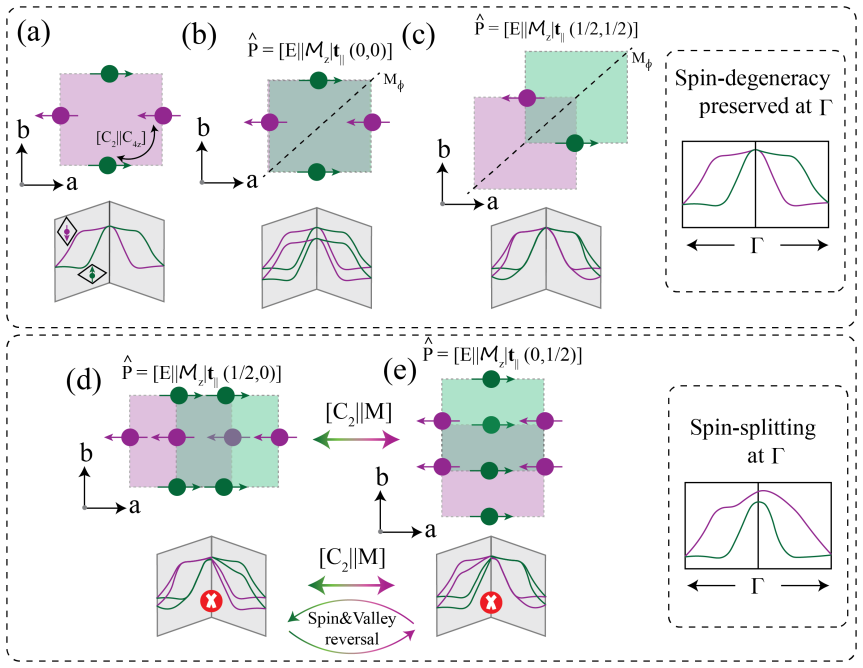
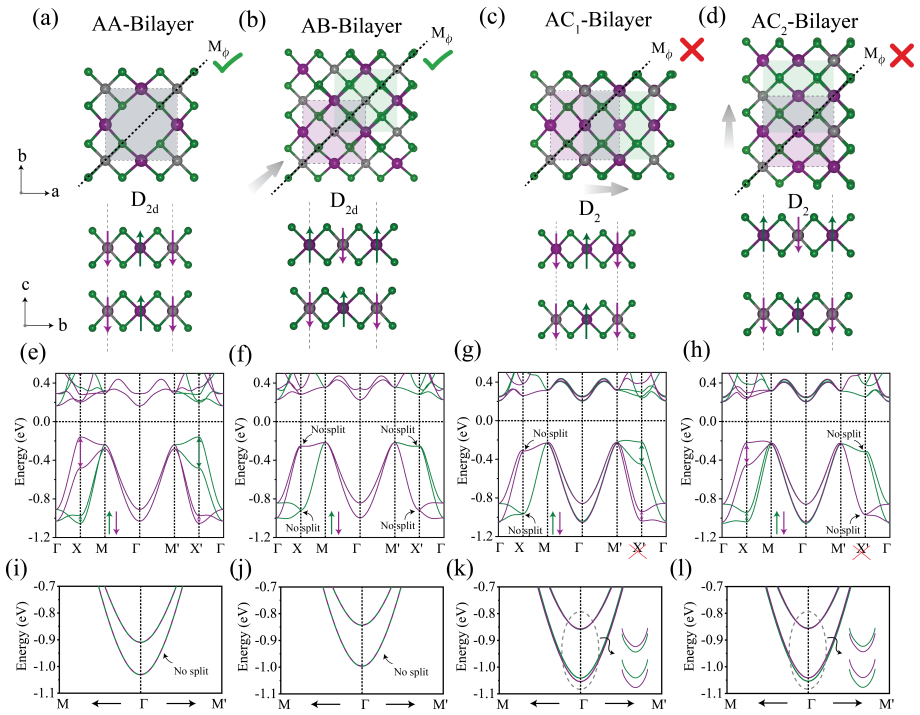
In sliding two-dimensional square-lattice systems, interlayer sliding induces transitions between altermagnetic and coupled quasi-altermagnetic states. The quasi-altermagnetic states support reversible type-IV non-relativistic spin splitting, with spin-polarized bands remaining split at the Gamma point in the absence of spin-orbit coupling. Spin-Laue symmetry analysis establishes a correspondence between reciprocal-space spin splitting and real-space switching of the quasi-altermagnetic states, as verified through calculations on Mn2WS4 and Mn2WS2Se2.
What carries the argument
The coupled quasi-altermagnetic state, induced and switched by interlayer sliding, which carries the reversible type-IV non-relativistic spin splitting and enables the classification of phases.
Load-bearing premise
The spin-Laue symmetry analysis and first-principles results on Mn2WS4 generalize to a wide class of two-dimensional square-lattice systems without dominant additional effects from defects or other interactions.
What would settle it
A sliding two-dimensional square-lattice system that shows no spin splitting at the Gamma point without spin-orbit coupling, or no reversible switching of the quasi-altermagnetic states upon interlayer sliding.
Figures

read the original abstract
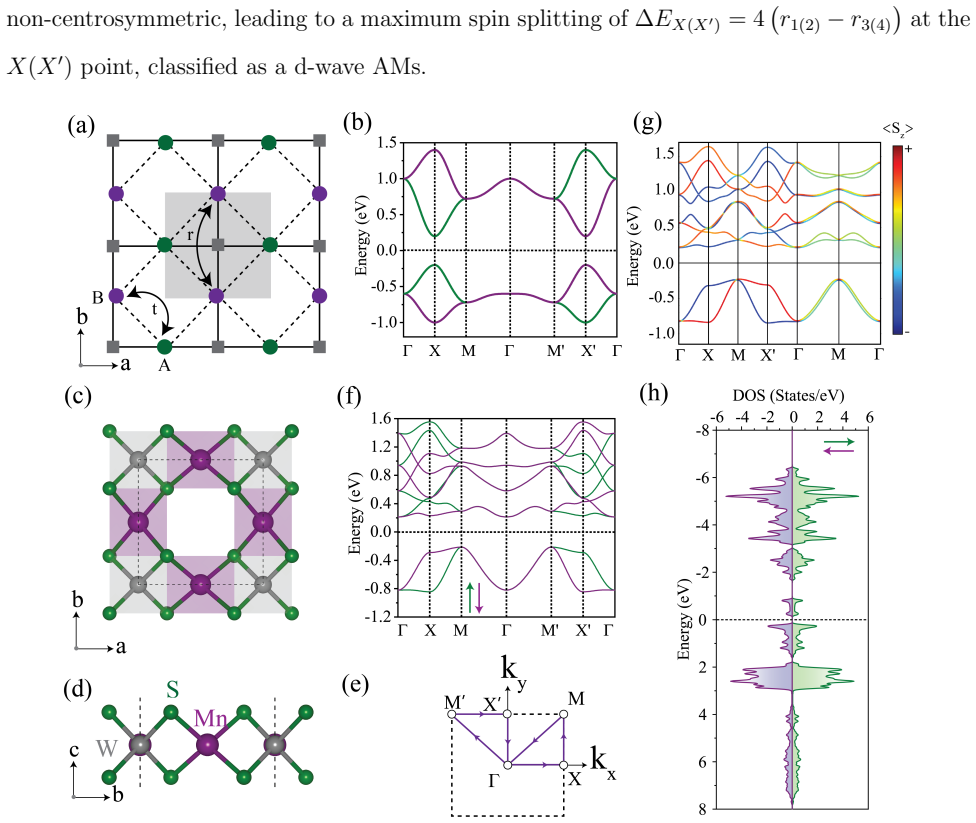
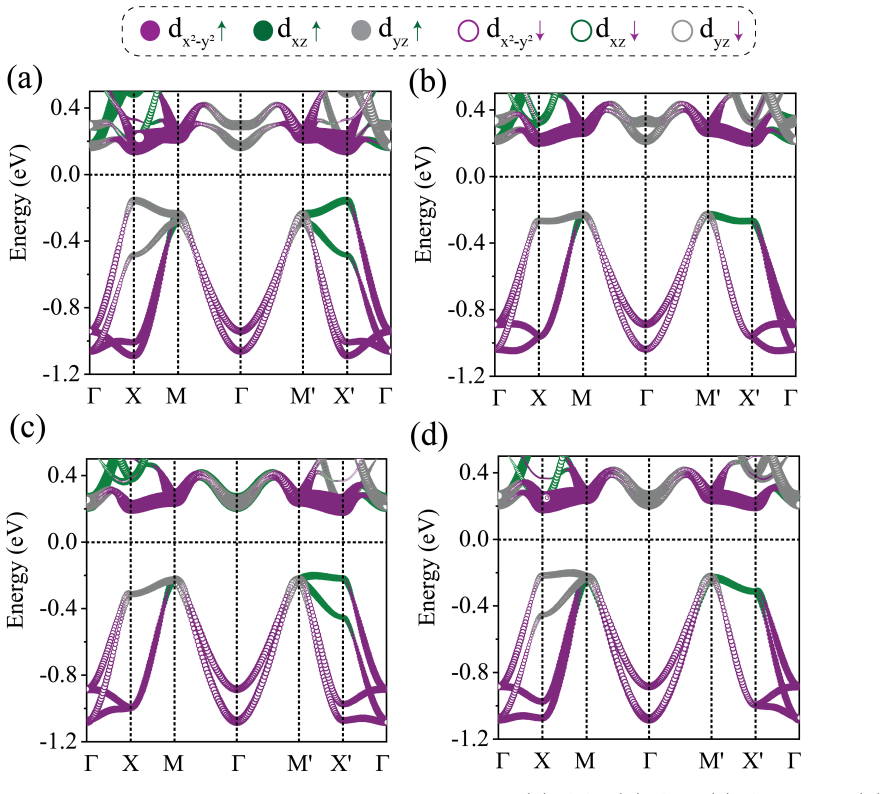
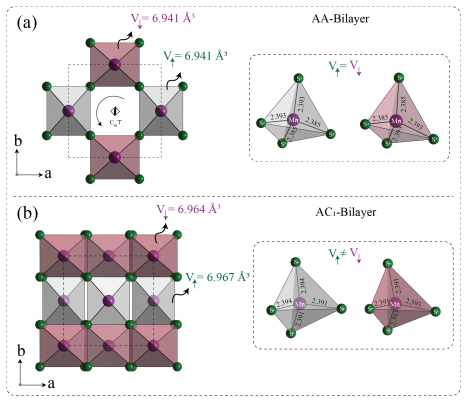
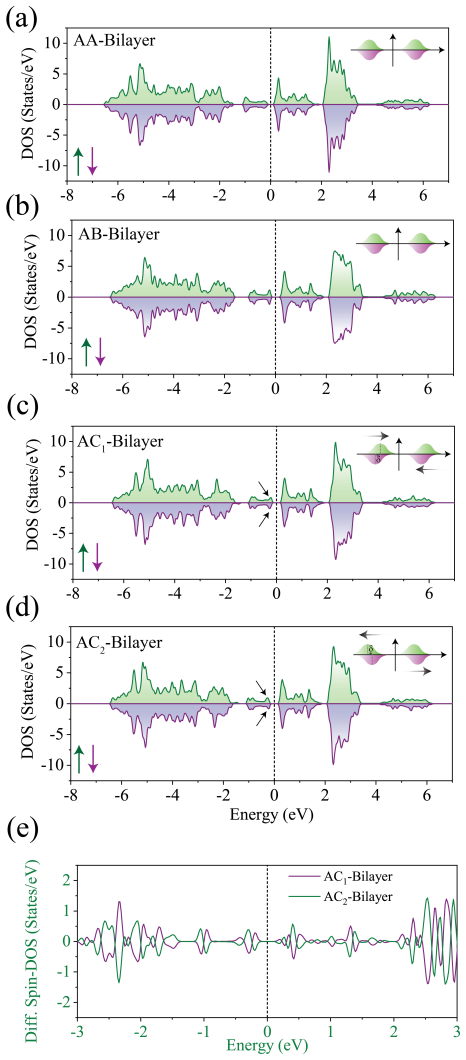
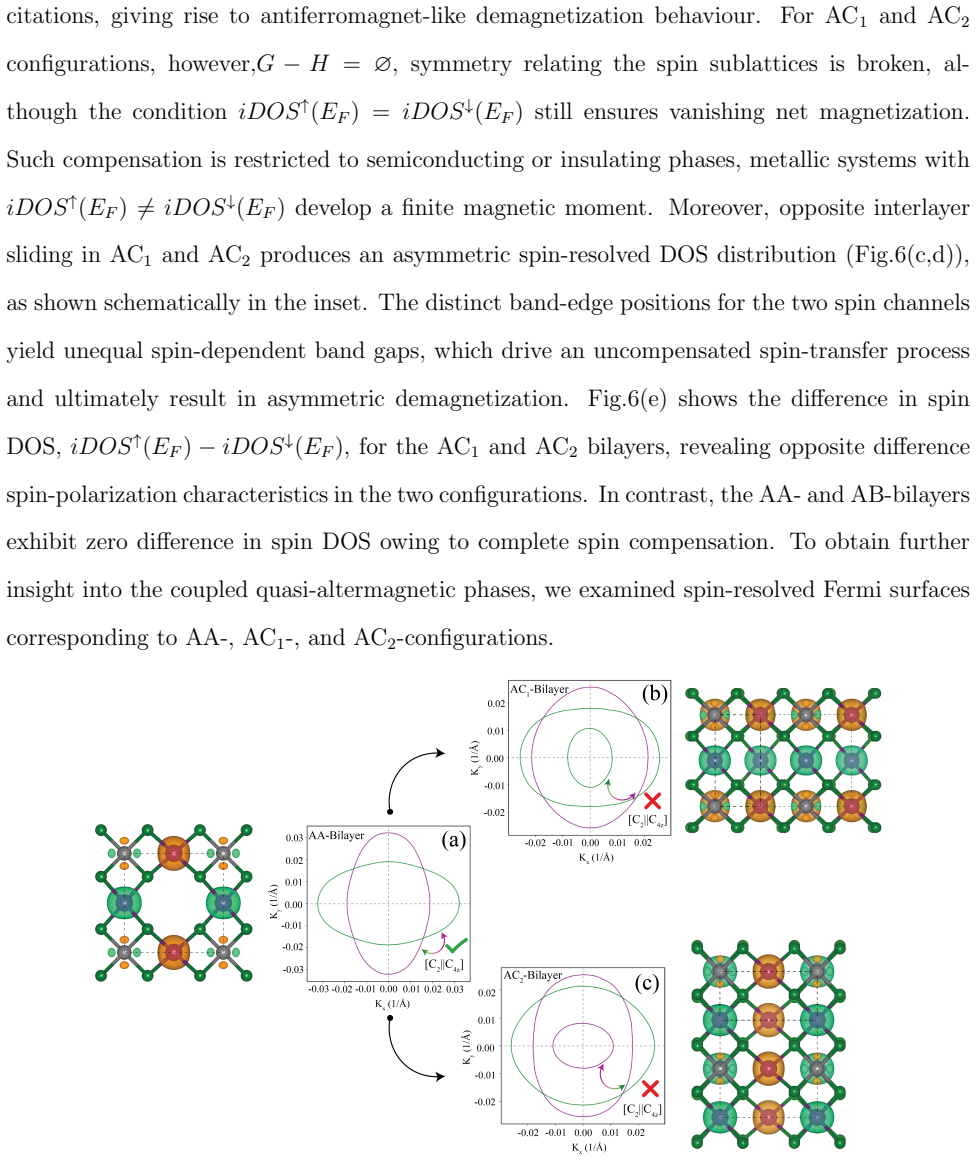
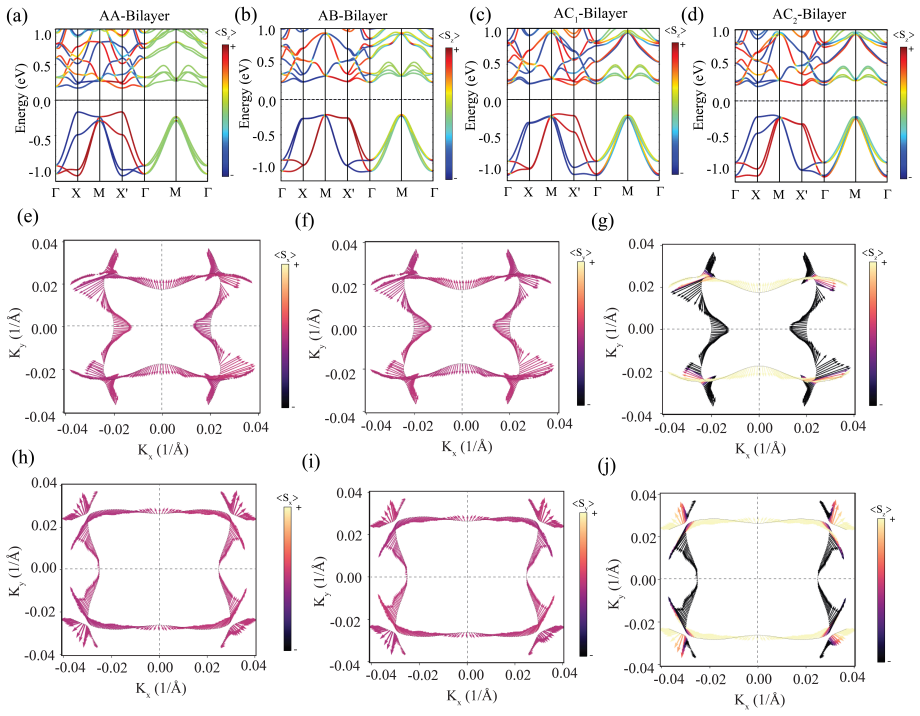
The emergence of non-relativistic spin splitting (NRSS) in altermagnetic systems has introduced a new paradigm in antiferromagnets with vanishing net magnetization. Although sliding-induced valley-polarized phases have recently been demonstrated in two-dimensional altermagnets, the observed valley-polarized state represents only a partial manifestation of altermagnetism, and a comprehensive classification based on spinsplitting characteristics remains lacking. Here, using first-principles calculations, general stacking theory, and spin-Laue symmetry analysis, we propose a coupled quasialtermagnetic state representing a distinct subclass of altermagnetism, in which reversible type-IV NRSS is controlled through interlayer sliding. Accordingly, the sliding-induced phases are classified into two categories: altermagnetic and quasi-altermagnetic states. We establish a direct correspondence between reciprocal-space spin splitting and real-space switching between the two quasi-altermagnetic states. Importantly, the spin-polarized bands in these states remain spin split at {\Gamma} point even in the absence of spin-orbit coupling (SOC), distinguishing them within the proposed classification framework. To demonstrate the interplay between altermagnetic and quasi-altermagnetic states, we investigate the two-dimensional Lieb-lattice material Mn2WS4 and its Janus derivative Mn2WS2Se2, analysing how changes in the local environment influence the different magnetic phases. Importantly, the underlying mechanism is broadly applicable to a wide class of twodimensional square-lattice systems. We further investigate the effects of SOC, focusing on spin texture and transport signatures in coupled quasi-altermagnetic states.
Editorial analysis
A structured set of objections, weighed in public.
Referee Report
Summary. The manuscript proposes a coupled quasi-altermagnetic state as a distinct subclass of altermagnetism in sliding 2D square lattices. Using first-principles DFT calculations, stacking theory, and spin-Laue symmetry analysis on Mn2WS4 and its Janus derivative Mn2WS2Se2, it classifies sliding-induced phases into altermagnetic versus quasi-altermagnetic categories, establishes a direct correspondence between reciprocal-space spin splitting (including type-IV NRSS) and real-space switching, highlights persistent Γ-point splitting without SOC, examines SOC effects on spin texture and transport, and asserts that the underlying mechanism applies broadly to 2D square-lattice systems.
Significance. If the classification and correspondence hold, the work introduces a sliding-controlled framework for NRSS in altermagnets that distinguishes a new quasi-altermagnetic subclass, with potential relevance for 2D spintronics. The combination of symmetry analysis with explicit DFT on a concrete material provides a concrete foundation, though the breadth of applicability remains to be substantiated.
major comments (1)
- [Abstract] Abstract: The statement that 'the underlying mechanism is broadly applicable to a wide class of two-dimensional square-lattice systems' is central to the impact of the proposed classification, yet the supporting evidence is limited to spin-Laue analysis and DFT on Mn2WS4/Mn2WS2Se2. The manuscript must address whether material-specific perturbations (strain, defects, substrate potentials) can lift the claimed Γ-point splitting, as these routinely appear in real 2D lattices and could undermine the generality of the altermagnetic/quasi-altermagnetic distinction.
minor comments (1)
- [Abstract] Abstract: Typographical issues include 'twodimensional' (should be 'two-dimensional') and 'spinsplitting' (should be 'spin splitting').
Simulated Author's Rebuttal
We thank the referee for the constructive feedback on our manuscript. We address the major comment below and have revised the manuscript to strengthen the discussion of generality.
read point-by-point responses
-
Referee: [Abstract] Abstract: The statement that 'the underlying mechanism is broadly applicable to a wide class of two-dimensional square-lattice systems' is central to the impact of the proposed classification, yet the supporting evidence is limited to spin-Laue analysis and DFT on Mn2WS4/Mn2WS2Se2. The manuscript must address whether material-specific perturbations (strain, defects, substrate potentials) can lift the claimed Γ-point splitting, as these routinely appear in real 2D lattices and could undermine the generality of the altermagnetic/quasi-altermagnetic distinction.
Authors: We agree that the robustness of the Γ-point splitting against realistic perturbations requires explicit discussion to support the claimed generality. The spin-Laue symmetry analysis in the manuscript shows that the type-IV NRSS and persistent Γ-point splitting (without SOC) are protected by the symmetry of the sliding-induced phases. Perturbations such as strain, defects, or substrate potentials that preserve the relevant spin-Laue symmetry will not lift the splitting, while those that break the symmetry would change the phase classification itself. We have added a dedicated paragraph in the Discussion section (new text following the SOC analysis) that explicitly addresses these effects, including estimates for typical strain values in 2D materials and the conditions under which the altermagnetic/quasi-altermagnetic distinction remains intact. This revision clarifies the scope of applicability without overstating it. revision: yes
Circularity Check
No circularity: claims derived from symmetry analysis and DFT on specific materials
full rationale
The paper derives its classification of altermagnetic vs. quasi-altermagnetic states, the coupled quasi-altermagnetic proposal, and the reciprocal-to-real-space correspondence directly from spin-Laue symmetry analysis plus first-principles calculations on Mn2WS4/Mn2WS2Se2. These steps do not reduce to self-definitions, fitted inputs renamed as predictions, or self-citation chains; the spin-splitting features at Gamma (even without SOC) are computed outputs used to distinguish the states rather than presupposed. Generalization to other 2D square lattices is stated as an applicability claim supported by the general stacking theory, not forced by construction from the specific results.
Axiom & Free-Parameter Ledger
axioms (2)
- domain assumption First-principles DFT calculations accurately capture the electronic and magnetic properties including NRSS in the studied materials.
- domain assumption Spin-Laue symmetry analysis provides a complete basis for classifying altermagnetic vs quasi-altermagnetic states under sliding.
invented entities (1)
-
coupled quasi-altermagnetic state
no independent evidence
Reference graph
Works this paper leans on
-
[1]
Antiferromagnetic opto-spintronics.Nature Physics, 14(3):229–241, 2018
Petr Nˇ emec, Manfred Fiebig, Tobias Kampfrath, and Alexey V Kimel. Antiferromagnetic opto-spintronics.Nature Physics, 14(3):229–241, 2018
2018
-
[2]
Spintronics: a spin-based electronics vision for the future.science, 294(5546):1488–1495, 2001
Stuart A Wolf, David D Awschalom, Ronald A Buhrman, JM Daughton, von S von Moln´ ar, Michael L Roukes, Anna Y Chtchelkanova, and David M Treger. Spintronics: a spin-based electronics vision for the future.science, 294(5546):1488–1495, 2001
2001
-
[3]
Emerging research landscape of alter- magnetism.Physical Review X, 12(4):040501, 2022
Libor ˇSmejkal, Jairo Sinova, and Tomas Jungwirth. Emerging research landscape of alter- magnetism.Physical Review X, 12(4):040501, 2022
2022
-
[4]
Beyond conventional ferromagnetism and antiferromagnetism: A phase with nonrelativistic spin and crystal rotation symmetry
Libor ˇSmejkal, Jairo Sinova, and Tomas Jungwirth. Beyond conventional ferromagnetism and antiferromagnetism: A phase with nonrelativistic spin and crystal rotation symmetry. Physical Review X, 12(3):031042, 2022
2022
-
[5]
Altermagnetic lifting of kramers spin degeneracy.Nature, 626(7999):517–522, 2024
Juraj Krempask` y, L ˇSmejkal, SW D’souza, M Hajlaoui, G Springholz, K Uhl´ ıˇ rov´ a, F Alarab, PC Constantinou, V Strocov, D Usanov, et al. Altermagnetic lifting of kramers spin degeneracy.Nature, 626(7999):517–522, 2024
2024
-
[6]
Altermagnetism: Exploring new frontiers in magnetism and spintronics.Advanced Func- tional Materials, 34(49):2409327, 2024
Ling Bai, Wanxiang Feng, Siyuan Liu, Libor ˇSmejkal, Yuriy Mokrousov, and Yugui Yao. Altermagnetism: Exploring new frontiers in magnetism and spintronics.Advanced Func- tional Materials, 34(49):2409327, 2024. 27
2024
-
[7]
Altermagnets as a new class of functional materials.Nature Reviews Materials, 10(6):473–485, 2025
Cheng Song, Hua Bai, Zhiyuan Zhou, Lei Han, Helena Reichlova, J Hugo Dil, Junwei Liu, Xianzhe Chen, and Feng Pan. Altermagnets as a new class of functional materials.Nature Reviews Materials, 10(6):473–485, 2025
2025
-
[8]
Altermagnetism: A chemical perspective.Journal of the American Chemical Society, 147(3):2257–2274, 2025
Shannon S Fender, Oscar Gonzalez, and D Kwabena Bediako. Altermagnetism: A chemical perspective.Journal of the American Chemical Society, 147(3):2257–2274, 2025
2025
-
[9]
Symmetry, microscopy and spec- troscopy signatures of altermagnetism.Nature, 649(8098):837–847, 2026
Tomas Jungwirth, Jairo Sinova, Rafael M Fernandes, Qihang Liu, Hikaru Watanabe, Shuichi Murakami, Satoru Nakatsuji, and Libor ˇSmejkal. Symmetry, microscopy and spec- troscopy signatures of altermagnetism.Nature, 649(8098):837–847, 2026
2026
-
[10]
Transition from antiferromagnets to altermagnets: Symmetry-breaking theory.Physical Review B, 112(14):144419, 2025
P Zhou, XN Peng, YZ Hu, BR Pan, SM Liu, PB Lyu, and LZ Sun. Transition from antiferromagnets to altermagnets: Symmetry-breaking theory.Physical Review B, 112(14):144419, 2025
2025
-
[11]
Large band splitting in g-wave altermagnet crsb.Physical Review Letters, 133(20):206401, 2024
Jianyang Ding, Zhicheng Jiang, Xiuhua Chen, Zicheng Tao, Zhengtai Liu, Tongrui Li, Jishan Liu, Jianping Sun, Jinguang Cheng, Jiayu Liu, et al. Large band splitting in g-wave altermagnet crsb.Physical Review Letters, 133(20):206401, 2024
2024
-
[12]
Three-dimensional mapping of the altermagnetic spin splitting in crsb.Nature Communications, 16(1):1442, 2025
Guowei Yang, Zhanghuan Li, Sai Yang, Jiyuan Li, Hao Zheng, Weifan Zhu, Ze Pan, Yifu Xu, Saizheng Cao, Wenxuan Zhao, et al. Three-dimensional mapping of the altermagnetic spin splitting in crsb.Nature Communications, 16(1):1442, 2025
2025
-
[13]
Observation of a giant band splitting in altermagnetic mnte
T Osumi, S Souma, T Aoyama, K Yamauchi, A Honma, K Nakayama, T Takahashi, K Ohgushi, and T Sato. Observation of a giant band splitting in altermagnetic mnte. Physical Review B, 109(11):115102, 2024
2024
-
[14]
Giant strain-induced spin splitting effect in mnte, ag-wave alter- magnetic semiconductor.Physical Review Letters, 134(8):086701, 2025
Kirill D Belashchenko. Giant strain-induced spin splitting effect in mnte, ag-wave alter- magnetic semiconductor.Physical Review Letters, 134(8):086701, 2025
2025
-
[15]
Direct observation of altermagnetic band splitting in crsb thin films.Nature Communications, 15(1):2116, 2024
Sonka Reimers, Lukas Odenbreit, Libor ˇSmejkal, Vladimir N Strocov, Procopios Con- stantinou, Anna B Hellenes, Rodrigo Jaeschke Ubiergo, Warlley H Campos, Venkata K Bharadwaj, Atasi Chakraborty, et al. Direct observation of altermagnetic band splitting in crsb thin films.Nature Communications, 15(1):2116, 2024. 28
2024
-
[16]
Manipulation of the altermagnetic order in crsb via crystal symmetry.Nature, 638(8051):645–650, 2025
Zhiyuan Zhou, Xingkai Cheng, Mengli Hu, Ruiyue Chu, Hua Bai, Lei Han, Junwei Liu, Feng Pan, and Cheng Song. Manipulation of the altermagnetic order in crsb via crystal symmetry.Nature, 638(8051):645–650, 2025
2025
-
[17]
Absence of altermagnetic spin splitting character in rutile oxide ruo 2.Physical Review Letters, 133(17):176401, 2024
Jiayu Liu, Jie Zhan, Tongrui Li, Jishan Liu, Shufan Cheng, Yuming Shi, Liwei Deng, Meng Zhang, Chihao Li, Jianyang Ding, et al. Absence of altermagnetic spin splitting character in rutile oxide ruo 2.Physical Review Letters, 133(17):176401, 2024
2024
-
[18]
Spin and orbital magnetism by light in rutile altermagnets.npj Spintronics, 2(1):46, 2024
Theodoros Adamantopoulos, Maximilian Merte, Frank Freimuth, Dongwook Go, Lishu Zhang, Marjana Leˇ zai´ c, Wanxiang Feng, Yugui Yao, Jairo Sinova, LiborˇSmejkal, et al. Spin and orbital magnetism by light in rutile altermagnets.npj Spintronics, 2(1):46, 2024
2024
-
[19]
Determining the nature of magnetism in altermagnetic candidate ruo 2.Physical Review Research, 8(1):L012072, 2026
Tiema Qian, Aya Rutherford, Eun Sang Choi, Haidong Zhou, Boris Maiorov, Minseong Lee, and Christopher A Mizzi. Determining the nature of magnetism in altermagnetic candidate ruo 2.Physical Review Research, 8(1):L012072, 2026
2026
-
[20]
First-principles investigation of anisotropic magnetic exchange interactions in altermagnetic rutile fluorides.Physical Review B, 113(5):054413, 2026
Surasree Sadhukhan and II Mazin. First-principles investigation of anisotropic magnetic exchange interactions in altermagnetic rutile fluorides.Physical Review B, 113(5):054413, 2026
2026
-
[21]
Determination of the n´ eel vector in rutile altermagnets through x-ray magnetic circular dichroism: The case of mnf 2.Physical Review B, 110(10):L100402, 2024
A Hariki, T Okauchi, Y Takahashi, and J Kuneˇ s. Determination of the n´ eel vector in rutile altermagnets through x-ray magnetic circular dichroism: The case of mnf 2.Physical Review B, 110(10):L100402, 2024
2024
-
[22]
Altermagnetic perovskites.npj Spin- tronics, 3(1):1, 2025
Makoto Naka, Yukitoshi Motome, and Hitoshi Seo. Altermagnetic perovskites.npj Spin- tronics, 3(1):1, 2025
2025
-
[23]
Altermagnetism and magnetic groups with pseudoscalar electron spin.Physical Review B, 106(9):094432, 2022
Ilja Turek. Altermagnetism and magnetic groups with pseudoscalar electron spin.Physical Review B, 106(9):094432, 2022
2022
-
[24]
Crystal-symmetry-paired spin–valley locking in a layered room-temperature metallic altermagnet candidate.Nature Physics, 21(5):760–767, 2025
Fayuan Zhang, Xingkai Cheng, Zhouyi Yin, Changchao Liu, Liwei Deng, Yuxi Qiao, Zheng Shi, Shuxuan Zhang, Junhao Lin, Zhengtai Liu, et al. Crystal-symmetry-paired spin–valley locking in a layered room-temperature metallic altermagnet candidate.Nature Physics, 21(5):760–767, 2025. 29
2025
-
[25]
Strain-tunable spin-valley locking and the influence of spin-orbit coupling in the two-dimensional altermagnet v 2 te 2 o.Physical Review B, 112(14):144427, 2025
Wenlin Zhang, Enhui Zhu, Zhongjun Li, and Hongyan Lv. Strain-tunable spin-valley locking and the influence of spin-orbit coupling in the two-dimensional altermagnet v 2 te 2 o.Physical Review B, 112(14):144427, 2025
2025
-
[26]
Catalog of c-paired spin- momentum locking in antiferromagnetic systems.Physical Review X, 15(2):021083, 2025
Mengli Hu, Xingkai Cheng, Zhenqiao Huang, and Junwei Liu. Catalog of c-paired spin- momentum locking in antiferromagnetic systems.Physical Review X, 15(2):021083, 2025
2025
-
[27]
Multifunctional antiferromagnetic materials with giant piezomagnetism and noncollinear spin current.Nature communications, 12(1):2846, 2021
Hai-Yang Ma, Mengli Hu, Nana Li, Jianpeng Liu, Wang Yao, Jin-Feng Jia, and Junwei Liu. Multifunctional antiferromagnetic materials with giant piezomagnetism and noncollinear spin current.Nature communications, 12(1):2846, 2021
2021
-
[28]
Directional interlayer spin-valley transfer in two-dimensional heterostructures.Nature communica- tions, 7(1):13747, 2016
John R Schaibley, Pasqual Rivera, Hongyi Yu, Kyle L Seyler, Jiaqiang Yan, David G Mandrus, Takashi Taniguchi, Kenji Watanabe, Wang Yao, and Xiaodong Xu. Directional interlayer spin-valley transfer in two-dimensional heterostructures.Nature communica- tions, 7(1):13747, 2016
2016
-
[29]
Spin-layer coupling in two-dimensional altermag- netic bilayers with tunable spin and valley splitting properties.Physical Review B, 110(1):014442, 2024
Yunxi Qi, Jun Zhao, and Hui Zeng. Spin-layer coupling in two-dimensional altermag- netic bilayers with tunable spin and valley splitting properties.Physical Review B, 110(1):014442, 2024
2024
-
[30]
Crystal symmetry paired spin-valley locking in the monolayered k 2 v 2 se 2 o altermagnet.Physical Review B, 113(10):104405, 2026
Hui Zeng, Weijie Zhang, Jun Zhao, and Dazhi Ding. Crystal symmetry paired spin-valley locking in the monolayered k 2 v 2 se 2 o altermagnet.Physical Review B, 113(10):104405, 2026
2026
-
[31]
Uncompensated linear dichroism of magneto-optical kerr effect in a 2d altermagnet.Advanced Functional Materials, 36(29):e21111, 2026
Mingliang Liu, Jia-Tao Sun, and Sheng Meng. Uncompensated linear dichroism of magneto-optical kerr effect in a 2d altermagnet.Advanced Functional Materials, 36(29):e21111, 2026
2026
-
[32]
Piezoelectric altermagnetism and spin-valley polarization in janus monolayer cr2so.Applied Physics Letters, 123(8), 2023
San-Dong Guo, Xiao-Shu Guo, Kai Cheng, Ke Wang, and Yee Sin Ang. Piezoelectric altermagnetism and spin-valley polarization in janus monolayer cr2so.Applied Physics Letters, 123(8), 2023
2023
-
[33]
Valley-dependent electronic prop- erties in two-dimensional altermagnetic iron-based transition metal chalcogenides.Physical Review B, 112(23):235135, 2025
An-Dong Fan, Yong-Kun Wang, Jin-Yang Li, and Si Li. Valley-dependent electronic prop- erties in two-dimensional altermagnetic iron-based transition metal chalcogenides.Physical Review B, 112(23):235135, 2025. 30
2025
-
[34]
Ferrovalley physics in stacked bilayer altermagnetic systems.Nano Letters, 25(15):6032–6039, 2025
Yun-Qin Li, Yu-Ke Zhang, Xin-Le Lu, Ya-Ping Shao, Zhi-Qiang Bao, Jun-Ding Zheng, Wen-Yi Tong, and Chun-Gang Duan. Ferrovalley physics in stacked bilayer altermagnetic systems.Nano Letters, 25(15):6032–6039, 2025
2025
-
[35]
Spin-selective second-order topo- logical insulators enabling cornertronics in two-dimensional altermagnets.Nano Letters, 25(43):15495–15500, 2025
Ning-Jing Yang, Zhigao Huang, and Jian-Min Zhang. Spin-selective second-order topo- logical insulators enabling cornertronics in two-dimensional altermagnets.Nano Letters, 25(43):15495–15500, 2025
2025
-
[36]
Layer-locked anoma- lous valley hall effect in a two-dimensional a-type tetragonal antiferromagnetic insulator
San-Dong Guo, Wei Xu, Yang Xue, Gangqiang Zhu, and Yee Sin Ang. Layer-locked anoma- lous valley hall effect in a two-dimensional a-type tetragonal antiferromagnetic insulator. Physical Review B, 109(13):134426, 2024
2024
-
[37]
Electric- field-tuned anomalous valley hall effect in a-type hexagonal antiferromagnetic monolayers
San-Dong Guo, Yu-Ling Tao, Zi-Yang Zhuo, Gangqiang Zhu, and Yee Sin Ang. Electric- field-tuned anomalous valley hall effect in a-type hexagonal antiferromagnetic monolayers. Physical Review B, 109(13):134402, 2024
2024
-
[38]
First-principles calculations study of valley polarization in antiferromagnetic bilayer systems.Physical Review B, 111(14):L140404, 2025
San-Dong Guo, Ping Li, and Guangzhao Wang. First-principles calculations study of valley polarization in antiferromagnetic bilayer systems.Physical Review B, 111(14):L140404, 2025
2025
-
[39]
Bilayer metal–organic framework altermagnets with electrically tunable spin-split valleys.Journal of the American Chemical Society, 147(17):14806–14814, 2025
Yixuan Che, Haifeng Lv, Xiaojun Wu, and Jinlong Yang. Bilayer metal–organic framework altermagnets with electrically tunable spin-split valleys.Journal of the American Chemical Society, 147(17):14806–14814, 2025
2025
-
[40]
Electric- field-induced switchable two-dimensional altermagnets.Nano Letters, 25(1):498–503, 2024
Dinghui Wang, Huaiqiang Wang, Lulu Liu, Junting Zhang, and Haijun Zhang. Electric- field-induced switchable two-dimensional altermagnets.Nano Letters, 25(1):498–503, 2024
2024
-
[41]
Stacking-, strain- engineering induced altermagnetism, multipiezo effect, and topological state in two- dimensional materials.Applied Physics Letters, 126(16), 2025
Wei Xun, Xin Liu, Youdong Zhang, Yin-Zhong Wu, and Ping Li. Stacking-, strain- engineering induced altermagnetism, multipiezo effect, and topological state in two- dimensional materials.Applied Physics Letters, 126(16), 2025
2025
-
[42]
Sliding- controlled spin-valley-layer polarized anomalous hall effect in two-dimensional altermag- netic bilayers.Physical Review B, 113(15):155424, 2026
Na Cheng, Yue Yin, Xiuwen Zhao, Guichao Hu, Xiaobo Yuan, and Junfeng Ren. Sliding- controlled spin-valley-layer polarized anomalous hall effect in two-dimensional altermag- netic bilayers.Physical Review B, 113(15):155424, 2026. 31
2026
-
[43]
Ferroelectric switchable altermagnetism.Phys- ical review letters, 134(10):106802, 2025
Mingqiang Gu, Yuntian Liu, Haiyuan Zhu, Kunihiro Yananose, Xiaobing Chen, Yongkang Hu, Alessandro Stroppa, and Qihang Liu. Ferroelectric switchable altermagnetism.Phys- ical review letters, 134(10):106802, 2025
2025
-
[44]
Mechanically and electri- cally switchable triferroic altermagnet in a pentagonal fe o 2 monolayer.Physical Review B, 112(19):195410, 2025
Deping Guo, Jiaqi Dai, Renhong Wang, Cong Wang, and Wei Ji. Mechanically and electri- cally switchable triferroic altermagnet in a pentagonal fe o 2 monolayer.Physical Review B, 112(19):195410, 2025
2025
-
[45]
Designing spin symmetry for altermagnetism with strong magnetoelec- tric coupling.Advanced Science, 12(30):e03235, 2025
Wei Sun, Wenxuan Wang, Changhong Yang, Shifeng Huang, Ning Ding, Shuai Dong, and Zhenxiang Cheng. Designing spin symmetry for altermagnetism with strong magnetoelec- tric coupling.Advanced Science, 12(30):e03235, 2025
2025
-
[46]
Ferroelastic altermagnetism.npj Quantum Materials, 2025
Rui Peng, Shibo Fang, Pin Ho, Fanxin Liu, Tong Zhou, Junwei Liu, and Yee Sin Ang. Ferroelastic altermagnetism.npj Quantum Materials, 2025
2025
-
[47]
Rui Peng, Guangxu Su, Yangyang Fan, Jiaan Li, Fanxin Liu, and Yee Sin Ang. Slid- ing ferroelectricity driven spin-layertronics in altermagnetic multilayers.arXiv preprint arXiv:2603.10907, 2026
arXiv 2026
-
[48]
Ab initio molecular-dynamics simulation of the liquid-metal–amorphous-semiconductor transition in germanium.Physical Review B, 49(20):14251, 1994
Georg Kresse and J¨ urgen Hafner. Ab initio molecular-dynamics simulation of the liquid-metal–amorphous-semiconductor transition in germanium.Physical Review B, 49(20):14251, 1994
1994
-
[49]
Projector augmented-wave method.Physical review B, 50(24):17953, 1994
Peter E Bl¨ ochl. Projector augmented-wave method.Physical review B, 50(24):17953, 1994
1994
-
[50]
From ultrasoft pseudopotentials to the projector augmented-wave method.Physical review b, 59(3):1758, 1999
Georg Kresse and Daniel Joubert. From ultrasoft pseudopotentials to the projector augmented-wave method.Physical review b, 59(3):1758, 1999
1999
-
[51]
Generalized gradient approxima- tion made simple.Physical review letters, 77(18):3865, 1996
John P Perdew, Kieron Burke, and Matthias Ernzerhof. Generalized gradient approxima- tion made simple.Physical review letters, 77(18):3865, 1996
1996
-
[52]
Hendrik J Monkhorst and James D Pack.Physical review B, 13(12):5188, 1976
1976
-
[53]
wannier90: A tool for obtaining maximally-localised wannier functions
Arash A Mostofi, Jonathan R Yates, Young-Su Lee, Ivo Souza, David Vanderbilt, and Nicola Marzari. wannier90: A tool for obtaining maximally-localised wannier functions. Computer physics communications, 178(9):685–699, 2008. 32
2008
-
[54]
Wannier90 as a community code: new features and applications.Journal of Physics: Condensed Matter, 32(16):165902, 2020
Giovanni Pizzi, Valerio Vitale, Ryotaro Arita, Stefan Bl¨ ugel, Frank Freimuth, Guillaume G´ eranton, Marco Gibertini, Dominik Gresch, Charles Johnson, Takashi Koretsune, et al. Wannier90 as a community code: new features and applications.Journal of Physics: Condensed Matter, 32(16):165902, 2020
2020
-
[55]
Bil- bao crystallographic server
Mois I Aroyo, Asen Kirov, Cesar Capillas, JM Perez-Mato, and Hans Wondratschek. Bil- bao crystallographic server. ii. representations of crystallographic point groups and space groups.Foundations of Crystallography, 62(2):115–128, 2006
2006
-
[56]
Findsym: program for identifying the space-group symmetry of a crystal.Applied Crystallography, 38(1):237–238, 2005
Harold T Stokes and Dorian M Hatch. Findsym: program for identifying the space-group symmetry of a crystal.Applied Crystallography, 38(1):237–238, 2005
2005
-
[57]
General stacking theory for altermagnetism in bilayer systems.Physical Review Letters, 133(16):166701, 2024
Baoru Pan, Pan Zhou, Pengbo Lyu, Huaping Xiao, Xuejuan Yang, and Lizhong Sun. General stacking theory for altermagnetism in bilayer systems.Physical Review Letters, 133(16):166701, 2024
2024
-
[58]
Sliding ferroelectric control of unconventional magnetism in stacked bilayers
Yongqian Zhu, Mingqiang Gu, Yuntian Liu, Xiaobing Chen, Yuhui Li, Shixuan Du, and Qihang Liu. Sliding ferroelectric control of unconventional magnetism in stacked bilayers. Physical review letters, 135(5):056801, 2025
2025
-
[59]
Vaspkit: A user- friendly interface facilitating high-throughput computing and analysis using vasp code
Vei Wang, Nan Xu, Jin-Cheng Liu, Gang Tang, and Wen-Tong Geng. Vaspkit: A user- friendly interface facilitating high-throughput computing and analysis using vasp code. Computer Physics Communications, 267:108033, 2021
2021
-
[60]
Vesta: a three-dimensional visualization system for electronic and structural analysis.Applied Crystallography, 41(3):653–658, 2008
Koichi Momma and Fujio Izumi. Vesta: a three-dimensional visualization system for electronic and structural analysis.Applied Crystallography, 41(3):653–658, 2008
2008
-
[61]
Com- mentary: The materials project: A materials genome approach to accelerating materials innovation.APL materials, 1(1), 2013
Anubhav Jain, Shyue Ping Ong, Geoffroy Hautier, Wei Chen, William Davidson Richards, Stephen Dacek, Shreyas Cholia, Dan Gunter, David Skinner, Gerbrand Ceder, et al. Com- mentary: The materials project: A materials genome approach to accelerating materials innovation.APL materials, 1(1), 2013
2013
-
[62]
Pyprocar: A python library for electronic structure pre/post- processing.Computer Physics Communications, 251:107080, 2020
Uthpala Herath, Pedram Tavadze, Xu He, Eric Bousquet, Sobhit Singh, Francisco Mu˜ noz, and Aldo H Romero. Pyprocar: A python library for electronic structure pre/post- processing.Computer Physics Communications, 251:107080, 2020. 33
2020
-
[63]
Magndata: towards a database of magnetic structures
Samuel V Gallego, J Manuel Perez-Mato, Luis Elcoro, Emre S Tasci, Robert M Hanson, Koichi Momma, Mois I Aroyo, and Gotzon Madariaga. Magndata: towards a database of magnetic structures. i. the commensurate case.Applied Crystallography, 49(5):1750–1776, 2016
2016
-
[64]
Description of two-dimensional altermagnetism: Categoriza- tion using spin group theory.Physical Review B, 110(5):054406, 2024
Sike Zeng and Yu-Jun Zhao. Description of two-dimensional altermagnetism: Categoriza- tion using spin group theory.Physical Review B, 110(5):054406, 2024
2024
-
[65]
Cross-state alternating magnetism in two-dimensional systems.Nano Letters, 25(52):18068–18074, 2025
Xiaokai Chen, Xiaoyu Xuan, Wanlin Guo, and Zhuhua Zhang. Cross-state alternating magnetism in two-dimensional systems.Nano Letters, 25(52):18068–18074, 2025
2025
-
[66]
Engineering altermagnetic states in two-dimensional square tessellations.Physical Review Letters, 135(3):036701, 2025
Yixuan Che, Haifeng Lv, Xiaojun Wu, and Jinlong Yang. Engineering altermagnetic states in two-dimensional square tessellations.Physical Review Letters, 135(3):036701, 2025
2025
-
[67]
Altermagnetic phase transition in a lieb metal.Phys- ical Review Letters, 135(3):036502, 2025
Matteo D¨ urrnagel, Hendrik Hohmann, Atanu Maity, Jannis Seufert, Michael Klett, Lennart Klebl, and Ronny Thomale. Altermagnetic phase transition in a lieb metal.Phys- ical Review Letters, 135(3):036502, 2025
2025
-
[68]
Alterpiezoresponse in two-dimensional lieb-lattice altermagnets
Xilong Xu and Li Yang. Alterpiezoresponse in two-dimensional lieb-lattice altermagnets. Nano Letters, 25(31):11870–11877, 2025
2025
-
[69]
Axial hall effect in altermagnetic lieb lattices
Xilong Xu, Haonan Wang, and Li Yang. Axial hall effect in altermagnetic lieb lattices. ACS Applied Materials & Interfaces, 18(9):14194–14202, 2026
2026
-
[70]
Valley-selective linear dichroism and excitonic effects in lieb-lattice altermagnets.Physical Review B, 113(11):115408, 2026
Haonan Wang, Xilong Xu, Du Li, and Li Yang. Valley-selective linear dichroism and excitonic effects in lieb-lattice altermagnets.Physical Review B, 113(11):115408, 2026
2026
-
[71]
Nonrelativistic spin splitting at the brillouin zone center in compensated magnets.Physical review letters, 133(21):216701, 2024
Lin-Ding Yuan, Alexandru B Georgescu, and James M Rondinelli. Nonrelativistic spin splitting at the brillouin zone center in compensated magnets.Physical review letters, 133(21):216701, 2024
2024
-
[72]
Unlocking doping effects on altermagnetism in mnte: Emergence of quasi-altermagnetism.Physical Review B, 113(10):104438, 2026
Nayana Devaraj, Anumita Bose, Arindom Das, Md Afsar Reja, Arijit Mandal, Awad- hesh Narayan, and BRK Nanda. Unlocking doping effects on altermagnetism in mnte: Emergence of quasi-altermagnetism.Physical Review B, 113(10):104438, 2026
2026
-
[73]
Spontaneous anomalous hall effect in two-dimensional altermagnets.Physical Review B, 111(18):184407, 2025
Sajjan Sheoran and Pratibha Dev. Spontaneous anomalous hall effect in two-dimensional altermagnets.Physical Review B, 111(18):184407, 2025. 34
2025
-
[74]
Engineering altermagnetism via layer shifts and spin order in bilayer mnps3.npj 2D Materials and Applications, 2025
JW Gonz´ alez, T Brumme, E Su´ arez Morell, and AM Le´ on. Engineering altermagnetism via layer shifts and spin order in bilayer mnps3.npj 2D Materials and Applications, 2025
2025
-
[75]
Spin-layer coupling in an altermagnetic multilayer: A design principle for spintronics.Physical Review B, 111(3):035437, 2025
Jianke Tian, Jia Li, Hengbo Liu, Yan Li, Ze Liu, Linyang Li, Jun Li, Guodong Liu, and Junjie Shi. Spin-layer coupling in an altermagnetic multilayer: A design principle for spintronics.Physical Review B, 111(3):035437, 2025. 35
2025
discussion (0)
Sign in with ORCID, Apple, or X to comment. Anyone can read and Pith papers without signing in.