Two Flavon Froggatt-Nielsen Models with Genetic Algorithms
Pith reviewed 2026-06-26 17:05 UTC · model grok-4.3
The pith
Two-flavon Froggatt-Nielsen models accommodate all fermion data in over 100000 distinct realizations found via genetic algorithms.
A machine-rendered reading of the paper's core claim, the machinery that carries it, and where it could break.
Core claim
By formulating each experimental constraint as a separate objective and running the Non-dominated Sorting Genetic Algorithm III, the authors identify over 100000 unique phenomenologically viable two-flavon FN models. The relative phase between the two flavon vacuum expectation values generates CP violation in both sectors, and the relative hierarchy of those vevs leads to distinct predictions for m_ee in the normal and inverted orderings. Minimal realizations exist with maximal flavon exponent as small as three, and some models reproduce the charged-fermion masses to within 6 percent without dedicated continuous-parameter tuning.
What carries the argument
NSGA-III multi-objective genetic algorithm that simultaneously optimizes the discrete FN charges and the continuous Wilson coefficients and flavon vev parameters against separate experimental objectives.
If this is right
- Both normal and inverted neutrino mass orderings are realized among the viable models.
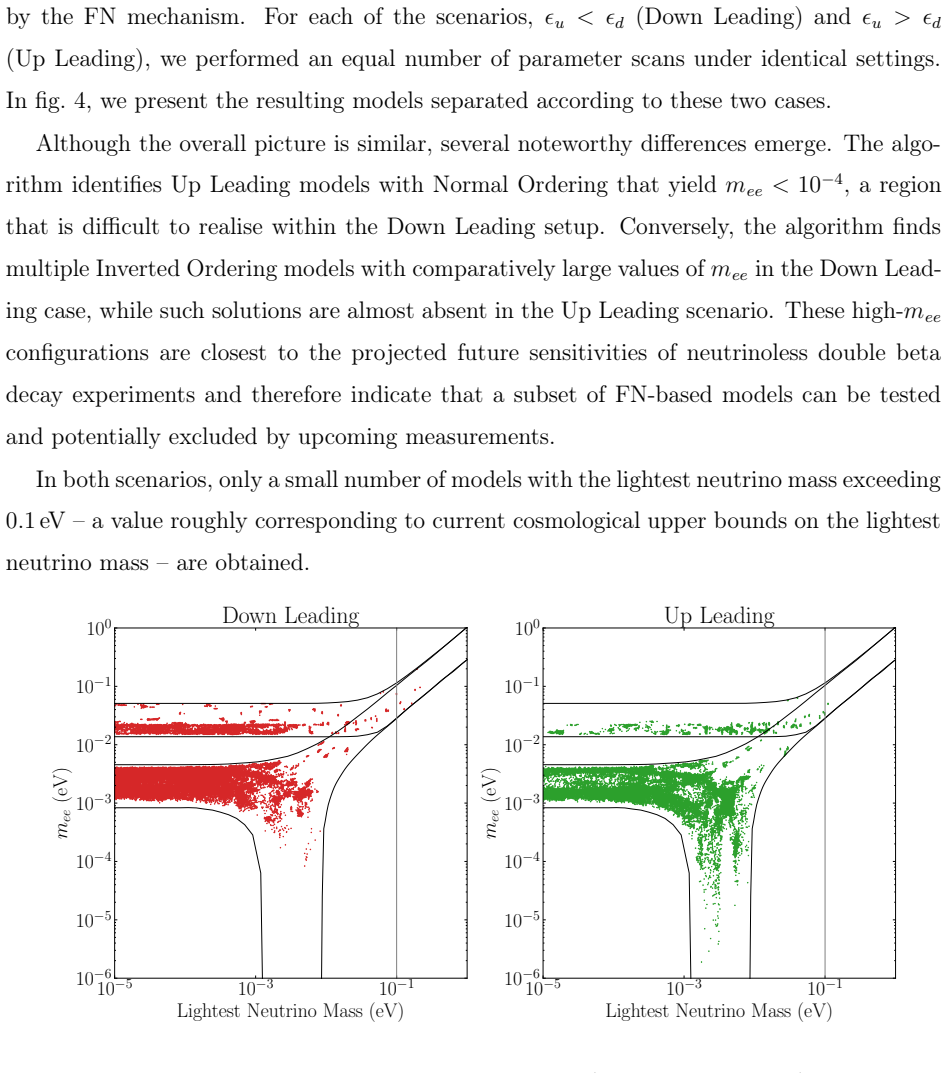
- The relative hierarchy between the two flavon vevs produces qualitatively distinct predictions for the effective neutrinoless double beta decay mass m_ee.
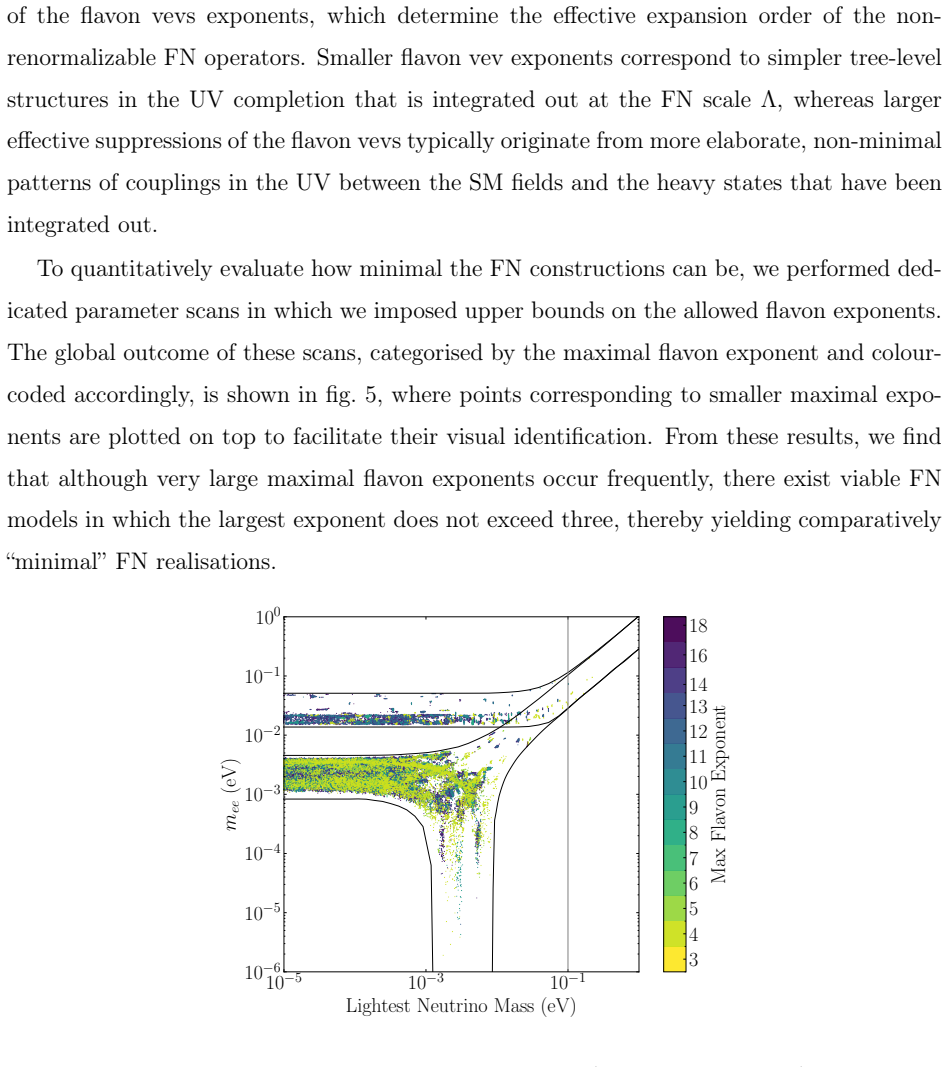
- Minimal FN realizations exist with maximal flavon exponent as small as three.
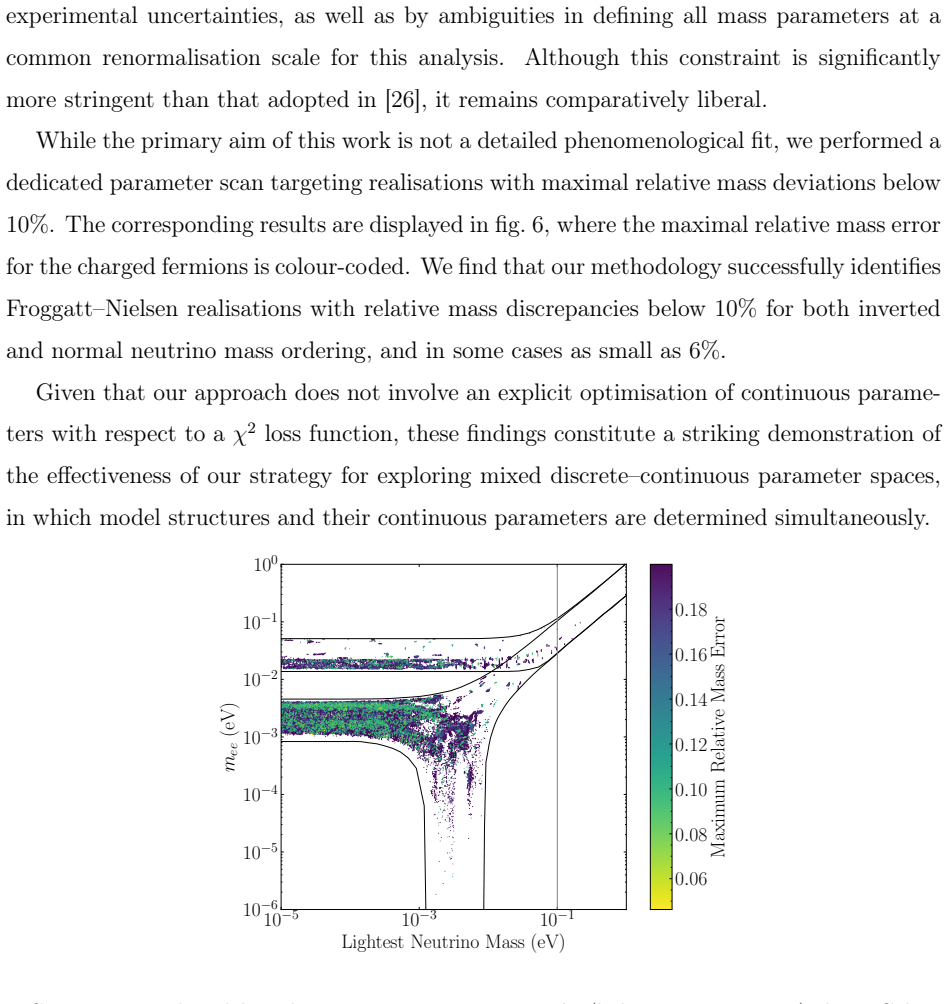
- Some models reproduce charged fermion masses to within 6 percent without dedicated continuous parameter optimization.
- The low duplication rate indicates that the space of valid two-flavon FN realizations has not been exhausted.
Where Pith is reading between the lines
- Precision measurements of m_ee could distinguish the relative flavon vev hierarchies realized in the viable models.
- The same multi-objective genetic algorithm approach could be applied to other high-dimensional discrete-continuous model spaces in flavor physics.
- The large number of solutions suggests that additional theoretical constraints, such as those from UV completions, would be needed to increase predictivity.
Load-bearing premise
The genetic algorithm has explored the full mixed discrete-continuous space of charges and parameters without bias, convergence failure, or incorrect encoding of the experimental constraints.
What would settle it
A precision measurement of m_ee that lies outside the ranges predicted by all viable models in both normal and inverted orderings, or updated mixing-angle data that no model in the scan can satisfy.
Figures


read the original abstract
We present the first systematic and comprehensive scan of two-flavon Froggatt-Nielsen (FN) models, employing artificial intelligence techniques to explore the high-dimensional, mixed discrete-continuous parameter space. Extending the standard single-flavon FN framework to a two-flavon setup in which separate flavon fields couple independently to the up- and down-type sectors, we demonstrate that the relative phase between their vacuum expectation values (vevs) provides a natural and generic source of CP violation absent in single-flavon models. To explore this enlarged model space, we cast the search for phenomenologically viable models as a multi-objective optimisation problem, formulating each experimental constraint as a separate objective, and employ the Non-dominated Sorting Genetic Algorithm III to simultaneously fit all 18 FN charges, 45 Wilson coefficients, and flavon parameters to both the quark and lepton sectors. Our approach requires no separate training phase and identifies phenomenologically viable models orders of magnitude faster than prior reinforcement learning methods. Imposing experimental constraints on CKM and PMNS mixing angles and CP phases, charged fermion masses, and neutrino squared-mass differences, we discover over $100\,000$ unique viable models with a remarkably low duplication rate, indicating that the space of valid two-flavon FN realisations has not been exhausted. Both Normal and Inverted neutrino mass squared orderings are realised, with the relative hierarchy between the flavon vevs producing qualitatively distinct predictions for the effective neutrinoless double beta decay mass $m_{ee}$. We further demonstrate the existence of minimal FN realisations with maximal flavon exponent as small as three, and of models reproducing charged fermion masses to within $6\%$ without any dedicated continuous parameter optimisation.
Editorial analysis
A structured set of objections, weighed in public.
Referee Report
Summary. The paper performs the first systematic scan of two-flavon Froggatt-Nielsen models by casting the search for viable realizations as a multi-objective optimization problem solved with the NSGA-III genetic algorithm. It simultaneously optimizes 18 FN charges, 45 Wilson coefficients, and flavon vev parameters to fit CKM/PMNS angles, CP phases, charged-fermion masses, and neutrino mass-squared differences, reporting the discovery of over 100,000 unique viable models (both normal and inverted orderings) with low duplication, distinct m_ee predictions depending on vev hierarchy, and minimal realizations with maximal exponent as small as three.
Significance. If the numerical results hold, the work would be significant for demonstrating that the two-flavon FN parameter space is substantially larger and less exhausted than previously appreciated, while providing a concrete illustration of how genetic algorithms can efficiently explore high-dimensional mixed discrete-continuous spaces in flavor model building. The reported distinction in neutrinoless double-beta-decay predictions between vev hierarchies and the existence of models fitting charged-fermion masses to 6% without dedicated continuous-parameter tuning are concrete, falsifiable outputs that could guide future model-building efforts.
major comments (3)
- [Abstract and §3 (algorithm description)] The central claim of >100,000 unique viable models (abstract) rests on the correctness of the NSGA-III implementation, yet no explicit formulation of the individual objective functions (e.g., how CKM angles, CP phases, or Δm² are encoded as separate objectives) or handling of integer FN charges is provided; without this, it is impossible to confirm that constraints are imposed without circularity or implementation error.
- [§4 (results) and §5 (discussion)] No convergence diagnostics, population size, generation count, or post-run validation (independent χ² recomputation on the output models) are reported; this leaves open the possibility that the reported count and low duplication rate are affected by incomplete exploration or sampling bias in the 18+45+flavon parameter space.
- [§4.2 (neutrino sector results)] The assertion that both normal and inverted orderings are realized with qualitatively distinct m_ee predictions depends on the relative flavon vev hierarchy being correctly sampled; the paper does not show that the multi-objective formulation treats the vev ratio as an independent continuous parameter without artificial constraints.
minor comments (2)
- [§2] Notation for the two flavon fields and their charges should be standardized across equations and tables to avoid ambiguity between up- and down-type sectors.
- [Abstract] The abstract states that the approach is 'orders of magnitude faster than prior reinforcement learning methods,' but no direct timing or iteration-count comparison is given in the text.
Simulated Author's Rebuttal
We thank the referee for their careful reading and constructive comments on our manuscript. We address each major comment below and will revise the paper accordingly to improve clarity and reproducibility.
read point-by-point responses
-
Referee: [Abstract and §3 (algorithm description)] The central claim of >100,000 unique viable models (abstract) rests on the correctness of the NSGA-III implementation, yet no explicit formulation of the individual objective functions (e.g., how CKM angles, CP phases, or Δm² are encoded as separate objectives) or handling of integer FN charges is provided; without this, it is impossible to confirm that constraints are imposed without circularity or implementation error.
Authors: We agree that explicit formulations are necessary for full verification. In the revised manuscript we will add a dedicated subsection in §3 providing the precise mathematical definitions of all objective functions (including the encoding of CKM/PMNS angles, CP phases, and mass-squared differences as separate objectives) together with the exact treatment of integer FN charges and the constraints applied to them. revision: yes
-
Referee: [§4 (results) and §5 (discussion)] No convergence diagnostics, population size, generation count, or post-run validation (independent χ² recomputation on the output models) are reported; this leaves open the possibility that the reported count and low duplication rate are affected by incomplete exploration or sampling bias in the 18+45+flavon parameter space.
Authors: We acknowledge that these implementation details were omitted. The revised version will report the NSGA-III population size, generation count, convergence diagnostics, and results of independent χ² recomputation performed on a representative sample of the output models to substantiate the reported count and low duplication rate. revision: yes
-
Referee: [§4.2 (neutrino sector results)] The assertion that both normal and inverted orderings are realized with qualitatively distinct m_ee predictions depends on the relative flavon vev hierarchy being correctly sampled; the paper does not show that the multi-objective formulation treats the vev ratio as an independent continuous parameter without artificial constraints.
Authors: The optimization treats the relative flavon vev hierarchy (magnitude ratio and phase) as fully independent continuous parameters subject only to physical bounds. We will revise §4.2 to state this parameterization explicitly and to show that the multi-objective setup imposes no additional artificial constraints, thereby confirming the sampling of both mass orderings and the associated distinct m_ee predictions. revision: yes
Circularity Check
No significant circularity; search targets external data
full rationale
The paper casts the search for viable two-flavon FN models as a multi-objective optimization problem solved by NSGA-III, with each experimental constraint (CKM/PMNS angles, CP phases, masses, neutrino mass-squared differences) formulated as a separate objective. The reported count of over 100,000 unique viable models and the qualitative distinctions in m_ee predictions are direct outputs of this search over the 18 charges + 45 Wilson coefficients + flavon parameters; they do not reduce by construction to any fitted input or self-citation. No load-bearing self-citation, uniqueness theorem, or ansatz smuggling appears in the derivation chain. The result is therefore self-contained against external benchmarks.
Axiom & Free-Parameter Ledger
free parameters (3)
- 18 FN charges
- 45 Wilson coefficients
- flavon vev scales and relative phase
axioms (2)
- standard math Standard Model gauge group, particle content, and flavor symmetry framework
- domain assumption Experimental constraints on masses, mixings, and mass-squared differences are accurately encoded as objectives
invented entities (1)
-
Two independent flavon fields
no independent evidence
Reference graph
Works this paper leans on
-
[1]
Scan Strategy and Methodology 12 A
PMNSNuFitConvention 10 III. Scan Strategy and Methodology 12 A. Comparison with Reinforcement Learning Approaches 12 B. Constraint Losses and Multi-Objective Optimisation 13
-
[2]
Constraint Losses 14
-
[3]
NSGA-III: Diversity in High-Dimensional Spaces 18 D
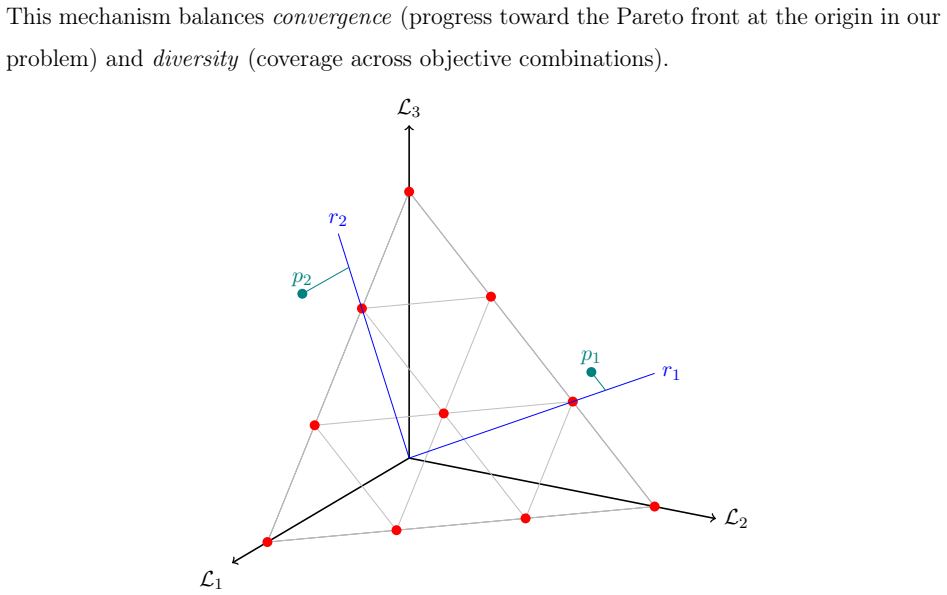
Combined Multi-objective and Pareto Front 15 C. NSGA-III: Diversity in High-Dimensional Spaces 18 D. Implementation Details 20 IV. Results 21 V. Conclusions and Outlook 27 Acknowledgements 28 A. CP Violation 28
-
[4]
PMNS Parameter Predictions 33 References 33 I
Two Flavon Models 31 B. PMNS Parameter Predictions 33 References 33 I. INTRODUCTION Understanding the origin of the observed pattern of fermion masses and mixing angles is one of the outstanding open problems in particle physics. The Standard Model (SM) 2 accommodates these hierarchies through Yukawa couplings that span several orders of mag- nitude, yet ...
-
[5]
PMNSNuFitConvention To connect the PMNS and neutrino mass predictions to data we need to further align our conventions with those used by theNuFitcollaboration [31], which communicates the leading global fits to neutrino data. To this effect, we first make use of the generic3×3 unitary matrix parametrisation, which is often used to express for example the...
-
[6]
For ex- ample, the electron mass is known with extremely high precision, whereas the neutrino CP-violating phase is still poorly constrained
Constraint Losses Our goal is to find models compatible with experimental flavour data – fermion masses, mixing angles, and CP-violating phases – which have very different uncertainties. For ex- ample, the electron mass is known with extremely high precision, whereas the neutrino CP-violating phase is still poorly constrained. Moreover, fermion masses are...
-
[7]
good point
Combined Multi-objective and Pareto Front A point in parameter space is a “good point” (i.e. a valid model) if allC-type losses vanish,L k(x) = 0. There are 17 constraint losses in total: four for the CKM mixing angles 15 and CP phase, four for the PMNS angles and missing phase, three for the quark masses, three for charged-lepton masses, two for the neut...
-
[8]
One Flavon In models with a single flavon field with real FN Wilson coefficients, the only possible source of CP violation is the a non-vanishing phase of the FN flavon vev. However, even this case is not a generic prediction, since a model with aU(1)F N flavour symmetry typically 28 allows to perform aU(1)F N rotation to render the flavon vev real withou...
-
[9]
Exploiting theU(1)F N freedom, we may, without loss of generality, choose one of the flavon vevs to be real, which we take to beΦu
Two Flavon Models Since the single-flavon scenario does not furnish a source of CP violation, we now turn to models with two flavons. Exploiting theU(1)F N freedom, we may, without loss of generality, choose one of the flavon vevs to be real, which we take to beΦu. For this exercise, we choose the parametrisation ϵ= ⟨Φu⟩ Λ , R= ⟨Φd⟩ ⟨Φu⟩ =|R|e iα ,(A15) w...
-
[10]
C. D. Froggatt and Holger Bech Nielsen. Hierarchy of Quark Masses, Cabibbo Angles and CP Violation.Nucl. Phys. B, 147:277–278, 1979
1979
-
[11]
Mass matrix models: The Sequel.Nucl
Miriam Leurer, Yosef Nir, and Nathan Seiberg. Mass matrix models: The Sequel.Nucl. Phys. B, 420:468–504, 1994
1994
-
[12]
Recent Progress in Flavor Model Building.Ann
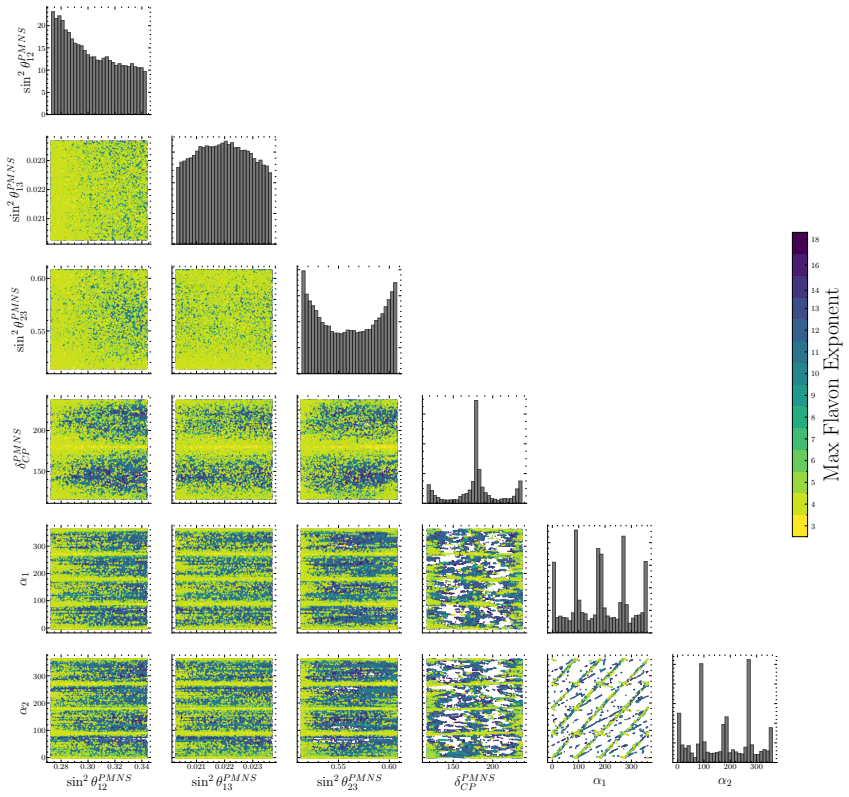
Wolfgang Altmannshofer and Admir Greljo. Recent Progress in Flavor Model Building.Ann. Rev. Nucl. Part. Sci., 75(1):201–322, 2025. 33 0 5 10 15 20 sin2θP M N S 12 0.021 0.022 0.023 sin2θP M N S 13 0.55 0.60 sin2θP M N S 23 150 200 δP M N S CP 0 100 200 300 α1 0.28 0.30 0.32 0.34 sin2θP M N S 12 0 100 200 300 α2 0.021 0.022 0.023 sin2θP M N S 13 0.55 0.60 ...
2025
-
[13]
Neil, and Jedidiah O
Claudia Cornella, David Curtin, Ethan T. Neil, and Jedidiah O. Thompson. Mapping and probing Froggatt-Nielsen solutions to the quark flavor puzzle.Phys. Rev. D, 111(1):015042, 2025
2025
-
[14]
Anomaly free Froggatt-Nielsen models of flavor.JHEP, 10:188, 2019
Aleks Smolkovič, Michele Tammaro, and Jure Zupan. Anomaly free Froggatt-Nielsen models of flavor.JHEP, 10:188, 2019. [Erratum: JHEP 02, 033 (2022)]
2019
-
[15]
Comprehensive Bayesian exploration of Froggatt-Nielsen mechanism.JHEP, 03:150, 2025
Masahiro Ibe, Satoshi Shirai, and Keiichi Watanabe. Comprehensive Bayesian exploration of Froggatt-Nielsen mechanism.JHEP, 03:150, 2025. 34
2025
-
[16]
Testing the Froggatt- Nielsen mechanism with lepton flavor and number violating processes.Phys
Claudia Cornella, David Curtin, Gordan Krnjaic, and Micah Mellors. Testing the Froggatt- Nielsen mechanism with lepton flavor and number violating processes.Phys. Rev. D, 112(11):115010, 2025
2025
-
[17]
A Living Review of Machine Learning for Particle Physics
HEP ML Community. A Living Review of Machine Learning for Particle Physics
-
[18]
The frontier of simulation-based inference
Kyle Cranmer, Johann Brehmer, and Gilles Louppe. The frontier of simulation-based inference. Proc. Nat. Acad. Sci., 117(48):30055–30062, 2020
2020
-
[19]
Goodsell and Ari Joury
Mark D. Goodsell and Ari Joury. Active learning BSM parameter spaces.Eur. Phys. J. C, 83(4):268, 2023
2023
-
[20]
Hammad, Myeonghun Park, Raymundo Ramos, and Pankaj Saha
A. Hammad, Myeonghun Park, Raymundo Ramos, and Pankaj Saha. Exploration of parameter spaces assisted by machine learning.Comput. Phys. Commun., 293:108902, 2023
2023
-
[21]
Harvey, and Andre Lukas
Steven Abel, Andrei Constantin, Thomas R. Harvey, and Andre Lukas. Evolving Heterotic Gauge Backgrounds: Genetic Algorithms versus Reinforcement Learning.Fortsch. Phys., 70(5):2200034, 2022
2022
-
[22]
Branes with Brains: Exploring String Vacua with Deep Reinforcement Learning.JHEP, 06:003, 2019
James Halverson, Brent Nelson, and Fabian Ruehle. Branes with Brains: Exploring String Vacua with Deep Reinforcement Learning.JHEP, 06:003, 2019
2019
-
[23]
Probing the Structure of String Theory Vacua with Genetic Algorithms and Reinforcement Learning
Alex Cole, Sven Krippendorf, Andreas Schachner, and Gary Shiu. Probing the Structure of String Theory Vacua with Genetic Algorithms and Reinforcement Learning. In35th Conference on Neural Information Processing Systems, 11 2021
2021
-
[24]
Exploring parameter spaces with artificial intelligence and machine learning black-box optimization algorithms.Phys
Fernando Abreu de Souza, Miguel Crispim Romão, Nuno Filipe Castro, Mehraveh Nikjoo, and Werner Porod. Exploring parameter spaces with artificial intelligence and machine learning black-box optimization algorithms.Phys. Rev. D, 107(3):035004, 2023
2023
-
[25]
Truth, beauty, and goodness in grand unification: A machine learning approach.Phys
Shinsuke Kawai and Nobuchika Okada. Truth, beauty, and goodness in grand unification: A machine learning approach.Phys. Lett. B, 860:139221, 2025
2025
-
[26]
Combining evolutionary strategies and nov- elty detection to go beyond the alignment limit of the Z3 3HDM.Phys
Jorge Crispim Romão and Miguel Crispim Romão. Combining evolutionary strategies and nov- elty detection to go beyond the alignment limit of the Z3 3HDM.Phys. Rev. D, 109(9):095040, 2024
2024
-
[27]
Exploring scotogenic parameter spaces and mapping uncharted dark matter phenomenology with multi-objective search algorithms.JHEP, 10:116, 2025
Fernando Abreu de Souza, Nuno Filipe Castro, Miguel Crispim Romão, and Werner Porod. Exploring scotogenic parameter spaces and mapping uncharted dark matter phenomenology with multi-objective search algorithms.JHEP, 10:116, 2025. 35
2025
-
[28]
Figueiredo, Jorge C
Fernando Abreu de Souza, Rafael Boto, Miguel Crispim Romão, Pedro N. Figueiredo, Jorge C. Romão, and João P. Silva. Unearthing large pseudoscalar Yukawa couplings with machine learning.JHEP, 07:268, 2025
2025
-
[29]
Rebelo, Jorge C
Rafael Boto, Tiago P. Rebelo, Jorge C. Romão, and João P. Silva. Machine Learning in the 2HDM2S model for Dark Matter. 9 2025
2025
-
[30]
Rafael Boto, João A. C. Matos, Jorge C. Romão, and João P. Silva. Surveying the complex three Higgs doublet model with Machine Learning. 10 2025
2025
-
[31]
Romão, Rui Santos, and João P
RafaelBoto, KarimElyaouti, DuarteFontes, MariaGonçalves, MargareteMühlleitner, JorgeC. Romão, Rui Santos, and João P. Silva. Reassessing CP Violation in the C2HDM with Machine Learning. 1 2026
2026
-
[32]
Goodsell, Farid Ibrahimov, and Werner Porod
Fernando Abreu de Souza, Nuno Filipe Castro, Miguel Crispim Romão, Mark D. Goodsell, Farid Ibrahimov, and Werner Porod. BSMArt 2: simpler and faster parameter space scans. 6 2026
2026
-
[33]
Matchev, Katia Matcheva, Pierre Ramond, and Sarunas Verner
Konstantin T. Matchev, Katia Matcheva, Pierre Ramond, and Sarunas Verner. Exploring the truth and beauty of theory landscapes with machine learning.Phys. Lett. B, 856:138941, 2024
2024
-
[34]
T. R. Harvey and A. Lukas. Quark Mass Models and Reinforcement Learning.JHEP, 08:161, 2021
2021
-
[35]
Exploring the flavor structure of quarks and leptons with reinforcement learning.JHEP, 23:021, 2020
Satsuki Nishimura, Coh Miyao, and Hajime Otsuka. Exploring the flavor structure of quarks and leptons with reinforcement learning.JHEP, 23:021, 2020
2020
-
[36]
Knapp-Perez, Jake Rudolph, and Daniel Whiteson
Jason Benjamin Baretz, Max Fieg, Vijay Ganesh, Aishik Ghosh, V. Knapp-Perez, Jake Rudolph, and Daniel Whiteson. Towards AI-assisted Neutrino Flavor Theory Design. 6 2025
2025
-
[37]
CP violation due to multi Froggatt-Nielsen fields.Eur
Shinya Kanemura, Koichi Matsuda, Toshihiko Ota, Serguey Petcov, Tetsuo Shindou, Eiichi Takasugi, and Koji Tsumura. CP violation due to multi Froggatt-Nielsen fields.Eur. Phys. J. C, 51:927–931, 2007
2007
-
[38]
Kalyanmoy Deb and Himanshu Jain. An evolutionary many-objective optimization algorithm using reference-point-based nondominated sorting approach, part i: solving problems with box constraints.IEEE transactions on evolutionary computation, 18(4):577–601, 2013
2013
-
[39]
Himanshu Jain and Kalyanmoy Deb. An evolutionary many-objective optimization algorithm using reference-point based nondominated sorting approach, part ii: Handling constraints and extending to an adaptive approach.IEEE Transactions on evolutionary computation, 36 18(4):602–622, 2013
2013
-
[40]
Ivan Esteban, M. C. Gonzalez-Garcia, Michele Maltoni, Ivan Martinez-Soler, João Paulo Pin- heiro, and Thomas Schwetz. NuFit-6.0: updated global analysis of three-flavor neutrino oscil- lations.JHEP, 12:216, 2024
2024
-
[41]
Navas et al
S. Navas et al. Review of particle physics.Phys. Rev. D, 110(3):030001, 2024
2024
-
[42]
S. F. King and Graham G. Ross. Fermion masses and mixing angles from SU (3) family symmetry and unification.Phys. Lett. B, 574:239–252, 2003
2003
-
[43]
Blank and K
J. Blank and K. Deb. pymoo: Multi-objective optimization in python.IEEE Access, 8:89497– 89509, 2020
2020
-
[44]
Jarlskog
C. Jarlskog. Commutator of the Quark Mass Matrices in the Standard Electroweak Model and a Measure of Maximal CP Nonconservation.Phys. Rev. Lett., 55:1039, 1985
1985
-
[45]
F. J. Botella and Joao P. Silva. Jarlskog - like invariants for theories with scalars and fermions. Phys. Rev. D, 51:3870–3875, 1995. 37
1995
discussion (0)
Sign in with ORCID, Apple, or X to comment. Anyone can read and Pith papers without signing in.