All-valid-state HOBO encoding for constrained combinatorial optimization on NISQ devices
Pith reviewed 2026-06-26 17:19 UTC · model grok-4.3
The pith
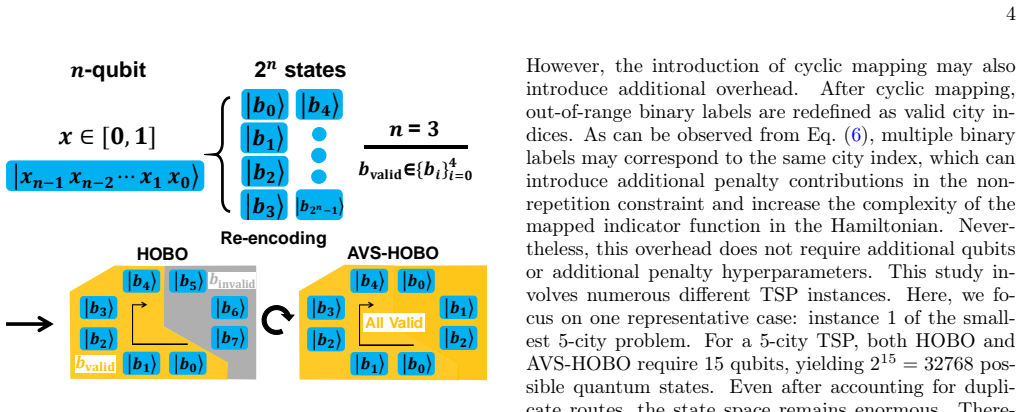
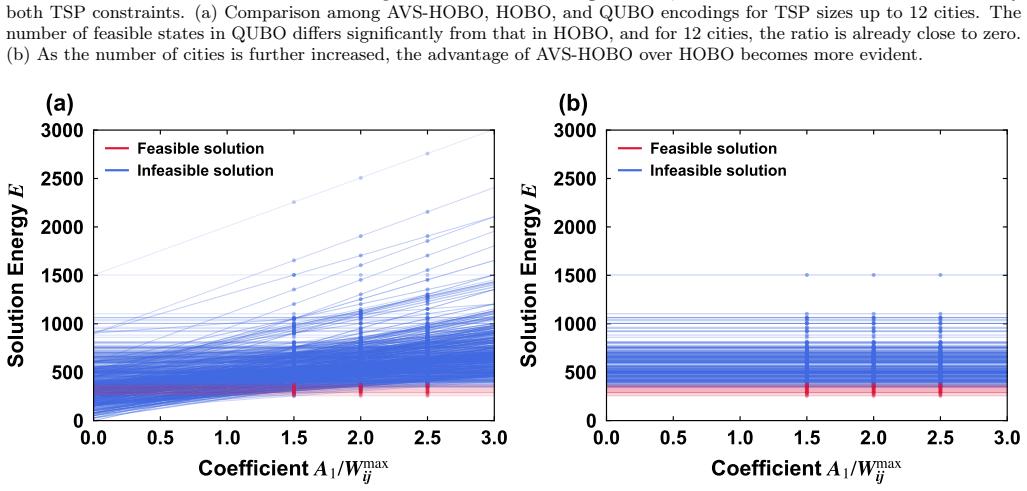
AVS-HOBO encoding eliminates one penalty term in TSP Hamiltonians by cyclic mapping of all binary states to valid tours.
A machine-rendered reading of the paper's core claim, the machinery that carries it, and where it could break.
Core claim
The central claim is that cyclic mapping in the HOBO formulation converts all 2^n binary states into representations of valid tours for TSP, eliminating one penalty term from the Hamiltonian while preserving the relative energies of valid solutions and avoiding new local minima that would impair VQE.
What carries the argument
The AVS-HOBO scheme based on cyclic mapping, which reuses states that would otherwise be invalid to remove a penalty term from the cost Hamiltonian.
If this is right
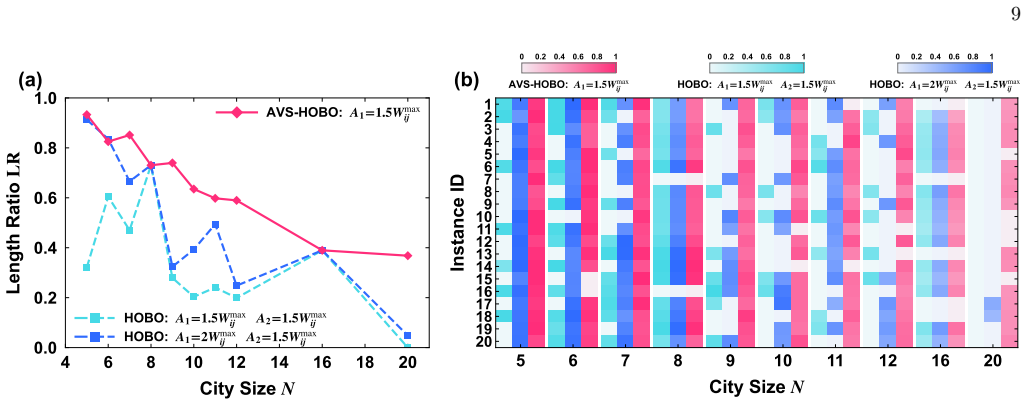
- Higher approximation and tour-length ratios emerge in VQE runs for TSP instances up to 20 cities.
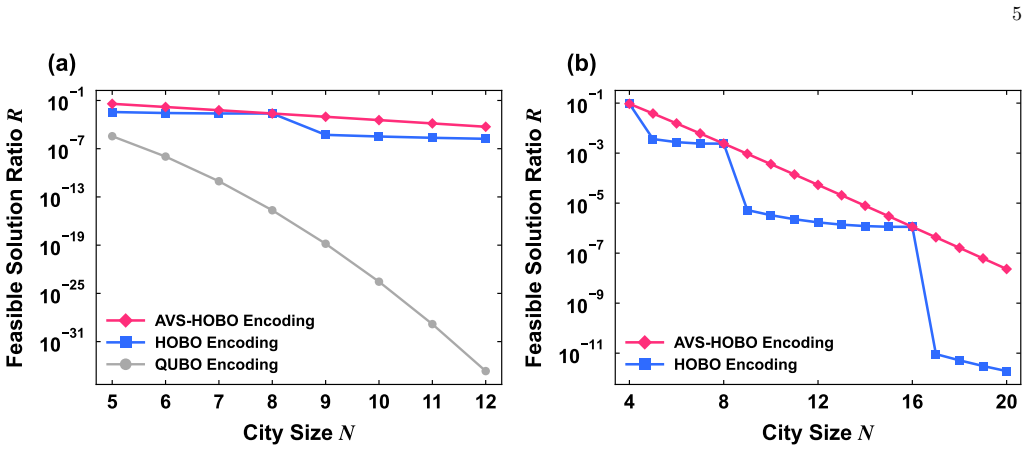
- Feasibility ratios increase because invalid states no longer need explicit penalization.
- Scalability improves for larger constrained optimization instances on NISQ hardware.
- The encoding extends to other problems that impose permutation or ordering constraints in quantum optimization.
Where Pith is reading between the lines
- The same cyclic-mapping trick could reduce qubit overhead in other ordering-constrained problems such as job-shop scheduling.
- Device-specific error profiles observed in the hardware comparisons suggest the method's advantage may be largest on chips with particular two-qubit gate fidelities.
- Combining AVS-HOBO with existing error-mitigation stacks could compound the observed feasibility gains without changing the encoding itself.
Load-bearing premise
Cyclic mapping reuses states without distorting the relative energies of valid tours or creating new local minima that degrade VQE performance.
What would settle it
An experiment on the same NISQ device that finds AVS-HOBO yields equal or lower feasibility ratios and slower energy convergence than standard HOBO for identical TSP instances would falsify the performance claim.
Figures



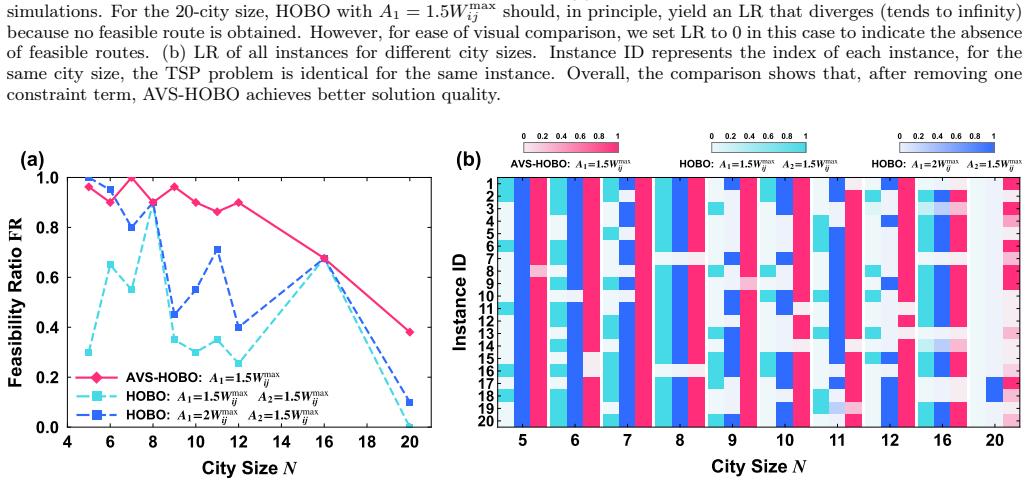


read the original abstract
Continued advancements in quantum computing have stimulated growing interest in translating quantum technologies into real-world applications. Consequently, the investigation of practically motivated NP-hard problems is of significant value. This study investigates the performance of a variational quantum eigensolver (VQE) in addressing the traveling salesperson problem (TSP) through noiseless simulations representative of noisy intermediate-scale quantum (NISQ) devices using higher-order binary optimization (HOBO) encodings. We construct a HOBO Hamiltonian with an efficient binary representation and propose an all-valid-state HOBO (AVS-HOBO) scheme based on cyclic mapping that eliminates one penalty term and reuses states that would otherwise be invalid. Using TSP instances of up to 20 cities, we compare the original HOBO and AVS-HOBO encodings from multiple perspectives, including the energy convergence behavior and the approximation, tour-length, and feasibility ratios. In addition to simulations, we perform computations on real quantum hardware with different device architectures, where we not only compare the performances of different chips but also investigate the effects of different error-mitigation methods on actual quantum machines. The results indicate that AVS-HOBO encoding enhances the practical reliability of VQE on NISQ devices and improves scalability for larger TSP instances, with broader applicability to constrained quantum optimization problems.
Editorial analysis
A structured set of objections, weighed in public.
Referee Report
Summary. The manuscript introduces an all-valid-state HOBO (AVS-HOBO) encoding for the traveling salesperson problem (TSP) that employs a cyclic mapping to reuse states that would otherwise be invalid under standard binary encoding. This construction eliminates one penalty term from the Hamiltonian. The authors compare AVS-HOBO against the original HOBO encoding in VQE simulations (noiseless, up to 20 cities) and on real NISQ hardware, reporting improvements in energy convergence, approximation ratio, tour length, and feasibility ratio, and claim broader applicability to constrained quantum optimization.
Significance. If the cyclic mapping preserves the relative energies among valid tours and does not introduce new local minima, the reduction in penalty terms could improve the practical performance and scalability of VQE for constrained combinatorial problems on NISQ devices. The hardware experiments and direct comparison of encodings provide concrete evidence that would be valuable if the underlying spectral assumption holds.
major comments (3)
- [§3] §3 (Encoding construction): The central claim that the cyclic mapping reuses invalid states without distorting the energy differences among valid tours or creating spurious minima is load-bearing for all reported performance gains. No explicit comparison of the restricted spectrum on valid configurations (before vs. after mapping) or degeneracy analysis is provided; without this, the reported improvements in feasibility ratio and tour length for n=20 instances could be artifacts of the specific penalty coefficients rather than a general property of AVS-HOBO.
- [Results] Results section (simulation and hardware metrics): The abstract and reported comparisons give energy, tour length, and feasibility ratios but supply no error bars, number of independent VQE runs, or statistical tests. This prevents assessment of whether the observed gains are significant or reproducible, directly undermining the claim of enhanced reliability on NISQ devices.
- [Hardware experiments] Hardware experiments: The manuscript states that different error-mitigation methods were tested on real chips, yet provides no quantitative breakdown of how mitigation interacts with the AVS-HOBO Hamiltonian (e.g., whether the eliminated penalty term changes the noise sensitivity). This detail is required to support the claim that AVS-HOBO improves practical reliability.
minor comments (2)
- [Abstract] The phrase 'noiseless simulations representative of NISQ devices' is imprecise; clarify whether any noise model was actually applied or whether the simulations are purely ideal.
- [§3] Notation for the cyclic mapping and the resulting HOBO terms should be introduced with an explicit example for a small TSP instance (e.g., n=4) to make the state reuse concrete.
Simulated Author's Rebuttal
We thank the referee for the constructive comments, which help improve the clarity and rigor of our work. We address each major point below and will revise the manuscript accordingly.
read point-by-point responses
-
Referee: [§3] §3 (Encoding construction): The central claim that the cyclic mapping reuses invalid states without distorting the energy differences among valid tours or creating spurious minima is load-bearing for all reported performance gains. No explicit comparison of the restricted spectrum on valid configurations (before vs. after mapping) or degeneracy analysis is provided; without this, the reported improvements in feasibility ratio and tour length for n=20 instances could be artifacts of the specific penalty coefficients rather than a general property of AVS-HOBO.
Authors: We agree that an explicit spectral comparison strengthens the central claim. The cyclic mapping is constructed to induce a bijection on valid tour configurations while leaving the relative energies among them unchanged (the eliminated penalty applies exclusively to invalid states). In the revised manuscript we will add to §3 a direct side-by-side evaluation of the restricted Hamiltonian on all valid configurations before and after mapping, together with a degeneracy count, to confirm that no new local minima are introduced among valid tours. revision: yes
-
Referee: [Results] Results section (simulation and hardware metrics): The abstract and reported comparisons give energy, tour length, and feasibility ratios but supply no error bars, number of independent VQE runs, or statistical tests. This prevents assessment of whether the observed gains are significant or reproducible, directly undermining the claim of enhanced reliability on NISQ devices.
Authors: We accept that statistical reporting is necessary for reproducibility claims. The revised Results section will state the number of independent VQE runs executed per instance, include error bars (standard deviation across runs) on all plotted metrics, and add paired statistical tests to quantify the significance of observed differences between the two encodings. revision: yes
-
Referee: [Hardware experiments] Hardware experiments: The manuscript states that different error-mitigation methods were tested on real chips, yet provides no quantitative breakdown of how mitigation interacts with the AVS-HOBO Hamiltonian (e.g., whether the eliminated penalty term changes the noise sensitivity). This detail is required to support the claim that AVS-HOBO improves practical reliability.
Authors: We will expand the hardware section with a quantitative comparison. The revision will include tables reporting mitigated versus unmitigated metrics for both encodings on each device, together with an analysis of how the reduced penalty term in AVS-HOBO alters observed noise sensitivity under the tested mitigation strategies. revision: yes
Circularity Check
No significant circularity; AVS-HOBO is a direct construction with independent empirical validation
full rationale
The paper proposes the AVS-HOBO encoding as an explicit construction using cyclic mapping to eliminate one penalty term and reuse otherwise-invalid states in the TSP Hamiltonian. Performance gains are shown via direct comparison of energy convergence, approximation ratios, tour lengths, and feasibility ratios in simulations up to n=20 and on real hardware, without any reduction of results to fitted parameters, self-definitional equivalences, or load-bearing self-citations. The derivation chain consists of a new ansatz plus external benchmarking, making the central claims self-contained rather than circular by construction.
Axiom & Free-Parameter Ledger
axioms (1)
- domain assumption VQE can locate low-energy states of the HOBO Hamiltonian that correspond to good TSP tours under the chosen encoding.
Reference graph
Works this paper leans on
-
[1]
Cerezo, A
M. Cerezo, A. Arrasmith, R. Babbush, S. C. Benjamin, S. Endo, K. Fujii, J. R. McClean, K. Mitarai, X. Yuan, L. Cincio,et al., Nature Reviews Physics3, 625 (2021)
2021
-
[2]
Preskill, Quantum2, 79 (2018)
J. Preskill, Quantum2, 79 (2018)
2018
-
[3]
Bharti, A
K. Bharti, A. Cervera-Lierta, T. H. Kyaw, T. Haug, S. Alperin-Lea, A. Anand, M. Degroote, H. Heimonen, J. S. Kottmann, T. Menke,et al., Reviews of Modern Physics94, 015004 (2022)
2022
-
[4]
N. Moll, P. Barkoutsos, L. S. Bishop, J. M. Chow, A. Cross, D. J. Egger, S. Filipp, A. Fuhrer, J. M. Gam- betta, M. Ganzhorn,et al., Quantum Science and Tech- nology3, 030503 (2018)
2018
-
[5]
D. F. Perez-Ramirez, arXiv preprint arXiv , :2407.06421 (2024)
arXiv 2024
-
[6]
Nannicini, Physical Review E99, 013304 (2019)
G. Nannicini, Physical Review E99, 013304 (2019)
2019
-
[7]
Glover, G
F. Glover, G. Kochenberger, R. Hennig, and Y. Du, An- nals of Operations Research314, 141 (2022)
2022
-
[8]
Lucas, Frontiers in physics2, 74887 (2014)
A. Lucas, Frontiers in physics2, 74887 (2014)
2014
-
[9]
Salehi, A
Ö. Salehi, A. Glos, and J. A. Miszczak, Quantum Infor- mation Processing21, 67 (2022)
2022
-
[10]
Palackal, B
L. Palackal, B. Poggel, M. Wulff, H. Ehm, J. M. Lorenz, and C. B. Mendl, Proceedings of the 2023 IEEE Inter- national Conference on Quantum Computing and Engi- neering (QCE) , 648 (2023)
2023
-
[11]
Domino, A
K. Domino, A. Kundu, Ö. Salehi, and K. Krawiec, Quan- tum Information Processing21, 337 (2022)
2022
-
[12]
Y. Chai, L. Funcke, T. Hartung, K. Jansen, S. Kühn, P. Stornati, and T. Stollenwerk, Physical review applied 20, 064025 (2023)
2023
-
[13]
A. Glos, A. Krawiec, and Z. Zimborás, npj Quantum In- formation8, 39 (2022)
2022
-
[14]
Schnaus, L
M. Schnaus, L. Palackal, B. Poggel, X. Runge, H. Ehm, J. M. Lorenz, and C. B. Mendl, Proceedings of the 2024 IEEE International Conference on Quantum Software (QSW) , 81 (2024)
2024
-
[15]
E. Farhi, J. Goldstone, and S. Gutmann, arXiv preprint arXiv , :1411.4028 (2014)
Pith/arXiv arXiv 2014
-
[16]
E. Farhi, J. Goldstone, S. Gutmann, and H. Neven, arXiv preprint arXiv , :1703.06199 (2017)
Pith/arXiv arXiv 2017
-
[17]
W. Qian, R. A. Basili, M. M. Eshaghian-Wilner, A. Khokhar, G. Luecke, and J. P. Vary, Entropy25, 1238 (2023)
2023
-
[18]
Peruzzo, J
A. Peruzzo, J. McClean, P. Shadbolt, M.-H. Yung, X.-Q. Zhou, P. J. Love, A. Aspuru-Guzik, and J. L. O’brien, Nature communications5, 4213 (2014)
2014
-
[19]
Tilly, H
J. Tilly, H. Chen, S. Cao, D. Picozzi, K. Setia, Y. Li, E. Grant, L. Wossnig, I. Rungger, G. H. Booth,et al., Physics Reports986, 1 (2022)
2022
-
[20]
J. R. McClean, J. Romero, R. Babbush, and A. Aspuru- Guzik, New Journal of Physics18, 023023 (2016)
2016
-
[21]
Tsukayama, J.-i
D. Tsukayama, J.-i. Shirakashi, T. Shibuya, and H. Imai, AIP Advances15(2025)
2025
- [22]
-
[23]
K. M. Nakanishi, K. Fujii, and S. Todo, Physical Review Research2, 043158 (2020)
2020
-
[24]
D. P. Kingma and J. Ba, arXiv preprint arXiv , :1412.6980 (2014)
Pith/arXiv arXiv 2014
-
[25]
Tsukayama, J.-i
D. Tsukayama, J.-i. Shirakashi, and H. Imai, Japanese Journal of Applied Physics62, 088003 (2023)
2023
-
[26]
A. Javadi-Abhari, M. Treinish, K. Krsulich, C. J. Wood, J. Lishman, J. Gacon, S. Martiel, P. D. Nation, L. S. Bishop, A. W. Cross,et al., arXiv preprint arXiv , :2405.08810 (2024)
Pith/arXiv arXiv 2024
-
[27]
IBM, Ibm quantum platform (2026),https: //quantum-computing.ibm.com/
2026
-
[28]
Matsuo, Y
A. Matsuo, Y. Suzuki, I. Hamamura, and S. Yamashita, IEICE TRANSACTIONS on Information and Systems 106, 1772 (2023)
2023
-
[29]
IBM Corporation, Ibm ilog cplex optimiza- tion studio user’s manual for cplex (2026), https://www.ibm.com/docs/en/icos/22.1.1?topic= optimizers-users-manual-cplex
2026
-
[30]
S. V. Barron, D. J. Egger, E. Pelofske, A. Bärtschi, S. Ei- denbenz, M. Lehmkuehler, and S. Woerner, Nature Com- putational Science4, 865 (2024)
2024
-
[31]
T. A. Chowdhury, K. Yu, M. A. Shamim, M. Kabir, and R. S. Sufian, Physical Review Research6, 033107 (2024)
2024
-
[32]
T. Lubinski, J. J. Goings, K. Mayer, S. Johri, N. Reddy, A. Mehta, N. Bhatia, S. Rappaport, D. Mills, C. H. Bald- win,et al., arXiv preprint arXiv , :2402.08985 (2024)
arXiv 2024
-
[33]
Ezzell, B
N. Ezzell, B. Pokharel, L. Tewala, G. Quiroz, and D. A. Lidar, Physical Review Applied20, 064027 (2023)
2023
-
[34]
B. Yang, R. Raymond, and S. Uno, Physical Review A 106, 012423 (2022)
2022
-
[35]
Kanezashi, D
T. Kanezashi, D. Tsukayama, J.-i. Shirakashi, T. Shibuya, and H. Imai, Applied Physics Express 18, 047001 (2025)
2025
-
[36]
P. K. Barkoutsos, G. Nannicini, A. Robert, I. Tavernelli, and S. Woerner, Quantum4, 256 (2020)
2020
-
[37]
R. Sato, C. Gordon, K. Saito, H. Kawashima, T. Nikuni, and S. Watabe, IEEE Transactions on Quantum Engi- neering (2025)
2025
-
[38]
L. Liu, L. Qian, X.-Y. Wu, C.-R. Fan, L.-F. Zhang, D.-B. Cai, H.-J. Lu, T.-J. Wang, and C. Wang, IEEE Transac- tions on Intelligent Transportation Systems (2025)
2025
-
[39]
Y. Sano, K. Mitarai, N. Yamamoto, and N. Ishikawa, IEEE Transactions on Quantum Engineering5, 1 (2024)
2024
-
[40]
Gilliam, S
A. Gilliam, S. Woerner, and C. Gonciulea, Quantum5, 428 (2021)
2021
discussion (0)
Sign in with ORCID, Apple, or X to comment. Anyone can read and Pith papers without signing in.