Reliable ORIS-assisted FSO Communications via HARQ
Pith reviewed 2026-06-26 15:45 UTC · model grok-4.3
The pith
A tractable reflected-channel model yields closed-form outage expressions for HARQ in ORIS-assisted FSO links.
A machine-rendered reading of the paper's core claim, the machinery that carries it, and where it could break.
Core claim
The joint statistical model of the Tx-ORIS-Rx reflected channel permits closed-form outage probability expressions for HARQ with Chase combining and analytical upper bounds for HARQ with incremental redundancy that remain valid for an arbitrary maximum number of transmission rounds; the same model supplies the diversity order at high SNR and the mean number of rounds needed for successful decoding.
What carries the argument
The tractable statistical model for the Tx-ORIS-Rx reflected channel that jointly accounts for atmospheric turbulence, ORIS-induced pointing errors, and geometric attenuation.
If this is right
- HARQ with Chase combining admits exact closed-form outage probability for any finite number of rounds.
- HARQ with incremental redundancy admits analytical outage upper bounds valid for arbitrary round limits.
- Both protocols exhibit explicit diversity orders obtained from the high-SNR expansion of the outage expressions.
- The mean number of transmission rounds and the conditional mean given success fully characterize the delay of the truncated HARQ process.
- Incremental-redundancy HARQ yields lower outage and lower average delay than Chase-combining HARQ even with few retransmissions.
Where Pith is reading between the lines
- The same channel model could be reused to obtain outage expressions for other combining or coding schemes without re-deriving the underlying distribution.
- Designers could choose the number of allowed retransmissions by balancing the closed-form outage target against the derived mean-round expressions.
- The framework supplies a benchmark against which measured outage data from real ORIS deployments could be compared.
- Similar statistical reductions might be attempted for visible-light or infrared surface-assisted links that share the same impairment types.
Load-bearing premise
The reflected channel admits a single tractable distribution that still incorporates turbulence, pointing errors, and loss in a form allowing closed-form outage derivations.
What would settle it
Monte Carlo simulations of the same channel parameters that produce outage curves visibly different from the derived closed-form expressions or upper bounds.
Figures



read the original abstract
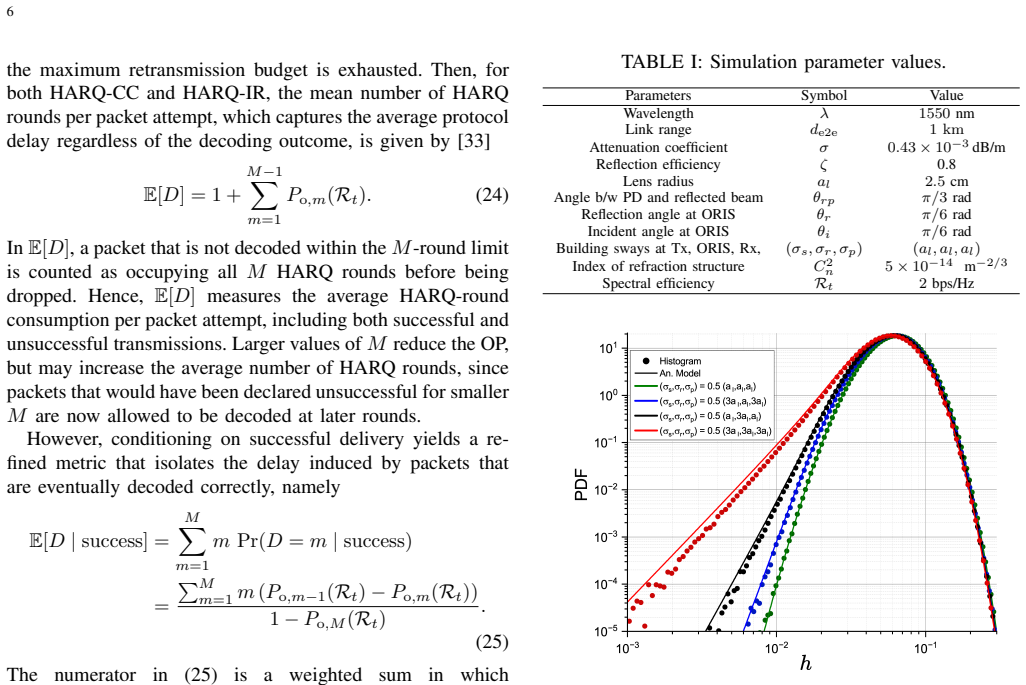
This paper studies a free-space optical (FSO) link assisted by an optical reconfigurable intelligent surface (ORIS) and enhanced by a hybrid automatic repeat request (HARQ) scheme. The ORIS creates a virtual line-of-sight path around obstacles, while HARQ recovers frames corrupted by turbulence, pointing jitter, and geometric loss through retransmission and combining. We first derive a tractable statistical model for the end-to-end transmitter-ORIS-receiver (Tx-ORIS-Rx) reflected channel by jointly accounting for atmospheric turbulence, ORIS-induced pointing errors, and geometric attenuation. Building on these results, we obtain closed-form outage probability (OP) expressions for HARQ with Chase combining (HARQ-CC) and analytical outage upper bounds for HARQ with incremental redundancy (HARQ-IR), valid for an arbitrary maximum number of transmission rounds. We further conduct a high signal-to-noise ratio (SNR) analysis that provides a thorough characterization of the outage behavior and reveals the diversity order of both schemes. In addition, we characterize the delay behavior of the truncated HARQ process through the mean number of transmission rounds and the conditional mean number of rounds given successful decoding. Finally, numerical and Monte Carlo results validate the proposed analysis and show that HARQ substantially improves ORIS-assisted FSO reliability, with HARQ-IR achieving lower outage and delay than HARQ-CC, even for a small number of retransmission rounds.
Editorial analysis
A structured set of objections, weighed in public.
Referee Report
Summary. The paper develops a tractable statistical model for the end-to-end Tx-ORIS-Rx channel in an FSO system that jointly incorporates atmospheric turbulence, ORIS-induced pointing errors, and geometric attenuation. Building on this model, it derives closed-form outage probability expressions for HARQ with Chase combining (HARQ-CC) and analytical upper bounds for HARQ with incremental redundancy (HARQ-IR) that hold for an arbitrary number of transmission rounds, performs high-SNR diversity-order analysis, characterizes delay via mean transmission rounds, and validates the results through numerical evaluation and Monte Carlo simulations demonstrating substantial reliability gains from HARQ.
Significance. If the claimed closed-form expressions and diversity orders are rigorously obtained without unstated approximations, the work would supply useful analytical tools for evaluating and optimizing reliability in ORIS-assisted FSO links under realistic impairments, potentially informing the design of retransmission protocols for high-reliability optical wireless systems.
major comments (2)
- [HARQ-CC outage probability derivation] The central claim of closed-form OP expressions for HARQ-CC (abstract and the HARQ-CC analysis section) rests on obtaining the CDF of the sum of per-round SNRs under the joint turbulence+pointing+geometric model. While a single-link gain may admit a Meijer-G or Fox-H representation, the distribution of the sum across an arbitrary number of rounds generally does not; the manuscript must explicitly show in the relevant derivation how the sum remains in closed form (or state any moment-matching/bounding step used) rather than implicitly assuming tractability.
- [High-SNR analysis] The high-SNR diversity-order results (high-SNR analysis section) are load-bearing for the reliability claims. The diversity order for HARQ-CC should be derived directly from the asymptotic behavior of the sum CDF; any mismatch between the stated diversity order and the actual asymptotic slope of the derived OP expression would undermine the comparison between HARQ-CC and HARQ-IR.
minor comments (2)
- [Channel model section] Notation for the joint channel PDF/CDF should be introduced with explicit dependence on the turbulence, pointing, and geometric parameters to improve readability when the expressions are later summed over rounds.
- [Numerical results] Figure captions for the Monte Carlo validation plots should state the number of realizations used and the exact parameter values (e.g., turbulence strength, pointing jitter variance) rather than referring only to 'typical' values.
Simulated Author's Rebuttal
We thank the referee for the constructive feedback and positive assessment of the manuscript's contributions. We address each major comment below with point-by-point responses and indicate planned revisions for clarity.
read point-by-point responses
-
Referee: [HARQ-CC outage probability derivation] The central claim of closed-form OP expressions for HARQ-CC (abstract and the HARQ-CC analysis section) rests on obtaining the CDF of the sum of per-round SNRs under the joint turbulence+pointing+geometric model. While a single-link gain may admit a Meijer-G or Fox-H representation, the distribution of the sum across an arbitrary number of rounds generally does not; the manuscript must explicitly show in the relevant derivation how the sum remains in closed form (or state any moment-matching/bounding step used) rather than implicitly assuming tractability.
Authors: We thank the referee for highlighting the need for explicit steps. The end-to-end Tx-ORIS-Rx channel is modeled as a product of Gamma-Gamma turbulence, pointing errors, and geometric loss, yielding a Meijer-G PDF/CDF for each round's SNR. For HARQ-CC with i.i.d. rounds, the CDF of the summed SNR is derived via successive convolution; the Meijer-G class is closed under this operation for the specific parameters arising from the joint impairment model, resulting in a single Meijer-G expression for the combined CDF (and thus the OP). No moment-matching or bounding is employed. We will insert the full intermediate convolution steps and the resulting expression in the revised HARQ-CC section to remove any implicit assumptions. revision: partial
-
Referee: [High-SNR analysis] The high-SNR diversity-order results (high-SNR analysis section) are load-bearing for the reliability claims. The diversity order for HARQ-CC should be derived directly from the asymptotic behavior of the sum CDF; any mismatch between the stated diversity order and the actual asymptotic slope of the derived OP expression would undermine the comparison between HARQ-CC and HARQ-IR.
Authors: We agree that the diversity order must follow directly from the asymptotic expansion of the sum CDF. In the high-SNR section we start from the small-argument expansion of the single-link Meijer-G CDF (which behaves as γ^δ where δ is the diversity order of the joint channel) and then apply the property that the CDF of the sum of L i.i.d. positive random variables scales as the L-fold product of the individual small-argument terms, yielding diversity order Lδ for HARQ-CC. This is consistent with the closed-form OP expression's high-SNR slope. We will expand the derivation with the explicit asymptotic steps and confirm numerical agreement with the OP curves in the revision. revision: partial
Circularity Check
No significant circularity detected
full rationale
The provided abstract and context describe a standard derivation sequence: first obtain a tractable joint statistical model for the Tx-ORIS-Rx channel (turbulence + pointing + geometric loss), then derive closed-form OP expressions and bounds for HARQ-CC/IR from that model. No equations, self-citations, or parameter-fitting steps are quoted that reduce the claimed results to their inputs by construction. The derivation chain is presented as independent mathematical work; the reader's preliminary score of 2 reflects only the absence of full equations rather than any exhibited circular reduction. This is the expected non-finding for a paper whose central steps are explicit derivations rather than re-labeling or self-referential fitting.
Axiom & Free-Parameter Ledger
axioms (1)
- domain assumption Atmospheric turbulence, ORIS-induced pointing errors, and geometric attenuation admit a joint statistical model that is tractable for closed-form outage analysis.
Reference graph
Works this paper leans on
-
[1]
Survey on free space optical communi- cation: A communication theory perspective,
M. A. Khalighi and M. Uysal, “Survey on free space optical communi- cation: A communication theory perspective,”IEEE Commun. Surveys Tuts., vol. 16, no. 4, pp. 2231–2258, 4th Quart. 2014
2014
-
[2]
A survey of free space optics (FSO) communication systems, links, and networks,
S. A. Al-Gailani, M. F. Mohd Salleh, A. A. Salem, R. Q. Shaddad, U. U. Sheikh, N. A. Algeelani, and T. A. Almohamad, “A survey of free space optics (FSO) communication systems, links, and networks,” IEEE Access, vol. 9, pp. 7353–7373, Dec. 2020
2020
-
[3]
Optical wireless communications: Enabling the next-generation network of networks,
A. Krishnamoorthyet al., “Optical wireless communications: Enabling the next-generation network of networks,”IEEE Veh. Technol. Mag., vol. 20, no. 2, pp. 20–39, Jun. 2025
2025
-
[4]
The road towards 6G: A comprehensive survey,
W. Jiang, B. Han, M. A. Habibi, and H. D. Schotten, “The road towards 6G: A comprehensive survey,”IEEE Open J. Commun. Soc., vol. 2, pp. 334–366, Feb. 2021
2021
-
[5]
Optically reconfigurable metasurfaces and photonic devices based on phase change materials,
Q. Wang, E. Rogers, B. Gholipour, C.-M. Wang, G. Yuan, J. Teng, and N. Zheludev, “Optically reconfigurable metasurfaces and photonic devices based on phase change materials,”Nature Photonics, vol. 10, 12 2015
2015
-
[6]
Me- chanically reconfigurable metasurfaces: fabrications and applications,
Y . Zhao, Z. Liu, C. Li, W. Jiao, S. Jiang, X. Li, J. Duan, and J. Li, “Me- chanically reconfigurable metasurfaces: fabrications and applications,” npj Nanophotonics, vol. 1, 06 2024
2024
-
[7]
Intelligent reflecting surface assisted free-space optical commu- nications,
V . Jamali, H. Ajam, M. Najafi, B. Schmauss, R. Schober, and H. V . Poor, “Intelligent reflecting surface assisted free-space optical commu- nications,”IEEE Commun. Mag., vol. 59, no. 10, pp. 57–63, Oct. 2021
2021
-
[8]
Optical reconfigurable intelligent surfaces aided optical wireless communications: Opportuni- ties, challenges, and trends,
H. Wang, Z. Zhang, B. Zhu, J. Dang, and L. Wu, “Optical reconfigurable intelligent surfaces aided optical wireless communications: Opportuni- ties, challenges, and trends,”IEEE Wireless Commun., vol. 30, no. 5, pp. 28–35, Oct. 2023
2023
-
[9]
Roadmap for optical metasurfaces,
A. I. Kuznetsov et al., “Roadmap for optical metasurfaces,”ACS Photonics, vol. 11, no. 3, pp. 816–865, 2024, pMID: 38550347
2024
-
[10]
Optical metasur- faces: Evolving from passive to adaptive,
C. Hail, A.-K. Michel, D. Poulikakos, and H. Eghlidi, “Optical metasur- faces: Evolving from passive to adaptive,”Advanced Optical Materials, vol. 7, 05 2019
2019
-
[11]
Electrically tunable optical metasurfaces,
F. Ding, C. Meng, and S. I. Bozhevolnyi, “Electrically tunable optical metasurfaces,”Photonics Insights, vol. 3, no. 3, p. R07, 2024. [Online]. Available: https://doi.org/10.3788/PI.2024.R07
-
[12]
Metasurface-based free-space multi-port beam splitter with arbitrary power ratio,
T. Tian, Y . Liao, X. Feng, K. Cui, F. Liu, W. Zhang, and Y . Huang, “Metasurface-based free-space multi-port beam splitter with arbitrary power ratio,”Advanced Optical Materials, vol. 11, no. 20, p. 2300664,
-
[13]
Available: https://advanced.onlinelibrary.wiley.com/doi/ abs/10.1002/adom.202300664
[Online]. Available: https://advanced.onlinelibrary.wiley.com/doi/ abs/10.1002/adom.202300664
-
[14]
Free-space optical communication with reconfigurable intelligent surfaces,
L. Yang, W. Guo, D. B. da Costa, and M. Alouini, “Free-space optical communication with reconfigurable intelligent surfaces,” 2020. [Online]. Available: https://arxiv.org/abs/2012.00547
-
[15]
Unified performance analysis of reconfigurable intelligent surface empowered free-space optical commu- nications,
V . K. Chapala and S. M. Zafaruddin, “Unified performance analysis of reconfigurable intelligent surface empowered free-space optical commu- nications,”IEEE Trans. Commun., vol. 70, no. 4, pp. 2575–2592, 2022
2022
-
[16]
Analysis of RIS-based terrestrial-FSO link over G-G turbulence with distance and jitter ratios,
A. R. Ndjiongue, T. M. N. Ngatched, O. A. Dobre, A. G. Armada, and H. Haas, “Analysis of RIS-based terrestrial-FSO link over G-G turbulence with distance and jitter ratios,”J. Lightw. Tech., vol. 39, no. 21, pp. 6746–6758, Nov. 2021
2021
-
[17]
Performance analysis of IRS-assisted multi-link FSO system under pointing errors,
T. Ishida, C. B. Naila, H. Okada, and M. Katayama, “Performance analysis of IRS-assisted multi-link FSO system under pointing errors,” IEEE Photonics J., vol. 16, no. 4, pp. 1–10, Aug. 2024
2024
-
[18]
Cascaded composite turbulence and misalignment: Statistical characterization and applications to reconfig- urable intelligent surface-empowered wireless systems,
A.-A. A. Boulogeorgos, N. D. Chatzidiamantis, H. G. Sandalidis, A. Alexiou, and M. D. Renzo, “Cascaded composite turbulence and misalignment: Statistical characterization and applications to reconfig- urable intelligent surface-empowered wireless systems,”IEEE Trans. Veh. Technol., vol. 71, no. 4, pp. 3821–3836, Apr. 2022
2022
-
[19]
Intelligent reflecting surfaces for free space optical communication systems,
M. Najafi, B. Schmauss, and R. Schober, “Intelligent reflecting surfaces for free space optical communication systems,”IEEE Trans. Commun., vol. 69, no. 9, pp. 6134–6151, Sep. 2021
2021
-
[20]
Outage-guaranteed transmission for IRS-assisted FSO systems,
B. Chen and X. Zhu, “Outage-guaranteed transmission for IRS-assisted FSO systems,”Opt. Express, vol. 32, no. 14, pp. 25 420–25 434, Jul. 2024
2024
-
[21]
Optical ris-enabled multiple access communications,
G. D. Chondrogiannis, A. P. Chrysologou, A.-A. A. Boulogeorgos, N. D. Chatzidiamantis, and H. Haas, “Optical ris-enabled multiple access communications,”IEEE Transactions on Green Communications and Networking, vol. 10, pp. 1068–1080, 2026
2026
-
[22]
On the performance analysis of hybrid ARQ with incremental redundancy and with code combining over free-space optical channels with pointing errors,
E. Zedini, A. Chelli, and M.-S. Alouini, “On the performance analysis of hybrid ARQ with incremental redundancy and with code combining over free-space optical channels with pointing errors,”IEEE Photonics Journal, vol. 6, no. 4, pp. 1–18, 2014
2014
-
[23]
HARQ performance over FSO channels with atmospheric fading and pointing errors,
A. Touati, M. O. Hasna, and F. Touati, “HARQ performance over FSO channels with atmospheric fading and pointing errors,” in2018 14th In- ternational Wireless Communications & Mobile Computing Conference (IWCMC), 2018, pp. 158–163
2018
-
[24]
Power-optimal HARQ protocol for reliable free space optical communication,
G. D. Chondrogiannis, N. A. Mitsiou, N. D. Chatzidiamantis, A.- A. A. Boulogeorgos, and G. K. Karagiannidis, “Power-optimal HARQ protocol for reliable free space optical communication,” in2023 IEEE International Conference on Communications Workshops (ICC Work- shops), 2023, pp. 1765–1770
2023
-
[25]
Toward practical HARQ-based RC-LDPC design for optical satellite-assisted vehicular networks,
C. T. Nguyen, H. D. Le, C. T. Nguyen, and A. T. Pham, “Toward practical HARQ-based RC-LDPC design for optical satellite-assisted vehicular networks,”IEEE Transactions on Aerospace and Electronic Systems, vol. 60, no. 6, pp. 8619–8634, 2024
2024
-
[26]
Cooperative HARQ-aided multiple UA Vs in optical aerospace backhaul networks,
K. D. Dang, H. D. Le, C. T. Nguyen, and A. T. Pham, “Cooperative HARQ-aided multiple UA Vs in optical aerospace backhaul networks,” IEEE Access, vol. 11, pp. 138 247–138 260, 2023
2023
-
[27]
I. S. Gradshteyn and I. M. Ryzhik,Table of integrals, series, and products. Academic press, 2014
2014
-
[28]
Mathai, R
A. Mathai, R. Saxena, and H. Haubold,The H-function: Theory and Applications, 01 2009
2009
-
[29]
Outage capacity optimization for free- space optical links with pointing errors,
A. A. Farid and S. Hranilovic, “Outage capacity optimization for free- space optical links with pointing errors,”J. Lightw. Technol., vol. 25, no. 7, pp. 1702–1710, Jul. 2007
2007
-
[30]
Fog attenuation prediction for optical and infrared waves,
M. C. A. Naboulsi, H. Sizun, and F. de Fornel, “Fog attenuation prediction for optical and infrared waves,”Opt. Eng., vol. 43, no. 2, pp. 319 – 329, Feb. 2004
2004
-
[31]
Intelligent reflecting surfaces for free space optical communications,
M. Najafi and R. Schober, “Intelligent reflecting surfaces for free space optical communications,” inProc. IEEE Global Commun. Conf. (GLOBECOM), Waikoloa, HI, USA, Dec. 2019, pp. 1–7
2019
-
[32]
The algorithm for calculating integrals of hypergeometric type functions and its realization in reduce system,
V . S. Adamchik and O. I. Marichev, “The algorithm for calculating integrals of hypergeometric type functions and its realization in reduce system,” inProc. Int. Symp. Symbolic Algebr. Comput. (ISSAC), New York, NY , USA, 1990, p. 212–224
1990
-
[33]
Non-orthogonal multiple access for FSO backhauling,
M. Najafi, V . Jamali, P. D. Diamantoulakis, G. K. Karagiannidis, and R. Schober, “Non-orthogonal multiple access for FSO backhauling,” in Proc. IEEE Wireless Commun. Netw. Conf. (WCNC), Barcelona, Spain, Apr. 2018, pp. 1–6
2018
-
[34]
Throughput and delay analysis of HARQ with code combining over double rayleigh fading channels,
A. Chelli, E. Zedini, M.-S. Alouini, M. P ¨atzold, and I. Balasingham, “Throughput and delay analysis of HARQ with code combining over double rayleigh fading channels,”IEEE Transactions on Vehicular Technology, vol. 67, no. 5, pp. 4233–4247, 2018
2018
-
[35]
An integral of Fox’s H-Functions with application to the performance of hybrid FSO/RF systems over generalized fading channels,
W. Ameen Alathwary and E. S. Altubaishi, “An integral of Fox’s H-Functions with application to the performance of hybrid FSO/RF systems over generalized fading channels,”IEEE Open J. Commun. Soc., vol. 6, pp. 1030–1041, 2025
2025
-
[36]
The kolmogorov-smirnov test for goodness of fit,
F. J. Massey, “The kolmogorov-smirnov test for goodness of fit,”Journal of the American Statistical Association, vol. 46, no. 253, pp. 68–78, 1951
1951
-
[37]
Luke,The Special Functions and Their Approximations, ser
Y . Luke,The Special Functions and Their Approximations, ser. Mathe- matics in Science and Engineering. Academic Press, 1969
1969
-
[38]
The Mathematical Functions Site
A. Kilbas and M. Saigo,H-transforms: Theory and applications, 2004. [38]“The Mathematical Functions Site. ”, 2022. [Online]. Available: https://functions.wolfram.com/
2004
discussion (0)
Sign in with ORCID, Apple, or X to comment. Anyone can read and Pith papers without signing in.