Smooth time-dependent control of dipolar Bose-Einstein condensates
Pith reviewed 2026-06-26 14:50 UTC · model grok-4.3
The pith
Time-dependent scattering length protocols prepare supersolid states in dipolar BECs with high fidelity.
A machine-rendered reading of the paper's core claim, the machinery that carries it, and where it could break.
Core claim
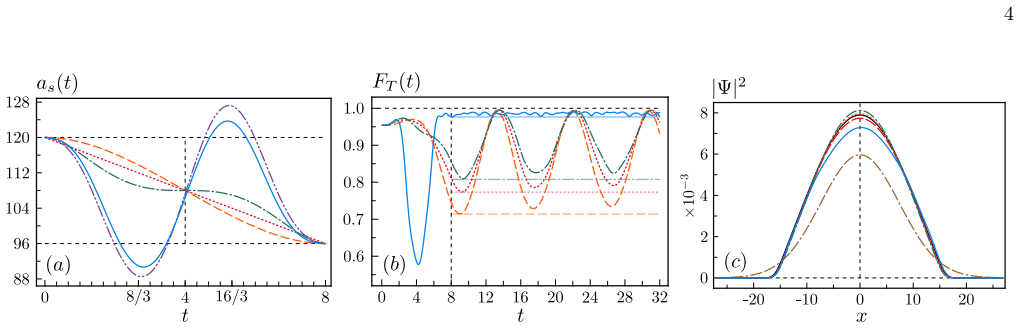
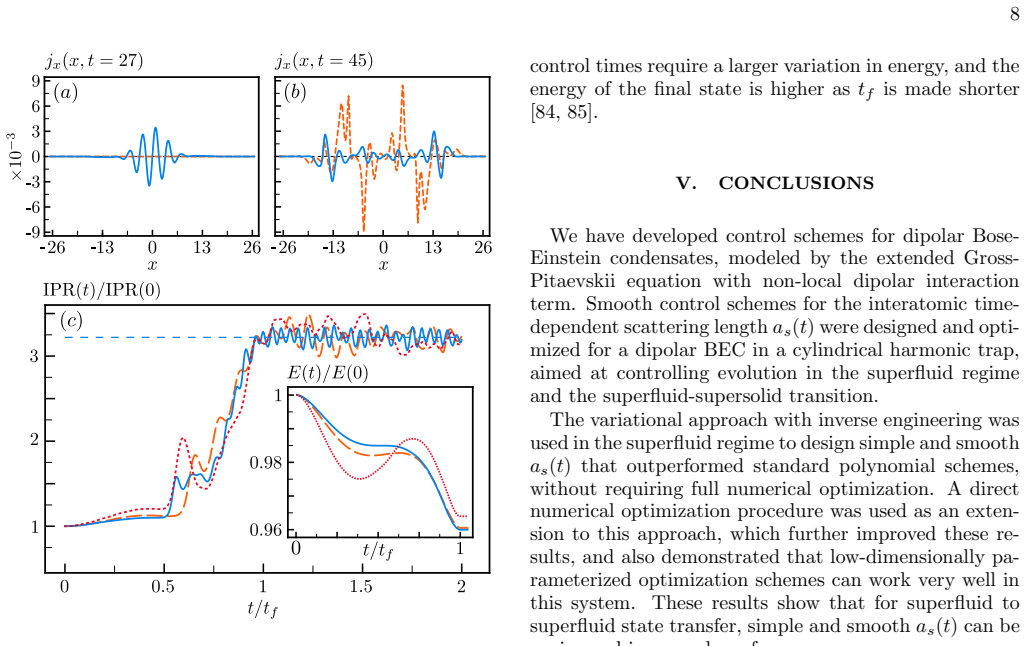
By designing the time dependence of the scattering length, either through variational equations on a separable ansatz or through direct optimization, the system can be driven from the uniform superfluid phase to the modulated supersolid phase while keeping excitations low, thereby achieving high overlap with the target ground state in finite time.
What carries the argument
Time-dependent scattering length, tuned via variational Euler-Lagrange dynamics or direct optimization to follow the ground-state manifold.
If this is right
- The supersolid phase becomes reachable on laboratory timescales without populating excited modes.
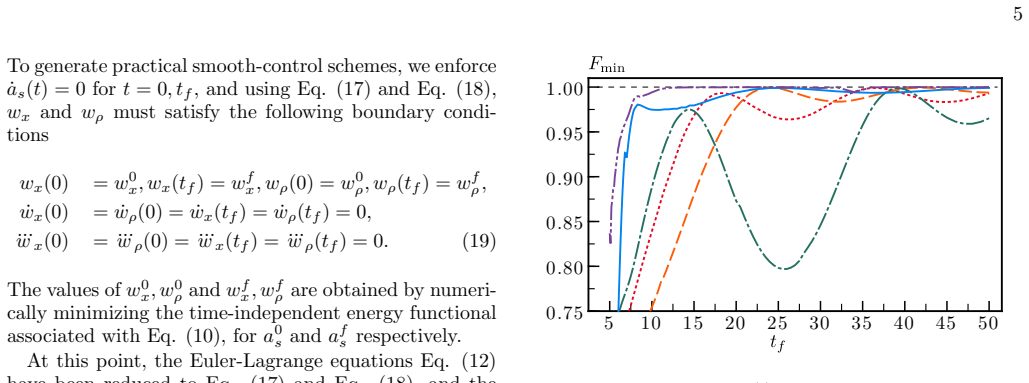
- Fidelity remains high when the scattering length is varied according to the derived protocols rather than changed suddenly.
- The same control parameter (scattering length) suffices to steer the transition because it directly influences the relative strength of contact and dipolar interactions.
- Both the variational and optimization routes yield usable time-dependent schedules that can be implemented with existing Feshbach resonance techniques.
Where Pith is reading between the lines
- Similar control strategies could be tested in other systems where a tunable interaction drives a density-modulated phase.
- The protocols might be combined with trap-shape adjustments to stabilize supersolids in different geometries.
- If the ansatz holds, the method supplies an experimentally accessible route to study supersolid dynamics without the need for infinite-time adiabatic ramps.
Load-bearing premise
The chosen ansatz or optimization procedure captures the essential many-body dynamics and prevents significant excitations from appearing during the finite-time ramp.
What would settle it
A many-body simulation or experiment that measures large density modulations away from the target supersolid pattern or reports low final-state fidelity after the designed ramp would falsify the claim of high-fidelity preparation.
Figures




read the original abstract
We consider protocols for control of dipolar Bose-Einstein condensates where the critical role is played by the long-range anisotropic interatomic magnetic dipole-dipole interaction. The phase diagram of such a condensate has been explored theoretically and experimentally with certain values of the interatomic scattering length corresponding to superfluid and supersolid phases, where supersolidity appears as a modulation in the ground state density. Preparation of this modulated ground state is challenging, since excitations appear as a result of a finite-time evolution required to produce qualitative changes in the wavefunction density. To solve this problem we consider the time-dependent control of a dipolar Bose-Einstein condensate using shortcuts to adiabaticity techniques, concentrating on design of the time-dependent scattering length, a parameter of the system easily tunable by contemporary experiments. The first technique is the variational approach based on the Euler-Lagrange equations for a separable ansatz describing the evolution of the superfluid state. Secondly, we study the transition from superfluid to supersolid using a direct optimization protocol. We discuss the fidelity of the developed protocols in terms of the evolution time.
Editorial analysis
A structured set of objections, weighed in public.
Referee Report
Summary. The manuscript proposes two protocols for preparing the modulated supersolid ground state of a dipolar BEC by designing a time-dependent scattering length a(t): a variational method based on Euler-Lagrange equations for a separable ansatz, and a direct optimization protocol. Fidelity of the resulting ramps is quantified as a function of total evolution time, with the goal of suppressing excitations that arise during finite-time transitions between superfluid and supersolid phases.
Significance. If the protocols remain high-fidelity when applied outside the reduced model, the work would supply experimentally accessible shortcuts-to-adiabaticity routes for preparing supersolid states in dipolar gases, where the scattering length is already a tunable experimental knob. The emphasis on smooth, finite-time control addresses a practical bottleneck in the field.
major comments (2)
- [Abstract] Abstract and methods: fidelity is reported only inside the variational/separable manifold or the optimization landscape; the central claim that the designed a(t) suppresses excitations in the full system therefore lacks an independent check against the unreduced 3D Gross-Pitaevskii equation or many-body dynamics once translational symmetry breaking and roton modes are treated without the separability constraint.
- [Variational approach] Variational section: the separable ansatz is stated to describe the superfluid-to-supersolid transition, yet the Euler-Lagrange evolution under this ansatz is not shown to remain accurate once the density modulation breaks translational invariance; an explicit test of the ansatz error against the full GPE would be required to support the fidelity numbers.
minor comments (2)
- Notation for the time-dependent scattering length a(t) should be introduced with an explicit functional form or parametrization in the first methods paragraph.
- [Abstract] The abstract mentions 'shortcuts to adiabaticity techniques' but does not cite the specific STA literature used; a short reference list entry would clarify the connection.
Simulated Author's Rebuttal
We thank the referee for the careful reading and constructive comments on our manuscript. We address the major comments point by point below.
read point-by-point responses
-
Referee: [Abstract] Abstract and methods: fidelity is reported only inside the variational/separable manifold or the optimization landscape; the central claim that the designed a(t) suppresses excitations in the full system therefore lacks an independent check against the unreduced 3D Gross-Pitaevskii equation or many-body dynamics once translational symmetry breaking and roton modes are treated without the separability constraint.
Authors: Our protocols and fidelity quantifications are developed and evaluated explicitly within the variational separable ansatz and the direct optimization framework, which reduce the problem to a tractable set of equations while capturing the density modulation of the supersolid phase. The manuscript does not perform or claim an independent validation on the unreduced 3D GPE. We will revise the abstract, introduction, and conclusions to state this scope more precisely and to note that extension to full GPE dynamics remains an important direction for future work. This clarification does not change the reported results but addresses the concern about overstatement. revision: partial
-
Referee: [Variational approach] Variational section: the separable ansatz is stated to describe the superfluid-to-supersolid transition, yet the Euler-Lagrange evolution under this ansatz is not shown to remain accurate once the density modulation breaks translational invariance; an explicit test of the ansatz error against the full GPE would be required to support the fidelity numbers.
Authors: The separable ansatz is selected because it permits derivation of closed Euler-Lagrange equations and reproduces the essential static properties of both phases, including the emergence of density modulation. Fidelity is defined and computed inside this manifold. We agree that a direct dynamical comparison of ansatz trajectories against the full 3D GPE would provide additional support; such tests were omitted owing to their high computational cost. In the revision we will add a dedicated paragraph in the variational section that quantifies static ansatz errors (already available from ground-state comparisons) and explicitly discusses the expected limitations for the time-dependent case. revision: partial
Circularity Check
No significant circularity; derivation self-contained within variational and optimization framework
full rationale
The paper develops time-dependent protocols for scattering length a(t) via a separable variational ansatz (Euler-Lagrange) and direct optimization, then reports fidelity of the resulting state overlap with the target supersolid ground state. All reported fidelities and claims are computed inside the same reduced manifold or optimization landscape used to generate the protocols; no step equates a claimed prediction to an external benchmark by construction, nor relies on self-citation chains, uniqueness theorems, or ansatz smuggling. The central result is therefore an internal consistency statement of the chosen methods rather than a tautological re-derivation of its inputs. Absence of cross-validation against unreduced 3D GPE is a separate correctness concern, not circularity.
Axiom & Free-Parameter Ledger
Reference graph
Works this paper leans on
-
[1]
defining a unit of timeτ 0 = 1/ω0, and unit of energyE 0 =ℏω 0. We scale Eq. (1) using et=t/τ 0 and er=r/l 0, with eΨ =l 3/2 0 Ψ. The trap angular frequencies are scaled byω 0, i.e.eωj =ω j/ω0 forj=x, y, z. For no- tational convenience, we drop the tilde notation and use dimensionless units, noting the physical units explicitly where necessary. A Lagrangi...
-
[2]
Lahaye, C
T. Lahaye, C. Menotti, L. Santos, M. Lewenstein, and T. Pfau, The physics of dipolar bosonic quantum gases, Reports on Progress in Physics72, 126401 (2009)
2009
-
[3]
M. A. Baranov, M. Dalmonte, G. Pupillo, and P. Zoller, Condensed Matter Theory of Dipolar Quantum Gases, Chemical Reviews112, 5012 (2012)
2012
-
[4]
B¨ ottcher, J.-N
F. B¨ ottcher, J.-N. Schmidt, J. Hertkorn, K. S. H. Ng, S. D. Graham, M. Guo, T. Langen, and T. Pfau, New states of matter with fine-tuned interactions: Quantum droplets and dipolar supersolids, Reports on Progress in Physics84, 012403 (2020)
2020
-
[5]
L. P. Pitaevskij and S. Stringari,Bose-Einstein Con- densation, updated edition ed., International Series of Monographs on Physics No. 164 (Oxford university press, Oxford, 2016)
2016
-
[6]
Chomaz, I
L. Chomaz, I. Ferrier-Barbut, F. Ferlaino, B. Laburthe- Tolra, B. L. Lev, and T. Pfau, Dipolar physics: A review of experiments with magnetic quantum gases, Reports on Progress in Physics86, 026401 (2022)
2022
-
[7]
Chomaz, Quantum-Stabilized States in Magnetic Dipolar Quantum Gases, Annual Review of Condensed Matter Physics17, 47 (2026)
L. Chomaz, Quantum-Stabilized States in Magnetic Dipolar Quantum Gases, Annual Review of Condensed Matter Physics17, 47 (2026)
2026
-
[8]
Recati and S
A. Recati and S. Stringari, Supersolidity in ultracold dipolar gases, Nature Reviews Physics5, 735 (2023)
2023
-
[9]
Chomaz, D
L. Chomaz, D. Petter, P. Ilzh¨ ofer, G. Natale, A. Traut- mann, C. Politi, G. Durastante, R. M. W. van Bijnen, A. Patscheider, M. Sohmen, M. J. Mark, and F. Fer- laino, Long-Lived and Transient Supersolid Behaviors in Dipolar Quantum Gases, Physical Review X9, 021012 (2019). 12
2019
-
[10]
Tanzi, E
L. Tanzi, E. Lucioni, F. Fam` a, J. Catani, A. Fioretti, C. Gabbanini, R. N. Bisset, L. Santos, and G. Mod- ugno, Observation of a Dipolar Quantum Gas with Metastable Supersolid Properties, Physical Review Let- ters122, 130405 (2019)
2019
-
[11]
B¨ ottcher, J.-N
F. B¨ ottcher, J.-N. Schmidt, M. Wenzel, J. Hertkorn, M. Guo, T. Langen, and T. Pfau, Transient Supersolid Properties in an Array of Dipolar Quantum Droplets, Physical Review X9, 011051 (2019)
2019
-
[12]
Schmitt, M
M. Schmitt, M. Wenzel, F. B¨ ottcher, I. Ferrier-Barbut, and T. Pfau, Self-bound droplets of a dilute magnetic quantum liquid, Nature539, 259 (2016)
2016
-
[13]
Ferrier-Barbut, H
I. Ferrier-Barbut, H. Kadau, M. Schmitt, M. Wenzel, and T. Pfau, Observation of Quantum Droplets in a Strongly Dipolar Bose Gas, Physical Review Letters 116, 215301 (2016)
2016
-
[14]
J. J. A. Houwman, D. Baillie, P. B. Blakie, G. Natale, F. Ferlaino, and M. J. Mark, Measurement of the Exci- tation Spectrum of a Dipolar Gas in the Macrodroplet Regime, Physical Review Letters132, 103401 (2024)
2024
-
[15]
Kadau, M
H. Kadau, M. Schmitt, M. Wenzel, C. Wink, T. Maier, I. Ferrier-Barbut, and T. Pfau, Observing the Rosensweig instability of a quantum ferrofluid, Nature 530, 194 (2016)
2016
-
[16]
Tanzi, S
L. Tanzi, S. M. Roccuzzo, E. Lucioni, F. Fam` a, A. Fioretti, C. Gabbanini, G. Modugno, A. Recati, and S. Stringari, Supersolid symmetry breaking from com- pressional oscillations in a dipolar quantum gas, Nature 574, 382 (2019)
2019
-
[17]
Tanzi, J
L. Tanzi, J. G. Maloberti, G. Biagioni, A. Fioretti, C. Gabbanini, and G. Modugno, Evidence of superflu- idity in a dipolar supersolid from nonclassical rotational inertia, Science371, 1162 (2021)
2021
-
[18]
Sohmen, C
M. Sohmen, C. Politi, L. Klaus, L. Chomaz, M. J. Mark, M. A. Norcia, and F. Ferlaino, Birth, Life, and Death of a Dipolar Supersolid, Physical Review Letters126, 233401 (2021)
2021
-
[19]
S´ anchez-Baena, C
J. S´ anchez-Baena, C. Politi, F. Maucher, F. Ferlaino, and T. Pohl, Heating a dipolar quantum fluid into a solid, Nature Communications14, 1868 (2023)
2023
-
[20]
Biagioni, N
G. Biagioni, N. Antolini, A. Ala˜ na, M. Modugno, A. Fioretti, C. Gabbanini, L. Tanzi, and G. Modugno, Dimensional Crossover in the Superfluid-Supersolid Quantum Phase Transition, Physical Review X12, 021019 (2022)
2022
-
[21]
Ala˜ na, N
A. Ala˜ na, N. Antolini, G. Biagioni, I. n. L. Egusquiza, and M. Modugno, Crossing the superfluid-supersolid transition of an elongated dipolar condensate, Phys. Rev. A106, 043313 (2022)
2022
-
[22]
Ala˜ na, Supersolid-formation-time shortcut and exci- tation reduction by manipulating the dynamical insta- bility, Physical Review A109, 023308 (2024)
A. Ala˜ na, Supersolid-formation-time shortcut and exci- tation reduction by manipulating the dynamical insta- bility, Physical Review A109, 023308 (2024)
2024
-
[23]
Ilzh¨ ofer, M
P. Ilzh¨ ofer, M. Sohmen, G. Durastante, C. Politi, A. Trautmann, G. Natale, G. Morpurgo, T. Giamarchi, L. Chomaz, M. J. Mark, and F. Ferlaino, Phase coher- ence in out-of-equilibrium supersolid states of ultracold dipolar atoms, Nature Physics17, 356 (2021)
2021
-
[24]
Pylak, M
M. Pylak, M. Gajda, and P. Zin, Dipolar droplets at the crossover from three dimensions to one dimension, Physical Review A110, 063322 (2024)
2024
-
[25]
Halder, K
S. Halder, K. Mukherjee, S. I. Mistakidis, S. Das, P. G. Kevrekidis, P. K. Panigrahi, S. Majumder, and H. R. Sadeghpour, Control of 164Dy bose–einstein condensate phases and dynamics with dipolar anisotropy, Physical Review Research4, 043124 (2022)
2022
-
[26]
R. R. W. Wang and J. L. Bohn, Viscous dynamics of a quenched trapped dipolar Fermi gas, Physical Review A108, 013322 (2023)
2023
-
[27]
Mukherjee, M
K. Mukherjee, M. N. Tengstrand, T. A. Cardinale, and S. M. Reimann, Supersolid stacks in antidipolar Bose- Einstein condensates, Physical Review A108, 023302 (2023)
2023
-
[28]
G. E. Astrakharchik and B. A. Malomed, Dynamics of one-dimensional quantum droplets, Physical Review A 98, 013631 (2018)
2018
-
[29]
S. Das, J. Bera, and A. Nath, Quantum droplet speed management and supersolid behavior in external har- monic confinement, Physics Letters A546, 130508 (2025)
2025
-
[30]
Mennemann, D
J.-F. Mennemann, D. Matthes, R.-M. Weish¨ aupl, and T. Langen, Optimal control of Bose–Einstein conden- sates in three dimensions, New Journal of Physics17, 113027 (2015)
2015
-
[31]
J. F. Mennemann, T. Langen, L. Exl, and N. J. Mauser, Optimal control of the self-bound dipolar droplet forma- tion process, Computer Physics Communications244, 205 (2019)
2019
-
[32]
Schmidt, L
M. Schmidt, L. Lassabli` ere, G. Qu´ em´ ener, and T. Lan- gen, Self-bound dipolar droplets and supersolids in molecular Bose-Einstein condensates, Physical Review Research4, 013235 (2022)
2022
-
[33]
Zhang, T
Y.-C. Zhang, T. Pohl, and F. Maucher, Phases of su- persolids in confined dipolar Bose-Einstein condensates, Physical Review A104, 013310 (2021)
2021
-
[34]
P. B. Blakie, Dirac Points and Shear Instability Induced Crystal Transitions in Honeycomb Supersolids, Physical Review Letters134, 013401 (2025)
2025
-
[35]
Torrontegui, S
E. Torrontegui, S. Ib´ a˜ nez, S. Mart´ ınez-Garaot, M. Mod- ugno, A. del Campo, D. Gu´ ery-Odelin, A. Ruschhaupt, X. Chen, and J. G. Muga, Chapter 2 - Shortcuts to Adiabaticity, inAdvances In Atomic, Molecular, and Optical Physics, Advances in Atomic, Molecular, and Optical Physics, Vol. 62, edited by E. Arimondo, P. R. Berman, and C. C. Lin (Academic Pr...
2013
-
[36]
Chen, R.-L
X. Chen, R.-L. Jiang, J. Li, Y. Ban, and E. Ya. Sher- man, Inverse engineering for fast transport and spin con- trol of spin-orbit-coupled Bose-Einstein condensates in moving harmonic traps, Physical Review A97, 013631 (2018)
2018
-
[37]
Gu´ ery-Odelin, A
D. Gu´ ery-Odelin, A. Ruschhaupt, A. Kiely, E. Tor- rontegui, S. Mart´ ınez-Garaot, and J. G. Muga, Short- cuts to adiabaticity: Concepts, methods, and applica- tions, Reviews of Modern Physics91, 045001 (2019)
2019
-
[38]
Rohringer, D
W. Rohringer, D. Fischer, F. Steiner, I. E. Mazets, J. Schmiedmayer, and M. Trupke, Non-equilibrium scale invariance and shortcuts to adiabaticity in a one- dimensional Bose gas, Scientific Reports5, 9820 (2015)
2015
-
[39]
X. Zhou, S. Jin, and J. Schmiedmayer, Shortcut loading a Bose–Einstein condensate into an optical lattice, New Journal of Physics20, 055005 (2018)
2018
-
[40]
Huang, B
T.-Y. Huang, B. A. Malomed, and X. Chen, Shortcuts to adiabaticity for an interacting Bose–Einstein con- densate via exact solutions of the generalized Ermakov equation, Chaos: An Interdisciplinary Journal of Non- linear Science30, 053131 (2020)
2020
-
[41]
Huang, M
T.-Y. Huang, M. Modugno, and X. Chen, Effective scaling approach to frictionless quantum quenches in 13 trapped Bose gases, Physical Review A104, 063313 (2021)
2021
-
[42]
Mishra, T
C. Mishra, T. Busch, and T. Fogarty, Shortcuts to adia- baticity in anisotropic Bose-Einstein condensates, New Journal of Physics27, 033009 (2025)
2025
-
[43]
J. Li, X. Chen, and A. Ruschhaupt, Fast transport of Bose–Einstein condensates in anharmonic traps, Philosophical Transactions of the Royal Society A: Mathematical, Physical and Engineering Sciences380, 20210280 (2022)
2022
-
[44]
J. Li, K. Sun, and X. Chen, Shortcut to adiabatic con- trol of soliton matter waves by tunable interaction, Sci- entific Reports6, 38258 (2016)
2016
-
[45]
J. Li, E. Y. Sherman, and A. Ruschhaupt, Quan- tum heat engine based on a spin-orbit- and Zeeman- coupled Bose-Einstein condensate, Physical Review A 106, L030201 (2022)
2022
-
[46]
Muruganandam and S
P. Muruganandam and S. K. Adhikari, Numerical and variational solutions of the dipolar Gross-Pitaevskii equation in reduced dimensions, Laser Physics22, 813 (2012)
2012
-
[47]
P. B. Blakie, D. Baillie, and S. Pal, Variational the- ory for the ground state and collective excitations of an elongated dipolar condensate, Communications in The- oretical Physics72, 085501 (2020)
2020
-
[48]
A.-C. Lee, D. Baillie, and P. B. Blakie, Numerical cal- culation of dipolar-quantum-droplet stationary states, Physical Review Research3, 013283 (2021)
2021
-
[49]
B. T. E. Ripley, D. Baillie, and P. B. Blakie, Two- dimensional supersolidity in a planar dipolar Bose gas, Physical Review A108, 053321 (2023)
2023
-
[50]
J. C. Smith, D. Baillie, and P. B. Blakie, Supersolidity and crystallization of a dipolar Bose gas in an infinite tube, Physical Review A107, 033301 (2023)
2023
-
[51]
L. M. Platt, D. Baillie, and P. B. Blakie, Sound waves and fluctuations in one-dimensional supersolids, Physi- cal Review A110, 023320 (2024)
2024
-
[52]
Baillie and P
D. Baillie and P. B. Blakie, A general theory of flattened dipolar condensates, New Journal of Physics17, 033028 (2015)
2015
-
[53]
Haas and B
F. Haas and B. Eliasson, Time-dependent variational approach for Bose–Einstein condensates with nonlocal interaction, Journal of Physics B: Atomic, Molecular and Optical Physics51, 175302 (2018)
2018
-
[54]
T. Ilg, R. Tsch¨ uter, A. Junginger, J. Main, and G. Wun- ner, Dynamics of solitons in the one-dimensional nonlin- earSchr¨ odinger equation, The European Physical Jour- nal D70, 232 (2016)
2016
-
[55]
M. J. Edmonds, T. Bland, D. H. J. O’Dell, and N. G. Parker, Exploring the stability and dynamics of dipo- lar matter-wave dark solitons, Physical Review A93, 063617 (2016)
2016
-
[56]
S. R. Otajonov, B. A. Umarov, and F. K. Abdullaev, Dynamics of quasi-one-dimensional quantum droplets in Bose–Bose mixtures, Chaos, Solitons & Fractals186, 115212 (2024)
2024
-
[57]
Pedri and L
P. Pedri and L. Santos, Two-Dimensional Bright Soli- tons in Dipolar Bose-Einstein Condensates, Physical Review Letters95, 200404 (2005)
2005
-
[58]
Ronen, D
S. Ronen, D. C. E. Bortolotti, and J. L. Bohn, Radial and Angular Rotons in Trapped Dipolar Gases, Physical Review Letters98, 030406 (2007)
2007
-
[59]
S. Rau, J. Main, and G. Wunner, Variational methods with coupled Gaussian functions for Bose-Einstein con- densates with long-range interactions. I. General con- cept, Physical Review A82, 023610 (2010)
2010
-
[60]
S. Rau, J. Main, H. Cartarius, P. K¨ oberle, and G. Wun- ner, Variational methods with coupled Gaussian func- tions for Bose-Einstein condensates with long-range interactions. II. Applications, Physical Review A82, 023611 (2010)
2010
-
[61]
Kreibich, J
M. Kreibich, J. Main, and G. Wunner, A variational approach to Bogoliubov excitations and dynamics of dipolar Bose–Einstein condensates, Journal of Physics B: Atomic, Molecular and Optical Physics46, 045302 (2013)
2013
-
[62]
Vudragovi´ c and A
D. Vudragovi´ c and A. Balaˇ z, Faraday and Resonant Waves in Dipolar Cigar-Shaped Bose-Einstein Conden- sates, Symmetry11, 1090 (2019)
2019
-
[63]
Timmermans, P
E. Timmermans, P. Tommasini, and K. Huang, Varia- tional Thomas-Fermi theory of a nonuniform Bose con- densate at zero temperature, Physical Review A55, 3645 (1997)
1997
-
[64]
Salasnich, A
L. Salasnich, A. Parola, and L. Reatto, Effective wave equations for the dynamics of cigar-shaped and disk- shaped Bose condensates, Physical Review A65, 043614 (2002)
2002
-
[65]
P. B. Blakie, D. Baillie, L. Chomaz, and F. Ferlaino, Su- persolidity in an elongated dipolar condensate, Physical Review Research2, 043318 (2020)
2020
-
[66]
D. S. King, D. Kim, P. Zhong, and B. Cheng, Machine learning of charges and long-range interactions from energies and forces, Nature Communications16, 8763 (2025)
2025
-
[67]
Kirkby, H
W. Kirkby, H. Salman, T. Gasenzer, and L. Chomaz, Kibble-Zurek scaling of the superfluid-supersolid tran- sition in an elongated dipolar gas, Physical Review Re- search7, 023248 (2025)
2025
-
[68]
Petter, A
D. Petter, A. Patscheider, G. Natale, M. J. Mark, M. A. Baranov, R. van Bijnen, S. M. Roccuzzo, A. Recati, B. Blakie, D. Baillie, L. Chomaz, and F. Ferlaino, Bragg scattering of an ultracold dipolar gas across the phase transition from Bose-Einstein condensate to supersolid in the free-particle regime, Physical Review A104, L011302 (2021)
2021
-
[69]
T. D. Lee, K. Huang, and C. N. Yang, Eigenvalues and Eigenfunctions of a Bose System of Hard Spheres and Its Low-Temperature Properties, Physical Review106, 1135 (1957)
1957
-
[70]
T. D. Lee and C. N. Yang, Many-Body Problem in Quantum Mechanics and Quantum Statistical Mechan- ics, Physical Review105, 1119 (1957)
1957
-
[71]
A. R. P. Lima and A. Pelster, Quantum fluctuations in dipolar Bose gases, Physical Review A84, 041604 (2011)
2011
-
[72]
A. R. P. Lima and A. Pelster, Beyond mean-field low- lying excitations of dipolar Bose gases, Physical Review A86, 063609 (2012)
2012
-
[73]
Braaten and A
E. Braaten and A. Nieto, Quantum corrections to the ground state of a trapped Bose-Einstein condensate, Physical Review B56, 14745 (1997)
1997
-
[74]
Boudjemˆ aa, Theory of excitations of dipolar Bose– Einstein condensate at finite temperature, Journal of Physics B: Atomic, Molecular and Optical Physics48, 035302 (2015)
A. Boudjemˆ aa, Theory of excitations of dipolar Bose– Einstein condensate at finite temperature, Journal of Physics B: Atomic, Molecular and Optical Physics48, 035302 (2015)
2015
-
[75]
R. Sch¨ utzhold, M. Uhlmann, Y. Xu, and U. R. Fischer, Mean-Field Expansion in Bose–Einstein Condensates with Finite-Range Interactions, International Journal of 14 Modern Physics B 10.1142/S0217979206035631 (2006)
-
[76]
W¨ achtler and L
F. W¨ achtler and L. Santos, Quantum filaments in dipo- lar Bose-Einstein condensates, Physical Review A93, 061603 (2016)
2016
-
[77]
H. Saito, Path-Integral Monte Carlo Study on a Droplet of a Dipolar Bose–Einstein Condensate Stabilized by Quantum Fluctuation, Journal of the Physical Society of Japan85, 053001 (2016)
2016
-
[78]
R. N. Bisset, R. M. Wilson, D. Baillie, and P. B. Blakie, Ground-state phase diagram of a dipolar con- densate with quantum fluctuations, Physical Review A 94, 033619 (2016)
2016
-
[79]
Hertkorn, J.-N
J. Hertkorn, J.-N. Schmidt, M. Guo, F. B¨ ottcher, K. S. H. Ng, S. D. Graham, P. Uerlings, T. Langen, M. Zwierlein, and T. Pfau, Pattern formation in quan- tum ferrofluids: From supersolids to superglasses, Phys- ical Review Research3, 033125 (2021)
2021
-
[80]
X. Yuan, S. Endo, Q. Zhao, Y. Li, and S. C. Benjamin, Theory of variational quantum simulation, Quantum3, 191 (2019)
2019
discussion (0)
Sign in with ORCID, Apple, or X to comment. Anyone can read and Pith papers without signing in.