Ground control to major time-lag: on-sky results of data-driven predictive wavefront control at Keck Observatory
Pith reviewed 2026-06-26 15:13 UTC · model grok-4.3
The pith
Predictive wavefront controller at Keck cuts sensor residuals by 20 percent versus integrator.
A machine-rendered reading of the paper's core claim, the machinery that carries it, and where it could break.
Core claim
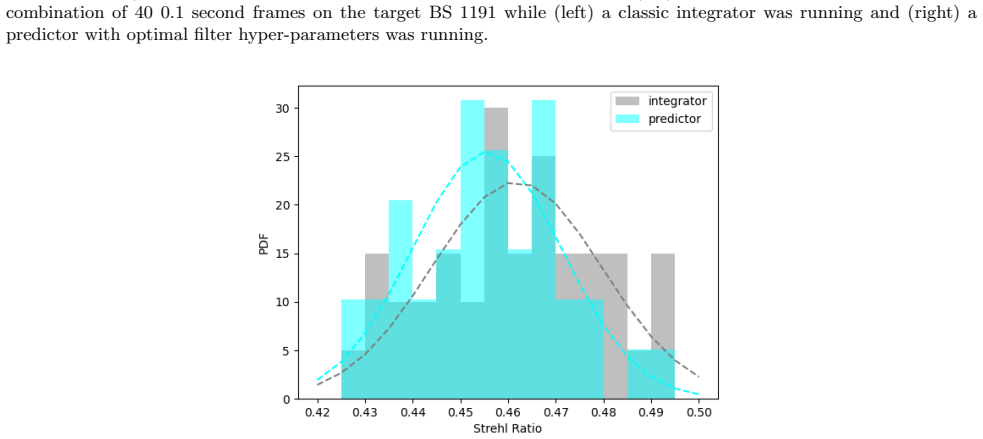
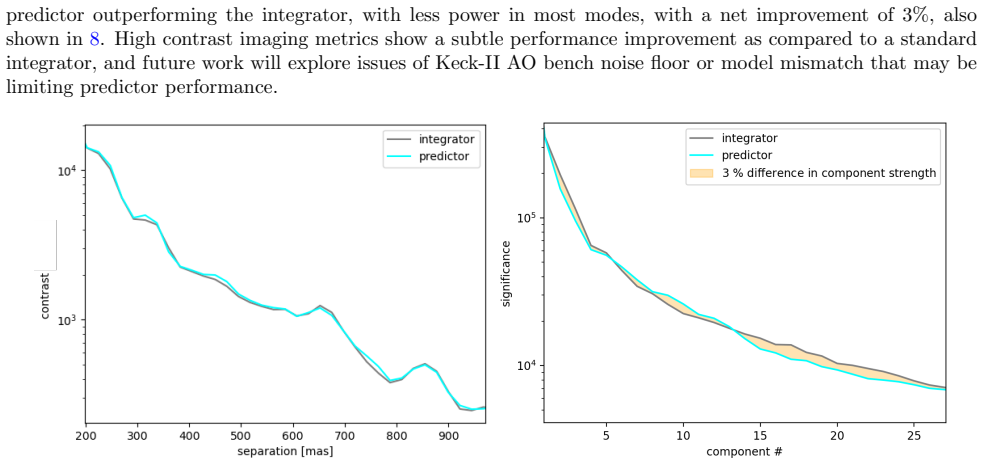
On-sky tests at Keck Observatory show the predictive controller achieves 20 percent lower wavefront residuals than a classic integrator according to Shack-Hartmann sensor data, while NIRC2 imaging through the Brackett Gamma filter yields comparable Strehl ratios and coronagraph-free contrast; parameter studies confirm the improvement holds across reasonable filter settings and principal-component power is modestly lower with the predictor.
What carries the argument
Empirical orthogonal functions that extract linear correlations from the recent history of wavefront sensor measurements to predict the wavefront at the moment of correction.
If this is right
- Temporal errors that limit extreme adaptive optics can be reduced by learning from past sensor states.
- The predictive filter improves residuals without degrading performance when its hyper-parameters are varied within tested ranges.
- The method supplies a direct on-sky demonstration usable as a pathfinder for control systems on future extremely large telescopes.
- Analysis of principal-component strength shows the predictor leaves modestly less residual power in higher-order modes.
Where Pith is reading between the lines
- The benefit may appear only under specific turbulence conditions where temporal lag dominates over other error sources.
- Integration of the same predictor with other real-time control layers could compound the residual reduction.
- Repeating the test across a broader set of guide-star magnitudes and seeing values would map the regimes where the gain is largest.
Load-bearing premise
A 20 percent drop in Shack-Hartmann wavefront sensor residuals produces a meaningful advance in overall system performance even when final imaging metrics remain comparable.
What would settle it
A set of paired observations under identical conditions that show identical Strehl ratios and contrast curves between predictor and integrator runs would falsify the claim of system-level improvement.
Figures




read the original abstract
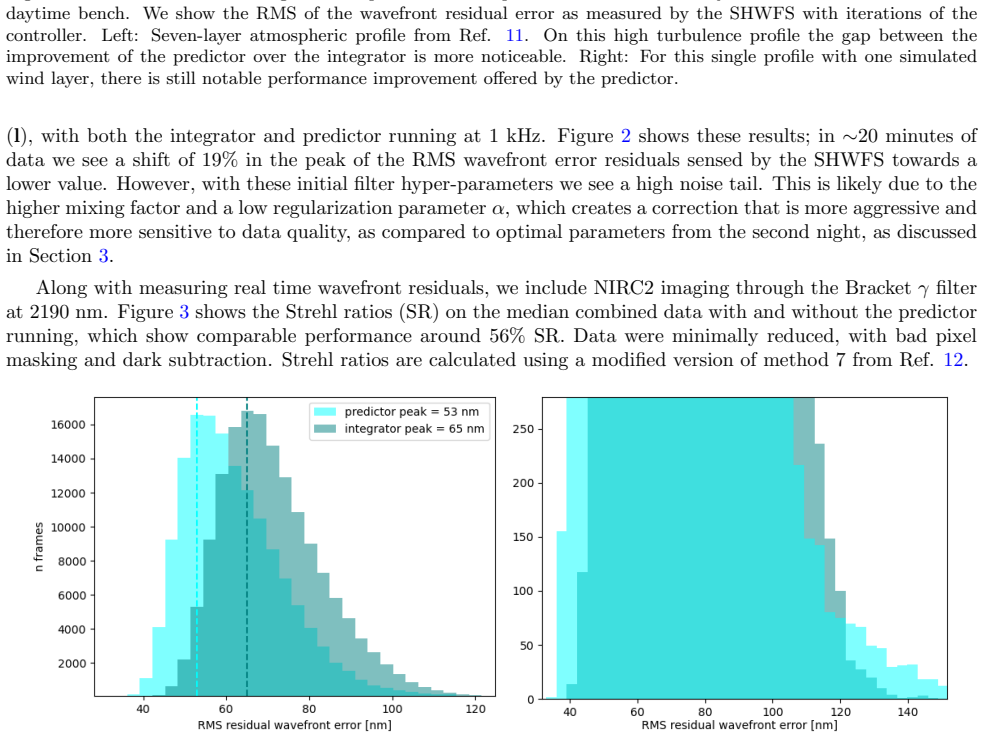
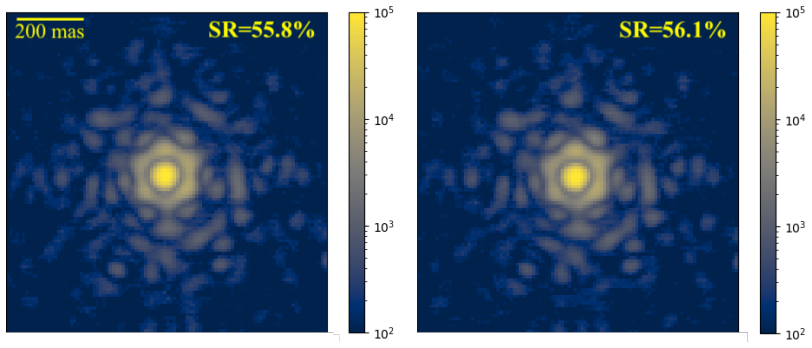
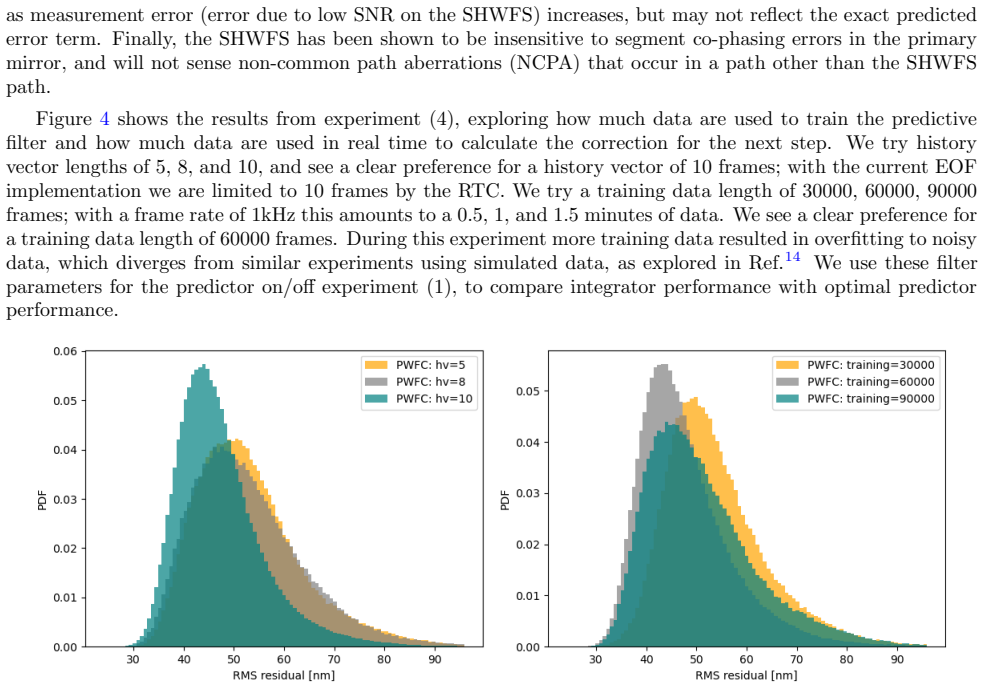
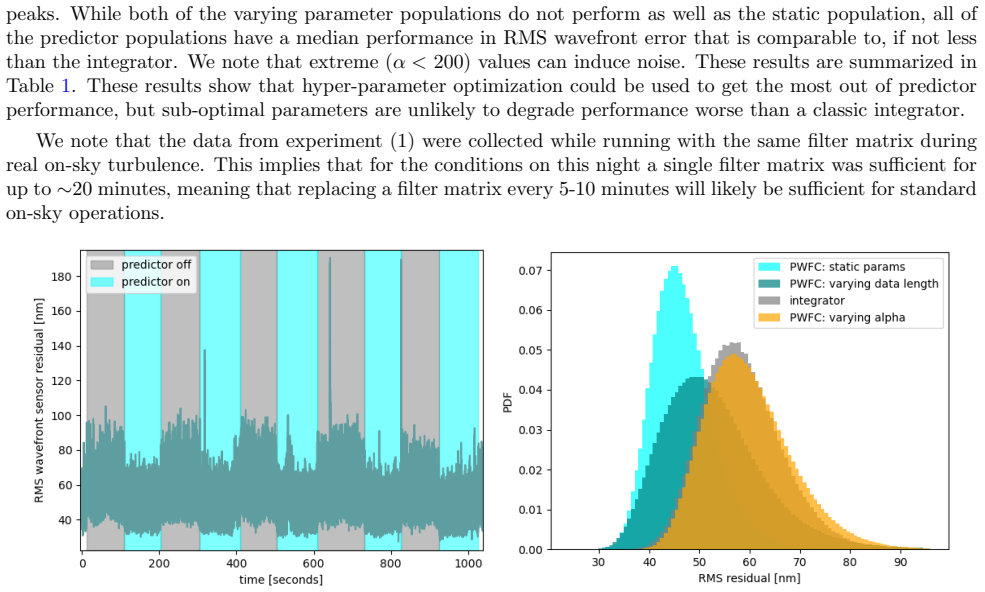
Directly imaging and characterizing exoplanets requires extreme adaptive optics (XAO), which achieves exquisite wavefront correction over a small (<5") field of view. Temporal errors, where the wavefront evolves faster than the lag between wavefront sensing and control, are often a leading term in the error budget for these XAO systems. Predictive control mitigates temporal errors by predicting where the wavefront will be by the time the system correction is applied. In particular, empirical orthogonal functions (EOF) learn linear correlations in a wavefront using previous states in the wavefront sensor history. We present on-sky results of a new implementation of EOF built directly into the Keck-II real time controller. On-sky engineering tests at Keck Observatory of the predictive controller show a 20% performance improvement over a classic integrator according to wavefront residuals from the Shack-Hartmann Wavefront Sensor (SHWFS). Parameter optimization studies show that there is a clear improvement based on varying predictive filter hyper-parameters, but that within a reasonable regime, varying filter parameters does not degrade performance to notably worse than an integrator. NIRC2 imaging through the Brackett Gamma=2190nm filter shows comparable performance between an integrator and predictor, both comparing Strehl Ratio (SR) and coronagraph-free contrast. We also explore power in principal components, and find a modest improvement (on the order of 3% less area under the curve of component strength) from the predictor over the integrator. This work not only improves current observing for the Keck community, but also acts as a pathfinder for predictive control methods with extremely large telescopes.
Editorial analysis
A structured set of objections, weighed in public.
Referee Report
Summary. The manuscript presents on-sky engineering tests at Keck Observatory of an empirical orthogonal function (EOF) predictive wavefront controller integrated into the Keck-II real-time controller. It reports a 20% reduction in Shack-Hartmann wavefront sensor (SHWFS) residuals relative to a classic integrator, robustness to hyper-parameter variation, a modest (~3%) reduction in principal-component power, and comparable Strehl ratio plus coronagraph-free contrast in NIRC2 Brackett-Gamma imaging.
Significance. An on-sky demonstration of data-driven predictive control on an 8-10 m telescope is a practical contribution to extreme AO instrumentation. The direct RTC integration and hyper-parameter study are useful engineering results. However, the absence of corresponding gains in the focal-plane metrics that matter for exoplanet imaging limits the immediate system-level significance.
major comments (1)
- [Abstract] Abstract: the headline claim of a 20% SHWFS-residual improvement is load-bearing for the paper's performance assertion, yet the same abstract states that NIRC2 Brackett-Gamma imaging yields comparable Strehl ratio and coronagraph-free contrast for predictor versus integrator. Because science metrics are the quantities that ultimately matter for XAO, this discrepancy must be reconciled (e.g., via error-budget breakdown or additional data) before the residual gain can be taken as evidence of a meaningful advance.
minor comments (2)
- The manuscript notes that full methods, error bars, and data-selection criteria are not visible in the provided text; ensure these are explicitly documented so readers can assess the statistical significance of the reported 20% residual reduction.
- Clarify whether the ~3% reduction in area under the principal-component curve is statistically significant and whether it correlates with the SHWFS residual metric.
Simulated Author's Rebuttal
We thank the referee for their constructive feedback. We address the single major comment below.
read point-by-point responses
-
Referee: [Abstract] Abstract: the headline claim of a 20% SHWFS-residual improvement is load-bearing for the paper's performance assertion, yet the same abstract states that NIRC2 Brackett-Gamma imaging yields comparable Strehl ratio and coronagraph-free contrast for predictor versus integrator. Because science metrics are the quantities that ultimately matter for XAO, this discrepancy must be reconciled (e.g., via error-budget breakdown or additional data) before the residual gain can be taken as evidence of a meaningful advance.
Authors: The abstract accurately reports both results without contradiction. The 20% SHWFS residual reduction is the direct, high-SNR metric of the controller's success at mitigating temporal error, which is the quantity the EOF predictor is engineered to improve. Comparable NIRC2 Strehl and contrast is the expected and desired outcome for an engineering test: it confirms the predictor introduces no new errors that degrade science performance. Under the short on-sky sequences and conditions used, other error terms (non-common-path aberrations, fitting error, vibration) dominate the focal-plane budget, so a residual gain need not produce an immediate measurable contrast gain. We will add one clarifying sentence to the abstract and a short paragraph in the discussion to make this distinction explicit. revision: partial
Circularity Check
No circularity: purely empirical on-sky comparison
full rationale
The manuscript reports direct on-sky measurements at Keck comparing an EOF predictive controller against a classic integrator. All performance numbers (20% SHWFS residual reduction, comparable NIRC2 Strehl/contrast, 3% PCA power difference) are obtained from hardware telemetry and imaging data. No derivation chain, fitted-parameter prediction, or self-citation is invoked to obtain the reported results; the claims rest on measured observables rather than any equation that reduces to its own inputs.
Axiom & Free-Parameter Ledger
free parameters (1)
- predictive filter hyper-parameters
axioms (1)
- domain assumption Past wavefront sensor states contain linear correlations that can be used to predict future states via empirical orthogonal functions.
Reference graph
Works this paper leans on
-
[1]
Origin of the asymmetry of the wind driven halo observed in high-contrast images,
Cantalloube, F., Por, E. H., Dohlen, K., Sauvage, J. F., Vigan, A., Kasper, M., Bharmal, N., Henning, T., Brandner, W., Milli, J., Correia, C., and Fusco, T., “Origin of the asymmetry of the wind driven halo observed in high-contrast images,”Astronomy & Astrophysics620, L10 (Dec. 2018)
2018
-
[2]
Modal prediction forclosed-loop adaptive optics,
Dessenne, C., Madec, P. Y., and Rousset, G., “Modal prediction forclosed-loop adaptive optics,”Optics Letters22, 1535–1537 (Oct. 1997)
1997
-
[3]
First on-sky SCAO validation of full LQG control with vibration mitigation on the CANARY pathfinder,
Sivo, G., Kulcs´ ar, C., Conan, J.-M., Raynaud, H.-F., Gendron, ´E., Basden, A., Vidal, F., Morris, T., Meimon, S., Petit, C., Gratadour, D., Martin, O., Hubert, Z., Sevin, A., Perret, D., Chemla, F., Rousset, G., Dipper, N., Talbot, G., Younger, E., Myers, R., Henry, D., Todd, S., Atkinson, D., Dickson, C., and Longmore, A., “First on-sky SCAO validation...
2014
-
[4]
Fourier transform wavefront control with adaptive prediction of the atmosphere,
Poyneer, L. A., Macintosh, B. A., and V´ eran, J.-P., “Fourier transform wavefront control with adaptive prediction of the atmosphere,”Journal of the Optical Society of America A24, 2645 (Jan. 2007)
2007
-
[5]
Self-optimizing adaptive optics control with reinforcement learning for high-contrast imaging,
Landman, R., Haffert, S. Y., Radhakrishnan, V. M., and Keller, C. U., “Self-optimizing adaptive optics control with reinforcement learning for high-contrast imaging,”Journal of Astronomical Telescopes, Instru- ments, and Systems7, 039002 (July 2021)
2021
-
[6]
Toward on-sky adaptive optics control using reinforcement learning. Model-based policy optimization for adaptive optics,
Nousiainen, J., Rajani, C., Kasper, M., Helin, T., Haffert, S. Y., V´ erinaud, C., Males, J. R., Van Gorkom, K., Close, L. M., Long, J. D., Hedglen, A. D., Guyon, O., Schatz, L., Kautz, M., Lumbres, J., Rodack, A., Knight, J. M., and Miller, K., “Toward on-sky adaptive optics control using reinforcement learning. Model-based policy optimization for adapti...
2022
-
[7]
Performance and early science with the Subaru Coronagraphic Extreme Adaptive Optics project,
Currie, T., Guyon, O., Lozi, J., Groff, T., Kasdin, N. J., Martinache, F., Brandt, T. D., Chilcote, J., Marois, C., Gerard, B., Jovanovic, N., and Vievard, S., “Performance and early science with the Subaru Coronagraphic Extreme Adaptive Optics project,” in [Society of Photo-Optical Instrumentation Engineers (SPIE) Conference Series],Society of Photo-Opti...
2019
-
[8]
Predictive wavefront control on Keck II adaptive optics bench: on-sky coronagraphic results,
van Kooten, M. A. M., Jensen-Clem, R., Cetre, S., Ragland, S., Bond, C. Z., Fowler, J., and Wizinowich, P., “Predictive wavefront control on Keck II adaptive optics bench: on-sky coronagraphic results,”Journal of Astronomical Telescopes, Instruments, and Systems8, 029006 (Apr. 2022)
2022
-
[9]
Adaptive Optics Predictive Control with Empirical Orthogonal Functions (EOFs),
Guyon, O. and Males, J., “Adaptive Optics Predictive Control with Empirical Orthogonal Functions (EOFs),”arXiv e-prints, arXiv:1707.00570 (July 2017)
Pith/arXiv arXiv 2017
-
[10]
Keck adaptive optics note 1456 high order keck adaptive optics (haka) project design review’,
Wizinowich, P., Bouchez, A., Cetre, S., van Dam, M., Gers, L., Guthery, C., Jensen-Clem, R., Lilley, S., Sallum, S., Steiner, J., Surendran, A., Vincent, M., Wetherell, M., and with ALPAO and Microgate, “Keck adaptive optics note 1456 high order keck adaptive optics (haka) project design review’,” tech. rep., W. M. Keck Observatory (January 2025)
2025
-
[11]
Keck adaptive optics note 303: Atmospheric parameters for mauna kea,
Neyman, C., “Keck adaptive optics note 303: Atmospheric parameters for mauna kea,” tech. rep., W. M. Keck Observatory (December 2004)
2004
-
[12]
Is that really your Strehl ratio?,
Roberts, Jr., L. C., Perrin, M. D., Marchis, F., Sivaramakrishnan, A., Makidon, R. B., Christou, J. C., Macintosh, B. A., Poyneer, L. A., van Dam, M. A., and Troy, M., “Is that really your Strehl ratio?,” in [Advancements in Adaptive Optics], Bonaccini Calia, D., Ellerbroek, B. L., and Ragazzoni, R., eds.,Society of Photo-Optical Instrumentation Engineers...
2004
-
[13]
Real time controller upgrade performance analysis,
C., C., P., W., and S., R., “Real time controller upgrade performance analysis,” tech. rep., W. M. Keck Observatory (March 2020)
2020
-
[14]
The future looks dark: improving high contrast imaging with hyper-parameter optimization for data-driven predictive wavefront control,
Fowler, J., Jensen-Clem, R., van Kooten, M. A. M., Chambouleyron, V., and Cetre, S., “The future looks dark: improving high contrast imaging with hyper-parameter optimization for data-driven predictive wavefront control,” in [Adaptive Optics Systems IX], Jackson, K. J., Schmidt, D., and Vernet, E., eds., Society of Photo-Optical Instrumentation Engineers ...
2024
-
[15]
pyKLIP: PSF Subtraction for Exoplanets and Disks,
Wang, J. J., Ruffio, J.-B., De Rosa, R. J., Aguilar, J., Wolff, S. G., and Pueyo, L., “pyKLIP: PSF Subtraction for Exoplanets and Disks,” (June 2015)
2015
-
[16]
SciPy 1.0: Fundamental Algorithms for Scientific Computing in Python,
Virtanen, P., Gommers, R., Oliphant, T. E., Haberland, M., Reddy, T., Cournapeau, D., Burovski, E., Peterson, P., Weckesser, W., Bright, J., van der Walt, S. J., Brett, M., Wilson, J., Millman, K. J., Mayorov, N., Nelson, A. R. J., Jones, E., Kern, R., Larson, E., Carey, C. J., Polat, ˙I., Feng, Y., Moore, E. W., VanderPlas, J., Laxalde, D., Perktold, J.,...
2020
-
[17]
Shining a Visible Light on Keck-II Adaptive Optics: Characterizing the visible light performance of Keck-II AO with the ORKID instrument,
Fowler, J., Millar-Blanchaer, M., Jensen-Clem, R., Marin, E., Kwok, S., Surendran, A., Bouchez, A., Gers, L., Ragland, S., Wizinowich, P., Peretz, E., Ashcraft, J., and Weiland Potter, J., “Shining a Visible Light on Keck-II Adaptive Optics: Characterizing the visible light performance of Keck-II AO with the ORKID instrument,”submitted to Journal of Astro...
2026
-
[18]
Theoretical Limits on Extrasolar Terrestrial Planet Detection with Coronagraphs,
Guyon, O., Pluzhnik, E. A., Kuchner, M. J., Collins, B., and Ridgway, S. T., “Theoretical Limits on Extrasolar Terrestrial Planet Detection with Coronagraphs,”Astrophysics Journal Supplement Series167, 81–99 (Nov. 2006)
2006
-
[19]
Closed-Loop Until Further Notice: Comparing Predictive Control Methods in Closed-Loop,
Fowler, J., van Kooten, M., and Jensen-Clem, R., “Closed-Loop Until Further Notice: Comparing Predictive Control Methods in Closed-Loop,” in [Adaptive Optics for Extremely Large Telescopes (AO4ELT7)], 49 (June 2023)
2023
-
[20]
Upgrading SPHERE with the second stage AO system SAXO+: RTC preliminary design,
Ferreira, F., Sevin, A., Gratadour, D., Chauvin, G., Diolaiti, E., Gratton, R., Loupias, M., Milli, J., Wildi, F., and Boccaletti, A., “Upgrading SPHERE with the second stage AO system SAXO+: RTC preliminary design,” in [Adaptive Optics Systems IX], Jackson, K. J., Schmidt, D., and Vernet, E., eds.,Society of Photo-Optical Instrumentation Engineers (SPIE)...
2024
discussion (0)
Sign in with ORCID, Apple, or X to comment. Anyone can read and Pith papers without signing in.