Quantum Enhancement of Particle-Size Segregation
Pith reviewed 2026-06-26 15:02 UTC · model grok-4.3
The pith
Quantum coherence in weakly decohering granular mixtures produces stronger size segregation than classical predictions allow.
A machine-rendered reading of the paper's core claim, the machinery that carries it, and where it could break.
Core claim
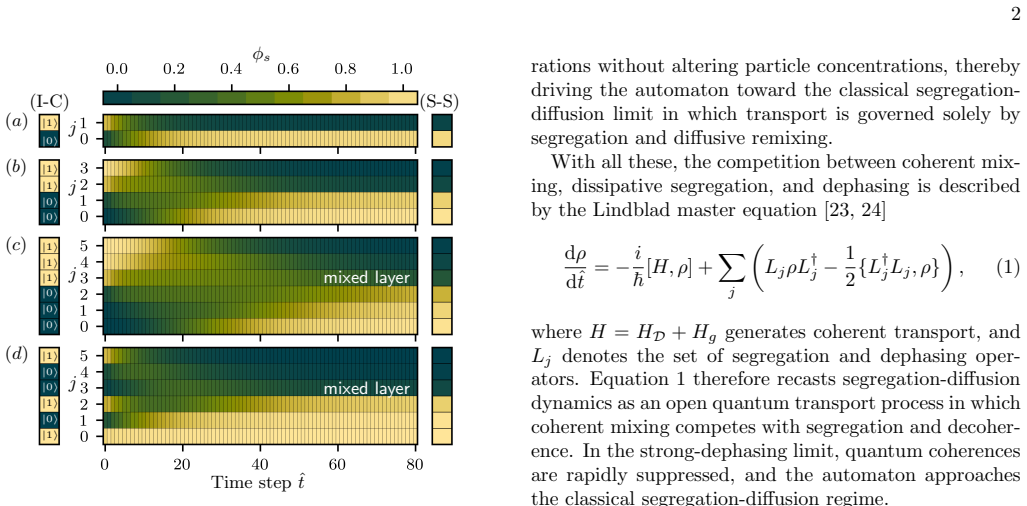
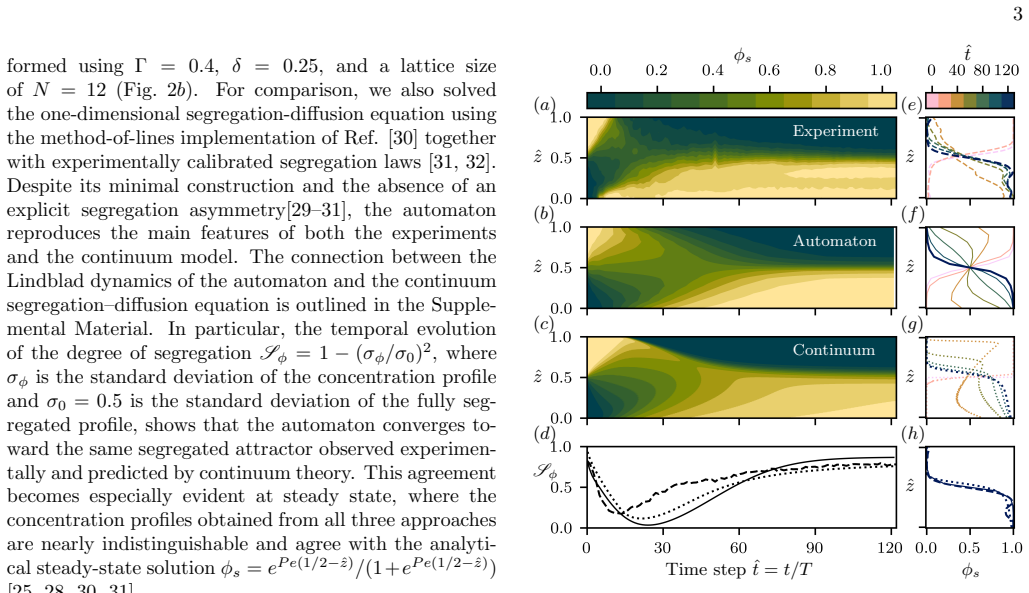
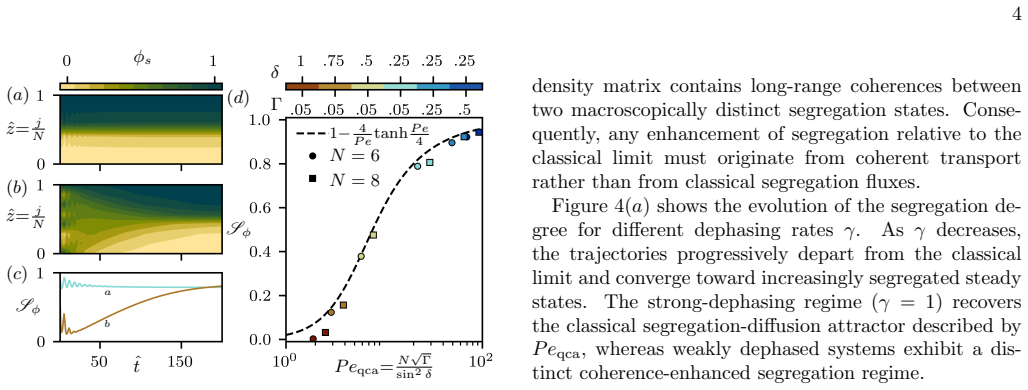
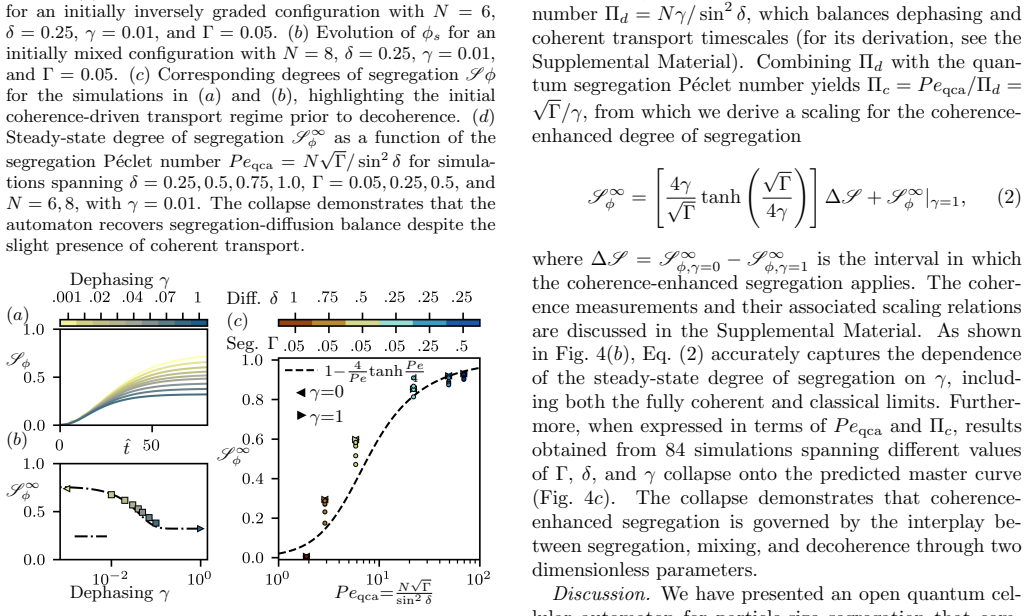
An open quantum cellular automaton for bidisperse mixtures reproduces experimental and continuum-theory segregation dynamics, yet weakly decohering systems enter a coherence-driven transport regime that yields more strongly segregated steady states than classical predictions, with the segregation degree collapsing onto two dimensionless numbers that govern the competition between segregation, diffusion, and decoherence.
What carries the argument
Open quantum cellular automaton that combines coherent transport and dissipative segregation for bidisperse mixtures.
If this is right
- Segregation in weakly decohering regimes exceeds the classical limit set by the Péclet number alone.
- Steady-state segregation collapses onto two dimensionless numbers that include decoherence.
- Quantum coherence acts as an additional driver of size-based separation.
- The automaton supplies a framework for transport studies in open many-body systems.
Where Pith is reading between the lines
- If the coherence enhancement survives in laboratory granular systems with controlled decoherence, it could open routes to tune segregation strength without changing particle properties or flow geometry.
- The same two-number collapse may appear in other dissipative many-body transport problems where coherent hopping competes with local relaxation.
- Numerical checks of the automaton against existing discrete-element simulations with added phase coherence would test the predicted departure from classical scaling.
Load-bearing premise
The open quantum cellular automaton accurately reproduces real experimental and continuum-theory segregation dynamics while correctly incorporating coherent transport and dissipative segregation mechanisms.
What would settle it
Measure the steady-state segregation index in a bidisperse granular flow with independently tunable decoherence rate and test whether it exceeds the classical Péclet-based prediction by the amount set by the two dimensionless numbers.
Figures
read the original abstract
Segregated states based on particle size emerge in granular materials from the competition between segregation and diffusive remixing. Here, we show that quantum coherence can enhance segregation beyond this classical limit. We introduce an open quantum cellular automaton for bidisperse mixtures that combines coherent transport and dissipative segregation. The automaton reproduces experimental and continuum-theory segregation dynamics, with segregation degrees collapsing onto a theoretical P\'eclet-dependent relationship. However, weakly decohering systems exhibit a coherence-driven transport regime that produces more strongly segregated steady states than classical predictions. Across a broad parameter range, the steady-state degree of segregation collapses onto two dimensionless numbers governing the competition between segregation, diffusion, and decoherence. These results identify quantum coherence as a mechanism for enhancing particle-size segregation and establish a framework for studying transport phenomena in open many-body systems.
Editorial analysis
A structured set of objections, weighed in public.
Referee Report
Summary. The manuscript introduces an open quantum cellular automaton for bidisperse granular mixtures that incorporates coherent transport and dissipative segregation. It claims that the model reproduces experimental and continuum-theory segregation dynamics in the strong-decoherence limit, with segregation degrees collapsing onto a Péclet-dependent relationship. In weakly decohering regimes, a coherence-driven transport regime produces more strongly segregated steady states than classical predictions, and the steady-state segregation degree collapses onto two dimensionless numbers that govern the competition between segregation, diffusion, and decoherence across a broad parameter range.
Significance. If the central claims hold after verification, the work would identify quantum coherence as a mechanism for enhancing particle-size segregation beyond classical limits and establish a framework for transport in open many-body systems. The reported collapse onto dimensionless numbers is a positive feature when the classical baseline is accurately reproduced. The result would be of interest to the granular and soft-matter communities if the enhancement is shown to arise specifically from coherent transport rather than model artifacts.
major comments (2)
- [Abstract and Methods] The load-bearing assumption is that the automaton accurately reproduces known classical segregation dynamics (Péclet-number scaling from continuum theory and experiments) when decoherence is strong. The abstract asserts reproduction but provides no quantitative error metrics, side-by-side plots, or explicit classical-limit derivation; without these, it remains possible that reported excess segregation at weak decoherence is an artifact of imperfect matching in the reference regime.
- [Results] The claim of a distinct 'coherence-driven transport regime' producing stronger segregation requires explicit checks that the enhancement is independent of discretization, boundary conditions, or the specific form of the dissipative channel. These controls are necessary to establish that the two dimensionless numbers capture genuine quantum effects rather than model-specific features.
minor comments (2)
- [Results] Notation for the two dimensionless numbers should be defined explicitly with their physical interpretations in a dedicated section or table for clarity.
- [Figures] Figure captions should include the range of decoherence rates and Péclet numbers used to demonstrate the collapse, to allow readers to assess the breadth of the parameter space.
Simulated Author's Rebuttal
We thank the referee for their careful reading and constructive comments on our manuscript. We address each major comment below and outline the revisions we will make to strengthen the presentation of our results.
read point-by-point responses
-
Referee: [Abstract and Methods] The load-bearing assumption is that the automaton accurately reproduces known classical segregation dynamics (Péclet-number scaling from continuum theory and experiments) when decoherence is strong. The abstract asserts reproduction but provides no quantitative error metrics, side-by-side plots, or explicit classical-limit derivation; without these, it remains possible that reported excess segregation at weak decoherence is an artifact of imperfect matching in the reference regime.
Authors: We agree that quantitative support for the classical limit would strengthen the manuscript. In the revised version we will add side-by-side plots of segregation degree versus Péclet number comparing the strong-decoherence automaton results directly to both experimental data and continuum-theory predictions, together with explicit error metrics (e.g., mean relative deviation from the theoretical Péclet scaling). We will also include a short derivation showing how the automaton reduces to the classical continuum equations in the strong-decoherence limit. These additions will confirm that the classical baseline is faithfully reproduced before presenting the weak-decoherence enhancement. revision: yes
-
Referee: [Results] The claim of a distinct 'coherence-driven transport regime' producing stronger segregation requires explicit checks that the enhancement is independent of discretization, boundary conditions, or the specific form of the dissipative channel. These controls are necessary to establish that the two dimensionless numbers capture genuine quantum effects rather than model-specific features.
Authors: We concur that robustness to implementation details is required. The revised manuscript will incorporate additional simulations that vary lattice discretization (multiple system sizes), boundary conditions (periodic versus reflecting), and the concrete form of the dissipative Lindblad operators. We will demonstrate that the collapse of the steady-state segregation onto the two dimensionless numbers remains quantitatively consistent across these variations, thereby supporting that the coherence-driven enhancement originates from the open quantum dynamics rather than from any particular choice of discretization or channel. revision: yes
Circularity Check
No significant circularity; derivation is self-contained.
full rationale
The paper introduces an open quantum cellular automaton model, asserts that it reproduces known classical segregation dynamics (Péclet scaling) in the strong-decoherence limit, and reports that weak decoherence yields stronger segregation with collapse onto two new dimensionless numbers. No quoted equations or sections demonstrate that any claimed prediction reduces by construction to fitted inputs, self-definitions, or load-bearing self-citations. The reproduction claim and the reported collapse are presented as simulation outcomes rather than tautological reparameterizations, and the central enhancement result is not shown to be forced by the model's own definitions. The derivation chain therefore remains independent of its inputs.
Axiom & Free-Parameter Ledger
axioms (1)
- domain assumption The automaton reproduces experimental and continuum-theory segregation dynamics
invented entities (1)
-
coherence-driven transport regime
no independent evidence
Reference graph
Works this paper leans on
-
[1]
J. M. Ottino and D. V. Khakhar, Mixing and segregation of granular materials, Annu. Rev. Fluid Mech.32, 55 (2000)
2000
-
[2]
J. M. N. T. Gray, Particle segregation in dense gran- ular flows, Annu. Rev. Fluid Mech.50, 407 (2018), https://doi.org/10.1146/annurev-fluid-122316-045201
-
[3]
P. B. Umbanhowar, R. M. Lueptow, and J. M. Ot- tino, Modeling segregation in granular flows, Annu. Rev. Chem. Biomol. Eng.10, 129 (2019)
2019
-
[4]
G. V. Middleton, Experimental studies related to prob- lems of flysch sedimentation, Flysch sedimentology in North America. , 253 (1970)
1970
-
[5]
Rosato, K
A. Rosato, K. J. Strandburg, F. Prinz, and R. H. Swend- sen, Why the brazil nuts are on top: Size segregation of particulate matter by shaking, Phys. Rev. Lett.58, 1038 (1987)
1987
-
[6]
S. B. Savage and C. Lun, Particle size segregation in in- clined chute flow of dry cohesionless granular solids, J. Fluid Mech.189, 311 (1988)
1988
-
[7]
A. R. Thornton, K. Hill, L. Jing, B. Marks, and D. R. Tunuguntla, Modeling granular segregation: Insights from four decades of research, Annu. Rev. Condens. Mat- ter Phys.17(2026)
2026
-
[8]
H. A. Makse, S. Havlin, P. R. King, and H. E. Stanley, Spontaneous stratification in granular mixtures, Nature 386, 379 (1997)
1997
-
[9]
C. G. Johnson, B. P. Kokelaar, R. M. Iverson, M. Logan, R. G. LaHusen, and J. M. N. T. Gray, Grain-size segre- gation and levee formation in geophysical mass flows, J. Geophys. Res. Earth Surf.117(2012)
2012
-
[10]
Baker, C
J. Baker, C. Johnson, and J. M. N. T. Gray, Segregation- induced finger formation in granular free-surface flows, J. Fluid Mech.809, 168 (2016)
2016
-
[11]
A. P. Pearse, C. G. Johnson, and J. M. N. T. Gray, Longitudinal stripe formation in bidisperse granular free- surface flows with secondary vortices, J. Fluid Mech. 1032, A4 (2026)
2026
-
[12]
Fitt and P
A. Fitt and P. Wilmott, Cellular-automaton model for segregation of a two-species granular flow, Phys. Rev. A 45, 2383 (1992)
1992
-
[13]
Yanagita, Three-dimensional cellular automaton model of segregation of granular materials in a rotating cylinder, Phys
T. Yanagita, Three-dimensional cellular automaton model of segregation of granular materials in a rotating cylinder, Phys. Rev. Lett.82, 3488 (1999)
1999
-
[14]
Marks and I
B. Marks and I. Einav, A cellular automaton for segrega- tion during granular avalanches, Granul. Matter13, 211 (2011)
2011
-
[15]
Castro, R
R. Castro, R. G´ omez, and L. Arancibia, Fine material migration modelled by cellular automata: R. castro et al., Granul. Matter24, 14 (2022)
2022
-
[16]
Dissanayake, G
S. Dissanayake, G. Salah, H. Salehi, S. Zigan, T. Deng, and M. Bradley, Frequency domain analysis for identify- ing dominant segregation units in a chain of material han- dling processes: A cellular automaton framework, Pow- der Technol. , 121559 (2025)
2025
-
[17]
G. W. Baxter and R. P. Behringer, Cellular automata models of granular flow, Phys. Rev. A42, 1017 (1990)
1990
-
[18]
Longhi, Quantum-optical analogies using photonic structures, Laser & Photonics Reviews3, 243 (2009)
S. Longhi, Quantum-optical analogies using photonic structures, Laser & Photonics Reviews3, 243 (2009)
2009
-
[19]
J. W. M. Bush, Pilot-wave hydrodynamics, Annual Rev. of Fluid Mech.47, 269 (2015)
2015
-
[20]
Breuer and F
H.-P. Breuer and F. Petruccione,The Theory of Open Quantum Systems(OUP Oxford, 2002)
2002
-
[21]
M. B. Plenio and S. F. Huelga, Dephasing-assisted trans- port: quantum networks and biomolecules, New Journal of Physics10, 113019 (2008)
2008
-
[22]
Caruso, A
F. Caruso, A. W. Chin, A. Datta, S. F. Huelga, and M. B. Plenio, Highly efficient energy excitation transfer in light- harvesting complexes: The fundamental role of noise- assisted transport, The Journal of Chemical Physics131 (2009)
2009
-
[23]
M. A. Nielsen and I. L. Chuang,Quantum Computation and Quantum Information(Cambridge University Press, 2010)
2010
-
[24]
Manzano, A short introduction to the lindblad master equation, AIP advances10(2020)
D. Manzano, A short introduction to the lindblad master equation, AIP advances10(2020)
2020
-
[25]
J. M. N. T. Gray and V. Chugunov, Particle-size seg- regation and diffusive remixing in shallow granular avalanches, Journal of Fluid Mechanics569, 365 (2006)
2006
-
[26]
H. N. Ulloa and T. Trewhela, Shear-driven mix- ing of segregated granular materials, arXiv preprint 6 arXiv:2604.24702 (2026)
Pith/arXiv arXiv 2026
-
[27]
Trewhela and H
T. Trewhela and H. N. Ulloa, Energetics of particle-size segregation, J. Fluid Mech.1000, A50 (2024)
2024
-
[28]
Wiederseiner, N
S. Wiederseiner, N. Andreini, G. ´Epely-Chauvin, G. Moser, M. Monnereau, J. M. N. T. Gray, and C. An- cey, Experimental investigation into segregating granular flows down chutes, Phys. Fluids23, 013301 (2011)
2011
-
[29]
van der Vaart, P
K. van der Vaart, P. Gajjar, G. Epely-Chauvin, N. An- dreini, J. M. N. T. Gray, and C. Ancey, Underlying asym- metry within particle size segregation, Phys. Rev. Lett. 114, 238001 (2015)
2015
-
[30]
Trewhela, Segregation–rheology feedback in bidisperse granular flows: a coupled stokes’ problem, J
T. Trewhela, Segregation–rheology feedback in bidisperse granular flows: a coupled stokes’ problem, J. Fluid Mech. 983, A45 (2024)
2024
-
[31]
Trewhela, C
T. Trewhela, C. Ancey, and J. M. N. T. Gray, An exper- imental scaling law for particle-size segregation in dense granular flows, J. Fluid Mech.916, A55 (2021)
2021
-
[32]
Trewhela, J
T. Trewhela, J. M. N. T. Gray, and C. Ancey, Large particle segregation in two-dimensional sheared granular flows, Phys. Rev. Fluids6, 054302 (2021)
2021
-
[33]
P. V. Danckwerts, The definition and measurement of some characteristics of mixtures, Appl. Sci. Res. A3, 279 (1952)
1952
-
[34]
Ferdowsi, C
B. Ferdowsi, C. P. Ortiz, M. Houssais, and D. J. Jerol- mack, River-bed armouring as a granular segregation phenomenon, Nat. Comm.8, 1363 (2017)
2017
-
[35]
Y. Fan, C. P. Schlick, P. B. Umbanhowar, J. M. Ottino, and R. M. Lueptow, Modelling size segregation of gran- ular materials: the roles of segregation, advection and diffusion, J. Fluid Mech.741, 252 (2014)
2014
-
[36]
Couder and E
Y. Couder and E. Fort, Single-particle diffraction and interference at a macroscopic scale, Phys. Rev. Lett.97, 154101 (2006)
2006
discussion (0)
Sign in with ORCID, Apple, or X to comment. Anyone can read and Pith papers without signing in.