High multiplex and precision: the design and development of FLEX, a grid-based fiber positioner with large patrol radius and minimized telecentric error
Pith reviewed 2026-06-26 13:19 UTC · model grok-4.3
The pith
FLEX fiber positioner achieves 22.5 mm patrol radius at under 0.39 degree telecentric error using Nitinol tilting tubes.
A machine-rendered reading of the paper's core claim, the machinery that carries it, and where it could break.
Core claim
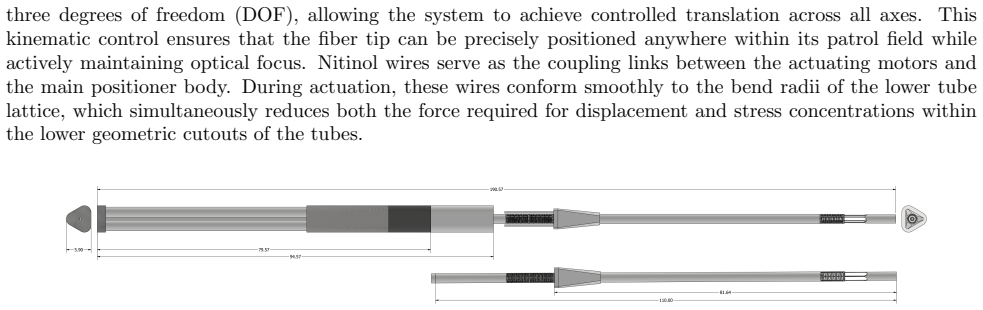
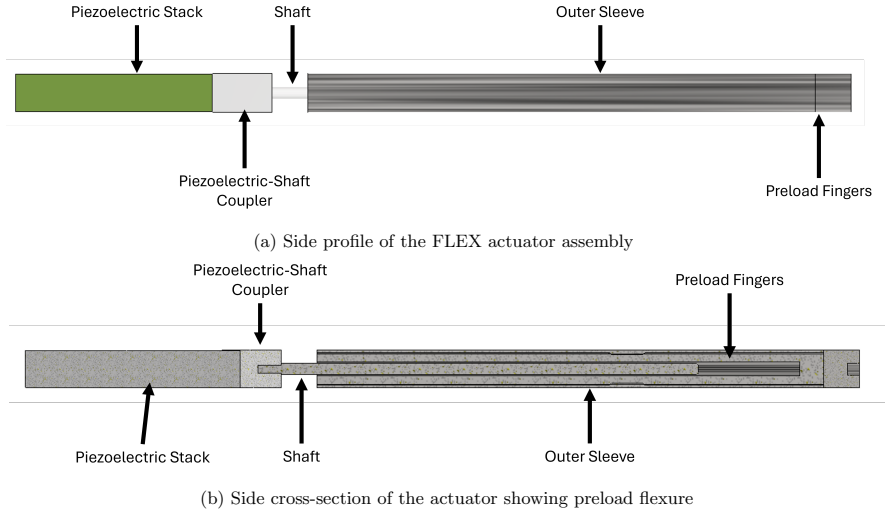
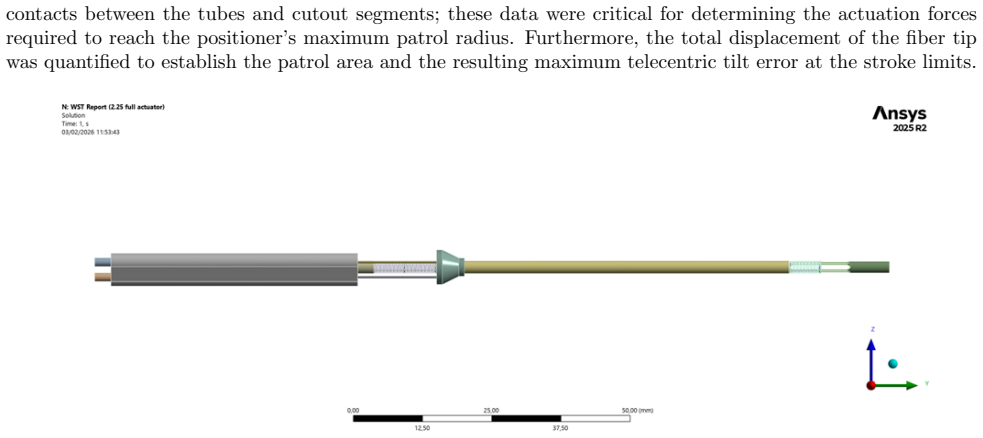
The FLEX positioner uses superelastic Nitinol inside three concentric geometrically altered tubes to keep the fiber tip parallel to its base during tilting, with internal fiber routing to limit focal ratio degradation; this yields a patrol radius up to 22.5 mm and telecentric error below 0.39 degrees, supported by three piezoelectric actuators and a 90-module layout that places 30,240 positioners across a 2-degree hexagonal field with a central hole for an integral field unit.
What carries the argument
The FLEX tilting mechanism of superelastic Nitinol inside three concentric geometrically altered tubes that maintains tip-to-base parallelism while allowing free fiber routing along the axis.
If this is right
- Enables 30,240 positioners on the WST focal surface with one in sixteen reserved for high-resolution spectroscopy.
- Limits support strut obscuration to 0.8 percent of the field of view while maintaining full positioner coverage.
- Provides 2.5 times pitch patrol radius within the WST architecture using three actuators per unit.
- Allows modular scaling across 90 identical curvilinear modules for the full 2-degree field.
Where Pith is reading between the lines
- The same tube-and-Nitinol approach might be adapted to smaller patrol radii in existing telescopes if the actuator count can be reduced.
- Lower telecentric error could reduce the need for corrective optics downstream in the spectrograph train.
- Long-term testing of Nitinol fatigue under continuous operation would be a natural next measurement not addressed in the design paper.
Load-bearing premise
The Nitinol tubes will keep the fiber tip parallel to the base throughout repeated tilts without excess focal ratio degradation or mechanical wear.
What would settle it
Prototype measurements that show telecentric error above 0.39 degrees or patrol radius below 22.5 mm at the design pitch would falsify the performance specification.
Figures



read the original abstract
In next-generation spectroscopic facilities, high-multiplex fiber positioning systems must operate within highly constrained focal surfaces, such as the Wide-Field Spectroscopic Telescope (WST) requiring 30,000+ fibers across a 1.4-meter surface. The Fiber Location EXtender (FLEX) positioner meets these constraints by improving fiber patrol radii while minimizing telecentric error and positioner spacing for dense clustering and high Multi-Object Spectrograph (MOS) multiplexing. The patented FLEX concept utilizes a superelastic nickel-titanium alloy (Nitinol) inside three concentric, geometrically altered tubes. This construction ensures the tip remains parallel with its base during tilting, while internal routing allows the fiber to run freely along the axis to minimize Focal Ratio Degradation (FRD). Designed for a patrol radius of 2.5x the pitch within the WST architecture, the design delivers a maximum patrol radius up to ~22.5 mm with a telecentric error of less than 0.39 degrees. FLEX utilizes three piezoelectric actuators to provide large radial displacements and precise focus adjustment. To scale this architecture, a modular focal surface layout of 90 identical curvilinear modules has been devised. This layout houses 30,240 positioners across a 2-degree hexagonal field-of-view (FoV), accommodating a central hole for an Integral Field pickoff mirror. Only three support struts are required, obscuring just 0.8% of the FoV while allowing full positioner coverage. One in 16 positioners is allocated for high-resolution spectroscopy, with the remainder split among three low-resolution spectrograph sets; all four sets achieve virtually full coverage of the FoV.
Editorial analysis
A structured set of objections, weighed in public.
Referee Report
Summary. The paper presents the design of the Fiber Location EXtender (FLEX), a grid-based fiber positioner for the Wide-Field Spectroscopic Telescope (WST) that uses three concentric geometrically altered superelastic Nitinol tubes driven by piezoelectric actuators. It claims this architecture achieves a maximum patrol radius of ~22.5 mm (2.5× pitch) with telecentric error <0.39° while minimizing FRD via free fiber routing, and describes a modular layout of 90 curvilinear modules housing 30,240 positioners over a 2° hexagonal FoV with only 0.8% obscuration.
Significance. If the performance figures are substantiated, the design would enable substantially higher multiplexing density on large focal surfaces while controlling telecentric error and FRD, directly addressing a central engineering constraint for 30,000-fiber-class MOS instruments such as WST.
major comments (3)
- [Abstract / design description] Abstract and main text: the quantitative claims of a ~22.5 mm patrol radius and <0.39° telecentric error are asserted on the basis of the three concentric Nitinol tubes maintaining tip-base parallelism, yet the manuscript contains no kinematic derivation, finite-element results, tolerance stack-up, or deflection analysis demonstrating that parallelism (and therefore the stated error bound) is preserved at the 2.5× pitch displacement.
- [Abstract / Nitinol tube construction] Abstract and mechanism section: no error budget, FRD modeling, or prototype metrology is supplied to support the assertion that internal fiber routing along the axis minimizes focal-ratio degradation while the tubes tilt; the performance numbers therefore rest on unverified design assertions.
- [Modular focal surface layout] Modular layout description: the claim that 90 identical curvilinear modules with only three support struts achieve full positioner coverage and 0.8% obscuration across the 1.4 m surface lacks any structural, thermal, or alignment analysis showing that the required positioning precision can be maintained at the focal-surface scale.
minor comments (1)
- [Introduction] The text refers to a 'patented FLEX concept' without providing a reference or patent number; a citation would improve traceability.
Simulated Author's Rebuttal
We thank the referee for the constructive and detailed review of our manuscript on the FLEX fiber positioner. We address each major comment below with proposed revisions to improve substantiation of the design claims where feasible.
read point-by-point responses
-
Referee: [Abstract / design description] Abstract and main text: the quantitative claims of a ~22.5 mm patrol radius and <0.39° telecentric error are asserted on the basis of the three concentric Nitinol tubes maintaining tip-base parallelism, yet the manuscript contains no kinematic derivation, finite-element results, tolerance stack-up, or deflection analysis demonstrating that parallelism (and therefore the stated error bound) is preserved at the 2.5× pitch displacement.
Authors: We agree the manuscript would benefit from additional supporting analysis. The stated performance derives from the geometric design of the concentric Nitinol tubes, which is intended to enforce tip-base parallelism. In revision we will add a dedicated subsection with a basic kinematic derivation of the tube geometry and an analytical tolerance stack-up estimate demonstrating preservation of parallelism at the target displacement. A full finite-element study is not yet available but the added analytical treatment will directly address the concern. revision: yes
-
Referee: [Abstract / Nitinol tube construction] Abstract and mechanism section: no error budget, FRD modeling, or prototype metrology is supplied to support the assertion that internal fiber routing along the axis minimizes focal-ratio degradation while the tubes tilt; the performance numbers therefore rest on unverified design assertions.
Authors: The FRD claim rests on the design choice of routing the fiber along the central axis with minimal curvature during tilt. We acknowledge the lack of quantitative error budget or modeling. The revised manuscript will include an expanded qualitative discussion of the routing approach together with references to FRD behavior in comparable positioner systems. No prototype metrology exists because the work remains at the design stage; this limitation will be explicitly noted. revision: partial
-
Referee: [Modular focal surface layout] Modular layout description: the claim that 90 identical curvilinear modules with only three support struts achieve full positioner coverage and 0.8% obscuration across the 1.4 m surface lacks any structural, thermal, or alignment analysis showing that the required positioning precision can be maintained at the focal-surface scale.
Authors: The modular layout is presented as a conceptual solution for coverage and low obscuration. We agree that structural, thermal, and alignment analyses at the full 1.4 m scale are absent. In revision we will add a paragraph outlining the key design assumptions and scaling rationale. Comprehensive engineering analyses of this type lie beyond the scope of the present design paper and are reserved for future detailed studies. revision: partial
- Prototype metrology data for FRD performance, as no physical prototypes have been fabricated or tested.
- Full finite-element structural or thermal analysis of the complete 1.4 m focal-surface assembly, which requires engineering resources outside the current conceptual design study.
Circularity Check
No circularity: design description with asserted specs, no derivations or self-referential fits
full rationale
The manuscript is an engineering design paper that describes the FLEX positioner construction (Nitinol tubes, piezoelectric actuators, modular layout) and directly states performance figures (patrol radius ~22.5 mm, telecentric error <0.39°). No equations, parameter fits, predictions from subsets of data, or load-bearing self-citations appear in the provided text. The quantitative claims are presented as outcomes of the described mechanism rather than derived quantities that reduce to the inputs by construction. This matches the default case of a self-contained forward-engineering description with no circular steps.
Axiom & Free-Parameter Ledger
axioms (1)
- domain assumption The superelastic properties of Nitinol combined with geometrically altered concentric tubes maintain tip parallelism during tilt.
invented entities (1)
-
FLEX positioner
no independent evidence
Reference graph
Works this paper leans on
-
[1]
WST - widefield spectroscopic telescope: motivation, science drivers and top level requirements for a new dedicated facility,
R. Bacon, V. Maineiri, S. Randich,et al., “WST - widefield spectroscopic telescope: motivation, science drivers and top level requirements for a new dedicated facility,” inGround-based and Airborne Telescopes X,Proc. SPIE13094, p. 130941O, 2024
2024
-
[2]
MegaMapper: concept and optical design for a 6.5m aperture mas- sively multiplexed spectroscopic facility,
G. A. Blanc, J. H. Silber,et al., “MegaMapper: concept and optical design for a 6.5m aperture mas- sively multiplexed spectroscopic facility,” inGround-based and Airborne Telescopes IX,Proc. SPIE12182, p. 1218230, 2022
2022
-
[3]
From large telescopes to the multiplexed survey telescope (must),
Z. Cai, S. Huang, Y. Liu, C. Zhao, and L. Huang, “From large telescopes to the multiplexed survey telescope (must),”Science China Physics, Mechanics & Astronomy68(9), 2025
2025
-
[4]
FLEX: a new grid-based fibre positioner concept with large patrol area, small pitch, and very good clustering capabilities,
R. S. de Jong, T. Liebner, and F. Dionies, “FLEX: a new grid-based fibre positioner concept with large patrol area, small pitch, and very good clustering capabilities,” inAdvances in Optical and Mechanical Technologies for Telescopes and Instrumentation VI,Proc. SPIE13100, p. 131002A, 2024
2024
-
[5]
The Echidna multi-object fiber positioner for the Subaru FMOS instrument,
P. R. Gillinghamet al., “The Echidna multi-object fiber positioner for the Subaru FMOS instrument,” in Optical and IR Telescope Instrumentation and Detectors,Proc. SPIE4008, pp. 1395–1403, 2000
2000
-
[6]
4MOST: Project overview and science objectives before first light,
R. S. de Jong, M. Aguiar, C. F. Alves,et al., “4MOST: Project overview and science objectives before first light,” inThe Messenger,175, pp. 3–11, 2019
2019
-
[7]
The parallel fiber positioning system for LAMOST,
X. Xing, C. Zhai, H. Du,et al., “The parallel fiber positioning system for LAMOST,” inGround-based and Airborne Instrumentation for Astronomy III,Proc. SPIE7735, p. 773516, 2010
2010
-
[8]
The DESI focal plane system,
J. Silberet al., “The DESI focal plane system,”The Astronomical Journal165(1), p. 9, 2023
2023
-
[9]
The fiber positioner system for the VLT-MOONS instru- ment,
R. Cirami, I. Coretti, P. Di Marcantonio,et al., “The fiber positioner system for the VLT-MOONS instru- ment,” inSoftware and Cyberinfrastructure for Astronomy III,Proc. SPIE9152, p. 915228, 2014
2014
-
[10]
Ansys, Inc., Canonsburg, PA, USA, 2026
Ansys Inc.,Ansys Mechanical User’s Guide, Release 2026 R1. Ansys, Inc., Canonsburg, PA, USA, 2026. Material Properties Database
2026
-
[11]
Exploration of small footprint stick-slip piezoelectric actuators for use in the FLEX fibre positioner system for the Wide-field Spectroscopic Telescope (WST),
J. W. Barrow, S. Saxena, J. S. Lawrence, A. Omadutt, and R. S. de Jong, “Exploration of small footprint stick-slip piezoelectric actuators for use in the FLEX fibre positioner system for the Wide-field Spectroscopic Telescope (WST),” inAdvances in Optical and Mechanical Technologies for Telescopes and Instrumentation VII (IN PRESS),14154, SPIE, 2026
2026
-
[12]
Optimisation of Nitinol positions for constant fatigue-life assessment,
A. R. Pelton, J. Dicello, P. Saffari, and M. R. Mitchell, “Optimisation of Nitinol positions for constant fatigue-life assessment,”International Journal of Fatigue30, pp. 130–145, jan 2008
2008
-
[13]
N. Tamuraet al., “Prime focus spectrograph (PFS) for the subaru telescope: Overview, recent progress, and future perspectives,” inGround-based and Airborne Instrumentation for Astronomy VI,Proc. SPIE9908, p. 99081M, 2016. arXiv:1608.01075
work page internal anchor Pith review Pith/arXiv arXiv 2016
-
[14]
Sphinx: a massively multiplexed fiber positioner for MSE,
S. Smedleyet al., “Sphinx: a massively multiplexed fiber positioner for MSE,” inGround-based and Airborne Instrumentation for Astronomy VII,Proc. SPIE10702, p. 107021M, jul 2018
2018
discussion (0)
Sign in with ORCID, Apple, or X to comment. Anyone can read and Pith papers without signing in.