Collective enhancement in sideband cooling of ion crystals
Pith reviewed 2026-06-26 13:56 UTC · model grok-4.3
The pith
In strong-coupling sideband cooling a single laser pulse leaves residual phonon occupation that falls as 1/N² with ion number N.
A machine-rendered reading of the paper's core claim, the machinery that carries it, and where it could break.
Core claim
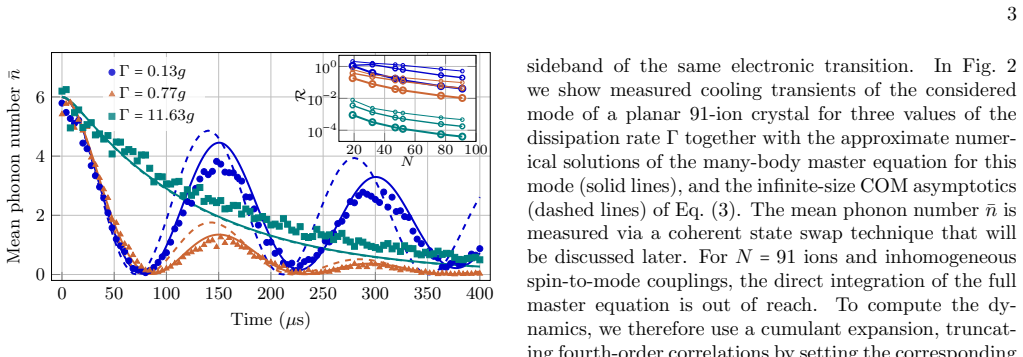
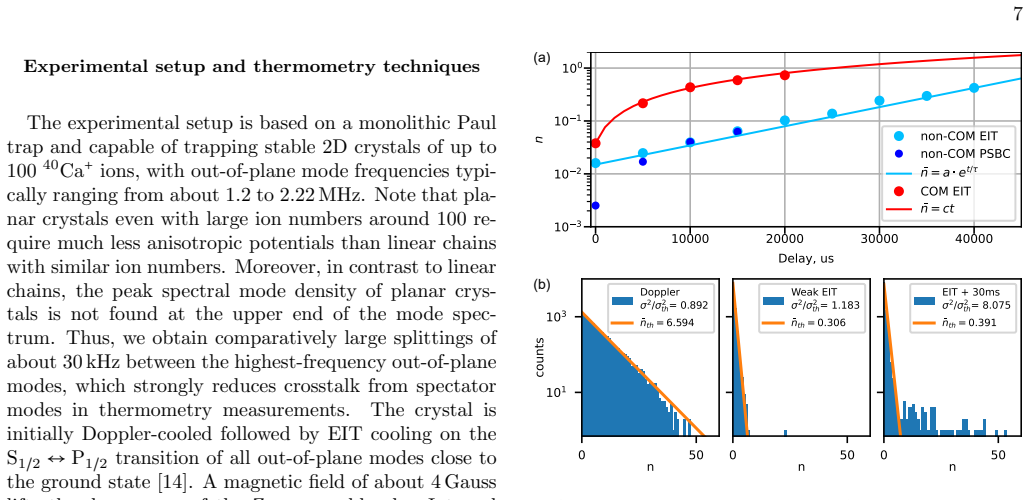
In the strong-coupling regime the spin and motional subsystems of an ion crystal undergo a coherent state swap when driven by a laser pulse. A suitably timed pulse therefore transfers the motional excitation into the spin subsystem, leaving the motion close to its ground state. The residual mean phonon occupation after one such pulse decreases as 1/N² where N is the number of ions. Iterating the pulses yields mean occupations below 2·10^{-4}. In large crystals the spin-motion dynamics becomes largely independent of the initial phonon statistics, so that spin measurements can be used to probe the phonon distribution.
What carries the argument
The coherent state swap between collective spin and motional mode in the strong-coupling regime, which maps motional excitations onto spin excitations during a timed laser pulse.
If this is right
- Larger crystals reach lower phonon numbers per pulse in the strong-coupling limit.
- Repeated pulses can bring mean phonon occupation below 2·10^{-4}.
- Spin measurements become a readout for the phonon distribution in large crystals.
- The final spin state is insensitive to the precise initial phonon statistics for large N.
Where Pith is reading between the lines
- The 1/N² scaling may allow ground-state preparation of ion crystals too large for conventional cooling methods.
- The same collective swap could be tested in other systems with strong spin-motion coupling, such as Rydberg atoms or superconducting circuits.
- The independence from initial phonon statistics suggests the protocol could serve as a robust state-preparation primitive for quantum information tasks.
Load-bearing premise
The spin and motional subsystems undergo a coherent state swap in the strong-coupling regime.
What would settle it
An experiment in the strong-coupling regime that finds the residual mean phonon occupation after one pulse does not decrease proportionally to 1/N² when N is increased.
Figures



read the original abstract
Low-entropy motional states of ion Coulomb crystals are an essential prerequisite for a plethora of applications and are typically prepared by laser cooling. As larger crystals are operated in the quantum regime, it remains unclear, and has recently become debated, whether increasing the ion number can be beneficial for cooling. Here, we investigate theoretically and experimentally many-ion sideband cooling and the role of collective effects in different spin-motion coupling regimes. For weak coupling, the many-body effects are insignificant. In the strong-coupling regime, however, the spin and motional subsystems undergo a coherent state swap, enabling cooling by a suitably timed laser pulse. Using planar Coulomb crystals with up to 91 ions, we demonstrate that the residual mean phonon occupation after one such pulse scales as $1/N^2$ with the number of ions. By iterating the pulses, we measure mean phonon occupations $<2\cdot10^{-4}$. For large crystals in the coherent regime, we further show that the spin-motion dynamics becomes largely independent of the initial phonon statistics. Through spin measurements, the state-swap mechanism can be utilized to probe the phonon distribution in the mode.
Editorial analysis
A structured set of objections, weighed in public.
Referee Report
Summary. The manuscript claims that in the strong-coupling regime of laser sideband cooling, collective spin-motion coupling in ion crystals enables a coherent state swap between the collective spin and a targeted motional mode. This produces a residual mean phonon occupation after one pulse that scales as 1/N² (experimentally verified up to N=91), with iterated pulses reaching <2×10^{-4}. In this regime the dynamics become largely independent of initial phonon statistics, and spin readout can probe the phonon distribution.
Significance. If the 1/N² scaling and mode isolation hold, the result is significant for preparing low-entropy motional states in large ion crystals used for quantum simulation and metrology. The experimental demonstration of collective enhancement and the theoretical identification of the coherent-swap mechanism constitute a clear advance over standard sideband cooling, particularly the reported independence from initial phonon number for large N.
major comments (3)
- [Abstract / strong-coupling regime paragraph] Abstract and strong-coupling regime paragraph: the central claim that a suitably timed pulse performs a clean coherent swap yielding exactly 1/N² residual occupation assumes isolation from off-resonant modes. For planar crystals at N=91 the mode spectrum is dense; the text supplies neither a multi-mode master-equation solution nor an experimental verification that the Rabi rate remains ≫ nearest-mode detuning while remaining resonant with only the target mode.
- [Experimental results] Experimental results (scaling with N and <2×10^{-4} occupation): the reported scaling and final occupation values are presented without error bars, data-exclusion criteria, or fit details. These omissions make it impossible to assess whether the 1/N² dependence is statistically supported or whether systematic offsets from leakage or imperfect swap timing are ruled out.
- [Theory / strong-coupling dynamics] Theory section on strong-coupling dynamics: the assertion that spin-motion evolution becomes independent of initial phonon statistics for large crystals is stated but not accompanied by an explicit derivation or numerical check against a multi-mode Hamiltonian; this independence is load-bearing for the claim that the method works irrespective of starting temperature.
minor comments (2)
- [Theory] Notation for the collective spin operator and the targeted motional mode should be introduced once with a clear definition before being used in the scaling argument.
- [Figures] Figure captions for the N-scaling data should explicitly state the number of experimental repetitions and any averaging procedure.
Simulated Author's Rebuttal
We thank the referee for their positive evaluation of the significance of our results and for the detailed comments, which have helped us improve the manuscript. We address each major comment below. Where the concerns identify omissions in the original text, we have incorporated revisions to provide the requested details, derivations, and data presentation.
read point-by-point responses
-
Referee: [Abstract / strong-coupling regime paragraph] Abstract and strong-coupling regime paragraph: the central claim that a suitably timed pulse performs a clean coherent swap yielding exactly 1/N² residual occupation assumes isolation from off-resonant modes. For planar crystals at N=91 the mode spectrum is dense; the text supplies neither a multi-mode master-equation solution nor an experimental verification that the Rabi rate remains ≫ nearest-mode detuning while remaining resonant with only the target mode.
Authors: We agree that additional justification for mode isolation strengthens the central claim. In the revised manuscript we have added an analysis of the mode spectrum for N=91 planar crystals, including the calculated nearest-mode detuning relative to the target mode and the chosen Rabi frequency. We show that the condition Rabi rate ≫ nearest detuning is satisfied while maintaining resonance with the target. A multi-mode numerical simulation for representative smaller crystals is included to quantify leakage; for N=91 the observed 1/N² scaling itself serves as experimental support, as significant off-resonant coupling would produce clear deviations from the predicted scaling. revision: yes
-
Referee: [Experimental results] Experimental results (scaling with N and <2×10^{-4} occupation): the reported scaling and final occupation values are presented without error bars, data-exclusion criteria, or fit details. These omissions make it impossible to assess whether the 1/N² dependence is statistically supported or whether systematic offsets from leakage or imperfect swap timing are ruled out.
Authors: The referee correctly identifies that the original presentation lacked quantitative uncertainty information. In the revision we have added error bars to all data points (derived from repeated measurements and fluorescence statistics), specified the data-exclusion criteria (fluorescence threshold and crystal stability checks), and provided the fitting procedure and chi-squared values for the 1/N² scaling. We also include a discussion bounding possible systematic offsets from leakage and timing imperfections, showing they are smaller than the reported statistical uncertainties. revision: yes
-
Referee: [Theory / strong-coupling dynamics] Theory section on strong-coupling dynamics: the assertion that spin-motion evolution becomes independent of initial phonon statistics for large crystals is stated but not accompanied by an explicit derivation or numerical check against a multi-mode Hamiltonian; this independence is load-bearing for the claim that the method works irrespective of starting temperature.
Authors: We thank the referee for highlighting this point. The independence follows from the collective enhancement: in the strong-coupling limit the effective Rabi frequency scales as √N, driving a near-complete swap whose residual occupation averages to 1/N² regardless of the initial phonon distribution. The revised theory section now contains an explicit derivation of this averaging and numerical solutions of the multi-mode Hamiltonian for several initial thermal states, confirming that the residual occupation converges to the 1/N² prediction for large N. revision: yes
Circularity Check
No significant circularity; derivation self-contained
full rationale
The paper derives the 1/N^2 residual phonon scaling from the coherent spin-motion state swap in the strong-coupling regime (abstract and theory sections), which follows from the Hamiltonian dynamics rather than any fitted parameter or self-citation. Experimental data with up to 91 ions independently confirm the scaling and sub-10^{-4} occupations after iterated pulses. No equations reduce by construction to inputs, no uniqueness theorems are imported from overlapping authors, and no ansatzes are smuggled via prior self-citations. The model assumptions (coherent swap) are external physical premises, not tautological with the claimed outputs.
Axiom & Free-Parameter Ledger
Reference graph
Works this paper leans on
-
[1]
Srinivas, S
R. Srinivas, S. C. Burd, H. M. Knaack, R. T. Sutherland, A. Kwiatkowski, S. Glancy, E. Knill, D. J. Wineland, D. Leibfried, A. C. Wilson, D. T. C. Allcock, and D. H. Slichter, Nature597, 209 (2021)
2021
-
[2]
Zarantonello, H
G. Zarantonello, H. Hahn, J. Morgner, M. Schulte, A. Bautista-Salvador, R. Werner, K. Hammerer, and C. Ospelkaus, Physical Review Letters123, 260503 (2019)
2019
-
[3]
L¨ oschnauer, J
C. L¨ oschnauer, J. Mosca Toba, A. Hughes, S. King, M. Weber, R. Srinivas, R. Matt, R. Nourshargh, D. All- cock, C. Ballance, C. Matthiesen, M. Malinowski, and T. Harty, PRX Quantum6, 040313 (2025)
2025
-
[4]
Guo, Y.-K
S.-A. Guo, Y.-K. Wu, J. Ye, L. Zhang, W.-Q. Lian, R. Yao, Y. Wang, R.-Y. Yan, Y.-J. Yi, Y.-L. Xu, B.-W. Li, Y.-H. Hou, Y.-Z. Xu, W.-X. Guo, C. Zhang, B.-X. Qi, Z.-C. Zhou, L. He, and L.-M. Duan, Nature630, 613 (2024)
2024
-
[5]
Monroe, W
C. Monroe, W. Campbell, L.-M. Duan, Z.-X. Gong, A. Gorshkov, P. Hess, R. Islam, K. Kim, N. Linke, G. Pagano, P. Richerme, C. Senko, and N. Yao, Reviews of Modern Physics93, 025001 (2021)
2021
-
[6]
M. Qiao, Z. Cai, Y. Wang, B. Du, N. Jin, W. Chen, P. Wang, C. Luan, E. Gao, X. Sun, H. Tian, J. Zhang, and K. Kim, Nature Physics20, 623 (2024)
2024
-
[7]
M. K. Joshi, F. Kranzl, A. Schuckert, I. Lovas, C. Maier, R. Blatt, M. Knap, and C. F. Roos, Science376, 720 (2022)
2022
-
[8]
Franke, S
J. Franke, S. R. Muleady, R. Kaubruegger, F. Kranzl, R. Blatt, A. M. Rey, M. K. Joshi, and C. F. Roos, Nature 621, 740 (2023)
2023
-
[9]
M. Filzinger, M. R. Steinel, J. Jiang, D. Bennett, T. E. Mehlst¨ aubler, E. Peik, and N. Huntemann, arXiv preprint 10.48550/arXiv.2603.23446 (2026)
-
[10]
Herschbach, K
N. Herschbach, K. Pyka, J. Keller, and T. E. Mehlst¨ aubler, Applied Physics B107, 891 (2012)
2012
-
[11]
Hausser, J
H. Hausser, J. Keller, T. Nordmann, N. Bhatt, J. Kiethe, H. Liu, I. Richter, M. Von Boehn, J. Rahm, S. Weyers, E. Benkler, B. Lipphardt, S. D¨ orscher, K. Stahl, J. Klose, C. Lisdat, M. Filzinger, N. Huntemann, E. Peik, and T. Mehlst¨ aubler, Physical Review Letters134, 023201 (2025)
2025
-
[12]
Y. Sokolik, R. Ozeri, and N. Akerman, arXiv preprint 10.48550/arXiv.2602.05626 (2026)
-
[13]
Jordan, K
E. Jordan, K. A. Gilmore, A. Shankar, A. Safavi-Naini, J. G. Bohnet, M. J. Holland, and J. J. Bollinger, Physical Review Letters122, 053603 (2019)
2019
-
[14]
Kiesenhofer, H
D. Kiesenhofer, H. Hainzer, A. Zhdanov, P. C. Holz, 6 M. Bock, T. Ollikainen, and C. F. Roos, PRX Quantum 4, 020317 (2023)
2023
-
[15]
Jensen, T
M. Jensen, T. Hasegawa, and J. Bollinger, Physical Re- view A70, 033401 (2004)
2004
-
[16]
D. H. E. Dubin and T. M. O’Neil, Reviews of Modern Physics71, 87 (1999)
1999
-
[17]
Vybornyi, L
I. Vybornyi, L. S. Dreissen, D. Kiesenhofer, H. Hainzer, M. Bock, T. Ollikainen, D. Vadlejch, C. F. Roos, T. E. Mehlst¨ aubler, and K. Hammerer, PRX Quantum4, 040346 (2023)
2023
-
[18]
G. Morigi, J. Bollinger, M. Drewsen, D. Podolsky, and E. Shimshoni, arXiv preprint 10.48550/arXiv.2508.07374 (2025)
-
[19]
J.-S. Chen, K. Wright, N. C. Pisenti, D. Murphy, K. M. Beck, K. Landsman, J. M. Amini, and Y. Nam, Physical Review A102, 043110 (2020)
2020
-
[20]
Diedrich, J
F. Diedrich, J. C. Bergquist, W. M. Itano, and D. J. Wineland, Physical Review Letters62, 403 (1989)
1989
-
[21]
B. E. King, C. S. Wood, C. J. Myatt, Q. A. Turchette, D. Leibfried, W. M. Itano, C. Monroe, and D. J. Wineland, Physical Review Letters81, 1525 (1998)
1998
-
[22]
Monroe, D
C. Monroe, D. M. Meekhof, B. E. King, S. R. Jefferts, W. M. Itano, D. J. Wineland, and P. Gould, Physical Review Letters75, 4011 (1995)
1995
-
[23]
Q. Wu, Y. Shi, and J. Zhang, Physical Review Research 5, 023022 (2023)
2023
-
[24]
Morigi, J
G. Morigi, J. Eschner, and C. H. Keitel, Physical Review Letters85, 4458 (2000)
2000
-
[26]
C. F. Roos, D. Leibfried, A. Mundt, F. Schmidt-Kaler, J. Eschner, and R. Blatt, Physical Review Letters85, 5547 (2000)
2000
-
[27]
Zhang, M.-C
J. Zhang, M.-C. Zhang, Y. Xie, C.-W. Wu, B.-Q. Ou, T. Chen, W.-S. Bao, P. Haljan, W. Wu, S. Zhang, and P.-X. Chen, Physical Review Applied18, 014022 (2022)
2022
-
[28]
M. Qiao, Y. Wang, Z. Cai, B. Du, P. Wang, C. Luan, W. Chen, H.-R. Noh, and K. Kim, Physical Review Let- ters126, 023604 (2021)
2021
-
[29]
L. Feng, W. Tan, A. De, A. Menon, A. Chu, G. Pagano, and C. Monroe, Physical Review Letters125, 053001 (2020)
2020
-
[30]
M. M. Khan, D. Wellnitz, B. Sundar, H. Zhang, A. Carter, J. J. Bollinger, A. Shankar, and A. M. Rey, arXiv preprint 10.48550/arXiv.2601.09180 (2026), arXiv:2601.09180
-
[31]
Y. Wan, F. Gebert, F. Wolf, and P. O. Schmidt, Physical Review A91, 043425 (2015)
2015
-
[32]
A. J. Rasmusson, M. D’Onofrio, Y. Xie, J. Cui, and P. Richerme, Physical Review A104, 043108 (2021)
2021
-
[33]
E. C. Reed, L. Qi, and K. R. Brown, Physical Review A 110, 013123 (2024)
2024
-
[34]
Stutter, P
G. Stutter, P. Hrmo, V. Jarlaud, M. K. Joshi, J. F. Good- win, and R. C. Thompson, Journal of Modern Optics65, 549 (2018)
2018
-
[35]
A. J. Rasmusson, arXiv preprint 10.48550/arXiv.2604.03435 (2026)
work page internal anchor Pith review Pith/arXiv arXiv doi:10.48550/arxiv.2604.03435 2026
-
[36]
J.-S. Chen, S. Brewer, C. Chou, D. Wineland, D. Leibrandt, and D. Hume, Physical Review Letters 118, 053002 (2017)
2017
-
[37]
A. M. Hankin, E. R. Clements, Y. Huang, S. M. Brewer, J.-S. Chen, C. W. Chou, D. B. Hume, and D. R. Leibrandt, Physical Review A100, 033419 (2019)
2019
-
[38]
Shankar, E
A. Shankar, E. Jordan, K. A. Gilmore, A. Safavi-Naini, J. J. Bollinger, and M. J. Holland, Physical Review A 99, 023409 (2019)
2019
-
[39]
See supplemental material for derivations and theoretical details. (2026)
2026
-
[40]
Leibfried, R
D. Leibfried, R. Blatt, C. Monroe, and D. Wineland, Re- views of Modern Physics75, 281 (2003)
2003
-
[41]
Leibfried, R
D. Leibfried, R. Blatt, C. Monroe, and D. Wineland, Rev. Mod. Phys.75, 281 (2003)
2003
-
[42]
D. B. Hume, C. W. Chou, T. Rosenband, and D. J. Wineland, Physical Review A80, 052302 (2009)
2009
-
[43]
Lechner, C
R. Lechner, C. Maier, C. Hempel, P. Jurcevic, B. P. Lanyon, T. Monz, M. Brownnutt, R. Blatt, and C. F. Roos, Phys. Rev. A93, 053401 (2016)
2016
-
[44]
A. V. Kirkova, W. Li, and P. A. Ivanov, Phys. Rev. Res. 3, 013244 (2021)
2021
-
[45]
Rajakumar, A
K. Rajakumar, A. Pandey, A. Das, and A. Shankar, Quantum beam-splitter cooling and thermometry in large trapped-ion crystals (2026), forthcoming preprint
2026
-
[46]
Morigi, Physical Review A67, 033402 (2003)
G. Morigi, Physical Review A67, 033402 (2003)
2003
-
[47]
D. A. Varshalovich, A. N. Moskalev, and V. K. Kher- sonskii,Quantum Theory of Angular Momentum(World Scientific, 1988)
1988
-
[48]
J. Kerber, H. Ritsch, and L. Ostermann, arXiv preprint 10.48550/arXiv.2511.20115 (2025)
-
[49]
Kirton, M
P. Kirton, M. M. Roses, J. Keeling, and E. G. Dalla Torre, Advanced Quantum Technologies2, 1800043 (2019)
2019
-
[50]
Pi˜ neiro Orioli, A
A. Pi˜ neiro Orioli, A. Safavi-Naini, M. L. Wall, and A. M. Rey, Physical Review A96, 033607 (2017)
2017
-
[51]
Schachenmayer, A
J. Schachenmayer, A. Pikovski, and A. Rey, Physical Re- view X5, 011022 (2015)
2015
-
[52]
W. K. Wootters, Annals of Physics176, 1 (1987)
1987
-
[53]
Huber, A
J. Huber, A. M. Rey, and P. Rabl, Physical Review A 105, 013716 (2022)
2022
-
[54]
Hosseinabadi, O
H. Hosseinabadi, O. Chelpanova, and J. Marino, PRX Quantum6, 030344 (2025). 7 Experimental setup and thermometry techniques The experimental setup is based on a monolithic Paul trap and capable of trapping stable 2D crystals of up to 100 40Ca+ ions, with out-of-plane mode frequencies typi- cally ranging from about 1.2 to 2.22 MHz. Note that pla- nar cryst...
2025
discussion (0)
Sign in with ORCID, Apple, or X to comment. Anyone can read and Pith papers without signing in.